
What is an AI avatar? Definition, types, and uses

What is an AI avatar? Definition, types, and uses

Written by

Creatify Team

What is an AI avatar
Creatify logo

Creatify Team

SHARE

LinkedIn icon
X icon
Facebook icon

IN THIS ARTICLE

The digital human market hit $6.27 billion in 2025 and is on track to reach $28.37 billion by 2030, growing at a 35% compound annual rate. That growth isn't coming from hype. It's coming from businesses that figured out AI avatars solve real problems - scaling video content, personalizing customer interactions, and producing multilingual communications without hiring an army of people.

But the term "AI avatar" gets used to describe everything from a cartoon profile picture to a photorealistic digital human that holds a conversation. If you've searched "what is an AI avatar" and gotten confused by the range of answers, this article clears it up. We'll define exactly what an artificial intelligence avatar is, break down the main types, explain how the technology works, and show you what people are actually using them for in 2026.

What is an AI avatar?

An AI avatar is a computer-generated character - 2D, 3D, or photorealistic - that uses artificial intelligence to simulate human-like communication, behavior, or appearance.

Three things make something an AI avatar rather than just a digital image:

  • Visual embodiment. There's a visible character - a face, a body, or at least a recognizable figure that represents a "person" on screen. This could be a realistic video of someone talking, a stylized 3D character, or an animated figure.

  • An AI brain. The avatar is powered by some form of artificial intelligence - natural language processing, large language models, text-to-speech systems, or computer vision. This is what separates an AI avatar from a static image or a manually animated character.

  • Interaction or communication. The avatar either responds to input in real time (answering questions, reacting to speech) or delivers scripted content with human-like presentation (lip-synced speech, gestures, facial expressions).

When all three come together, you get an artificial intelligence avatar: a digital figure that can talk, present, explain, sell, teach, or assist - and do it at a scale that no single human could match.

How AI avatars differ from traditional avatars and chatbots

This is where most people get confused, so let's draw clear lines.

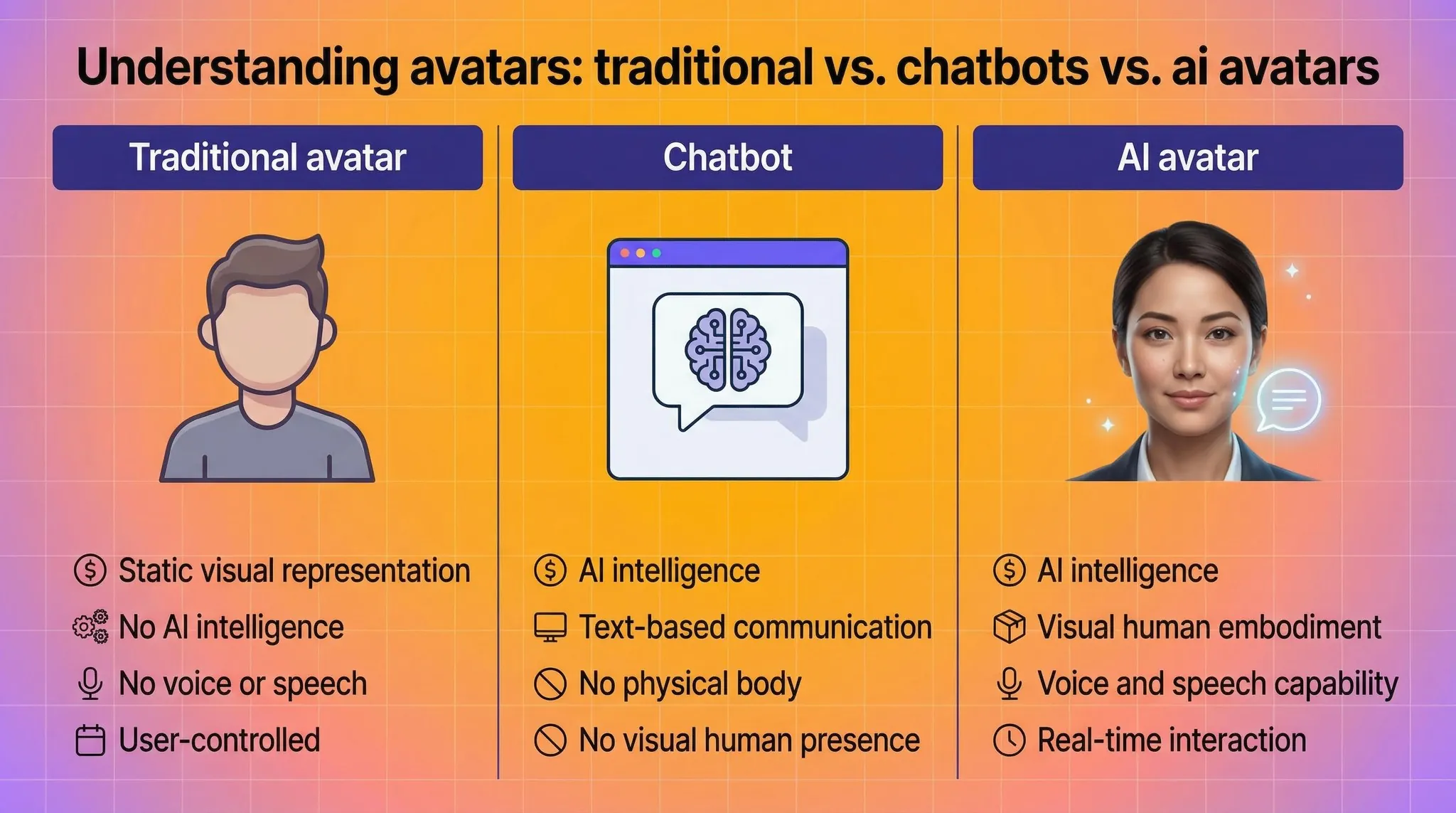
  • Traditional avatars are static or manually controlled digital representations. Your Xbox gamertag image, your Slack profile picture, a character you control in a video game - those are traditional avatars. They don't think, speak, or act on their own. You move them, or they sit there.

  • Chatbots are AI-powered text systems that understand and respond to language. They're smart, but they have no visual body. A chatbot is a brain without a face.

  • AI avatars combine both. They have visual embodiment (the face, the body, the human-like appearance) and an AI brain (language understanding, speech synthesis, decision-making). An AI avatar is what you get when you put a chatbot inside a realistic digital human and give it a voice.

The distinction matters because visual embodiment changes how people respond. Research from MIT Media Lab found that students learning from AI-generated virtual instructors showed higher motivation and more positive emotions compared to text-only or audio-only formats. The face matters. People pay more attention, trust more, and engage longer when there's a human-like presence delivering the information.
Understanding avatars differences

Types of AI avatars

Not all AI avatars work the same way or serve the same purpose. Here are the main categories.

Scripted presenter avatars

These are the most common types in business today. A scripted presenter avatar reads a pre-written script, synced with realistic lip movements, facial expressions, and gestures. You write the words, the AI handles the delivery.

This is what most marketers and content teams use for product explainer videos, social media ads, training content, and localized campaigns. You don't need a camera, a studio, or a voice actor. You need a script and a platform.

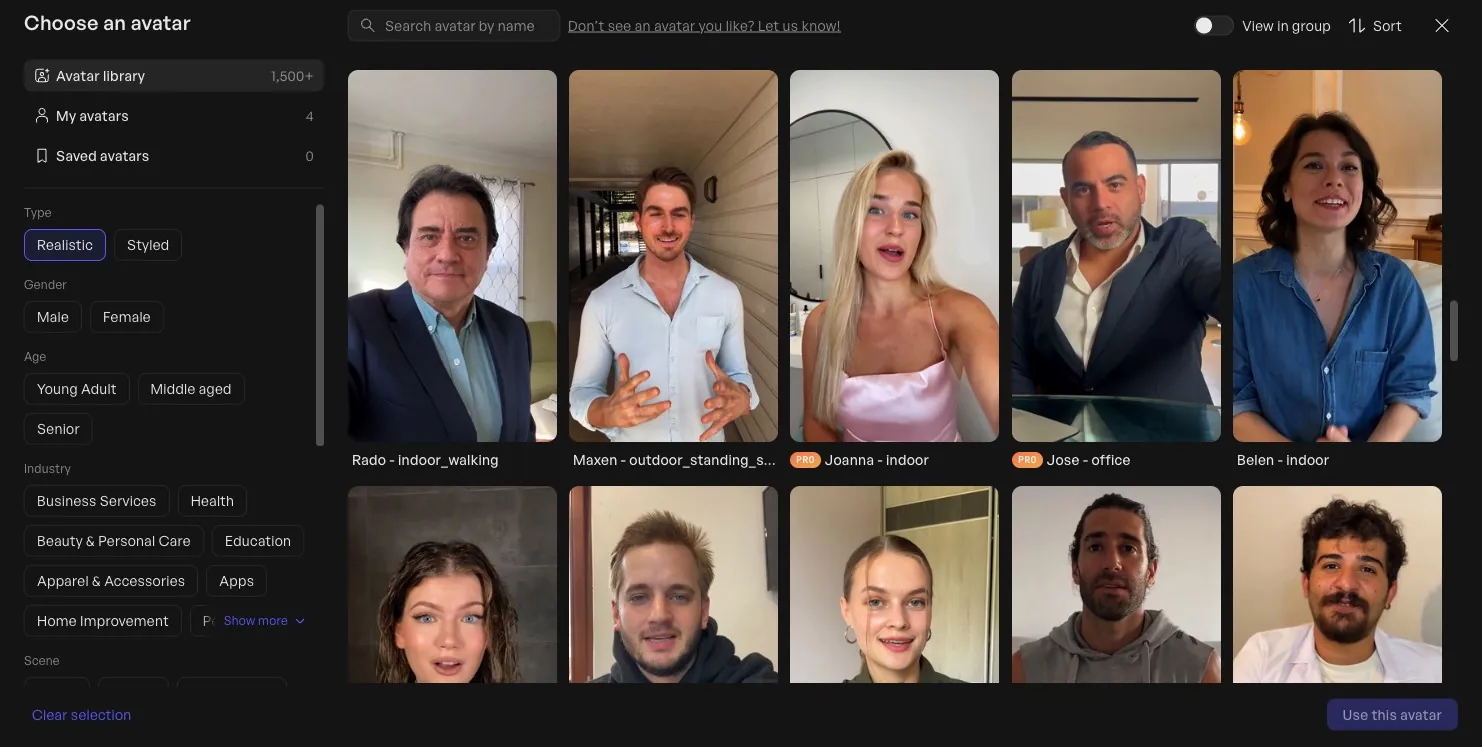
Creatify's AI Avatar generator works this way - you choose from 1,500+ avatars, pair them with a script (written by you or generated by the AI scriptwriter), select a voice from 140+ options across 75+ languages, and generate the video. The output is a photorealistic talking-head video with lip sync, natural gestures, and emotional expressiveness. On Pro plans, avatars can hold products, wear branded outfits, and change backgrounds. For more nuance, read the full guide to creating AI avatar videos.
AI Avatar Editor

Interactive conversational avatars

These avatars respond in real time. They listen, process what you said, and answer - with voice, facial reactions, and body language. Think of them as embodied chatbots.

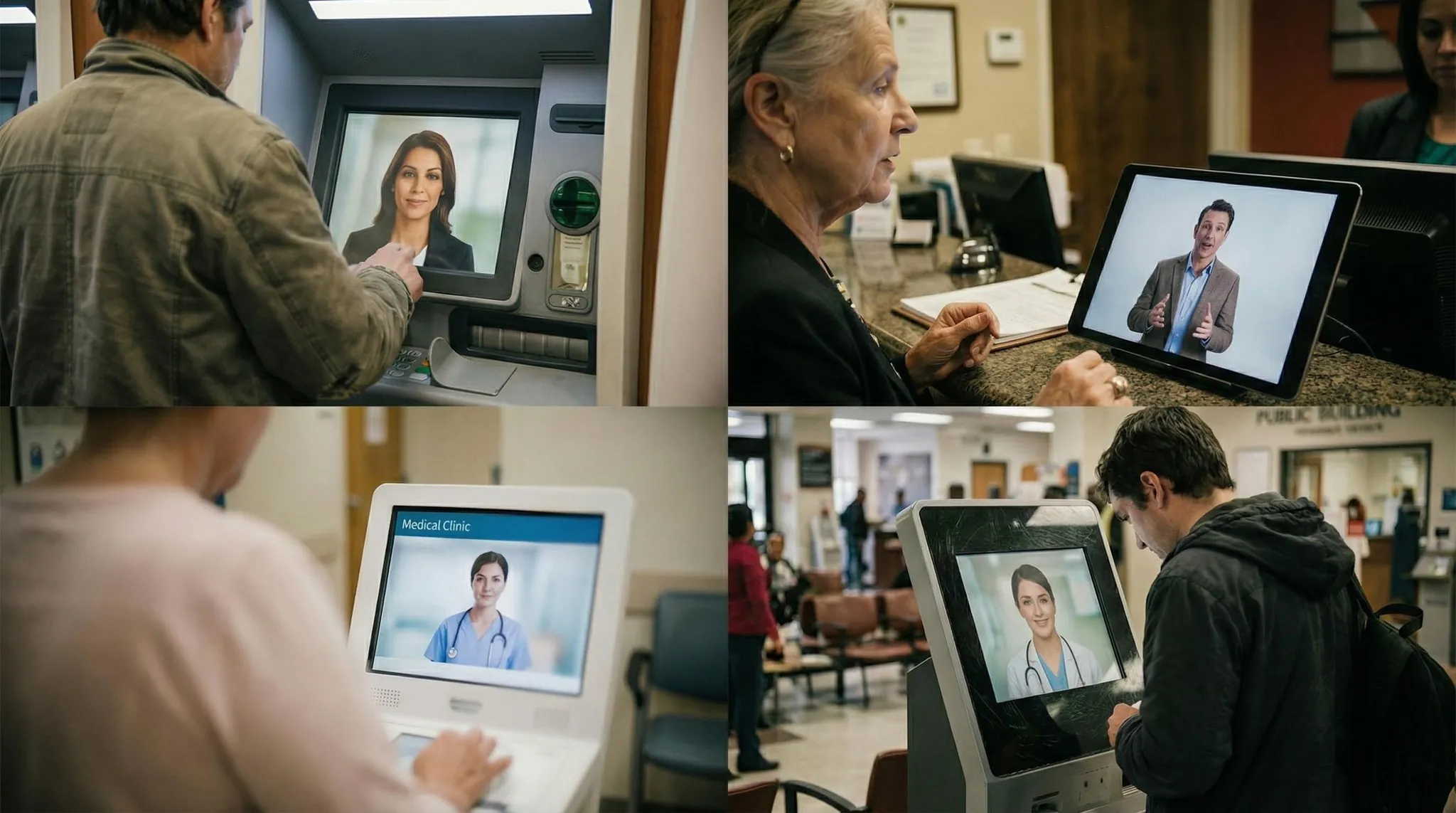
You'll find interactive conversational avatars in customer service kiosks, banking lobbies, hotel reception desks, and healthcare onboarding flows. They handle FAQs, guide users through processes, and escalate to humans when needed. The difference from a text chatbot is the face-to-face quality of the interaction, which drives higher completion rates and user satisfaction in documented implementations.
AI Avatars on Screens

Digital twin avatars

A digital twin avatar is built to look and sound like a specific real person. It's created from photos, video footage, and voice samples of that individual - then driven by AI to speak new scripts in their likeness.

Creators, founders, educators, and influencers use digital twins to scale their presence. A founder can "appear" in 50 onboarding videos without filming any of them. A teacher can deliver lessons in languages they don't speak.

Game, metaverse, and XR avatars

These are AI-augmented characters in virtual environments - game companions, NPC guides in virtual worlds, or avatars in VR/AR training simulations. Unlike scripted presenters, these avatars make decisions, react to their environment, and adapt their behavior based on what the user does.

This category is growing fast as gaming engines and XR platforms integrate large language models for more dynamic character interactions.

Assistive and companion avatars

These avatars are designed for care and support - elder companionship, mental health check-ins, social skills training for children with autism, sign-language interpretation, and accessibility assistance. Research shows that AI-based avatars can individualize instruction for language learning, science education, and professional training, adapting in real time to each learner's pace and comprehension level, and foster self-regulation.

Ready to create your own digital persona? Discover top AI avatar tools and choose the one that fits your goals.

How AI avatars work: The technical layers

You don't need to be an engineer to understand this. Every AI avatar runs on four interconnected layers.

The visual layer is what you see. This is the avatar's face and body, created through 3D modeling, neural rendering, or diffusion-based generation. Modern systems like Aurora model - Creatify’s proprietary diffusion transformer architecture - produce photorealistic avatars with full-body expressiveness, including facial micro-movements, hand gestures, and natural eye contact at 24 frames per second.
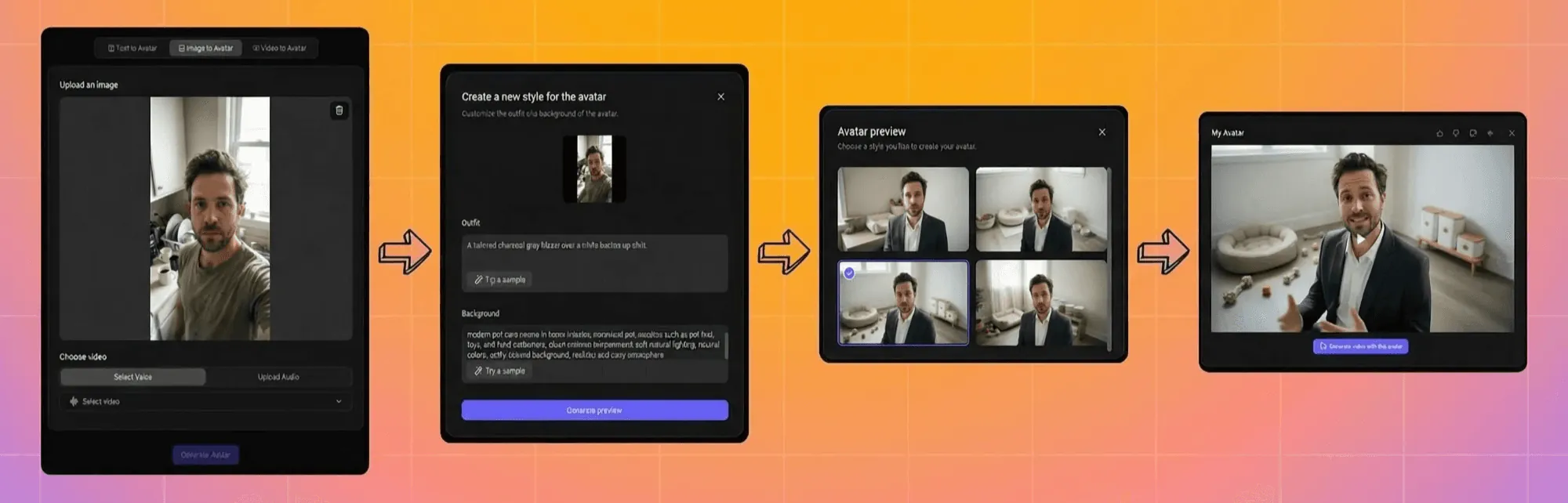
AI Avatar Creation

The intelligence layer is how the avatar thinks. Natural language processing and large language models let the avatar understand input (text or speech) and generate appropriate responses or scripts. For scripted avatars, this layer handles script generation. For interactive avatars, it handles real-time conversation.

The voice layer is how the avatar sounds. Text-to-speech systems convert written text into natural-sounding speech. Modern TTS systems support emotional delivery (excitement, concern, warmth), multiple accents per language, and voice cloning capabilities. Creatify's voice system offers 140+ distinct voices with an advanced V3 model that supports emotional tags like [laugh] and [excited] for more natural delivery.

The behavior layer is how the avatar moves. Facial animation, lip sync, gesture generation, and body movement are all synchronized with the speech and emotional intent. This is what makes the difference between an avatar that feels like a real person talking and one that feels like a mannequin reading text.

When these four layers work together smoothly, you get a digital human that's hard to distinguish from a real video of a real person.

What people actually use AI avatars for

Marketing and video ad production

This is the fastest-growing use case. Brands use AI avatars to produce video ads at a volume and speed that traditional production can't match. Instead of hiring actors, booking studios, and waiting weeks for edits - you generate dozens of video variations in an afternoon.

The math matters here: a single professional video ad with actors typically costs $3,000-$15,000. With AI avatars, you create that same video for a fraction of the cost, and you can test 50 different hooks, scripts, and avatar styles against each other to find what converts best.

In professional AI tools tuned for ad production at scale you paste a product URL, and the system generates multiple script variations with AI avatars ready to present them. The result is a ready-to-export video ad in 9:16, 16:9, or 1:1 format, optimized for TikTok, Instagram, Meta, YouTube, or Snapchat. All just from a link to your product.
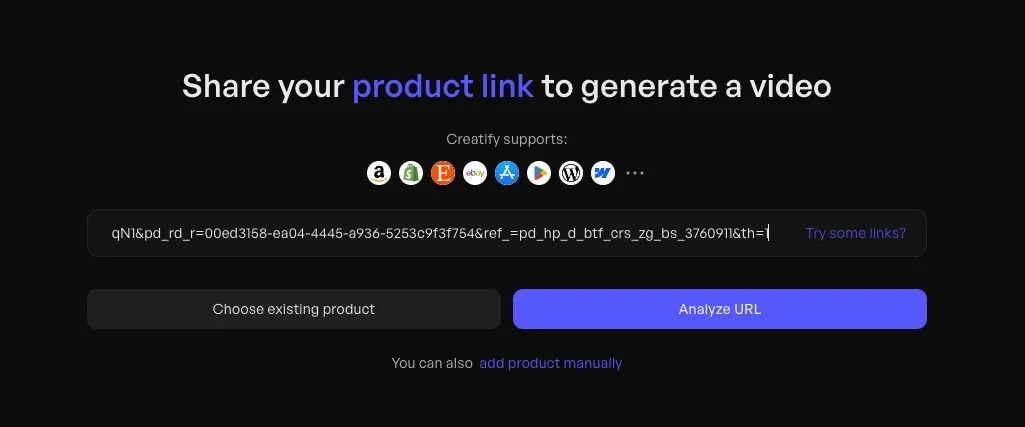
Product Link Share

UGC-style content at scale

AI avatars that look like everyday people (not polished spokesmodels) are used to create user-generated content style ads - the casual, to-camera testimonial format that performs well on social platforms. Instead of hiring 10 UGC creators, shipping products, and waiting two weeks for content, you generate 50 variations in one session. Different faces, different scripts, different hooks.
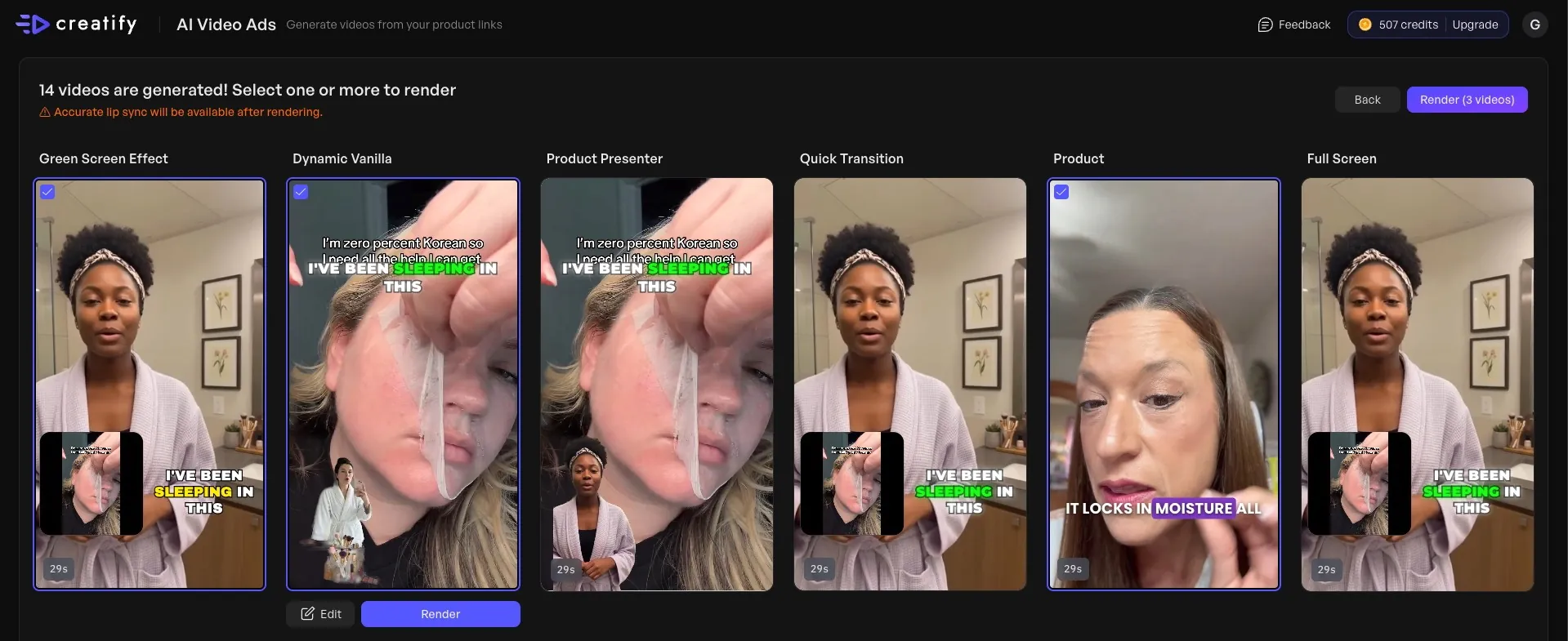
AI Avatar Video Ads

Education and corporate training

AI avatars deliver training content, explain complex topics, and serve as virtual tutors. A peer-reviewed study published in Frontiers in Education found that AI-based educational avatars offer cost-effective instruction that competes with role-playing exercises and trained actors, while going beyond the limitations of rule-based virtual tutors. Research from MIT showed that AI-generated instructors increased student motivation and positive learning emotions.

For corporate teams, the advantage is consistency and scalability. You create one training module with an AI avatar, translate it into 20 languages, and roll it out globally. Updates happen in minutes, not months.

Customer service and virtual agents

AI avatars replace text-only chatbots with face-to-face digital assistants on websites, in apps, and at physical kiosks. The visual presence increases user trust and engagement compared to text-only interfaces. Airlines, banks, hotels, and telecom companies have deployed interactive avatar agents for lobby assistance, account support, and onboarding flows.

Healthcare and accessibility

AI avatars are being used for mental health support conversations, patient onboarding, health education, and sign-language interpretation. The always-available, patient, multilingual nature of AI avatars makes them particularly useful for populations that face barriers to human care access.
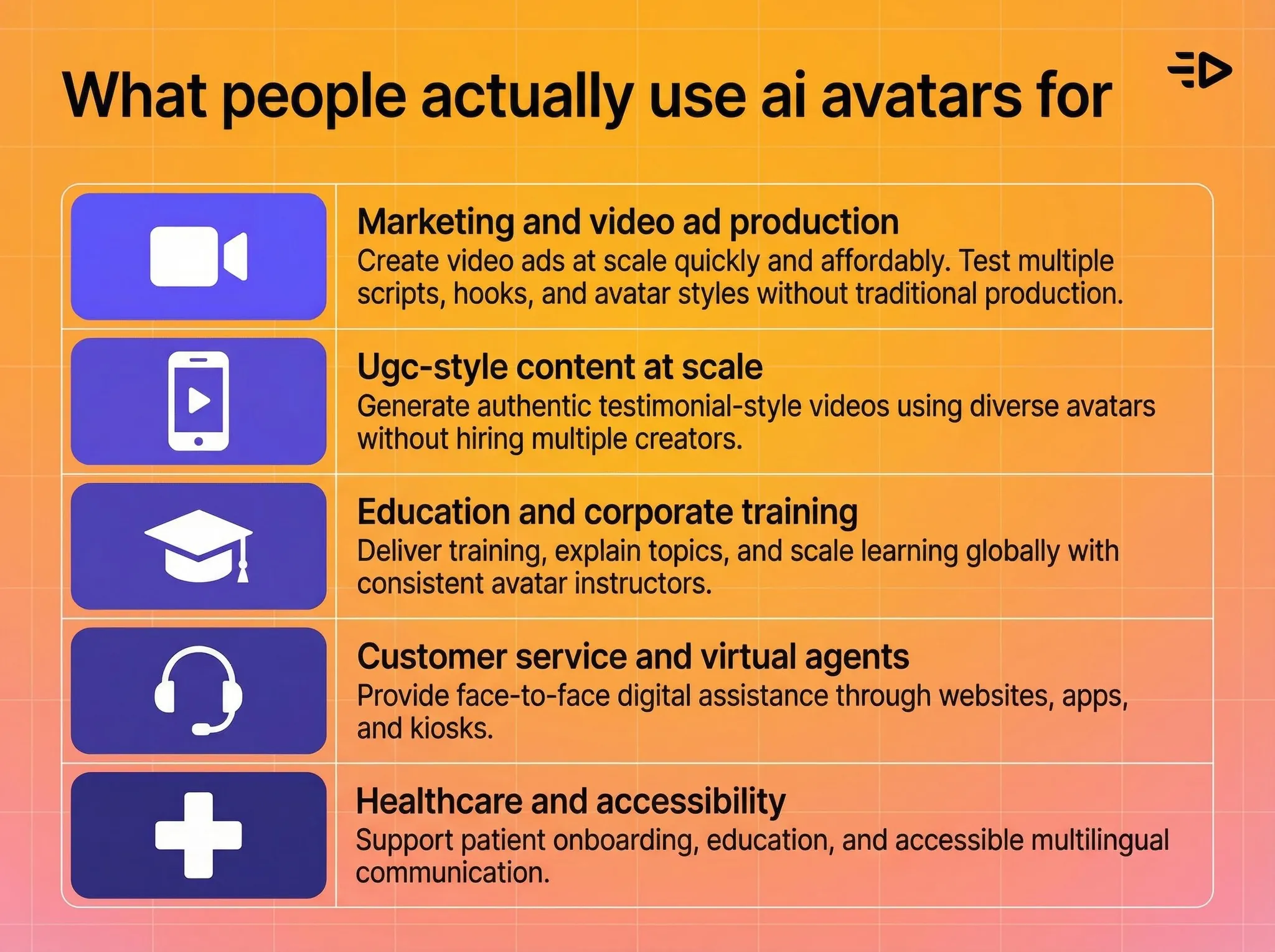
What ppl actually use AI Avatars for

Why organizations use AI avatars

  • Speed and cost. An AI avatar video takes minutes to produce. A traditional video takes weeks and thousands of dollars. When you need 100 video variations for A/B testing across five markets, the only realistic option is AI.

  • Consistency. An AI avatar delivers the same message, in the same tone, with the same brand elements every single time. No off-script moments, no bad takes, no talent availability issues.

  • Multilingual scale. A single avatar can be presented in 75+ languages without hiring native speakers for each market. For companies expanding internationally, this compresses what used to be months of localization work into hours.

  • Personalization. AI avatars can be customized per audience segment, product line, or campaign. Different avatars, different scripts, different voices - all generated from the same platform without starting from scratch.

Risks and ethical considerations

AI avatars are powerful, and that power creates responsibility.

  • Deepfakes and misuse. The same technology that creates a helpful product explainer can create a non-consensual likeness of a real person. The Brookings Institution, UNESCO, and multiple regulatory bodies have published guidance on synthetic media governance. The EU AI Act specifically addresses transparency requirements for AI-generated content.

  • Bias in representation. If avatar libraries default to narrow demographics, the content they produce reflects that limitation. Diverse, inclusive avatar libraries matter - both for ethical reasons and because your audience is diverse. Creatify's library of 1,500+ avatars spans a wide range of ages, ethnicities, and styles for this reason.

  • Privacy. Building custom avatars from someone's face and voice requires informed consent and secure data handling. Any platform you use should have clear policies on how biometric data is stored, processed, and protected.

  • Over-trust. People naturally attribute more authority and empathy to a face than to text on a screen. This is useful for engagement, but it means AI avatars need clear disclosure. Users should always know they're interacting with AI, not a real person.

AI ethics writing on a typewriter

How to start using AI avatars

If you've never created an AI avatar video before, the entry point is simpler than you'd expect.

Start with a single use case. Don't try to deploy AI avatars across every channel at once. Pick one problem - product video ads, training content, multilingual customer FAQs - and test there first.

Choose the right avatar type. For marketing and ads, scripted presenter avatars are the fastest path to results. For customer service, interactive conversational avatars make more sense. For personal branding, a digital twin built from your own likeness might be the move.

Read also: How to create an AI influencer: Step-by-step guide

Test, measure, iterate. Run your AI avatar content alongside your existing content. Compare conversion rates, engagement metrics, and production costs. The data will tell you whether to scale up.

Creatify offers a free plan that lets you generate your first AI avatar videos and see the quality for yourself before committing to a paid tier. If you're in ecommerce, paste a product URL and have a complete video ad in under two minutes.

FAQ

What is an AI avatar?

An AI avatar is a computer-generated digital character that uses artificial intelligence to communicate in human-like ways - through speech, facial expressions, gestures, and body movement. Unlike traditional avatars (static images or manually controlled characters), AI avatars can autonomously deliver scripts, respond to questions, or interact with users in real time.

What is AI avatar technology used for?

Businesses use AI avatar technology for video ad production, UGC-style marketing content, customer service, education and training, healthcare communication, and multilingual content creation. The most common commercial application in 2026 is producing video ads at scale - generating dozens or hundreds of video variations with different scripts, avatars, and languages from a single platform.

How does an artificial intelligence avatar work?

An artificial intelligence avatar runs on four layers: a visual layer (the character's appearance, created through 3D modeling or neural rendering), an intelligence layer (natural language processing and large language models for understanding and generating text), a voice layer (text-to-speech systems for natural-sounding speech), and a behavior layer (facial animation, lip sync, and gesture generation synchronized with speech).

What's the difference between an AI avatar and a chatbot?

A chatbot is a text-based AI system that understands and responds to language but has no visual presence. An AI avatar adds visual embodiment - a face, body, and human-like movement - to that same intelligence. Research shows that visual presence increases user engagement, trust, and attention compared to text-only interfaces.

Can I create an AI avatar that looks like me?

Yes. This is called a digital twin avatar. You provide video footage or photos of yourself, and the AI builds an avatar that matches your appearance and can be paired with a clone of your voice. Creatify supports this through BYOA (Bring Your Own Avatar), which creates a digital twin from a short video recording.

Are AI avatars the same as deepfakes?

No. AI avatars and deepfakes use some overlapping technology (neural rendering, face synthesis), but the intent and context are different. AI avatars are created with consent for legitimate business, education, or creative purposes. Deepfakes typically refer to non-consensual manipulation of someone's likeness. Responsible AI avatar platforms require consent for any custom likeness creation and provide transparency about synthetic content.

How much does it cost to create an AI avatar video?

Costs vary widely by platform and use case. Creatify's plans start at $0 (free plan with watermarked exports), with paid plans at $19/month and $49/month that include access to 1,500+ avatars, 140+ voices, 75+ languages, and commercial usage rights. Traditional video production with human actors typically costs $3,000-$15,000 per video.

What should I look for in an AI avatar platform?

Avatar realism and diversity (how many avatars are available, and do they represent different demographics), language and voice options, customization capabilities (custom avatars, branded outfits, product holding), video output quality and format options, and ethical safeguards (consent requirements, content moderation, data protection). For marketing use cases, also look for ad platform integrations and batch production capabilities.

The digital human market hit $6.27 billion in 2025 and is on track to reach $28.37 billion by 2030, growing at a 35% compound annual rate. That growth isn't coming from hype. It's coming from businesses that figured out AI avatars solve real problems - scaling video content, personalizing customer interactions, and producing multilingual communications without hiring an army of people.

But the term "AI avatar" gets used to describe everything from a cartoon profile picture to a photorealistic digital human that holds a conversation. If you've searched "what is an AI avatar" and gotten confused by the range of answers, this article clears it up. We'll define exactly what an artificial intelligence avatar is, break down the main types, explain how the technology works, and show you what people are actually using them for in 2026.

What is an AI avatar?

An AI avatar is a computer-generated character - 2D, 3D, or photorealistic - that uses artificial intelligence to simulate human-like communication, behavior, or appearance.

Three things make something an AI avatar rather than just a digital image:

  • Visual embodiment. There's a visible character - a face, a body, or at least a recognizable figure that represents a "person" on screen. This could be a realistic video of someone talking, a stylized 3D character, or an animated figure.

  • An AI brain. The avatar is powered by some form of artificial intelligence - natural language processing, large language models, text-to-speech systems, or computer vision. This is what separates an AI avatar from a static image or a manually animated character.

  • Interaction or communication. The avatar either responds to input in real time (answering questions, reacting to speech) or delivers scripted content with human-like presentation (lip-synced speech, gestures, facial expressions).

When all three come together, you get an artificial intelligence avatar: a digital figure that can talk, present, explain, sell, teach, or assist - and do it at a scale that no single human could match.

How AI avatars differ from traditional avatars and chatbots

This is where most people get confused, so let's draw clear lines.

  • Traditional avatars are static or manually controlled digital representations. Your Xbox gamertag image, your Slack profile picture, a character you control in a video game - those are traditional avatars. They don't think, speak, or act on their own. You move them, or they sit there.

  • Chatbots are AI-powered text systems that understand and respond to language. They're smart, but they have no visual body. A chatbot is a brain without a face.

  • AI avatars combine both. They have visual embodiment (the face, the body, the human-like appearance) and an AI brain (language understanding, speech synthesis, decision-making). An AI avatar is what you get when you put a chatbot inside a realistic digital human and give it a voice.

The distinction matters because visual embodiment changes how people respond. Research from MIT Media Lab found that students learning from AI-generated virtual instructors showed higher motivation and more positive emotions compared to text-only or audio-only formats. The face matters. People pay more attention, trust more, and engage longer when there's a human-like presence delivering the information.

Understanding avatars differences

Types of AI avatars

Not all AI avatars work the same way or serve the same purpose. Here are the main categories.

Scripted presenter avatars

These are the most common types in business today. A scripted presenter avatar reads a pre-written script, synced with realistic lip movements, facial expressions, and gestures. You write the words, the AI handles the delivery.

This is what most marketers and content teams use for product explainer videos, social media ads, training content, and localized campaigns. You don't need a camera, a studio, or a voice actor. You need a script and a platform.

Creatify's AI Avatar generator works this way - you choose from 1,500+ avatars, pair them with a script (written by you or generated by the AI scriptwriter), select a voice from 140+ options across 75+ languages, and generate the video. The output is a photorealistic talking-head video with lip sync, natural gestures, and emotional expressiveness. On Pro plans, avatars can hold products, wear branded outfits, and change backgrounds. For more nuance, read the full guide to creating AI avatar videos.

AI Avatar Editor

Interactive conversational avatars

These avatars respond in real time. They listen, process what you said, and answer - with voice, facial reactions, and body language. Think of them as embodied chatbots.

You'll find interactive conversational avatars in customer service kiosks, banking lobbies, hotel reception desks, and healthcare onboarding flows. They handle FAQs, guide users through processes, and escalate to humans when needed. The difference from a text chatbot is the face-to-face quality of the interaction, which drives higher completion rates and user satisfaction in documented implementations.

AI Avatars on Screens

Digital twin avatars

A digital twin avatar is built to look and sound like a specific real person. It's created from photos, video footage, and voice samples of that individual - then driven by AI to speak new scripts in their likeness.

Creators, founders, educators, and influencers use digital twins to scale their presence. A founder can "appear" in 50 onboarding videos without filming any of them. A teacher can deliver lessons in languages they don't speak.

Game, metaverse, and XR avatars

These are AI-augmented characters in virtual environments - game companions, NPC guides in virtual worlds, or avatars in VR/AR training simulations. Unlike scripted presenters, these avatars make decisions, react to their environment, and adapt their behavior based on what the user does.

This category is growing fast as gaming engines and XR platforms integrate large language models for more dynamic character interactions.

Assistive and companion avatars

These avatars are designed for care and support - elder companionship, mental health check-ins, social skills training for children with autism, sign-language interpretation, and accessibility assistance. Research shows that AI-based avatars can individualize instruction for language learning, science education, and professional training, adapting in real time to each learner's pace and comprehension level, and foster self-regulation.

Ready to create your own digital persona? Discover top AI avatar tools and choose the one that fits your goals.

How AI avatars work: The technical layers

You don't need to be an engineer to understand this. Every AI avatar runs on four interconnected layers.

The visual layer is what you see. This is the avatar's face and body, created through 3D modeling, neural rendering, or diffusion-based generation. Modern systems like Aurora model - Creatify’s proprietary diffusion transformer architecture - produce photorealistic avatars with full-body expressiveness, including facial micro-movements, hand gestures, and natural eye contact at 24 frames per second.

AI Avatar Creation

The intelligence layer is how the avatar thinks. Natural language processing and large language models let the avatar understand input (text or speech) and generate appropriate responses or scripts. For scripted avatars, this layer handles script generation. For interactive avatars, it handles real-time conversation.

The voice layer is how the avatar sounds. Text-to-speech systems convert written text into natural-sounding speech. Modern TTS systems support emotional delivery (excitement, concern, warmth), multiple accents per language, and voice cloning capabilities. Creatify's voice system offers 140+ distinct voices with an advanced V3 model that supports emotional tags like [laugh] and [excited] for more natural delivery.

The behavior layer is how the avatar moves. Facial animation, lip sync, gesture generation, and body movement are all synchronized with the speech and emotional intent. This is what makes the difference between an avatar that feels like a real person talking and one that feels like a mannequin reading text.

When these four layers work together smoothly, you get a digital human that's hard to distinguish from a real video of a real person.

What people actually use AI avatars for

Marketing and video ad production

This is the fastest-growing use case. Brands use AI avatars to produce video ads at a volume and speed that traditional production can't match. Instead of hiring actors, booking studios, and waiting weeks for edits - you generate dozens of video variations in an afternoon.

The math matters here: a single professional video ad with actors typically costs $3,000-$15,000. With AI avatars, you create that same video for a fraction of the cost, and you can test 50 different hooks, scripts, and avatar styles against each other to find what converts best.

In professional AI tools tuned for ad production at scale you paste a product URL, and the system generates multiple script variations with AI avatars ready to present them. The result is a ready-to-export video ad in 9:16, 16:9, or 1:1 format, optimized for TikTok, Instagram, Meta, YouTube, or Snapchat. All just from a link to your product.

Product Link Share

UGC-style content at scale

AI avatars that look like everyday people (not polished spokesmodels) are used to create user-generated content style ads - the casual, to-camera testimonial format that performs well on social platforms. Instead of hiring 10 UGC creators, shipping products, and waiting two weeks for content, you generate 50 variations in one session. Different faces, different scripts, different hooks.

AI Avatar Video Ads

Education and corporate training

AI avatars deliver training content, explain complex topics, and serve as virtual tutors. A peer-reviewed study published in Frontiers in Education found that AI-based educational avatars offer cost-effective instruction that competes with role-playing exercises and trained actors, while going beyond the limitations of rule-based virtual tutors. Research from MIT showed that AI-generated instructors increased student motivation and positive learning emotions.

For corporate teams, the advantage is consistency and scalability. You create one training module with an AI avatar, translate it into 20 languages, and roll it out globally. Updates happen in minutes, not months.

Customer service and virtual agents

AI avatars replace text-only chatbots with face-to-face digital assistants on websites, in apps, and at physical kiosks. The visual presence increases user trust and engagement compared to text-only interfaces. Airlines, banks, hotels, and telecom companies have deployed interactive avatar agents for lobby assistance, account support, and onboarding flows.

Healthcare and accessibility

AI avatars are being used for mental health support conversations, patient onboarding, health education, and sign-language interpretation. The always-available, patient, multilingual nature of AI avatars makes them particularly useful for populations that face barriers to human care access.

What ppl actually use AI Avatars for

Why organizations use AI avatars

  • Speed and cost. An AI avatar video takes minutes to produce. A traditional video takes weeks and thousands of dollars. When you need 100 video variations for A/B testing across five markets, the only realistic option is AI.

  • Consistency. An AI avatar delivers the same message, in the same tone, with the same brand elements every single time. No off-script moments, no bad takes, no talent availability issues.

  • Multilingual scale. A single avatar can be presented in 75+ languages without hiring native speakers for each market. For companies expanding internationally, this compresses what used to be months of localization work into hours.

  • Personalization. AI avatars can be customized per audience segment, product line, or campaign. Different avatars, different scripts, different voices - all generated from the same platform without starting from scratch.

Risks and ethical considerations

AI avatars are powerful, and that power creates responsibility.

  • Deepfakes and misuse. The same technology that creates a helpful product explainer can create a non-consensual likeness of a real person. The Brookings Institution, UNESCO, and multiple regulatory bodies have published guidance on synthetic media governance. The EU AI Act specifically addresses transparency requirements for AI-generated content.

  • Bias in representation. If avatar libraries default to narrow demographics, the content they produce reflects that limitation. Diverse, inclusive avatar libraries matter - both for ethical reasons and because your audience is diverse. Creatify's library of 1,500+ avatars spans a wide range of ages, ethnicities, and styles for this reason.

  • Privacy. Building custom avatars from someone's face and voice requires informed consent and secure data handling. Any platform you use should have clear policies on how biometric data is stored, processed, and protected.

  • Over-trust. People naturally attribute more authority and empathy to a face than to text on a screen. This is useful for engagement, but it means AI avatars need clear disclosure. Users should always know they're interacting with AI, not a real person.

AI ethics writing on a typewriter

How to start using AI avatars

If you've never created an AI avatar video before, the entry point is simpler than you'd expect.

Start with a single use case. Don't try to deploy AI avatars across every channel at once. Pick one problem - product video ads, training content, multilingual customer FAQs - and test there first.

Choose the right avatar type. For marketing and ads, scripted presenter avatars are the fastest path to results. For customer service, interactive conversational avatars make more sense. For personal branding, a digital twin built from your own likeness might be the move.

Read also: How to create an AI influencer: Step-by-step guide

Test, measure, iterate. Run your AI avatar content alongside your existing content. Compare conversion rates, engagement metrics, and production costs. The data will tell you whether to scale up.

Creatify offers a free plan that lets you generate your first AI avatar videos and see the quality for yourself before committing to a paid tier. If you're in ecommerce, paste a product URL and have a complete video ad in under two minutes.

FAQ

What is an AI avatar?

An AI avatar is a computer-generated digital character that uses artificial intelligence to communicate in human-like ways - through speech, facial expressions, gestures, and body movement. Unlike traditional avatars (static images or manually controlled characters), AI avatars can autonomously deliver scripts, respond to questions, or interact with users in real time.

What is AI avatar technology used for?

Businesses use AI avatar technology for video ad production, UGC-style marketing content, customer service, education and training, healthcare communication, and multilingual content creation. The most common commercial application in 2026 is producing video ads at scale - generating dozens or hundreds of video variations with different scripts, avatars, and languages from a single platform.

How does an artificial intelligence avatar work?

An artificial intelligence avatar runs on four layers: a visual layer (the character's appearance, created through 3D modeling or neural rendering), an intelligence layer (natural language processing and large language models for understanding and generating text), a voice layer (text-to-speech systems for natural-sounding speech), and a behavior layer (facial animation, lip sync, and gesture generation synchronized with speech).

What's the difference between an AI avatar and a chatbot?

A chatbot is a text-based AI system that understands and responds to language but has no visual presence. An AI avatar adds visual embodiment - a face, body, and human-like movement - to that same intelligence. Research shows that visual presence increases user engagement, trust, and attention compared to text-only interfaces.

Can I create an AI avatar that looks like me?

Yes. This is called a digital twin avatar. You provide video footage or photos of yourself, and the AI builds an avatar that matches your appearance and can be paired with a clone of your voice. Creatify supports this through BYOA (Bring Your Own Avatar), which creates a digital twin from a short video recording.

Are AI avatars the same as deepfakes?

No. AI avatars and deepfakes use some overlapping technology (neural rendering, face synthesis), but the intent and context are different. AI avatars are created with consent for legitimate business, education, or creative purposes. Deepfakes typically refer to non-consensual manipulation of someone's likeness. Responsible AI avatar platforms require consent for any custom likeness creation and provide transparency about synthetic content.

How much does it cost to create an AI avatar video?

Costs vary widely by platform and use case. Creatify's plans start at $0 (free plan with watermarked exports), with paid plans at $19/month and $49/month that include access to 1,500+ avatars, 140+ voices, 75+ languages, and commercial usage rights. Traditional video production with human actors typically costs $3,000-$15,000 per video.

What should I look for in an AI avatar platform?

Avatar realism and diversity (how many avatars are available, and do they represent different demographics), language and voice options, customization capabilities (custom avatars, branded outfits, product holding), video output quality and format options, and ethical safeguards (consent requirements, content moderation, data protection). For marketing use cases, also look for ad platform integrations and batch production capabilities.
Icon
Icon

Ready to turn your product into an engaging video?

Ready to speed up your marketing?

Test your new product ideas in minutes with AI-generated video ads

Arrow icon.
Gradient

Ready to speed up your marketing?

Test your new product ideas in minutes with AI-generated video ads

Arrow icon.
Gradient

Ready to speed up your marketing?

Test your new product ideas in minutes with AI-generated video ads

Arrow icon.
Gradient

Ready to speed up your marketing?

Test your new product ideas in minutes with AI-generated video ads

Arrow icon.
Gradient
Gradient