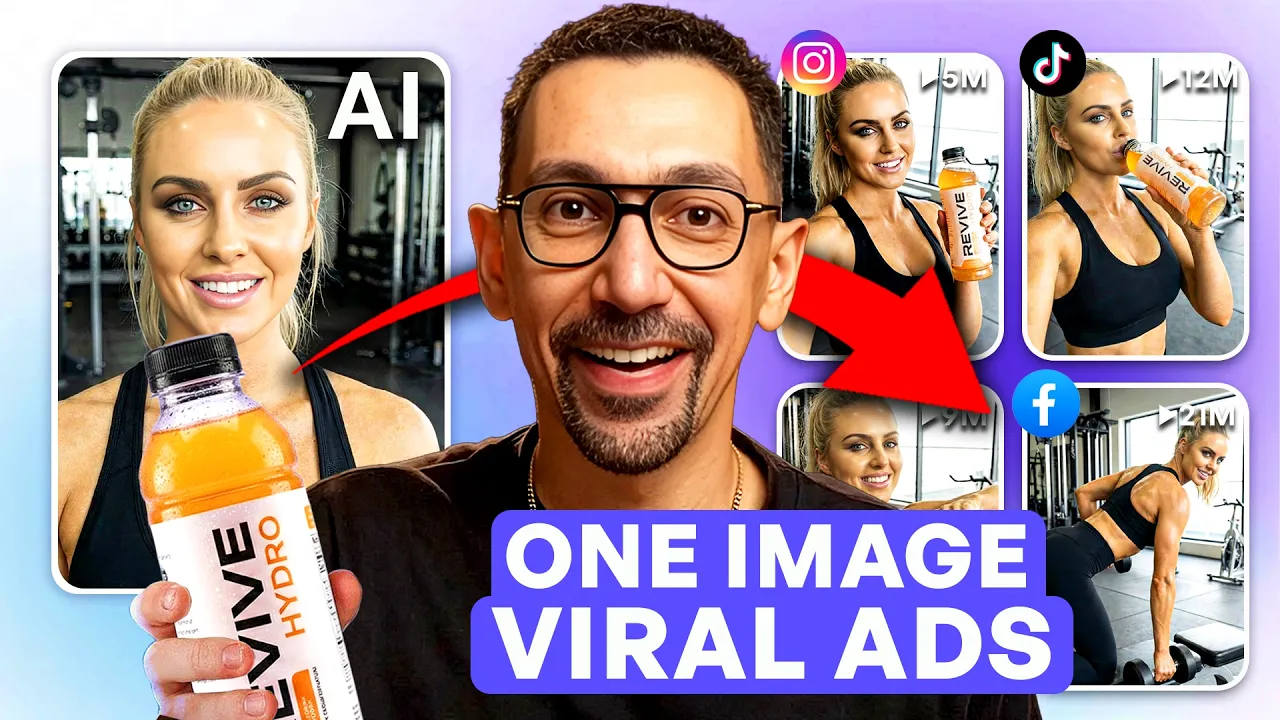
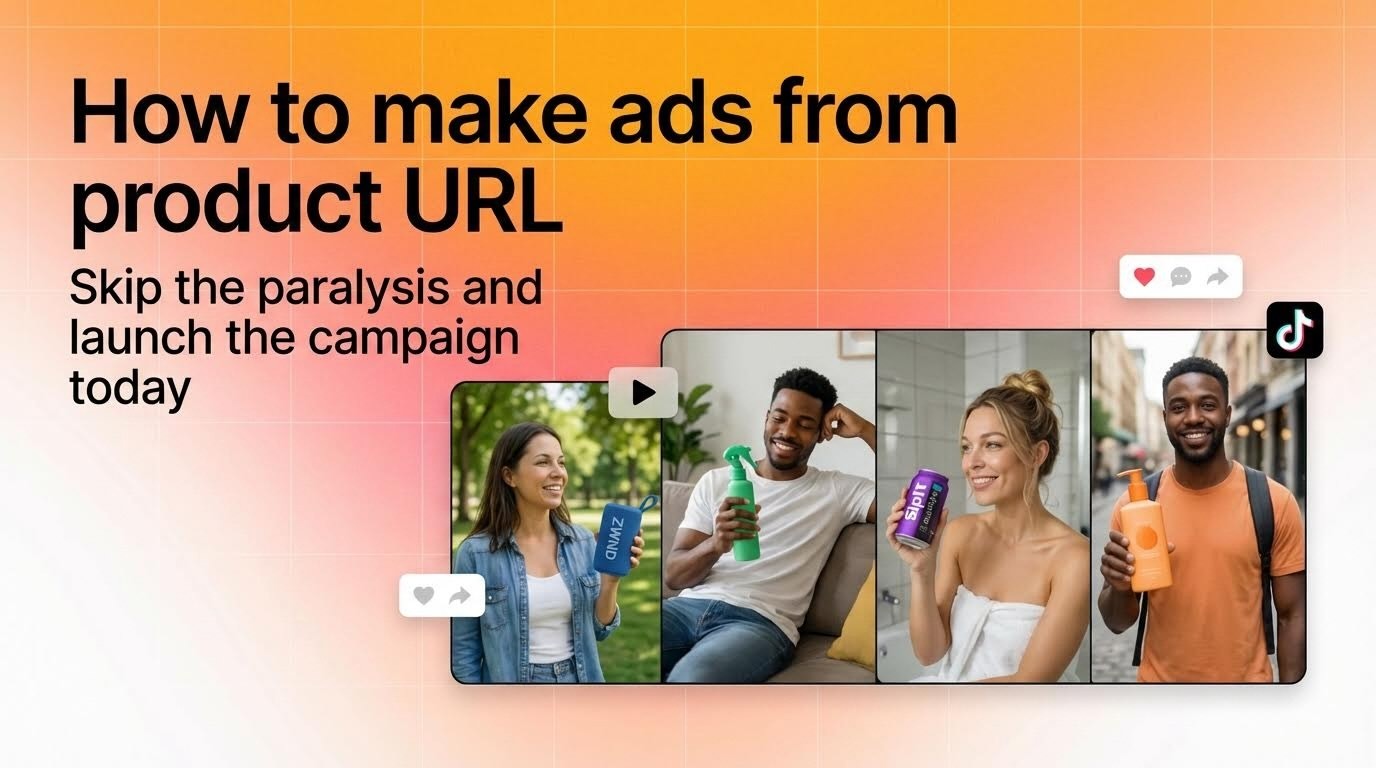
How to turn product URLs into high-converting video ads
How to turn product URLs into high-converting video ads

Creatify Team
SHARE


IN THIS ARTICLE
Your product page already did the hard work. It convinced people to buy with the right benefits, proof, and visuals. Now you just need to rearrange those elements into 30 seconds of video.
Most advertisers start from scratch - brainstorming product commercials, writing scripts, coordinating shoots. That's why creating product video ads costs $5,000+ and takes months. But your URL contains everything: the hook is in your headline, the demo is in your product images, the proof is in your reviews.
Here's how to extract it and turn one product advertisement into 50+ video variations.
Why product URLs make perfect product commercial scripts
Think about what's already on your product page:
Your headline explains what problem you solve.
Your hero image shows the product working.
Your bullet points list benefits.
Your reviews contain customer language about outcomes.
Your FAQ answers objections.
That's not a product page - that's a video script that hasn't been edited yet.
The reason 87% of people say product videos convinced them to purchase isn't because video is magic. It's because video demonstrates the outcome, shows social proof, and removes uncertainty simultaneously. Your product page does this too, just slower - people have to scroll, read, imagine.
Product video ads compress that journey into 30 seconds.
What is the fastest path to product advertisements: extraction VS creation
Traditional product commercial script ideas begin with "what should we say?" That's backwards. Your customers already told you what to say - in the reviews they left, the questions they asked, the features they cared about.
Start here:
Open your product page. Find the top 3 benefits customers mention most in reviews (not features you think matter - benefits they actually care about). Find your strongest proof element - a specific review with numbers, a star rating, a before/after result.
That's your raw material.
Then structure it:
Hook (3 seconds): State the problem or show a surprising moment
Demo (15 seconds): Show 2-3 benefits visually with the product in action
Proof (5 seconds): Flash the review or stat that makes it credible
CTA (3 seconds): Tell them exactly what to do next
That's 26 seconds. You just wrote a product video ad.
Example using a water bottle product advertisement:
Problem: "Tired of lukewarm coffee by 9:30am?"
Benefit 1: Show time-lapse of coffee staying hot for 12 hours
Benefit 2: Show bottle fitting in car cup holder, not leaking when dropped
Proof: "12,000+ five-star reviews"
CTA: "Order now, get 20% off"
Every element came from the product page. You extracted it, you didn't create from scratch.
Platform differences that matter for product video ads
YouTube viewers tolerate 30-60 seconds if the hook worked. They have sound on. They're leaning back.
Your YouTube product commercials can tell stories. Open with a customer scenario - someone struggling with the problem your product solves. Show them discovering your solution. End with their success and your CTA. This works because YouTube viewers came to watch videos.
TikTok, Reels, and Meta feeds give you 1-3 seconds before the scroll.
Your social product ads need hooks that interrupt the pattern. Start with the product already working, doing something unexpected, or showing a result. "This bottle kept ice frozen for 3 days" with a video of someone pulling ice cubes out. Hook first, explanation after.
The difference isn't production quality for product commercials - it's how much patience the viewer has. YouTube has patience. Social feeds don't.
Turn product images into product video ads without filming
You don't need a film crew to create product advertisements. Your product page has photos. Those photos can move.
Pan across a product shot to show different angles. Zoom into a close-up to highlight a specific feature. Animate your comparison chart. Overlay customer review text on your existing product images.
This isn't about faking video production - it's about using motion to direct attention. A slow zoom into the detail that proves your main benefit works better than a static image because eyes follow movement.
Add an AI avatar reading your script. Add captions for sound-off viewing. Add music that matches the energy level (calm for premium products, upbeat for impulse buys). Export vertical for social, horizontal for YouTube.
You just created a product commercial from a URL without shooting anything.
How Creatify turns URLs into product video ads automatically
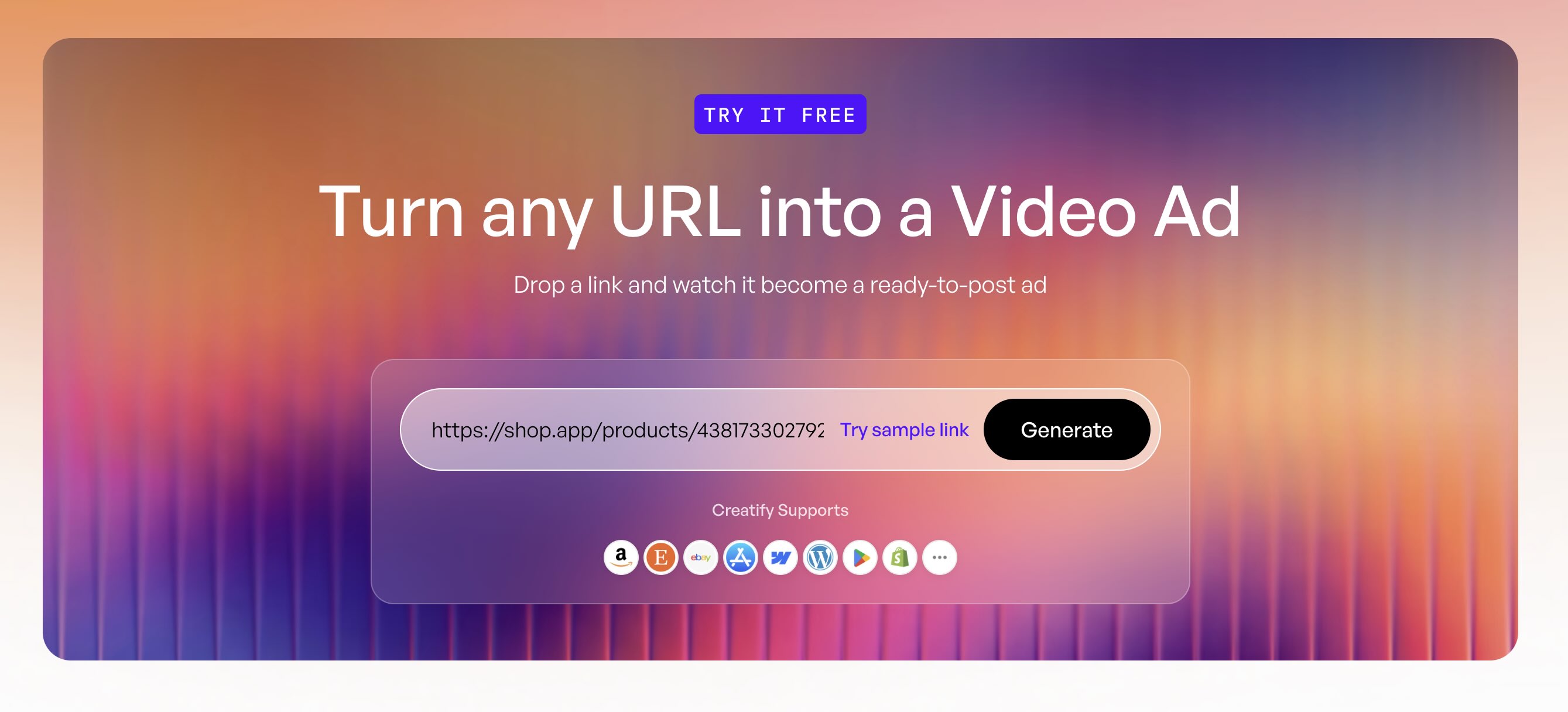
Paste your product URL - Amazon, Shopify, app store, landing page. Creatify's AI scans the page, pulls out product name, description, images, features, then generates 5-10 script variations testing different angles for your product advertisement.
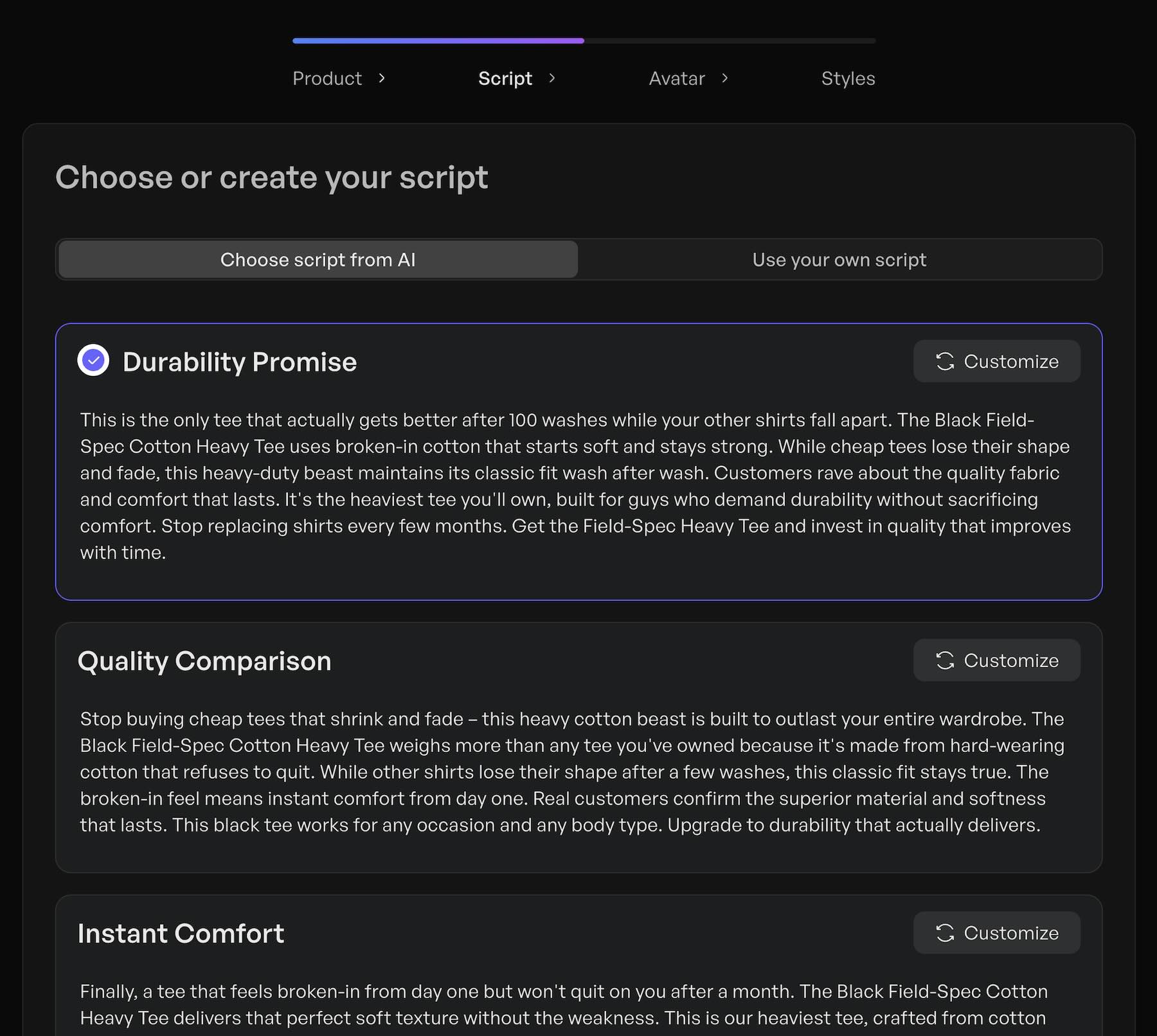
Pick the script you like (or write your own). Choose an AI avatar from 1,500+ options. The platform auto-formats your product commercials for each platform - 9:16 vertical for TikTok, 16:9 horizontal for YouTube, 1:1 square for Facebook. Add captions, music, end cards in the built-in editor.
Time from URL to finished product video ad: under 10 minutes.
For scale, use Batch Mode - upload 20 different product URLs, apply different avatars and script angles, export all variations simultaneously. This is how you go from 6 videos per year to 100 product ads per month without hiring anyone.
Cost: Traditional production at $5,000 per video × 50 variations = $250,000. Creatify Pro subscription = $49/month.
Test product ad concepts, not just creative
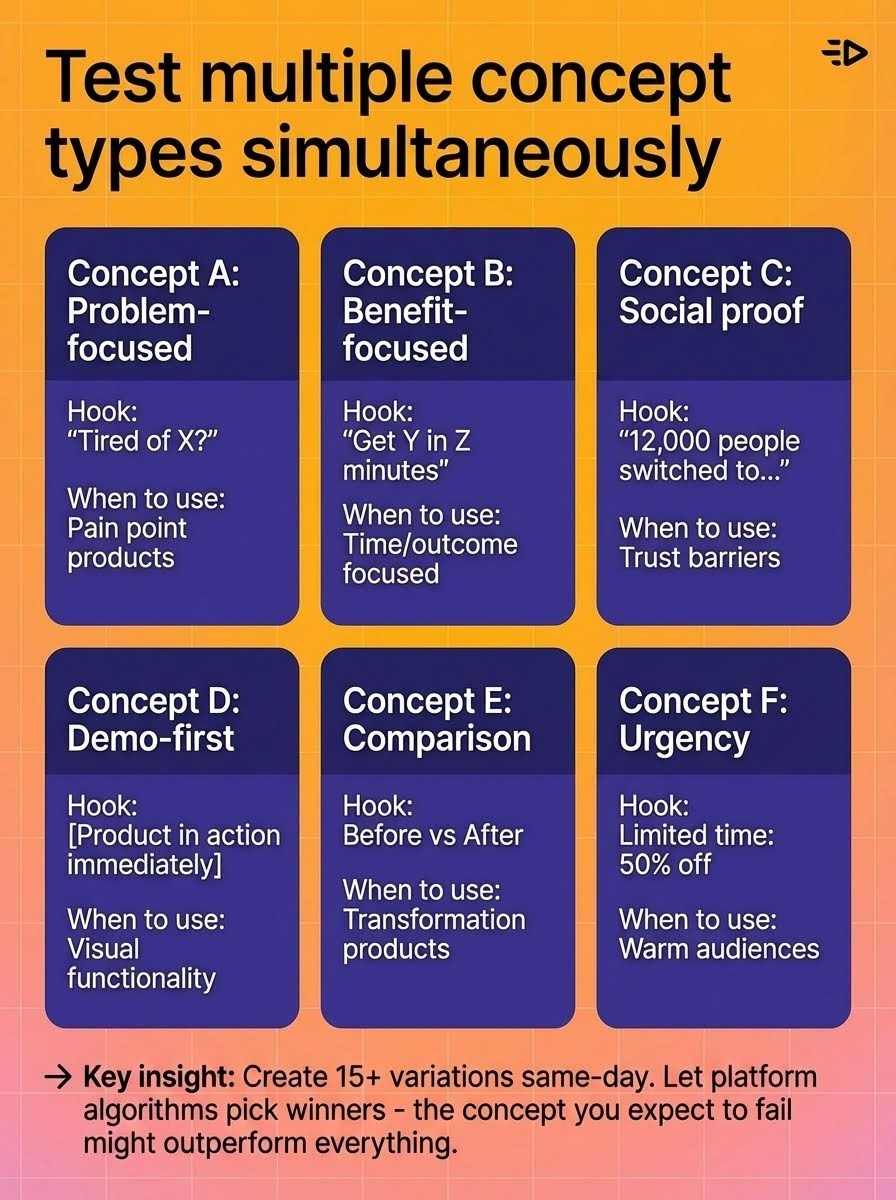
Don't make one "perfect" product commercial. Make 15 variations testing different concepts.
Concept A: Problem-focused hook ("Tired of X?")
Concept B: Benefit-focused hook ("Get Y in Z minutes")
Concept C: Social proof hook ("12,000 people switched to...")
Run all three product video ads. Let the platform's algorithm pick winners. The concept that works for your audience might surprise you - the advertisement product angle you thought would fail might outperform everything.
Traditional video production can't support this testing velocity. By the time you get 3 product advertisements from an agency, the winning concept already fatigued and you need fresh creative. URL-to-video workflows let you rotate new product ads same-day.
What to measure (and what to ignore)
View count means nothing. You want: click-through rate, add-to-cart rate, conversion rate, cost per acquisition.
The metrics that matter:
3-second view rate: Did your hook work? If 80% of viewers scroll past in 3 seconds, your hook failed.
Hold rate: Did they watch to your CTA? If average watch time is 8 seconds on a 30-second video, your middle 22 seconds were boring.
CTR: Did they click? If hold rate is high but CTR is low, your CTA is unclear or your offer isn't compelling.
Conversion rate: Did they buy? If CTR is high but conversion is low, your landing page doesn't match your ad promise.
Run tests at the concept level. If problem-focused hooks consistently outperform benefit-focused hooks, extract more problem language from your product page reviews and FAQs for future scripts.
The mistakes that kill product advertisement performance
Listing features instead of demonstrating outcomes
"Aerospace-grade aluminum" is a feature. "Survives 6-foot drops without denting" is an outcome. Your product video ad should show the bottle being dropped, not text listing its material specs.
Slow intros on social product ads
If your product doesn't appear in the first frame, you've already lost. YouTube product commercials can start with story setup. TikTok product ads cannot.
Mismatched ad and landing page
Your product video ad says "50% off today." The landing page shows regular pricing. You just paid for a click that will never convert. Match the promise.
Plan your campaign first, create second
The reason most teams never start creating product video ads isn't lack of ideas - it's decision paralysis. They stare at a blank page wondering "what should this video say?" and never ship anything.
Here's what actually removes the paralysis: plan the campaign before you write a single script.
Start with inventory, not inspiration:
How many product videos do you need?
Running YouTube? You need 5-10 variations to test different hooks and stories
Running Meta? You need 15-20 for social feeds (3 hooks × 5 benefit angles)
Running TikTok? You need 10-15 ultra-fast concepts
Running all three? You need 30-50 total
Which platforms are you targeting?
YouTube = 30-second stories with educational value
Meta/Instagram = 15-second benefit-focused verticals
TikTok = 15-second hooks that interrupt the scroll
What's your goal for each platform?
Awareness (cold traffic): Focus on problem/solution hooks
Consideration (warm traffic): Focus on benefit demonstrations and social proof
Conversion (retargeting): Focus on urgency and specific offers
Why this removes creative freeze:
Once you write "I need 15 videos for Meta testing 3 different hooks," you're no longer searching for the one perfect idea. You're filling inventory slots. Concept #7 doesn't need to be brilliant - it just needs to test a different angle than concepts 1-6.
The bird's eye view turns a creative problem into a checklist problem. You're not brainstorming genius. You're systematically extracting 15 different angles from your product page and testing them.
Example campaign plan:
Week 1: Launch YouTube awareness campaign
5 videos testing problem-focused vs benefit-focused hooks
30 seconds each, story format
Extract from: product page headline, top 3 review themes
Week 1: Launch Meta consideration campaign
15 videos testing 3 hooks × 5 product benefits
15 seconds each, vertical format
Extract from: product images, customer review quotes
Week 2: Add TikTok prospecting
10 videos with scroll-stopping hooks
15 seconds each, demo-first format
Extract from: product images showing transformation
That's 30 videos. Without this plan, you'd spend weeks searching for the "right" concept. With this plan, you spend 3 hours extracting 30 different angles from your URL and letting the algorithm tell you which ones work.
The illusion of needing to "invent" product ads
Here's what most advertisers get wrong: they think creating product video ads requires invention. Brainstorming sessions. Creative breakthroughs. Finding the perfect angle that nobody's thought of yet.
That's backwards.
Your product already speaks for itself. Your customers already told you what matters - in the reviews they left, the questions they asked, the features they ignored and the benefits they mentioned three times. Your product page already contains the hook, the demo, and the proof.
The work isn't inventing a message. The work is extraction - pulling what's already there and rearranging it into 30 seconds.
This is why URL-to-video workflows work. You're not starting from zero. You're starting from a product page that already convinced people to buy. The video ad is just that same persuasion path, compressed and reformatted for different platforms.
Stop treating product advertisements like creative projects that need genius ideas. Treat them like data extraction projects that need systematic processes. Your product speaks. You just need to let it.
FAQ
What are product ads?
Product ads promote specific items for sale by highlighting features, benefits, and direct purchase CTAs. Product video ads demonstrate the product working rather than showing static images. They run on Google Shopping, Meta, TikTok, YouTube, and other platforms to drive immediate product sales.
What's the difference between product advertisements and brand advertisements?
Product advertisements sell specific items with direct CTAs ("Buy this water bottle for $29.99"). Brand advertisements build awareness and emotional connection with the company overall ("We believe in sustainability"). Product ads optimize for conversion, brand ads optimize for recall and equity.
How long should product commercials be?
15-30 seconds for social feeds (TikTok, Reels, Meta). 30-60 seconds for YouTube. Shorter for warm audiences who already know your product, longer for cold audiences who need education. Test multiple lengths - the optimal duration varies by product complexity.
Can I create product video ads without filming?
Yes. Creatify turns product URLs into video using AI avatars, existing product images, and automated scripts. Paste your product link, pick an AI spokesperson, customize with your photos, export finished video. No filming, actors, or studios required.
What makes a product video ad convert?
Clear benefit (what outcome they get), credible proof (reviews, demonstrations, results), specific CTA (what to do next, with urgency). Also: fast hooks for social platforms, captions for sound-off viewing, landing pages that match ad promises.
How many product ad variations should I create?
Start with 10-15 testing different hooks, benefits, and CTAs. High-performing brands rotate 50-100+ new concepts monthly to combat creative fatigue. This volume only works with systematic workflows or AI tools - traditional production at $3,000+ per video makes testing impossible.
What's the best platform for product video ads?
YouTube for products needing explanation (complex gadgets, premium items). Meta/Instagram for impulse buys and visual products. TikTok for trends and younger audiences. Google Shopping for high-intent search. Most successful brands run video ads across multiple platforms with creative adapted to each.
How do I turn an Amazon listing into a product video ad?
Extract listing elements: title becomes hook, bullet points become benefits, reviews become proof, images become visuals. Script a 15-30 second product commercial with Problem-Solution-Proof-CTA structure. Tools like Creatify automate this - paste your Amazon URL, AI generates scripts from your listing, creates product advertisements with avatars demonstrating your product.
Your product page already did the hard work. It convinced people to buy with the right benefits, proof, and visuals. Now you just need to rearrange those elements into 30 seconds of video.
Most advertisers start from scratch - brainstorming product commercials, writing scripts, coordinating shoots. That's why creating product video ads costs $5,000+ and takes months. But your URL contains everything: the hook is in your headline, the demo is in your product images, the proof is in your reviews.
Here's how to extract it and turn one product advertisement into 50+ video variations.
Why product URLs make perfect product commercial scripts
Think about what's already on your product page:
Your headline explains what problem you solve.
Your hero image shows the product working.
Your bullet points list benefits.
Your reviews contain customer language about outcomes.
Your FAQ answers objections.
That's not a product page - that's a video script that hasn't been edited yet.
The reason 87% of people say product videos convinced them to purchase isn't because video is magic. It's because video demonstrates the outcome, shows social proof, and removes uncertainty simultaneously. Your product page does this too, just slower - people have to scroll, read, imagine.
Product video ads compress that journey into 30 seconds.
What is the fastest path to product advertisements: extraction VS creation
Traditional product commercial script ideas begin with "what should we say?" That's backwards. Your customers already told you what to say - in the reviews they left, the questions they asked, the features they cared about.
Start here:
Open your product page. Find the top 3 benefits customers mention most in reviews (not features you think matter - benefits they actually care about). Find your strongest proof element - a specific review with numbers, a star rating, a before/after result.
That's your raw material.
Then structure it:
Hook (3 seconds): State the problem or show a surprising moment
Demo (15 seconds): Show 2-3 benefits visually with the product in action
Proof (5 seconds): Flash the review or stat that makes it credible
CTA (3 seconds): Tell them exactly what to do next
That's 26 seconds. You just wrote a product video ad.
Example using a water bottle product advertisement:
Problem: "Tired of lukewarm coffee by 9:30am?"
Benefit 1: Show time-lapse of coffee staying hot for 12 hours
Benefit 2: Show bottle fitting in car cup holder, not leaking when dropped
Proof: "12,000+ five-star reviews"
CTA: "Order now, get 20% off"
Every element came from the product page. You extracted it, you didn't create from scratch.
Platform differences that matter for product video ads
YouTube viewers tolerate 30-60 seconds if the hook worked. They have sound on. They're leaning back.
Your YouTube product commercials can tell stories. Open with a customer scenario - someone struggling with the problem your product solves. Show them discovering your solution. End with their success and your CTA. This works because YouTube viewers came to watch videos.
TikTok, Reels, and Meta feeds give you 1-3 seconds before the scroll.
Your social product ads need hooks that interrupt the pattern. Start with the product already working, doing something unexpected, or showing a result. "This bottle kept ice frozen for 3 days" with a video of someone pulling ice cubes out. Hook first, explanation after.
The difference isn't production quality for product commercials - it's how much patience the viewer has. YouTube has patience. Social feeds don't.
Turn product images into product video ads without filming
You don't need a film crew to create product advertisements. Your product page has photos. Those photos can move.
Pan across a product shot to show different angles. Zoom into a close-up to highlight a specific feature. Animate your comparison chart. Overlay customer review text on your existing product images.
This isn't about faking video production - it's about using motion to direct attention. A slow zoom into the detail that proves your main benefit works better than a static image because eyes follow movement.
Add an AI avatar reading your script. Add captions for sound-off viewing. Add music that matches the energy level (calm for premium products, upbeat for impulse buys). Export vertical for social, horizontal for YouTube.
You just created a product commercial from a URL without shooting anything.
How Creatify turns URLs into product video ads automatically
Paste your product URL - Amazon, Shopify, app store, landing page. Creatify's AI scans the page, pulls out product name, description, images, features, then generates 5-10 script variations testing different angles for your product advertisement.
Pick the script you like (or write your own). Choose an AI avatar from 1,500+ options. The platform auto-formats your product commercials for each platform - 9:16 vertical for TikTok, 16:9 horizontal for YouTube, 1:1 square for Facebook. Add captions, music, end cards in the built-in editor.
Time from URL to finished product video ad: under 10 minutes.
For scale, use Batch Mode - upload 20 different product URLs, apply different avatars and script angles, export all variations simultaneously. This is how you go from 6 videos per year to 100 product ads per month without hiring anyone.
Cost: Traditional production at $5,000 per video × 50 variations = $250,000. Creatify Pro subscription = $49/month.
Test product ad concepts, not just creative
Don't make one "perfect" product commercial. Make 15 variations testing different concepts.
Concept A: Problem-focused hook ("Tired of X?")
Concept B: Benefit-focused hook ("Get Y in Z minutes")
Concept C: Social proof hook ("12,000 people switched to...")
Run all three product video ads. Let the platform's algorithm pick winners. The concept that works for your audience might surprise you - the advertisement product angle you thought would fail might outperform everything.
Traditional video production can't support this testing velocity. By the time you get 3 product advertisements from an agency, the winning concept already fatigued and you need fresh creative. URL-to-video workflows let you rotate new product ads same-day.
What to measure (and what to ignore)
View count means nothing. You want: click-through rate, add-to-cart rate, conversion rate, cost per acquisition.
The metrics that matter:
3-second view rate: Did your hook work? If 80% of viewers scroll past in 3 seconds, your hook failed.
Hold rate: Did they watch to your CTA? If average watch time is 8 seconds on a 30-second video, your middle 22 seconds were boring.
CTR: Did they click? If hold rate is high but CTR is low, your CTA is unclear or your offer isn't compelling.
Conversion rate: Did they buy? If CTR is high but conversion is low, your landing page doesn't match your ad promise.
Run tests at the concept level. If problem-focused hooks consistently outperform benefit-focused hooks, extract more problem language from your product page reviews and FAQs for future scripts.
The mistakes that kill product advertisement performance
Listing features instead of demonstrating outcomes
"Aerospace-grade aluminum" is a feature. "Survives 6-foot drops without denting" is an outcome. Your product video ad should show the bottle being dropped, not text listing its material specs.
Slow intros on social product ads
If your product doesn't appear in the first frame, you've already lost. YouTube product commercials can start with story setup. TikTok product ads cannot.
Mismatched ad and landing page
Your product video ad says "50% off today." The landing page shows regular pricing. You just paid for a click that will never convert. Match the promise.
Plan your campaign first, create second
The reason most teams never start creating product video ads isn't lack of ideas - it's decision paralysis. They stare at a blank page wondering "what should this video say?" and never ship anything.
Here's what actually removes the paralysis: plan the campaign before you write a single script.
Start with inventory, not inspiration:
How many product videos do you need?
Running YouTube? You need 5-10 variations to test different hooks and stories
Running Meta? You need 15-20 for social feeds (3 hooks × 5 benefit angles)
Running TikTok? You need 10-15 ultra-fast concepts
Running all three? You need 30-50 total
Which platforms are you targeting?
YouTube = 30-second stories with educational value
Meta/Instagram = 15-second benefit-focused verticals
TikTok = 15-second hooks that interrupt the scroll
What's your goal for each platform?
Awareness (cold traffic): Focus on problem/solution hooks
Consideration (warm traffic): Focus on benefit demonstrations and social proof
Conversion (retargeting): Focus on urgency and specific offers
Why this removes creative freeze:
Once you write "I need 15 videos for Meta testing 3 different hooks," you're no longer searching for the one perfect idea. You're filling inventory slots. Concept #7 doesn't need to be brilliant - it just needs to test a different angle than concepts 1-6.
The bird's eye view turns a creative problem into a checklist problem. You're not brainstorming genius. You're systematically extracting 15 different angles from your product page and testing them.
Example campaign plan:
Week 1: Launch YouTube awareness campaign
5 videos testing problem-focused vs benefit-focused hooks
30 seconds each, story format
Extract from: product page headline, top 3 review themes
Week 1: Launch Meta consideration campaign
15 videos testing 3 hooks × 5 product benefits
15 seconds each, vertical format
Extract from: product images, customer review quotes
Week 2: Add TikTok prospecting
10 videos with scroll-stopping hooks
15 seconds each, demo-first format
Extract from: product images showing transformation
That's 30 videos. Without this plan, you'd spend weeks searching for the "right" concept. With this plan, you spend 3 hours extracting 30 different angles from your URL and letting the algorithm tell you which ones work.
The illusion of needing to "invent" product ads
Here's what most advertisers get wrong: they think creating product video ads requires invention. Brainstorming sessions. Creative breakthroughs. Finding the perfect angle that nobody's thought of yet.
That's backwards.
Your product already speaks for itself. Your customers already told you what matters - in the reviews they left, the questions they asked, the features they ignored and the benefits they mentioned three times. Your product page already contains the hook, the demo, and the proof.
The work isn't inventing a message. The work is extraction - pulling what's already there and rearranging it into 30 seconds.
This is why URL-to-video workflows work. You're not starting from zero. You're starting from a product page that already convinced people to buy. The video ad is just that same persuasion path, compressed and reformatted for different platforms.
Stop treating product advertisements like creative projects that need genius ideas. Treat them like data extraction projects that need systematic processes. Your product speaks. You just need to let it.
FAQ
What are product ads?
Product ads promote specific items for sale by highlighting features, benefits, and direct purchase CTAs. Product video ads demonstrate the product working rather than showing static images. They run on Google Shopping, Meta, TikTok, YouTube, and other platforms to drive immediate product sales.
What's the difference between product advertisements and brand advertisements?
Product advertisements sell specific items with direct CTAs ("Buy this water bottle for $29.99"). Brand advertisements build awareness and emotional connection with the company overall ("We believe in sustainability"). Product ads optimize for conversion, brand ads optimize for recall and equity.
How long should product commercials be?
15-30 seconds for social feeds (TikTok, Reels, Meta). 30-60 seconds for YouTube. Shorter for warm audiences who already know your product, longer for cold audiences who need education. Test multiple lengths - the optimal duration varies by product complexity.
Can I create product video ads without filming?
Yes. Creatify turns product URLs into video using AI avatars, existing product images, and automated scripts. Paste your product link, pick an AI spokesperson, customize with your photos, export finished video. No filming, actors, or studios required.
What makes a product video ad convert?
Clear benefit (what outcome they get), credible proof (reviews, demonstrations, results), specific CTA (what to do next, with urgency). Also: fast hooks for social platforms, captions for sound-off viewing, landing pages that match ad promises.
How many product ad variations should I create?
Start with 10-15 testing different hooks, benefits, and CTAs. High-performing brands rotate 50-100+ new concepts monthly to combat creative fatigue. This volume only works with systematic workflows or AI tools - traditional production at $3,000+ per video makes testing impossible.
What's the best platform for product video ads?
YouTube for products needing explanation (complex gadgets, premium items). Meta/Instagram for impulse buys and visual products. TikTok for trends and younger audiences. Google Shopping for high-intent search. Most successful brands run video ads across multiple platforms with creative adapted to each.
How do I turn an Amazon listing into a product video ad?
Extract listing elements: title becomes hook, bullet points become benefits, reviews become proof, images become visuals. Script a 15-30 second product commercial with Problem-Solution-Proof-CTA structure. Tools like Creatify automate this - paste your Amazon URL, AI generates scripts from your listing, creates product advertisements with avatars demonstrating your product.

You might also like






Ready to speed up your marketing?
Test your new product ideas in minutes with AI-generated video ads


Ready to speed up your marketing?
Test your new product ideas in minutes with AI-generated video ads
Ready to speed up your marketing?
Test your new product ideas in minutes with AI-generated video ads
Ready to speed up your marketing?
Test your new product ideas in minutes with AI-generated video ads

Generate engaging video ads for your products
from any URL



Creatify Lab • Copyright © 2026
Language
English
Features
Tools
Generate engaging video ads for your products
from any URL
Creatify Lab • Copyright © 2026
Language
English
Features
Tools
Generate engaging video ads for your products
from any URL
Creatify Lab • Copyright © 2026
Language
English
Features
Tools
Use Cases
YouTube
Snapchat
Shopify
Create AI Avatar
OTT & CTV
Lead Generation
Generate engaging video ads for your products
from any URL
Creatify Lab • Copyright © 2026
Language
English
Features
Tools