
Meta ads keep getting more expensive. Meta's average price per ad rose 14% year over year in Q3 2026, after 12% rises in each of the two quarters before.
Lead costs held steady anyway. In WordStream by LocaliQ's 2026 Facebook benchmarks, the average cost per lead for lead campaigns was $27.39, slightly down from $27.66 a year earlier.
In the same data, click-through rate went up (2.59% to 2.70%), clicks got cheaper ($1.92 to $1.80), and more clicks turned into leads (7.72% to 8.54%). Those are the parts of the funnel you control, and this guide covers the benchmarks, how to judge your own number, and the changes that bring it down.
What is cost per lead on Meta?
Cost per lead (CPL) is your ad spend divided by the number of leads it produced. Spend $1,000, get 40 leads, and your CPL is $25. When marketers talk about CPL ads, this is the number they’re judging them on.
In Meta Ads Manager, a campaign optimized for leads shows this as cost per result. A "lead" is whatever you told Meta to count: an instant form submission, a website form fill tracked by your pixel, or a conversation that ends with contact details.
One catch: CPL counts form submissions, and some of those people will never buy. Two campaigns with the same CPL can produce very different sales, which comes up again below.
Average cost per lead on Facebook in 2026
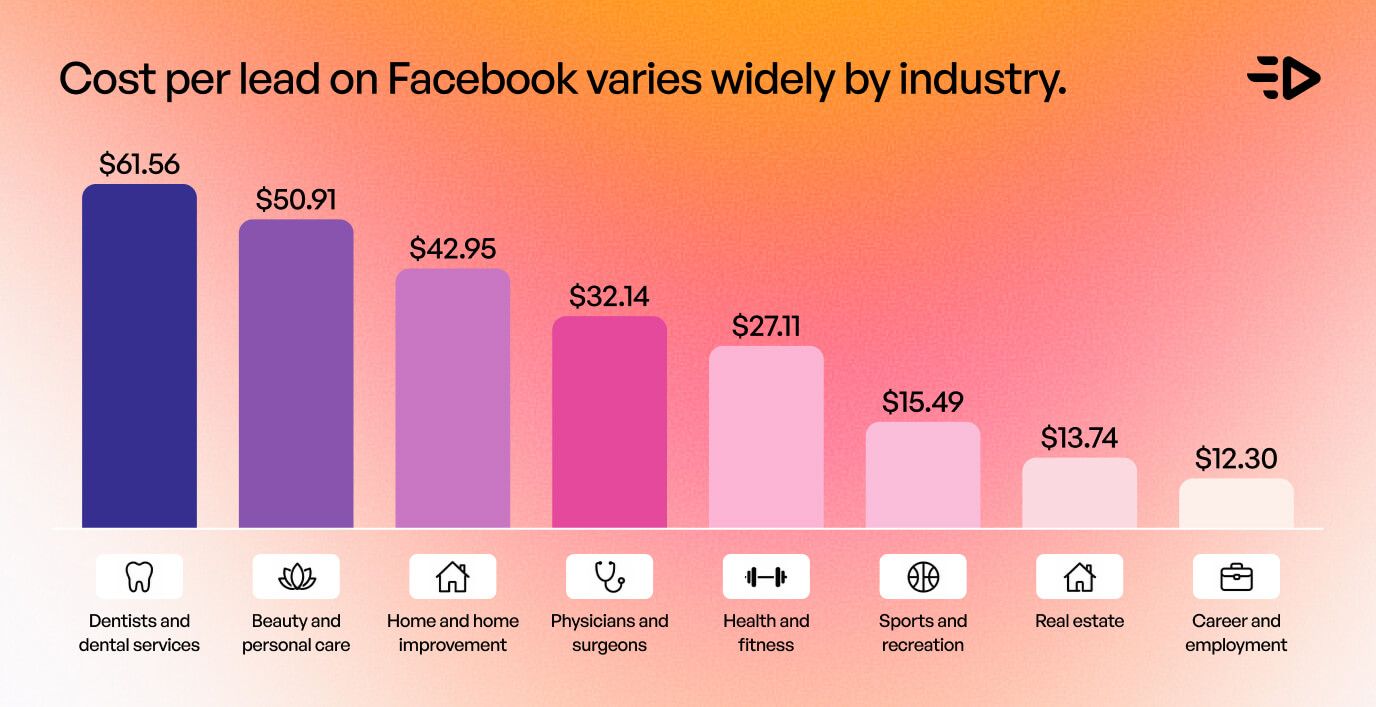
Across industries, WordStream's 2026 data puts the average Facebook cost per lead at $27.39. The report covers US campaigns that ran between April 2025 and June 2026 (its "averages" are technically medians, to limit the pull of outliers), and they vary a lot by industry:
Industry | Average CPL (2026) |
|---|---|
Dentists and dental services | $61.56 |
Beauty and personal care | $50.91 |
Home and home improvement | $42.95 |
Furniture | $39.25 |
Personal services | $38.09 |
Industrial and commercial | $35.87 |
Automotive (for sale) | $35.52 |
Physicians and surgeons | $32.14 |
Health and fitness | $27.11 |
Education and instruction | $26.31 |
Sports and recreation | $15.49 |
Arts and entertainment | $14.59 |
Real estate | $13.74 |
Career and employment | $12.30 |
The flat 2026 number follows a big jump. In the 2025 edition, the average CPL rose about 21%, from $22.87 to $27.66.
Read more: How to Make AI Ads for Mortgage Lead Generation
For context, Facebook leads came in well below search leads in WordStream's data. WordStream's 2026 Google Ads benchmarks, which cover Google and Microsoft search ads, put the average cost per lead at $66.69. It's an imperfect comparison (different samples, and search leads usually come with stronger intent), but the gap is wide.
Use these figures as a starting point. They're US averages from one vendor's client base, and your offer, location, and form setup can move your CPL as much as your industry does.
What is a good cost per lead on Facebook?
A good CPL is the highest CPL your business can afford while still making money on the customers those leads become. You can work it out with two numbers you already have:
Your target ad cost per customer, meaning what you can spend on ads to win one customer and still make money (after sales costs and other acquisition costs)
Your lead-to-customer rate, meaning the share of leads that end up buying (your CRM has it)
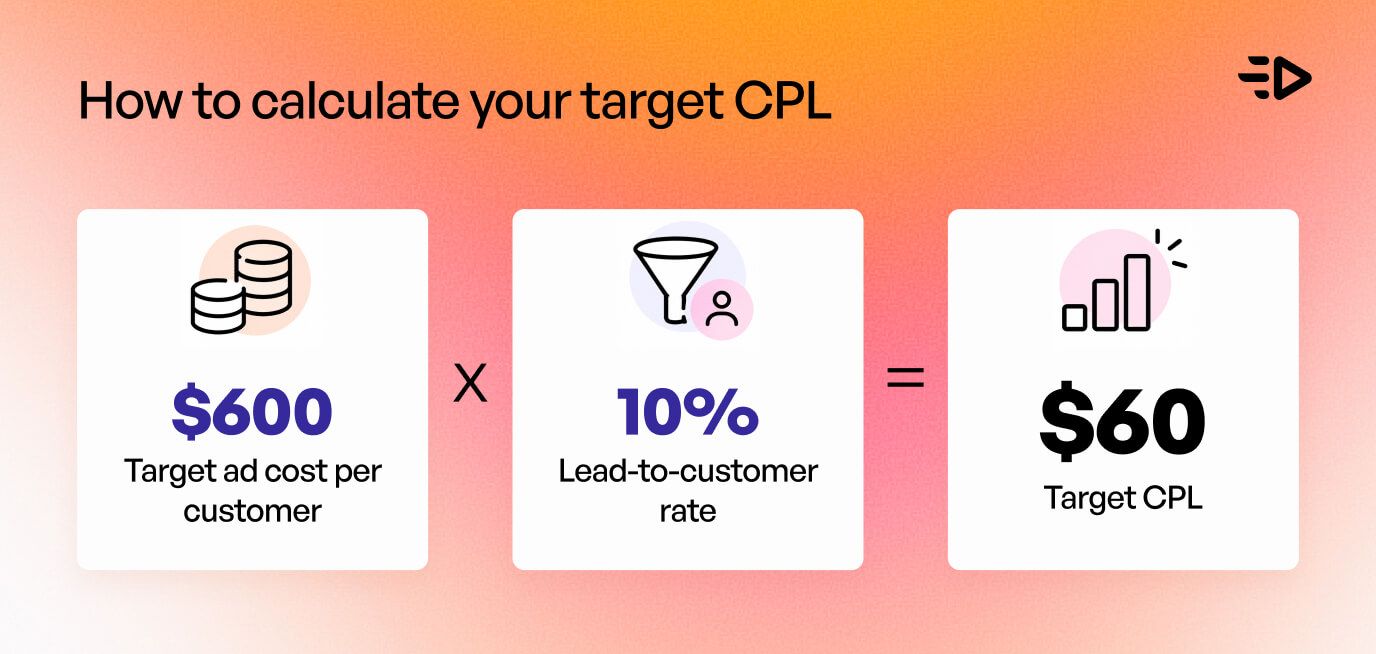
Multiply them, and you get your CPL ceiling. Say you sell a $3,000 service and can spend $600 in ads to win a customer. If 1 in 10 leads closes, you can pay up to $60 per lead. If only 1 in 30 closes, your ceiling drops to $20.
That's why a "cheap" lead can be the expensive one. A $20 lead where 1 in 5 qualifies costs $100 per qualified lead. A $30 lead where half qualify costs $60.
Read more: How to Make AI Ads for Service Businesses (No Product Needed)
Why your Meta cost per lead goes up
Four things push CPL up, and only some of them are yours to fix.
Auction prices keep rising. Meta's average price per ad rose 12% to 14% year over year in each of the first three quarters of 2026. In Q3 2026, ad impressions grew 10% while average price per ad grew 14%.
The calendar matters. Costs climb around the holidays. In Triple Whale's data on 33,000+ ecommerce shops, Meta CPMs averaged $22.26 over Black Friday and Cyber Monday 2025, against $14.19 in its full-year 2025 benchmarks. Early January can be the opposite: Meta says advertisers optimizing for qualified leads saw a 25% lower median CPM and 26% lower cost per qualified lead in the first week of January 2025 than in the first week of October 2024.
Ad sets run short of data. Meta's delivery usually stabilizes after about 50 optimization events in 7 days per ad set. Spread a small budget across lots of ad sets and each one can stay stuck in learning, where costs swing.
Creative gets tired. When the same people see the same ad too many times, costs rise. Ads Manager can flag ads as "creative fatigue" or "creative limited" when their cost per result climbs above where it was.
How to lower your cost per lead on Facebook and Instagram
1. Run website and instant forms in the same campaign
Instant forms open inside Facebook or Instagram with the person's details pre-filled, so they're quick to submit. Website forms give people more context before they commit. You don't have to choose anymore: Meta lets one campaign use both and serves each person the version they're more likely to finish. Meta reports this setup delivers 14% to 24% lower CPL than website forms alone.
Instant forms come in three types. "More volume" is the default and the easiest to submit. "Higher intent" adds a screen where people review and confirm their details, which trades some volume for more deliberate leads. "Rich creative" lets you add images, brand colors, and extra text for more context.
Easier forms can still bring good leads. In one small test by Jon Loomer with the same creative and audience, instant form leads cost $2.04 against $3.77 for the website form, and about 29% of each group went on to click his follow-up emails. It's one small test, but it's a useful check on the "instant forms mean junk leads" assumption.
2. Tell Meta which leads became customers
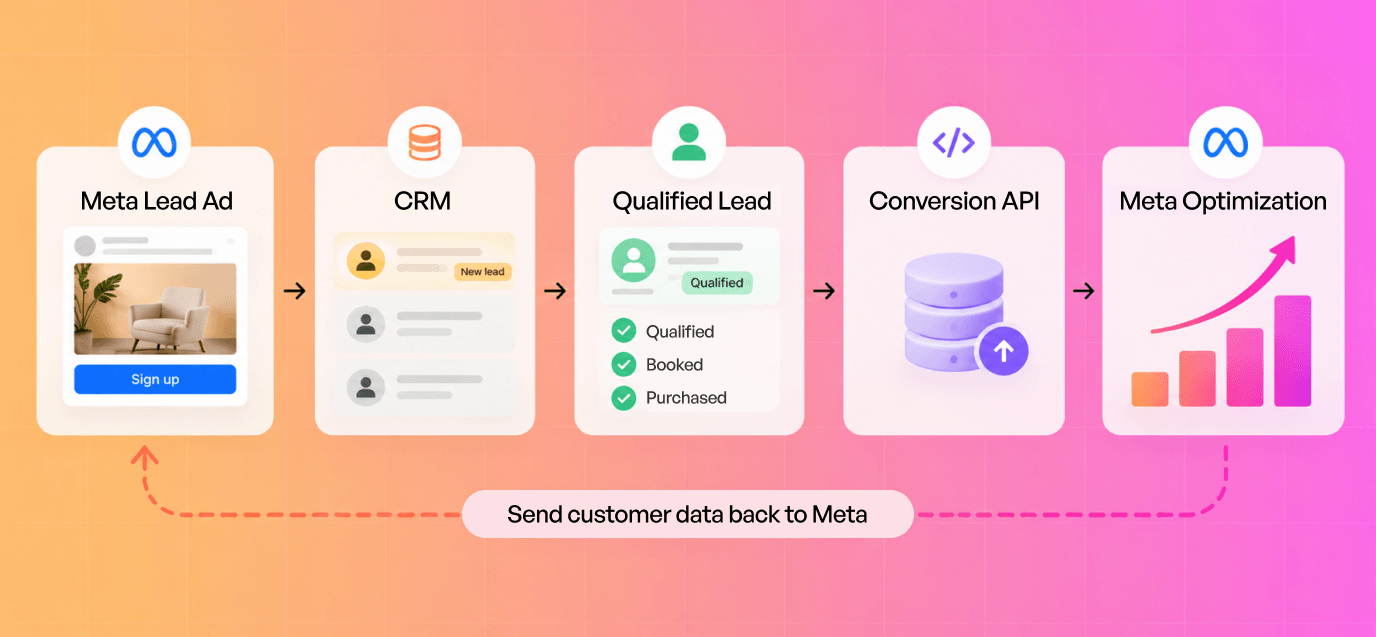
By default, lead ads optimize for volume, so Meta finds people who fill out forms. If you send your CRM outcomes back through the Conversions API for CRM and use the qualified leads performance goal (formerly called conversion leads), Meta optimizes for people who go on to book or buy. Meta said in October 2025 that advertisers using the two together saw 19% lower cost per quality lead on average.
It's also become a requirement. Since April 2026, the qualified leads goal isn't available for new campaigns without a Conversions API integration, and existing campaigns lose it from August 2026. The good news: Meta removed the minimum monthly lead volume requirement in late 2025, and you can pick a single event that matters (like a sale or a booking) right in the ad setup.
3. Filter out junk leads at the form
Fake numbers and typos inflate your lead count and quietly raise your real cost per lead. Meta's instant forms can now require SMS phone verification, and on Instagram or through the Marketing API, a work email. Meta says Dubai real estate firm The First Group cut invalid phone numbers by 45% with SMS verification, and its quality conversion rate rose 11%.
You can also add custom qualifying questions (budget, timeline, location). Each one costs you a little volume, and it saves your sales team calls to people who were never going to buy.
4. Test Advantage+ leads campaigns
Advantage+ leads campaigns hand audience, placement, and budget decisions to Meta's automation. Meta says advertisers using them saw 14% lower cost per lead and 10% lower cost per qualified lead on average. Run it as an A/B test against your current setup before moving your whole budget, since averages hide plenty of accounts that do worse.
5. Give the system more creative to work with
With targeting increasingly automated, your creative carries more of the load. In NCSolutions' analysis of nearly 450 sales-effect studies (consumer goods campaigns on TV and digital), creative accounted for 49% of the sales lift from advertising, against 11% for targeting. In separate Advertiser Perceptions surveys, marketers guessed creative's share at only about 20%.
Meta now calls creative diversification "a foundational best practice", and its advice boils down to "diversify your creative, test, and let the system optimize," as a Meta spokesperson told Marketing Brew. Agencies in the same piece say ads with the same look or opening hook get treated as essentially the same ad.
In practice, that means real variety:
Different concepts and hooks, beyond swapping a headline
Different formats: vertical video for Reels and Stories, square or static for feeds
Different people on screen and different angles (price, proof, problem, demo)
Fresh ads ready before fatigue sets in
6. Consolidate so each ad set can learn
Since learning usually needs about 50 optimization events a week per ad set, rough math helps: if you optimize for leads at a $30 CPL, an ad set needs around $1,500 a week to get there. If your budget can't support that across five ad sets, run one or two. Fewer, better-fed ad sets usually beat many starved ones.
Read more: Facebook Ad Best Practices, Tips and Examples
7. Trim form friction, but test it
Cutting fields can backfire. In a test covered by CXL, cutting a form from 9 fields to 6 lowered conversions by 14%, while keeping all 9 and rewriting the labels raised them by 19.2%. Cut the questions that confuse people, keep the ones that qualify, and test the change.
8. Call leads back fast
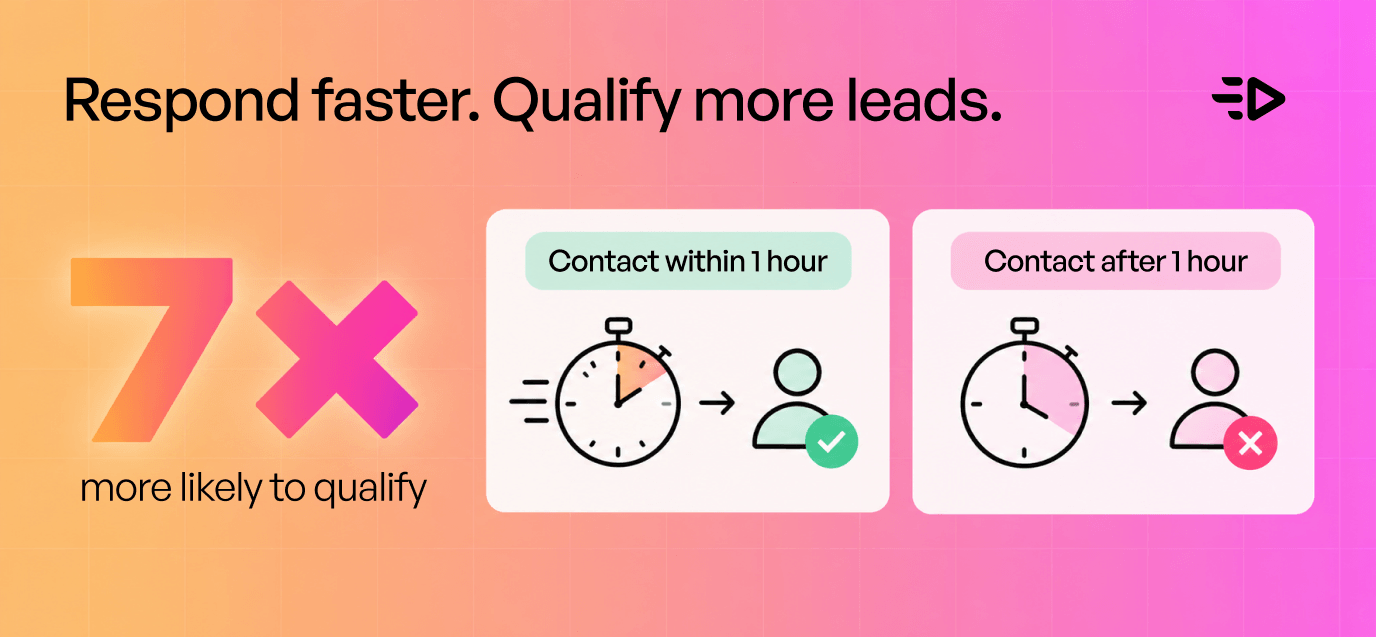
This one doesn't show up in Ads Manager, but it changes what each lead is worth. In a 2011 Harvard Business Review study, companies that contacted a lead within an hour were nearly 7 times more likely to qualify it than those that waited even an hour longer.
Most teams are still slow. In a Workato test of 114 B2B companies published in 2026, only 1 sent a personalized email within 5 minutes, none called within 5 minutes, and the average email reply took almost 12 hours. A $40 lead you call in 5 minutes can beat a $20 lead you call tomorrow.
9. Plan spend around the calendar
If you have flexibility, push harder in the post-holiday window (Meta calls it "Q5," from Christmas into January), when auction competition drops. Auction costs often rise around Black Friday and the holidays, so check your own past CPL and lead quality for those weeks before you judge a campaign, and don't kill good campaigns over a seasonal spike.
Where Creatify fits
Most of the levers above need a steady supply of new, clearly different ads, and that's the part we built Creatify to handle.
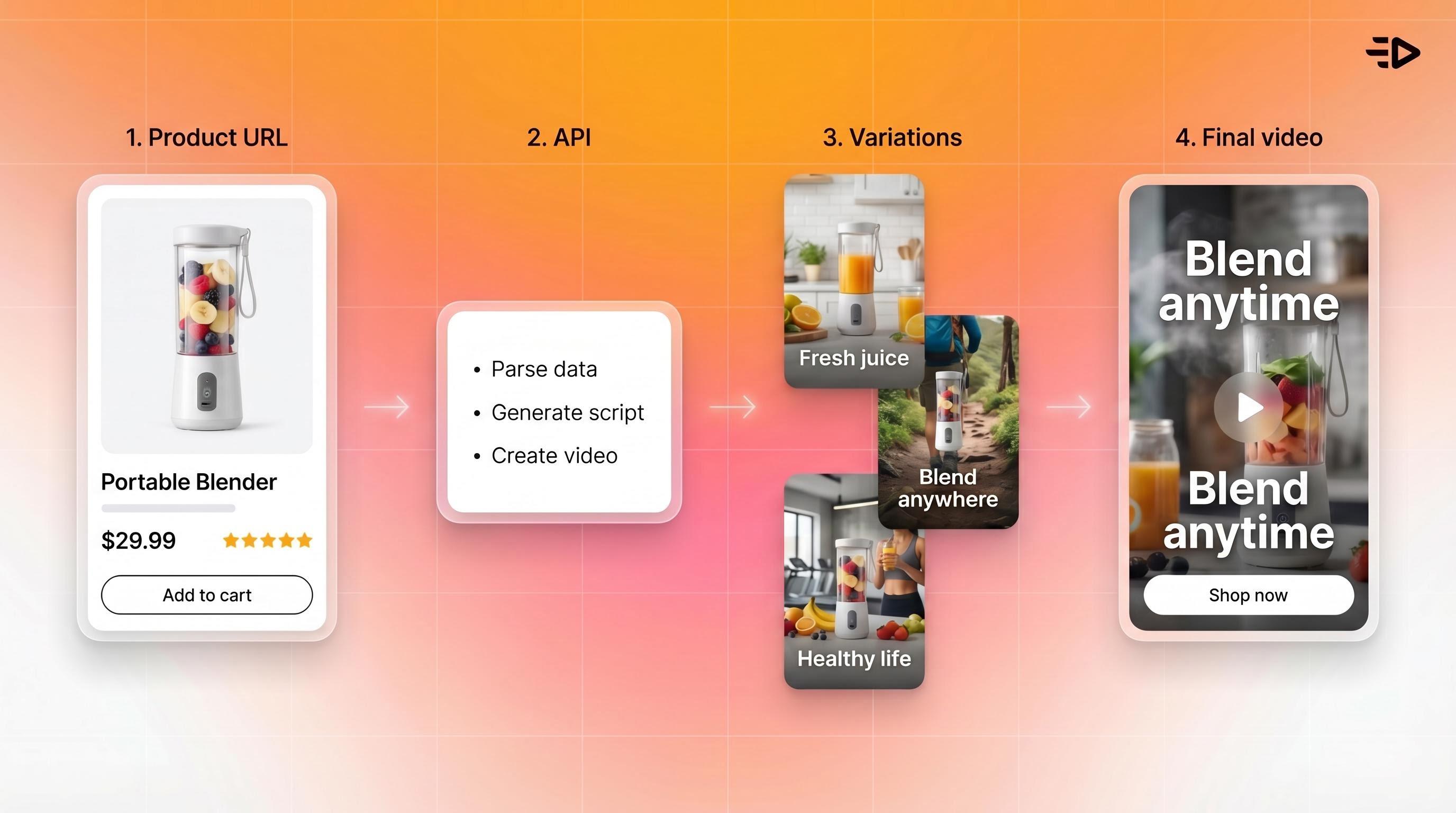
Creatify Agent turns a product link, brief, or idea into finished video ads for about $5 to $8 each. It researches your brand and competitors, writes the script, casts and produces the ad, and checks it against the brief. You can swap a single scene (the avatar, location, voiceover, or music) to make a new variant without rerunning the whole production, and we output 9:16, 16:9, and 1:1 for Reels, Stories, and feeds.
Once ads are live, our Performance Agent connects to your Meta account, audits campaigns for wasted spend, and monitors performance around the clock.
Zerorez's carpet cleaning franchises in Austin and Las Vegas used Creatify for their Meta lead generation campaigns, grew their creative testing volume 4x, and cut cost per lead by 28%.
Summing it up
The average Facebook cost per lead in WordStream's 2026 benchmarks was $27.39, ranging from about $12 for career and employment to $62 for dentists. A good CPL for you is your target ad cost per customer times your lead-to-customer rate, and that matters more than any benchmark.
To bring it down, run website and instant forms together, connect your CRM to Meta, filter junk leads, test Advantage+ leads, keep fresh and varied creative in rotation, consolidate ad sets, and call leads back within minutes.
One bonus thought. Meta's own lead-gen announcements increasingly report cost per qualified lead next to CPL. That's a good habit to copy: track both numbers side by side, because a form fill only pays off when the person behind it wants to buy.
FAQ
What is the average cost per lead on Facebook?
In WordStream by LocaliQ's 2026 benchmarks, the average cost per lead for Facebook lead campaigns was $27.39. By industry, it ranged from $12.30 for career and employment to $61.56 for dentists.
What is a good cost per lead on Facebook?
A good CPL is one that stays under what you can spend on ads per customer, multiplied by your lead-to-customer rate. If you can spend $600 in ads per customer and 1 in 10 leads buys, you can afford up to $60 per lead.
How much do Facebook lead ads cost?
You set the budget, and Meta typically bills lead campaigns by impressions, so your cost per lead is the result of that spend. With a $27.39 average CPL, a $1,000 budget would get you roughly 35 to 40 leads, though your industry and setup can move that a lot.
What does CPL mean in ads?
CPL stands for cost per lead: total ad spend divided by the number of leads generated. In Meta Ads Manager it shows up as cost per result when your campaign is optimized for leads.
Why is my Facebook cost per lead so high?
The usual causes are rising auction prices, seasonal competition in Q4, ad sets that never exit learning, and creative fatigue. Check your frequency and the delivery column in Ads Manager first, then look at your form and how many ad sets you're splitting the budget across.
Are instant form leads lower quality than website leads?
Not necessarily. Instant forms are easier to submit, so they tend to cost less, and quality depends on your setup. Adding the higher intent form type, qualifying questions, SMS verification, or CRM-based optimization helps keep quality up.