
Creatify Team
SHARE


IN THIS ARTICLE
Most Facebook ad advice optimizes for the ad. A better hook, a cleaner visual, a stronger CTA. All useful, and none of it matters much when you're running three creatives and hoping one sticks.
The brands consistently winning on Meta run creative like a volume game. Dozens of variants, multiple hooks, different formats, and the algorithm tells them what works. This guide covers how to build that system, from campaign structure to creative execution to testing.
How Facebook ads work?
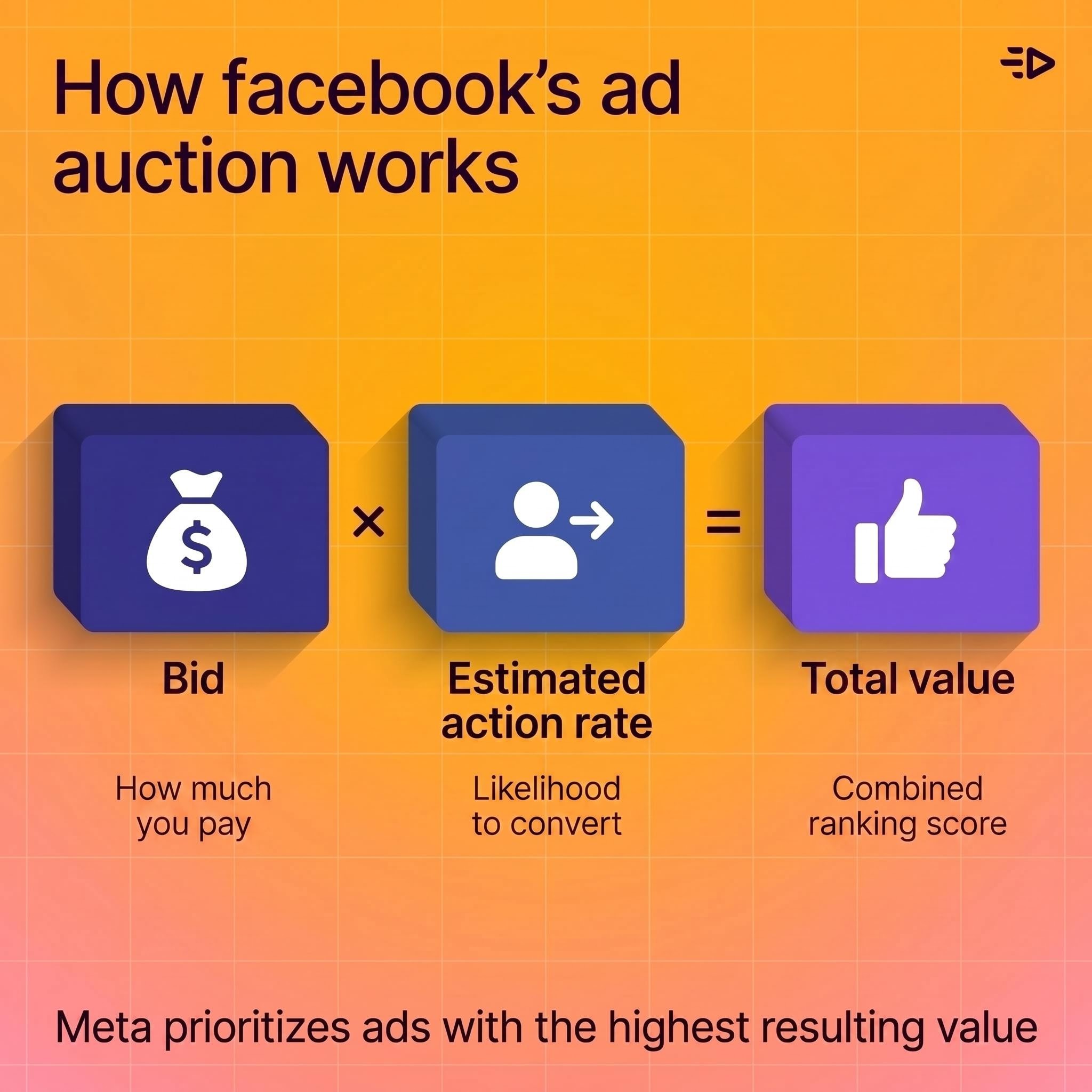
Every Facebook ad competes in an auction. The winner isn't always the highest bidder. Meta's auction weighs three things: your bid, the estimated action rate (how likely your ad is to get the result you're optimizing for), and ad quality.
Ad quality is Meta's assessment of how your ad is experienced by users. Ads that generate negative feedback, use low-quality tactics, or fail to deliver relevant experiences for their target audience get penalized in delivery. Better quality ads can lower your cost per result and improve efficiency over time.
Winning on Facebook depends heavily on relevance and creative quality, not just spend size.
3 Best Facebook ad tips for 2026
1. Start with the right objective
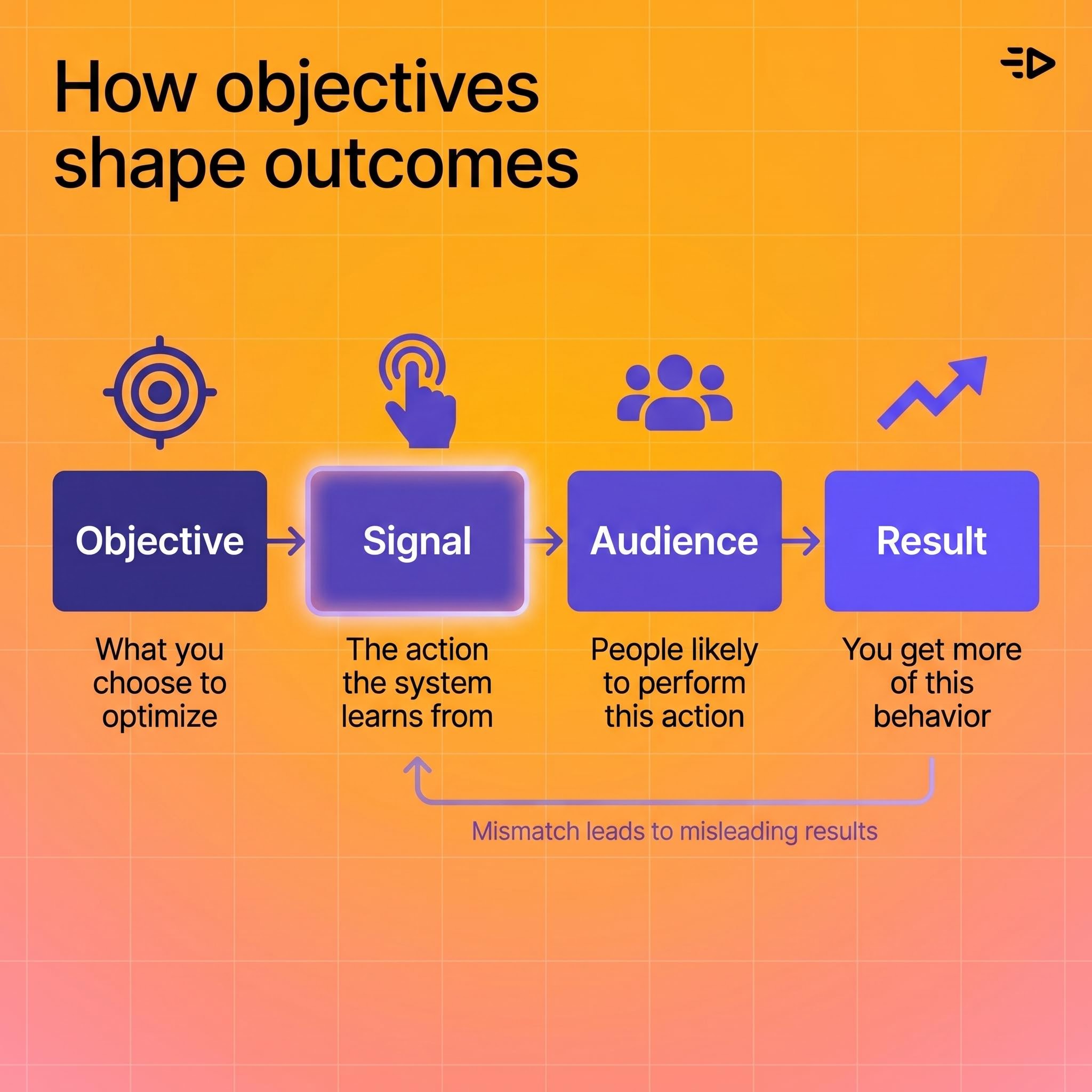
The campaign objective tells Meta what result to optimize for. If your objective doesn't match your actual business goal, the algorithm optimizes toward the wrong thing and your data becomes misleading.
Common mismatches:
Running a Traffic objective when you want purchases (you'll get clicks, not buyers)
Running Reach when you want leads (you'll get impressions, not conversions)
Running Engagement when you want sales (you'll get likes, not revenue)
Set a Purchase objective for e-commerce. Set a Leads objective for service businesses or lead-gen funnels. Set an Awareness or Reach objective only when the explicit goal is visibility, not conversion. The objective shapes every downstream decision, so get it right first.
2. Build with audience relevance
Relevance isn't just a creative quality. It starts with who sees the ad. Meta explicitly recommends making ads relevant and useful to the target audience, and that means your audience selection and your creative need to match.

Overly narrow audiences can limit delivery and learning in some campaigns. The algorithm needs room to find the people most likely to convert, and if you've constrained it too tightly, it can't learn efficiently. In many accounts, broad audiences with strong creative outperform over-segmented ones, particularly when conversion data is sufficient.
The practical balance: start with a clearly defined audience (interest stack, lookalike, or retargeting), let it run with enough budget to generate signal, then adjust based on what the data tells you, not what you assumed going in.
Read also: 10 best social media advertising tools and platforms in 2026
3. Creative is the performance lever
Meta's research has found that creative quality drives a significant share of ad ROI and improves both short- and long-term sales outcomes. It's not just the wrapper for your message. It's the primary driver of whether the ad works.
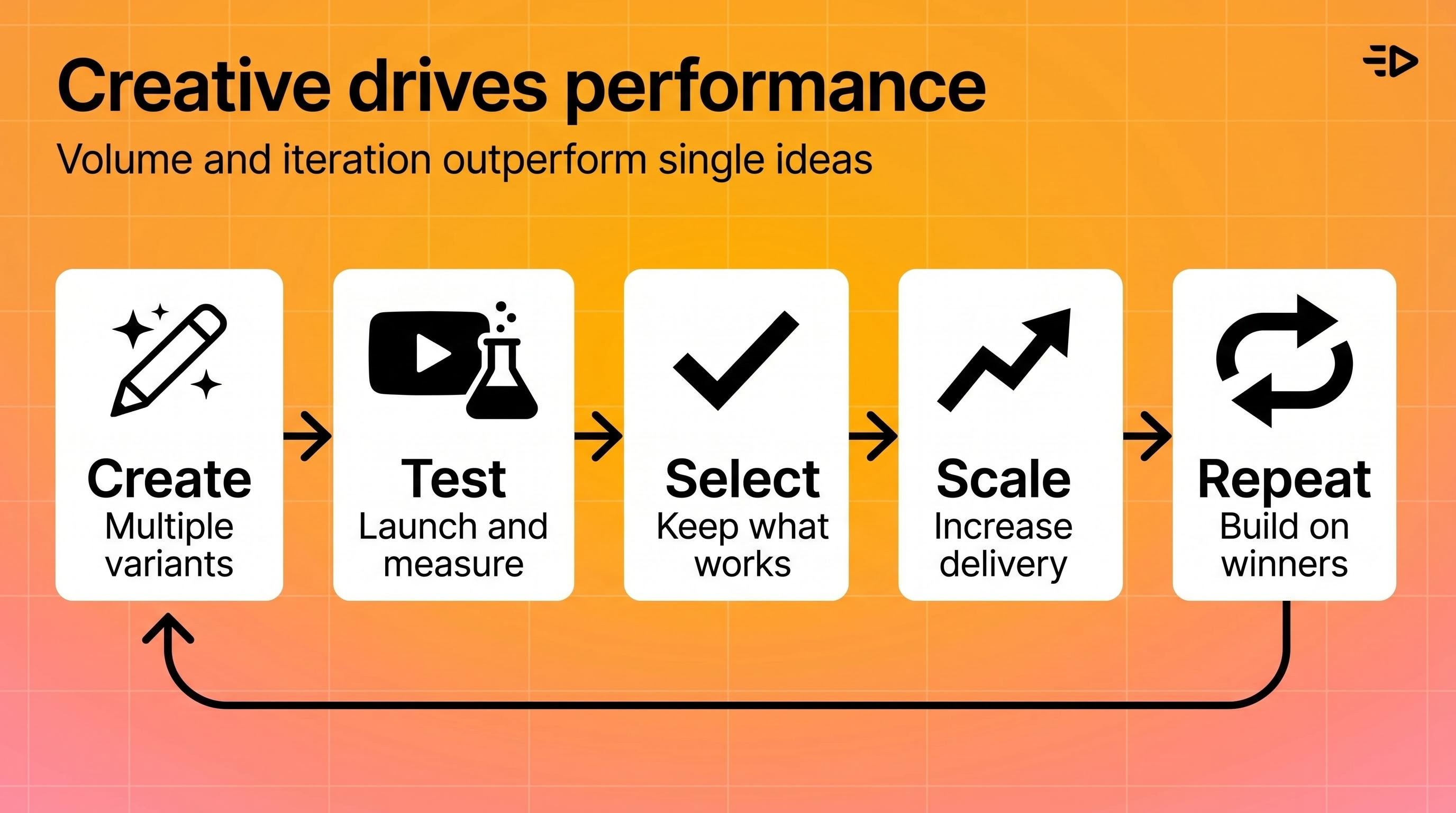
This is why the volume-of-variants approach wins. One great creative is a guess. Thirty tested variants is a system. You find out which hook stops the scroll, which CTA converts, which visual style resonates with which segment, and you build on what the data tells you rather than what someone in a meeting room believed.
The teams that consistently win on Meta aren't producing Hollywood-quality content. They're producing a high volume of clear, specific, on-brand creative and letting the platform tell them what works.
Facebook ad creative best practices
1. Hook fast
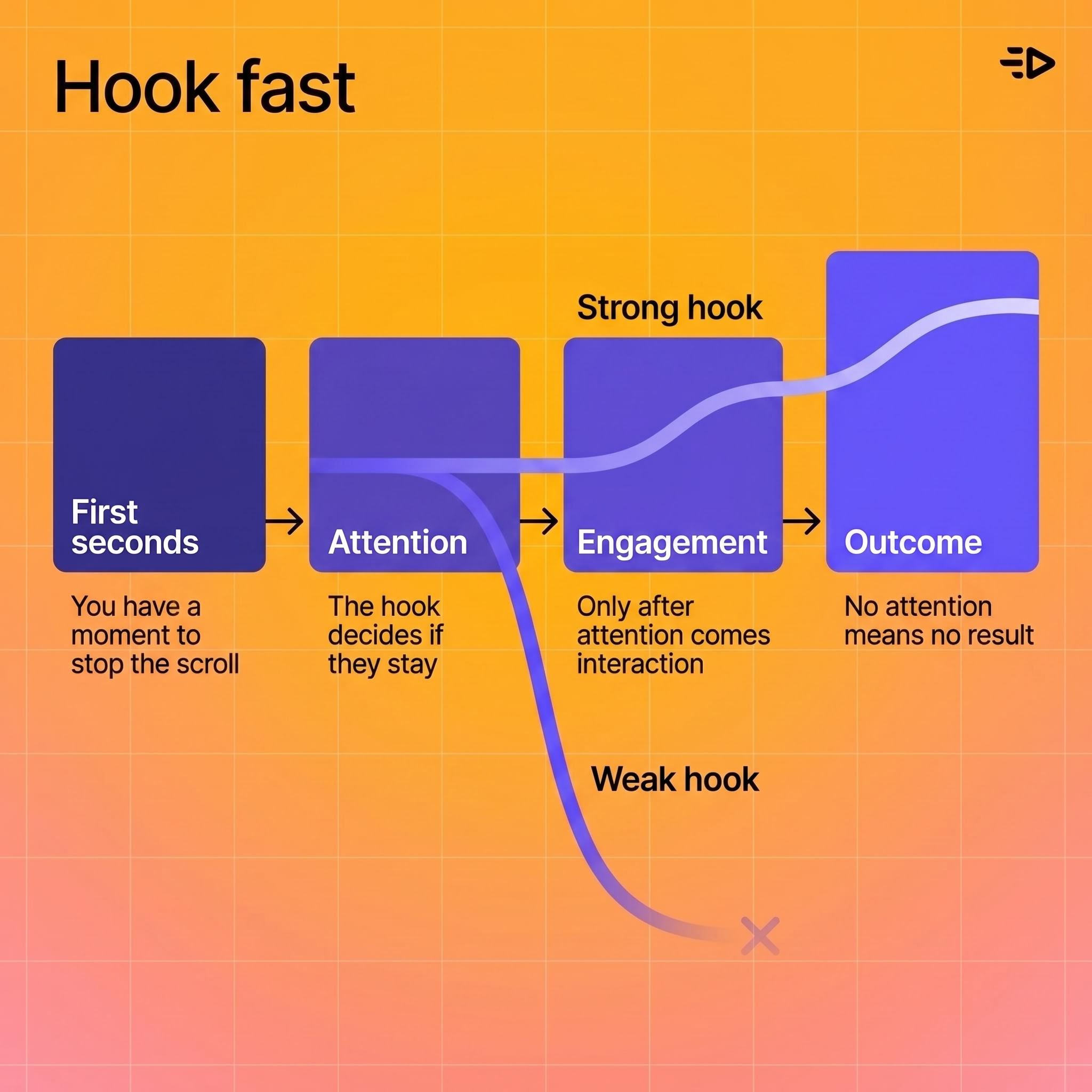
You usually have only a few seconds to earn attention before someone scrolls past. For video, Meta recommends getting to the story quickly and showing brand or product imagery early. Don't build to the point. Open with it.
For static ads, the visual carries the hook. The image needs to communicate the core idea before anyone reads a word of copy. If it doesn't stop the scroll on its own, the rest of the ad doesn't matter.
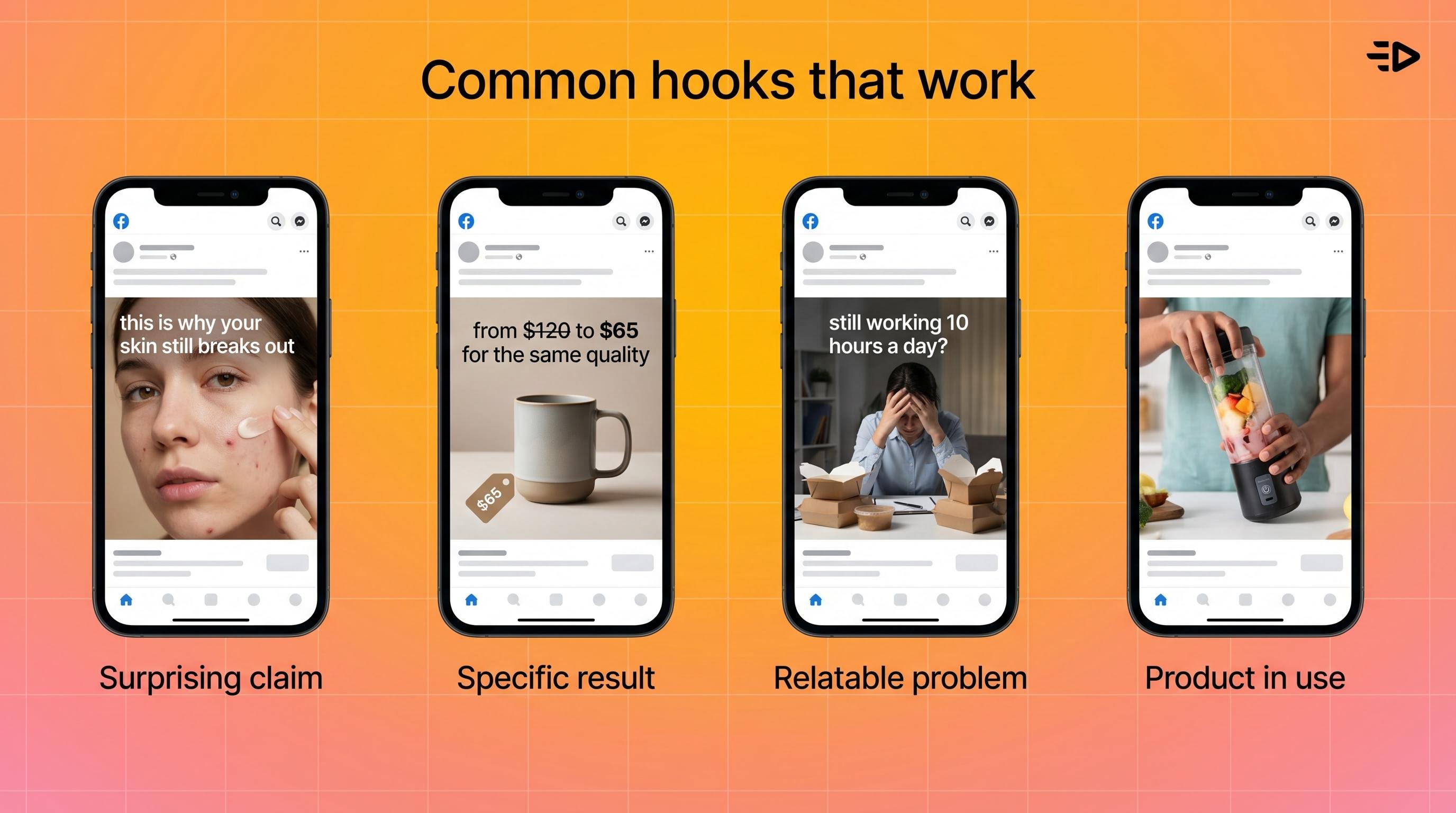
Common hooks that work:
surprising claim
specific result ("from $55 to $30 cost per order")
relatable problem stated plainly
product in use doing something visually interesting.
2. Match message to audience
A generic ad trying to speak to everyone usually speaks to no one. Meta recommends customizing video creative for different audience segments, and the same logic applies to every format.
Cold audiences need context and proof. Retargeting audiences already know you and need a reason to come back. Lookalike audiences respond to the same signals as your best existing customers. Each of those scenarios calls for different messaging, different hooks, and often different creative formats.
The easiest way to segment: vary the hook and opening 5 seconds across audience types while keeping the core offer and CTA consistent. That alone can move conversion rates significantly.
3. Keep the story simple
Strong ads focus on one idea. One problem, one product, one outcome, one action. Meta's video guidance stresses concise storytelling over arbitrary length. The same principle applies to every format.
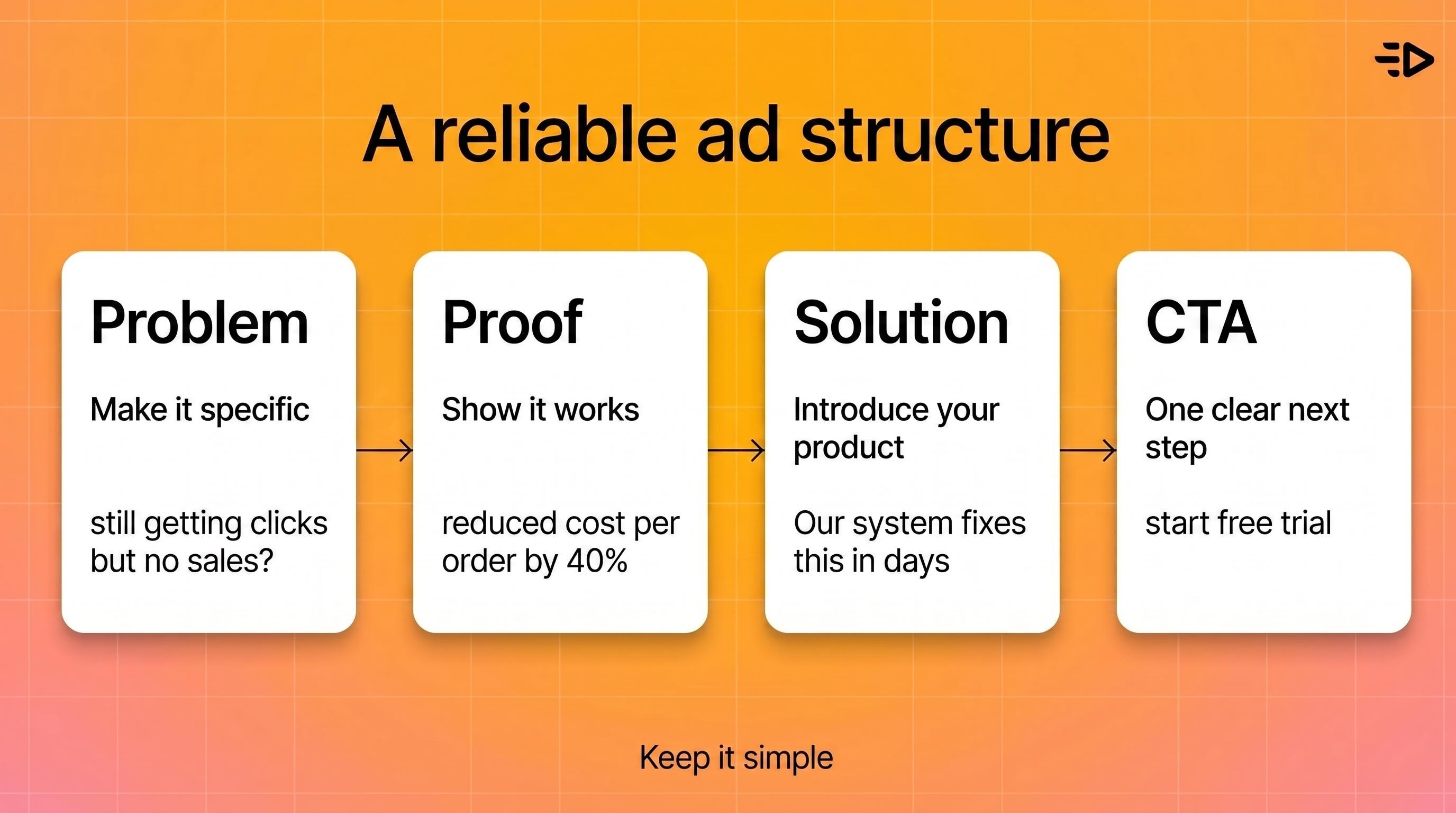
A reliable structure: problem (make it specific) → proof (show it works) → solution (your product) → CTA (one clear next step). That's it. If you're trying to communicate more than that in a single ad, you're probably trying to do too much.
4. Use strong visuals
Visuals need to show the product in context and make the value obvious without relying on copy to explain it. Clean composition, single focal point, product clearly visible. Avoid cluttered layouts, grainy images, awkward cropping, or anything that requires the viewer to work to understand what they're looking at.
For ecommerce specifically: show the product being used, not just existing. A person using the product tells a story. A product on a white background presents a catalog.
5. Design for mobile

Most Facebook ads are seen on mobile screens. Your creative needs to work at phone size: readable text, legible at a glance, no important details lost at the edges of a vertical crop.
For video, design for sound-off viewing. Captions aren't optional. A large share of mobile video is watched in environments where audio is off, and if your video depends on narration to make sense, you're losing those viewers entirely.
Vertical (9:16) and square (1:1) formats take up more screen real estate than landscape. More screen means more attention. Use the space.
6. Maintain brand consistency
Repeated colors, visual style, and framing build recognition over time. In a feed environment where attention is scarce and ad recall is fragile, consistent creative identity speeds up brand recognition and makes individual ads more effective as part of a broader campaign.
This doesn't mean every ad looks identical. It means the visual language is consistent enough that someone who's seen your ads before recognizes your brand before they read a word.
Best practices for Facebook ad copy creation
Copy supports the creative. Strong copy usually cannot fully compensate for weak creative.
The first line of your ad copy is the most important. Most people won't click "see more," so your opening line needs to earn attention or state the value clearly on its own. Lead with the most compelling thing you have to say, not with your company name or a generic greeting.
What works: specific claims ("150+ video variations in 2 weeks"), social proof ("4.8 stars, 1,000+ reviews"), direct questions that mirror the reader's situation ("Running Facebook ads but not seeing results?"), or a concrete offer stated plainly.
What doesn't work: vague claims ("the best solution for your business"), generic openers ("In today's competitive landscape..."), or copy that just describes the ad creative in words.
One CTA per ad. "Shop now," "Get started," "Book a call." Pick one and make it specific to what happens next when someone clicks.
Image ads
Image ads are the simplest format and one of the most commonly underexecuted. A strong image ad has a single focal point, a readable visual hierarchy, and a composition that communicates the core idea without needing copy to explain it.
Keep text in the image minimal. Heavy text overlays reduce readability on mobile and tend to underperform cleaner compositions in feed placements.

Video ads
Video is where the creative volume argument is strongest. One video at one length for one audience is a minimum viable test. Meta recommends varying video by audience and using length that serves the story, not a predetermined time target.
In practice, this means: a 6-15 second cut for cold audiences and paid social placements, a 30-60 second cut for warmer audiences and YouTube-style contexts, and a longer version for product pages or email. The same core content, cut differently for where it lives.
For ecommerce and DTC, UGC-style video often performs well on conversion metrics in feed placements, though results vary by brand, audience, and offer. Authentic, specific, product-in-use content tends to build trust faster than studio creative in direct-response contexts.
Carousel and sequence ads
Carousels work best when each card advances one idea, not when each card repeats a variation of the same message. Use the format to tell a sequential story, highlight multiple products with individual value propositions, or walk through a before-and-after.
The first card carries the hook. If the first card doesn't earn the swipe, the rest of the cards don't matter.
How to prevent creative fatigue in your Facebook ad campaigns
Creative fatigue happens when an audience has seen the same ad enough times that performance starts to drop. Frequency goes up, click-through rate goes down, cost per result climbs.
Meta's guidance on creative differentiation is clear: varied creative can help reduce fatigue and reach different audience segments more effectively. The same message delivered through different hooks, formats, and visual styles reaches different people and keeps the campaign fresh for people who've already seen one version.
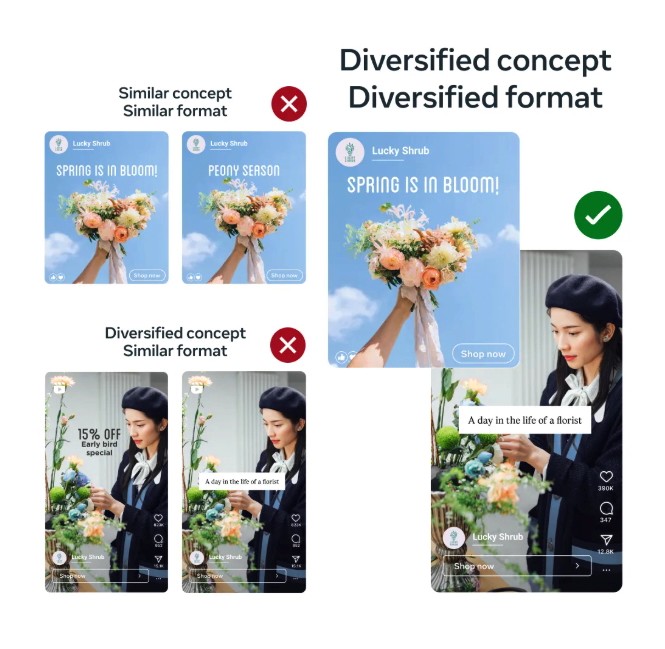
The practical answer to creative fatigue is creative volume before it becomes a problem. If you're running 20-30 variants across a campaign, you're rotating creative constantly and fatigue becomes far less of an issue than if you're running 2-3 ads and hoping they hold.
Test like a marketer, not an artist
A/B testing one variable at a time is the textbook answer. In practice, the teams running Meta ads at scale run more creative simultaneously and let the platform's delivery data sort winners from losers.
What to test: hooks (the opening line or first 3 seconds), visual style (UGC vs. polished vs. product-only), offer framing (percentage discount vs. dollar amount vs. risk reversal), CTA language, and format (video vs. image vs. carousel).
What not to do: run one ad for three weeks, declare it a failure, and start over. Build a creative pipeline that produces variants consistently, test against a clear hypothesis, and use the data to build the next round of creative, not to replace everything.
The ads creative volume problem (and how to solve it)
Here's the bottleneck most teams hit: they understand the logic of running 20-40 creative variants, but they don't have the production capacity to make it happen. Traditional video production costs $3,000-$15,000 per video and takes weeks. At that rate, running 30 variants isn't a strategy, it's a fantasy.
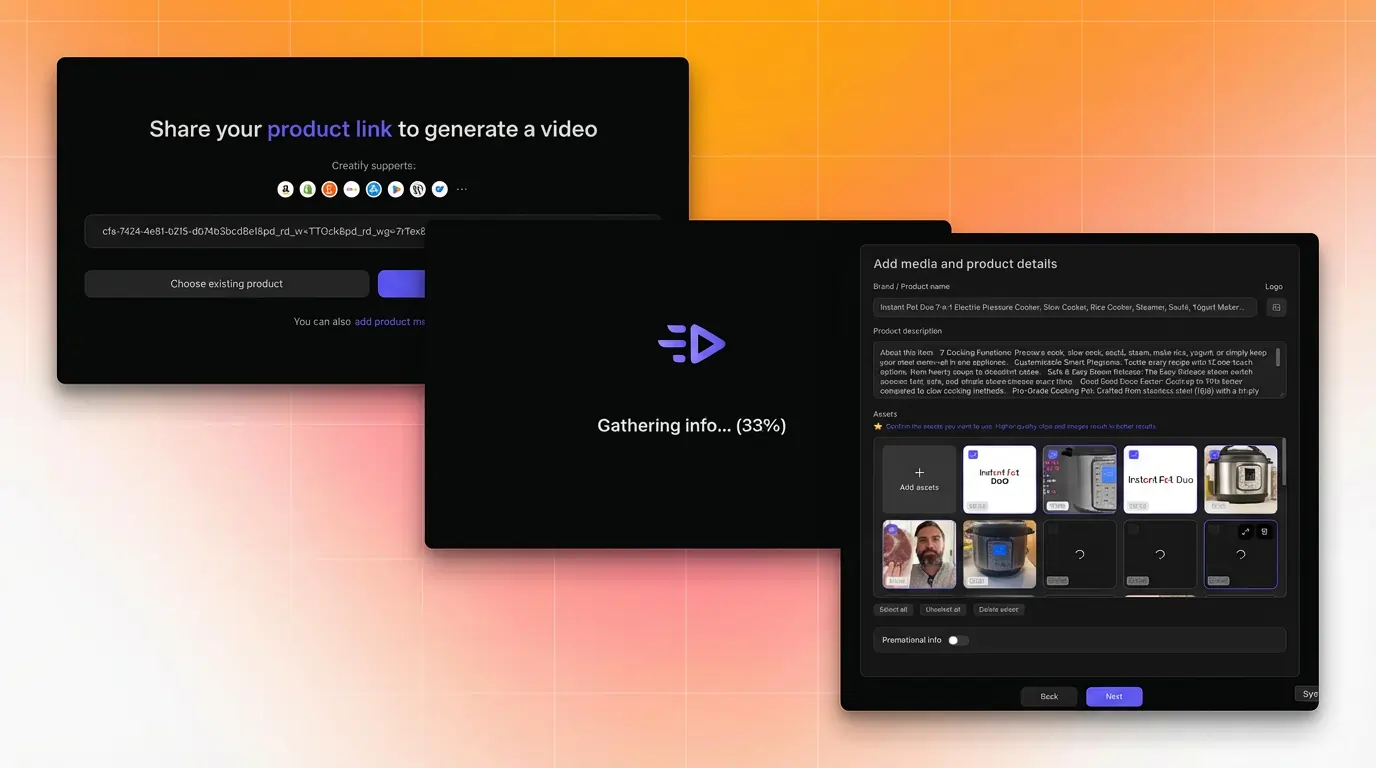
This is where AI-assisted production changes the equation. Creatify lets you generate video and image ad variants from a product URL or existing assets, with different hooks, avatars, scripts, and formats, at a fraction of the cost and time of traditional production.
Unicorn Marketers used Creatify's Asset Generator to produce 150+ video ad variations in 2 weeks for a client whose creative had plateaued, which led to a 45% CPA reduction and 73% ROAS improvement. LAIFE, a DTC brand, went from testing 10 videos per week to 50, and achieved a $3.89 cost per order on TikTok Shop.
The economics shift when production cost per video drops from thousands to single digits. You can actually run the volume-based testing strategy that Meta rewards, rather than just knowing you should.
Common mistakes to avoid with Facebook ads
Weak hook. If the first 2-3 seconds don't earn attention, nothing downstream matters.
Too much text in the creative. Cluttered visuals and heavy text overlays hurt readability and historically get penalized in delivery.
Misaligned message and audience. Cold audiences need context. Retargeting audiences need a reason to return. Treating them the same wastes budget.
Low-resolution or poorly cropped visuals. Grainy images and bad crops signal low quality before the viewer even reads a word.
Ignoring mobile. If it doesn't work at phone size with sound off, it doesn't work.
Running the same ad too long. Frequency climbs, performance drops. Rotate creative before fatigue sets in, not after.
Weak landing page. Meta's ad quality guidance explicitly includes the post-click experience. An ad that promises one thing and lands somewhere that delivers another is penalized in quality assessment and in conversion rate.
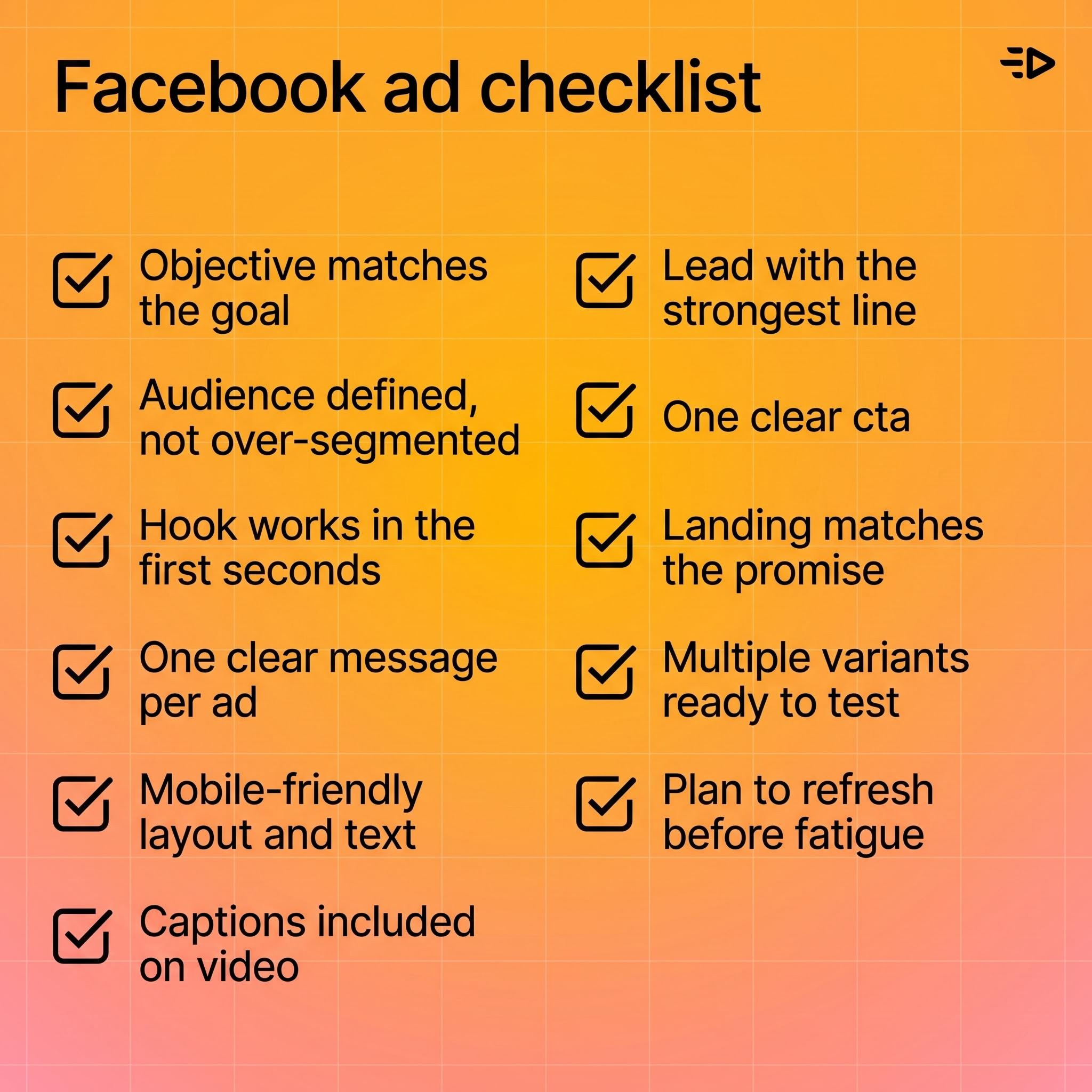
Facebook ad checklist
Before launching any campaign:
Campaign objective matches the actual business goal
Audience is defined but not over-segmented
Creative hook lands in the first 2-3 seconds
One core message per ad
Mobile-readable composition and text
Captions on video
Copy opens with the most compelling line, not the brand name
One CTA, stated clearly
Landing page matches the ad promise
At least 5-10 creative variants ready to test, not 1-2
Plan in place to refresh creative before fatigue
What the best Facebook ads have in common
They're specific. They're clear. They get to the point fast. And there are a lot of them.
The brands winning on Meta aren't doing it with one overproduced creative that took a month to make. They're running a system: clear objective, relevant audience, high volume of tested creative, and continuous iteration based on what the data returns. Meta's own research supports this directly: higher-quality, differentiated creative improves sales outcomes both short and long term.
The creative is the variable. Test more of it.
FAQ
What are Facebook ad best practices?
Facebook ad best practices are the repeatable principles that improve ad relevance, creative quality, and campaign efficiency in Meta's ad auction. They cover campaign objective alignment, audience targeting, creative execution, copy, format selection, and testing methodology.
What makes a good Facebook ad creative?
A strong hook in the first 2-3 seconds, a single clear message, visuals that show the product in context, mobile-first composition, captions for sound-off viewing, and brand consistency. Creative that is specific and relevant to its target audience consistently outperforms generic, broadly-targeted ads.
How many Facebook ad creatives should I run?
More than most advertisers run. Testing 20-40 variants across hooks, formats, and audience types is more effective than betting on one polished ad. Meta's algorithm rewards creative variety, and higher creative volume is the most reliable defense against fatigue and performance plateaus.
What are Facebook creative best practices for video ads?
Hook within the first 3 seconds, design for sound-off viewing with captions, tailor length to the story (not a preset time), customize by audience segment, and show the product in use rather than just in frame. UGC-style video consistently outperforms polished brand films on conversion metrics in feed placements.
How do I prevent Facebook ad creative fatigue?
Run more variants from the start. Creative fatigue happens when audiences see the same ad too many times. Rotating 20-30 variants keeps frequency from concentrating on any single creative and extends campaign lifespan. Refresh creative before performance drops, not after.
What is the best Facebook ad format?
It depends on the goal. Video drives the strongest engagement and conversion performance in most feed placements. Image ads work well for retargeting and simple offers. Carousels suit multi-product ecommerce and sequential storytelling. The best approach is to test multiple formats rather than defaulting to one.
How do I improve Facebook ad performance?
Start with the objective: make sure it matches your business goal. Then improve creative quality and volume: more hooks, more variants, more formats tested. Use the data to identify what's working and build the next round from there. Landing page relevance matters too. Meta's quality assessment includes the post-click experience, so a weak landing page hurts ad performance even if the creative is strong.
What are the best practices for Facebook ads in ecommerce?
Use a Purchase objective with conversion tracking properly set up. Show products in use, not just on a white background. Run UGC-style creative alongside polished product shots and let performance data pick the winner. Test at least 10-20 creative variants per campaign. Retarget visitors with specific product ads, not generic brand messaging. Refresh creative regularly to stay ahead of fatigue.
Most Facebook ad advice optimizes for the ad. A better hook, a cleaner visual, a stronger CTA. All useful, and none of it matters much when you're running three creatives and hoping one sticks.
The brands consistently winning on Meta run creative like a volume game. Dozens of variants, multiple hooks, different formats, and the algorithm tells them what works. This guide covers how to build that system, from campaign structure to creative execution to testing.
How Facebook ads work?
Every Facebook ad competes in an auction. The winner isn't always the highest bidder. Meta's auction weighs three things: your bid, the estimated action rate (how likely your ad is to get the result you're optimizing for), and ad quality.
Ad quality is Meta's assessment of how your ad is experienced by users. Ads that generate negative feedback, use low-quality tactics, or fail to deliver relevant experiences for their target audience get penalized in delivery. Better quality ads can lower your cost per result and improve efficiency over time.
Winning on Facebook depends heavily on relevance and creative quality, not just spend size.
3 Best Facebook ad tips for 2026
1. Start with the right objective
The campaign objective tells Meta what result to optimize for. If your objective doesn't match your actual business goal, the algorithm optimizes toward the wrong thing and your data becomes misleading.
Common mismatches:
Running a Traffic objective when you want purchases (you'll get clicks, not buyers)
Running Reach when you want leads (you'll get impressions, not conversions)
Running Engagement when you want sales (you'll get likes, not revenue)
Set a Purchase objective for e-commerce. Set a Leads objective for service businesses or lead-gen funnels. Set an Awareness or Reach objective only when the explicit goal is visibility, not conversion. The objective shapes every downstream decision, so get it right first.
2. Build with audience relevance
Relevance isn't just a creative quality. It starts with who sees the ad. Meta explicitly recommends making ads relevant and useful to the target audience, and that means your audience selection and your creative need to match.
Overly narrow audiences can limit delivery and learning in some campaigns. The algorithm needs room to find the people most likely to convert, and if you've constrained it too tightly, it can't learn efficiently. In many accounts, broad audiences with strong creative outperform over-segmented ones, particularly when conversion data is sufficient.
The practical balance: start with a clearly defined audience (interest stack, lookalike, or retargeting), let it run with enough budget to generate signal, then adjust based on what the data tells you, not what you assumed going in.
Read also: 10 best social media advertising tools and platforms in 2026
3. Creative is the performance lever
Meta's research has found that creative quality drives a significant share of ad ROI and improves both short- and long-term sales outcomes. It's not just the wrapper for your message. It's the primary driver of whether the ad works.
This is why the volume-of-variants approach wins. One great creative is a guess. Thirty tested variants is a system. You find out which hook stops the scroll, which CTA converts, which visual style resonates with which segment, and you build on what the data tells you rather than what someone in a meeting room believed.
The teams that consistently win on Meta aren't producing Hollywood-quality content. They're producing a high volume of clear, specific, on-brand creative and letting the platform tell them what works.
Facebook ad creative best practices
1. Hook fast
You usually have only a few seconds to earn attention before someone scrolls past. For video, Meta recommends getting to the story quickly and showing brand or product imagery early. Don't build to the point. Open with it.
For static ads, the visual carries the hook. The image needs to communicate the core idea before anyone reads a word of copy. If it doesn't stop the scroll on its own, the rest of the ad doesn't matter.
Common hooks that work:
surprising claim
specific result ("from $55 to $30 cost per order")
relatable problem stated plainly
product in use doing something visually interesting.
2. Match message to audience
A generic ad trying to speak to everyone usually speaks to no one. Meta recommends customizing video creative for different audience segments, and the same logic applies to every format.
Cold audiences need context and proof. Retargeting audiences already know you and need a reason to come back. Lookalike audiences respond to the same signals as your best existing customers. Each of those scenarios calls for different messaging, different hooks, and often different creative formats.
The easiest way to segment: vary the hook and opening 5 seconds across audience types while keeping the core offer and CTA consistent. That alone can move conversion rates significantly.
3. Keep the story simple
Strong ads focus on one idea. One problem, one product, one outcome, one action. Meta's video guidance stresses concise storytelling over arbitrary length. The same principle applies to every format.
A reliable structure: problem (make it specific) → proof (show it works) → solution (your product) → CTA (one clear next step). That's it. If you're trying to communicate more than that in a single ad, you're probably trying to do too much.
4. Use strong visuals
Visuals need to show the product in context and make the value obvious without relying on copy to explain it. Clean composition, single focal point, product clearly visible. Avoid cluttered layouts, grainy images, awkward cropping, or anything that requires the viewer to work to understand what they're looking at.
For ecommerce specifically: show the product being used, not just existing. A person using the product tells a story. A product on a white background presents a catalog.
5. Design for mobile
Most Facebook ads are seen on mobile screens. Your creative needs to work at phone size: readable text, legible at a glance, no important details lost at the edges of a vertical crop.
For video, design for sound-off viewing. Captions aren't optional. A large share of mobile video is watched in environments where audio is off, and if your video depends on narration to make sense, you're losing those viewers entirely.
Vertical (9:16) and square (1:1) formats take up more screen real estate than landscape. More screen means more attention. Use the space.
6. Maintain brand consistency
Repeated colors, visual style, and framing build recognition over time. In a feed environment where attention is scarce and ad recall is fragile, consistent creative identity speeds up brand recognition and makes individual ads more effective as part of a broader campaign.
This doesn't mean every ad looks identical. It means the visual language is consistent enough that someone who's seen your ads before recognizes your brand before they read a word.
Best practices for Facebook ad copy creation
Copy supports the creative. Strong copy usually cannot fully compensate for weak creative.
The first line of your ad copy is the most important. Most people won't click "see more," so your opening line needs to earn attention or state the value clearly on its own. Lead with the most compelling thing you have to say, not with your company name or a generic greeting.
What works: specific claims ("150+ video variations in 2 weeks"), social proof ("4.8 stars, 1,000+ reviews"), direct questions that mirror the reader's situation ("Running Facebook ads but not seeing results?"), or a concrete offer stated plainly.
What doesn't work: vague claims ("the best solution for your business"), generic openers ("In today's competitive landscape..."), or copy that just describes the ad creative in words.
One CTA per ad. "Shop now," "Get started," "Book a call." Pick one and make it specific to what happens next when someone clicks.
Image ads
Image ads are the simplest format and one of the most commonly underexecuted. A strong image ad has a single focal point, a readable visual hierarchy, and a composition that communicates the core idea without needing copy to explain it.
Keep text in the image minimal. Heavy text overlays reduce readability on mobile and tend to underperform cleaner compositions in feed placements.
Video ads
Video is where the creative volume argument is strongest. One video at one length for one audience is a minimum viable test. Meta recommends varying video by audience and using length that serves the story, not a predetermined time target.
In practice, this means: a 6-15 second cut for cold audiences and paid social placements, a 30-60 second cut for warmer audiences and YouTube-style contexts, and a longer version for product pages or email. The same core content, cut differently for where it lives.
For ecommerce and DTC, UGC-style video often performs well on conversion metrics in feed placements, though results vary by brand, audience, and offer. Authentic, specific, product-in-use content tends to build trust faster than studio creative in direct-response contexts.
Carousel and sequence ads
Carousels work best when each card advances one idea, not when each card repeats a variation of the same message. Use the format to tell a sequential story, highlight multiple products with individual value propositions, or walk through a before-and-after.
The first card carries the hook. If the first card doesn't earn the swipe, the rest of the cards don't matter.
How to prevent creative fatigue in your Facebook ad campaigns
Creative fatigue happens when an audience has seen the same ad enough times that performance starts to drop. Frequency goes up, click-through rate goes down, cost per result climbs.
Meta's guidance on creative differentiation is clear: varied creative can help reduce fatigue and reach different audience segments more effectively. The same message delivered through different hooks, formats, and visual styles reaches different people and keeps the campaign fresh for people who've already seen one version.
The practical answer to creative fatigue is creative volume before it becomes a problem. If you're running 20-30 variants across a campaign, you're rotating creative constantly and fatigue becomes far less of an issue than if you're running 2-3 ads and hoping they hold.
Test like a marketer, not an artist
A/B testing one variable at a time is the textbook answer. In practice, the teams running Meta ads at scale run more creative simultaneously and let the platform's delivery data sort winners from losers.
What to test: hooks (the opening line or first 3 seconds), visual style (UGC vs. polished vs. product-only), offer framing (percentage discount vs. dollar amount vs. risk reversal), CTA language, and format (video vs. image vs. carousel).
What not to do: run one ad for three weeks, declare it a failure, and start over. Build a creative pipeline that produces variants consistently, test against a clear hypothesis, and use the data to build the next round of creative, not to replace everything.
The ads creative volume problem (and how to solve it)
Here's the bottleneck most teams hit: they understand the logic of running 20-40 creative variants, but they don't have the production capacity to make it happen. Traditional video production costs $3,000-$15,000 per video and takes weeks. At that rate, running 30 variants isn't a strategy, it's a fantasy.
This is where AI-assisted production changes the equation. Creatify lets you generate video and image ad variants from a product URL or existing assets, with different hooks, avatars, scripts, and formats, at a fraction of the cost and time of traditional production.
Unicorn Marketers used Creatify's Asset Generator to produce 150+ video ad variations in 2 weeks for a client whose creative had plateaued, which led to a 45% CPA reduction and 73% ROAS improvement. LAIFE, a DTC brand, went from testing 10 videos per week to 50, and achieved a $3.89 cost per order on TikTok Shop.
The economics shift when production cost per video drops from thousands to single digits. You can actually run the volume-based testing strategy that Meta rewards, rather than just knowing you should.
Common mistakes to avoid with Facebook ads
Weak hook. If the first 2-3 seconds don't earn attention, nothing downstream matters.
Too much text in the creative. Cluttered visuals and heavy text overlays hurt readability and historically get penalized in delivery.
Misaligned message and audience. Cold audiences need context. Retargeting audiences need a reason to return. Treating them the same wastes budget.
Low-resolution or poorly cropped visuals. Grainy images and bad crops signal low quality before the viewer even reads a word.
Ignoring mobile. If it doesn't work at phone size with sound off, it doesn't work.
Running the same ad too long. Frequency climbs, performance drops. Rotate creative before fatigue sets in, not after.
Weak landing page. Meta's ad quality guidance explicitly includes the post-click experience. An ad that promises one thing and lands somewhere that delivers another is penalized in quality assessment and in conversion rate.
Facebook ad checklist
Before launching any campaign:
Campaign objective matches the actual business goal
Audience is defined but not over-segmented
Creative hook lands in the first 2-3 seconds
One core message per ad
Mobile-readable composition and text
Captions on video
Copy opens with the most compelling line, not the brand name
One CTA, stated clearly
Landing page matches the ad promise
At least 5-10 creative variants ready to test, not 1-2
Plan in place to refresh creative before fatigue
What the best Facebook ads have in common
They're specific. They're clear. They get to the point fast. And there are a lot of them.
The brands winning on Meta aren't doing it with one overproduced creative that took a month to make. They're running a system: clear objective, relevant audience, high volume of tested creative, and continuous iteration based on what the data returns. Meta's own research supports this directly: higher-quality, differentiated creative improves sales outcomes both short and long term.
The creative is the variable. Test more of it.
FAQ
What are Facebook ad best practices?
Facebook ad best practices are the repeatable principles that improve ad relevance, creative quality, and campaign efficiency in Meta's ad auction. They cover campaign objective alignment, audience targeting, creative execution, copy, format selection, and testing methodology.
What makes a good Facebook ad creative?
A strong hook in the first 2-3 seconds, a single clear message, visuals that show the product in context, mobile-first composition, captions for sound-off viewing, and brand consistency. Creative that is specific and relevant to its target audience consistently outperforms generic, broadly-targeted ads.
How many Facebook ad creatives should I run?
More than most advertisers run. Testing 20-40 variants across hooks, formats, and audience types is more effective than betting on one polished ad. Meta's algorithm rewards creative variety, and higher creative volume is the most reliable defense against fatigue and performance plateaus.
What are Facebook creative best practices for video ads?
Hook within the first 3 seconds, design for sound-off viewing with captions, tailor length to the story (not a preset time), customize by audience segment, and show the product in use rather than just in frame. UGC-style video consistently outperforms polished brand films on conversion metrics in feed placements.
How do I prevent Facebook ad creative fatigue?
Run more variants from the start. Creative fatigue happens when audiences see the same ad too many times. Rotating 20-30 variants keeps frequency from concentrating on any single creative and extends campaign lifespan. Refresh creative before performance drops, not after.
What is the best Facebook ad format?
It depends on the goal. Video drives the strongest engagement and conversion performance in most feed placements. Image ads work well for retargeting and simple offers. Carousels suit multi-product ecommerce and sequential storytelling. The best approach is to test multiple formats rather than defaulting to one.
How do I improve Facebook ad performance?
Start with the objective: make sure it matches your business goal. Then improve creative quality and volume: more hooks, more variants, more formats tested. Use the data to identify what's working and build the next round from there. Landing page relevance matters too. Meta's quality assessment includes the post-click experience, so a weak landing page hurts ad performance even if the creative is strong.
What are the best practices for Facebook ads in ecommerce?
Use a Purchase objective with conversion tracking properly set up. Show products in use, not just on a white background. Run UGC-style creative alongside polished product shots and let performance data pick the winner. Test at least 10-20 creative variants per campaign. Retarget visitors with specific product ads, not generic brand messaging. Refresh creative regularly to stay ahead of fatigue.