
In 2022, Heinz's agency Rethink typed "ketchup" into DALL-E 2. Prompt after prompt, the image generator drew something that looked like a Heinz bottle. The brand turned the results into the A.I. Ketchup campaign and reported 850 million earned impressions.
Generations of a recognizable bottle, label, and color built that brand. The AI just showed it.
That's the most useful way to think about AI branding. Your brand strategy is the platform, and AI tools are the solutions you plug into each part of it. Below is the framework, the tools that handle each element in 2026, and the parts that should stay human.
What is AI branding?
AI branding is using AI tools to research, build, express, protect, and measure a brand. The strategy decides what the brand stands for. The tools speed up everything that follows.
AI for brands is no longer an experiment, and most marketing teams are already there. In Salesforce's 2026 State of Marketing report, 75% of the 4,450 marketing leaders surveyed said they'd adopted AI. Gartner's 2026 CMO survey found AI now takes 15.3% of the average marketing budget, but only 30% of CMOs reported mature AI readiness.
Part of that gap is a strategy problem. Teams buy a logo generator, a copy tool, and a video tool, and each one produces a slightly different version of the brand.
Read more: What Is AI-Powered Marketing?
The AI branding framework: 10 elements in 5 layers
Brand strategy has decades of theory behind it. Kevin Lane Keller's brand equity pyramid runs from salience (do people think of you?) up to resonance (do they feel loyal?). Byron Sharp's How Brands Grow argues brands grow by being easy to notice and easy to buy, using distinctive assets people recognize fast.
We’ve turned that thinking into a working framework for AI in branding. Each element answers one strategy question, and each has AI tools that can do part of the job.
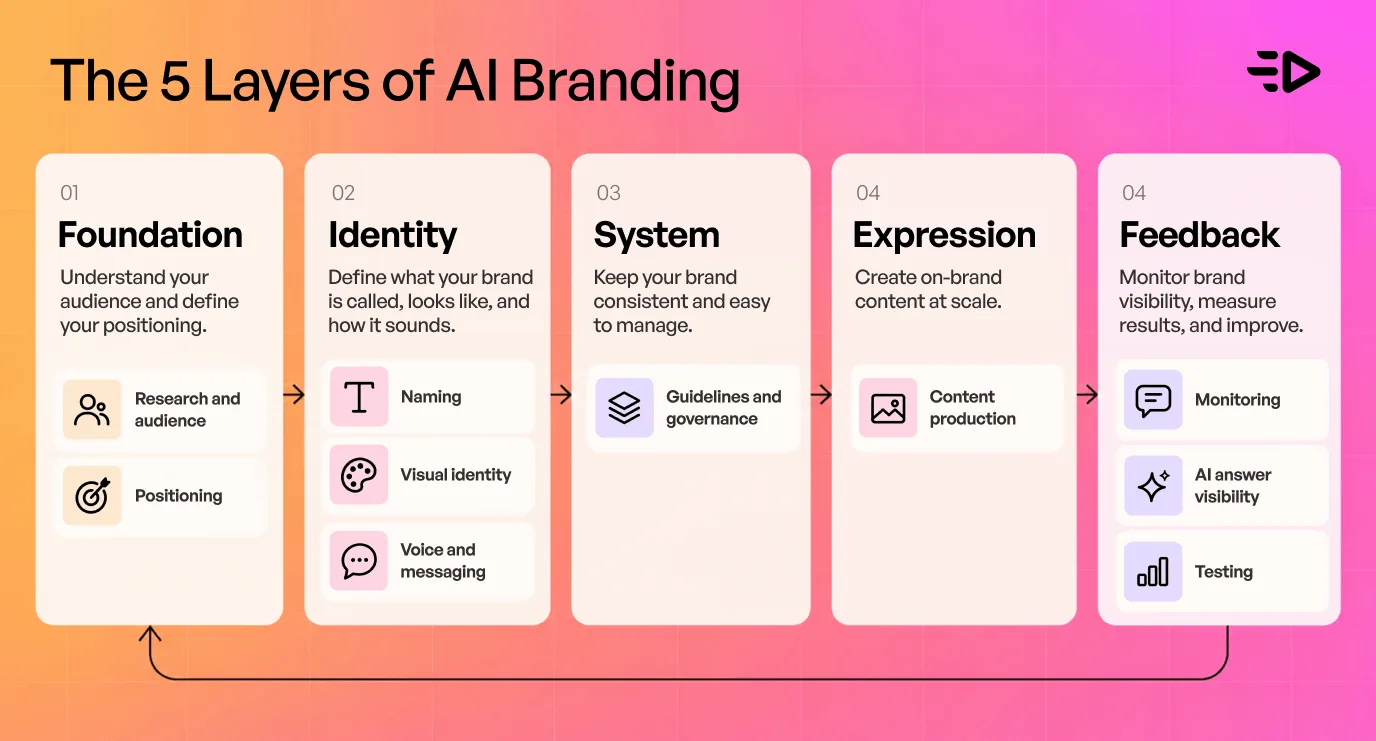
Layer | Element | Strategy question | Where AI helps | What stays human |
|---|---|---|---|---|
Foundation | Research and audience | Who are we for, and what do they need? | Summarizing research, clustering feedback, drafting surveys | Deciding what the evidence means |
Foundation | Positioning | Why us, and not the alternatives? | Mapping competitors, drafting positioning options | Choosing one and saying no to the rest |
Identity | Naming | What are we called? | Generating name lists, checking domains | Cultural review and legal clearance |
Identity | Visual identity | What do we look like? | Exploring directions, mockups, on-style assets | Art direction and the final system |
Identity | Voice and messaging | How do we sound, and what do we say? | Applying voice rules, rewriting by channel, flagging off-brand copy | The point of view and the claims |
System | Guidelines and governance | How do we stay consistent? | Making guidelines searchable and machine-readable | Owning the rules and approvals |
Expression | Content production | How do we show up everywhere? | Producing on-brand images, copy, and video ads at volume | Concepts, facts, final sign-off |
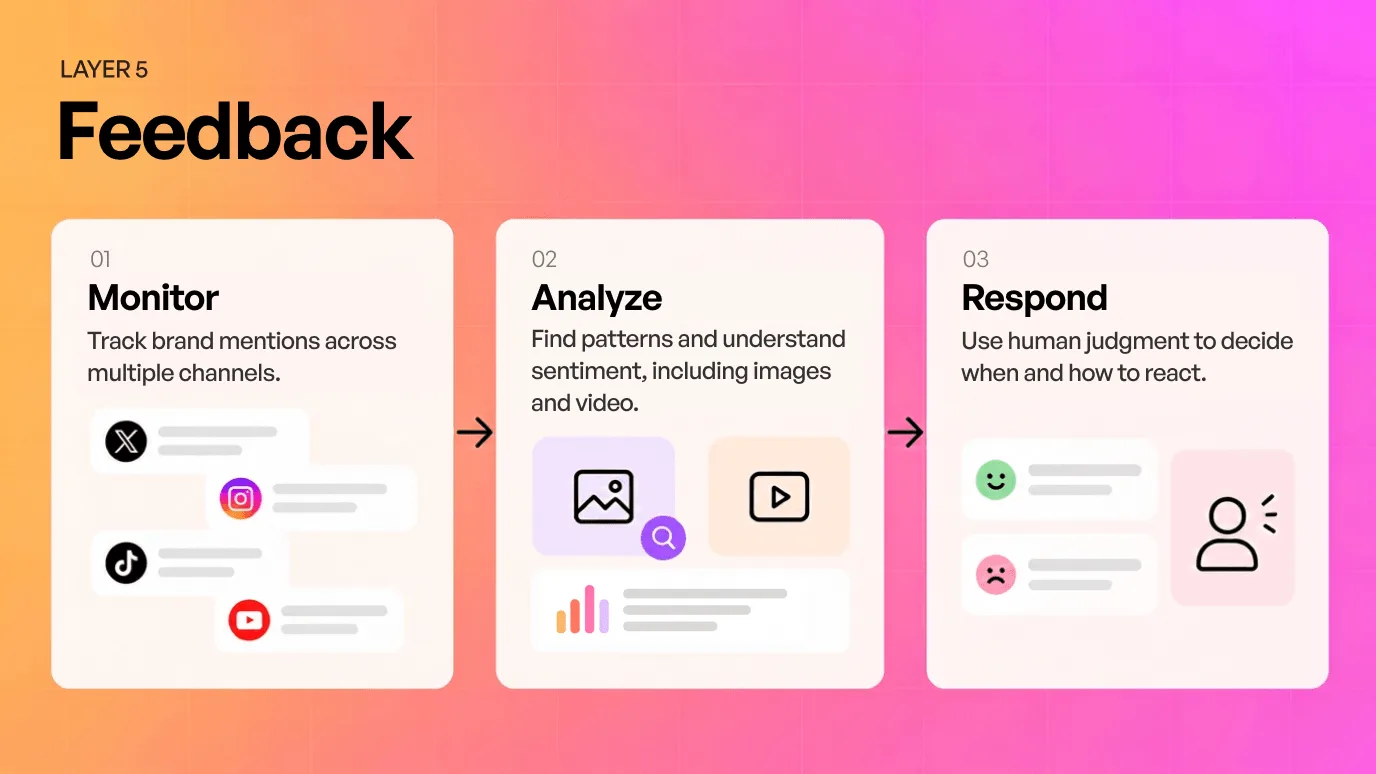
Feedback | Monitoring | What are people saying about us? | Summarizing conversation, spotting spikes | Reading context and deciding how to respond |
Feedback | AI answer visibility | What do chatbots say about us? | Tracking mentions and citations across AI answers | Fixing the facts and earning the citations |
Feedback | Testing | Is the work building the brand? | Predicting how ads will perform before launch | Setting the hypothesis and trusting in-market results |
The order is also important. Foundation feeds identity, identity feeds the system, and the system keeps every piece of content on-brand. Skip a layer and the tools downstream amplify whatever's missing.
Layer 1: foundation
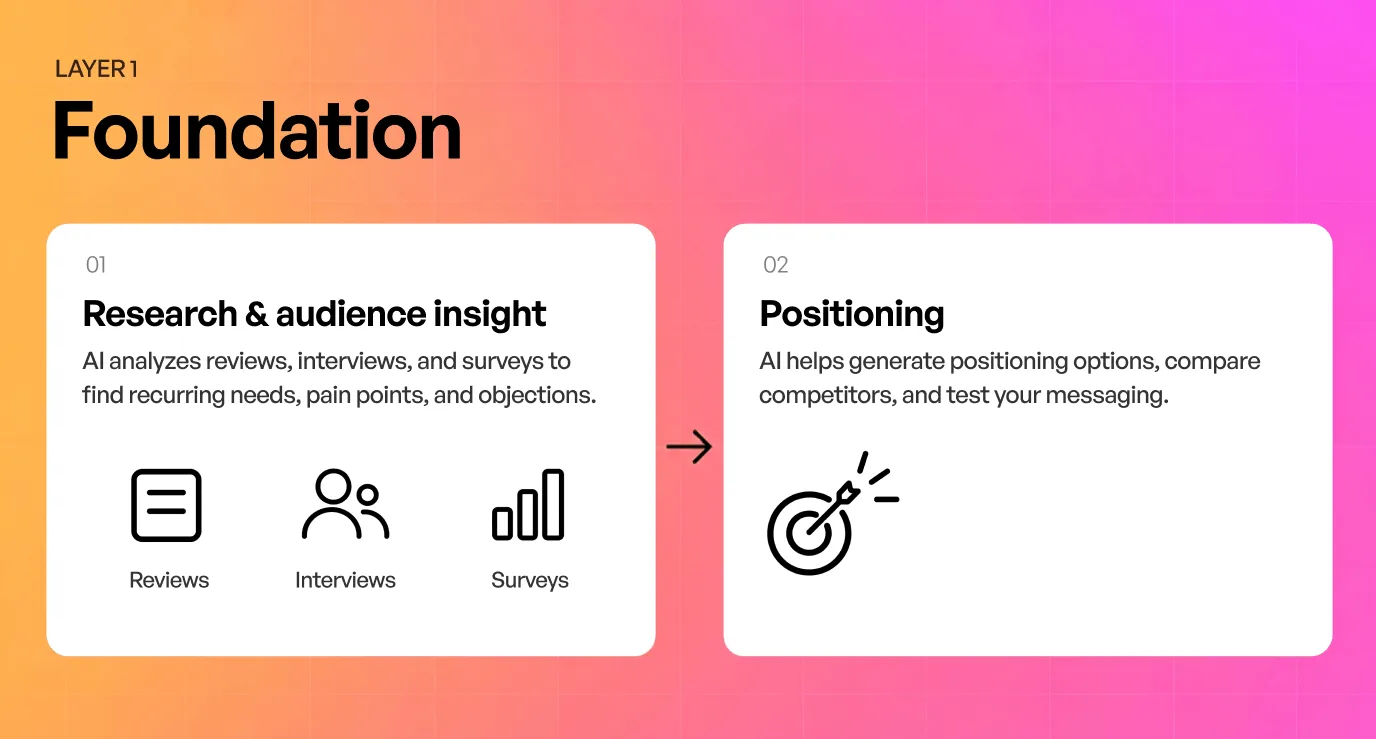
Research and audience insight
AI is quick at turning a pile of evidence into patterns. It can read hundreds of reviews, interview transcripts, or survey answers and tell you which needs and objections keep coming up.
ChatGPT deep research pulls information from many sources into a cited report. Perplexity's Pro plan does something similar with Perplexity Research.
Brandwatch's Iris AI answers plain-language questions about social and consumer conversation data.
Attest drafts surveys from a brief and runs AI-moderated interviews with real respondents.
What stays human: deciding whether the people you studied are the people you're building for. Treat AI-generated personas as hypotheses until real customers back them up.
Positioning
Positioning is the choice of where you win. AI can draft a stack of positioning statements from your research in minutes, compare competitors' messaging, and stress-test a claim against your brief.
The choice itself matters a lot. Kantar's BrandZ data shows three-quarters of growing brands grew by building meaningful difference, and only a quarter grew on salience alone.
A general-purpose assistant like ChatGPT or Claude works well here, as long as you load it with your real research (a project with your interviews, reviews, and competitor pages beats a blank chat). What stays human: picking one position and rejecting the others.
Layer 2: identity
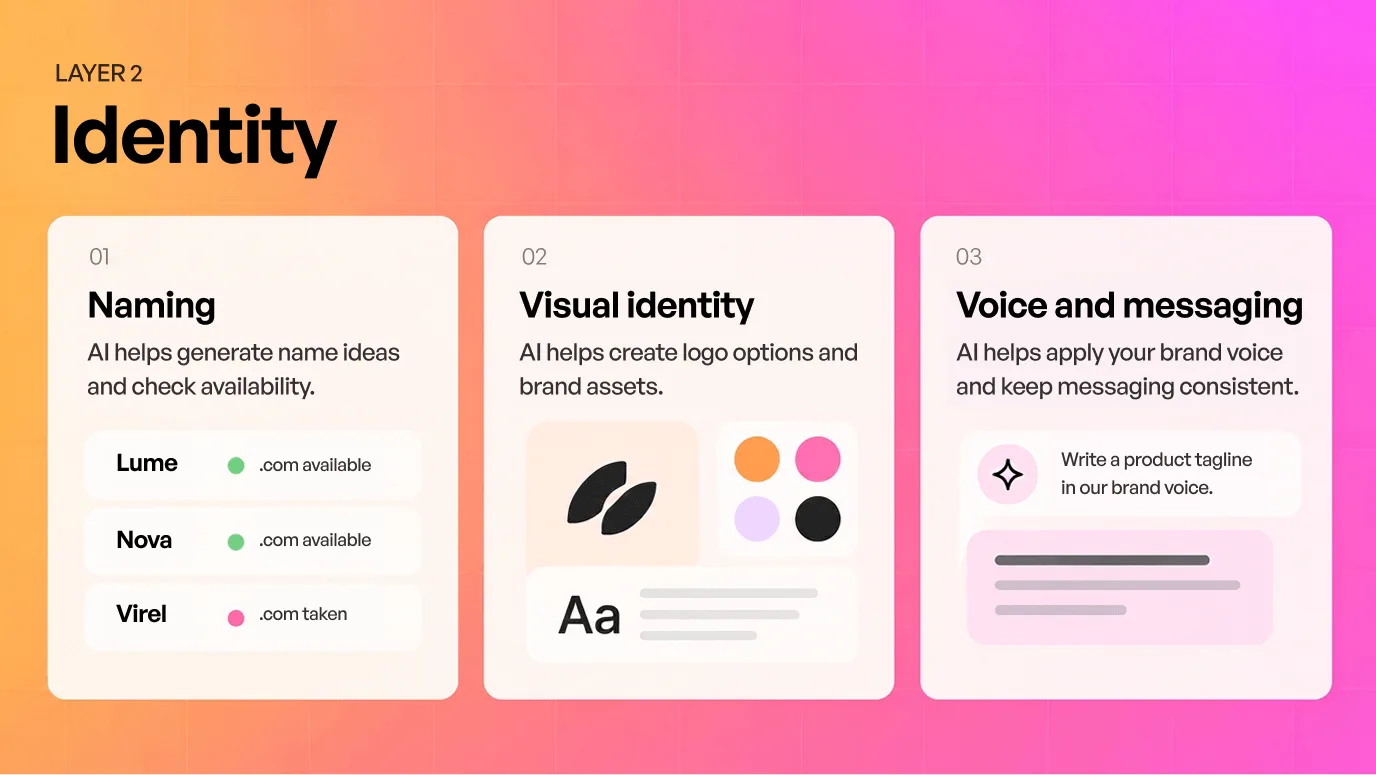
Naming
AI naming tools are fast and free. They're also the start of the process, since a name that's available as a domain can still be a trademark problem.
Namelix, made by Brandmark, uses generative AI to suggest short, brandable business names and checks domains.
Looka's business name generator checks domain and social handle availability.
Atom's name generator adds a quick screen of USPTO trademark records.
What stays human: saying the name out loud in every market you sell in, and paying a trademark lawyer before you print anything. Names and short phrases can't be copyrighted in the US, so trademark is the protection that counts.
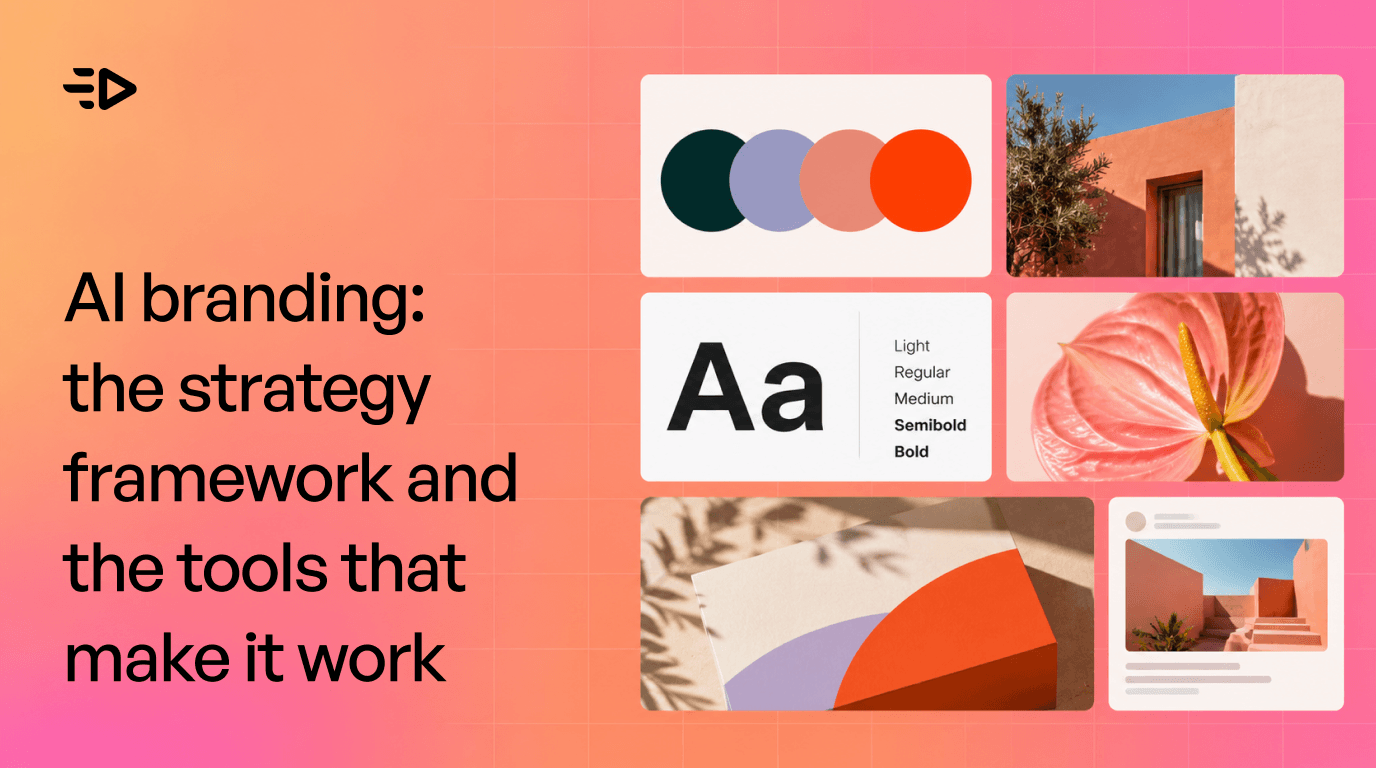
Visual identity
This is the part of AI branding people search for most ("ai logo generator" gets about 27,000 US searches a month, according to Ahrefs). Type a company name, get dozens of logos.
Looka and Brandmark generate logo options and turn the one you pick into a brand kit with templates.
Adobe Firefly Custom Models train on 10 to 30 of your own images so new visuals match your style.
Canva AI uses your Brand Kit's fonts, colors, and rules so designs start on-brand.
Figma's AI brand guideline generator, built on Figma Make, turns a description of your brand into draft rules for color, type, layout, and imagery.
Read more: Best AI Image Generators and Tools
Two warnings before you ship an AI logo.
First, ownership. The US Copyright Office says prompts alone don't make you an author, though work a human meaningfully selects, arranges, or modifies can be protected. In March 2026 the Supreme Court declined to hear Thaler v. Perlmutter, leaving in place a ruling that copyright requires a human author. A logo can still be a registered trademark, which protects it as a source identifier rather than as art. (This isn't legal advice. Talk to a lawyer before you file.)
Second, consistency. System1 and Effie studied 56 brands and found that brands with a year of using distinctive assets averaged 2.4 stars, against 3.5 stars for brands with four to five years of consistent use. Distinctive assets pay off when you repeat them for years. A tool that makes a new logo in seconds makes it easy to keep fiddling, and that's how brands lose recognition.
Voice and messaging
Voice drifts easily, because every person and every tool writes a little differently. AI is good at applying voice rules once you've written them down.
Jasper's Brand IQ stores your brand voice and style guide, then flags off-brand tone and suggests fixes.
Writer applies voice profiles, terminology, and style guides to the content it generates.
Grammarly's brand tones shape its suggestions to match your voice wherever your team writes.
Feed these tools real examples, including "we'd never say this" examples. Adjectives like "friendly" and "bold" don't give a model much to work with. What stays human: what the brand believes and which claims it can prove.
Layer 3: system
Brand guidelines and governance
Source: Leeloo The First
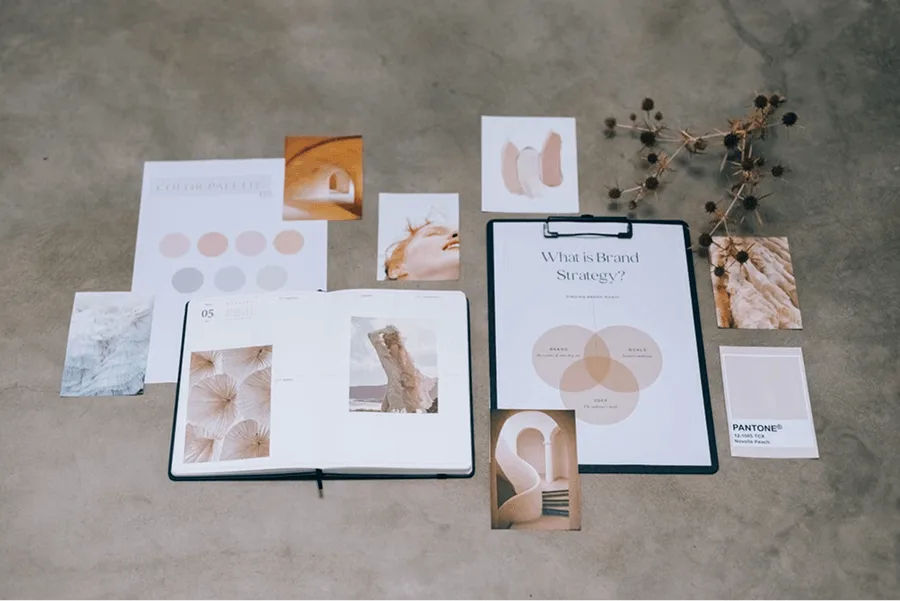
This layer is easy to skip, and it decides whether every other tool stays on-brand. Brand guidelines often sit in a PDF that never gets loaded into the branding AI tools a team uses. A structured, machine-readable version can guide compatible tools through uploads, integrations, or APIs.
Frontify's Brand Assistant answers usage questions and suggests on-brand copy and assets straight from your guidelines.
brand.ai turns brand PDFs and decks into structured brand data and scores copy, images, and campaigns for brand alignment.
Bynder and Brandfolder are digital asset managers with AI tagging, search, and governance features, so teams pull the approved logo instead of the one saved on someone's desktop.
What stays human: who owns the rules, who approves exceptions, and which AI uses are off-limits (more on that below).
Layer 4: expression
On-brand content production
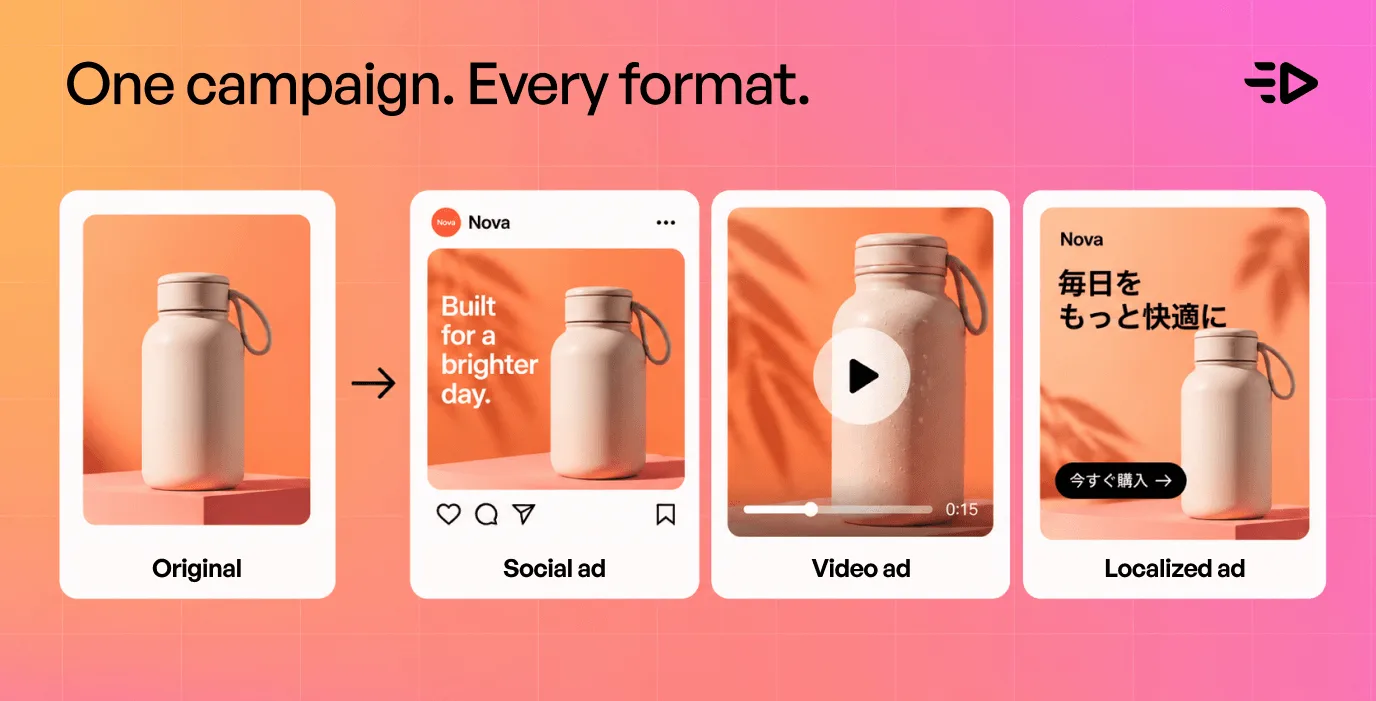
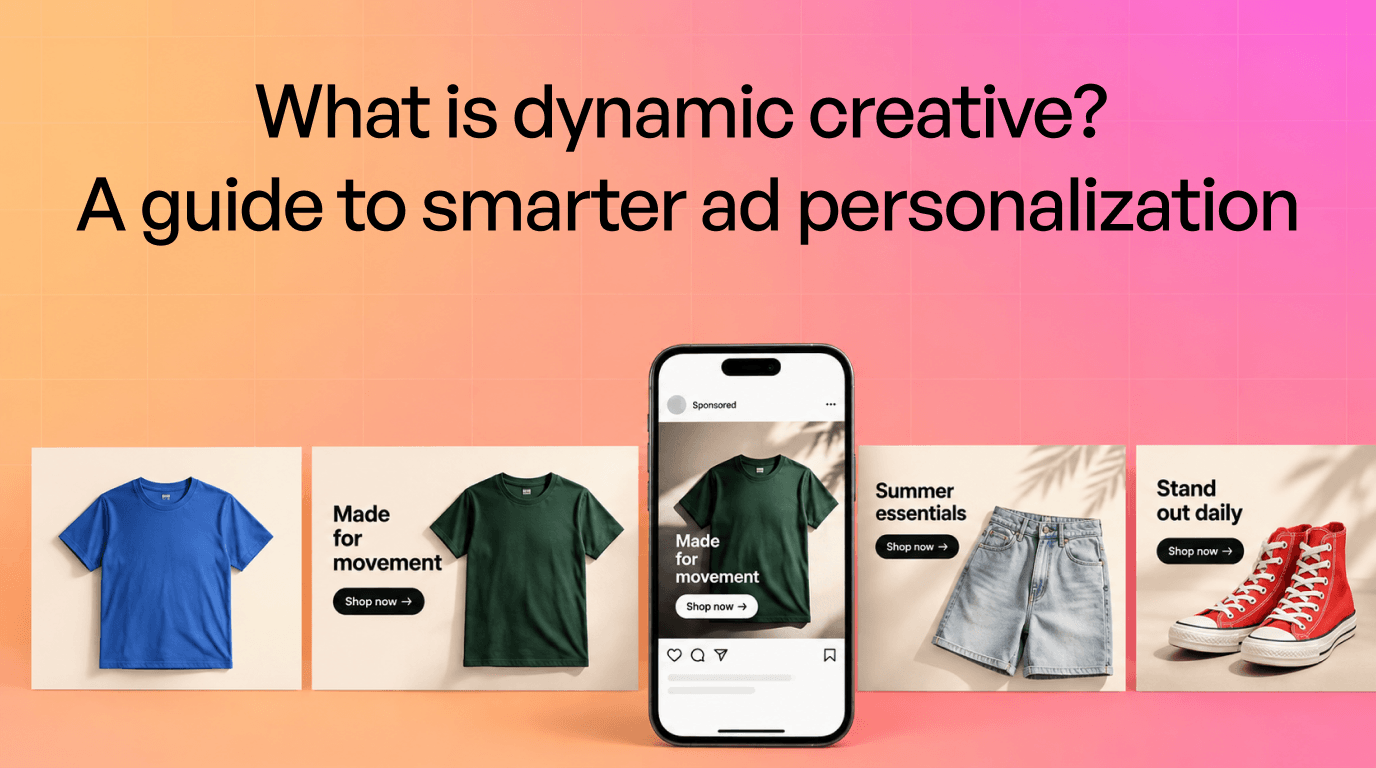
This is where AI saves a lot of time. One campaign now needs dozens of sizes, lengths, languages, and variations for each platform, and the tools below are built to produce them inside your brand rules.
Adobe GenStudio for Performance Marketing lets you define voice, tone, and channel rules, generates variants, and checks assets against brand, accessibility, and regulatory standards before they go live.
Canva AI with a Brand Kit produces on-brand designs for teams that don't have a designer on every project.
Firefly Custom Models (see visual identity) keep generated imagery in your style.
Video ads are where we come in. Creatify Agent starts by researching your brand and competitors, then writes scripts, casts avatars, generates the shots, and edits the ad. Before anything goes into the cut, it checks each scene against the brief and validates logos, brand colors, and on-screen text against your confirmed brand data. A finished ad costs about $5 to $8, on all plans.
Underneath, our Boreal-H3 video model is post-trained for advertising and built to keep product labels, packaging, and on-screen creators intact from shot to shot (the details that usually drift first). It costs $0.04 per second at 768p.
What stays human: the campaign idea, the facts in the ad, and the final yes.
Layer 5: feedback
Brand monitoring
AI-powered listening tools read far more conversation than any team could and summarize what changed.
Sprout Social's Trellis agent answers questions about your social listening data in plain language.
Lumen by Talkwalker (formerly Talkwalker) uses visual recognition to find your logo in images and video, even when the post never mentions your name in text.
Meltwater's Mira assistant turns media, social, and AI search signals into answers.
What stays human: telling sarcasm from praise, and deciding when to respond.
Visibility in AI answer engines
This element didn't exist a few years ago. Pew found 49% of US adults have used AI chatbots, and Google says AI Mode has passed 1 billion monthly users. When someone asks a chatbot for the best option in your category, the answer is part of your brand now.
Retail is feeling it first. Adobe measured AI-referred traffic to US retail sites up 393% year over year in early 2026, and those visitors converted 42% better than other traffic in March.
Peec AI tracks how often your brand appears in the prompts you monitor, how it's described, and which sources get cited across ChatGPT, Perplexity, Gemini, and Google's AI answers.
Profound shows how answer engines describe your category and estimates prompt volumes.
Ahrefs Brand Radar tracks brand visibility across AI answers, YouTube, and Reddit.
Semrush's AI Visibility Toolkit benchmarks your brand against competitors in AI answers. (Semrush became an Adobe company in April 2026.)
What stays human: fixing the wrong facts at their source and earning mentions on the sites these engines cite.
Creative testing
Your gut is a bad judge of your own brand. Ehrenberg-Bass researchers tested more than 400 brand elements and found marketers' judgements of their assets' strength were rarely accurate.
AI pre-testing tools give you a cheap second opinion before you spend media money:
System1's Test Your Ad Screen is trained on 18 million human emotional responses and returns predictions in minutes for finished long-form video in the US and UK.
Kantar's LINK AI predicts ad performance, including attention, across formats.
Zappi's Amplify AI screens up to 100 US and UK social video assets in 30 to 60 minutes.
What stays human: deciding what you're testing for, and trusting in-market results over predictions when they disagree.
Read more: Best Ad Testing Platforms
Where AI branding goes wrong
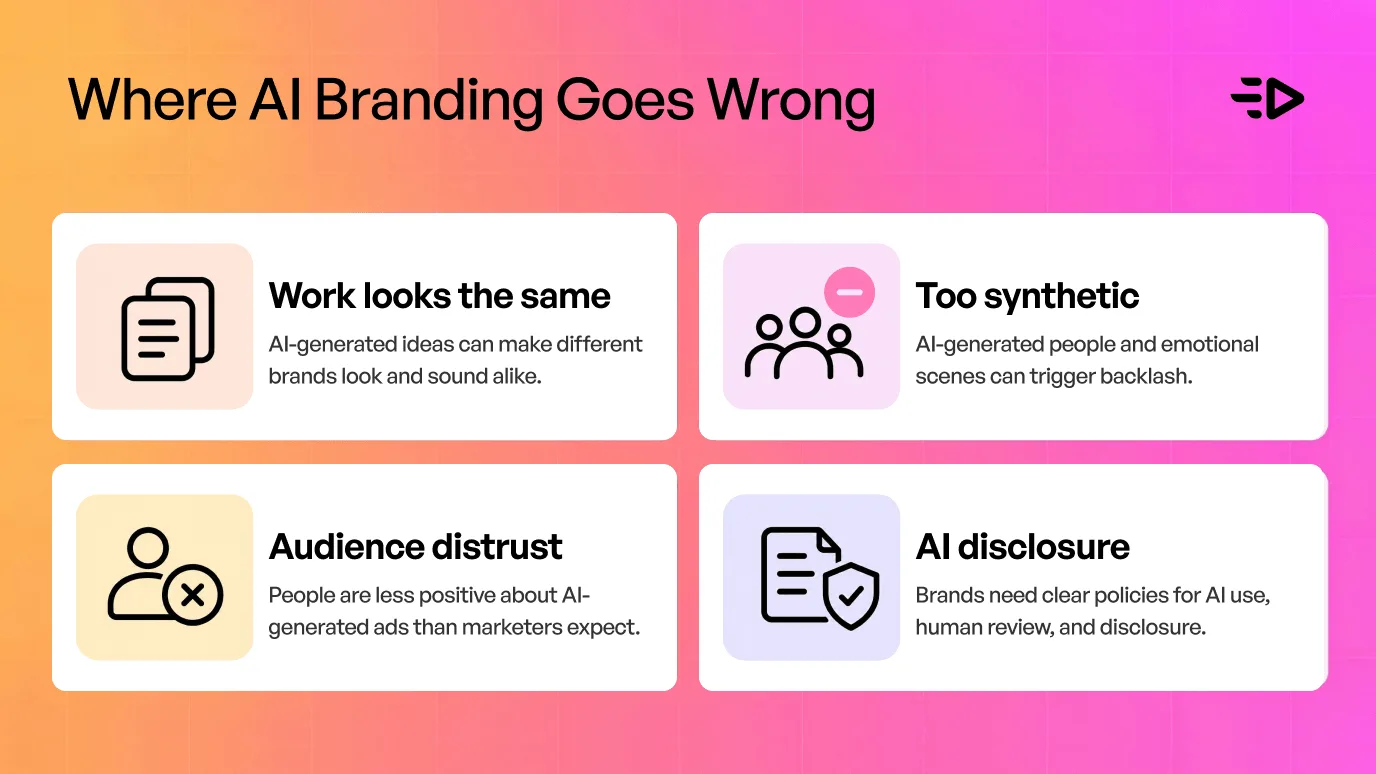
The framework helps with each of these. They're still worth knowing.
Work starts to look the same
AI-assisted ideas can narrow the variety of what a team makes. In a 2024 study in Science Advances, people writing short stories with AI-generated ideas produced stories rated more creative. Their stories were also more similar to each other. Better individual work, less variety across the group.
That's a branding problem, because brands grow by being recognizable and meaningfully different. Give the tools your own research, references, and rules, and do the concept work before you ask AI to multiply it.
Marketers overestimate how much audiences like AI ads
IAB found 82% of ad executives believe Gen Z and millennial consumers feel positive about AI-generated ads. Only 45% of those consumers said they do. Those consumers were also twice as likely as executives to call brands that use AI in ads "manipulative" (20% versus 10%).
People looking too synthetic, and emotional moments lack realism
McDonald's Netherlands pulled a fully AI-generated Christmas ad within days in December 2025 after a wave of criticism online. Coca-Cola's AI holiday ads drew heavy criticism in 2024 and again in 2025, even though the company said its 2024 film performed exceptionally well.
Some brands have turned this into positioning. Dove pledged in 2024 to never use AI to represent real women in its ads, and Aerie banned AI-generated bodies and people in its marketing while still using AI for media buying and analytics.
Disclosure rules are arriving
The EU AI Act's transparency rules have applied since 2 August 2026. They require disclosure of deepfakes: AI-generated or manipulated images, audio, or video that resemble real people, objects, places, or events and would falsely appear authentic. In the US, IAB published a voluntary AI disclosure framework in January 2026 built around the same idea.
A brand AI policy is a good place to start. Decide where AI is welcome (production, research, testing), where it needs extra review (anything with a realistic person), and how you disclose it.
Summing it up
AI branding works when strategy comes first. Build the foundation (research and positioning), lock the identity (name, visuals, voice), turn your guidelines into a system the tools can read, and only then scale content. Use the feedback layer to check what people, and now chatbots, say about you.
One bonus thought. AI has made it cheap to produce more brand material than ever, which makes the expensive parts more valuable: a clear position, assets people recognize, and the discipline to repeat them for years. Heinz earned its A.I. Ketchup moment by keeping a recognizable bottle long enough for the internet to learn it.
Frequently Asked Questions
Can you use AI for branding?
Yes, for a lot of it. AI can speed up research, naming, visual exploration, copywriting, content production, monitoring, and creative testing. Keep humans in charge of positioning, final creative decisions, and legal clearance.
What is the best AI tool for branding?
There's no single best tool. It depends on the element: Looka or Brandmark for logo exploration, Jasper or Writer for voice, Frontify for guidelines, Canva AI or Adobe GenStudio for on-brand content, and Peec AI or Profound for AI answer visibility.
Are AI-generated logos legal to use?
They can be, but generating a logo doesn't clear it. Check it against existing trademarks and read the tool's terms. Copyright is a separate question: the US Copyright Office says that with today's tools, prompts alone don't give you enough control to be the author of the output, and a logo needs enough original human-made expression to qualify. A trademark can still protect it, depending on how distinctive it is and how you use it.
What is the 3-7-27 rule of branding?
It's an internet rule of thumb with several versions (one reads it as 3 seconds for a first impression, 7 seconds to connect, 27 exposures to be remembered), and we couldn't find a primary research source behind any of them. The research on consistency is more useful: in System1 and Effie's study, ads from brands that had used their distinctive assets for four to five years scored higher than ads from brands using them for one year.
How do you keep AI-generated content on brand?
Turn your guidelines into something tools can read: approved assets, voice examples, and clear rules. Then use tools that check output against those rules, like Frontify, Jasper's Brand IQ, or Adobe GenStudio, and keep a human approval step for anything public.