
In 2023, the IAB Tech Lab rewrote how video ad slots get labeled in the auction. Two years later, Jounce Media found that about 30% of online video supply was "accompanying content" (video players sitting around articles and other non-video pages), and that Google Ad Manager was still passing all of it as "instream" to bidders that hadn't adopted the new labels.
That's programmatic video in one story. The machinery is fast and efficient, and the labels on what you're buying can be generous. This guide covers how it works, where it runs in 2026, what it costs, and the habits that separate good buys from expensive ones.
What is programmatic video advertising?
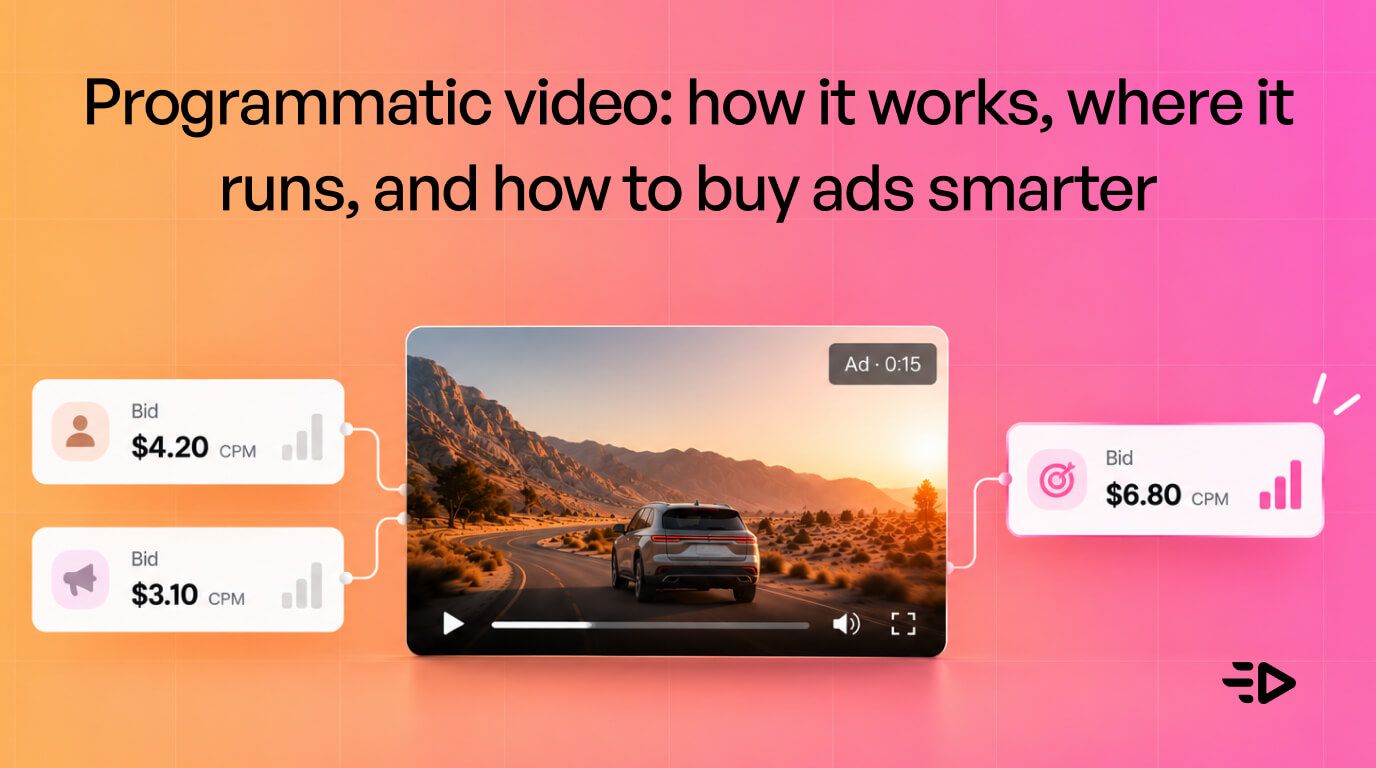
Programmatic video advertising uses software to automate the buying and selling of video ad slots, through auctions or negotiated deals. In auction-based buying, platforms evaluate each ad opportunity and bid within tight response windows. Programmatic guaranteed deals instead reserve inventory at agreed terms, with delivery automated.
The money is large. In the US, programmatic accounted for $162.4 billion of internet ad revenue in 2025 across all formats, up 20.5%. Separately, the IAB expects total US digital video spend (programmatic or not, social included) to reach $81.9 billion in 2026, with $29.3 billion of it on connected TV (CTV).
How programmatic video works, step by step
Here's a simplified version of what happens when an auction-based video ad opportunity comes up:
A viewer opens a video, or scrolls a video player into view, in an app, on a site, or on a TV.
The video player asks its ad server for an ad. The request goes to a supply-side platform (SSP) or exchange.
The SSP sends a bid request to demand-side platforms (DSPs). It uses the OpenRTB standard and describes the device, the app or site, the content, and the type of placement.
Each DSP checks the request against its advertisers' targeting, budgets, and deals, then bids. The exchange sets a deadline; Google's exchange says it typically ranges from 80 to 1,000 milliseconds.
The winning bid includes (or points to) a VAST file, the standard format that tells the player where to fetch the video and which tracking to fire.
The player shows the ad. Where it's supported, verification code such as the IAB Tech Lab's Open Measurement SDK reports whether it was viewable.
On CTV, delivery often uses server-side ad insertion (SSAI), which stitches the ad into the video stream on a server so it plays like TV. With OpenRTB 2.6, the IAB Tech Lab's CTV update, buyers can also bid on specific slots inside an ad break, such as the first position.
The cast of characters behind programmatic video platforms:
Player | What it does | Examples |
|---|---|---|
DSP | Buys impressions for advertisers | The Trade Desk, Google DV360, Amazon DSP, Yahoo DSP, StackAdapt, Viant |
SSP or exchange | Sells impressions for publishers | Magnite, PubMatic, Index Exchange, FreeWheel |
Publisher | Runs the app, site, or channel and sells its ad slots | Netflix, Roku, Disney, news sites, apps |
Verification | Checks fraud, viewability, brand safety | DoubleVerify, IAS, HUMAN |
Curator | Packages inventory and data into deals | SSPs, data companies, agencies |
The four ways to buy programmatic video
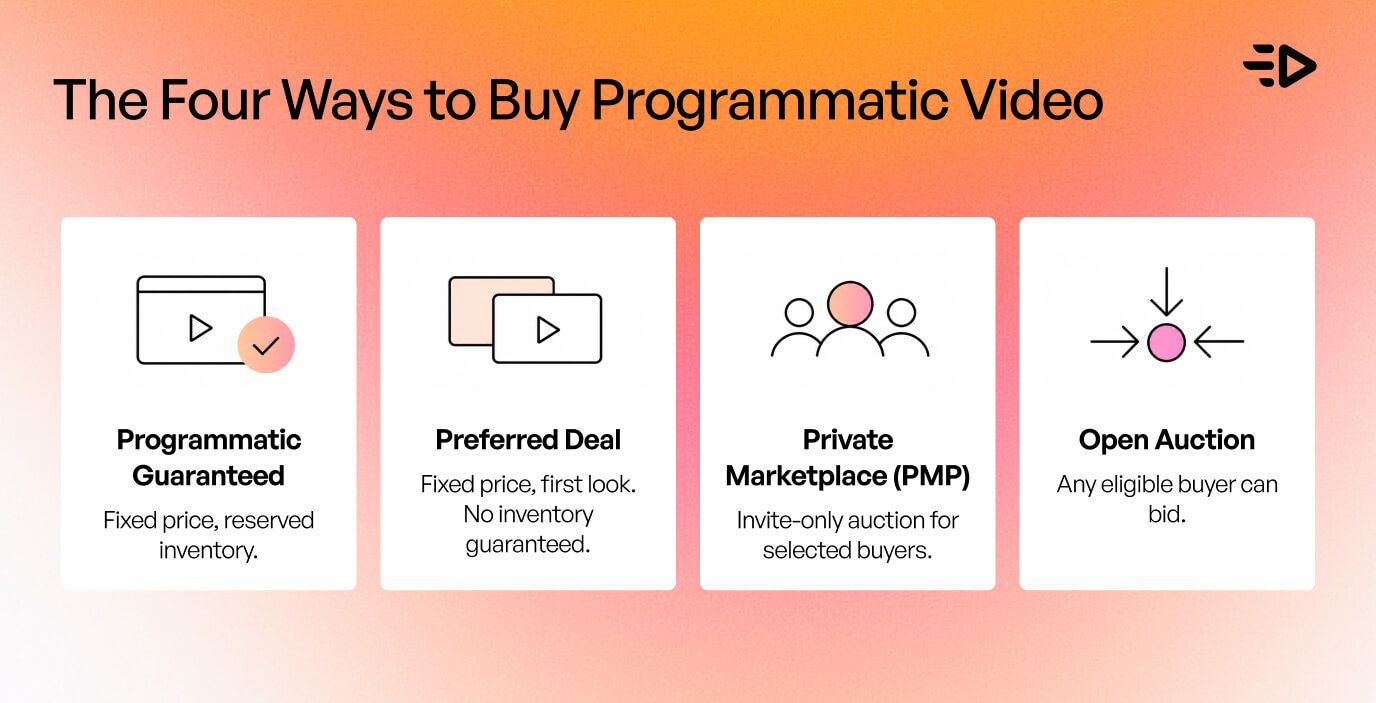
The open auction is only one of four ways to buy. In 2026, eMarketer expects 76.3% of US programmatic spend to go through programmatic direct deals rather than the open market (50.4% if you leave out social platforms).
Deal type | How it works | Buyers highly confident in CTV inventory quality |
|---|---|---|
Programmatic guaranteed | Fixed price, reserved inventory, automated delivery | 57% |
Preferred deal | Fixed price, first look at inventory, nothing reserved | 47% |
Private marketplace (PMP) | Invite-only auction for selected buyers | 45% |
Open auction | Any eligible buyer can bid | 33% |
Confidence figures come from the IAB's 2026 video report. They measure what buyers believe, not measured fraud rates. Definitions follow Google Ad Manager.
There's a fifth thing you'll hear about constantly: curation. A curator (often an SSP or data company) bundles inventory from many publishers into one deal ID, sometimes with audience data attached. In a March 2025 Jounce sample of 1.5 billion bid requests, only 18.6% of bidding opportunities were pure open auction, and 73% involved multi-seller curated deals (these count bidding opportunities rather than spend). About half of curated deals carried no extra curator fee; among those charging a percentage margin, the median was 14%.
Where programmatic video runs in 2026
Connected TV and streaming
CTV is where the money is moving. In the ANA's Q4 2025 benchmark, CTV was about 40% of tracked programmatic spend. Most premium streamers now sell programmatically:
Netflix sells through Google DV360, Amazon, Yahoo, and The Trade Desk, and its pause ads are now buyable programmatically across all four.
Amazon and Roku's combined authenticated footprint of about 80 million US CTV households (across Roku and Fire TV) is available exclusively through Amazon's DSP, while Roku inventory is also sold through The Trade Desk, Yahoo, and others.
Disney sells Disney+, Hulu, and ESPN through its own exchange, DRAX, connected to DV360, The Trade Desk, and Amazon.
Prime Video runs through Amazon's DSP, which Amazon folded into its new Amazon Ads Agent in September 2026, alongside a new DVA+ campaign type for display, video, and audio.
New formats are arriving too. In July 2026, the IAB Tech Lab finalized standards for six CTV ad formats that live outside the ad break: pause, screensaver, menu, in-scene, overlay, and squeezeback (where the show shrinks to make room for the ad).
YouTube
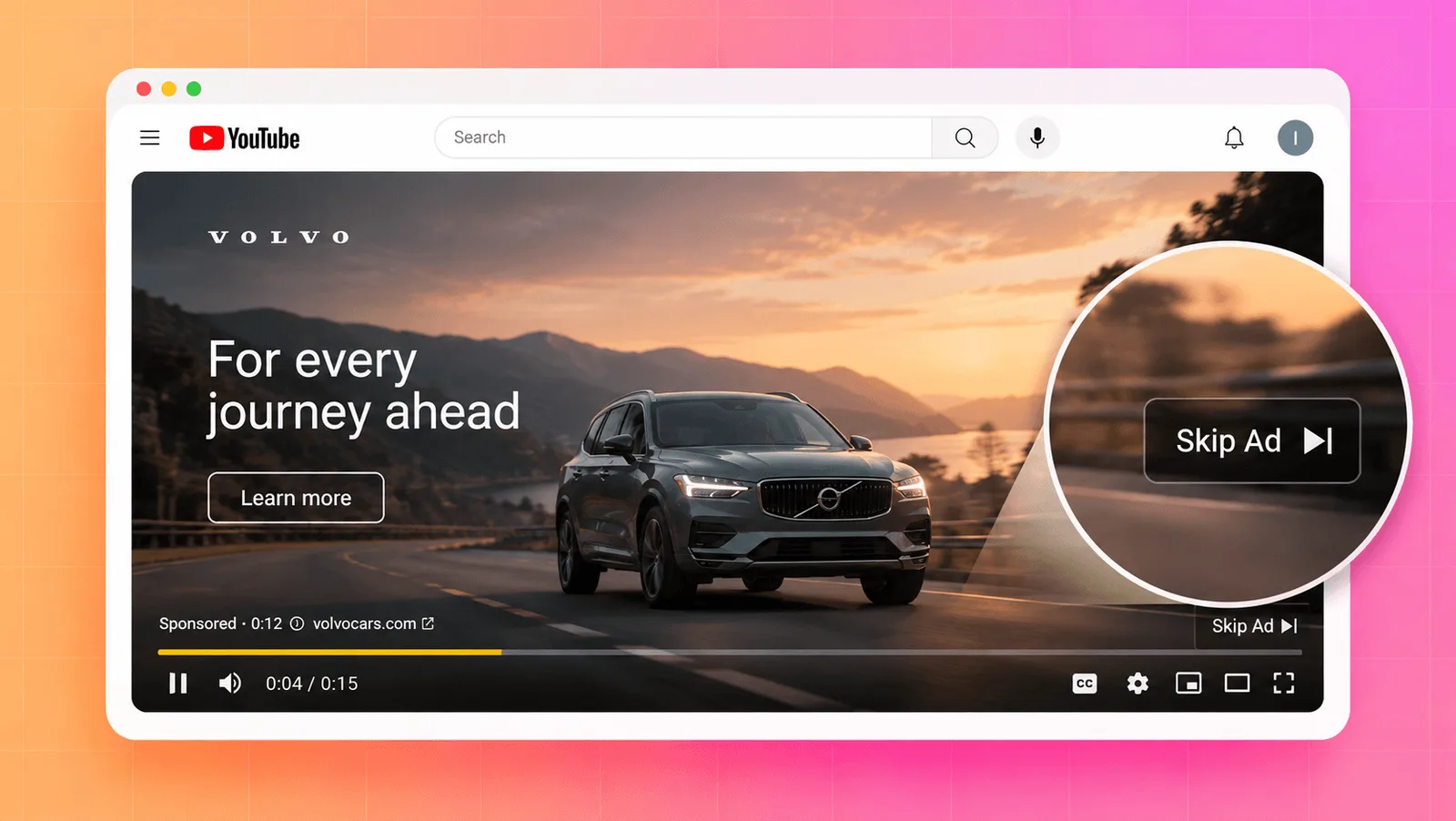
YouTube is programmatic video too, but you buy it through Google's own tools: Google Ads or Display & Video 360. It's worth treating separately: YouTube led all US TV distributors in Nielsen's May 2026 Media Distributor Gauge, with 13.8% of US TV time.
Open web: instream and everything else
Since 2023, OpenRTB's plcmt field has sorted web video into four original types (it was extended in July 2026 to cover the new CTV formats):
Placement | What it means |
|---|---|
1. Instream | Pre-, mid-, or post-roll in a video the viewer chose to watch, with sound on by default or a clear choice to watch |
2. Accompanying content | Plays around text or images, often muted, starts when scrolled into view, and may stick to the screen |
3. Interstitial | Fills most of the screen with no video content around it, and can't be scrolled away |
4. No content or standalone | Video ads without streaming video content, such as in feeds, slideshows, or standalone in-content players |
Types 2 to 4 are what most people call outstream. They're often cheaper and reach people outside video sites. Many are muted, and accompanying and feed players are easy to scroll past, so they need different creative and different expectations.
In-app and other screens
Mobile games and apps sell rewarded and interstitial video, mostly through app ad networks. In June 2026, AppLovin opened its self-serve platform to all advertisers and renamed it AppLovin Ads (Axon is now the name of its AI recommendation system). Digital out-of-home screens in airports, gyms, and elevators are also bought programmatically through DSPs like DV360.
How much does programmatic video cost?
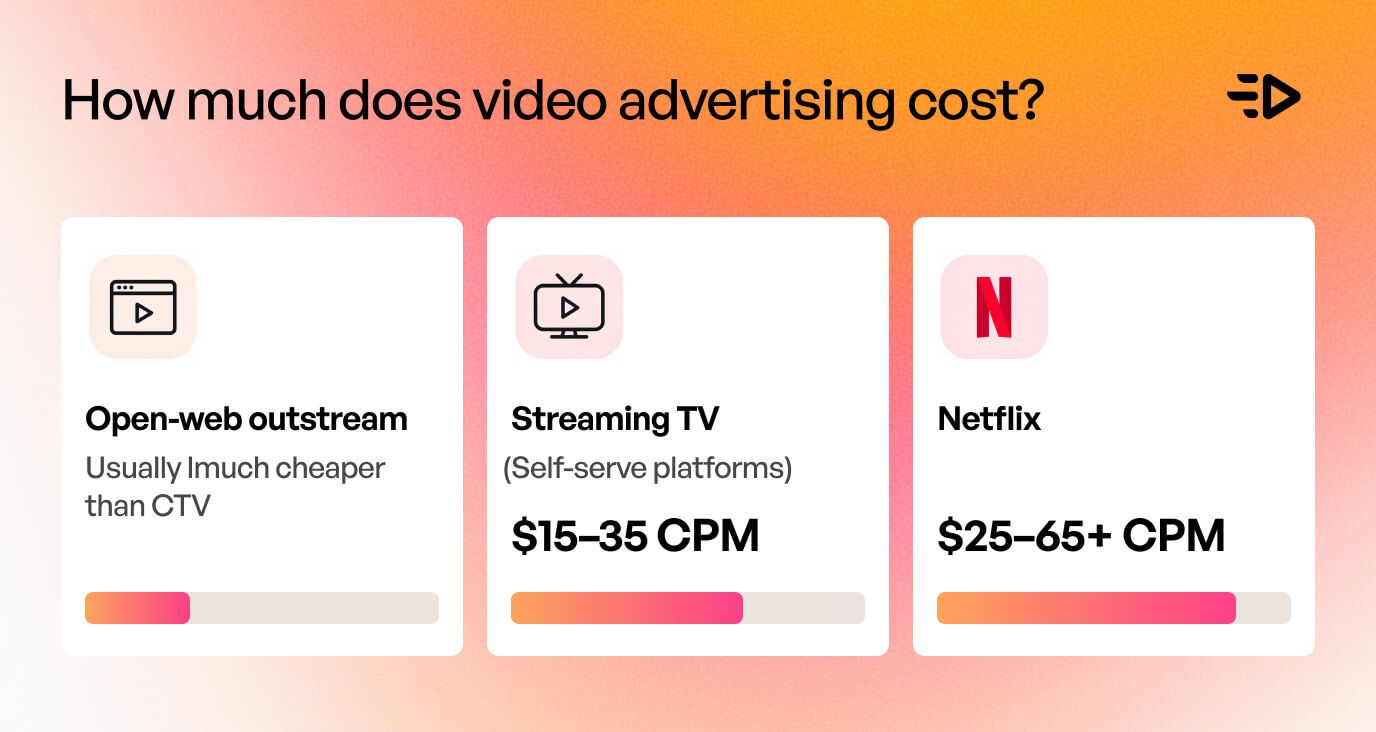
Programmatic video is mostly priced by CPM (cost per thousand impressions), and prices vary a lot by environment:
In December 2025, eMarketer estimated US streaming CPMs would average about $26 to $27 over the following few quarters.
Netflix inventory runs roughly $25 to $65 or more per thousand, with sports (especially the NFL) at the top, per MediaPost's estimates.
Self-serve CTV platforms like Vibe quote $15 to $35.
Open-web outstream is usually much cheaper than CTV, which is exactly why mislabeled inventory was a problem.
You don’t need a big budget to start on a programmatic video advertising platform anymore. Vibe (now owned by Walmart) has a $50 daily minimum, Roku Ads Manager is self-serve, and Netflix inventory has no minimum spend through The Trade Desk's marketplace (though you'll usually reach The Trade Desk through an agency or managed seat). Amazon's self-serve streaming TV ads launched with no minimum and are now moving into its new campaign types, so check the current terms.
How to use programmatic video right
1. Buy the placement, not the label
"Video" covers everything from a Netflix pre-roll to a muted player in the corner of a recipe blog. In 2023, Adalytics reported that some brands' YouTube TrueView ads ran heavily on Google Video Partners sites, and that much of one brand's TrueView budget landed in muted or non-instream players. Google called the report "extremely inaccurate," but the lesson stuck.
Ask your DSP or agency for placement-level reports on your programmatic video ads that show the plcmt value, app or domain, and player size. Price instream and outstream as different products, because they are.
2. Optimize for quality-adjusted cost, not cheap CPMs
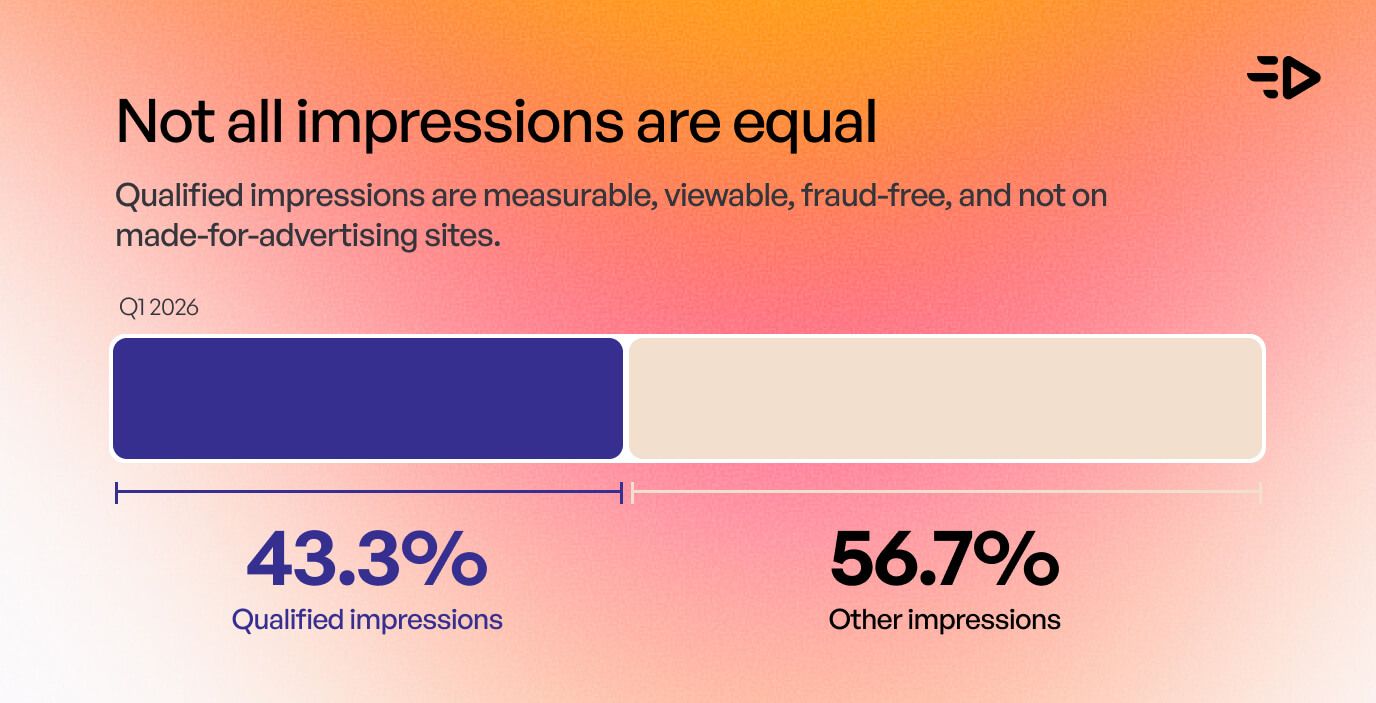
The ANA tracks how much programmatic money buys impressions that are measurable, viewable, fraud-free, and not on made-for-advertising sites. Its 2023 study found only 36 cents of each dollar entering a DSP did. Its Q1 2026 benchmark put the share at 43.3% (the two studies aren't a like-for-like comparison, but the direction is clear).
Better, but less than half. And the gap between buyers is wide: top performers converted 56.7% of spend into qualified impressions in Q4 2025, against 37.5% for laggards. In the ANA's case studies, brands that optimized to quality-adjusted metrics saw nearly 40% lower cost per conversion, even though their CPMs went up.
One more twist. In the ANA's Q2 2025 data, made-for-advertising sites scored 5.8% higher on viewability than real publishers. Junk inventory can be built to pass the metrics.
3. Verify CTV, even on direct deals
CTV feels safe because it's on a TV. Fraudsters know that. DoubleVerify counted 140% more CTV fraud schemes and variants in Q1 2026 than a year earlier. In its data, fraud rates ran around 9% for unprotected campaigns versus under 1% for protected ones. In two direct deals it studied, bots took 34% and 25% of impressions.
The schemes are big. HUMAN's 2025 BADBOX 2.0 investigation found more than 1 million infected devices, mostly cheap off-brand TV boxes, and a set of look-alike apps that generated up to 5 billion fraudulent bid requests a week at their peak. And a GroupM and iSpot study published in 2022 (using 2021 data) estimated that 8% to 10% of CTV ads played with the TV off, because the streaming device keeps running after the screen goes dark.
The basics help: buy only from sellers that publishers authorize in their ads.txt or app-ads.txt files, cross-checked against the sellers.json files SSPs publish, run third-party verification on CTV, and ask your partners about device attestation, an IAB Tech Lab method for confirming a request came from a real device.
4. Cap frequency across publishers, not inside each one
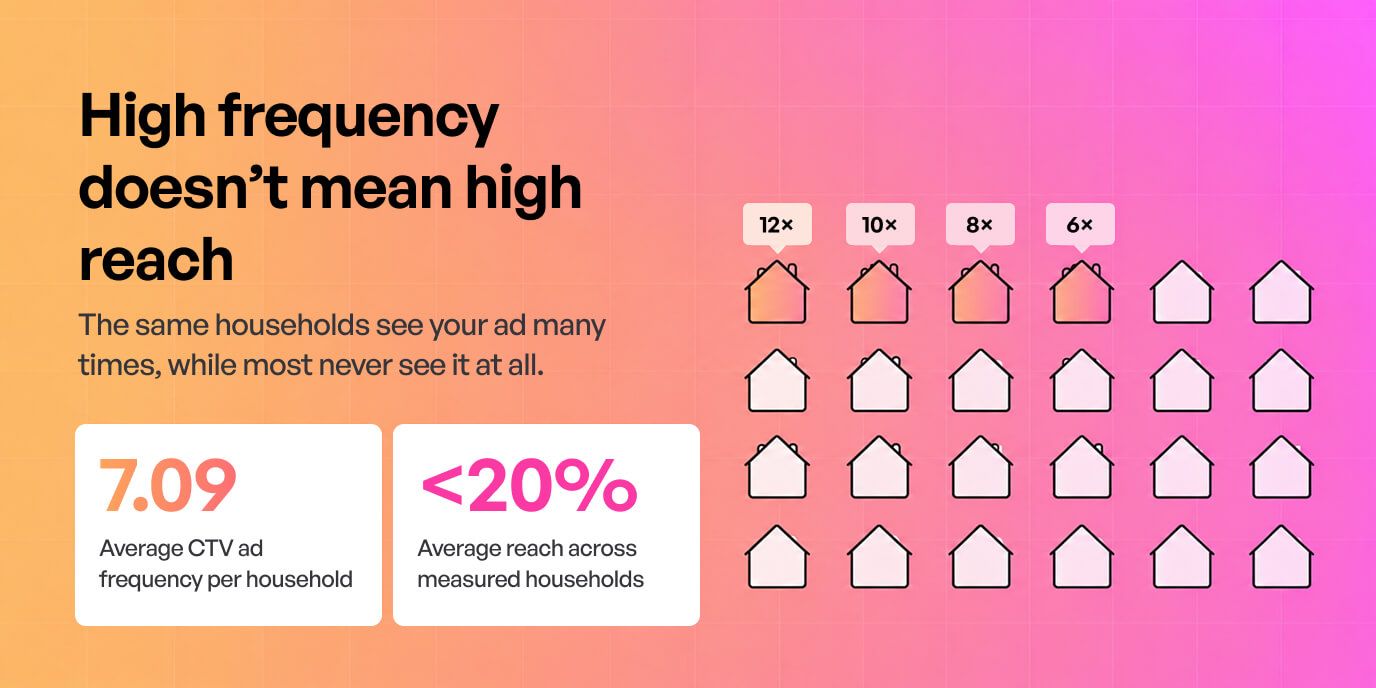
A frequency cap in one DSP doesn't know what happened in another, or on YouTube, or on Netflix's direct buy. Innovid's benchmarks of 2024 campaigns found an average CTV frequency of 7.09, with average reach under 20% of the households it measures. Plenty of exposure, piled onto a small share of homes.
Viewers notice. In a Magna and Nexxen study, purchase intent was 16% lower after six exposures than after one, and 68% thought the brand meant to repeat the ad. Consolidate buys where you can, ask for the full frequency distribution (averages hide the households seeing your ad 20 times), and rotate creative.
5. Treat creative as the biggest lever
Programmatic puts most of its effort into targeting, yet creative can be the bigger driver. In NCSolutions' analysis of nearly 450 sales-effect studies, creative accounted for an estimated 49% of incremental sales, against 11% for targeting.
That means one ad cut won't cover every environment:
Standard CTV spots need 16:9, sound-on, broadcast-quality files. Netflix asks for 1080p or 720p with loudness at -24 LKFS, and Amazon wants Prime Video files of at least 15 Mbps.
Outstream and feed placements need captions and a story that works muted.
Mobile and in-app placements often need vertical or square versions, depending on the placement.
Plan for 15 and 30 seconds as your core lengths for programmatic videos, with a 6-second cut for bumpers.
Spec problems cost real time. In a 2023 analysis, The Trade Desk said 55% of creative rejections at one top publisher came from files with too-low resolution.
Read more: How to Make an Ad That Drives Real Results
6. Measure outcomes, not proxies
Viewability, completion rate, and attention are useful hygiene checks. They're weak goals.
A video counts as viewable when half its pixels are on screen for 2 continuous seconds, even if it's a 30-second ad.
CTV completion rates run high (an earlier Innovid analysis measured about 95% for interactive CTV campaigns), largely because most CTV ads can't be skipped.
The IAB and MRC's 2025 attention guidelines frame attention as an exposure signal, not a business outcome.
Judge campaigns on what they cause: site visits, sales, sign-ups, or brand lift, ideally against a holdout group that didn't see the ads.
7. Know who sits between you and the screen
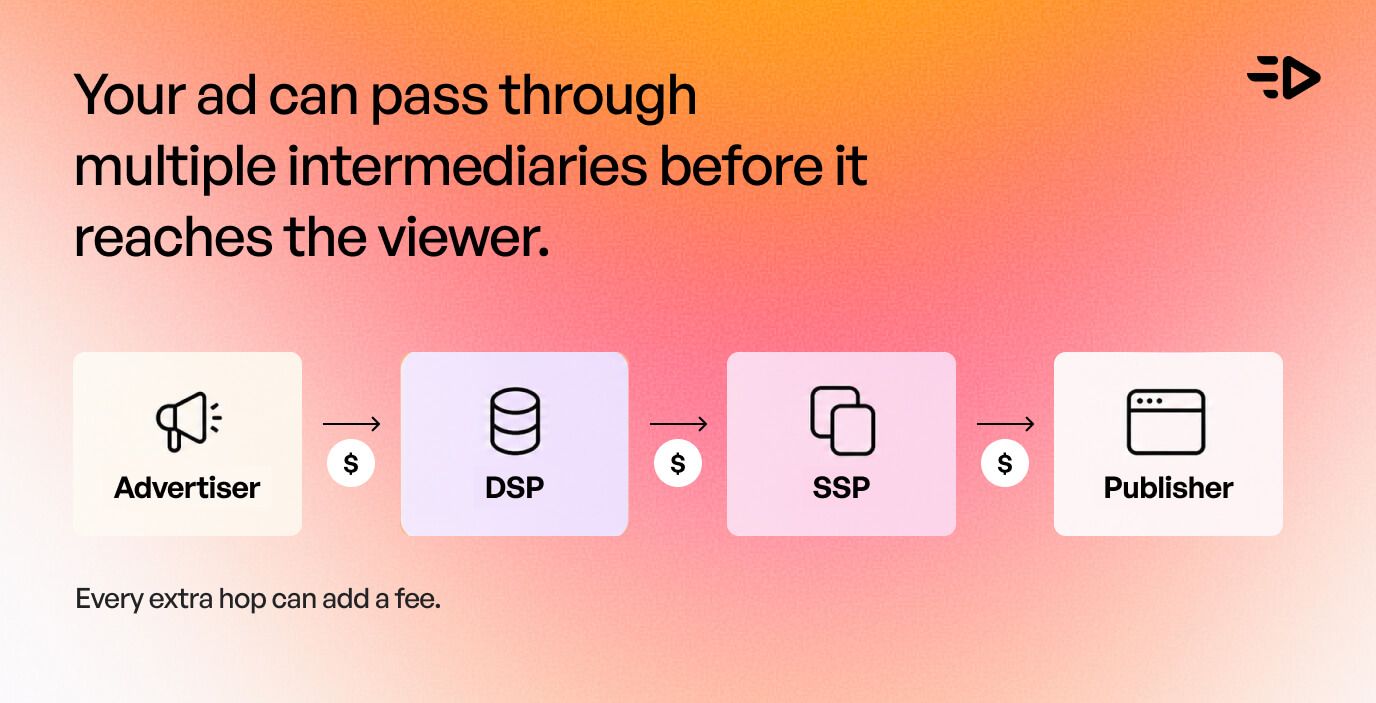
The Trade Desk's SPO guide cites Sincera data showing up to 600 paths to the same impression, and Jounce data showing the top 20 publishers work with 24.5 SSPs on average. Every hop can take a fee. Supply path optimization (SPO) means choosing efficient, transparent paths and dropping the ones that add cost without adding value.
Check your agency's role too. In the ANA's 2026 study, 58% of surveyed marketers used principal media, where the agency buys inventory itself and resells it, and 90% worried whether those recommendations were in their best interest. Ask what's principal-based, what the margin is, and whether you can opt out.
8. Give AI agents good rules
Agentic buying, where AI agents plan and run buys, is arriving fast in video programmatic. The IAB Tech Lab released its Agentic Real Time Framework for public comment in late 2025 and is extending its standards so buyer and seller agents can talk to each other, while a rival group launched the Ad Context Protocol in 2025.
Buyers are interested and cautious. In the IAB's 2026 video research, 96% saw a role for agents, but they want humans in the loop, audit trails, and guardrails. An agent will scale whatever goals you set, so set them on quality-adjusted outcomes, with placement and fraud rules built in.
Where Creatify fits
Programmatic video runs on creative volume: different lengths, aspect ratios, and cuts for CTV, outstream, and in-app, plus fresh versions as frequency builds. The IAB found nearly two in three video buyers now use generative AI for video creative.
That's the part we handle. Creatify Agent takes a product link, brief, or idea and produces finished video ads in 16:9, 9:16, and 1:1, so the same campaign has versions in the shapes CTV, mobile, and feeds use (CTV versions still need to meet each publisher's file specs). You can swap a single scene (the hook, the presenter, the voiceover) to make a new version without rerunning the whole ad, and a finished ad costs about $5 to $8.
For TV specifically, Creatify works with Comcast's Universal Ads, which offers inventory that can reach more than 90% of US households, and our Boreal-H3 video model is post-trained for advertising to improve product and label consistency from shot to shot.
Summing it up
Programmatic video uses automated auctions and deals to decide which ad plays across CTV, YouTube, the open web, and apps. Buy placements instead of labels, optimize for quality-adjusted outcomes, verify CTV even on direct deals, manage frequency across publishers, and make creative for each environment.
One bonus thought. Programmatic was built to make targeting efficient, and it mostly succeeded. As more premium inventory becomes buyable through the same handful of DSPs, the edge moves to the parts automation can't hand everyone equally: clean supply paths, honest measurement, and better ads.
FAQ
What is programmatic video?
Programmatic video is video advertising bought and sold through software. Ad slots are filled through real-time auctions or negotiated deals between a buyer's DSP and a seller's SSP, and auction bids typically have to come back within a second.
What are the four types of programmatic deals?
Open auction, private marketplace (PMP), preferred deal, and programmatic guaranteed. They range from anyone-can-bid auctions to fixed-price deals with reserved inventory, and most US programmatic money now goes through the deal types rather than the open auction.
How much does programmatic video advertising cost?
It depends on where it runs. eMarketer estimated US streaming CPMs at roughly $26 to $27, Netflix ranges from about $25 to $65 or more, self-serve CTV platforms quote around $15 to $35, and open-web outstream is usually cheaper.
What are the best programmatic video advertising platforms?
The big DSPs are The Trade Desk, Google DV360 (the main route to YouTube), Amazon DSP (now part of Amazon Ads Agent), and Yahoo DSP, with StackAdapt and Viant popular with mid-size advertisers. Smaller brands often start with self-serve CTV options like Roku Ads Manager or Vibe.
Is programmatic video the same as CTV advertising?
No. CTV is one place programmatic video runs, alongside YouTube, open-web instream and outstream, and in-app video. CTV inventory can be bought programmatically or through directly negotiated insertion orders.
How is programmatic video different from programmatic display?
The buying mechanics are the same, but video adds a VAST ad file, player and placement types, and video-specific measurement like completion rate. It also costs more per impression, which makes placement quality and fraud checks matter more.