
UGC creator: How to produce user-generated content at scale

UGC creator: How to produce user-generated content at scale

Dec 9, 2025

imaginary UGC AI content factory, with a title: How to scale UGC content production.
Creatify logo
Creatify logo

Creatify Team

December 9, 2025

SHARE

LinkedIn icon
X icon
Facebook icon

IN THIS ARTICLE

You're spending $5,000 on a polished product video. It launches on Meta. CTR: 0.8%. Your ad account manager suggests "try UGC-style content instead."

You hire a creator for $300. They shoot a casual iPhone video in their kitchen—no fancy lighting, just real talk about your product. CTR jumps to 2.4%. Three times better.

Now you need 50 more videos like that to test different hooks, angles, and audiences. At $300 each, that's $15,000. And you'll wait a month while creators film, revise, and deliver.

Here's what changed: AI UGC creators now generate authentic-looking user videos using synthetic avatars and automated scripts in minutes, not weeks. Same casual aesthetic, same conversational tone, but you can produce 100 variations for the cost of three human creator videos.

In many tests run by performance marketers, UGC-style ads match or outperform polished brand content on engagement and click-through rate. The bottleneck was never the idea—it was production speed and cost. AI removes that bottleneck.

This guide shows you what UGC is, why it converts, how AI replicates the style at scale, and how to build a repeatable system that lets you test faster than your competitors.
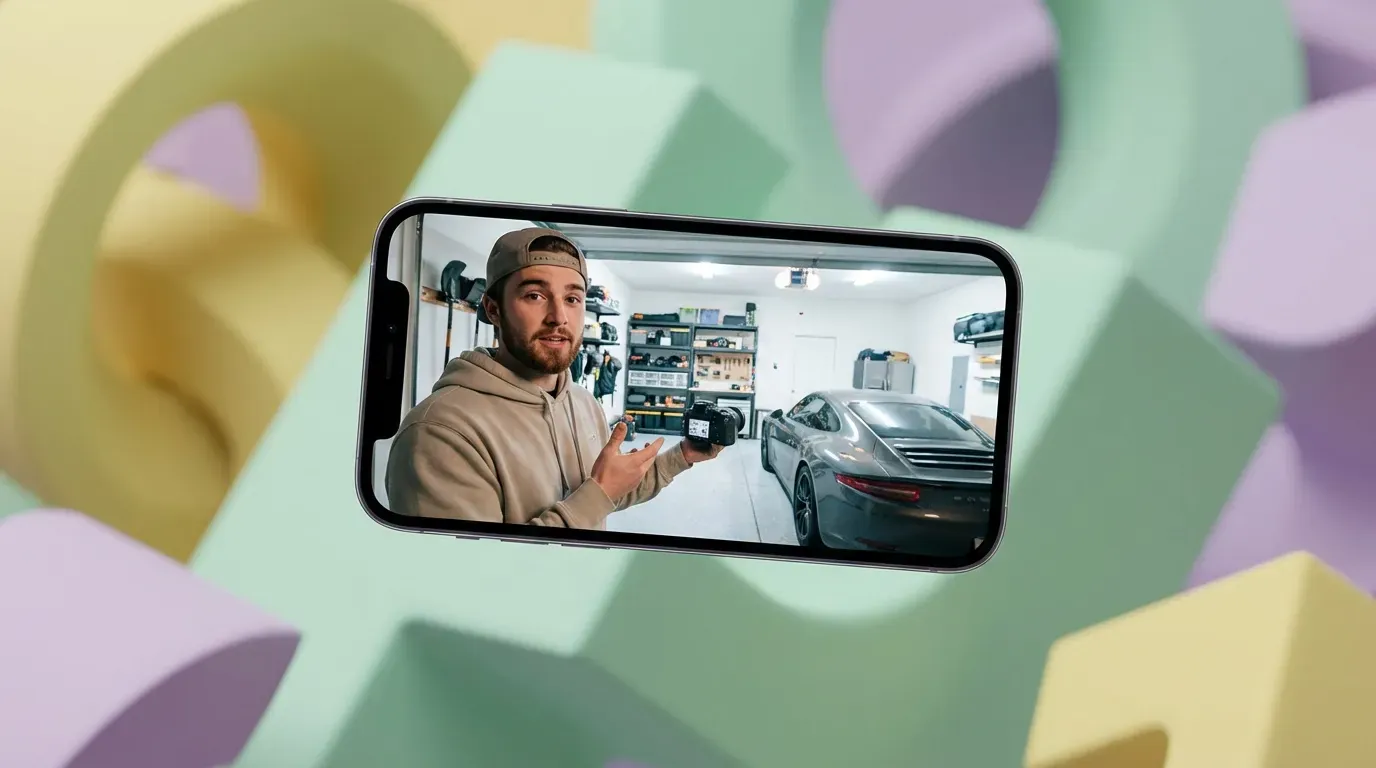
UGC creator footage in the phone.

What is UGC content? UGC meaning in marketing

UGC (user-generated content) is any content created by customers or creators, not your internal team. This includes unboxing videos, testimonials, product demos, tutorials, before-and-after clips, and "day in the life" posts.

The defining characteristic: it looks organic and platform-native, not like a polished ad. Shot on a phone in someone's living room with natural lighting and real reactions.

Common UGC formats:

  • Product unboxings and first impressions

  • Tutorial or how-to demonstrations

  • Testimonials and review videos

  • Before-and-after transformations

  • "Get ready with me" or lifestyle integration

  • Reaction videos and stitches/duets

UGC works across platforms—TikTok, Instagram Reels, YouTube Shorts, Facebook, and even as website embeds—but it's particularly effective in social feeds where algorithm favor authentic, engaging content over obvious ads.

What is a UGC creator?

A UGC creator is someone who produces authentic-looking content for brands on a freelance or contract basis. Unlike influencers who post to their own audiences, UGC creators deliver raw footage and finished videos that brands use in their own paid ads and organic posts.

UGC creators typically provide:

  • Multiple video angles and takes

  • Hook variations (different first 3 seconds)

  • Raw B-roll footage

  • Scripted talking-head segments

  • Platform-specific edits (9:16 for TikTok, 1:1 for feed posts)

They charge per deliverable—typically in the $100-$500 per video range depending on usage rights, complexity, and creator experience—and work from creative briefs specifying messaging, product features to highlight, and desired emotional tone.

The key difference between UGC creators and traditional influencers: UGC creators focus on creating performance-driven creative assets, not driving reach through their own follower base.

What is a UGC video and UGC ad?

A UGC video mimics the first-person, shot-on-phone aesthetic of authentic social content. A UGC ad takes that style and adds direct marketing elements: strong hooks, social proof, clear product benefits, and calls-to-action.
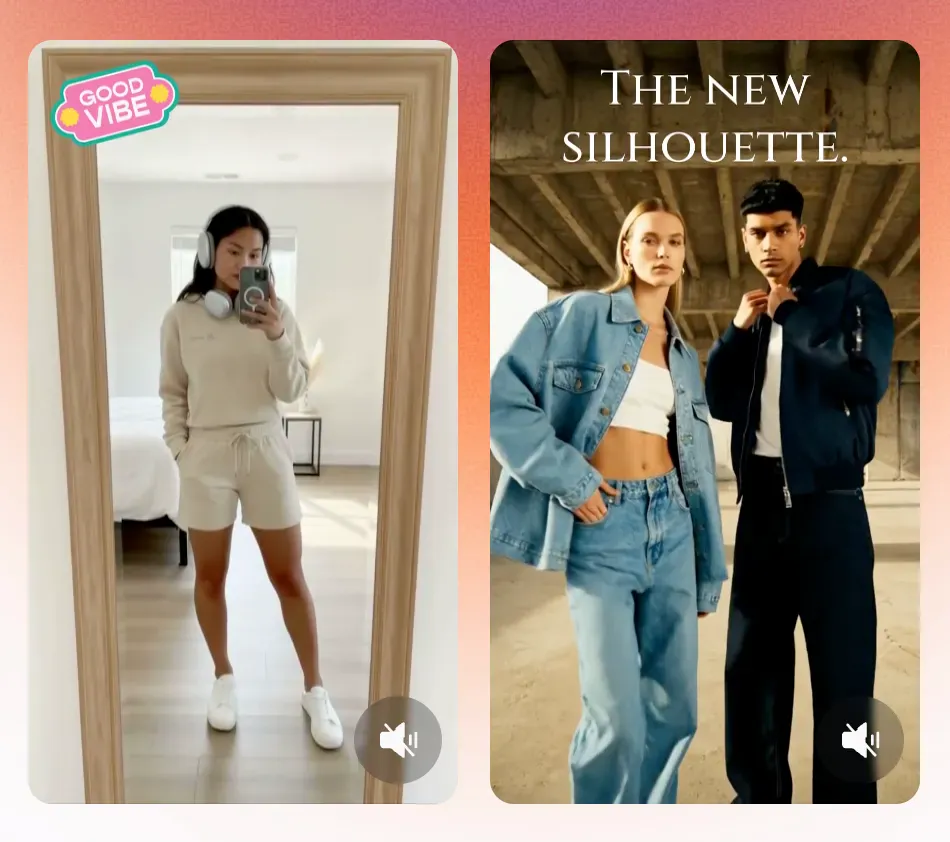
two vertical UGC video ads.

In numerous public case studies, UGC ads often outperform traditional brand commercials because they:

  • Blend into native feed content (less ad fatigue)

  • Feel like peer recommendations, not sales pitches

  • Use conversational language that matches how customers actually talk

  • Show real-world product usage in relatable settings

Example: Instead of a studio-shot product demo with perfect lighting, a UGC ad shows someone recording themselves in their kitchen, saying "I was skeptical about this coffee maker, but after two weeks I'm obsessed—here's why."
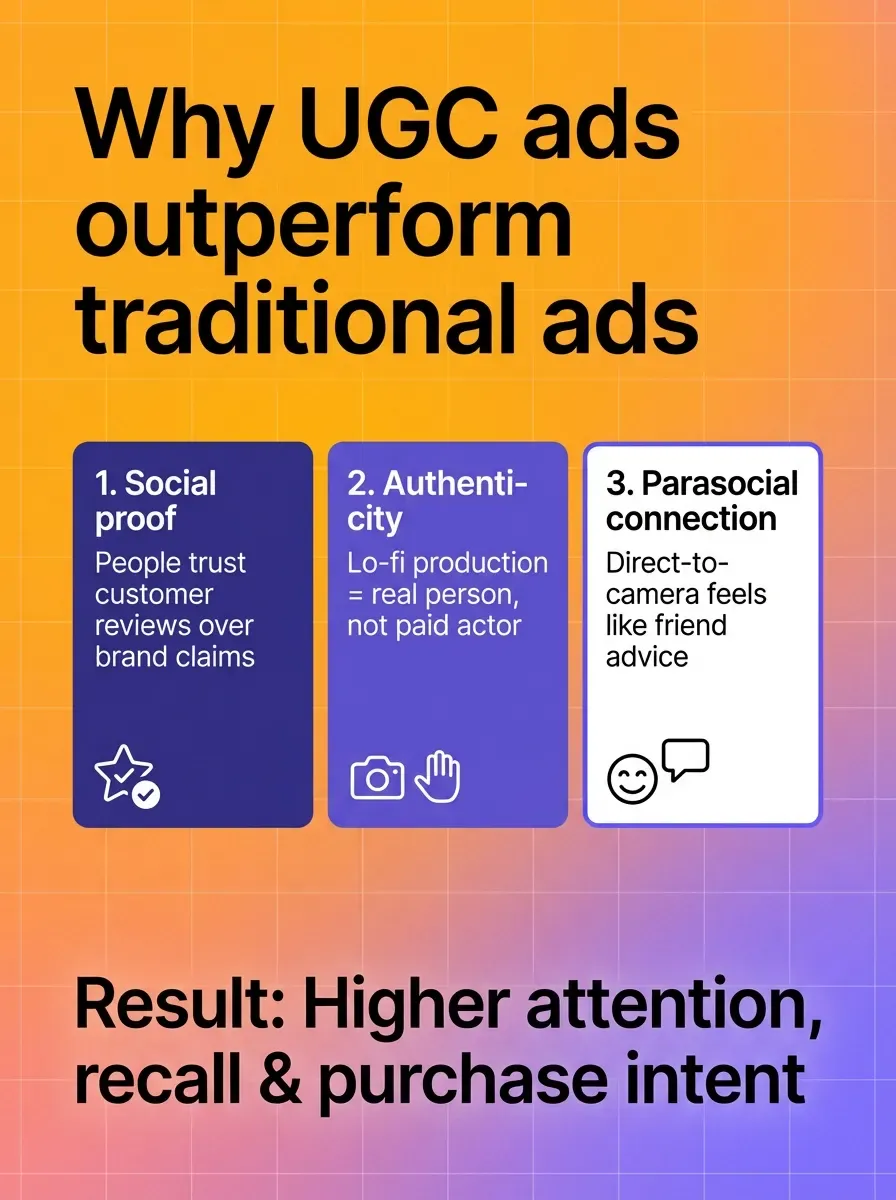
Why UGC ads outperform traditional ads - a diagram with 3 factors: Social proof, Authenticity, Parasocial connection.

Why UGC works: psychology and performance

Three psychological principles explain UGC's effectiveness:

Social proof: People trust peer recommendations more than brand claims. When someone who looks like your target customer endorses your product in their own words, it carries more weight than professional ad copy.

Authenticity perception: Lo-fi production quality signals "real person, real opinion" rather than "paid actor reading a script." The imperfections—casual lighting, ambient noise, natural speech patterns—build trust.

Parasocial relationships: Watching someone talk directly to camera creates a sense of connection. Viewers process first-person testimonials as advice from a friend, lowering psychological resistance to the marketing message.

Marketing studies confirm this. AI and content marketing research shows that relatable storytelling and perceived authenticity drive attention, recall, and purchase intent better than polished brand messaging, especially in digital environments.

Limits of "manual" UGC: cost, time, and control

Working with human UGC creators presents operational challenges:

Cost barriers: Many UGC creators charge in the $100-$500 per video range, depending on usage rights and deliverables. Ongoing creator relationships for consistent content can run $1,000+ per month. Traditional influencer collaborations or agency-produced content can easily cost several thousand dollars per video for mid-tier creators and above, making large-scale creative testing financially unsustainable for most brands.

Time delays: For brands starting from scratch with new creators, the full production cycle often takes 2-4 weeks: finding and vetting creators, shipping products, coordinating briefs, waiting for footage, requesting revisions, and final approval. Brands with established creator rosters move faster, but immediate turnaround remains impossible.

Creative control issues: Each creator interprets your brief differently. You might get messaging that's off-brand, footage that's unusable, or angles that miss your key selling points. Coordinating 10+ creators for consistency is a logistics nightmare.

Scaling bottlenecks: Testing different hooks, product angles, and platforms requires multiple videos. With human creators, producing 50 variations means managing 50 contracts, briefs, and review cycles.

Brand safety risks: Creators' off-platform behavior and personal opinions can create compliance issues. You need usage rights agreements, content approval workflows, and monitoring systems.

The core problem: manual UGC doesn't scale fast enough or cheap enough for modern performance marketing, which requires rapid creative iteration based on data.

Four AI UGC avatars.

Enter the AI UGC creator: concept and use cases

An AI UGC creator is a system that generates UGC-style videos using artificial intelligence—synthetic avatars, AI-written scripts, natural voice synthesis, and automated editing—instead of coordinating human creators.

AI content scaling approaches combine text-to-video generation, realistic digital presenters, and multi-language voice synthesis to replicate the look and feel of authentic UGC while eliminating coordination overhead.

Key use cases:

  • Always-on ad iteration: Generate 10 hook variations per product in an hour, test them, kill losers, scale winners

  • Multi-language localization: Take your best-performing English UGC ad and generate Spanish, French, and German versions with native-speaking avatars (75+ languages supported)

  • Fast creative testing: Launch 50 different angles across platforms in days, not months

  • Product explainers at scale: Turn product specs and customer reviews into dozens of UGC-style testimonial videos

  • Evergreen content: Generate fresh UGC-style videos from existing text reviews and survey data without reshooting

The shift: from "produce a few expensive videos and hope they work" to "generate many cheap variations and let data decide."

How AI improves creativity, not just speed

AI isn't replacing creative thinking—it's compressing the production bottleneck between idea and execution.

Research on AI as a creative partner shows that marketers use AI to rapidly ideate hooks, angles, and storyboards, freeing them to focus on strategy and judgment rather than execution logistics.

The best results come from human-directed prompts layered on AI generation:

  • You decide the creative strategy, target audience, and core message

  • AI generates 10 variations of that message with different hooks and presentations

  • You review, select winners, and refine based on brand standards

  • AI produces the final videos in minutes

This is faster than brief-shoot-edit cycles with creators and gives you more creative control. AI for content marketing strategies emphasize that judgment, taste, and strategic direction remain human responsibilities—AI just removes production friction.

Building an AI UGC strategy (before choosing tools)

Start with strategy, not software.

Define your audience and angles: What pain points does your product solve? What objections do customers raise? What transformations or results can you demonstrate? Map these to UGC concepts: problem-solution narratives, skeptic-to-believer journeys, before-after reveals.

Clarify your content themes:

  • Pain-point demos ("I used to struggle with X until I found this")

  • Transformation stories ("Here's what happened after 30 days")

  • Objection-handling ("I thought this would be Y, but actually Z")

  • Social proof compilation ("Here's why 10,000 people love this")

Map to funnel stages:

  • Top of funnel: Hook-driven awareness ads, pattern interrupts, surprising claims

  • Mid-funnel: Deep-dive explainers, detailed benefits, comparison content

  • Bottom of funnel: Testimonials, guarantees, urgency-driven offers

Set performance metrics: What matters for your business—CTR, thumb-stop rate, view-through rate, cost per click, cost per acquisition? Define benchmarks before producing content so you can measure AI UGC performance against traditional ads.

This upfront work ensures your AI-generated UGC serves a strategic purpose rather than just being "more content."

Core building blocks of AI UGC production

AI UGC systems combine four capabilities:

Script generation: AI analyzes product descriptions, customer reviews, and FAQs to draft UGC-style scripts with conversational language, natural pauses, and authentic phrasing. Instead of "Our revolutionary formula delivers unparalleled results," it generates "Honestly, I was skeptical, but after two weeks I noticed a huge difference."

AI avatars and synthetic presenters: Digital characters that look and move like real people deliver your scripts on camera. They can be:

  • Stock avatars from a library of diverse presenters

  • Custom avatars designed to match your brand aesthetic

  • Digital twins of real creators (with permission) for scaled production

These avatars can hold products, wear branded clothing, and emote naturally—all while maintaining the casual, selfie-framed aesthetic of mobile-shot UGC.

Voice synthesis and dubbing: Natural-sounding speech generation in 75+ languages lets you localize content without hiring native speakers. Voice models can match emotional tone—enthusiastic, thoughtful, conversational—to fit different UGC scenarios.

Smart editing and formatting: AI handles jump cuts, captions, B-roll insertion, and resizing for different platforms (9:16 for TikTok/Reels, 16:9 for YouTube, 1:1 for feed posts). This eliminates the manual editing that usually takes hours per video.

How to create AI UGC videos with Creatify

Here's the practical workflow using Creatify's platform:
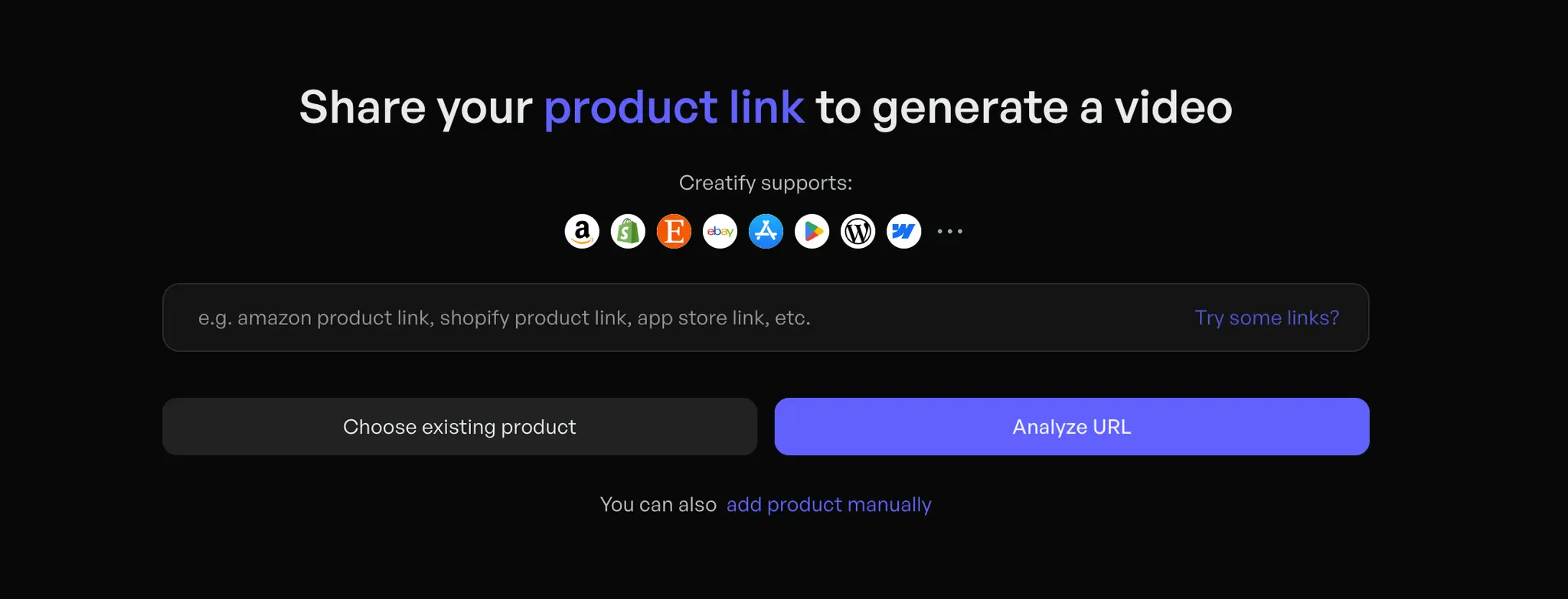
Creatify AI Url-to-video feature.

Step 1: Generate scripts from your product

Paste your product URL into Creatify's URL-to-Video tool. The AI crawler analyzes your product page and automatically generates 5-10 UGC-style script variations—each with different hooks, angles, and emotional approaches.

You can also manually input product descriptions, customer reviews, or key selling points if you don't have a URL.

Step 2: Choose your AI avatar

Browse Creatify's library of 1500+ hyper-realistic avatars representing different ages, ethnicities, and presentation styles. These avatars are built with Aurora, a proprietary diffusion transformer model that renders full-body expressiveness, natural facial movements, and emotional authenticity at 24 fps.

Options:

  • Pre-made avatars: Select from the stock library

  • BYOA (Bring Your Own Avatar): Upload 2-5 minutes of video footage of yourself or a real creator to create a custom digital twin. Avatar is ready in 1-2 business days.

  • DYOA (Design Your Own Avatar): Generate a completely synthetic avatar from a text description (age, gender, outfit, background). Creatify creates 2 variations, you select one, and it's ready within 24 hours.

Step 3: Select voice and language

Choose from 140+ AI voices across 75+ languages. Voices include multiple accents and emotional styles (enthusiastic, calm, conversational, professional).

For multilingual UGC: Generate your video in English, then duplicate it with Spanish, French, or German voiceovers and matching avatars—no new shoots required.
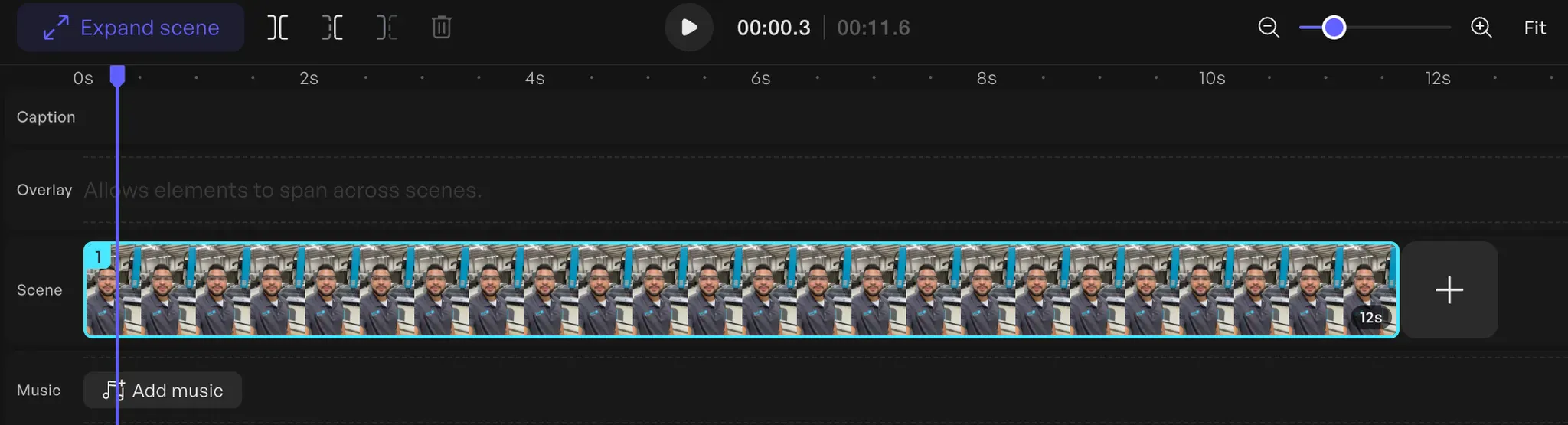
Creatify AI app - editing feature.

Step 4: Customize and edit

Use Creatify's built-in editor to:

  • Adjust script phrasing for brand voice

  • Add or remove scenes

  • Insert product images or B-roll from Creatify's 10,000+ clip library (Pro tier)

  • Modify avatar positioning, background, and outfit

  • Add emotional tags like [laugh] or [excited] to the script for avatar expression changes

  • Generate auto-captions in platform-appropriate styles

Step 5: Render multiple variations

Use Batch Mode to create dozens of variations simultaneously:

  • Same script with 10 different avatars

  • Same avatar with 10 different hooks

  • Multiple aspect ratios (9:16, 16:9, 1:1) for cross-platform deployment

Rendering completes in under 60 seconds per video. Pro plan allows 3 concurrent generations, so you can produce 100+ videos per day.

Step 6: Export and deploy

Download finished videos or publish directly to Meta, TikTok, YouTube, LinkedIn, or Snapchat through Creatify's platform integrations.

Cost comparison:

  • Traditional UGC creator: typically $200-500 per video, 2-4 weeks for new creator relationships

  • Creatify Pro plan: $49/month for 480 videos/year (2,400 credits), videos complete in minutes

That's roughly 90% cost reduction and 30x faster production for most workflows.

Creative principles for AI UGC style ads

Apply proven UGC best practices to AI-generated content:

Hooks matter most: Your first 1-3 seconds determine performance. Pattern interrupts work best—surprising claims, direct questions, or strong visual openers. Test these hook formats:

  • "I wish I knew this before..."

  • "Stop doing [wrong thing], try [your product] instead"

  • "This sounds too good to be true, but..."

  • "Here's what no one tells you about [problem]"

Use relatable language: Pull phrases directly from customer reviews and support tickets. If customers say "total game-changer" or "way easier than I expected," use those exact words in your AI scripts. Corporate speak breaks the UGC illusion.

Show imperfection: Perfect videos look like ads. Add natural elements—slight pauses, "um" sounds, ambient background noise. Creatify's avatars already include natural eye movements, head tilts, and hand gestures that make them feel less robotic.

Keep it dynamic: Visual variety prevents boredom. Cut between different avatar angles, insert product close-ups, and vary pacing. Don't let your avatar stand still talking for 60 seconds.

Soft CTAs: Instead of "Buy now!" use platform-native prompts like "see why everyone's trying this" or "link in bio for more." UGC ads should feel like helpful recommendations, not hard sales pitches.

Building a scalable AI UGC pipeline

Turn AI UGC from a one-time experiment into a repeatable system:

1. Research and angle discovery

Use social listening tools to analyze comments on competitor ads, your organic posts, and customer support conversations. What questions keep coming up? What objections do people raise? What language do customers use when they're excited about results?

Document 10-20 angles: pain points, transformations, comparisons, objection-handling, social proof themes.

2. Scripting and concepting

Feed your angles into Creatify's AI Script Writer. Generate 5-10 script variations per angle, then manually review and shortlist based on:

  • Message clarity

  • Hook strength

  • Brand voice alignment

  • Platform appropriateness

Expect to edit AI-generated scripts—trim corporate language, add specific product details, strengthen transitions.

3. Production

Generate videos using Batch Mode:

  • Select 3-5 avatars that represent your target demographics

  • Produce every script with every avatar (15-50 total videos)

  • Render multiple aspect ratios simultaneously

  • Add platform-specific elements (captions, music from Creatify's 7,000+ track library)

This takes hours, not weeks.

4. Testing and optimization

Launch your AI UGC ads as creative tests:

  • Run each video against a control (your current best ad)

  • Track CTR, thumb-stop rate, watch time, cost per result

  • Kill underperformers after $50-100 spend

  • Scale winners with increased budgets

Feed performance data back into your next production cycle. If transformation story hooks outperform skeptic-to-believer angles, double down on transformations next batch.

5. Iteration

Repeat monthly. Reddit discussions on UGC video ads emphasize that volume and iteration beat perfection—you learn what resonates by testing many angles quickly, not by agonizing over one script.

AI UGC makes this sustainable at roughly $2-4 per video instead of $200-500 with traditional creators.

Measurement: proving AI UGC works

Set up structured tests comparing AI UGC against traditional ads and human-only UGC.
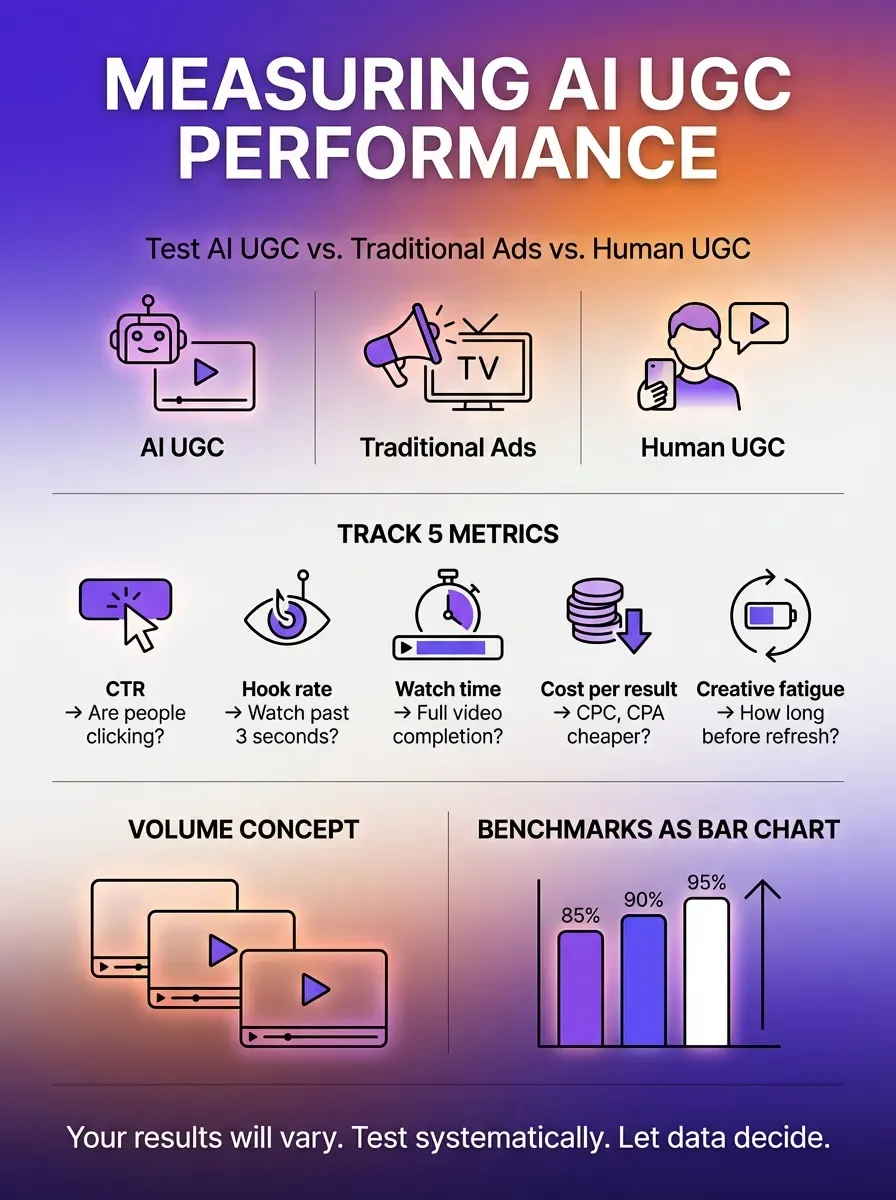
Measuring AI UGC performance - a diagram.

Metrics to track:

  • CTR (click-through rate): Are people clicking your AI UGC ads more than polished brand content?

  • Thumb-stop rate / hook rate: What percentage of viewers watch past 3 seconds?

  • Watch time: How much of your video do viewers actually watch?

  • Cost per result: CPM, CPC, CPA—is AI UGC cheaper at driving outcomes?

  • Creative fatigue: How long before performance drops and you need fresh creative?

The benefit of using AI tools for marketing isn't finding one perfect ad—it's producing volume fast enough to continuously test and refresh creative based on data.

Expected results based on documented case studies:

  • 2.7x more leads vs. static image ads - 1MORE case study

  • 200% increase in CTR for UGC-style video vs. traditional video - Twist Digital

  • 28-31% lower cost per result than standard UGC ads in some tests

Your mileage will vary by product, audience, and platform, which is why systematic testing matters more than assuming AI UGC will automatically win.

Ethics, disclosure, and brand safety for AI UGC

Transparency matters. As synthetic media become more accessible, marketers face evolving ethical expectations.

Best practices:

Disclosure: When using AI avatars or synthetic characters in ads, many experts recommend clear disclosure - either in video captions ("This video features an AI avatar") or in ad copy. This builds trust and avoids the "deepfake" perception problem.

Platform compliance: Meta, TikTok, and Google have policies around synthetic media in advertising. Review each platform's current rules before deploying AI UGC at scale. Compliant synthetic influencer advertising requires understanding jurisdiction-specific regulations.

Brand safety standards: Maintain content review workflows even with AI. Just because a human didn't create the video doesn't mean you skip approvals. Check for:

  • On-brand messaging

  • Appropriate tone and language

  • Accurate product claims

  • No unintended offensive content

Authenticity line: Don't use AI avatars to impersonate real people without consent or to fake testimonials from customers who don't exist. Use AI to scale production of authentic messages, not to deceive.

Legal and rights considerations

Data and consent: If you're training AI systems on customer testimonials, reviews, faces, or voices, you need clear rights and permissions. This includes:

  • Terms of service that grant you content usage rights

  • Explicit consent forms if creating digital twins of real people

  • Model releases for any human footage you're modifying with AI

BYOA compliance: When using Creatify's Bring Your Own Avatar feature to create a digital twin, ensure you have proper consent from the person. They should understand their likeness will be used to generate synthetic videos. Document this consent clearly.

Platform-specific rules: Each advertising platform has its own policies. TikTok, Meta, Google, and others regulate synthetic media differently. Stay current on these rules—they're evolving as AI tools proliferate.

FTC and regulatory compliance: In the US, FTC guidelines require clear disclosure of sponsored content and material connections. Ethical marketing considerations for synthetic media suggest that AI-generated ads must still follow all standard advertising disclosure rules.

The bottom line

AI UGC ads aren't just cheaper than traditional UGC - they're 30x faster to produce and infinitely easier to test. You can create dozens of variations in the time it used to take to brief a single creator.

The best part? You don't need to choose between cost, speed, and quality anymore. Tools like Creatify let you generate professional UGC-style ads in minutes, not weeks. Just paste your product URL and watch the platform analyze your listing, generate optimized scripts, and create multiple ad variations with lifelike avatars.

Ready to see how fast you can go from product URL to running ad? Try Creatify free for 7 days—no credit card required. Create your first AI UGC ad in under 10 minutes and test whether this approach works for your brand. If it doesn't perform, you've lost nothing. If it does, you've just unlocked a massive competitive advantage.

Create your first AI UGC ad today →


FAQs

What is UGC content?

UGC content (user-generated content) is any video, image, or text created by customers or independent creators rather than brand marketing teams. Common formats include product reviews, unboxing videos, tutorials, and testimonials. UGC content typically looks authentic and platform-native rather than polished like traditional advertising.


What is a UGC video?

A UGC video is short-form content that mimics the authentic, first-person style of social media posts—usually shot on a phone with casual lighting and natural presentation. UGC videos show real product usage in everyday settings, making them more relatable than studio-produced commercials.


What makes a good UGC creator?

Good UGC creators understand platform-native content styles, can follow creative briefs while adding authentic personality, and deliver multiple hook variations for testing. The best UGC creators produce videos that don't look like ads—they blend naturally into TikTok, Instagram, and YouTube feeds with conversational language and relatable scenarios.


How do UGC ads perform compared to traditional ads?

In many documented case studies, UGC ads match or outperform polished brand commercials on metrics like CTR, engagement, and cost per result. They often generate higher trust because they feel like peer recommendations rather than sales pitches, and they typically experience less ad fatigue because they blend into native feed content. Results vary by product, audience, and execution quality.


Is AI-generated UGC really "UGC"?

Not technically—it's not created by actual users. But "AI UGC" accurately describes videos that mimic the UGC aesthetic using AI avatars and conversational scripts. The style and performance characteristics matter more than literal origin. AI UGC works best when combined with real customer language pulled from reviews and testimonials.


How do I create UGC videos at scale without hiring dozens of creators?

Use AI UGC platforms like Creatify to generate UGC-style videos with synthetic avatars and automated scripting. You can produce 50-100 video variations in hours instead of coordinating months of creator shoots. This lets you test multiple angles, hooks, and formats quickly while maintaining the authentic UGC aesthetic.


Will AI UGC replace human UGC creators?

No. Human UGC creators still produce the most authentic content for brand building and hero campaigns. AI UGC works best for scaling testing, localization, and high-volume production where speed and cost matter more than absolute authenticity. The optimal approach is hybrid: humans for strategy and hero content, AI for iteration and scale.


Are AI UGC ads allowed on major ad platforms?

Yes, with disclosure requirements that vary by platform. Meta, TikTok, and Google all allow synthetic media in ads but may require clear labeling. Check each platform's current synthetic media policies before launching campaigns, and consider transparent disclosure in your ad creative to build trust with audiences.

You're spending $5,000 on a polished product video. It launches on Meta. CTR: 0.8%. Your ad account manager suggests "try UGC-style content instead."

You hire a creator for $300. They shoot a casual iPhone video in their kitchen—no fancy lighting, just real talk about your product. CTR jumps to 2.4%. Three times better.

Now you need 50 more videos like that to test different hooks, angles, and audiences. At $300 each, that's $15,000. And you'll wait a month while creators film, revise, and deliver.

Here's what changed: AI UGC creators now generate authentic-looking user videos using synthetic avatars and automated scripts in minutes, not weeks. Same casual aesthetic, same conversational tone, but you can produce 100 variations for the cost of three human creator videos.

In many tests run by performance marketers, UGC-style ads match or outperform polished brand content on engagement and click-through rate. The bottleneck was never the idea—it was production speed and cost. AI removes that bottleneck.

This guide shows you what UGC is, why it converts, how AI replicates the style at scale, and how to build a repeatable system that lets you test faster than your competitors.

UGC creator footage in the phone.

What is UGC content? UGC meaning in marketing

UGC (user-generated content) is any content created by customers or creators, not your internal team. This includes unboxing videos, testimonials, product demos, tutorials, before-and-after clips, and "day in the life" posts.

The defining characteristic: it looks organic and platform-native, not like a polished ad. Shot on a phone in someone's living room with natural lighting and real reactions.

Common UGC formats:

  • Product unboxings and first impressions

  • Tutorial or how-to demonstrations

  • Testimonials and review videos

  • Before-and-after transformations

  • "Get ready with me" or lifestyle integration

  • Reaction videos and stitches/duets

UGC works across platforms—TikTok, Instagram Reels, YouTube Shorts, Facebook, and even as website embeds—but it's particularly effective in social feeds where algorithm favor authentic, engaging content over obvious ads.

What is a UGC creator?

A UGC creator is someone who produces authentic-looking content for brands on a freelance or contract basis. Unlike influencers who post to their own audiences, UGC creators deliver raw footage and finished videos that brands use in their own paid ads and organic posts.

UGC creators typically provide:

  • Multiple video angles and takes

  • Hook variations (different first 3 seconds)

  • Raw B-roll footage

  • Scripted talking-head segments

  • Platform-specific edits (9:16 for TikTok, 1:1 for feed posts)

They charge per deliverable—typically in the $100-$500 per video range depending on usage rights, complexity, and creator experience—and work from creative briefs specifying messaging, product features to highlight, and desired emotional tone.

The key difference between UGC creators and traditional influencers: UGC creators focus on creating performance-driven creative assets, not driving reach through their own follower base.

What is a UGC video and UGC ad?

A UGC video mimics the first-person, shot-on-phone aesthetic of authentic social content. A UGC ad takes that style and adds direct marketing elements: strong hooks, social proof, clear product benefits, and calls-to-action.

two vertical UGC video ads.

In numerous public case studies, UGC ads often outperform traditional brand commercials because they:

  • Blend into native feed content (less ad fatigue)

  • Feel like peer recommendations, not sales pitches

  • Use conversational language that matches how customers actually talk

  • Show real-world product usage in relatable settings

Example: Instead of a studio-shot product demo with perfect lighting, a UGC ad shows someone recording themselves in their kitchen, saying "I was skeptical about this coffee maker, but after two weeks I'm obsessed—here's why."

Why UGC ads outperform traditional ads - a diagram with 3 factors: Social proof, Authenticity, Parasocial connection.

Why UGC works: psychology and performance

Three psychological principles explain UGC's effectiveness:

Social proof: People trust peer recommendations more than brand claims. When someone who looks like your target customer endorses your product in their own words, it carries more weight than professional ad copy.

Authenticity perception: Lo-fi production quality signals "real person, real opinion" rather than "paid actor reading a script." The imperfections—casual lighting, ambient noise, natural speech patterns—build trust.

Parasocial relationships: Watching someone talk directly to camera creates a sense of connection. Viewers process first-person testimonials as advice from a friend, lowering psychological resistance to the marketing message.

Marketing studies confirm this. AI and content marketing research shows that relatable storytelling and perceived authenticity drive attention, recall, and purchase intent better than polished brand messaging, especially in digital environments.

Limits of "manual" UGC: cost, time, and control

Working with human UGC creators presents operational challenges:

Cost barriers: Many UGC creators charge in the $100-$500 per video range, depending on usage rights and deliverables. Ongoing creator relationships for consistent content can run $1,000+ per month. Traditional influencer collaborations or agency-produced content can easily cost several thousand dollars per video for mid-tier creators and above, making large-scale creative testing financially unsustainable for most brands.

Time delays: For brands starting from scratch with new creators, the full production cycle often takes 2-4 weeks: finding and vetting creators, shipping products, coordinating briefs, waiting for footage, requesting revisions, and final approval. Brands with established creator rosters move faster, but immediate turnaround remains impossible.

Creative control issues: Each creator interprets your brief differently. You might get messaging that's off-brand, footage that's unusable, or angles that miss your key selling points. Coordinating 10+ creators for consistency is a logistics nightmare.

Scaling bottlenecks: Testing different hooks, product angles, and platforms requires multiple videos. With human creators, producing 50 variations means managing 50 contracts, briefs, and review cycles.

Brand safety risks: Creators' off-platform behavior and personal opinions can create compliance issues. You need usage rights agreements, content approval workflows, and monitoring systems.

The core problem: manual UGC doesn't scale fast enough or cheap enough for modern performance marketing, which requires rapid creative iteration based on data.

Four AI UGC avatars.

Enter the AI UGC creator: concept and use cases

An AI UGC creator is a system that generates UGC-style videos using artificial intelligence—synthetic avatars, AI-written scripts, natural voice synthesis, and automated editing—instead of coordinating human creators.

AI content scaling approaches combine text-to-video generation, realistic digital presenters, and multi-language voice synthesis to replicate the look and feel of authentic UGC while eliminating coordination overhead.

Key use cases:

  • Always-on ad iteration: Generate 10 hook variations per product in an hour, test them, kill losers, scale winners

  • Multi-language localization: Take your best-performing English UGC ad and generate Spanish, French, and German versions with native-speaking avatars (75+ languages supported)

  • Fast creative testing: Launch 50 different angles across platforms in days, not months

  • Product explainers at scale: Turn product specs and customer reviews into dozens of UGC-style testimonial videos

  • Evergreen content: Generate fresh UGC-style videos from existing text reviews and survey data without reshooting

The shift: from "produce a few expensive videos and hope they work" to "generate many cheap variations and let data decide."

How AI improves creativity, not just speed

AI isn't replacing creative thinking—it's compressing the production bottleneck between idea and execution.

Research on AI as a creative partner shows that marketers use AI to rapidly ideate hooks, angles, and storyboards, freeing them to focus on strategy and judgment rather than execution logistics.

The best results come from human-directed prompts layered on AI generation:

  • You decide the creative strategy, target audience, and core message

  • AI generates 10 variations of that message with different hooks and presentations

  • You review, select winners, and refine based on brand standards

  • AI produces the final videos in minutes

This is faster than brief-shoot-edit cycles with creators and gives you more creative control. AI for content marketing strategies emphasize that judgment, taste, and strategic direction remain human responsibilities—AI just removes production friction.

Building an AI UGC strategy (before choosing tools)

Start with strategy, not software.

Define your audience and angles: What pain points does your product solve? What objections do customers raise? What transformations or results can you demonstrate? Map these to UGC concepts: problem-solution narratives, skeptic-to-believer journeys, before-after reveals.

Clarify your content themes:

  • Pain-point demos ("I used to struggle with X until I found this")

  • Transformation stories ("Here's what happened after 30 days")

  • Objection-handling ("I thought this would be Y, but actually Z")

  • Social proof compilation ("Here's why 10,000 people love this")

Map to funnel stages:

  • Top of funnel: Hook-driven awareness ads, pattern interrupts, surprising claims

  • Mid-funnel: Deep-dive explainers, detailed benefits, comparison content

  • Bottom of funnel: Testimonials, guarantees, urgency-driven offers

Set performance metrics: What matters for your business—CTR, thumb-stop rate, view-through rate, cost per click, cost per acquisition? Define benchmarks before producing content so you can measure AI UGC performance against traditional ads.

This upfront work ensures your AI-generated UGC serves a strategic purpose rather than just being "more content."

Core building blocks of AI UGC production

AI UGC systems combine four capabilities:

Script generation: AI analyzes product descriptions, customer reviews, and FAQs to draft UGC-style scripts with conversational language, natural pauses, and authentic phrasing. Instead of "Our revolutionary formula delivers unparalleled results," it generates "Honestly, I was skeptical, but after two weeks I noticed a huge difference."

AI avatars and synthetic presenters: Digital characters that look and move like real people deliver your scripts on camera. They can be:

  • Stock avatars from a library of diverse presenters

  • Custom avatars designed to match your brand aesthetic

  • Digital twins of real creators (with permission) for scaled production

These avatars can hold products, wear branded clothing, and emote naturally—all while maintaining the casual, selfie-framed aesthetic of mobile-shot UGC.

Voice synthesis and dubbing: Natural-sounding speech generation in 75+ languages lets you localize content without hiring native speakers. Voice models can match emotional tone—enthusiastic, thoughtful, conversational—to fit different UGC scenarios.

Smart editing and formatting: AI handles jump cuts, captions, B-roll insertion, and resizing for different platforms (9:16 for TikTok/Reels, 16:9 for YouTube, 1:1 for feed posts). This eliminates the manual editing that usually takes hours per video.

How to create AI UGC videos with Creatify

Here's the practical workflow using Creatify's platform:

Creatify AI Url-to-video feature.

Step 1: Generate scripts from your product

Paste your product URL into Creatify's URL-to-Video tool. The AI crawler analyzes your product page and automatically generates 5-10 UGC-style script variations—each with different hooks, angles, and emotional approaches.

You can also manually input product descriptions, customer reviews, or key selling points if you don't have a URL.

Step 2: Choose your AI avatar

Browse Creatify's library of 1500+ hyper-realistic avatars representing different ages, ethnicities, and presentation styles. These avatars are built with Aurora, a proprietary diffusion transformer model that renders full-body expressiveness, natural facial movements, and emotional authenticity at 24 fps.

Options:

  • Pre-made avatars: Select from the stock library

  • BYOA (Bring Your Own Avatar): Upload 2-5 minutes of video footage of yourself or a real creator to create a custom digital twin. Avatar is ready in 1-2 business days.

  • DYOA (Design Your Own Avatar): Generate a completely synthetic avatar from a text description (age, gender, outfit, background). Creatify creates 2 variations, you select one, and it's ready within 24 hours.

Step 3: Select voice and language

Choose from 140+ AI voices across 75+ languages. Voices include multiple accents and emotional styles (enthusiastic, calm, conversational, professional).

For multilingual UGC: Generate your video in English, then duplicate it with Spanish, French, or German voiceovers and matching avatars—no new shoots required.

Creatify AI app - editing feature.

Step 4: Customize and edit

Use Creatify's built-in editor to:

  • Adjust script phrasing for brand voice

  • Add or remove scenes

  • Insert product images or B-roll from Creatify's 10,000+ clip library (Pro tier)

  • Modify avatar positioning, background, and outfit

  • Add emotional tags like [laugh] or [excited] to the script for avatar expression changes

  • Generate auto-captions in platform-appropriate styles

Step 5: Render multiple variations

Use Batch Mode to create dozens of variations simultaneously:

  • Same script with 10 different avatars

  • Same avatar with 10 different hooks

  • Multiple aspect ratios (9:16, 16:9, 1:1) for cross-platform deployment

Rendering completes in under 60 seconds per video. Pro plan allows 3 concurrent generations, so you can produce 100+ videos per day.

Step 6: Export and deploy

Download finished videos or publish directly to Meta, TikTok, YouTube, LinkedIn, or Snapchat through Creatify's platform integrations.

Cost comparison:

  • Traditional UGC creator: typically $200-500 per video, 2-4 weeks for new creator relationships

  • Creatify Pro plan: $49/month for 480 videos/year (2,400 credits), videos complete in minutes

That's roughly 90% cost reduction and 30x faster production for most workflows.

Creative principles for AI UGC style ads

Apply proven UGC best practices to AI-generated content:

Hooks matter most: Your first 1-3 seconds determine performance. Pattern interrupts work best—surprising claims, direct questions, or strong visual openers. Test these hook formats:

  • "I wish I knew this before..."

  • "Stop doing [wrong thing], try [your product] instead"

  • "This sounds too good to be true, but..."

  • "Here's what no one tells you about [problem]"

Use relatable language: Pull phrases directly from customer reviews and support tickets. If customers say "total game-changer" or "way easier than I expected," use those exact words in your AI scripts. Corporate speak breaks the UGC illusion.

Show imperfection: Perfect videos look like ads. Add natural elements—slight pauses, "um" sounds, ambient background noise. Creatify's avatars already include natural eye movements, head tilts, and hand gestures that make them feel less robotic.

Keep it dynamic: Visual variety prevents boredom. Cut between different avatar angles, insert product close-ups, and vary pacing. Don't let your avatar stand still talking for 60 seconds.

Soft CTAs: Instead of "Buy now!" use platform-native prompts like "see why everyone's trying this" or "link in bio for more." UGC ads should feel like helpful recommendations, not hard sales pitches.

Building a scalable AI UGC pipeline

Turn AI UGC from a one-time experiment into a repeatable system:

1. Research and angle discovery

Use social listening tools to analyze comments on competitor ads, your organic posts, and customer support conversations. What questions keep coming up? What objections do people raise? What language do customers use when they're excited about results?

Document 10-20 angles: pain points, transformations, comparisons, objection-handling, social proof themes.

2. Scripting and concepting

Feed your angles into Creatify's AI Script Writer. Generate 5-10 script variations per angle, then manually review and shortlist based on:

  • Message clarity

  • Hook strength

  • Brand voice alignment

  • Platform appropriateness

Expect to edit AI-generated scripts—trim corporate language, add specific product details, strengthen transitions.

3. Production

Generate videos using Batch Mode:

  • Select 3-5 avatars that represent your target demographics

  • Produce every script with every avatar (15-50 total videos)

  • Render multiple aspect ratios simultaneously

  • Add platform-specific elements (captions, music from Creatify's 7,000+ track library)

This takes hours, not weeks.

4. Testing and optimization

Launch your AI UGC ads as creative tests:

  • Run each video against a control (your current best ad)

  • Track CTR, thumb-stop rate, watch time, cost per result

  • Kill underperformers after $50-100 spend

  • Scale winners with increased budgets

Feed performance data back into your next production cycle. If transformation story hooks outperform skeptic-to-believer angles, double down on transformations next batch.

5. Iteration

Repeat monthly. Reddit discussions on UGC video ads emphasize that volume and iteration beat perfection—you learn what resonates by testing many angles quickly, not by agonizing over one script.

AI UGC makes this sustainable at roughly $2-4 per video instead of $200-500 with traditional creators.

Measurement: proving AI UGC works

Set up structured tests comparing AI UGC against traditional ads and human-only UGC.

Measuring AI UGC performance - a diagram.

Metrics to track:

  • CTR (click-through rate): Are people clicking your AI UGC ads more than polished brand content?

  • Thumb-stop rate / hook rate: What percentage of viewers watch past 3 seconds?

  • Watch time: How much of your video do viewers actually watch?

  • Cost per result: CPM, CPC, CPA—is AI UGC cheaper at driving outcomes?

  • Creative fatigue: How long before performance drops and you need fresh creative?

The benefit of using AI tools for marketing isn't finding one perfect ad—it's producing volume fast enough to continuously test and refresh creative based on data.

Expected results based on documented case studies:

  • 2.7x more leads vs. static image ads - 1MORE case study

  • 200% increase in CTR for UGC-style video vs. traditional video - Twist Digital

  • 28-31% lower cost per result than standard UGC ads in some tests

Your mileage will vary by product, audience, and platform, which is why systematic testing matters more than assuming AI UGC will automatically win.

Ethics, disclosure, and brand safety for AI UGC

Transparency matters. As synthetic media become more accessible, marketers face evolving ethical expectations.

Best practices:

Disclosure: When using AI avatars or synthetic characters in ads, many experts recommend clear disclosure - either in video captions ("This video features an AI avatar") or in ad copy. This builds trust and avoids the "deepfake" perception problem.

Platform compliance: Meta, TikTok, and Google have policies around synthetic media in advertising. Review each platform's current rules before deploying AI UGC at scale. Compliant synthetic influencer advertising requires understanding jurisdiction-specific regulations.

Brand safety standards: Maintain content review workflows even with AI. Just because a human didn't create the video doesn't mean you skip approvals. Check for:

  • On-brand messaging

  • Appropriate tone and language

  • Accurate product claims

  • No unintended offensive content

Authenticity line: Don't use AI avatars to impersonate real people without consent or to fake testimonials from customers who don't exist. Use AI to scale production of authentic messages, not to deceive.

Legal and rights considerations

Data and consent: If you're training AI systems on customer testimonials, reviews, faces, or voices, you need clear rights and permissions. This includes:

  • Terms of service that grant you content usage rights

  • Explicit consent forms if creating digital twins of real people

  • Model releases for any human footage you're modifying with AI

BYOA compliance: When using Creatify's Bring Your Own Avatar feature to create a digital twin, ensure you have proper consent from the person. They should understand their likeness will be used to generate synthetic videos. Document this consent clearly.

Platform-specific rules: Each advertising platform has its own policies. TikTok, Meta, Google, and others regulate synthetic media differently. Stay current on these rules—they're evolving as AI tools proliferate.

FTC and regulatory compliance: In the US, FTC guidelines require clear disclosure of sponsored content and material connections. Ethical marketing considerations for synthetic media suggest that AI-generated ads must still follow all standard advertising disclosure rules.

The bottom line

AI UGC ads aren't just cheaper than traditional UGC - they're 30x faster to produce and infinitely easier to test. You can create dozens of variations in the time it used to take to brief a single creator.

The best part? You don't need to choose between cost, speed, and quality anymore. Tools like Creatify let you generate professional UGC-style ads in minutes, not weeks. Just paste your product URL and watch the platform analyze your listing, generate optimized scripts, and create multiple ad variations with lifelike avatars.

Ready to see how fast you can go from product URL to running ad? Try Creatify free for 7 days—no credit card required. Create your first AI UGC ad in under 10 minutes and test whether this approach works for your brand. If it doesn't perform, you've lost nothing. If it does, you've just unlocked a massive competitive advantage.

Create your first AI UGC ad today →


FAQs

What is UGC content?

UGC content (user-generated content) is any video, image, or text created by customers or independent creators rather than brand marketing teams. Common formats include product reviews, unboxing videos, tutorials, and testimonials. UGC content typically looks authentic and platform-native rather than polished like traditional advertising.


What is a UGC video?

A UGC video is short-form content that mimics the authentic, first-person style of social media posts—usually shot on a phone with casual lighting and natural presentation. UGC videos show real product usage in everyday settings, making them more relatable than studio-produced commercials.


What makes a good UGC creator?

Good UGC creators understand platform-native content styles, can follow creative briefs while adding authentic personality, and deliver multiple hook variations for testing. The best UGC creators produce videos that don't look like ads—they blend naturally into TikTok, Instagram, and YouTube feeds with conversational language and relatable scenarios.


How do UGC ads perform compared to traditional ads?

In many documented case studies, UGC ads match or outperform polished brand commercials on metrics like CTR, engagement, and cost per result. They often generate higher trust because they feel like peer recommendations rather than sales pitches, and they typically experience less ad fatigue because they blend into native feed content. Results vary by product, audience, and execution quality.


Is AI-generated UGC really "UGC"?

Not technically—it's not created by actual users. But "AI UGC" accurately describes videos that mimic the UGC aesthetic using AI avatars and conversational scripts. The style and performance characteristics matter more than literal origin. AI UGC works best when combined with real customer language pulled from reviews and testimonials.


How do I create UGC videos at scale without hiring dozens of creators?

Use AI UGC platforms like Creatify to generate UGC-style videos with synthetic avatars and automated scripting. You can produce 50-100 video variations in hours instead of coordinating months of creator shoots. This lets you test multiple angles, hooks, and formats quickly while maintaining the authentic UGC aesthetic.


Will AI UGC replace human UGC creators?

No. Human UGC creators still produce the most authentic content for brand building and hero campaigns. AI UGC works best for scaling testing, localization, and high-volume production where speed and cost matter more than absolute authenticity. The optimal approach is hybrid: humans for strategy and hero content, AI for iteration and scale.


Are AI UGC ads allowed on major ad platforms?

Yes, with disclosure requirements that vary by platform. Meta, TikTok, and Google all allow synthetic media in ads but may require clear labeling. Check each platform's current synthetic media policies before launching campaigns, and consider transparent disclosure in your ad creative to build trust with audiences.
Icon
Icon
Icon

Ready to turn your product into an engaging video?

Ready to speed up your marketing?

Test your new product ideas in minutes with AI-generated video ads

Arrow icon.
Gradient

Ready to speed up your marketing?

Test your new product ideas in minutes with AI-generated video ads

Arrow icon.
Gradient

Ready to speed up your marketing?

Test your new product ideas in minutes with AI-generated video ads

Arrow icon.
Gradient

Ready to speed up your marketing?

Test your new product ideas in minutes with AI-generated video ads

Arrow icon.
Gradient
Gradient