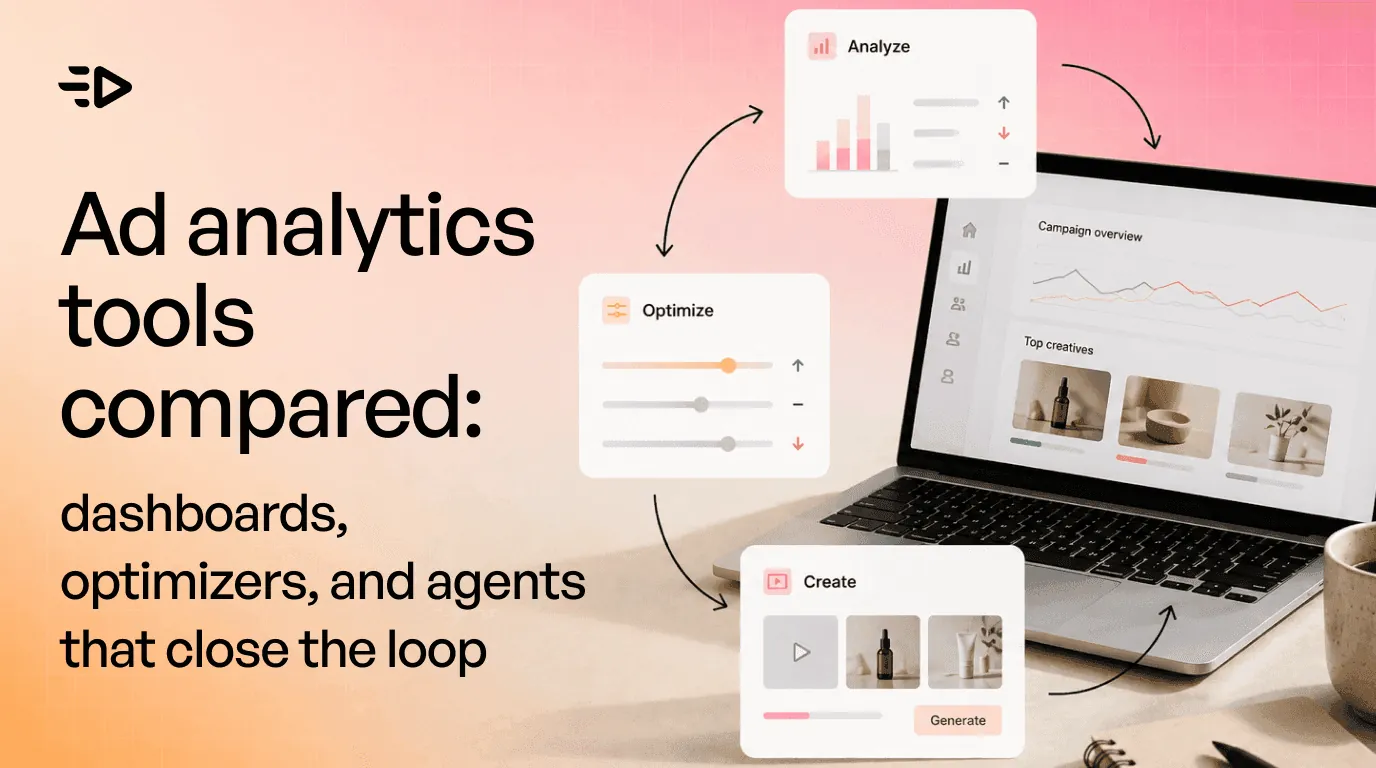

Ad analytics tools compared: dashboards, optimizers, and agents that close the loop

Ad analytics tools compared: dashboards, optimizers, and agents that close the loop

Written by

Creatify Team

Ad Analytics Tools Compared
Creatify logo

Creatify Team

SHARE

LinkedIn icon
X icon
Facebook icon

IN THIS ARTICLE

Most tools filed under "ad analytics" do one thing: they tell you what already happened. A smaller set goes further and acts on it, adjusting bids and budgets in your live accounts. And a rare few close the entire loop, generating the replacement creative when an ad fatigues and pushing it live with far less hand-holding. Those are three genuinely different jobs, and a lot of buying decisions go wrong because a team picks a tool from the wrong rung. This roundup sorts the field by how much of the loop each tool closes, digs into what each one actually does, and links every one, so you can match the tool to your real bottleneck.

The three rungs of ad automation
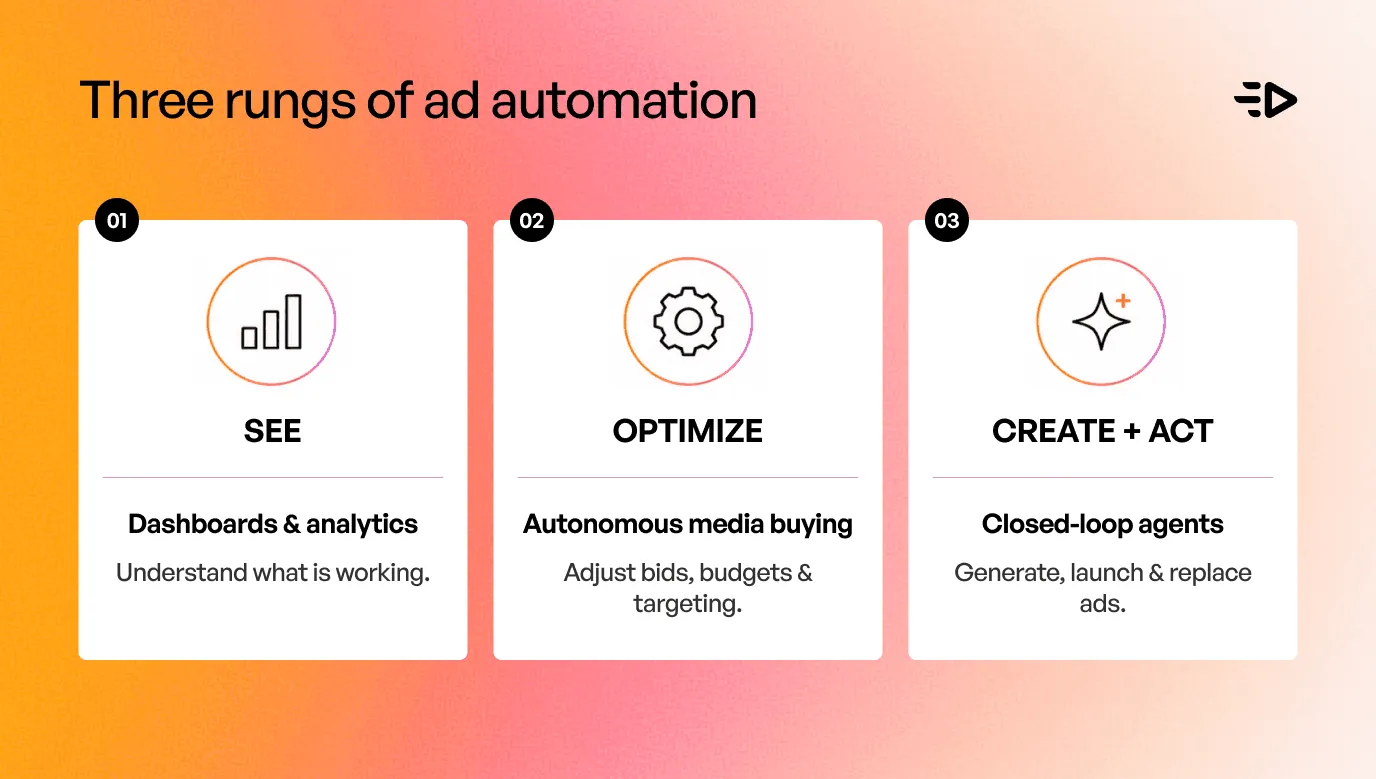
The three rungs of ad automation

Think of it as a ladder. Rung one is ad analysis: dashboards, creative analytics, and attribution that report performance but take no action. Rung two is execution: platforms that connect your data and then run and optimize the ads, changing bids, budgets, and targeting on their own. Rung three is the closed loop: systems that also generate net-new creative to replace losing ads and launch it, so measurement feeds production feeds measurement again. The higher the rung, the more of the work the software does, and the fewer tools genuinely operate there.

Rung 1: tools that analyze, and stop there
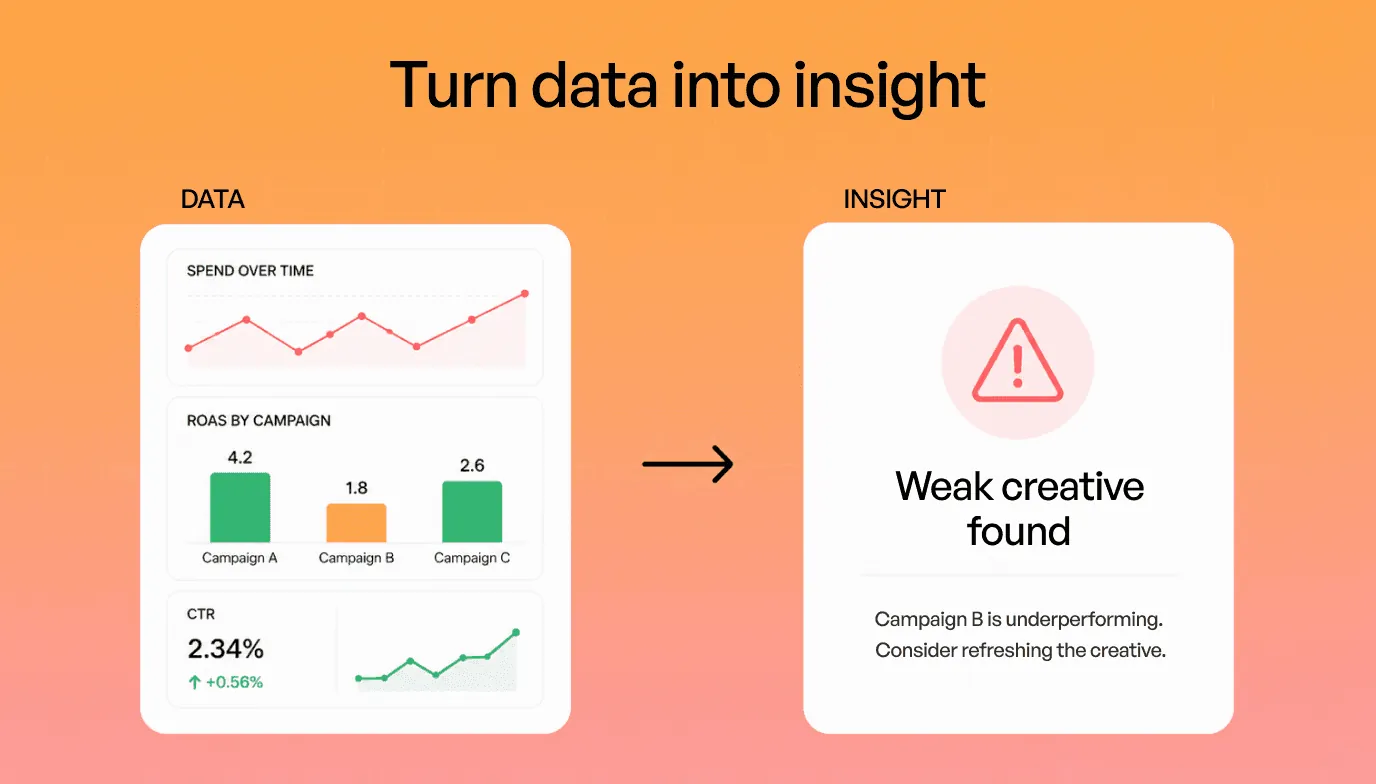
Rung1 tools that analyze and stop there

Everything on this rung is a reporting layer. It makes your data legible; it does not touch your campaigns. Within it there are three flavors: creative and ad copy analysis tools, which organize performance around the ad itself; data pipes, which move your numbers into a warehouse or dashboard; and attribution, which works out what drove the sale.

Motion

Motion is the popular pick for creative analytics on paid social. It connects your ad accounts across Meta, TikTok, YouTube, and LinkedIn and ties performance back to the creative behind each ad: the hook, the format, the messaging angle, the talent. It scores creative on a Hook, Watch, Click, and Conversion funnel and auto-tags ads at scale across a fixed set of dimensions, so patterns across hooks, formats, creators, and angles surface without manual sorting. Its AI Tasks run one-click workflows to analyze top performers, review how diverse your creative mix is, or suggest what to make next, and an Agent Chat lets you interrogate any report in plain language. The main gap to know about is that it doesn't proactively alert you when a creative starts to decline, so fatigue shows up when you check the dashboard rather than before. Pricing runs from roughly $150 a month for small teams up to several hundred for agencies, with custom plans for the biggest spenders.

VidMob

VidMob is the enterprise-grade version of creative intelligence, aimed at brands and agencies that want a quality gate rather than just a report. Its AI analyzes each ad frame by frame with computer vision, scoring individual elements, color, motion, text placement, facial expressions, against historical performance so it can predict likely click-through, view-through, and conversion before an ad goes live. The workflow is built around that score: a team uploads a finished creative, gets an instant read, and anything falling below a set threshold can be automatically flagged or held back from launch, which keeps weak assets from burning media budget. A Creative Scoring API lets larger organizations pipe those scores straight into their own asset-management systems or dashboards. It advises the creative team; the actual edits still happen in human hands or a connected design workflow.

Supermetrics

Supermetrics is a data pipe, not a dashboard. It works as a pass-through extraction layer that pulls performance data from your ad platforms and pushes it straight into Google Sheets, Looker, BigQuery, or Snowflake, without storing the data itself. That makes it fast and comparatively cheap, and the right pick if you already have a BI stack and just need marketing data flowing into it reliably. The trade-off is that it does light transformation and standardized outputs rather than deep custom modeling, so the ad analysis still happens wherever your data lands.

Funnel.io

Funnel.io solves the same job as a managed data hub rather than a pipe. Instead of passing data straight through, it ingests everything into its own storage layer first, where it cleans, normalizes, and maps it before feeding curated data to your destinations. With 500-plus connectors and stronger transformation than a pure extractor, it fits teams that want broad channel coverage and governed, business-ready data without building the plumbing themselves.

Improvado

Improvado is the enterprise end of the data-pipe category, centralizing collection, transformation, visualization, and governance in one platform. It carries 1,000-plus connectors, writes to your warehouse, standardizes messy platform taxonomies, and layers AI-assisted insights on top. What separates it at this tier is service: contracts include customization credits, professional services, and a dedicated success manager who builds custom connectors and tunes the pipeline for you, which is why it lands with large organizations rather than small teams.

Triple Whale

Triple Whale is the analytics operating system for Shopify direct-to-consumer brands, pulling attribution, profit, lifetime value, and creative performance into one view. Its Triple Pixel does server-side tracking that captures conversions even when browser tracking fails, and its Sonar layer enriches those signals back to Meta, Google, TikTok, and Klaviyo to improve match rates and platform optimization. The Creative Cockpit breaks results down to the individual asset, image, copy variant, video, so creative teams can see what to scale and what to cut, and a built-in AI agent called Moby answers questions and runs automations on the data. It connects to Shopify and the major ad channels in about 15 minutes for the core setup, with the deeper features taking a few weeks to dial in.

Northbeam

Northbeam is an independent measurement platform for DTC and ecommerce brands that want a neutral read on how paid media turns into revenue. It runs on three parts: multi-touch attribution that uses a first-party pixel, direct API connections, and machine learning to assign fractional credit across every touchpoint; media-mix modeling that estimates the incremental contribution of each channel, including hard-to-track ones like connected TV, podcasts, and out-of-home; and Northbeam Apex, which pushes attribution signals back to the ad platforms to improve their delivery. Its edge over legacy measurement is speed, refreshing daily or near-real-time rather than on weekly or monthly cycles. It suits higher-consideration products and longer sales cycles, and it starts around $1,500 a month, so it's aimed at brands with real scale.

Rung 2: paid ads analytics tools that connect your data and run your ads
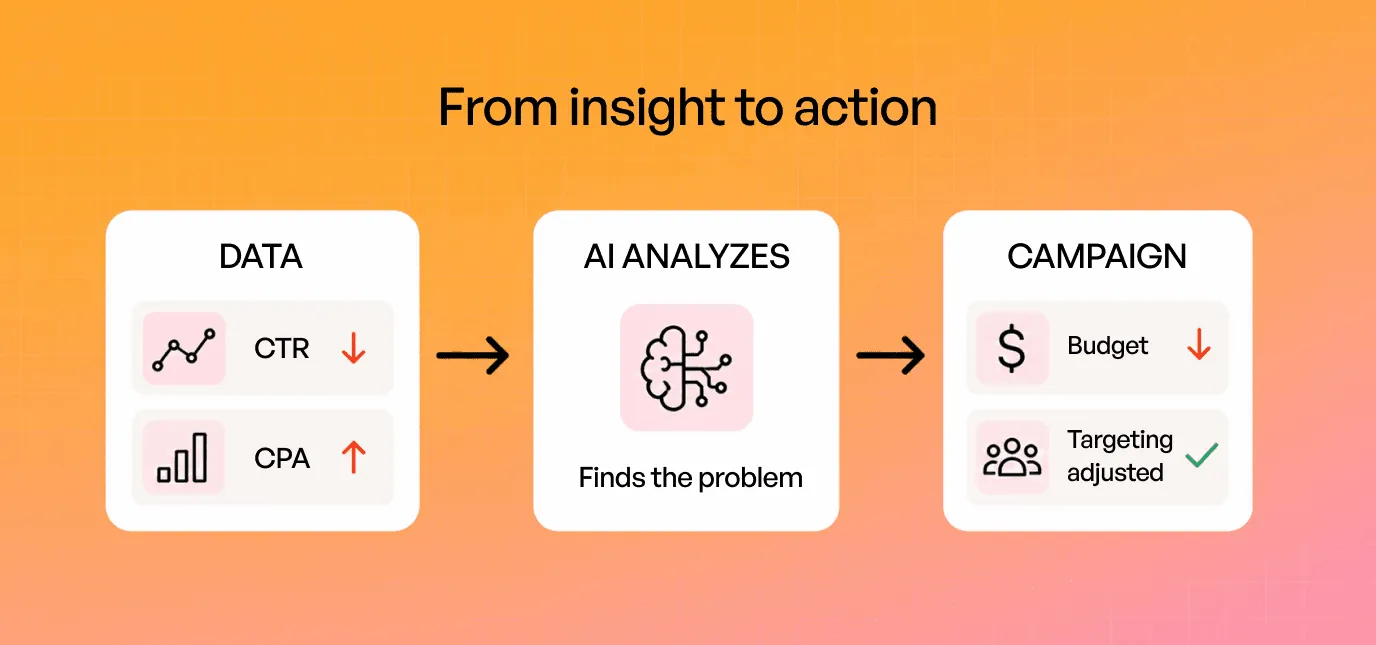
From insight to action

This rung executes. These platforms make changes in your ad accounts, pausing and scaling, shifting budget, adjusting bids and targeting, either on rules you write or through their own optimization models. A couple of them have started bolting creative generation onto the side, which is where the line to rung three begins to blur.

Madgicx

Madgicx is a Meta-focused AI campaign manager that positions itself as a personal ad agency for Facebook and Instagram. Its AI Marketer audits your account and tells you what to change, while the centerpiece, an Autonomous Budget Optimizer, uses a rules engine layered with machine-learning signals from the Meta Marketing API to shift budget toward winners and pause losers in near real time. It also generates creative: a Meta Ad Creative Optimizer and Automated Ad Launch produce net-new AI images and copy and push them straight into Meta Ads Manager in one click, with a Creative Tracker to scale what works. That combination pulls it toward the top rung, with two honest limits: the creative step is triggered by a user prompt rather than kicked off on its own when an ad dies, and the generator makes mostly static images and edits, not video, UGC, or talking-head creative.

Revealbot (Birch)

Revealbot, rebranded Birch in late 2024, is the choice for teams that want transparent, rule-based automation across Meta, Google, TikTok, and Snapchat from one interface. You write multi-condition rules with AND/OR logic and custom metric comparisons, "pause the ad if CPA goes above $40," "scale the budget 20% if ROAS holds," and it executes them 24/7 across bids, budgets, pausing, and audience rotation. It also handles bulk editing across hundreds of ads at once and automated reporting into Slack. It rewards experienced media buyers who prefer to codify their own playbook over trusting a black box, and it will bulk-launch and duplicate the assets you give it, but it does not create new ones. Pricing starts around $49 a month and scales with spend.

Smartly

Smartly is the enterprise end of paid social, unifying creative, media, and measurement in one platform that runs across Meta, TikTok, Pinterest, Snap, Google, YouTube, Reddit, Spotify, and connected TV. Its AI Studio generates dynamic creative variants that adapt messaging, visuals, and calls-to-action by audience, product, market, language, and device while holding brand consistency, and Smartly reports it has produced millions of assets with meaningful lifts over static creative. On the media side it pairs that with predictive budget allocation and real-time optimization, all wrapped in the brand-safety, approval, and governance controls large advertisers require. It comes closer than most on this rung to closing the loop, but its generation leans on dynamic templates and variants rather than producing net-new concepts to replace dead ads on its own, which is why it sits here. It's built for high-volume advertisers, generally those spending upward of $50,000 a month with big product catalogs.

Skai

Skai, formerly Kenshoo, is an enterprise commerce-media suite that manages campaigns across 100-plus retailers like Amazon, Walmart, Target, and Instacart alongside paid search and social, all from one login. Its Celeste AI agent, a generative agent built for commerce marketers, delivers budget recommendations, bidding-strategy insight, cross-channel performance comparisons, and anomaly detection that explains not just what moved but why. Its strength is omnichannel breadth tied to retailer data and digital-shelf signals, and early users report meaningful efficiency and performance gains. It's a media management and optimization engine, not a creative generator.

Optmyzr

Optmyzr is a search ads analytics and PPC optimization suite for Google, Microsoft, and Amazon Ads, built for hands-on managers who want automation without writing scripts. It's the closest thing on this list to classic adwords analysis software, updated for how Google Ads works today. Its Rule Engine offers a visual builder, a preview step before any change goes live, and version history, so you can design and test custom optimization strategies at scale with full control. On bidding it layers on top of Google's Smart Bidding to tune Target CPA and Target ROAS, letting you reset bids hourly through monthly with prebuilt, tweakable rules. It also generates and refines responsive search ads, assets, and extensions with AI suggestions, and runs account-structure audits, all pointed at search rather than net-new social or video creative.

Albert.ai

Albert.ai, now Albert by Zoomd, is a fully autonomous cross-channel media buyer for enterprise advertisers. Rather than assisting a marketer, it takes control of execution across paid search, social, programmatic, and YouTube at once, continuously analyzing performance and adjusting bids, reallocating budgets, refining audiences, and running multivariate tests, with guardrails tied to your business goals and minimal human intervention. It rotates and tests creative as part of that loop, but its core is autonomous buying and optimization rather than generating net-new assets from scratch, which is why it lands on this rung. It's aimed at large teams and agencies managing substantial budgets across many channels.

Ryze AI

Ryze AI is an autonomous optimizer that runs continuously across Google and Meta, and in places TikTok and LinkedIn, tuning bids, budgets, and targeting on its own rather than handing you a list of changes to make. Independent reviews frame it as one of the few tools that executes campaign changes autonomously under human approval, and by some accounts it also generates ad copy and visuals as part of its agent workflow. Treat the creative-generation claim as the fuzzier part of its pitch; the solid, agreed-on capability is autonomous campaign management. The common thread on this whole rung is that the software moves real money on its own, and a few, Madgicx especially, are starting to reach up into the top rung.

Read also: Best ad testing platforms in 2026: what each one is good for

Rung 3: agents that close the loop

This is the newest and thinnest rung, and it's worth defining strictly because the marketing here is loose. A true closed-loop system has to do two things in one place: generate brand-new creative, actual new video or images rather than recombinations of assets you already uploaded, and then put it into live campaigns to replace the underperformers. Most tools that advertise "closing the loop" are really rung-two systems with a creative-assembly feature bolted on, and remixing existing elements or spinning dynamic templates is not the same as generating a fresh ad to replace a dead one. One honest caveat applies to every tool here, ours included: none run fully unattended. Brand-safety risk and the ad platforms' own rules mean a human approval step is standard, so "autonomous" in practice means the software does the heavy lifting and a person signs off, not that it spends your budget with nobody watching.

Versaunt

Versaunt is an autonomous ad platform built around two engines. Its Nova engine takes a product URL and generates on-brand video and image ads ready to deploy, without needing a product feed. Its Singularity engine then runs the loop: it continuously monitors live campaigns across Meta, TikTok, YouTube, and LinkedIn, identifies underperforming creatives, and automatically regenerates new optimized versions from real-time performance data, routing budget as it goes. That generate-then-regenerate cycle is the clearest example of the closed loop among the named tools, aimed at teams that want ads that keep evolving rather than being rebuilt by hand.

Pencil

Pencil, part of the Brandtech Group, sits at the generation-and-prediction end of the loop. Through a chat-based interface it turns a product URL or feed into 10 to 20 video variants in minutes, each carrying a Pencil Score that predicts performance before launch, drawn from a model trained on more than a billion dollars of ad spend across thousands of brands. Connect your Meta account and it tunes those predictions to your own history, then publishes winners straight into Meta Ads Manager without a download-and-reupload step. It's strongest on generating and pre-scoring net-new creative and pushing it live; the ongoing bid-and-budget optimization is lighter than a dedicated autonomous buyer.

Creatify Performance Agent
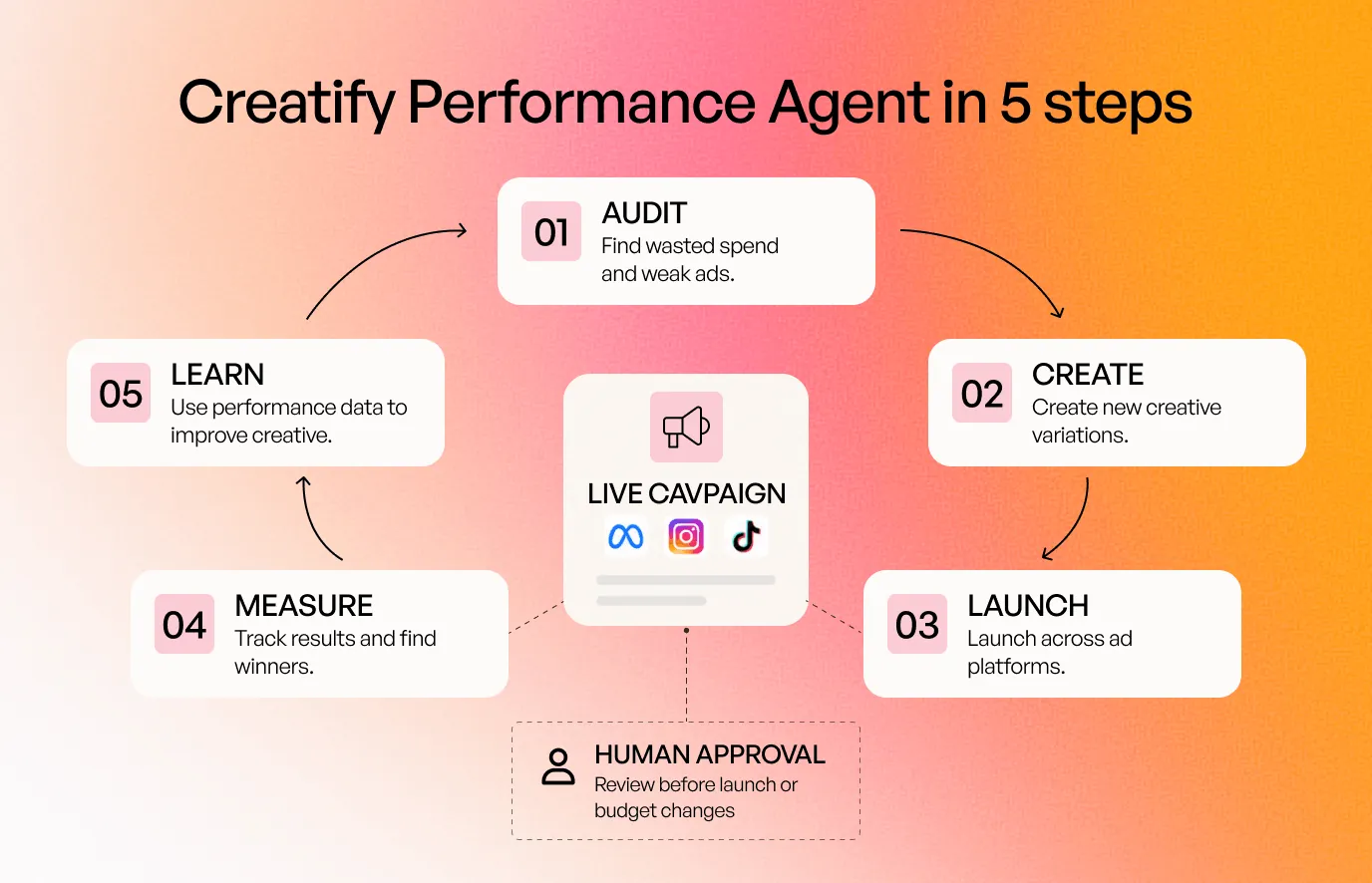
Creatify Performance Agent

Creatify’s Performance Agent sits in this group, and we'll be specific about what it does rather than wave at "closing the loop." It connects your accounts across Meta, Google, TikTok, Snap, AppLovin, and OpenAI Ads, plus Shopify and GA4 for context, with MCP connectors for tools like Slack, Notion, and Sheets so its decisions draw on your real business data. It starts by auditing spend, reading every campaign to flag wasted budget and point to where to cut and where to scale. Then, through a built-in creative engine, it generates net-new video and image ads, launches them, measures the results, and feeds what it learns into the next round, all inside one chat. In other words, the ad analysis and the production of the next ad happen in the same place. It watches competitor ad strategies, runs around the clock, and compounds: reading your account in week one, learning your winning hooks and pacing by week two, and by the end of the first month flagging fatigue before it hits and scaling winners before you ask. It's powered by Claude, and the numbers are ours to prove: a 94% win rate against leading AI ad tools in our own testing, under a minute from brief to a live campaign, and a 4.8 out of 5 across more than a thousand G2 reviews. We think the closed loop is where ad tooling is heading, and we're one of a handful of teams building it, not the only one.

Which rung of ad analysis tools do you need

The trap is buying up the ladder when your bottleneck is lower down, or the reverse. If your problem is that you can't see clearly what's working, you need rung one, and a dashboard or attribution tool solves it cheaply. If you can see fine but your team is drowning in manual bid and budget changes, rung two is the fix, and an optimizer will earn its keep. Only if your real constraint is creative, if winners keep fatiguing faster than your team can produce replacements, does rung three pay off, because that's the specific bottleneck a closed-loop agent removes. Match the tool to the job in front of you, not to the most impressive demo.

Read also: How to do competitor ad analysis: a 7-step framework for 2026

Frequently Asked Questions

What's the difference between an ad analytics dashboard and an optimizer?

A dashboard reports: it shows you performance, creative fatigue, or attribution, and then a human decides what to do. An optimizer acts: it changes bids, budgets, and targeting in your live accounts, either on rules you set or through its own models. Analytics tools like Motion or Triple Whale sit on the first rung; optimizers like Madgicx, Revealbot, or Skai sit on the second.

What does "close the loop" mean for ad tools?

Closing the loop means one system handles the full cycle: it measures performance, decides what's failing, generates net-new creative to replace it, and launches that creative, then measures again. The key word is "generate." Many tools automate the buying and analysis but still depend on humans, or on recombining existing assets, for the creative step, which leaves the loop open.

Do any tools really generate replacement creative automatically?

A small, growing set are, including Versaunt, Pencil, Madgicx, and our own Performance Agent. Two caveats matter, though. Most platforms that claim it are really assembling variations from assets you already provided or spinning dynamic templates, which is not the same as producing a brand-new ad. And even the genuine ones keep a human approval step rather than running fully unattended, partly because Meta and Google limit hands-off asset creation and deployment. Test any "closed-loop" claim against a live account before committing.

Creative analytics or attribution, which do I need?

They answer different questions. Creative analytics, from tools like Motion or VidMob, tells you which hook, format, or concept is working, so it's for improving the ads themselves. Attribution, from tools like Triple Whale or Northbeam, tells you which channel or campaign earned the revenue, so it's for allocating budget. If your creative is the weak point, start with analytics; if you're unsure where sales come from, start with attribution. Larger teams usually run both.

Can one tool replace my whole stack?

Sometimes, but only if your needs sit mostly on one rung. A closed-loop agent can cover analysis, optimization, and creation for teams whose main constraint is shipping and testing creative fast. Teams with heavy enterprise reporting or attribution needs often still pair a rung-one analytics layer with an execution tool. The honest answer is to map your bottleneck first, then see how many rungs one tool genuinely covers rather than how many it lists on a feature page.

Most tools filed under "ad analytics" do one thing: they tell you what already happened. A smaller set goes further and acts on it, adjusting bids and budgets in your live accounts. And a rare few close the entire loop, generating the replacement creative when an ad fatigues and pushing it live with far less hand-holding. Those are three genuinely different jobs, and a lot of buying decisions go wrong because a team picks a tool from the wrong rung. This roundup sorts the field by how much of the loop each tool closes, digs into what each one actually does, and links every one, so you can match the tool to your real bottleneck.

The three rungs of ad automation

The three rungs of ad automation

Think of it as a ladder. Rung one is ad analysis: dashboards, creative analytics, and attribution that report performance but take no action. Rung two is execution: platforms that connect your data and then run and optimize the ads, changing bids, budgets, and targeting on their own. Rung three is the closed loop: systems that also generate net-new creative to replace losing ads and launch it, so measurement feeds production feeds measurement again. The higher the rung, the more of the work the software does, and the fewer tools genuinely operate there.

Rung 1: tools that analyze, and stop there

Rung1 tools that analyze and stop there

Everything on this rung is a reporting layer. It makes your data legible; it does not touch your campaigns. Within it there are three flavors: creative and ad copy analysis tools, which organize performance around the ad itself; data pipes, which move your numbers into a warehouse or dashboard; and attribution, which works out what drove the sale.

Motion

Motion is the popular pick for creative analytics on paid social. It connects your ad accounts across Meta, TikTok, YouTube, and LinkedIn and ties performance back to the creative behind each ad: the hook, the format, the messaging angle, the talent. It scores creative on a Hook, Watch, Click, and Conversion funnel and auto-tags ads at scale across a fixed set of dimensions, so patterns across hooks, formats, creators, and angles surface without manual sorting. Its AI Tasks run one-click workflows to analyze top performers, review how diverse your creative mix is, or suggest what to make next, and an Agent Chat lets you interrogate any report in plain language. The main gap to know about is that it doesn't proactively alert you when a creative starts to decline, so fatigue shows up when you check the dashboard rather than before. Pricing runs from roughly $150 a month for small teams up to several hundred for agencies, with custom plans for the biggest spenders.

VidMob

VidMob is the enterprise-grade version of creative intelligence, aimed at brands and agencies that want a quality gate rather than just a report. Its AI analyzes each ad frame by frame with computer vision, scoring individual elements, color, motion, text placement, facial expressions, against historical performance so it can predict likely click-through, view-through, and conversion before an ad goes live. The workflow is built around that score: a team uploads a finished creative, gets an instant read, and anything falling below a set threshold can be automatically flagged or held back from launch, which keeps weak assets from burning media budget. A Creative Scoring API lets larger organizations pipe those scores straight into their own asset-management systems or dashboards. It advises the creative team; the actual edits still happen in human hands or a connected design workflow.

Supermetrics

Supermetrics is a data pipe, not a dashboard. It works as a pass-through extraction layer that pulls performance data from your ad platforms and pushes it straight into Google Sheets, Looker, BigQuery, or Snowflake, without storing the data itself. That makes it fast and comparatively cheap, and the right pick if you already have a BI stack and just need marketing data flowing into it reliably. The trade-off is that it does light transformation and standardized outputs rather than deep custom modeling, so the ad analysis still happens wherever your data lands.

Funnel.io

Funnel.io solves the same job as a managed data hub rather than a pipe. Instead of passing data straight through, it ingests everything into its own storage layer first, where it cleans, normalizes, and maps it before feeding curated data to your destinations. With 500-plus connectors and stronger transformation than a pure extractor, it fits teams that want broad channel coverage and governed, business-ready data without building the plumbing themselves.

Improvado

Improvado is the enterprise end of the data-pipe category, centralizing collection, transformation, visualization, and governance in one platform. It carries 1,000-plus connectors, writes to your warehouse, standardizes messy platform taxonomies, and layers AI-assisted insights on top. What separates it at this tier is service: contracts include customization credits, professional services, and a dedicated success manager who builds custom connectors and tunes the pipeline for you, which is why it lands with large organizations rather than small teams.

Triple Whale

Triple Whale is the analytics operating system for Shopify direct-to-consumer brands, pulling attribution, profit, lifetime value, and creative performance into one view. Its Triple Pixel does server-side tracking that captures conversions even when browser tracking fails, and its Sonar layer enriches those signals back to Meta, Google, TikTok, and Klaviyo to improve match rates and platform optimization. The Creative Cockpit breaks results down to the individual asset, image, copy variant, video, so creative teams can see what to scale and what to cut, and a built-in AI agent called Moby answers questions and runs automations on the data. It connects to Shopify and the major ad channels in about 15 minutes for the core setup, with the deeper features taking a few weeks to dial in.

Northbeam

Northbeam is an independent measurement platform for DTC and ecommerce brands that want a neutral read on how paid media turns into revenue. It runs on three parts: multi-touch attribution that uses a first-party pixel, direct API connections, and machine learning to assign fractional credit across every touchpoint; media-mix modeling that estimates the incremental contribution of each channel, including hard-to-track ones like connected TV, podcasts, and out-of-home; and Northbeam Apex, which pushes attribution signals back to the ad platforms to improve their delivery. Its edge over legacy measurement is speed, refreshing daily or near-real-time rather than on weekly or monthly cycles. It suits higher-consideration products and longer sales cycles, and it starts around $1,500 a month, so it's aimed at brands with real scale.

Rung 2: paid ads analytics tools that connect your data and run your ads

From insight to action

This rung executes. These platforms make changes in your ad accounts, pausing and scaling, shifting budget, adjusting bids and targeting, either on rules you write or through their own optimization models. A couple of them have started bolting creative generation onto the side, which is where the line to rung three begins to blur.

Madgicx

Madgicx is a Meta-focused AI campaign manager that positions itself as a personal ad agency for Facebook and Instagram. Its AI Marketer audits your account and tells you what to change, while the centerpiece, an Autonomous Budget Optimizer, uses a rules engine layered with machine-learning signals from the Meta Marketing API to shift budget toward winners and pause losers in near real time. It also generates creative: a Meta Ad Creative Optimizer and Automated Ad Launch produce net-new AI images and copy and push them straight into Meta Ads Manager in one click, with a Creative Tracker to scale what works. That combination pulls it toward the top rung, with two honest limits: the creative step is triggered by a user prompt rather than kicked off on its own when an ad dies, and the generator makes mostly static images and edits, not video, UGC, or talking-head creative.

Revealbot (Birch)

Revealbot, rebranded Birch in late 2024, is the choice for teams that want transparent, rule-based automation across Meta, Google, TikTok, and Snapchat from one interface. You write multi-condition rules with AND/OR logic and custom metric comparisons, "pause the ad if CPA goes above $40," "scale the budget 20% if ROAS holds," and it executes them 24/7 across bids, budgets, pausing, and audience rotation. It also handles bulk editing across hundreds of ads at once and automated reporting into Slack. It rewards experienced media buyers who prefer to codify their own playbook over trusting a black box, and it will bulk-launch and duplicate the assets you give it, but it does not create new ones. Pricing starts around $49 a month and scales with spend.

Smartly

Smartly is the enterprise end of paid social, unifying creative, media, and measurement in one platform that runs across Meta, TikTok, Pinterest, Snap, Google, YouTube, Reddit, Spotify, and connected TV. Its AI Studio generates dynamic creative variants that adapt messaging, visuals, and calls-to-action by audience, product, market, language, and device while holding brand consistency, and Smartly reports it has produced millions of assets with meaningful lifts over static creative. On the media side it pairs that with predictive budget allocation and real-time optimization, all wrapped in the brand-safety, approval, and governance controls large advertisers require. It comes closer than most on this rung to closing the loop, but its generation leans on dynamic templates and variants rather than producing net-new concepts to replace dead ads on its own, which is why it sits here. It's built for high-volume advertisers, generally those spending upward of $50,000 a month with big product catalogs.

Skai

Skai, formerly Kenshoo, is an enterprise commerce-media suite that manages campaigns across 100-plus retailers like Amazon, Walmart, Target, and Instacart alongside paid search and social, all from one login. Its Celeste AI agent, a generative agent built for commerce marketers, delivers budget recommendations, bidding-strategy insight, cross-channel performance comparisons, and anomaly detection that explains not just what moved but why. Its strength is omnichannel breadth tied to retailer data and digital-shelf signals, and early users report meaningful efficiency and performance gains. It's a media management and optimization engine, not a creative generator.

Optmyzr

Optmyzr is a search ads analytics and PPC optimization suite for Google, Microsoft, and Amazon Ads, built for hands-on managers who want automation without writing scripts. It's the closest thing on this list to classic adwords analysis software, updated for how Google Ads works today. Its Rule Engine offers a visual builder, a preview step before any change goes live, and version history, so you can design and test custom optimization strategies at scale with full control. On bidding it layers on top of Google's Smart Bidding to tune Target CPA and Target ROAS, letting you reset bids hourly through monthly with prebuilt, tweakable rules. It also generates and refines responsive search ads, assets, and extensions with AI suggestions, and runs account-structure audits, all pointed at search rather than net-new social or video creative.

Albert.ai

Albert.ai, now Albert by Zoomd, is a fully autonomous cross-channel media buyer for enterprise advertisers. Rather than assisting a marketer, it takes control of execution across paid search, social, programmatic, and YouTube at once, continuously analyzing performance and adjusting bids, reallocating budgets, refining audiences, and running multivariate tests, with guardrails tied to your business goals and minimal human intervention. It rotates and tests creative as part of that loop, but its core is autonomous buying and optimization rather than generating net-new assets from scratch, which is why it lands on this rung. It's aimed at large teams and agencies managing substantial budgets across many channels.

Ryze AI

Ryze AI is an autonomous optimizer that runs continuously across Google and Meta, and in places TikTok and LinkedIn, tuning bids, budgets, and targeting on its own rather than handing you a list of changes to make. Independent reviews frame it as one of the few tools that executes campaign changes autonomously under human approval, and by some accounts it also generates ad copy and visuals as part of its agent workflow. Treat the creative-generation claim as the fuzzier part of its pitch; the solid, agreed-on capability is autonomous campaign management. The common thread on this whole rung is that the software moves real money on its own, and a few, Madgicx especially, are starting to reach up into the top rung.

Read also: Best ad testing platforms in 2026: what each one is good for

Rung 3: agents that close the loop

This is the newest and thinnest rung, and it's worth defining strictly because the marketing here is loose. A true closed-loop system has to do two things in one place: generate brand-new creative, actual new video or images rather than recombinations of assets you already uploaded, and then put it into live campaigns to replace the underperformers. Most tools that advertise "closing the loop" are really rung-two systems with a creative-assembly feature bolted on, and remixing existing elements or spinning dynamic templates is not the same as generating a fresh ad to replace a dead one. One honest caveat applies to every tool here, ours included: none run fully unattended. Brand-safety risk and the ad platforms' own rules mean a human approval step is standard, so "autonomous" in practice means the software does the heavy lifting and a person signs off, not that it spends your budget with nobody watching.

Versaunt

Versaunt is an autonomous ad platform built around two engines. Its Nova engine takes a product URL and generates on-brand video and image ads ready to deploy, without needing a product feed. Its Singularity engine then runs the loop: it continuously monitors live campaigns across Meta, TikTok, YouTube, and LinkedIn, identifies underperforming creatives, and automatically regenerates new optimized versions from real-time performance data, routing budget as it goes. That generate-then-regenerate cycle is the clearest example of the closed loop among the named tools, aimed at teams that want ads that keep evolving rather than being rebuilt by hand.

Pencil

Pencil, part of the Brandtech Group, sits at the generation-and-prediction end of the loop. Through a chat-based interface it turns a product URL or feed into 10 to 20 video variants in minutes, each carrying a Pencil Score that predicts performance before launch, drawn from a model trained on more than a billion dollars of ad spend across thousands of brands. Connect your Meta account and it tunes those predictions to your own history, then publishes winners straight into Meta Ads Manager without a download-and-reupload step. It's strongest on generating and pre-scoring net-new creative and pushing it live; the ongoing bid-and-budget optimization is lighter than a dedicated autonomous buyer.

Creatify Performance Agent

Creatify Performance Agent

Creatify’s Performance Agent sits in this group, and we'll be specific about what it does rather than wave at "closing the loop." It connects your accounts across Meta, Google, TikTok, Snap, AppLovin, and OpenAI Ads, plus Shopify and GA4 for context, with MCP connectors for tools like Slack, Notion, and Sheets so its decisions draw on your real business data. It starts by auditing spend, reading every campaign to flag wasted budget and point to where to cut and where to scale. Then, through a built-in creative engine, it generates net-new video and image ads, launches them, measures the results, and feeds what it learns into the next round, all inside one chat. In other words, the ad analysis and the production of the next ad happen in the same place. It watches competitor ad strategies, runs around the clock, and compounds: reading your account in week one, learning your winning hooks and pacing by week two, and by the end of the first month flagging fatigue before it hits and scaling winners before you ask. It's powered by Claude, and the numbers are ours to prove: a 94% win rate against leading AI ad tools in our own testing, under a minute from brief to a live campaign, and a 4.8 out of 5 across more than a thousand G2 reviews. We think the closed loop is where ad tooling is heading, and we're one of a handful of teams building it, not the only one.

Which rung of ad analysis tools do you need

The trap is buying up the ladder when your bottleneck is lower down, or the reverse. If your problem is that you can't see clearly what's working, you need rung one, and a dashboard or attribution tool solves it cheaply. If you can see fine but your team is drowning in manual bid and budget changes, rung two is the fix, and an optimizer will earn its keep. Only if your real constraint is creative, if winners keep fatiguing faster than your team can produce replacements, does rung three pay off, because that's the specific bottleneck a closed-loop agent removes. Match the tool to the job in front of you, not to the most impressive demo.

Read also: How to do competitor ad analysis: a 7-step framework for 2026

Frequently Asked Questions

What's the difference between an ad analytics dashboard and an optimizer?

A dashboard reports: it shows you performance, creative fatigue, or attribution, and then a human decides what to do. An optimizer acts: it changes bids, budgets, and targeting in your live accounts, either on rules you set or through its own models. Analytics tools like Motion or Triple Whale sit on the first rung; optimizers like Madgicx, Revealbot, or Skai sit on the second.

What does "close the loop" mean for ad tools?

Closing the loop means one system handles the full cycle: it measures performance, decides what's failing, generates net-new creative to replace it, and launches that creative, then measures again. The key word is "generate." Many tools automate the buying and analysis but still depend on humans, or on recombining existing assets, for the creative step, which leaves the loop open.

Do any tools really generate replacement creative automatically?

A small, growing set are, including Versaunt, Pencil, Madgicx, and our own Performance Agent. Two caveats matter, though. Most platforms that claim it are really assembling variations from assets you already provided or spinning dynamic templates, which is not the same as producing a brand-new ad. And even the genuine ones keep a human approval step rather than running fully unattended, partly because Meta and Google limit hands-off asset creation and deployment. Test any "closed-loop" claim against a live account before committing.

Creative analytics or attribution, which do I need?

They answer different questions. Creative analytics, from tools like Motion or VidMob, tells you which hook, format, or concept is working, so it's for improving the ads themselves. Attribution, from tools like Triple Whale or Northbeam, tells you which channel or campaign earned the revenue, so it's for allocating budget. If your creative is the weak point, start with analytics; if you're unsure where sales come from, start with attribution. Larger teams usually run both.

Can one tool replace my whole stack?

Sometimes, but only if your needs sit mostly on one rung. A closed-loop agent can cover analysis, optimization, and creation for teams whose main constraint is shipping and testing creative fast. Teams with heavy enterprise reporting or attribution needs often still pair a rung-one analytics layer with an execution tool. The honest answer is to map your bottleneck first, then see how many rungs one tool genuinely covers rather than how many it lists on a feature page.

Icon
Icon

Ready to turn your product into an engaging video?

Ready to speed up your marketing?

Test your new product ideas in minutes with AI-generated video ads

Arrow icon.
Gradient

Ready to speed up your marketing?

Test your new product ideas in minutes with AI-generated video ads

Arrow icon.
Gradient

Ready to speed up your marketing?

Test your new product ideas in minutes with AI-generated video ads

Arrow icon.
Gradient

Ready to speed up your marketing?

Test your new product ideas in minutes with AI-generated video ads

Arrow icon.
Gradient
background