
In November 2025, AdExchanger reported that some advertisers were seeing Meta campaigns spend 150% or more of their daily budget in the first hour, often between 1 and 2 a.m. Others said conversion campaigns were bringing in reach-style traffic at around $10 CPMs. One advertiser described an AI price and promo feature, switched on without being asked, advertising a "100% off" deal built from codes the account had made for comped gifts. Meta said it had fixed technical bugs and saw no further concerning trends.
Even so, a huge amount of spend now runs through that automation. Meta's Advantage+ end-to-end solutions passed a $75 billion annual revenue run-rate in Q2 2026. So the useful question about ad management is which decisions you hand to software, and which ones stay with you.
This guide covers what an ad management platform is, what the ad networks already automate on their own, what third-party ad management software adds, and a simple way to decide what to automate.
What is an ad management platform?
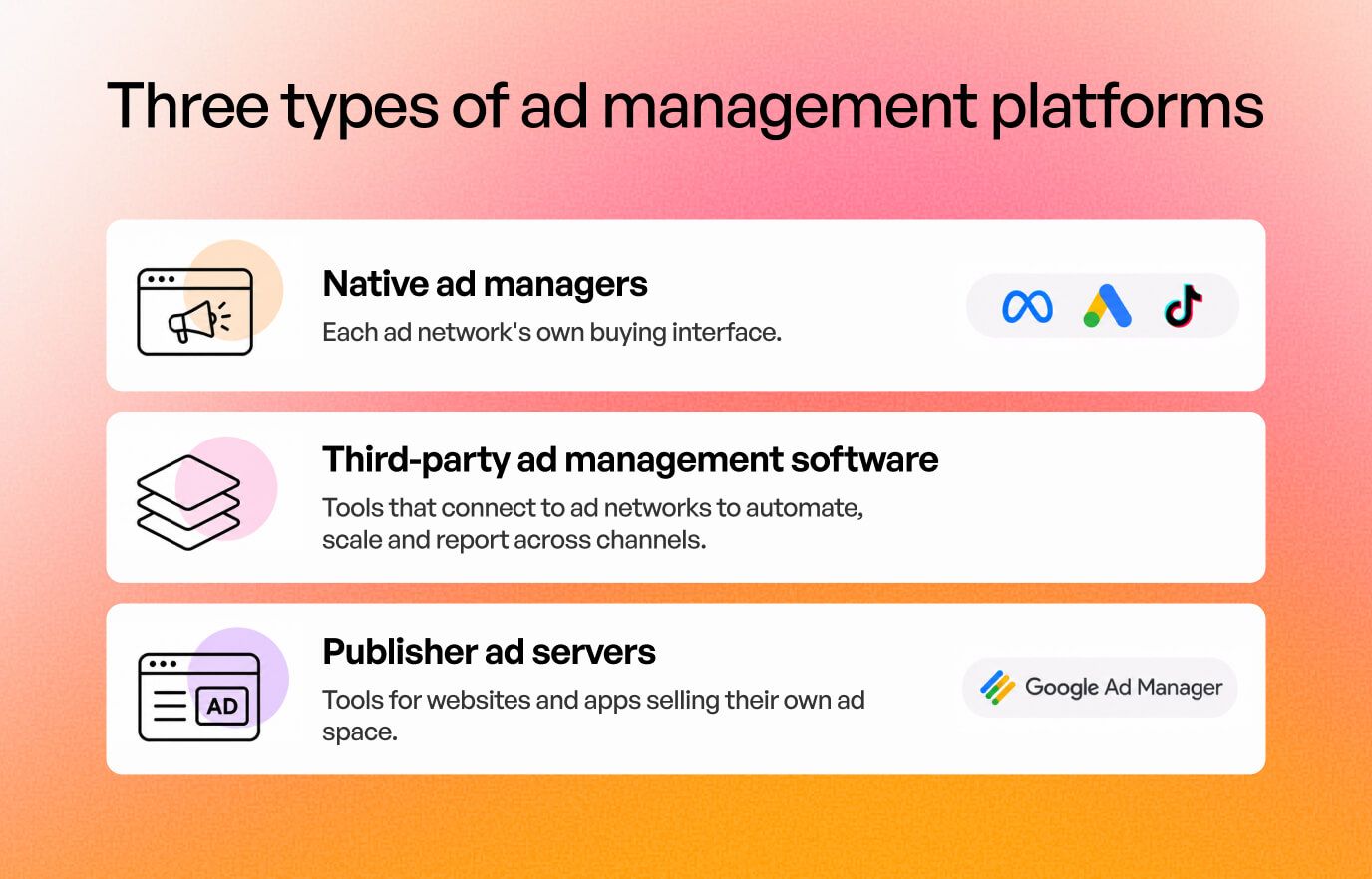
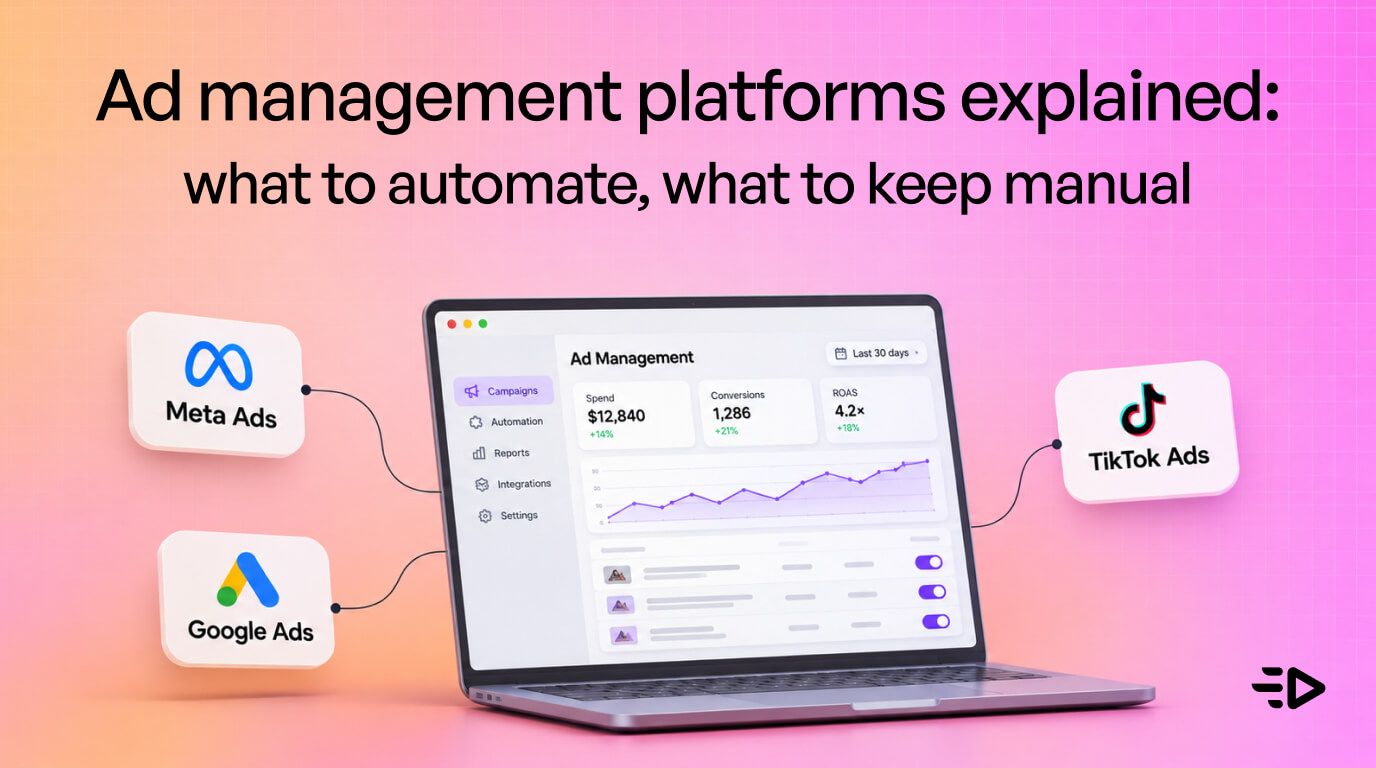
An ad management platform (sometimes called an advertising management platform) is software for planning, launching, optimizing and reporting on paid ads. The term covers three different kinds of tools, and they get mixed up a lot:
Native ad managers: Meta Ads Manager, Google Ads and TikTok Ads Manager are each network's own buying interface. Every advertiser uses at least one.
Third-party ad management software: tools that connect to those networks through their APIs to launch ads in bulk, run rules, manage bids, build reports across channels, or run the account with an AI agent.
Publisher ad servers: Google Ad Manager calls itself "an ad management platform for large publishers who have significant direct sales." It's for websites and apps selling their own ad space. If you're buying ads, you want Google Ads.
The rest of this guide is about the first two, the tools advertisers use.
Read more: Best Social Media Advertising Tools
What Meta, Google and TikTok already automate
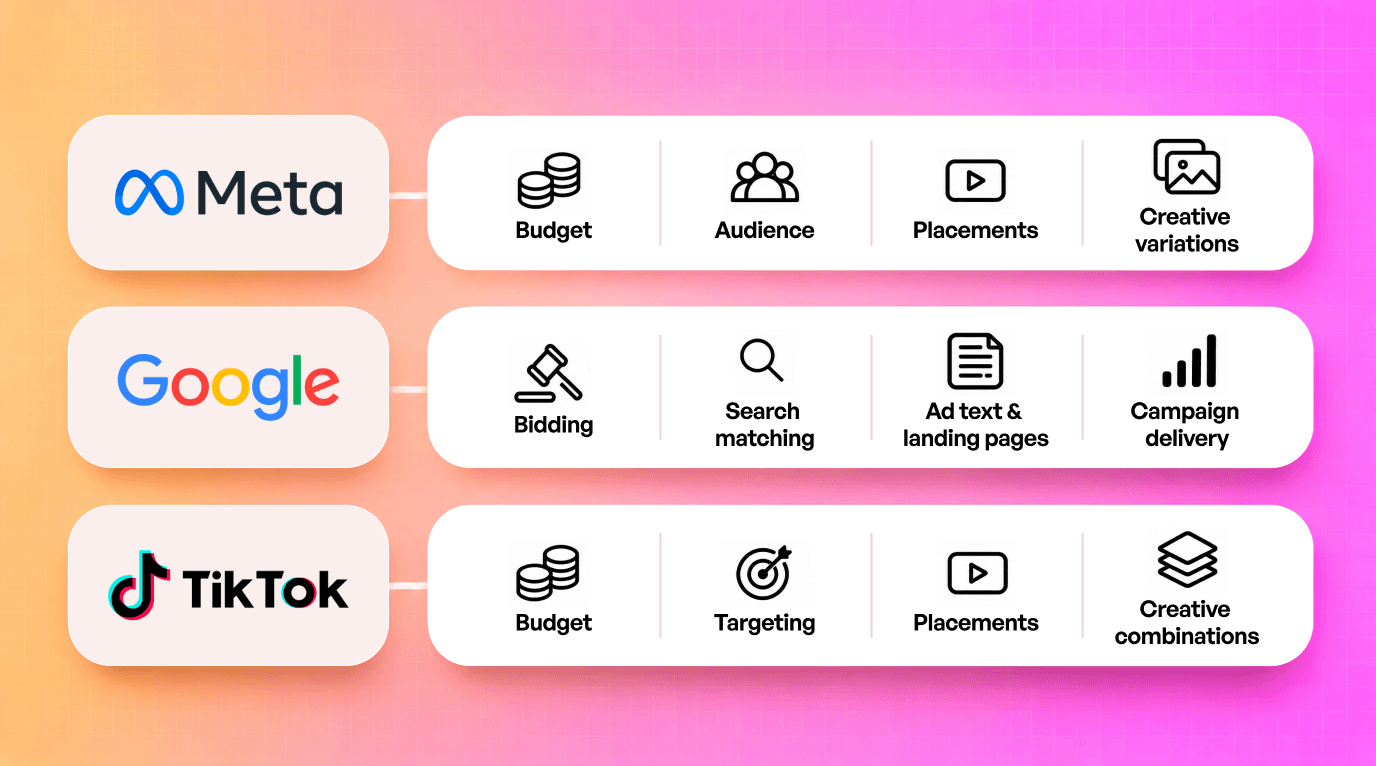
Before paying for any tool, it helps to know how much the networks now do by default. Quite a lot:
Platform | Automation products | What the system decides |
|---|---|---|
Meta | Advantage+ sales, app and leads campaigns | Budget across ad sets, audience, placements, and (if enabled) creative variations |
Performance Max (campaign type) | Delivery across Google's channels toward your conversion goals | |
AI Max for Search (Search feature suite) | Search term matching, ad text and landing pages, when turned on | |
Smart Bidding (bid strategies) | The bid in every auction | |
TikTok | Smart+ | Budget, audience, placements, and which creative combinations run (up to 50 creatives and 5 texts per ad group) |
On Meta, a campaign counts as Advantage+ "on" when three levers are automated: campaign budget, audience and placements. Since 2025, new sales, app and leads campaigns start in that setup by default, and overriding those three settings takes a campaign out of Advantage+.
In April 2025, Google said over 1 million advertisers use Performance Max. AI Max for Search, launched in 2025, adds keywordless matching, AI-written ad text and final URL expansion to regular Search campaigns.
TikTok's Smart+ went the other way in October 2025: you can now automate targeting, budget and creative module by module instead of all or nothing.
The networks also hand back controls when advertisers ask for them. In April 2025, Google announced channel-level reporting and full search terms reporting for Performance Max, calling channel reporting a "top-requested feature," alongside controls like campaign-level negative keywords and brand exclusions.
Read more: How to Optimize Meta, Google and TikTok Ads Automatically With AI
What third-party ad management software adds
If the networks automate this much, what's left for an outside tool? Mostly the things a single network can't do for you: working across channels, enforcing your own rules, and saving hours of manual setup.
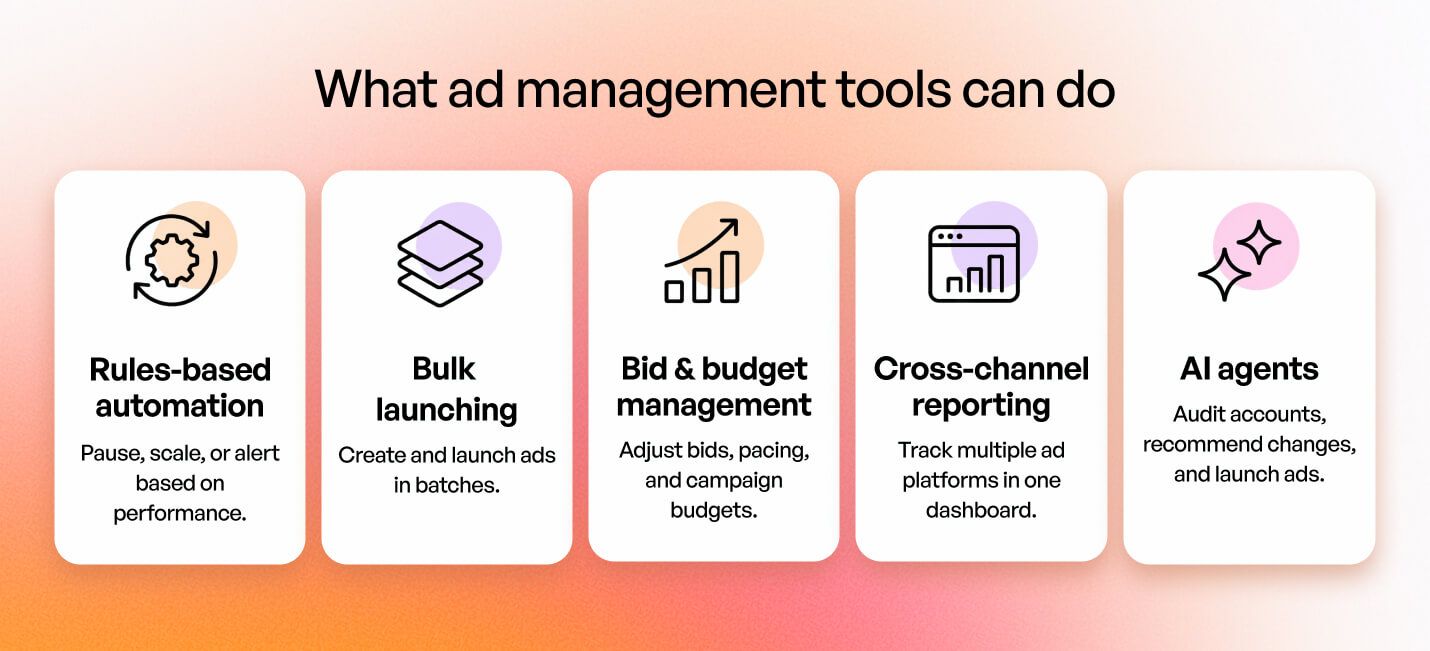
Category | What it automates | Examples (starting price, from vendor pages) |
|---|---|---|
Rules-based automation | Pause, scale or alert when a metric crosses a threshold | Bïrch, formerly Revealbot (from $49/mo for up to $10K monthly spend, rules on the $99 plan) |
Bulk launching | Building and uploading hundreds of ads and variations at once | AdManage.ai (from £199.99/mo for one ad account), AdEspresso for Meta and Instagram (from $49/mo up to $1,000 monthly spend; bulk creation on the $99 plan) |
Bid and budget management | Bid adjustments, pacing, budget shifts across campaigns | Optmyzr (priced by spend tier), Marin (data connectivity from $500/mo; optimization plans cost more) |
Cross-channel reporting | One dashboard across Meta, Google, TikTok and more | Most tools above; HubSpot Ads ties ads to CRM data (free for up to 3 ad accounts, with limited features) |
Enterprise platforms | Creative production, media and measurement for large budgets | Smartly (sales-led pricing), Skai (from $114K/year for up to $4M annual spend) |
AI agents | Auditing the account, recommending changes, launching ads | Madgicx (Meta-focused), Creatify's Ad Agent, and AI assistants in Skai, Optmyzr and Bïrch |
A note on vendor stability: Marin Software, one of the oldest names in PPC management software, filed for Chapter 11 in July 2025 and now runs under new ownership. Before moving your whole account workflow into a tool, check how easily you can move it back out.
What to automate in ad management
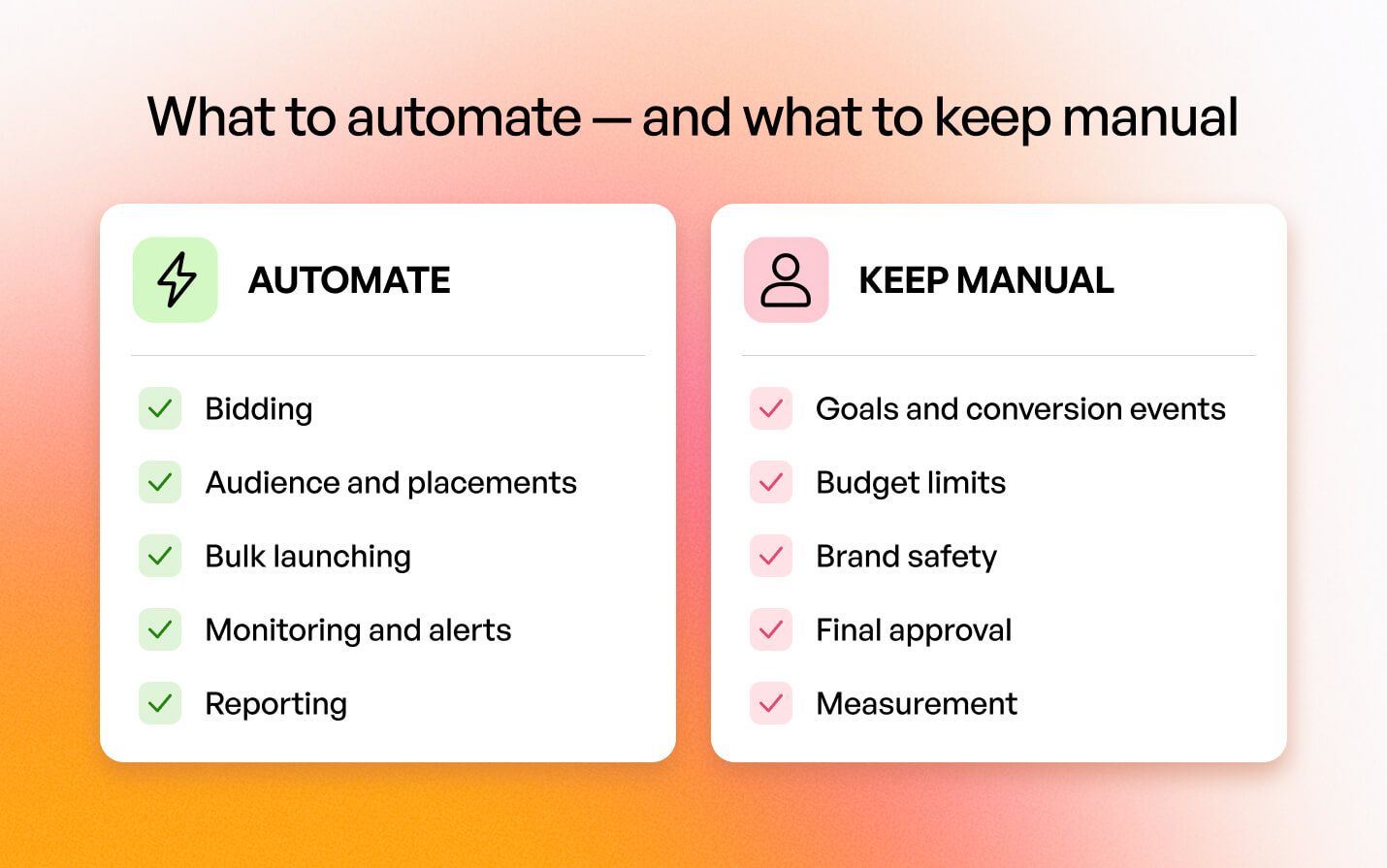
Automation works best on decisions that happen often, follow clear signals, and are easy to undo.
Bidding inside a campaign: Smart Bidding sets a bid for every auction using signals like device, location, time and the search query. No human can match that per-auction speed.
Placements and audience expansion: automated delivery can test placements and audiences beyond the ones you'd pick by hand. Judge it on conversion quality and cost, since broader reach doesn't always mean better customers.
Bulk launching and variations: uploading 40 ad variations by hand is pure busywork. This is where bulk tools and AI creative tools save the most hours.
Monitoring and alerts: rules that email you when a campaign has spent 80% of its lifetime budget, or pause an ad when cost per result doubles, catch problems at 2 a.m. while you sleep. TikTok's automated rules can do both.
Reporting: if you manage ad accounts on several networks, pulling numbers from four ad accounts into one sheet every Monday is a job for software.
What to keep manual
In ads management, the decisions worth keeping are the ones that set direction, cost real money when they go wrong, or need business context the algorithm doesn't have.
Goals and conversion events: what counts as a conversion, and what each one is worth, steers every automated bid. Google lists a significant change to conversion goals as one of the few things that puts Smart Bidding back into "Learning" status (it keeps its historical data).
Budget limits: let the system pace spend inside a campaign, and set the ceiling yourself. The overspend in AdExchanger's report happened inside Meta's own budget pacing.
Brand safety and exclusions: Google says its Performance Max content exclusions can't guarantee that all related content is excluded, and the default inventory setting is the broadest one. Brand lists and placement exclusions are yours to build.
Final approval on AI-generated changes: generating ad variations is a great job for AI. Publishing them unreviewed is risky. In April 2026, Marketing Brew quoted a LinkedIn post by Meghan Kelly, CEO of agency Formada Social, saying Meta's AI features "re-enable themselves, generate new visuals, and override decisions that were already made." Meta says advertisers can opt out of AI creative testing in Ad Account Settings, so check those settings regularly.
Auto-applied recommendations: Google's auto-apply can add broad match keywords, change bid targets and expand to Display. Turn on only the types you'd approve anyway, and review the daily queue.
Measurement: every network grades its own homework. Run incrementality tests to see what your ads cause. Google says it lowered the minimum cost of an incrementality experiment to $5,000 in 2025, from a previous high of $100,000.
Plenty of marketers draw the line in a similar place. In a StackAdapt survey of 500 marketing and advertising professionals, 90% were comfortable with AI recommending actions and 78% with AI acting inside rules people set, while 50% were comfortable with fully autonomous AI.
A quick test before you automate anything
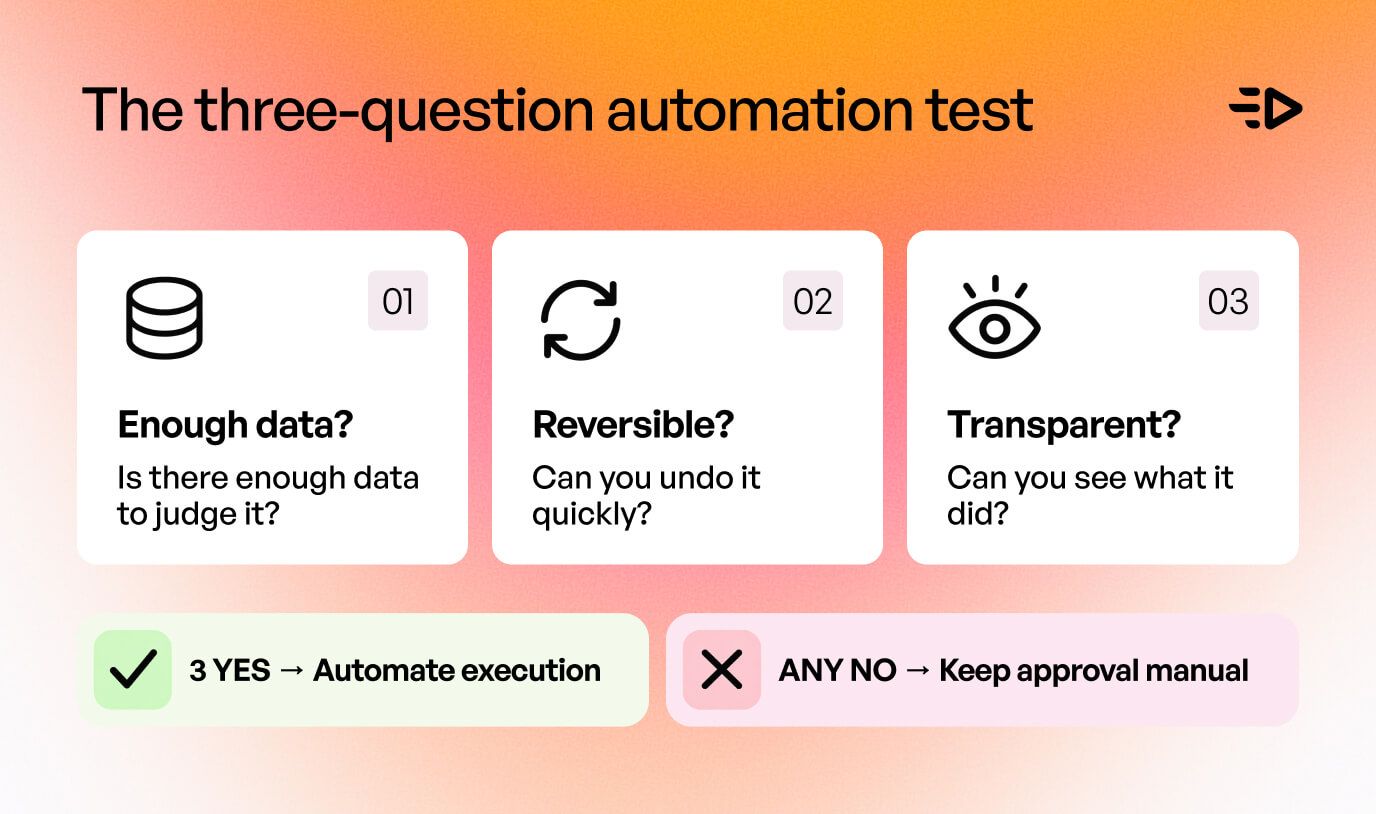
Run each decision through three questions:
Is there enough data to judge it? Automated bidding works better with volume. Google recommends evaluating Smart Bidding over a period with at least 30 conversions (50 for Target ROAS). For Display campaigns with fewer than 30 conversions a month per ad group, it says CPA or ROAS can swing by up to 100%. Below that volume, keep a closer hand on bids and budgets.
Can you undo it quickly? A paused ad comes back with one click. A "100% off" promo that's already live is harder to take back.
Can you see what it did? If a tool can't show a change log of what it changed and why, it's hard to trust it with real budget.
Three yeses: automate the execution inside limits you set. Any no: automate the suggestion and keep the approval.
Where Creatify fits
Creatify's Ad Agent works the way this guide suggests. It connects to Meta, Google Ads, TikTok, Snapchat, Reddit and OpenAI Ads, explains why results moved, and says what to scale, fix or cut. Budget, bid and campaign changes show up as approval cards, and nothing runs until you approve it. Scheduled routines can run recurring checks and reports, and when a winning ad wears out, it makes new video and image ads to replace it.
Summing it up
Ad management platforms come in three flavors: native ad managers, third-party ad management software, and publisher ad servers like Google Ad Manager. Meta, Google and TikTok already automate bidding, placements, audiences and a growing share of creative. Third-party tools add cross-channel reporting, rules, bulk launching and AI agents. Automate the frequent, reversible, data-rich decisions. Keep goals, budget caps, brand safety, final approval and measurement in your own hands.
One bonus thought: the networks keep handing back controls they once took away (search terms, negative keywords, channel reporting in Performance Max). Automation settings are worth revisiting every quarter, because the best split between automated and manual keeps moving.
FAQ
What is an ad management platform?
It's software for creating, launching, optimizing and reporting on paid ads. The term covers native tools like Meta Ads Manager and Google Ads, third-party tools that manage several ad networks at once, and publisher ad servers like Google Ad Manager.
What's the difference between Google Ads and Google Ad Manager?
Google Ads is for advertisers buying ads. Google Ad Manager is for publishers selling ad space on their own websites and apps, mainly large publishers with direct sales teams.
What is the best ad management software?
It depends on what you need to automate. Bïrch starts at $49 a month (automated rules from $99). Bulk launchers suit teams shipping lots of creative, and enterprise platforms like Skai start around $114,000 a year. If you only run one network at modest spend, its native tools may cover most of what you need.
Can ad management be fully automated?
Most of the execution can: bidding, placements, audiences, launching and reporting. Goals, budget limits, brand safety and measurement still need a human, because those are business decisions and the algorithms optimize toward whatever you set.
How much conversion data does automated bidding need?
Google recommends evaluating Smart Bidding over periods with at least 30 conversions, or 50 for Target ROAS. That's a guide for judging results, not a requirement to switch it on. With fewer conversions, results swing more and the system takes longer to settle.
Should I turn on Google's auto-applied recommendations?
Only for recommendation types you'd approve anyway. Auto-apply can add broad match keywords and change bid targets, so review the daily queue and switch off any category you want to control yourself.