Équipe Creatify
PARTAGER


DANS CET ARTICLE
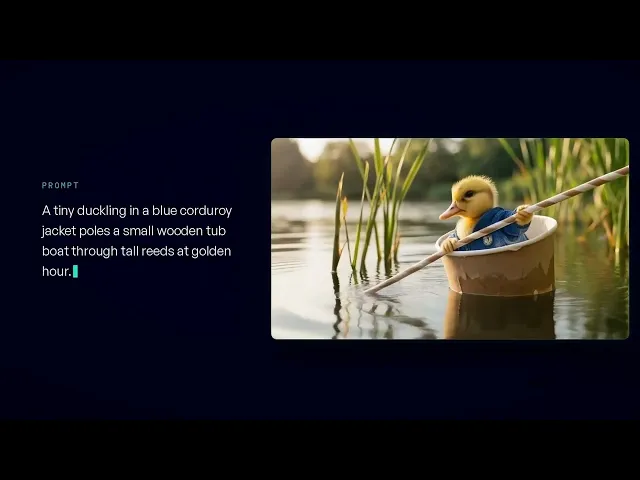
Today we're launching Boreal, our AI video model for advertising. It generates text-to-video and image-to-video at one cent per second, which works out to about $0.05 for a five-second clip, and it renders in realtime, so that clip is ready in roughly the time it takes to watch it. In our benchmarks it rivals the quality of the top-tier closed models advertisers pay for today, at a fraction of the price and up to 40 times the speed.
This post is about why we built it, how it works, and what the numbers actually show, including where it falls short.

We build video ads for a living, so we started from the two things an ad has to get right, which happen to be the two things general-purpose video models get wrong most often. A person has to read as a real creator filming themselves, with natural skin and natural pacing and no AI sheen. And a product has to stay the exact object the advertiser shipped, with the same label, the same text, and the same shape, with no invented variants and no second unit appearing halfway through the shot. Most models will happily swap a creator for a different person mid-clip or melt a product label into nonsense, and those are the failures a viewer notices instantly.
Trained on advertising, tuned for marketing needs
That's what we trained Boreal to protect. It's built on top of an open-source video generation model that generates audio and video jointly.
We post-trained it on a large body of advertising footage, pushing it toward what an ad needs: a product that stays the exact object the advertiser shipped, and a person who reads as a real creator. Because we own the weights and serve them ourselves, we can offer that quality at a cent a second and at realtime speed, instead of paying list price and waiting in someone else's queue for every clip.
The rest of this post is what that training buys, measured against the untouched base through an identical pipeline and confirmed by blind human review and image metrics.
What the numbers show
To measure what the post-training actually changed, we hold everything identical except the trained weights: the same rewritten prompt, the same input image, the same resolution, frame count, and seed, run through the deployed pipeline. The only variable is the model.
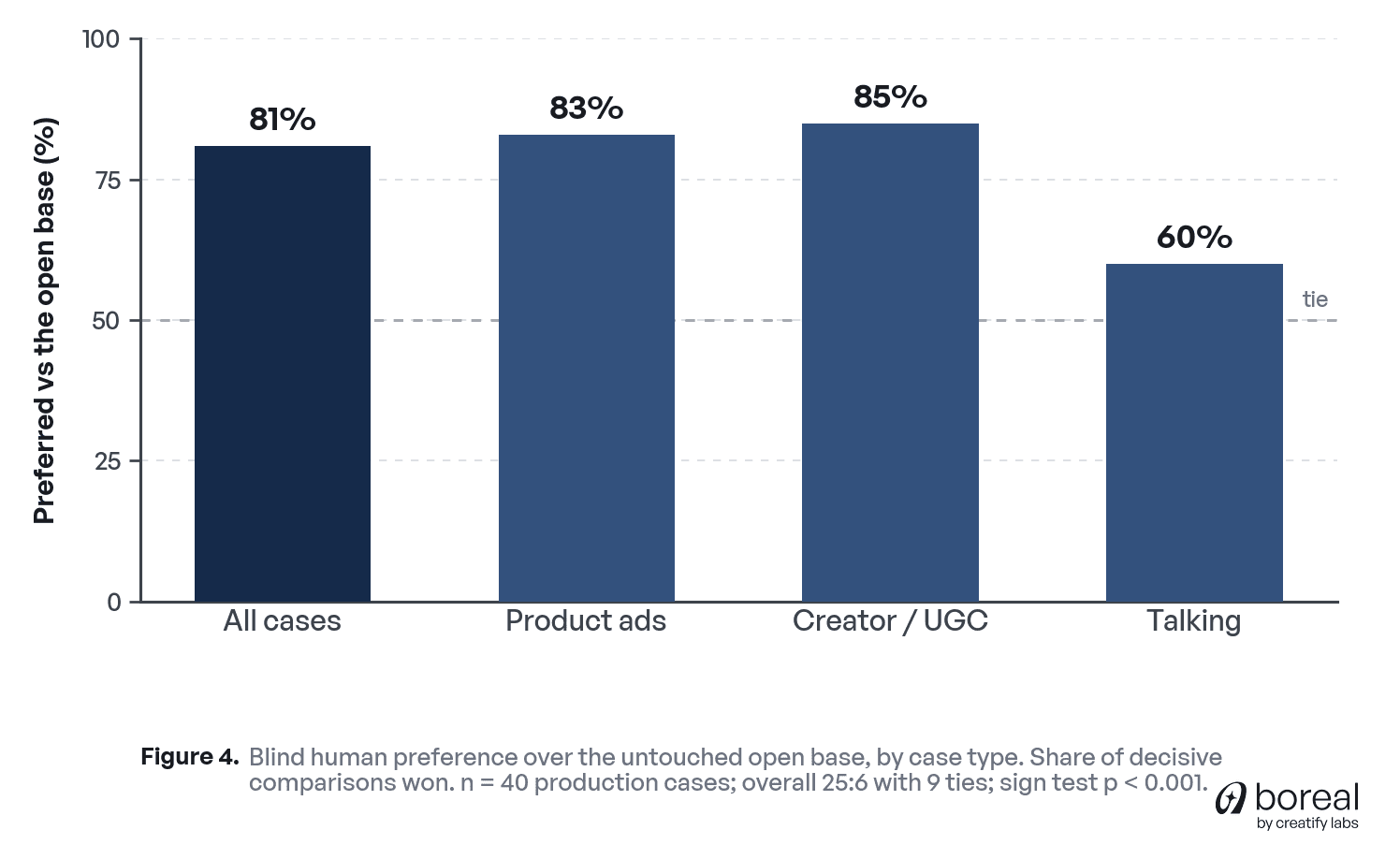
In blind side-by-side review, evaluators preferred Boreal to its untouched base in 81% of decisive comparisons (25 to 6, with 9 ties, across 40 production cases; sign test p<0.001). Broken out by case type, that's 83% on product ads, 85% on creator and UGC scenes, and 60% on single-person talking clips, the full range of what customers actually make.
Product cases are the hard, high-stakes half, and they went 5 to 1 with 2 ties for Boreal in blind review. To measure fidelity without a human, we track how much of the input image's detail survives to the last frame and how much of the motion is non-rigid warping. Against the base, Boreal shows significant gains in image quality (MUSIQ, p<0.001) and in fine-detail retention (+11.3%, p=0.004), with warping trending down. In plain terms: a personalized journal keeps its cover design and the child's name on camera for the whole clip; a creator stays one continuous person instead of being swapped mid-shot; an app demo renders the actual interface where the base paints a generic wallpaper.
How Boreal compares to the closed models
The real commercial question isn't whether post-training beats its own base, but whether the result competes with the closed model an advertiser would otherwise buy. So we ran Boreal against the closed models an advertiser would consider, on identical inputs.
Boreal matches Seedance 2.0 on perceptual quality and leads it on motion, at roughly 40 times the speed and 12 times cheaper at the benchmarked price. We'll be honest about the trade-off: on raw fidelity the quality figures land within a few percent in both directions, and Seedance renders those inputs at 1080p against our 720p-class output, so resolution-sensitive measures read in its favor, not ours. What differs by two orders of magnitude is time and cost. During our benchmark, Seedance 2.0 returned a five-second clip in a median 198 seconds at $0.60; Boreal returns it in about 5 seconds at $0.05.
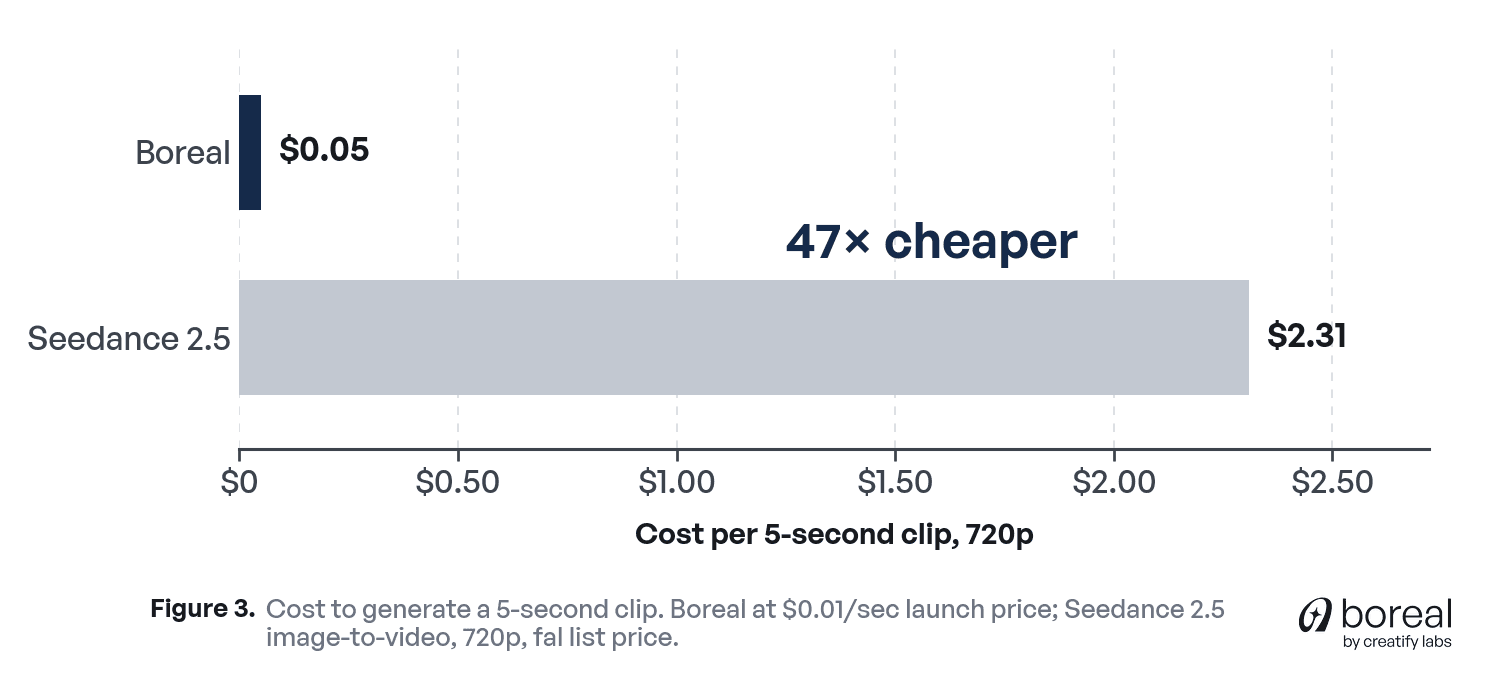
H3 Max is the other reference point. It reports faster raw inference than our five-second target, but costs roughly eight times more per five-second clip at its launch-day list price, which leaves Boreal as the best quality-per-cost trade-off in the set. Against the newer Seedance 2.5, whose image-to-video list price at 720p was about $0.473 per second in early September 2026, Boreal at a cent a second is roughly 47 times cheaper: about $0.05 for a five-second clip against $2.31.
Put on a single ad-quality scale, the trade-off is easy to see. On a blind product-fair judge across 20 ad prompts, Boreal passes 70% of the time at a nickel a clip. Seedance 2.0 scores higher at 80%, but at its current list price that quality runs more than 30 times as much; H3 Max sits at 65% for eight times the price; and the untouched base manages 50%. Boreal is the best quality-per-dollar point in the set, and on speed it beats everything except H3 Max, which scores below it.
The way this lands in practice: a storyboard of twenty five-second shots costs about $1 and finishes in under two minutes on Boreal, against roughly $12 and over an hour of vendor queue on Seedance 2.0. Every comparison here comes from our own testing across these models on identical inputs. You can see Boreal specs on its model page.
Price and speed, built for API users
The gap is widest at the API level, where teams generate at volume, so this is where Boreal is designed to win. Two things drive it.
The first is how we bill. Boreal is priced per second of finished video, not per credit or per token, so you can work out an AI video generation cost before you run the job rather than after. A second of video is a cent. A five-second clip is a nickel. Twenty of them is about a dollar. For anyone who has tried to reverse-engineer a video generation cost per second out of an opaque credit system, that predictability is the point.
The second is throughput. Running on our own optimized serving stack, Boreal generates one second of finished video for every second of GPU time, 1:1 with realtime. Cheap generation that still takes minutes doesn't change how you work; cheap generation that returns in seconds does. You can run several versions of a shot at once, keep the one that works, and still pay less than a single generation elsewhere.
Where Boreal is today, honestly
Boreal is a new model, and we'd rather tell you where it's weakest than have you find out mid-campaign. It's strongest on short clips and simple scenes. The place it improves least over its base is single-person talking clips, where the two are closest, at 60%. On lip-sync it holds even with its base, and a separate audio-specialized variant of the same lineage does better, which is the direction that work is heading. And on raw resolution, a 1080p flagship still has an edge on the kind of shot where resolution is what you're buying.
What we're confident about is the trade-off Boreal was built for: the quality that decides an ad, with the product and the creator held intact, at a cost and speed nothing in its quality neighborhood matches.
What's next
We're training a judge that scores explicit defects like extra objects, label edits, and identity drift, so the model can optimize against exactly the hallucinations that hurt an ad. We're also extending Boreal to reference-conditioned generation for multi-shot ads built from several product views or a creator's face. Both aim at the same thing: more of the consistency advertisers need, across longer and more complex spots.
Try Boreal
Boreal is available now, with both text-to-video and image-to-video supported at launch. You can reach it through our API, generate with it in Creatify's Model Playground, put it to work inside AdFlow, or run it on fal.ai. Full details are on the Boreal model page. We think it's the strongest quality-per-dollar option in AI video right now, and it's there for you to put to the test.
Today we're launching Boreal, our AI video model for advertising. It generates text-to-video and image-to-video at one cent per second, which works out to about $0.05 for a five-second clip, and it renders in realtime, so that clip is ready in roughly the time it takes to watch it. In our benchmarks it rivals the quality of the top-tier closed models advertisers pay for today, at a fraction of the price and up to 40 times the speed.
This post is about why we built it, how it works, and what the numbers actually show, including where it falls short.
We build video ads for a living, so we started from the two things an ad has to get right, which happen to be the two things general-purpose video models get wrong most often. A person has to read as a real creator filming themselves, with natural skin and natural pacing and no AI sheen. And a product has to stay the exact object the advertiser shipped, with the same label, the same text, and the same shape, with no invented variants and no second unit appearing halfway through the shot. Most models will happily swap a creator for a different person mid-clip or melt a product label into nonsense, and those are the failures a viewer notices instantly.
Trained on advertising, tuned for marketing needs
That's what we trained Boreal to protect. It's built on top of an open-source video generation model that generates audio and video jointly.
We post-trained it on a large body of advertising footage, pushing it toward what an ad needs: a product that stays the exact object the advertiser shipped, and a person who reads as a real creator. Because we own the weights and serve them ourselves, we can offer that quality at a cent a second and at realtime speed, instead of paying list price and waiting in someone else's queue for every clip.
The rest of this post is what that training buys, measured against the untouched base through an identical pipeline and confirmed by blind human review and image metrics.
What the numbers show
To measure what the post-training actually changed, we hold everything identical except the trained weights: the same rewritten prompt, the same input image, the same resolution, frame count, and seed, run through the deployed pipeline. The only variable is the model.
In blind side-by-side review, evaluators preferred Boreal to its untouched base in 81% of decisive comparisons (25 to 6, with 9 ties, across 40 production cases; sign test p<0.001). Broken out by case type, that's 83% on product ads, 85% on creator and UGC scenes, and 60% on single-person talking clips, the full range of what customers actually make.
Product cases are the hard, high-stakes half, and they went 5 to 1 with 2 ties for Boreal in blind review. To measure fidelity without a human, we track how much of the input image's detail survives to the last frame and how much of the motion is non-rigid warping. Against the base, Boreal shows significant gains in image quality (MUSIQ, p<0.001) and in fine-detail retention (+11.3%, p=0.004), with warping trending down. In plain terms: a personalized journal keeps its cover design and the child's name on camera for the whole clip; a creator stays one continuous person instead of being swapped mid-shot; an app demo renders the actual interface where the base paints a generic wallpaper.
How Boreal compares to the closed models
The real commercial question isn't whether post-training beats its own base, but whether the result competes with the closed model an advertiser would otherwise buy. So we ran Boreal against the closed models an advertiser would consider, on identical inputs.
Boreal matches Seedance 2.0 on perceptual quality and leads it on motion, at roughly 40 times the speed and 12 times cheaper at the benchmarked price. We'll be honest about the trade-off: on raw fidelity the quality figures land within a few percent in both directions, and Seedance renders those inputs at 1080p against our 720p-class output, so resolution-sensitive measures read in its favor, not ours. What differs by two orders of magnitude is time and cost. During our benchmark, Seedance 2.0 returned a five-second clip in a median 198 seconds at $0.60; Boreal returns it in about 5 seconds at $0.05.
H3 Max is the other reference point. It reports faster raw inference than our five-second target, but costs roughly eight times more per five-second clip at its launch-day list price, which leaves Boreal as the best quality-per-cost trade-off in the set. Against the newer Seedance 2.5, whose image-to-video list price at 720p was about $0.473 per second in early September 2026, Boreal at a cent a second is roughly 47 times cheaper: about $0.05 for a five-second clip against $2.31.
Put on a single ad-quality scale, the trade-off is easy to see. On a blind product-fair judge across 20 ad prompts, Boreal passes 70% of the time at a nickel a clip. Seedance 2.0 scores higher at 80%, but at its current list price that quality runs more than 30 times as much; H3 Max sits at 65% for eight times the price; and the untouched base manages 50%. Boreal is the best quality-per-dollar point in the set, and on speed it beats everything except H3 Max, which scores below it.
The way this lands in practice: a storyboard of twenty five-second shots costs about $1 and finishes in under two minutes on Boreal, against roughly $12 and over an hour of vendor queue on Seedance 2.0. Every comparison here comes from our own testing across these models on identical inputs. You can see Boreal specs on its model page.
Price and speed, built for API users
The gap is widest at the API level, where teams generate at volume, so this is where Boreal is designed to win. Two things drive it.
The first is how we bill. Boreal is priced per second of finished video, not per credit or per token, so you can work out an AI video generation cost before you run the job rather than after. A second of video is a cent. A five-second clip is a nickel. Twenty of them is about a dollar. For anyone who has tried to reverse-engineer a video generation cost per second out of an opaque credit system, that predictability is the point.
The second is throughput. Running on our own optimized serving stack, Boreal generates one second of finished video for every second of GPU time, 1:1 with realtime. Cheap generation that still takes minutes doesn't change how you work; cheap generation that returns in seconds does. You can run several versions of a shot at once, keep the one that works, and still pay less than a single generation elsewhere.
Where Boreal is today, honestly
Boreal is a new model, and we'd rather tell you where it's weakest than have you find out mid-campaign. It's strongest on short clips and simple scenes. The place it improves least over its base is single-person talking clips, where the two are closest, at 60%. On lip-sync it holds even with its base, and a separate audio-specialized variant of the same lineage does better, which is the direction that work is heading. And on raw resolution, a 1080p flagship still has an edge on the kind of shot where resolution is what you're buying.
What we're confident about is the trade-off Boreal was built for: the quality that decides an ad, with the product and the creator held intact, at a cost and speed nothing in its quality neighborhood matches.
What's next
We're training a judge that scores explicit defects like extra objects, label edits, and identity drift, so the model can optimize against exactly the hallucinations that hurt an ad. We're also extending Boreal to reference-conditioned generation for multi-shot ads built from several product views or a creator's face. Both aim at the same thing: more of the consistency advertisers need, across longer and more complex spots.
Try Boreal
Boreal is available now, with both text-to-video and image-to-video supported at launch. You can reach it through our API, generate with it in Creatify's Model Playground, put it to work inside AdFlow, or run it on fal.ai. Full details are on the Boreal model page. We think it's the strongest quality-per-dollar option in AI video right now, and it's there for you to put to the test.

Prêt à transformer votre produit en une vidéo captivante ?