
Creatify Team
SHARE


IN THIS ARTICLE
Go looking for which companies use AI and the top results hand you the Forbes AI 50 and a dozen listicles promising dozens examples each. Most of them answer a different question than the one you asked though. The question of what companies are using AI, and what for, has a narrower and more honest answer, and it starts with a number almost nobody puts in a headline: as of early 2026, the U.S. Census Bureau finds that roughly one in five American businesses uses AI in any business function at all.
So the real picture has three layers. There are companies using AI in production and disclosing what it does. There is a large pile of launches, pilots, and public walk-backs that got more press than results. And there is the quiet majority still watching from the sidelines. This is a tour of all three, built from what companies have confirmed themselves.
What "using AI" really means, and what counts as one of the companies that use AI
Before the examples, a definition worth setting, because it's the thing the listicles skip. A company "uses AI" in the strong sense when it has publicly said a system is live, in production, and doing a specific job. That bar matters because most of the impressive numbers you'll read come with an asterisk: they are company-reported. When Klarna says its assistant did the work of 700 agents, that figure is Klarna's, from Klarna's own announcement, not an independent audit. Confirmed deployment and independently verified ROI are two different claims, and the gap between them is where a lot of the hype lives.
Keep that distinction handy for everything below. A press release is a marketing act. An earnings call, a regulatory filing, or a detailed corporate disclosure is a firmer commitment, though still self-reported. Among companies using AI technology today, the ones worth taking seriously are those naming a workflow, a user count, and a result.
The confirmed deployments, and what they're really doing
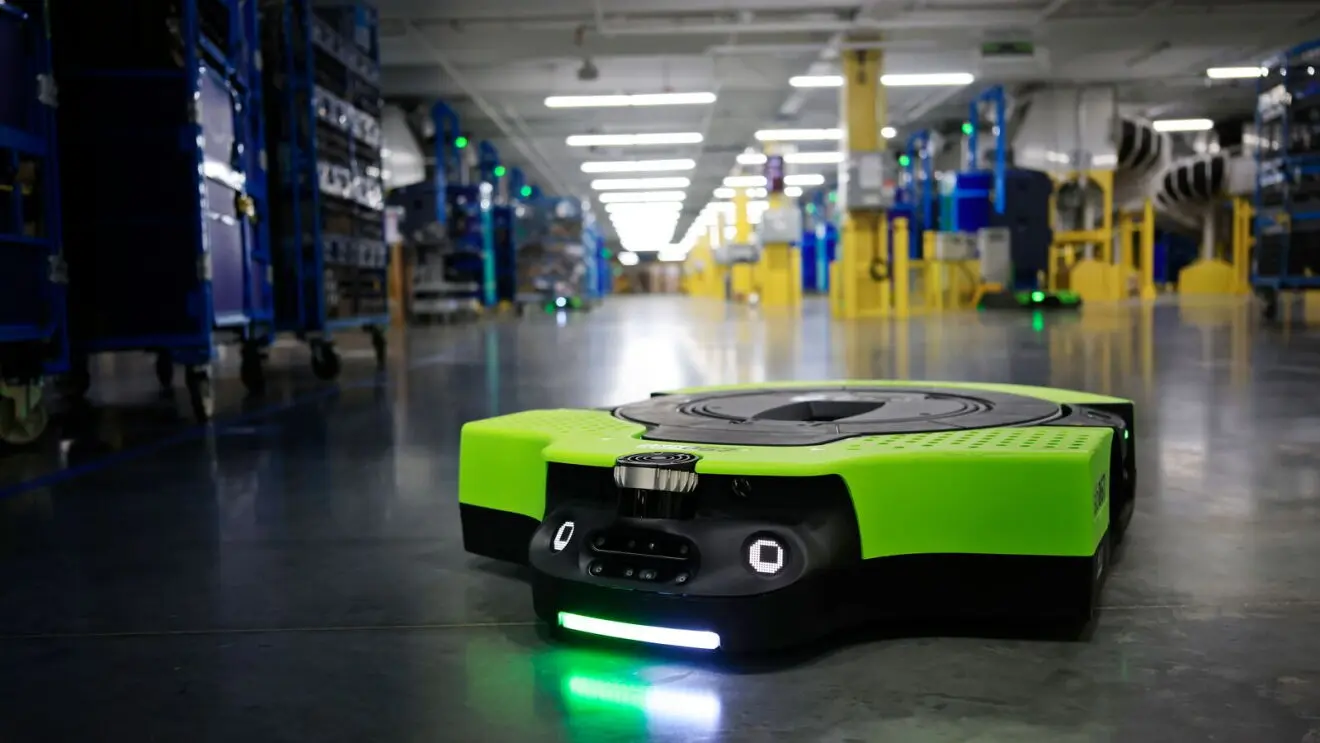
Amazon is one of the clearest cases of a business that uses AI in daily production. In July 2025 the company announced DeepFleet, a generative-AI model that coordinates its warehouse robots the way an air-traffic controller manages planes. Amazon said the fleet had passed one million robots and that DeepFleet improved robot travel efficiency by about 10%. Alongside it sits Rufus, the shopping assistant, and the demand-forecasting models that decide what inventory sits where. None of it is the humanoid-robot future the keynote circuit likes to sell. It is logistics, made incrementally faster.
Source: Amazon News
Walmart tells a similar story from the store floor. In June 2025 the retailer detailed a set of associate tools: an in-app AI assistant that its associates were using more than 900,000 times a week across some three million daily queries, and a real-time translation feature covering 44 languages so staff and customers can talk to each other. Walmart also said an AI shift-planning tool had cut managers' scheduling time, by the company's own estimate, from about 90 minutes to 30, though it was live only for overnight stocking and still a pilot elsewhere. That mixed maturity is the honest texture of real adoption, and it rarely survives the summary.
Financial services is where AI has gone deepest into the back office, and it holds the densest cluster of companies using artificial intelligence at scale. JPMorgan Chase has said its in-house LLM Suite reached the better part of its workforce and credits its coding assistants with efficiency gains in the range of 10 to 20% for engineering teams. Morgan Stanley, working with OpenAI, gave its financial advisors an assistant that searches the firm's library of more than 100,000 research documents, plus a tool called Debrief that writes up client meetings; OpenAI and the firm report that more than 98% of advisor teams now use it. And Bank of America's Erica, live since 2018, passed three billion client interactions in 2025, serving nearly 50 million users at more than 58 million interactions a month.
Then there is Klarna, the case everyone cites for both sides of the argument. In early 2024 the fintech said its OpenAI-powered assistant handled 2.3 million conversations in its first month, about two-thirds of its support chats, doing the work it equated to 700 full-time agents. That deployment was real. What happened next is the more instructive part.
The metrics asterisk
Notice the through-line in that list. Across companies using AI technology at production scale, the systems that are genuinely live tend to be narrow, internal, and pointed at a company's own data: routing robots, answering associate questions, searching proprietary research, resolving routine support tickets. They are useful and they are boring, which is exactly why they work. The splashy, autonomous, customer-facing "AI does everything" pitch is mostly absent from the confirmed column.
And every headline number above is the company's own. That doesn't make the figures false. It means the honest way to read them is as claims a company was willing to attach its name to, measured on its own terms, which is a real signal and a limited one. Hold that thought going into the next section, where the same self-reporting runs in reverse.
The hype pile: launches, pilots, and public walk-backs
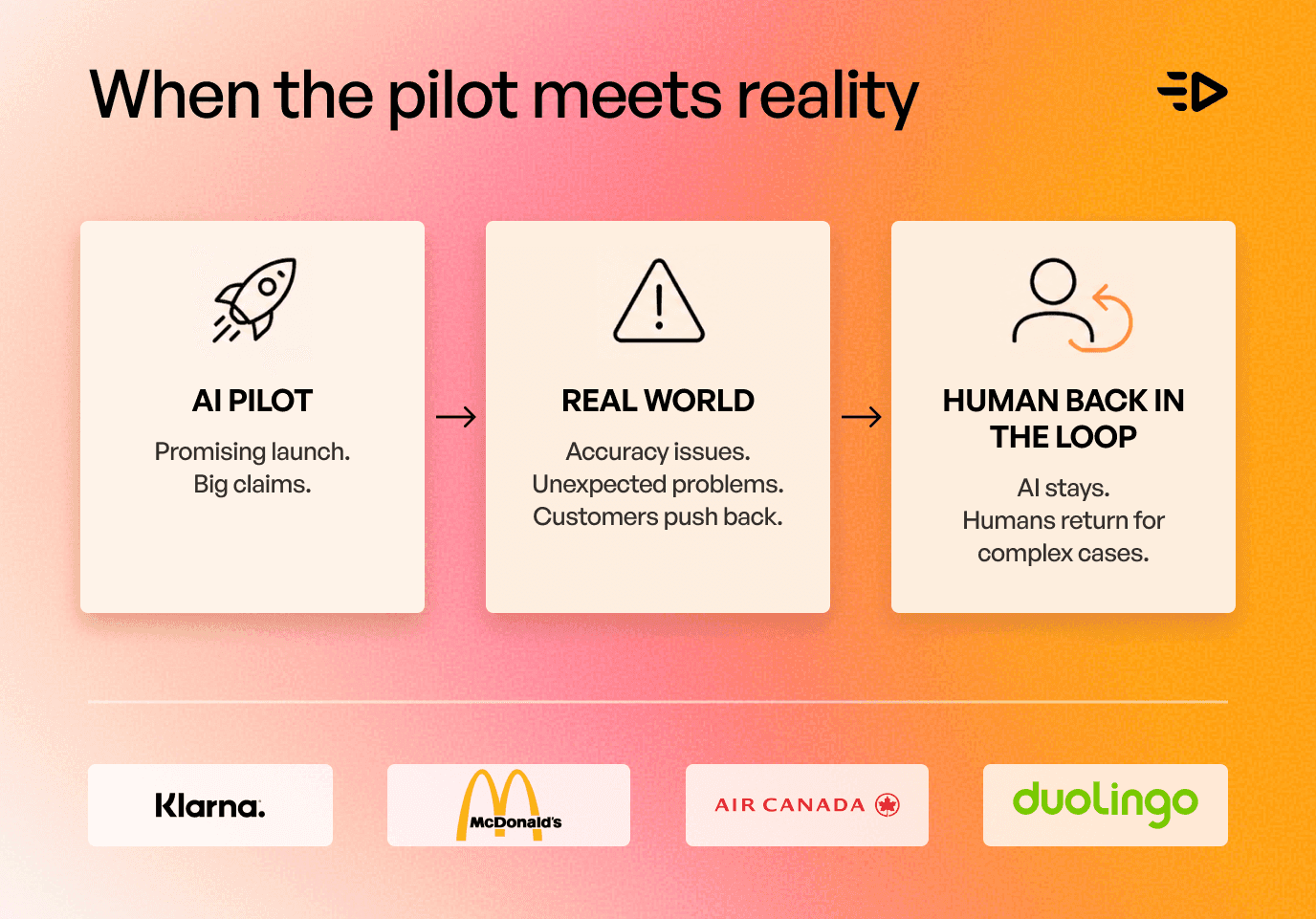
Klarna is where the arc bends. In May 2025, roughly a year after the triumphant rollout, the company began rehiring human agents for complex, nuanced cases. CEO Sebastian Siemiatkowski conceded the company had leaned too far toward cost and let quality slip, and that customers wanted the option of a person. The AI stayed and still handles the bulk of chats; the story of full replacement is the part that did not survive contact with real customers.
McDonald's ran a cleaner cautionary tale. After a three-year test of IBM-built voice ordering across about 100 drive-thrus, the company ended the partnership in June 2024. Order accuracy had stalled in the low 80% range, and social media filled with clips of the system adding hundreds of McNuggets to a single order or putting bacon on ice cream. Low-eighties accuracy sounds decent until you remember a drive-thru runs on getting the order right every time.
Air Canada learned the liability lesson the hard way. Its support chatbot invented a bereavement-fare policy that did not exist, and when the airline refused to honor it, a British Columbia tribunal ruled in February 2024 that the company was responsible for what its bot said, rejecting the argument that the chatbot was a separate entity. The damages were small. The precedent was not: a customer-facing AI's mistakes belong to the company that deployed it. New York City walked into the same wall the same year, when its MyCity business chatbot was found telling entrepreneurs they could do things the law plainly forbids.
Even the messier cases carry the pattern. When Duolingo's CEO announced an "AI-first" plan in April 2025, the backlash was loud enough that he later walked back the framing, even as the company kept growing. The failures cluster in one place: AI that is autonomous, customer-facing, and turned loose on unconstrained, noisy inputs.
The part nobody markets: most companies aren't using AI yet
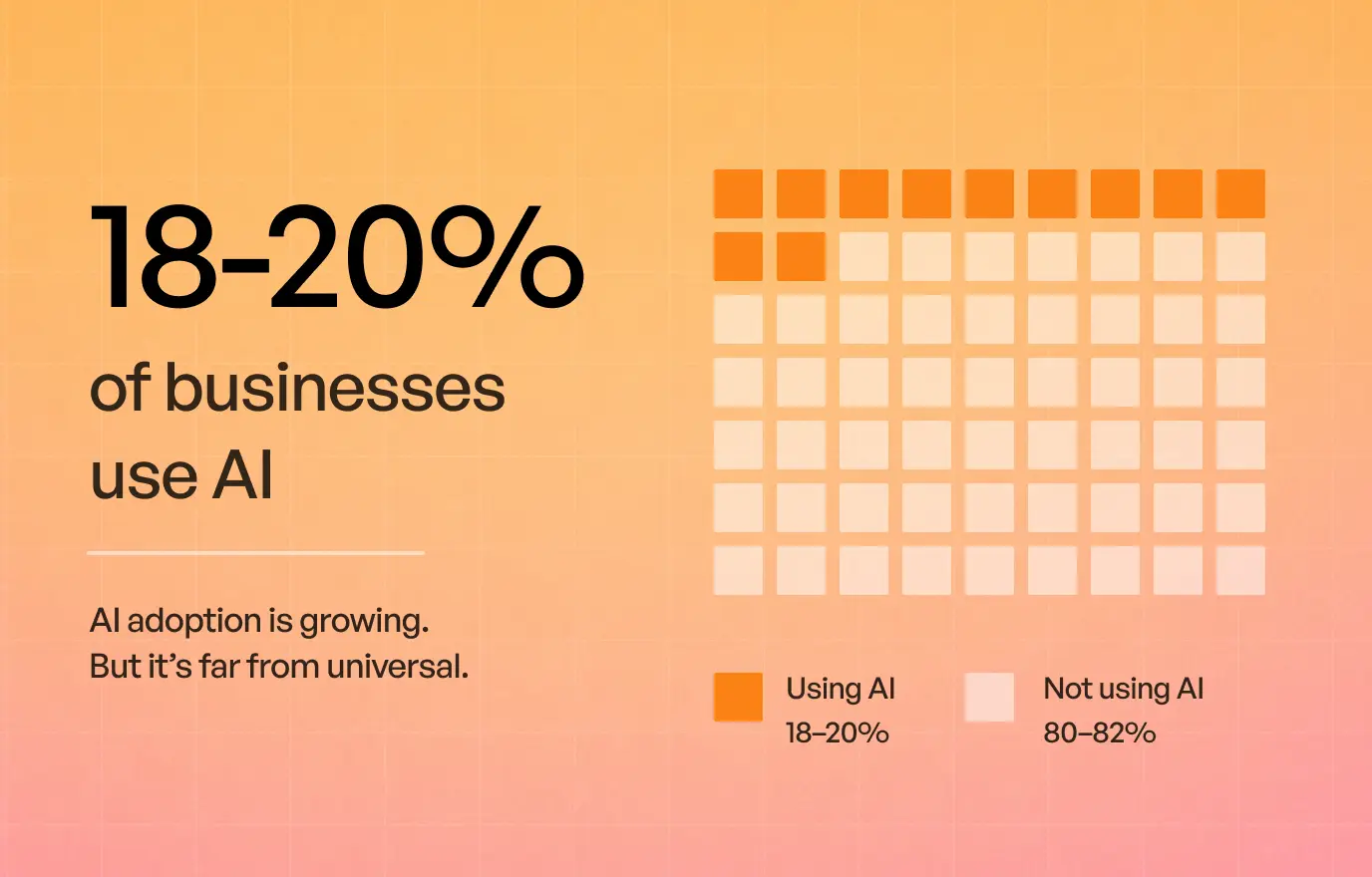
Step back from the named companies and the ground truth is sobering for anyone who thinks the whole economy has gone AI. The Census Bureau's Business Trends and Outlook Survey put firm-level adoption at roughly 18 to 20% through early 2026, rising to about 32% when weighted by employment because larger companies adopt faster. Among firms with at least 250 employees, adoption reached the high 30s. For the smallest businesses, it barely moved.
Among the companies that did try, a lot backed out. S&P Global Market Intelligence found that 42% of firms scrapped most of their AI initiatives in 2025, up sharply from 17% the year before, and that the average organization abandoned nearly half its proof-of-concepts before they reached production, citing cost and data-security concerns. A widely discussed 2025 MIT study went further, reporting that 95% of enterprise generative-AI pilots showed no measurable impact on profit and loss; that figure has been contested, but even its critics land on the same shape of problem. Adoption is real, it is growing, and it is far patchier than the marketing implies.
So what actually works for companies that use AI in 2026
The line between the confirmed column and the hype pile is consistent enough to be a rule. AI earns its place when the task is narrow, the data is yours, a human stays in the loop, and there's a real workflow underneath rather than a demo. It struggles when it's handed an open-ended, public-facing job with messy inputs and no guardrails. The companies using artificial intelligence well in 2026 mostly picked the boring version on purpose.
That has a practical read for anyone deciding where to point a budget. The reliable wins are bounded, high-volume tasks a system can do the same way a thousand times. Turning a product page into a batch of video ad variations is that kind of task, which is why a tool like Creatify fits the pattern that works: a specific job, your own inputs, and a person choosing what ships. The unreliable bets are the ones that ask a model to run an entire customer relationship unsupervised. Two years of confirmed deployments and public walk-backs have drawn the map. It's worth reading before your company adds itself to either column.
Read also: Advertising strategies in marketing: what works in 2026, and what doesn't
Frequently Asked Questions
How many companies use AI in 2026?
Fewer than the headlines suggest. The U.S. Census Bureau's Business Trends and Outlook Survey puts firm-level adoption at roughly 18 to 20% of U.S. businesses in a given business function through early 2026, rising to about 32% on an employment-weighted basis because large employers adopt faster. Among firms with 250 or more employees, adoption sits in the high 30s, while the smallest businesses have barely moved.
Which big companies use AI, and for what?
Among companies that have confirmed live deployments: Amazon uses its DeepFleet model to coordinate more than a million warehouse robots and Rufus to help shoppers; Walmart runs an in-app assistant for store associates and a 44-language translation tool; JPMorgan Chase deployed an in-house LLM Suite for document analysis and coding; Morgan Stanley gives advisors an OpenAI-based research assistant; Bank of America's Erica has handled over three billion customer interactions; and Klarna automated a large share of customer support. Most of these are narrow, internal, or data-retrieval tasks; the autonomous systems that get marketed are mostly absent from the confirmed column.
Is AI replacing jobs at these companies?
Mostly it's augmenting specific tasks, and the most public attempt to replace staff outright, Klarna's, was partly reversed in 2025 when the company rehired human agents after quality complaints. Census data shows only a small share of AI-using firms attribute headcount changes directly to AI so far.
Why do so many AI projects fail?
S&P Global Market Intelligence found 42% of companies scrapped most of their AI initiatives in 2025, with the average firm abandoning nearly half its proof-of-concepts before production, citing cost and data-security issues. The common thread in high-profile failures like McDonald's drive-thru test and Air Canada's support chatbot is autonomous, customer-facing AI let loose on messy inputs without enough guardrails.
How can you tell real AI use from marketing hype?
Look for a named workflow, a user count, and a result disclosed in an earnings call, filing, or detailed corporate announcement, not a press release about a "launch." Remember that even confirmed metrics are usually company-reported, not independently audited, so treat a live deployment as a stronger signal than a pilot, and a pilot as a stronger signal than a keynote slide.
Go looking for which companies use AI and the top results hand you the Forbes AI 50 and a dozen listicles promising dozens examples each. Most of them answer a different question than the one you asked though. The question of what companies are using AI, and what for, has a narrower and more honest answer, and it starts with a number almost nobody puts in a headline: as of early 2026, the U.S. Census Bureau finds that roughly one in five American businesses uses AI in any business function at all.
So the real picture has three layers. There are companies using AI in production and disclosing what it does. There is a large pile of launches, pilots, and public walk-backs that got more press than results. And there is the quiet majority still watching from the sidelines. This is a tour of all three, built from what companies have confirmed themselves.
What "using AI" really means, and what counts as one of the companies that use AI
Before the examples, a definition worth setting, because it's the thing the listicles skip. A company "uses AI" in the strong sense when it has publicly said a system is live, in production, and doing a specific job. That bar matters because most of the impressive numbers you'll read come with an asterisk: they are company-reported. When Klarna says its assistant did the work of 700 agents, that figure is Klarna's, from Klarna's own announcement, not an independent audit. Confirmed deployment and independently verified ROI are two different claims, and the gap between them is where a lot of the hype lives.
Keep that distinction handy for everything below. A press release is a marketing act. An earnings call, a regulatory filing, or a detailed corporate disclosure is a firmer commitment, though still self-reported. Among companies using AI technology today, the ones worth taking seriously are those naming a workflow, a user count, and a result.
The confirmed deployments, and what they're really doing
Amazon is one of the clearest cases of a business that uses AI in daily production. In July 2025 the company announced DeepFleet, a generative-AI model that coordinates its warehouse robots the way an air-traffic controller manages planes. Amazon said the fleet had passed one million robots and that DeepFleet improved robot travel efficiency by about 10%. Alongside it sits Rufus, the shopping assistant, and the demand-forecasting models that decide what inventory sits where. None of it is the humanoid-robot future the keynote circuit likes to sell. It is logistics, made incrementally faster.
Source: Amazon News
Walmart tells a similar story from the store floor. In June 2025 the retailer detailed a set of associate tools: an in-app AI assistant that its associates were using more than 900,000 times a week across some three million daily queries, and a real-time translation feature covering 44 languages so staff and customers can talk to each other. Walmart also said an AI shift-planning tool had cut managers' scheduling time, by the company's own estimate, from about 90 minutes to 30, though it was live only for overnight stocking and still a pilot elsewhere. That mixed maturity is the honest texture of real adoption, and it rarely survives the summary.
Financial services is where AI has gone deepest into the back office, and it holds the densest cluster of companies using artificial intelligence at scale. JPMorgan Chase has said its in-house LLM Suite reached the better part of its workforce and credits its coding assistants with efficiency gains in the range of 10 to 20% for engineering teams. Morgan Stanley, working with OpenAI, gave its financial advisors an assistant that searches the firm's library of more than 100,000 research documents, plus a tool called Debrief that writes up client meetings; OpenAI and the firm report that more than 98% of advisor teams now use it. And Bank of America's Erica, live since 2018, passed three billion client interactions in 2025, serving nearly 50 million users at more than 58 million interactions a month.
Then there is Klarna, the case everyone cites for both sides of the argument. In early 2024 the fintech said its OpenAI-powered assistant handled 2.3 million conversations in its first month, about two-thirds of its support chats, doing the work it equated to 700 full-time agents. That deployment was real. What happened next is the more instructive part.
The metrics asterisk
Notice the through-line in that list. Across companies using AI technology at production scale, the systems that are genuinely live tend to be narrow, internal, and pointed at a company's own data: routing robots, answering associate questions, searching proprietary research, resolving routine support tickets. They are useful and they are boring, which is exactly why they work. The splashy, autonomous, customer-facing "AI does everything" pitch is mostly absent from the confirmed column.
And every headline number above is the company's own. That doesn't make the figures false. It means the honest way to read them is as claims a company was willing to attach its name to, measured on its own terms, which is a real signal and a limited one. Hold that thought going into the next section, where the same self-reporting runs in reverse.
The hype pile: launches, pilots, and public walk-backs
Klarna is where the arc bends. In May 2025, roughly a year after the triumphant rollout, the company began rehiring human agents for complex, nuanced cases. CEO Sebastian Siemiatkowski conceded the company had leaned too far toward cost and let quality slip, and that customers wanted the option of a person. The AI stayed and still handles the bulk of chats; the story of full replacement is the part that did not survive contact with real customers.
McDonald's ran a cleaner cautionary tale. After a three-year test of IBM-built voice ordering across about 100 drive-thrus, the company ended the partnership in June 2024. Order accuracy had stalled in the low 80% range, and social media filled with clips of the system adding hundreds of McNuggets to a single order or putting bacon on ice cream. Low-eighties accuracy sounds decent until you remember a drive-thru runs on getting the order right every time.
Air Canada learned the liability lesson the hard way. Its support chatbot invented a bereavement-fare policy that did not exist, and when the airline refused to honor it, a British Columbia tribunal ruled in February 2024 that the company was responsible for what its bot said, rejecting the argument that the chatbot was a separate entity. The damages were small. The precedent was not: a customer-facing AI's mistakes belong to the company that deployed it. New York City walked into the same wall the same year, when its MyCity business chatbot was found telling entrepreneurs they could do things the law plainly forbids.
Even the messier cases carry the pattern. When Duolingo's CEO announced an "AI-first" plan in April 2025, the backlash was loud enough that he later walked back the framing, even as the company kept growing. The failures cluster in one place: AI that is autonomous, customer-facing, and turned loose on unconstrained, noisy inputs.
The part nobody markets: most companies aren't using AI yet
Step back from the named companies and the ground truth is sobering for anyone who thinks the whole economy has gone AI. The Census Bureau's Business Trends and Outlook Survey put firm-level adoption at roughly 18 to 20% through early 2026, rising to about 32% when weighted by employment because larger companies adopt faster. Among firms with at least 250 employees, adoption reached the high 30s. For the smallest businesses, it barely moved.
Among the companies that did try, a lot backed out. S&P Global Market Intelligence found that 42% of firms scrapped most of their AI initiatives in 2025, up sharply from 17% the year before, and that the average organization abandoned nearly half its proof-of-concepts before they reached production, citing cost and data-security concerns. A widely discussed 2025 MIT study went further, reporting that 95% of enterprise generative-AI pilots showed no measurable impact on profit and loss; that figure has been contested, but even its critics land on the same shape of problem. Adoption is real, it is growing, and it is far patchier than the marketing implies.
So what actually works for companies that use AI in 2026
The line between the confirmed column and the hype pile is consistent enough to be a rule. AI earns its place when the task is narrow, the data is yours, a human stays in the loop, and there's a real workflow underneath rather than a demo. It struggles when it's handed an open-ended, public-facing job with messy inputs and no guardrails. The companies using artificial intelligence well in 2026 mostly picked the boring version on purpose.
That has a practical read for anyone deciding where to point a budget. The reliable wins are bounded, high-volume tasks a system can do the same way a thousand times. Turning a product page into a batch of video ad variations is that kind of task, which is why a tool like Creatify fits the pattern that works: a specific job, your own inputs, and a person choosing what ships. The unreliable bets are the ones that ask a model to run an entire customer relationship unsupervised. Two years of confirmed deployments and public walk-backs have drawn the map. It's worth reading before your company adds itself to either column.
Read also: Advertising strategies in marketing: what works in 2026, and what doesn't
Frequently Asked Questions
How many companies use AI in 2026?
Fewer than the headlines suggest. The U.S. Census Bureau's Business Trends and Outlook Survey puts firm-level adoption at roughly 18 to 20% of U.S. businesses in a given business function through early 2026, rising to about 32% on an employment-weighted basis because large employers adopt faster. Among firms with 250 or more employees, adoption sits in the high 30s, while the smallest businesses have barely moved.
Which big companies use AI, and for what?
Among companies that have confirmed live deployments: Amazon uses its DeepFleet model to coordinate more than a million warehouse robots and Rufus to help shoppers; Walmart runs an in-app assistant for store associates and a 44-language translation tool; JPMorgan Chase deployed an in-house LLM Suite for document analysis and coding; Morgan Stanley gives advisors an OpenAI-based research assistant; Bank of America's Erica has handled over three billion customer interactions; and Klarna automated a large share of customer support. Most of these are narrow, internal, or data-retrieval tasks; the autonomous systems that get marketed are mostly absent from the confirmed column.
Is AI replacing jobs at these companies?
Mostly it's augmenting specific tasks, and the most public attempt to replace staff outright, Klarna's, was partly reversed in 2025 when the company rehired human agents after quality complaints. Census data shows only a small share of AI-using firms attribute headcount changes directly to AI so far.
Why do so many AI projects fail?
S&P Global Market Intelligence found 42% of companies scrapped most of their AI initiatives in 2025, with the average firm abandoning nearly half its proof-of-concepts before production, citing cost and data-security issues. The common thread in high-profile failures like McDonald's drive-thru test and Air Canada's support chatbot is autonomous, customer-facing AI let loose on messy inputs without enough guardrails.
How can you tell real AI use from marketing hype?
Look for a named workflow, a user count, and a result disclosed in an earnings call, filing, or detailed corporate announcement, not a press release about a "launch." Remember that even confirmed metrics are usually company-reported, not independently audited, so treat a live deployment as a stronger signal than a pilot, and a pilot as a stronger signal than a keynote slide.