
Creatify Team
SHARE


IN THIS ARTICLE
Your mobile ad has 2 seconds to meet viewability standards and capture attention. Miss that window and you just burned budget on an impression nobody saw.
Mobile advertising isn't getting easier. Users see thousands of ads weekly across apps, games, and social feeds. Algorithms on Meta, TikTok, Unity Ads, and AppLovin decide which ads get shown based on predicted performance—and your creative is the signal they read.
This guide shows you how to build mobile video ads that actually perform. We'll cover what mobile advertising is, how it works, what makes creative stop scrolls, and the production frameworks that let you test at scale.
What is mobile advertising?
Mobile advertising delivers promotional content through smartphones and tablets. Unlike desktop ads, mobile advertising happens primarily in-app (88% of mobile time) rather than through browsers.
The mobile advertising ecosystem connects three players: advertisers (you), ad networks that distribute your creative, and publishers (apps and games) where ads appear. When someone opens an app, networks bid in real-time auctions to show their ads. Winners pay per impression, click, install, or conversion depending on campaign goals.
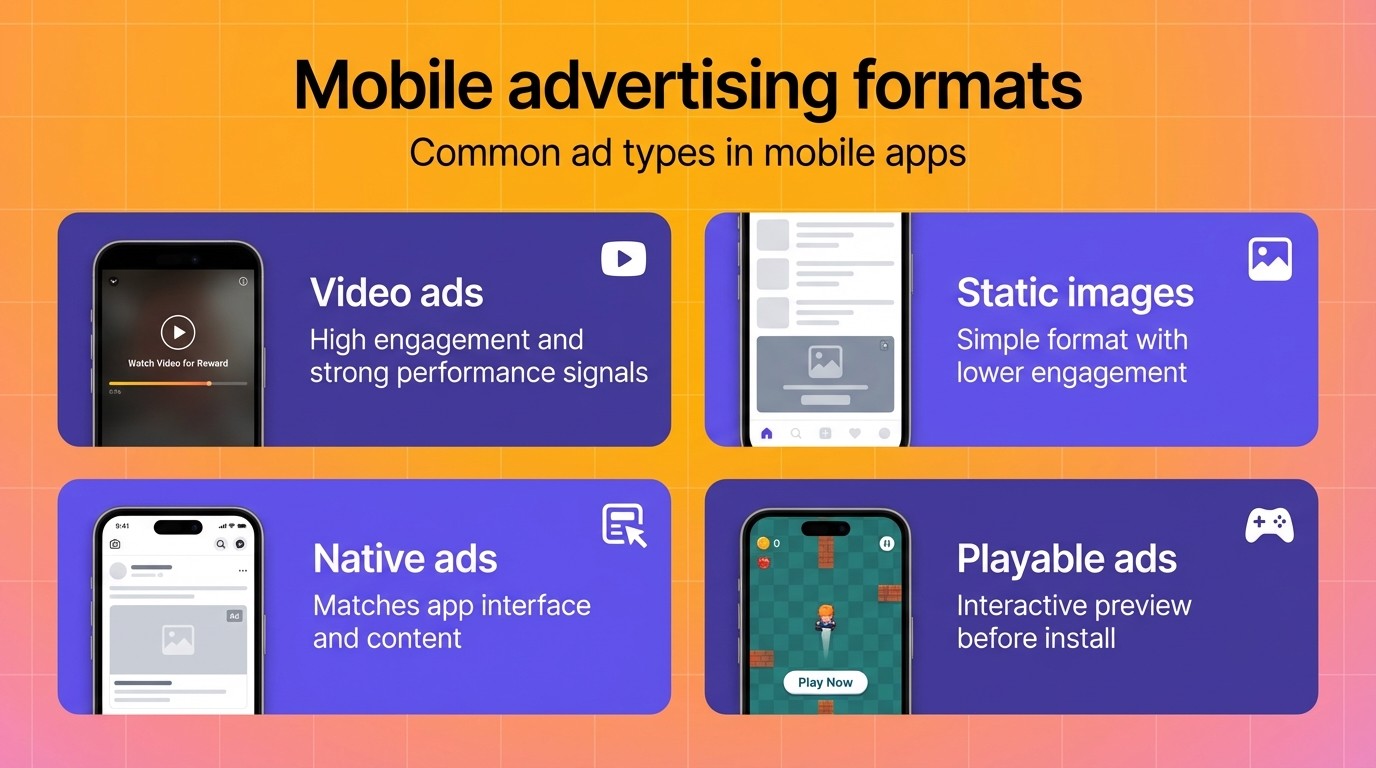
Mobile advertising formats include video (most effective), static images, native ads that match app content, and interactive playables. Video typically outperforms static formats for engagement and revenue in mobile apps, especially in rewarded and interstitial placements, while also providing algorithms with clearer performance signals.
The rise of short-form vertical video on TikTok, Reels, and Shorts rewired how people consume content. They expect fast, visual, immediately rewarding experiences. Your mobile ads need to match this energy - clear payoff within seconds, no confusing setup.
How mobile advertising works
Understanding the mobile advertising supply chain helps you optimize for what actually matters - not vanity metrics.
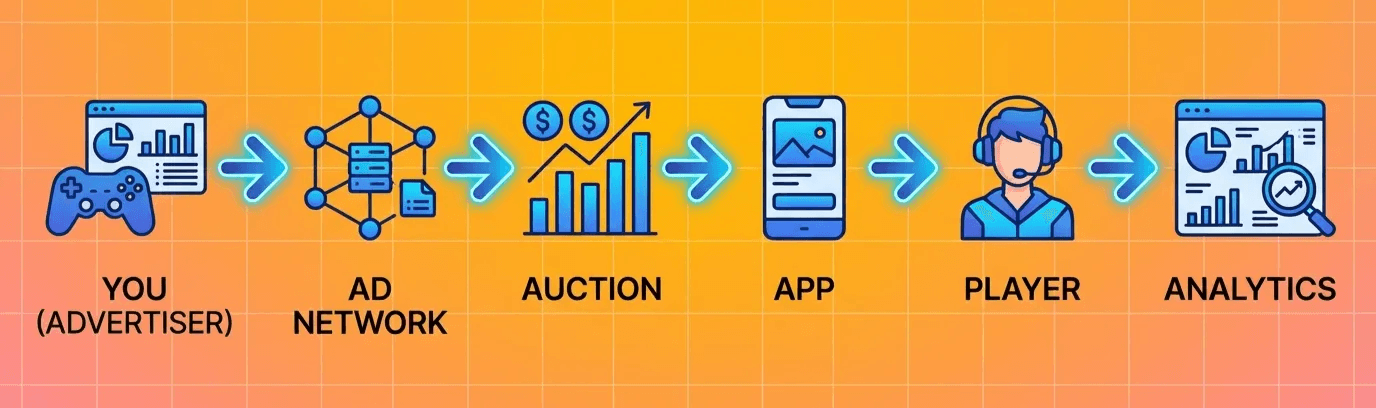
Here's the flow: You work with demand-side platforms or ad networks that bid on impressions through exchanges. Those impressions show up in publisher apps via mediation layers. Measurement platforms track installs and post-install events back to your campaigns.
The auction runs programmatically. Networks bid on each impression based on predicted return. If your creative signals high-value actions (tutorial completion, first purchase, D7 retention), the algorithm bids more aggressively because it expects better returns.
This is why "signal-rich" creative matters—but only when you've configured tracking correctly. Clear outcomes, strong CTAs, and properly implemented conversion events give optimization algorithms clean feedback to learn from. Vague brand videos confuse the system.
How mobile ad algorithms optimize delivery
Modern mobile advertising platforms - Meta, Google, TikTok, Unity Ads, AppLovin—all use machine learning to match ads with users. You set goals (installs, purchases, subscriptions), and the algorithm predicts which impressions will deliver those outcomes.
These systems learn from massive signal sets: device model, OS version, app usage patterns, browsing history, purchase behavior, and how users responded to previous ads. Your conversion tracking and event configuration determine which signals the algorithm can actually use—creative quality matters, but only when paired with proper technical implementation. They're not just predicting clicks anymore—they predict which users will complete valuable actions like making purchases or subscribing.
The optimization runs as a continuous loop. Show ad → user converts → feed outcome back → adjust future delivery. Better creative accelerates this loop because it maps more clearly to the actions you're optimizing for.
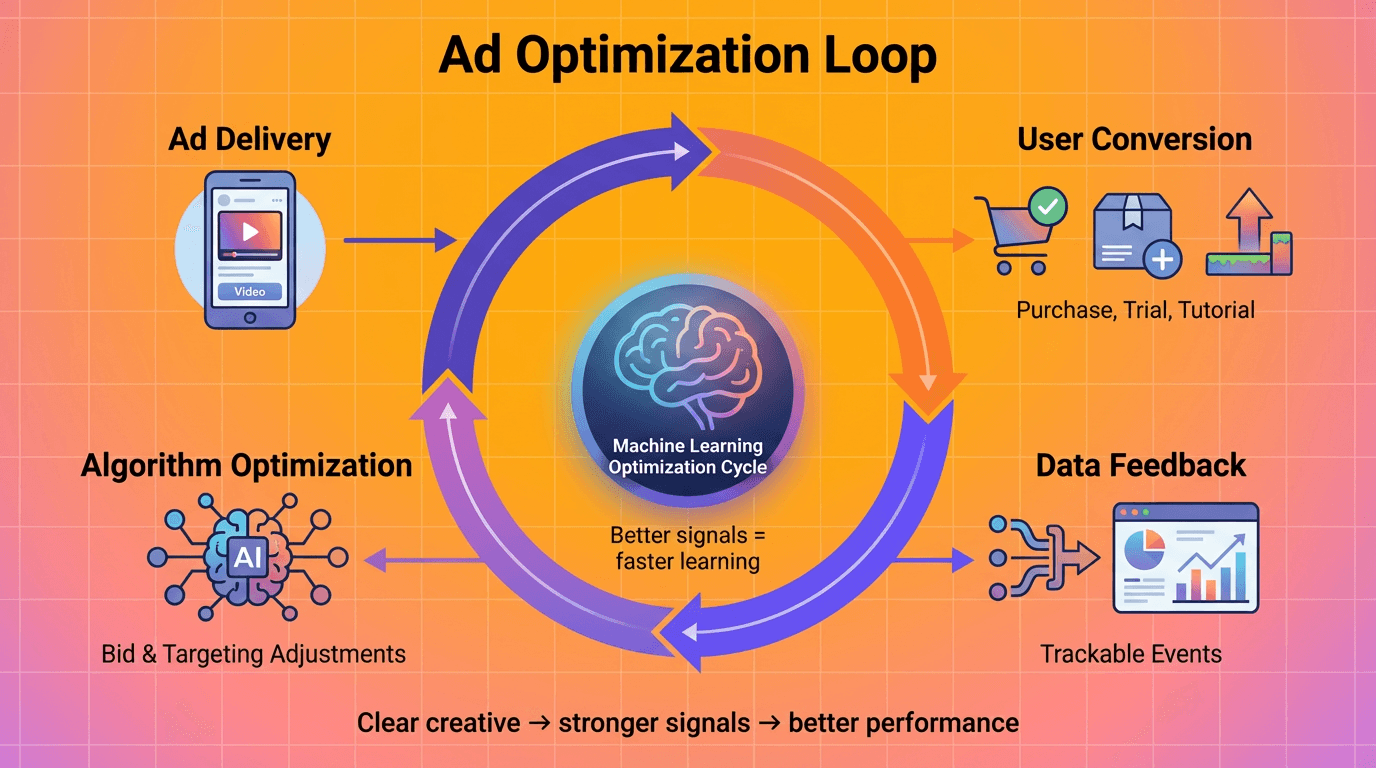
The more explicitly your video shows the outcome you want, the better algorithms perform. If you're optimizing for app purchases, show the purchase moment. If you're targeting tutorial completers, show tutorial gameplay.
Design creatives with clear, trackable outcomes and specific CTAs. "Get 50% off your first order" beats "Shop now" because it signals purchase intent. "Start your free trial" beats "Learn more" because it signals conversion readiness.
Platforms like AppLovin's Axon take this further with predictive bidding across 1 billion+ daily users, but the principle holds everywhere: signal-rich creative that clearly demonstrates your target action gives algorithms better data to optimize delivery.
Types of mobile advertising formats
Mobile advertising uses several formats, each with different user expectations and performance characteristics.
In-feed video ads
Standard video that appears in social feeds (TikTok, Instagram, Facebook). Best for discovery and broad reach. Users scroll past unless your first 3 seconds hook attention. Vertical (9:16) or square (1:1) formats perform best.
Story ads
Full-screen vertical takeover on Instagram, Snapchat, Facebook. Creates urgency with immersive format. 15-second max length. Works for limited-time offers and product launches.
Rewarded video ads
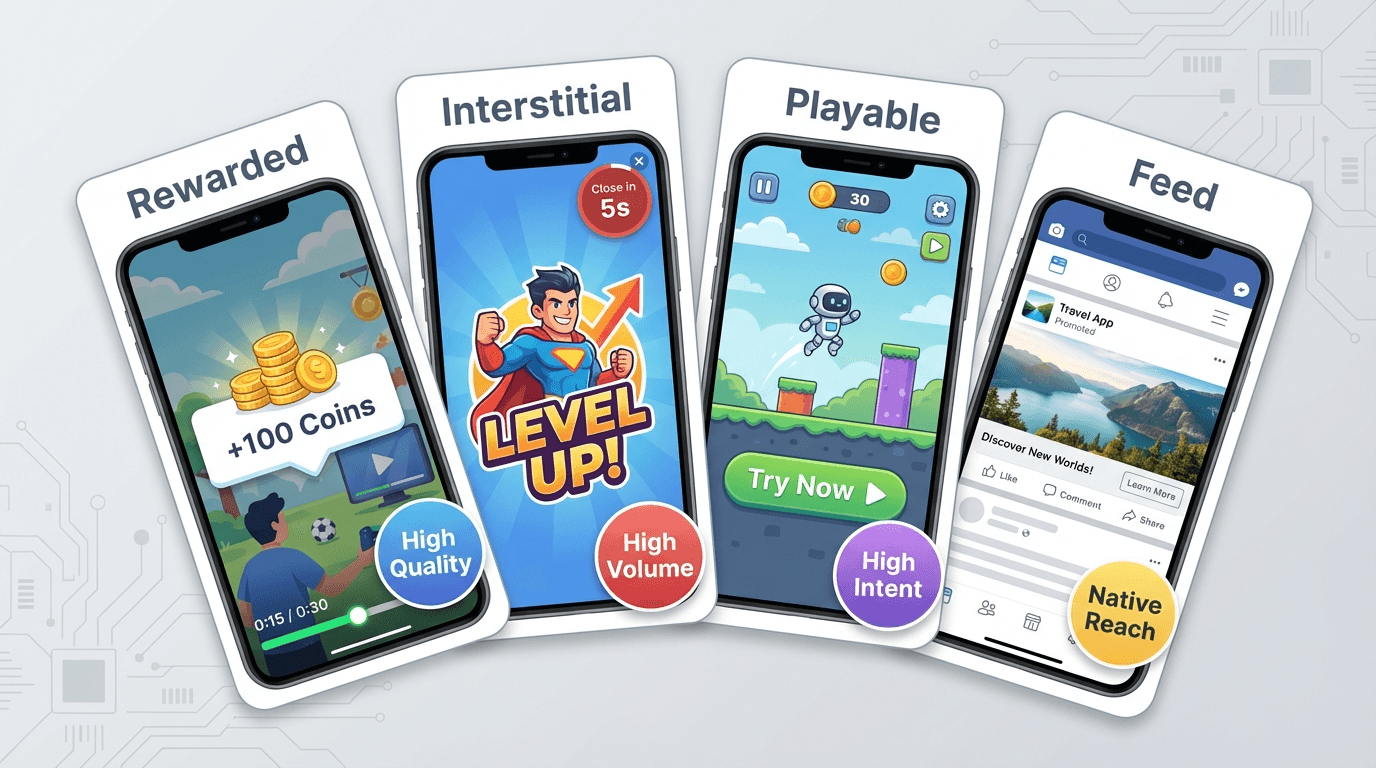
Users watch 15-30 seconds (occasionally up to 60s for higher-value rewards) to earn in-game currency, lives, or premium content. Highest completion rates (70-90%) because users choose to engage. Best for mobile games and apps with virtual economies.
Interstitial video ads
Full-screen ads between content sessions (between game levels, during app transitions). Cannot be skipped for first 5 seconds. Works for volume but can annoy users if overused.
Playable ads
Interactive demos where users try gameplay or app features before installing. Expensive to produce but filters for high-intent users. Best for games and interactive apps.
Native video ads
Video that matches the look and style of surrounding content. Appears in news feeds, article pages, and content streams. Less intrusive but must provide clear value to stand out.
Mobile advertising costs and pricing models
Mobile advertising costs vary by format, platform, geography, and competition. Here's what to expect:
Cost models
CPM (Cost Per Thousand Impressions): Often ranges from $3-$10 for standard placements and $8-$20 for premium inventory in tier-1 markets, though exact costs vary significantly by vertical, targeting precision, and seasonality. You pay for views regardless of actions.
CPC (Cost Per Click): $0.50-$3.00, depending on platform and targeting. You only pay when users click.
CPI (Cost Per Install): Typically ranges from $0.50-$5.00 for casual games/apps in tier-1 markets (US, UK, Western Europe) and $0.10-$1.00 in tier-2/3 markets, with significant variation based on genre, competition, and creative quality. Premium apps can see $10-$30+ CPI.
CPA (Cost Per Action): Variable based on your target action. First purchase might cost $20-$100, depending on product value.Understanding mobile user behavior and attention
Cost Model | What You Pay For | Typical Price Range | Notes |
|---|---|---|---|
CPM (Cost Per 1000 Impressions) | Ad views | $3–$10 standard placements$8–$20 premium inventory (Tier-1 markets) | Varies by vertical, targeting precision, and seasonality. You pay regardless of user action. |
CPC (Cost Per Click) | Clicks on the ad | $0.50–$3.00 per click | Strongly influenced by platform, targeting, and competition. |
CPI (Cost Per Install) | App installs | $0.50–$5.00 Tier-1 markets$0.10–$1.00 Tier-2/3 markets$10–$30+ premium apps | Affected by genre, competition, and creative quality. |
CPA (Cost Per Action) | Specific conversion (purchase, signup, etc.) | $20–$100 first purchase (varies) | Highly variable depending on product value and funnel quality. |
What affects costs
Geography: US/UK/Canada cost 5-10x more than Southeast Asia or Latin America.
Platform: TikTok and Meta typically cost more than Unity Ads or AppLovin for gaming.
Competition: Black Friday, holiday shopping, and major game launches drive prices up 30-50%.
Creative quality: Better-performing ads get lower costs because algorithms bid more efficiently.
The real metric isn't CPI—it's cost per paying user and return on ad spend (ROAS). A $5 CPI that converts at 10% to $20 purchases delivers better returns than a $1 CPI with 1% conversion.
How to start mobile advertising: step-by-step
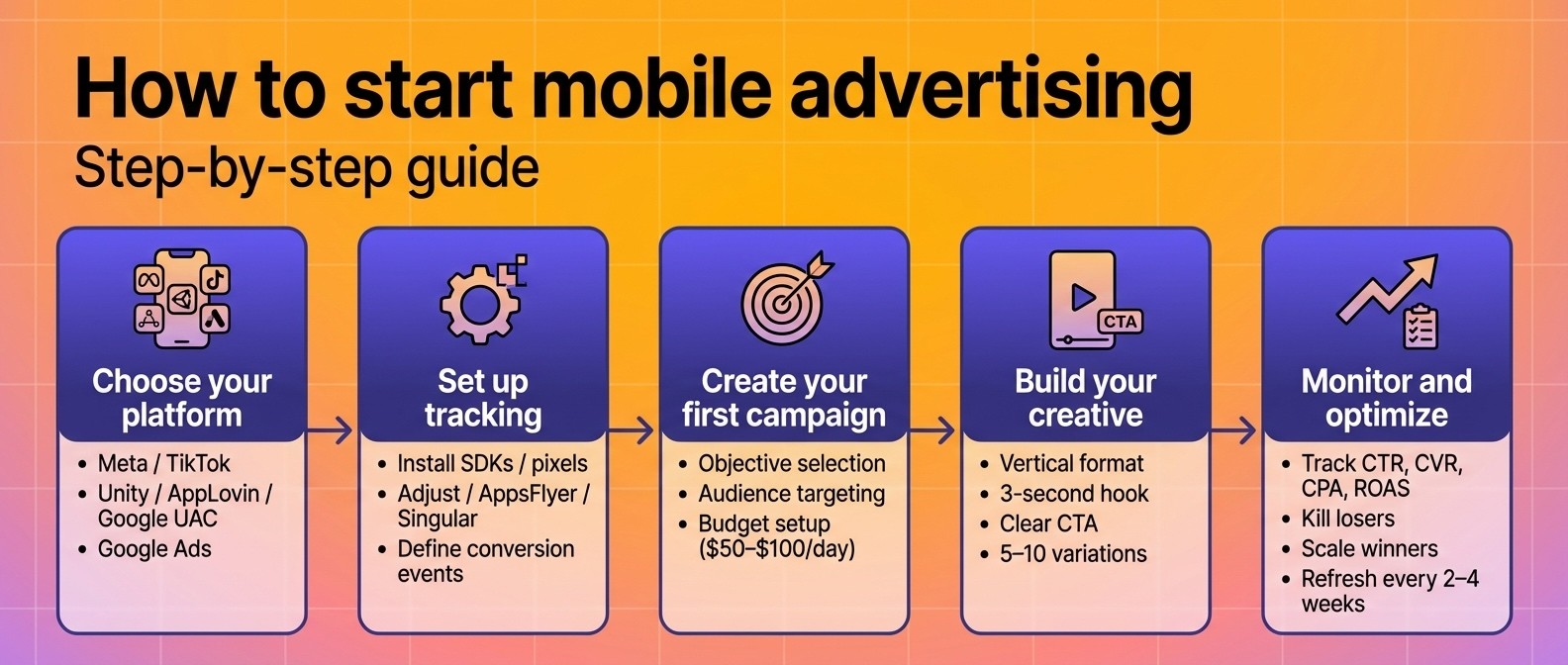
1. Choose your platform
For e-commerce/DTC brands: Start with Meta (Facebook/Instagram) or TikTok. Both offer robust creative tools and a broad reach.
For mobile apps/games: Unity Ads, AppLovin, Google UAC (Universal App Campaigns), and ironSource reach in-app audiences.
For broad reach: Google Ads covers search, YouTube, and the display network.
2. Set up tracking
Install platform SDKs (Software Development Kits) or pixels on your website/app to track conversions. Use measurement platforms like Adjust, AppsFlyer, or Singular for mobile app attribution.
Define your conversion events: purchases, signups, tutorial completions, or other valuable actions. Algorithms optimize toward these events.
3. Create your first campaign
Set campaign objective: awareness, traffic, app installs, conversions, or sales.
Define your audience: demographics, interests, behaviors, or lookalikes based on existing customers.
Set budget: Start with $50-$100/day to gather data. Scale once you identify winning creative.
4. Build your creative
Follow the principles in this guide: vertical format, 3-second hook, clear value proposition, specific CTA.
Launch with 5-10 creative variations minimum. Test different hooks, angles, and CTAs.
5. Monitor and optimize
Check performance daily for the first week. Key metrics: viewable impressions, CTR (click-through rate), CVR (conversion rate), CPA, and ROAS.
Kill underperformers after 3-5 days. Double budget on winners. Refresh creative every 2-4 weeks to combat ad fatigue.
Measurement standards: what counts as a real "view"?
Not all impressions are created equal. The Media Rating Council (MRC) and IAB set standards for what counts as a valid, viewable impression.
The baseline: video impressions count on "begin to render"—when the ad actually starts displaying, not when it's served to a device. This shift eliminates phantom impressions that never reached screens.
For viewable video impressions in mobile apps, the MRC requires at least 50% of pixels visible for 2 continuous seconds. This 2-second viewability threshold is why creative must hook immediately—your ad needs to deliver value before the measurement window expires, not because human attention universally drops at exactly 2 seconds. If you don't capture attention in these 2 seconds, the impression counts but the user never engaged.
Here's the brutal math: Your creative must deliver value before the viewability timer expires. Strong first-second visual, immediate payoff, legible branding within the first 2-3 seconds. No slow builds, no abstract intros.
Monitor viewability and completion rates as leading indicators. High viewability with low completion means your hook works but your payoff doesn't. Low viewability means placement or creative targeting issues. Both matter more than raw impression counts.
Mobile advertising examples that convert
Example 1: E-commerce product ad (skin care)
Hook (0-3s): Close-up of dry, flaky skin → quick cut to smooth, hydrated result
Body (3-15s): Product bottle appears → shows application → before/after split screen
CTA (15s): "Get 40% off your first order" with clear button
Why it works: Immediate problem-solution, tangible transformation, specific offer
Example 2: Mobile game ad (puzzle)
Hook (0-3s): Character stuck in impossible-looking puzzle → text overlay "Can you solve this?"
Body (3-20s): Shows simple swipe mechanic solving puzzle → rewards cascade
CTA (20s): "Download now and get 100 free coins"
Why it works: Triggers curiosity and competitive instinct, shows actual gameplay, promises immediate reward
Example 3: App service ad (meal planning)
Hook (0-3s): Stressed person staring at empty fridge → text: "Dinner in 20 minutes or less"
Body (3-25s): Shows app interface → quick recipe selection → ingredients delivered
CTA (25s): "Start your 7-day free trial"
Why it works: Addresses specific pain point, demonstrates core value, low-friction trial
Understanding mobile user behavior and attention

Mobile users consume content in micro-moments—waiting in line, commuting, between tasks. Sessions are fragmented and attention is limited. This shapes what kinds of ads work.
People use mobile apps differently than desktop. They scroll fast, expect instant gratification, and abandon anything that requires effort. Your ad competes with hundreds of other dopamine hits in their feed—messages, posts, videos, other ads.
The tolerance for advertising varies by context. In social feeds, ads must match the content format (vertical video, native styling, engaging hooks). In games, rewarded video performs well because it's a value exchange: watch 30 seconds, get in-game currency. The user chooses to engage.
Mobile game advertising offers useful insights for all mobile advertisers. Games have solved the attention problem by making ads feel like content. Hyper-casual games succeed with simple mechanics and instant understanding—lessons that apply to product ads, app ads, and service ads.
Key trends shaping mobile advertising: vertical video dominance (TikTok, Reels, Shorts), sound-off viewing becoming default, interactive formats gaining traction, and performance creative replacing brand creative as the standard.
Your mobile ads should match the snackable, scrollable, immediate-reward nature of mobile itself. Show quick wins, simple value props, obvious payoffs. Save the slow storytelling for desktop campaigns.
Principles of scroll-stopping mobile video ads
Most mobile video ads are watched sound-off on vertical screens controlled by thumbs. Design for this reality, not the widescreen experience you wish you had.
Vertical or square formats (9:16 or 1:1) work best. Use large, legible text because users scan fast. Assume sound is off—add captions, use visual storytelling, make the core value obvious without audio. Avoid dense information or tiny text that disappears on small screens.
The three-second rule: hook, clarity, payoff. Your first 2-3 seconds must show your product in action, create a pattern break, or trigger emotion. Start mid-transformation showing before/after. Show an obvious problem followed immediately by your solution.
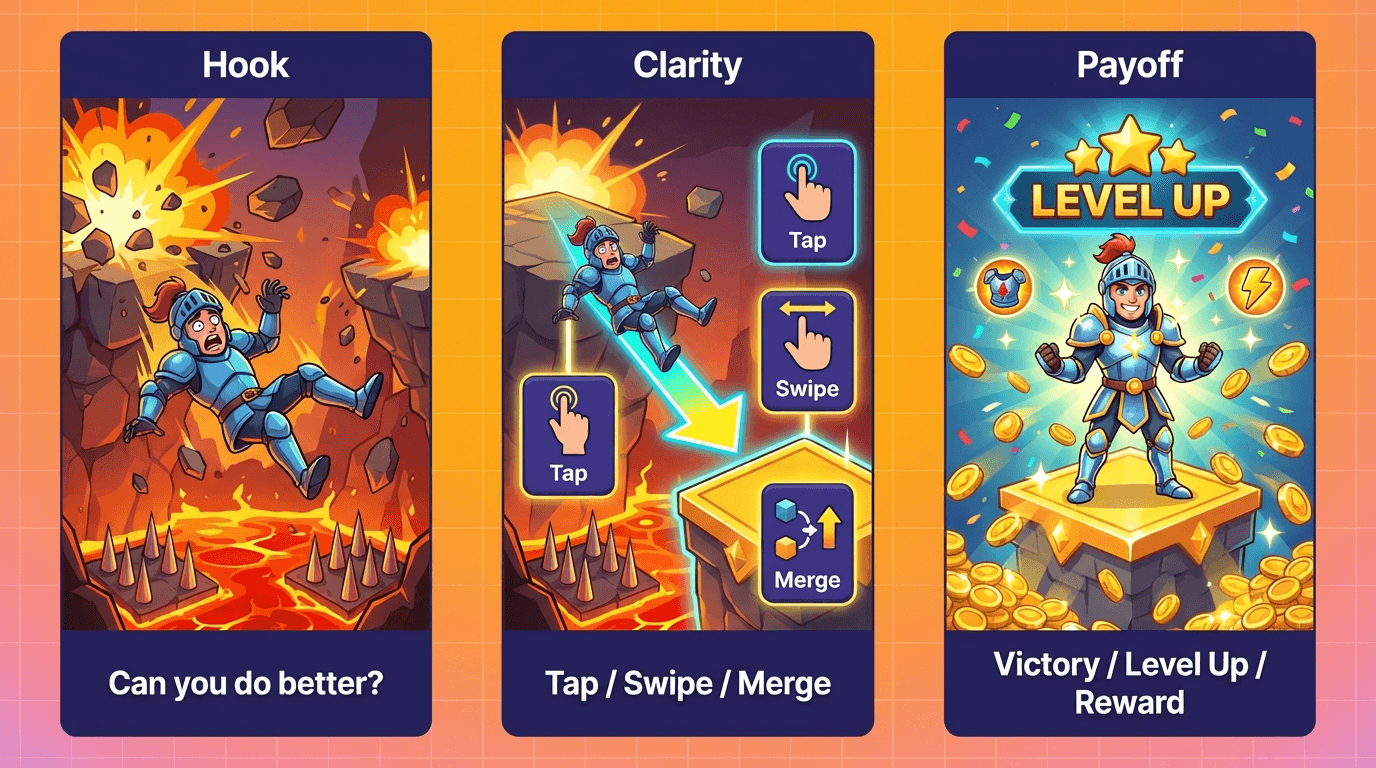
Here's what works: Customer struggling with problem → "There's a better way" → show product solving it. Or: Boring old solution → vs arrow → exciting new solution. Or: Product doing something unexpected → hook curiosity → explain benefit.
Make your value proposition instantly obvious. Show what people get and how they get it. Not abstract concepts, not brand storytelling—tangible outcomes users can understand in 3 seconds.
For mobile game ads specifically: Show the gameplay loop players will repeat—tap, merge, swipe, aim. Real gameplay capture with minimal overlays gives algorithms clear signals and sets accurate expectations.
For ecommerce/product ads: Show the product in use, the transformation it creates, or the problem it solves. "Here's the mess → here's our product → here's the clean result."
For app/service ads: Demonstrate the core action users will take repeatedly. One clear use case, one obvious benefit, one specific outcome.
Creative playbook for mobile video ads
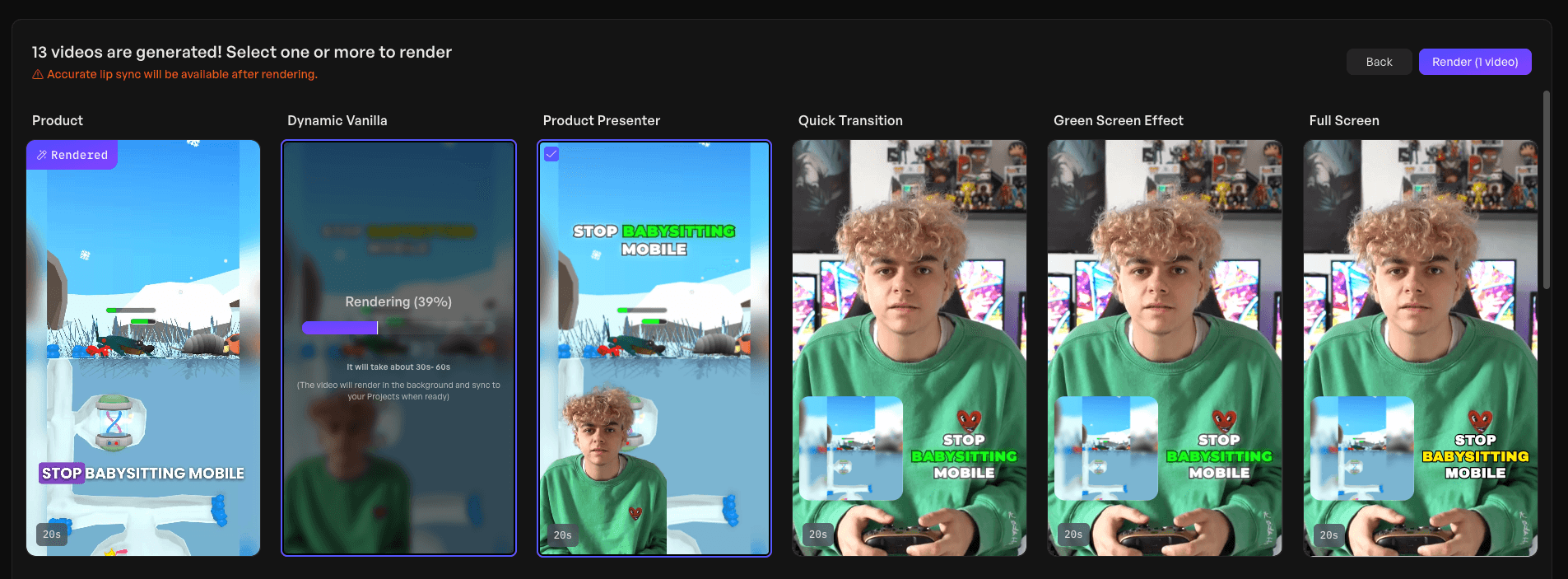
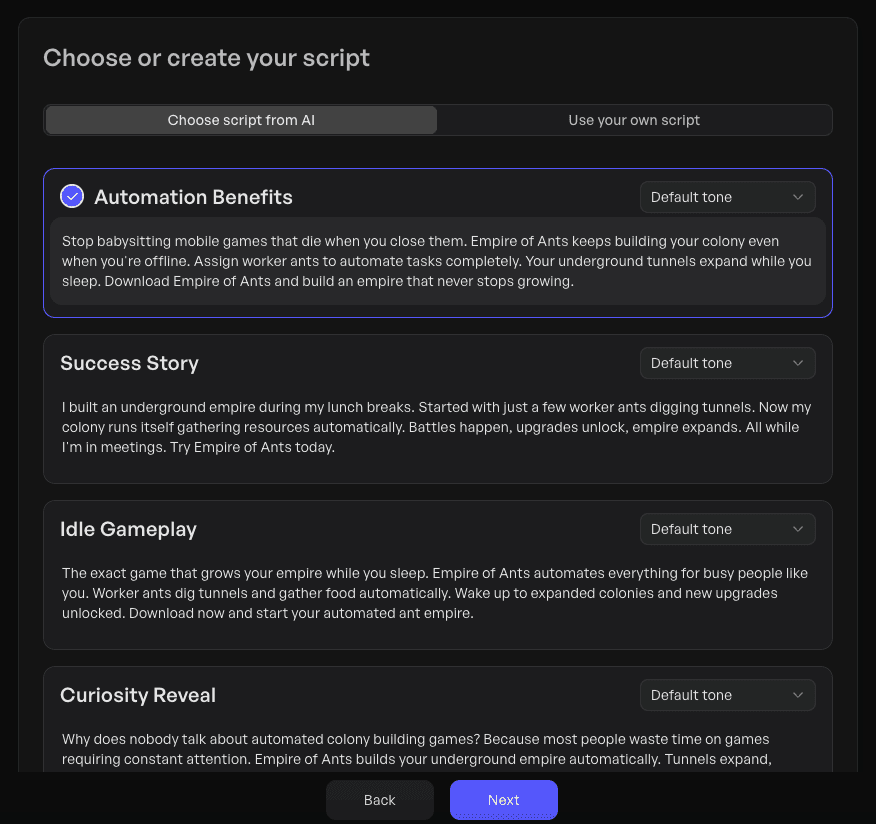
When you're testing 50-100 creative variations (which high-performing mobile advertisers do), production speed matters. Creatify's AI avatars and URL-to-Video tool let you generate dozens of mobile ads in minutes.
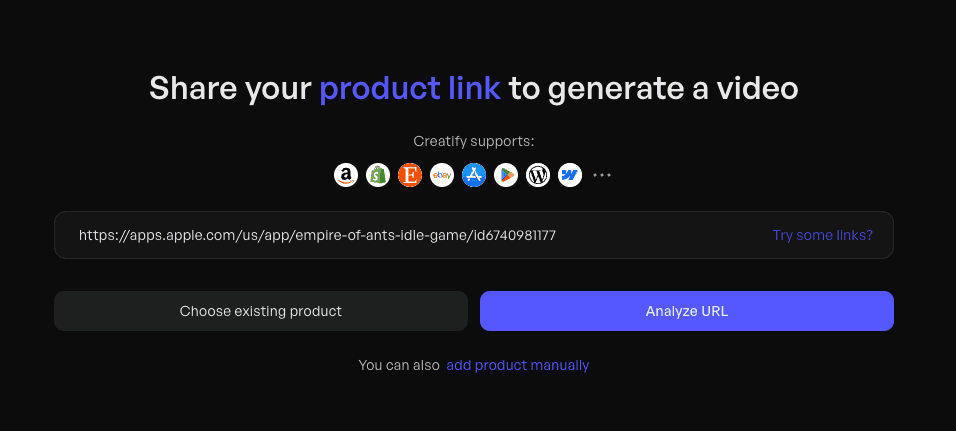
Paste your product URL, select vertical format,
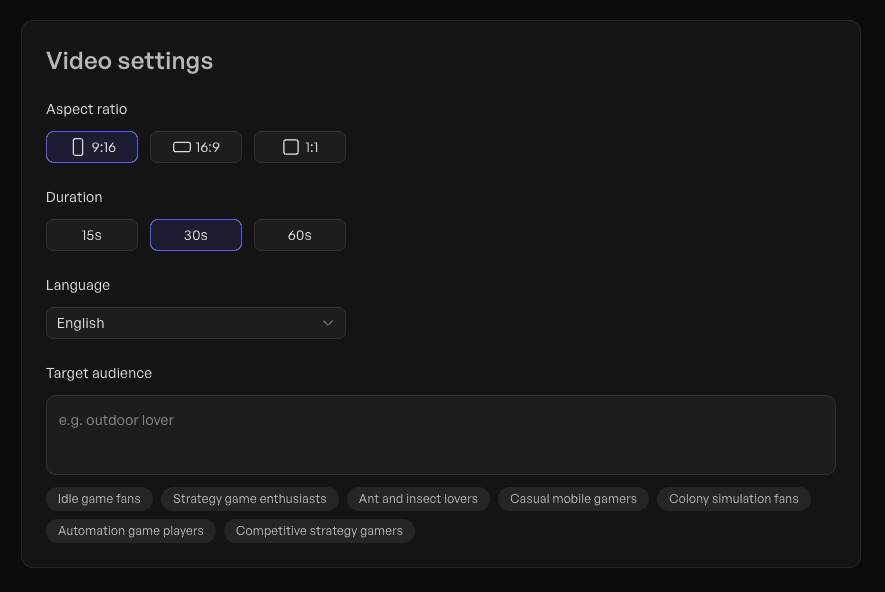
and test multiple hooks without coordinating shoots.
Proven creative concepts that work across mobile advertising
Problem-solution hooks show frustration followed by relief. "Tired of [pain point]? → Here's [product] → Look how easy."
Before/after transformations work for fitness, beauty, home, productivity. Show the dramatic change your product creates.
Social proof formats display review snippets, user counts, or testimonials. "Join 5M users" or "4.9★ from 100K reviews."
Curiosity/mystery hooks start with unexpected scenarios. "I didn't believe this worked until..." or "This changed everything about [category]."
Demo/tutorial style walks through key features. "Here's how to [achieve outcome] in 30 seconds."
Fail ads (game-specific) show obvious mistakes inviting users to "do better." Works because it triggers competitive instinct.
Unboxing/reveal formats tap into discovery dopamine. Show product unveiling, app interface reveal, or feature walkthrough.
Data-driven creative testing for mobile advertising
One hero video won't carry your mobile advertising campaign. Performance follows a power-law distribution: a few creatives drive most results, and you can't predict which ones beforehand.
The answer is volume testing. Create dozens of variations testing different hooks, first 3 seconds, CTAs, visual themes, and product angles. Modern ad platforms (Meta, TikTok, Google, AppLovin, Unity) push budget toward winners fast when you provide diverse inputs.
Structure your creative experiments properly:
Fix one target event—purchase, signup, tutorial completion. Hold targeting and bid strategy constant. Test creatives in structured batches so you can isolate what's working. Week 1: test 10 hook variations. Week 2: test 5 CTA variations on the winning hook. Week 3: test visual themes.
This systematic approach beats random A/B testing because you build knowledge. "Our audience responds to problem-solution hooks better than curiosity hooks" becomes an insight you can scale.
Feed algorithms clear signals by mapping your ad creative to campaign goals. If you're optimizing for purchases, show the product being purchased. If you're targeting signups, show the signup flow and benefit. Make the connection explicit.
Meta's algorithm learns what "purchase intent" looks like when your creative shows someone completing a purchase. TikTok's system identifies "high engagement" users when your creative demonstrates the engaging outcome. AppLovin's Axon optimizes for long-term value when you show the value moments.
Traditional production makes volume testing impossible. At $3,000-15,000 per video, you can't afford 50 variations. With AI-powered platforms like Creatify, you generate 50 variations for the cost of one traditional video—and test what actually converts instead of guessing.
Discover how AdMax transformed static creatives into scroll-stopping ads and helped an e-commerce agency achieve 10x better performance.
Integrating video ads into your full mobile marketing strategy
Mobile advertising works best when integrated with your full marketing mix. Paid campaigns through Meta, Google, TikTok, AppLovin, and other platforms drive immediate results, but successful brands mix paid with organic channels: SEO, social media, content marketing, and community building.
Strong video creatives should be repurposed across every channel. Your mobile ads become social media content, website videos, email marketing assets, and sales presentation materials. This compounds your creative investment across touchpoints.
Cross-channel consistency matters for conversion. When someone sees your ad on Instagram, clicks through to your site, and sees matching visuals and messaging, conversion rates improve. Mismatched experiences—different style, different promise—create friction and kill trust.
Your customer lifetime value feeds back into ad strategy. Higher LTV means you can bid more aggressively in auctions. Track which creative types attract the most valuable customers, then produce more variations of those winners.
For ecommerce: Promote seasonal sales, new product launches, and special offers directly in your mobile ads to attract high-intent buyers.
For apps: Show the specific features that drive retention and upgrade conversions. Optimize creative for users likely to subscribe or purchase.
For games: Highlight LiveOps events, limited-time content, and starter packs in ads. These attract players who already understand in-app monetization.
The full loop: Create ad → drive conversion → deliver value → increase LTV → use LTV data to bid higher → acquire more valuable customers. Your video creative is the entry point to this entire system.
Ethical, privacy, and user-experience considerations
AppLovin's Axon and similar systems use device identifiers, app usage data, and behavioral signals for targeting. Users can opt out of interest-based advertising through device settings. Platforms must respect these choices and comply with privacy regulations.
Be transparent about data use. Follow platform privacy policies. Don't collect more data than you need for optimization and measurement.
Avoid deceptive creative practices. Showing fake gameplay, impossible scenarios, or misleading rewards damages your brand long-term through poor retention, bad ratings, and player complaints. The short-term install boost isn't worth the churn.
Industry guidelines are clear: show representative gameplay, avoid scenarios that can't occur in the actual game, clearly display reward terms and requirements. If your ad shows level 50 gameplay, players should realistically reach level 50.
Design ads that respect players. Use frequency caps so the same person doesn't see your ad 20 times per day. Make close buttons visible and functional. Allow skipping after a reasonable period. Give players control.
"Scroll-stopping" should mean earning attention with genuinely engaging content, not tricking users into accidental clicks. Build trust through honest representation and you'll acquire players who stick around.
Actionable checklist: building your next mobile video ad
Use this to ship better mobile advertising campaigns faster.
Pre-production checklist
Define target audience segments and optimization events (D1 retention? First purchase? Tutorial completion?)
Choose ad platforms for your campaign (Meta, Google, TikTok, Unity Ads, AppLovin)
Note on AppLovin: If you're planning to run AppLovin ads, register in advance—new accounts without referral codes face wait times for approval. You can use Creatify's partnership page to skip the line, and get immediate access to Axon.
Choose ad format based on funnel stage: rewarded for engagement, interstitial for volume, playable for quality
Research successful ads in your genre—what hooks and formats are competitors using?
Set success metrics: viewable impressions, CTR, install rate, D1/D7 retention, ROAS targets
Creative production checklist
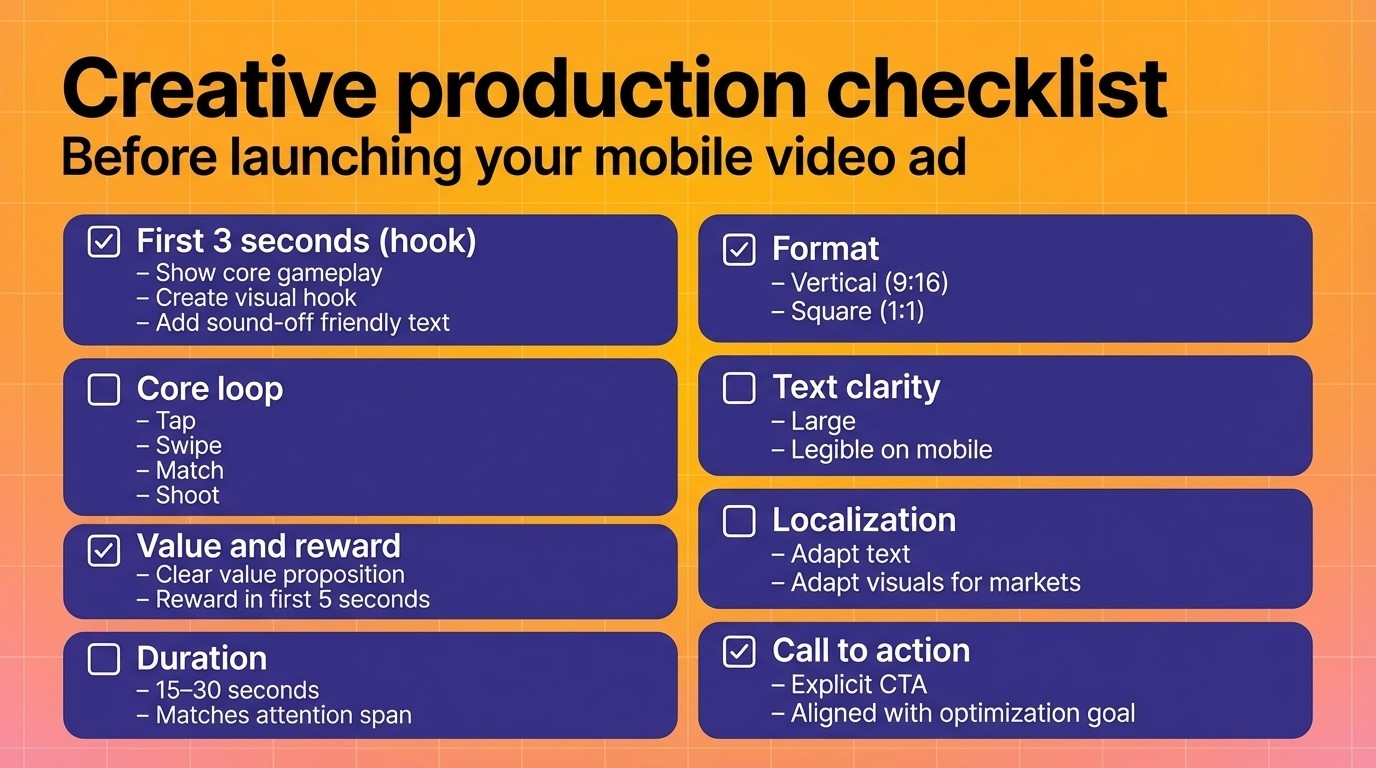
First 3 seconds: show core gameplay, create visual hook, add on-screen text that works sound-off
Demonstrate the core loop players will repeat—tap, swipe, match, shoot
Show clear value proposition and reward within first 5 seconds
Keep length to 15-30 seconds for most placements (players' actual attention span)
Design for vertical (9:16) or square (1:1) formats
Use large, legible text that reads on mobile screens
Localize text and visual elements for target markets
Include explicit CTA aligned with your optimization goal
Testing and iteration checklist
Set up event tracking and attribution for down-funnel actions
Launch with 10-20 creative variations minimum
Monitor viewability, completion rate, CTR, CVR, retention, and ROAS
Kill underperformers after 3-5 days, double down on winners
Refresh creative every 2-4 weeks to combat ad fatigue
Test new hooks, CTAs, and visual themes in structured batches
Document what works for future campaigns
Production speed advantage
When you need 50 variations tested monthly, traditional production fails. Creatify generates mobile ads in minutes—paste your product URL, choose format, customize hooks and CTAs, render in batch. This lets you test at the volume modern mobile advertising demands.
Summing it up
Mobile advertising success comes down to understanding three systems: how users consume content (fast, visual, vertical, sound-off), how algorithms optimize (based on signal-rich creative that maps to value events), and how to test at volume (dozens of variations, structured experiments).
The attention window is 2 seconds. The optimization engines are predictive. The creative that wins shows exactly what users will experience and why they should care—right now, in the first 3 seconds, without sound.
Traditional production can't keep pace with the testing velocity modern mobile advertising demands. AI-powered creative tools like Creatify solve this by making volume production financially viable. Generate 50 variations for the price and time of one traditional video.
Your next step: audit your current mobile ads against this framework. Are they vertical? Do they hook in 3 seconds? Do they show real product value? Do they map to your optimization events? Fix the gaps, test aggressively, and let algorithms find your winners.
FAQ
What is mobile advertising?
Mobile advertising is promotional content delivered through mobile devices—typically video ads shown in apps, mobile games, and social feeds. The mobile advertising ecosystem uses programmatic auctions where advertisers bid on impressions. Major platforms include Meta (Facebook/Instagram), Google (YouTube, UAC), TikTok, Unity Ads, and AppLovin. These networks use machine learning to predict which users will convert and automatically optimize delivery.
How do mobile game ads work?
Mobile game ads work through mediation platforms that connect advertisers (game studios) with publisher apps (other games showing ads). When someone opens an app, the mediation layer requests ads from multiple networks, runs an auction, and displays the highest-value ad. Performance is tracked through attribution platforms (Adjust, AppsFlyer, Singular) that connect ad views to installs and in-game events. Networks optimize delivery using behavioral data and conversion patterns.
What makes a mobile video ad scroll-stopping?
A scroll-stopping mobile video ad hooks attention in the first 2-3 seconds with clear action, visual pattern breaks, or immediate value propositions. It's designed for vertical or square formats, works without sound, uses large legible text, and shows the core product or gameplay instantly. The best mobile ads start mid-action (dramatic moment), demonstrate what users actually get, and include specific CTAs. Avoid slow builds, abstract concepts, or confusing setups.
What video formats work best for mobile advertising?
Rewarded video (watch for in-game rewards) generates the highest engagement because it's a voluntary value exchange. Interstitial video (full-screen between sessions) works for volume. Playable ads (interactive demos) filter for high-intent users but cost more. Vertical video (9:16) performs best because it matches phone orientation and social media habits. Square (1:1) works across multiple placements. Length should be 15-30 seconds—matching actual attention spans.
How much does mobile advertising cost?
Mobile advertising costs vary by format, platform, geography, and competition. CPM (cost per thousand impressions) ranges from $3-$20. CPI (cost per install) ranges from $0.50-$5.00 for casual apps in tier-1 markets (US, UK, Western Europe) and $0.10-$1.00 in tier-2/3 markets. Premium apps can see $10-$30+ CPI. The real metric is cost per paying user and ROAS (return on ad spend), which depends on your conversion rate and creative quality.
How often should you refresh mobile ad creative?
Refresh mobile ad creative every 2-4 weeks to combat ad fatigue. Performance typically drops 20-40% after 2-3 weeks of continuous delivery to the same audiences. Test new hooks, visual themes, or gameplay moments in structured batches rather than replacing all creative at once. Keep winning concepts running while introducing variations. High-volume advertisers maintain 20-50+ active creative variations and continuously test new concepts to maintain performance.
What are the best mobile advertising platforms?
For ecommerce/DTC: Meta (Facebook/Instagram) and TikTok offer the best targeting and creative tools for product discovery.
For mobile apps/games: Unity Ads, AppLovin, Google UAC, and ironSource reach in-app audiences with rewarded and interstitial formats.
For broad reach: Google Ads covers search, YouTube, and display network.
Platform choice depends on your audience, budget, and objectives. Most successful advertisers run multi-platform campaigns and let data determine budget allocation.maintain performance.
Your mobile ad has 2 seconds to meet viewability standards and capture attention. Miss that window and you just burned budget on an impression nobody saw.
Mobile advertising isn't getting easier. Users see thousands of ads weekly across apps, games, and social feeds. Algorithms on Meta, TikTok, Unity Ads, and AppLovin decide which ads get shown based on predicted performance—and your creative is the signal they read.
This guide shows you how to build mobile video ads that actually perform. We'll cover what mobile advertising is, how it works, what makes creative stop scrolls, and the production frameworks that let you test at scale.
What is mobile advertising?
Mobile advertising delivers promotional content through smartphones and tablets. Unlike desktop ads, mobile advertising happens primarily in-app (88% of mobile time) rather than through browsers.
The mobile advertising ecosystem connects three players: advertisers (you), ad networks that distribute your creative, and publishers (apps and games) where ads appear. When someone opens an app, networks bid in real-time auctions to show their ads. Winners pay per impression, click, install, or conversion depending on campaign goals.
Mobile advertising formats include video (most effective), static images, native ads that match app content, and interactive playables. Video typically outperforms static formats for engagement and revenue in mobile apps, especially in rewarded and interstitial placements, while also providing algorithms with clearer performance signals.
The rise of short-form vertical video on TikTok, Reels, and Shorts rewired how people consume content. They expect fast, visual, immediately rewarding experiences. Your mobile ads need to match this energy - clear payoff within seconds, no confusing setup.
How mobile advertising works
Understanding the mobile advertising supply chain helps you optimize for what actually matters - not vanity metrics.
Here's the flow: You work with demand-side platforms or ad networks that bid on impressions through exchanges. Those impressions show up in publisher apps via mediation layers. Measurement platforms track installs and post-install events back to your campaigns.
The auction runs programmatically. Networks bid on each impression based on predicted return. If your creative signals high-value actions (tutorial completion, first purchase, D7 retention), the algorithm bids more aggressively because it expects better returns.
This is why "signal-rich" creative matters—but only when you've configured tracking correctly. Clear outcomes, strong CTAs, and properly implemented conversion events give optimization algorithms clean feedback to learn from. Vague brand videos confuse the system.
How mobile ad algorithms optimize delivery
Modern mobile advertising platforms - Meta, Google, TikTok, Unity Ads, AppLovin—all use machine learning to match ads with users. You set goals (installs, purchases, subscriptions), and the algorithm predicts which impressions will deliver those outcomes.
These systems learn from massive signal sets: device model, OS version, app usage patterns, browsing history, purchase behavior, and how users responded to previous ads. Your conversion tracking and event configuration determine which signals the algorithm can actually use—creative quality matters, but only when paired with proper technical implementation. They're not just predicting clicks anymore—they predict which users will complete valuable actions like making purchases or subscribing.
The optimization runs as a continuous loop. Show ad → user converts → feed outcome back → adjust future delivery. Better creative accelerates this loop because it maps more clearly to the actions you're optimizing for.
The more explicitly your video shows the outcome you want, the better algorithms perform. If you're optimizing for app purchases, show the purchase moment. If you're targeting tutorial completers, show tutorial gameplay.
Design creatives with clear, trackable outcomes and specific CTAs. "Get 50% off your first order" beats "Shop now" because it signals purchase intent. "Start your free trial" beats "Learn more" because it signals conversion readiness.
Platforms like AppLovin's Axon take this further with predictive bidding across 1 billion+ daily users, but the principle holds everywhere: signal-rich creative that clearly demonstrates your target action gives algorithms better data to optimize delivery.
Types of mobile advertising formats
Mobile advertising uses several formats, each with different user expectations and performance characteristics.
In-feed video ads
Standard video that appears in social feeds (TikTok, Instagram, Facebook). Best for discovery and broad reach. Users scroll past unless your first 3 seconds hook attention. Vertical (9:16) or square (1:1) formats perform best.
Story ads
Full-screen vertical takeover on Instagram, Snapchat, Facebook. Creates urgency with immersive format. 15-second max length. Works for limited-time offers and product launches.
Rewarded video ads
Users watch 15-30 seconds (occasionally up to 60s for higher-value rewards) to earn in-game currency, lives, or premium content. Highest completion rates (70-90%) because users choose to engage. Best for mobile games and apps with virtual economies.
Interstitial video ads
Full-screen ads between content sessions (between game levels, during app transitions). Cannot be skipped for first 5 seconds. Works for volume but can annoy users if overused.
Playable ads
Interactive demos where users try gameplay or app features before installing. Expensive to produce but filters for high-intent users. Best for games and interactive apps.
Native video ads
Video that matches the look and style of surrounding content. Appears in news feeds, article pages, and content streams. Less intrusive but must provide clear value to stand out.
Mobile advertising costs and pricing models
Mobile advertising costs vary by format, platform, geography, and competition. Here's what to expect:
Cost models
CPM (Cost Per Thousand Impressions): Often ranges from $3-$10 for standard placements and $8-$20 for premium inventory in tier-1 markets, though exact costs vary significantly by vertical, targeting precision, and seasonality. You pay for views regardless of actions.
CPC (Cost Per Click): $0.50-$3.00, depending on platform and targeting. You only pay when users click.
CPI (Cost Per Install): Typically ranges from $0.50-$5.00 for casual games/apps in tier-1 markets (US, UK, Western Europe) and $0.10-$1.00 in tier-2/3 markets, with significant variation based on genre, competition, and creative quality. Premium apps can see $10-$30+ CPI.
CPA (Cost Per Action): Variable based on your target action. First purchase might cost $20-$100, depending on product value.Understanding mobile user behavior and attention
Cost Model | What You Pay For | Typical Price Range | Notes |
|---|---|---|---|
CPM (Cost Per 1000 Impressions) | Ad views | $3–$10 standard placements$8–$20 premium inventory (Tier-1 markets) | Varies by vertical, targeting precision, and seasonality. You pay regardless of user action. |
CPC (Cost Per Click) | Clicks on the ad | $0.50–$3.00 per click | Strongly influenced by platform, targeting, and competition. |
CPI (Cost Per Install) | App installs | $0.50–$5.00 Tier-1 markets$0.10–$1.00 Tier-2/3 markets$10–$30+ premium apps | Affected by genre, competition, and creative quality. |
CPA (Cost Per Action) | Specific conversion (purchase, signup, etc.) | $20–$100 first purchase (varies) | Highly variable depending on product value and funnel quality. |
What affects costs
Geography: US/UK/Canada cost 5-10x more than Southeast Asia or Latin America.
Platform: TikTok and Meta typically cost more than Unity Ads or AppLovin for gaming.
Competition: Black Friday, holiday shopping, and major game launches drive prices up 30-50%.
Creative quality: Better-performing ads get lower costs because algorithms bid more efficiently.
The real metric isn't CPI—it's cost per paying user and return on ad spend (ROAS). A $5 CPI that converts at 10% to $20 purchases delivers better returns than a $1 CPI with 1% conversion.
How to start mobile advertising: step-by-step
1. Choose your platform
For e-commerce/DTC brands: Start with Meta (Facebook/Instagram) or TikTok. Both offer robust creative tools and a broad reach.
For mobile apps/games: Unity Ads, AppLovin, Google UAC (Universal App Campaigns), and ironSource reach in-app audiences.
For broad reach: Google Ads covers search, YouTube, and the display network.
2. Set up tracking
Install platform SDKs (Software Development Kits) or pixels on your website/app to track conversions. Use measurement platforms like Adjust, AppsFlyer, or Singular for mobile app attribution.
Define your conversion events: purchases, signups, tutorial completions, or other valuable actions. Algorithms optimize toward these events.
3. Create your first campaign
Set campaign objective: awareness, traffic, app installs, conversions, or sales.
Define your audience: demographics, interests, behaviors, or lookalikes based on existing customers.
Set budget: Start with $50-$100/day to gather data. Scale once you identify winning creative.
4. Build your creative
Follow the principles in this guide: vertical format, 3-second hook, clear value proposition, specific CTA.
Launch with 5-10 creative variations minimum. Test different hooks, angles, and CTAs.
5. Monitor and optimize
Check performance daily for the first week. Key metrics: viewable impressions, CTR (click-through rate), CVR (conversion rate), CPA, and ROAS.
Kill underperformers after 3-5 days. Double budget on winners. Refresh creative every 2-4 weeks to combat ad fatigue.
Measurement standards: what counts as a real "view"?
Not all impressions are created equal. The Media Rating Council (MRC) and IAB set standards for what counts as a valid, viewable impression.
The baseline: video impressions count on "begin to render"—when the ad actually starts displaying, not when it's served to a device. This shift eliminates phantom impressions that never reached screens.
For viewable video impressions in mobile apps, the MRC requires at least 50% of pixels visible for 2 continuous seconds. This 2-second viewability threshold is why creative must hook immediately—your ad needs to deliver value before the measurement window expires, not because human attention universally drops at exactly 2 seconds. If you don't capture attention in these 2 seconds, the impression counts but the user never engaged.
Here's the brutal math: Your creative must deliver value before the viewability timer expires. Strong first-second visual, immediate payoff, legible branding within the first 2-3 seconds. No slow builds, no abstract intros.
Monitor viewability and completion rates as leading indicators. High viewability with low completion means your hook works but your payoff doesn't. Low viewability means placement or creative targeting issues. Both matter more than raw impression counts.
Mobile advertising examples that convert
Example 1: E-commerce product ad (skin care)
Hook (0-3s): Close-up of dry, flaky skin → quick cut to smooth, hydrated result
Body (3-15s): Product bottle appears → shows application → before/after split screen
CTA (15s): "Get 40% off your first order" with clear button
Why it works: Immediate problem-solution, tangible transformation, specific offer
Example 2: Mobile game ad (puzzle)
Hook (0-3s): Character stuck in impossible-looking puzzle → text overlay "Can you solve this?"
Body (3-20s): Shows simple swipe mechanic solving puzzle → rewards cascade
CTA (20s): "Download now and get 100 free coins"
Why it works: Triggers curiosity and competitive instinct, shows actual gameplay, promises immediate reward
Example 3: App service ad (meal planning)
Hook (0-3s): Stressed person staring at empty fridge → text: "Dinner in 20 minutes or less"
Body (3-25s): Shows app interface → quick recipe selection → ingredients delivered
CTA (25s): "Start your 7-day free trial"
Why it works: Addresses specific pain point, demonstrates core value, low-friction trial
Understanding mobile user behavior and attention
Mobile users consume content in micro-moments—waiting in line, commuting, between tasks. Sessions are fragmented and attention is limited. This shapes what kinds of ads work.
People use mobile apps differently than desktop. They scroll fast, expect instant gratification, and abandon anything that requires effort. Your ad competes with hundreds of other dopamine hits in their feed—messages, posts, videos, other ads.
The tolerance for advertising varies by context. In social feeds, ads must match the content format (vertical video, native styling, engaging hooks). In games, rewarded video performs well because it's a value exchange: watch 30 seconds, get in-game currency. The user chooses to engage.
Mobile game advertising offers useful insights for all mobile advertisers. Games have solved the attention problem by making ads feel like content. Hyper-casual games succeed with simple mechanics and instant understanding—lessons that apply to product ads, app ads, and service ads.
Key trends shaping mobile advertising: vertical video dominance (TikTok, Reels, Shorts), sound-off viewing becoming default, interactive formats gaining traction, and performance creative replacing brand creative as the standard.
Your mobile ads should match the snackable, scrollable, immediate-reward nature of mobile itself. Show quick wins, simple value props, obvious payoffs. Save the slow storytelling for desktop campaigns.
Principles of scroll-stopping mobile video ads
Most mobile video ads are watched sound-off on vertical screens controlled by thumbs. Design for this reality, not the widescreen experience you wish you had.
Vertical or square formats (9:16 or 1:1) work best. Use large, legible text because users scan fast. Assume sound is off—add captions, use visual storytelling, make the core value obvious without audio. Avoid dense information or tiny text that disappears on small screens.
The three-second rule: hook, clarity, payoff. Your first 2-3 seconds must show your product in action, create a pattern break, or trigger emotion. Start mid-transformation showing before/after. Show an obvious problem followed immediately by your solution.
Here's what works: Customer struggling with problem → "There's a better way" → show product solving it. Or: Boring old solution → vs arrow → exciting new solution. Or: Product doing something unexpected → hook curiosity → explain benefit.
Make your value proposition instantly obvious. Show what people get and how they get it. Not abstract concepts, not brand storytelling—tangible outcomes users can understand in 3 seconds.
For mobile game ads specifically: Show the gameplay loop players will repeat—tap, merge, swipe, aim. Real gameplay capture with minimal overlays gives algorithms clear signals and sets accurate expectations.
For ecommerce/product ads: Show the product in use, the transformation it creates, or the problem it solves. "Here's the mess → here's our product → here's the clean result."
For app/service ads: Demonstrate the core action users will take repeatedly. One clear use case, one obvious benefit, one specific outcome.
Creative playbook for mobile video ads
When you're testing 50-100 creative variations (which high-performing mobile advertisers do), production speed matters. Creatify's AI avatars and URL-to-Video tool let you generate dozens of mobile ads in minutes.
Paste your product URL, select vertical format,
and test multiple hooks without coordinating shoots.
Proven creative concepts that work across mobile advertising
Problem-solution hooks show frustration followed by relief. "Tired of [pain point]? → Here's [product] → Look how easy."
Before/after transformations work for fitness, beauty, home, productivity. Show the dramatic change your product creates.
Social proof formats display review snippets, user counts, or testimonials. "Join 5M users" or "4.9★ from 100K reviews."
Curiosity/mystery hooks start with unexpected scenarios. "I didn't believe this worked until..." or "This changed everything about [category]."
Demo/tutorial style walks through key features. "Here's how to [achieve outcome] in 30 seconds."
Fail ads (game-specific) show obvious mistakes inviting users to "do better." Works because it triggers competitive instinct.
Unboxing/reveal formats tap into discovery dopamine. Show product unveiling, app interface reveal, or feature walkthrough.
Data-driven creative testing for mobile advertising
One hero video won't carry your mobile advertising campaign. Performance follows a power-law distribution: a few creatives drive most results, and you can't predict which ones beforehand.
The answer is volume testing. Create dozens of variations testing different hooks, first 3 seconds, CTAs, visual themes, and product angles. Modern ad platforms (Meta, TikTok, Google, AppLovin, Unity) push budget toward winners fast when you provide diverse inputs.
Structure your creative experiments properly:
Fix one target event—purchase, signup, tutorial completion. Hold targeting and bid strategy constant. Test creatives in structured batches so you can isolate what's working. Week 1: test 10 hook variations. Week 2: test 5 CTA variations on the winning hook. Week 3: test visual themes.
This systematic approach beats random A/B testing because you build knowledge. "Our audience responds to problem-solution hooks better than curiosity hooks" becomes an insight you can scale.
Feed algorithms clear signals by mapping your ad creative to campaign goals. If you're optimizing for purchases, show the product being purchased. If you're targeting signups, show the signup flow and benefit. Make the connection explicit.
Meta's algorithm learns what "purchase intent" looks like when your creative shows someone completing a purchase. TikTok's system identifies "high engagement" users when your creative demonstrates the engaging outcome. AppLovin's Axon optimizes for long-term value when you show the value moments.
Traditional production makes volume testing impossible. At $3,000-15,000 per video, you can't afford 50 variations. With AI-powered platforms like Creatify, you generate 50 variations for the cost of one traditional video—and test what actually converts instead of guessing.
Discover how AdMax transformed static creatives into scroll-stopping ads and helped an e-commerce agency achieve 10x better performance.
Integrating video ads into your full mobile marketing strategy
Mobile advertising works best when integrated with your full marketing mix. Paid campaigns through Meta, Google, TikTok, AppLovin, and other platforms drive immediate results, but successful brands mix paid with organic channels: SEO, social media, content marketing, and community building.
Strong video creatives should be repurposed across every channel. Your mobile ads become social media content, website videos, email marketing assets, and sales presentation materials. This compounds your creative investment across touchpoints.
Cross-channel consistency matters for conversion. When someone sees your ad on Instagram, clicks through to your site, and sees matching visuals and messaging, conversion rates improve. Mismatched experiences—different style, different promise—create friction and kill trust.
Your customer lifetime value feeds back into ad strategy. Higher LTV means you can bid more aggressively in auctions. Track which creative types attract the most valuable customers, then produce more variations of those winners.
For ecommerce: Promote seasonal sales, new product launches, and special offers directly in your mobile ads to attract high-intent buyers.
For apps: Show the specific features that drive retention and upgrade conversions. Optimize creative for users likely to subscribe or purchase.
For games: Highlight LiveOps events, limited-time content, and starter packs in ads. These attract players who already understand in-app monetization.
The full loop: Create ad → drive conversion → deliver value → increase LTV → use LTV data to bid higher → acquire more valuable customers. Your video creative is the entry point to this entire system.
Ethical, privacy, and user-experience considerations
AppLovin's Axon and similar systems use device identifiers, app usage data, and behavioral signals for targeting. Users can opt out of interest-based advertising through device settings. Platforms must respect these choices and comply with privacy regulations.
Be transparent about data use. Follow platform privacy policies. Don't collect more data than you need for optimization and measurement.
Avoid deceptive creative practices. Showing fake gameplay, impossible scenarios, or misleading rewards damages your brand long-term through poor retention, bad ratings, and player complaints. The short-term install boost isn't worth the churn.
Industry guidelines are clear: show representative gameplay, avoid scenarios that can't occur in the actual game, clearly display reward terms and requirements. If your ad shows level 50 gameplay, players should realistically reach level 50.
Design ads that respect players. Use frequency caps so the same person doesn't see your ad 20 times per day. Make close buttons visible and functional. Allow skipping after a reasonable period. Give players control.
"Scroll-stopping" should mean earning attention with genuinely engaging content, not tricking users into accidental clicks. Build trust through honest representation and you'll acquire players who stick around.
Actionable checklist: building your next mobile video ad
Use this to ship better mobile advertising campaigns faster.
Pre-production checklist
Define target audience segments and optimization events (D1 retention? First purchase? Tutorial completion?)
Choose ad platforms for your campaign (Meta, Google, TikTok, Unity Ads, AppLovin)
Note on AppLovin: If you're planning to run AppLovin ads, register in advance—new accounts without referral codes face wait times for approval. You can use Creatify's partnership page to skip the line, and get immediate access to Axon.
Choose ad format based on funnel stage: rewarded for engagement, interstitial for volume, playable for quality
Research successful ads in your genre—what hooks and formats are competitors using?
Set success metrics: viewable impressions, CTR, install rate, D1/D7 retention, ROAS targets
Creative production checklist
First 3 seconds: show core gameplay, create visual hook, add on-screen text that works sound-off
Demonstrate the core loop players will repeat—tap, swipe, match, shoot
Show clear value proposition and reward within first 5 seconds
Keep length to 15-30 seconds for most placements (players' actual attention span)
Design for vertical (9:16) or square (1:1) formats
Use large, legible text that reads on mobile screens
Localize text and visual elements for target markets
Include explicit CTA aligned with your optimization goal
Testing and iteration checklist
Set up event tracking and attribution for down-funnel actions
Launch with 10-20 creative variations minimum
Monitor viewability, completion rate, CTR, CVR, retention, and ROAS
Kill underperformers after 3-5 days, double down on winners
Refresh creative every 2-4 weeks to combat ad fatigue
Test new hooks, CTAs, and visual themes in structured batches
Document what works for future campaigns
Production speed advantage
When you need 50 variations tested monthly, traditional production fails. Creatify generates mobile ads in minutes—paste your product URL, choose format, customize hooks and CTAs, render in batch. This lets you test at the volume modern mobile advertising demands.
Summing it up
Mobile advertising success comes down to understanding three systems: how users consume content (fast, visual, vertical, sound-off), how algorithms optimize (based on signal-rich creative that maps to value events), and how to test at volume (dozens of variations, structured experiments).
The attention window is 2 seconds. The optimization engines are predictive. The creative that wins shows exactly what users will experience and why they should care—right now, in the first 3 seconds, without sound.
Traditional production can't keep pace with the testing velocity modern mobile advertising demands. AI-powered creative tools like Creatify solve this by making volume production financially viable. Generate 50 variations for the price and time of one traditional video.
Your next step: audit your current mobile ads against this framework. Are they vertical? Do they hook in 3 seconds? Do they show real product value? Do they map to your optimization events? Fix the gaps, test aggressively, and let algorithms find your winners.
FAQ
What is mobile advertising?
Mobile advertising is promotional content delivered through mobile devices—typically video ads shown in apps, mobile games, and social feeds. The mobile advertising ecosystem uses programmatic auctions where advertisers bid on impressions. Major platforms include Meta (Facebook/Instagram), Google (YouTube, UAC), TikTok, Unity Ads, and AppLovin. These networks use machine learning to predict which users will convert and automatically optimize delivery.
How do mobile game ads work?
Mobile game ads work through mediation platforms that connect advertisers (game studios) with publisher apps (other games showing ads). When someone opens an app, the mediation layer requests ads from multiple networks, runs an auction, and displays the highest-value ad. Performance is tracked through attribution platforms (Adjust, AppsFlyer, Singular) that connect ad views to installs and in-game events. Networks optimize delivery using behavioral data and conversion patterns.
What makes a mobile video ad scroll-stopping?
A scroll-stopping mobile video ad hooks attention in the first 2-3 seconds with clear action, visual pattern breaks, or immediate value propositions. It's designed for vertical or square formats, works without sound, uses large legible text, and shows the core product or gameplay instantly. The best mobile ads start mid-action (dramatic moment), demonstrate what users actually get, and include specific CTAs. Avoid slow builds, abstract concepts, or confusing setups.
What video formats work best for mobile advertising?
Rewarded video (watch for in-game rewards) generates the highest engagement because it's a voluntary value exchange. Interstitial video (full-screen between sessions) works for volume. Playable ads (interactive demos) filter for high-intent users but cost more. Vertical video (9:16) performs best because it matches phone orientation and social media habits. Square (1:1) works across multiple placements. Length should be 15-30 seconds—matching actual attention spans.
How much does mobile advertising cost?
Mobile advertising costs vary by format, platform, geography, and competition. CPM (cost per thousand impressions) ranges from $3-$20. CPI (cost per install) ranges from $0.50-$5.00 for casual apps in tier-1 markets (US, UK, Western Europe) and $0.10-$1.00 in tier-2/3 markets. Premium apps can see $10-$30+ CPI. The real metric is cost per paying user and ROAS (return on ad spend), which depends on your conversion rate and creative quality.
How often should you refresh mobile ad creative?
Refresh mobile ad creative every 2-4 weeks to combat ad fatigue. Performance typically drops 20-40% after 2-3 weeks of continuous delivery to the same audiences. Test new hooks, visual themes, or gameplay moments in structured batches rather than replacing all creative at once. Keep winning concepts running while introducing variations. High-volume advertisers maintain 20-50+ active creative variations and continuously test new concepts to maintain performance.
What are the best mobile advertising platforms?
For ecommerce/DTC: Meta (Facebook/Instagram) and TikTok offer the best targeting and creative tools for product discovery.
For mobile apps/games: Unity Ads, AppLovin, Google UAC, and ironSource reach in-app audiences with rewarded and interstitial formats.
For broad reach: Google Ads covers search, YouTube, and display network.
Platform choice depends on your audience, budget, and objectives. Most successful advertisers run multi-platform campaigns and let data determine budget allocation.maintain performance.