
AI-generated ads are no longer a novelty or a press stunt. Some of the best AI advertising campaigns of the last two years came from brands that used AI to produce faster, cheaper, and occasionally more interesting creative than traditional production would allow. Others tried it and learned hard lessons about where audiences will and won't accept synthetic content.
Both kinds of examples are worth studying. Here are 7 real AI marketing campaigns — what they did, how they did it, and what marketers can take from them.
How to read these campaigns
It helps to distinguish between two different things that get called "AI campaigns":
Fully AI-generated creative means the visual output (images, video) was produced by generative models rather than filmed or photographed. Mango and Toys R Us fall here.
AI-assisted production means human creatives directed the work, but AI tools handled significant production steps: generating footage, editing, generating audio. Popeyes and Under Armour fall here.
These are different tools with different trade-offs. Conflating them produces confused campaign decisions for companies using AI for marketing.
7 AI Marketing Campaign Examples
1. Mango Teen "Sunset Dream" - fully AI-generated fashion campaign
What it is: In July 2024, Mango became one of the first major fashion brands to create a campaign generated entirely with AI for its Teen youth line's limited-edition Sunset Dream collection. The campaign runs in 95 markets.
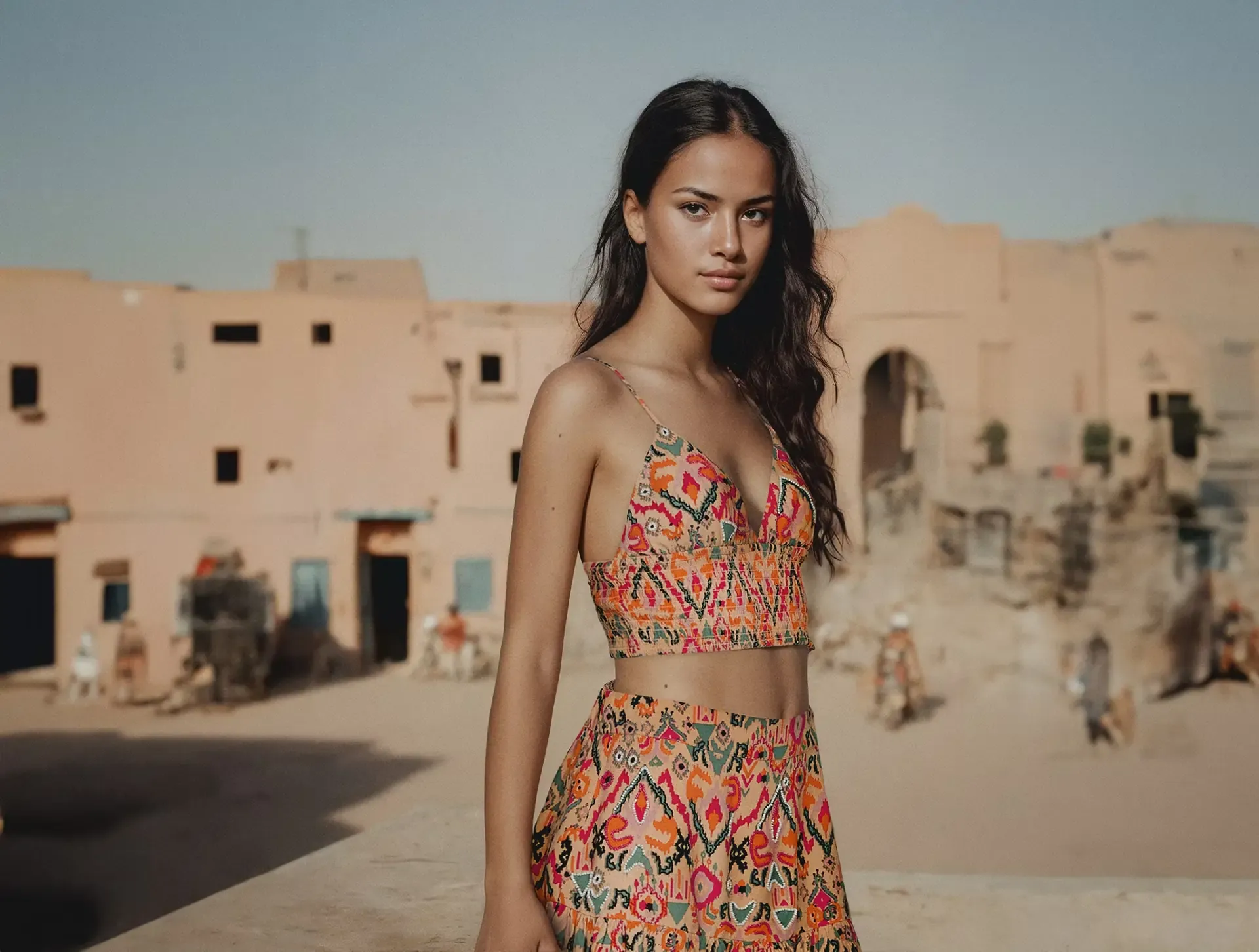
How it was made: Mango photographed each real garment from the collection first. A generative AI model was then trained on those photos to learn how to position the real clothing on a model and generate editorial-quality images. The art team selected, retouched, and finalized the AI-generated outputs. Multiple internal teams collaborated: design, art direction, styling, dataset management, AI model training, and the photography studio.
Why it's notable: It's one of the clearest documented artificial intelligence advertising examples in fashion — not just for ideation or copy. Mango described it as part of their 2024-2026 strategic plan, with AI as a core production tool, not a one-off experiment.
What to take from it: The workflow started with real product photography, then used AI to generate the lifestyle imagery around it. The AI didn't replace the product; it replaced the location, model, and shoot logistics. For ecommerce brands with large catalogs, that's a useful model of AI-based marketing execution.
2. Under Armour "Forever Is Made Now" - AI commercial without accessing the athlete
What it is: In March 2024, Under Armour released an AI-generated sports commercial featuring Anthony Joshua to mark the renewal of their long-term partnership ahead of his fight with Francis Ngannou.
How it was made: Director Wes Walker worked with the Tool AI team to create the film. The premise was specifically built around what AI enables: Joshua was deep in fight camp and unavailable for a traditional production. AI allowed the brand to tell a high-intensity narrative about him without needing to access him physically during his preparation period.
Why it's notable: The creative concept grew directly from the production constraint. The film is called "Forever Is Made Now" — built around intensity, focus, and the present moment. It's one of the stronger examples of AI in marketing, where the technology enabled a campaign concept rather than just cutting production costs.
What to take from it: AI makes it possible to build AI ad campaign around athletes, talent, or any subject without coordinating their physical availability. For brands with endorsement relationships but unpredictable schedules, that's a real production unlock.
3. Toys R Us "Origin Story" - first brand film made with OpenAI's Sora
What it is: In June 2024, Toys R Us premiered what it claimed was the first brand film made with OpenAI's Sora at the Cannes Lions Festival. The one-minute film tells the origin story of founder Charles Lazarus and the creation of the Geoffrey the Giraffe mascot.
How it was made: Toys R Us Studios partnered with creative agency Native Foreign, whose chief creative officer had early alpha access to Sora. The film went from concept to final product in a few weeks, compressing what would normally be hundreds of iterative shots into a few dozen. The video was almost entirely Sora-generated, with some corrective VFX and an original score.
Why it's notable: The public reaction was mixed-to-negative. Research firm Carma recorded a significant fall in positive brand sentiment following the film's release. Many viewers described it as "creepy" or aesthetically off. It's one of the most documented early examples of audience resistance to AI-generated video at the brand level.
What to take from it: Technically impressive and publicly controversial are not mutually exclusive. The film was a genuine first for AI-generated brand content. But it also demonstrated that nostalgia-driven creative — especially content that trades heavily on emotional memory — is a high-risk context for fully synthetic visuals. Where AI replaces expected warmth or authenticity, audiences notice.
4. Coca-Cola "Holidays Are Coming" - AI remake of an iconic ad (twice)
What it is: In November 2024, Coca-Cola released a fully AI-generated version of its 1995 "Holidays Are Coming" ad, produced by studios Secret Level, Silverside AI, and Wild Card, and ran it on UK TV screens. It generated significant backlash. In November 2025, they did it again with a new iteration produced by Secret Level, this time removing human faces from the creative after the previous year's criticism.
How it was made: The 2024 version used AI models including Kling, Leonardo, and Runway to recreate the trucks, snowy landscapes, and festive imagery of the original. The 2025 version was produced by Secret Level with Silverside AI using more advanced models, and avoided human depictions almost entirely. Pratik Thakar, Coca-Cola's global VP of generative AI, noted "the craftsmanship is ten times better" in the second iteration.
Why it's notable: Coca-Cola ran an AI-generated version of arguably their most emotionally significant annual ad — twice — despite the first generating sustained criticism. It's the most high-profile test of whether audiences will accept AI creative in an emotionally loaded context. The second version performed better on quality benchmarks, but the fundamental tension (AI + nostalgia + beloved cultural artifact) remains unresolved.
What to take from it: Brand-building creative that relies on emotional memory is harder territory for AI than performance advertising. Audiences have clear expectations for iconic campaigns. AI can accelerate production and reduce cost significantly, but in these specific contexts the synthetic quality still reads as a substitution for something real.
5. Popeyes "Wrap Battle" - AI diss track made in under 3 days
What it is: In July 2025, Popeyes released an AI-generated rap video targeting McDonald's after McDonald's brought back its Snack Wrap one day after Popeyes launched its own Chicken Wraps. The "Wrap Battle" diss track went viral across TikTok, Instagram, and X.
How it was made: AI filmmaker PJ Accetturo scripted the campaign and produced it using Google's Veo 3 for video and Suno for AI music production. The team started with image-to-video tools but switched entirely to Veo 3 when that approach proved too slow. The entire ad — music, visuals, and editing — was completed in under 3 days.
Why it's notable: It demonstrated something specific about what AI enables in marketing: reactive speed. Traditional campaign production takes weeks. A reactive ad with a tight cultural window — McDonald's announcement, Popeyes' counter — would normally be impossible to produce in time. With AI tools and a small team, it wasn't.
What to take from it: The production model is more interesting than the ad itself. A small team, a tight deadline, a specific cultural moment, and AI tools that can produce polished video and audio in hours — that's a workflow that didn't exist two years ago. Popeyes is an early example of AI enabling reactive advertising at a quality level previously reserved for well-resourced agencies with long timelines.
6. BMW x Lil Miquela - AI influencer in automotive advertising
What it is: BMW partnered with Lil Miquela, one of the most established AI-generated influencers, for a campaign called "Make It Real." The collaboration placed the virtual influencer in BMW creative content targeting younger audiences.
Why it's notable: AI influencers have been used in brand campaigns since at least 2019, but automotive is a category that has traditionally relied on aspirational human lifestyle imagery. The BMW partnership showed AI-based marketing with virtual influencers moving into premium, considered-purchase categories - not just fashion and beauty.
What to take from it: AI influencers give brands full creative control, guaranteed message accuracy, and no off-brand behavior risk. The trade-off is authenticity ceiling: audiences generally know these characters are synthetic, which changes how emotional connection works. The approach makes most sense for audiences who already engage with virtual personas, particularly Gen Z.
Read also: How to create an AI influencer: Step-by-step guide
7. Liquid Death — AI voice as the punchline
What it is: Liquid Death ran a deadpan "blind taste test" ad pitting their canned mountain water against a lineup of genuinely disgusting "most expensive drinks": lobster béarnaise sauce ($50), Spanish squid ink ($58), a tallboy of Beluga caviar ($580), and a blended Japanese wagyu cheeseburger. Participants tasted each one blind. The results were, predictably, awful. Liquid Death won. An AI voice at the end delivered the verdict with complete, clinical indifference.
Worth noting: This isn't an AI-generated ad in the production sense. The footage is real, the taste testers are real, the whole setup is a live stunt. The AI element is specifically the voiceover at the end — which is exactly why it works.
Why it works: The humor is built on specificity and commitment. The "most expensive drinks" conceit is absurd enough to be funny on its own. The AI voice plays into the brand's deliberately low-budget, anti-corporate aesthetic — it sounds like the least impressive spokesperson possible for the most ridiculous product comparison, which is exactly the point. A polished human voiceover would try too hard. The flatness of the AI delivery is the joke.
What to take from it: AI voice doesn't have to be used for efficiency. Liquid Death used it as a creative tool - the slight clinical distance amplifies the absurdity rather than undermining it. One of the few examples where the choice to use AI voice was clearly a creative decision, not a production shortcut.
Read also: AI generated advertising: Everything you need to know in 2026
What the best AI marketing campaigns have in common
Looking across these examples of AI in marketing, a few patterns stand out.
The creative concept came first. The Under Armour campaign's concept — telling Joshua's story without accessing him - grew from the production constraint. Popeyes built its campaign around the specific moment of McDonald's announcement. The brands that got the most from AI used it to solve a specific creative or production problem, not as a novelty layer on top of a generic brief.
Reactive speed is a genuine differentiator. Popeyes' three-day turnaround represents something new: the ability to produce polished, platform-ready creative in the same news cycle as the event that prompted it. Traditional production can't do that.
Audience trust varies by context. Fully AI-generated creative in fashion (Mango) landed better than in nostalgic emotional contexts (Coca-Cola, Toys R Us). Performance ads with AI voice and AI avatars get less scrutiny than brand campaigns, because performance audiences evaluate on utility rather than authenticity.
Read also: How to use AI in e-commerce: 15 examples for 2026
Frequently Asked Questions
What are AI marketing campaigns?
AI marketing campaigns use artificial intelligence at some stage of the creative or delivery process. This ranges from AI-generated images and video (Mango, Toys R Us) to AI-generated audio and voice, and AI avatar spokespersons in performance advertising. The term covers a wide range of implementations with different use cases and trade-offs.
What are the best examples of AI in marketing?
The most documented examples of AI in marketing include Mango's fully AI-generated fashion campaign, Coca-Cola's AI remake of "Holidays Are Coming," Toys R Us's Sora-generated brand film, Popeyes' AI diss track made in under 3 days using Google's Veo 3, and Under Armour's AI commercial featuring Anthony Joshua. At the performance level, DTC brands using AI video platforms for high-volume creative testing represent the most widespread adoption.
Which brands are using AI for marketing?
Most major brands now use AI somewhere in their marketing stack — for content generation, personalization, or creative production. Mango, Coca-Cola, Under Armour, Popeyes, BMW, and Liquid Death have all made publicly documented AI creative decisions. At the DTC and ecommerce level, AI video production platforms like Creatify are used across thousands of brands for performance advertising.
What is an AI advertising campaign?
An AI advertising campaign uses AI tools to generate, optimize, or deliver advertising creative. Fully AI-generated ads use models like Veo 3 or Sora to produce video footage from text prompts. AI-assisted ads use AI for specific production steps — voiceover, footage generation, editing — alongside human creative direction.
What are examples of AI in marketing beyond ads?
AI in marketing extends to product recommendations, email personalization, customer service automation, dynamic pricing, demand forecasting, and AI-generated product content at scale. In advertising specifically, AI now touches creative generation, media buying, audience targeting, and campaign testing simultaneously.
How do brands use AI for marketing campaigns?
The most common approaches: AI video and image generation for ad creative, reducing production time and cost; AI voiceover and avatar presenters for performance ads; and high-volume creative testing using AI to generate dozens of hook and format variations for A/B testing.
Are AI marketing campaigns effective?
It depends on the context. AI-generated creative performs well in performance advertising where audiences evaluate ads on utility rather than authenticity. Brand campaigns in emotionally loaded contexts — nostalgia, representation, identity — have shown more resistance. The clearest performance data comes from DTC brands running AI video at volume: Creatify's published case studies document CTR doubling, CPA reductions of 45%, and ROAS improvements of 73% after introducing AI-generated creative testing at scale.
What's the difference between AI-generated ads and AI-assisted ads?
AI-generated ads use AI to create the creative content — images, video, audio — with minimal human production involvement. AI-assisted ads use human creative direction but rely on AI tools for specific production steps: generating footage, voiceover, music, or editing. Most effective campaigns combine both: human strategy and concept, AI execution and scale.