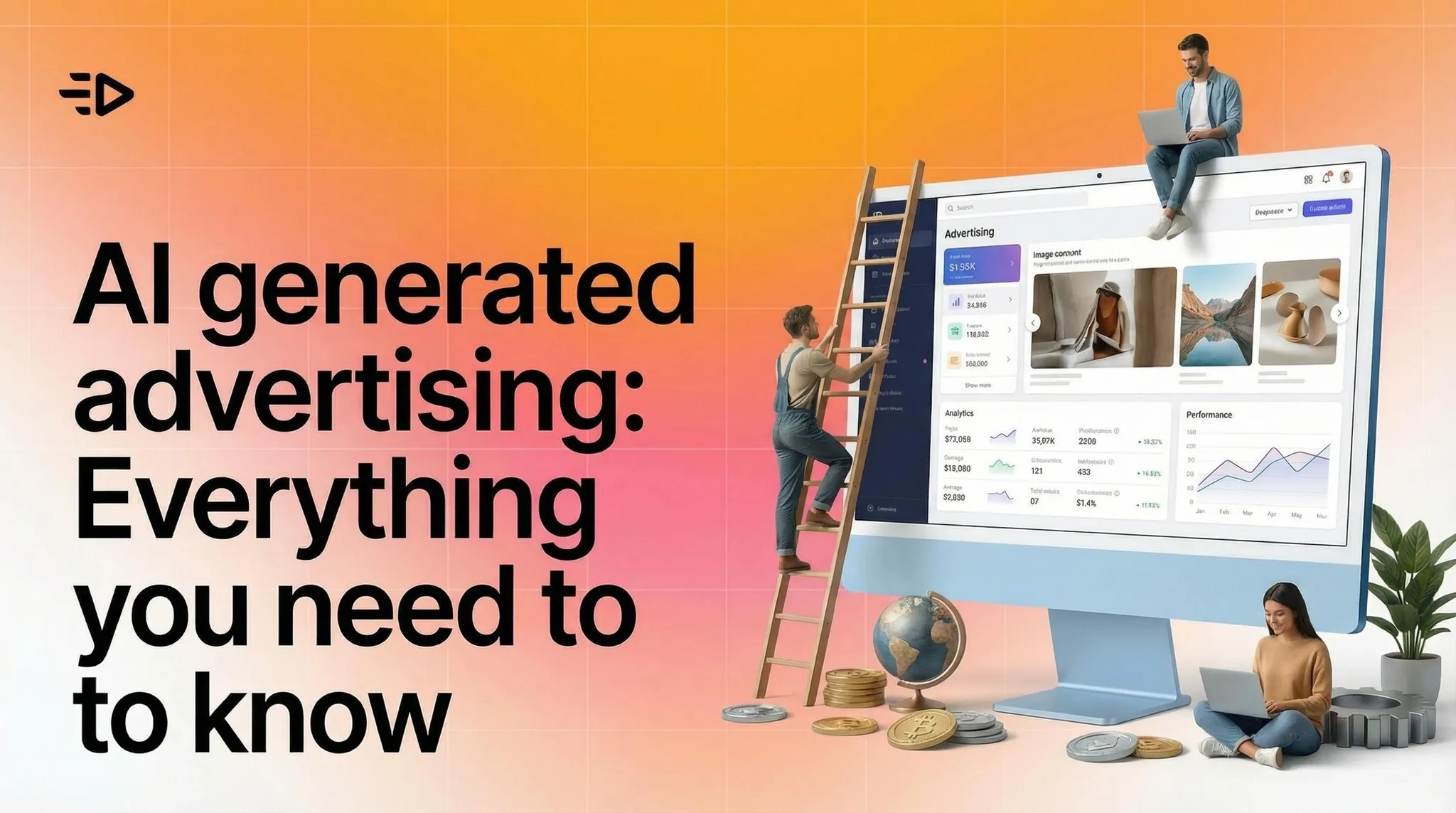

AI generated advertising: Everything you need to know in 2026

AI generated advertising: Everything you need to know in 2026

Written by

Boris Goncharov

AI Generated advertising
Creatify logo

Boris Goncharov

SHARE

LinkedIn icon
X icon
Facebook icon

IN THIS ARTICLE

For a decade, AI in advertising meant one thing: the algorithm. It bid on your behalf, picked your audience, decided which creative to show. It was powerful and completely invisible. Nobody called it AI. Then generative models arrived and made the whole thing impossible to ignore.
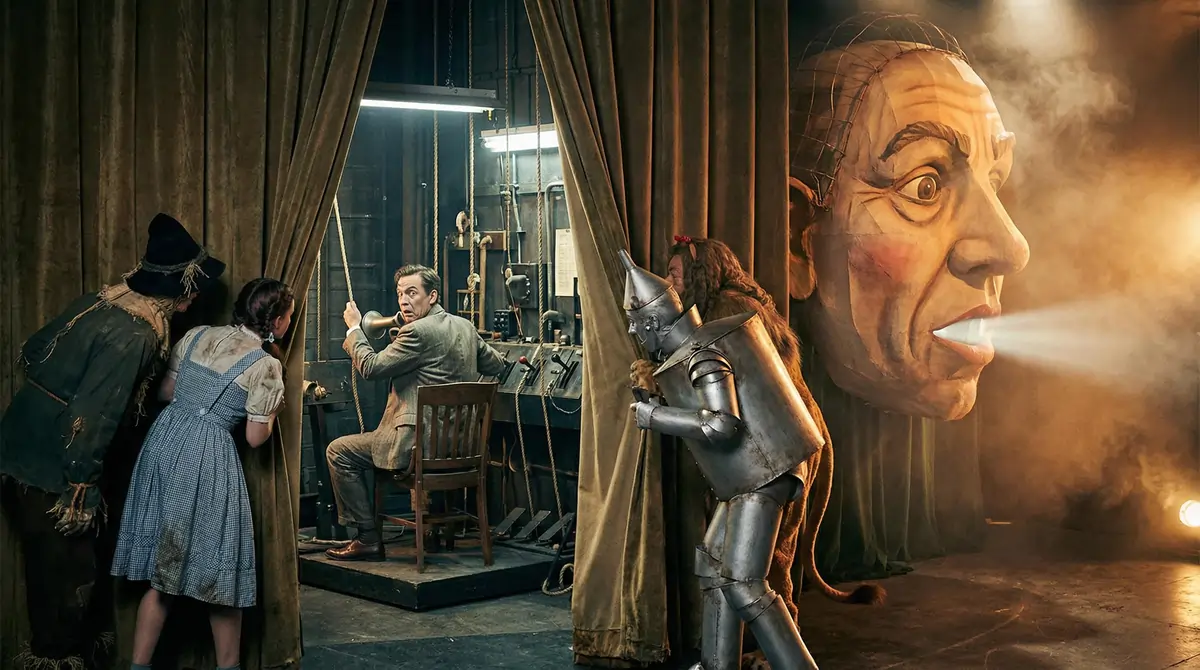
Ai generated ad

The second wave is impossible to miss. Generative AI is now creating the ads themselves: writing scripts, generating visuals, synthesizing voices, producing video. AI generated commercials and AI created commercials were once the stuff of speculation — now the line between "AI-optimized" and "AI-created" has blurred, and for most marketing teams, that changes everything from how budgets are spent to who's responsible for what goes live.

This guide covers what AI-generated advertising actually is, how it's built, what the research says about whether it works, and where the legal and ethical lines currently sit.

What counts as an AI-generated ad?

Worth getting specific here, because the term gets stretched.

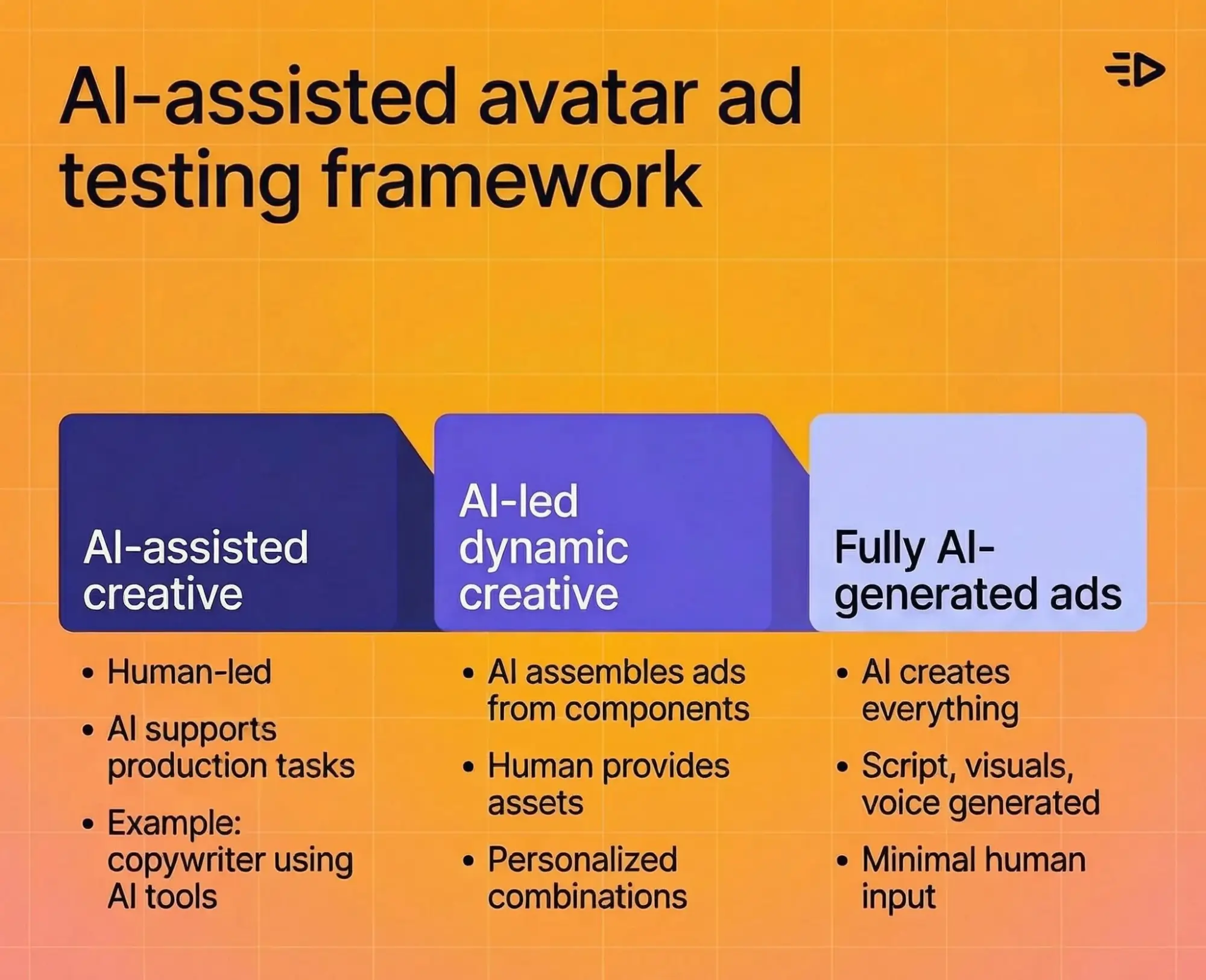
Building on distinctions in a Journal of Business Research article, we can think of three levels of AI involvement in advertising:

  • AI-assisted creative is human-led with AI tools in the mix — a copywriter using an LLM to draft options, a designer using generative image tools to iterate faster. Humans make the core decisions. AI handles production tasks.

  • AI-led dynamic creative is where AI is driving personalization and assembly at scale — pulling from a library of pre-approved assets (headlines, images, CTAs) and serving combinations based on audience signals. The human built the parts; the machine assembles the ad.

  • Fully AI-generated ads use minimal human-created assets. The script, visuals, voice, and edit are all generated by AI models from a brief or prompt. Some TV spots now fall into this category.

Most campaigns in 2026 sit somewhere between the first and second category. Full AI generation is growing but still a fraction of total ad production.
AI assisted avatar ad

The building blocks of AI-generated ads

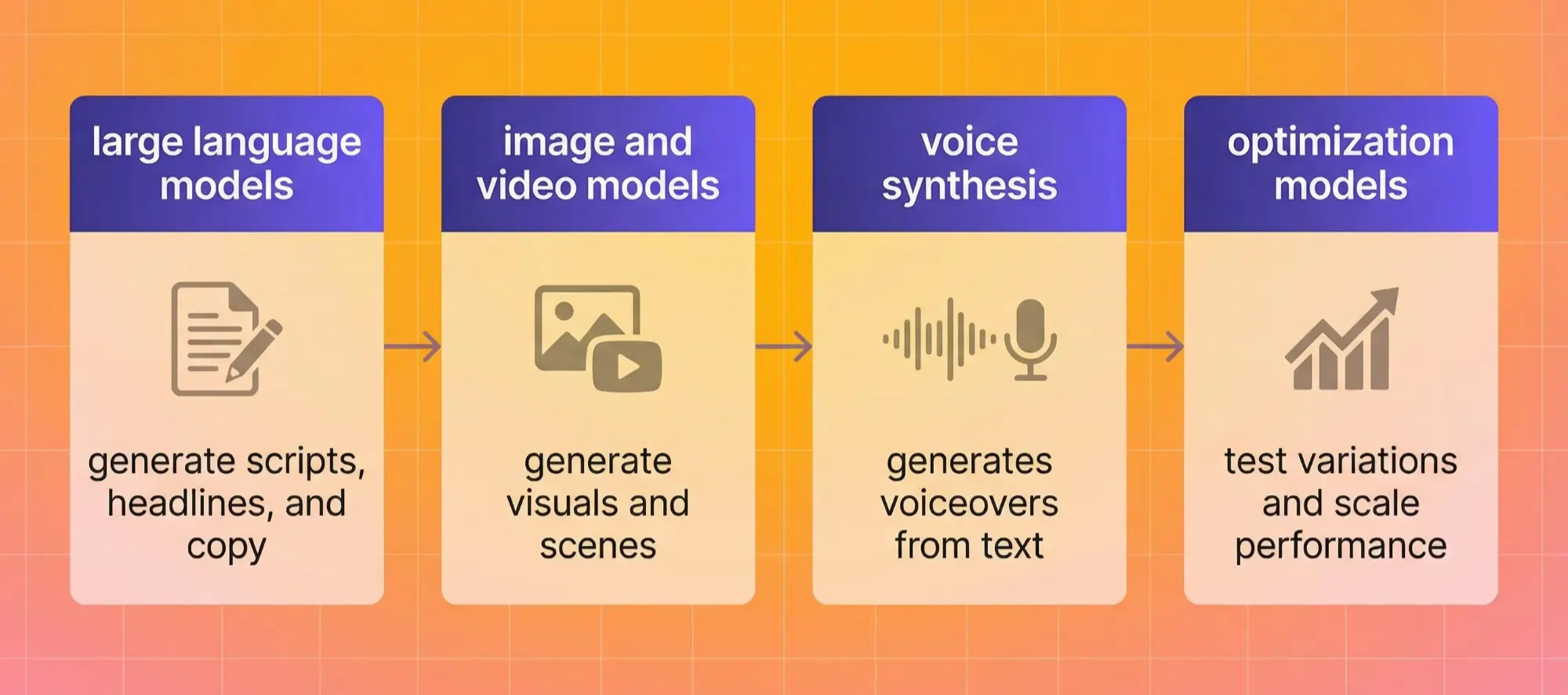
BCG's research on how AI is reshaping advertising identifies four core technologies doing most of the work:

  • Large language models generate scripts, headlines, body copy, CTAs, and concept variations. They can produce dozens of script angles from a single brief in seconds.

  • Generative image and video models produce visuals from text prompts, animate existing images, or synthesize entirely new scenes. Video generation quality has improved dramatically in 18 months.

  • Voice synthesis generates voiceovers in any language, tone, or character from text input — without a studio booking. Voice cloning (replicating an existing voice with consent) is also increasingly common for brand consistency.

  • Predictive optimization models sit on top of the creative layer, testing which combinations perform best and shifting spend toward winners automatically.

These don't operate in isolation. The most sophisticated Artificial Intelligence ad workflows chain them together: LLM writes the script, video model generates the visual, voice synthesis adds narration, optimization model tests variations and scales what works.
LLM Models Image and video models

How an AI commercial is made

The workflow has compressed significantly. BCG describes what used to take weeks now taking days or hours for mid-complexity campaigns:

  • Brief and strategy. AI tools analyze audience data, past campaign performance, and competitive signals to inform messaging territories and concept directions. This replaces or accelerates the research and planning phase.

  • Creative development. LLMs generate script variations. Generative image and video tools produce storyboards, animatics, or full motion assets. Voice synthesis handles temp or final tracks. For ecommerce and performance marketing, URL-to-video tools (like Creatify) can take a product page and output multiple ready-to-run ad variations in under 10 minutes.

  • Production and adaptation. AI handles the mechanical work: cutting different lengths, reformatting for 9:16 vs 16:9, adapting copy for different markets, generating subtitle variations. What used to require a production coordinator now runs automatically.

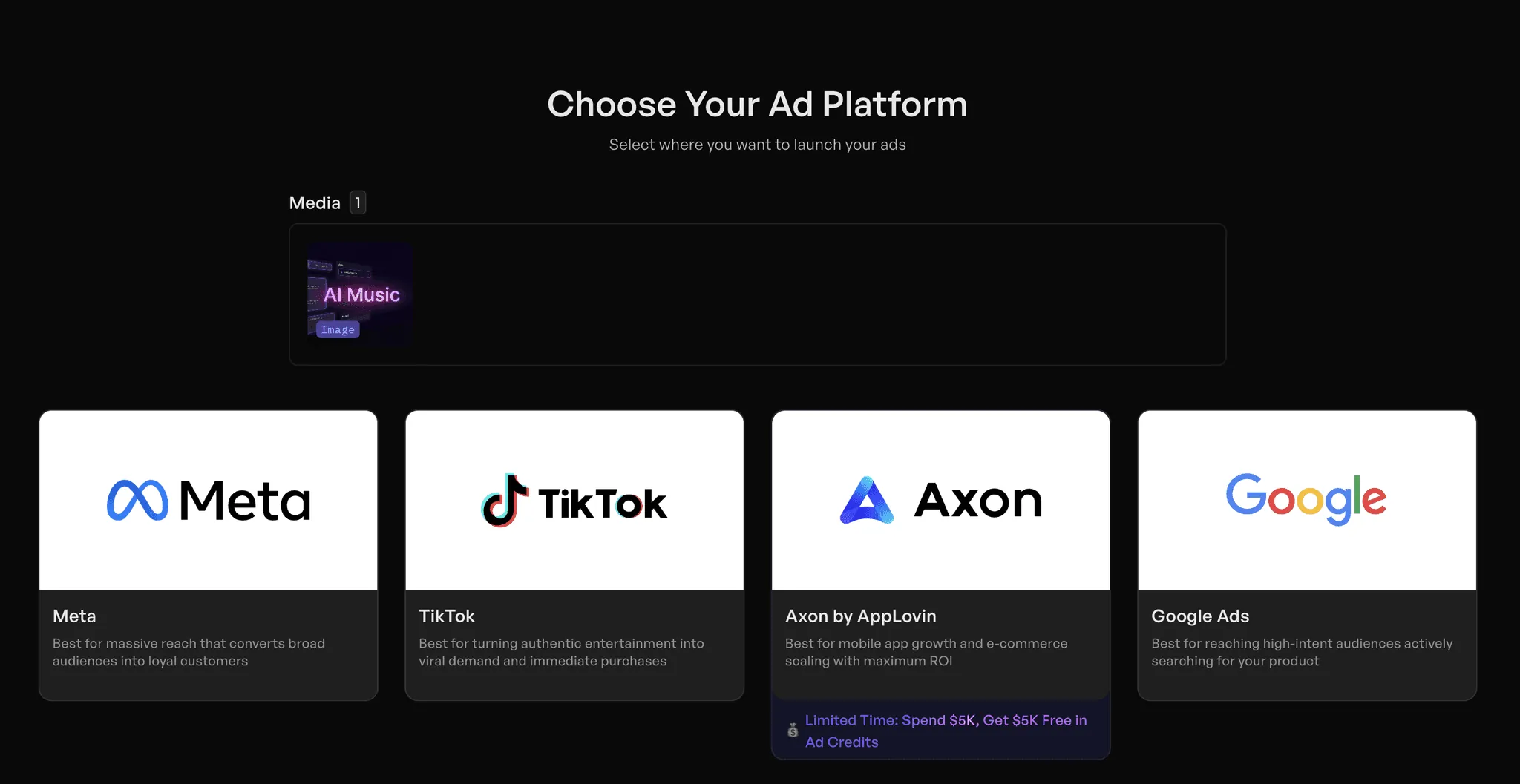
  • Deployment and optimization. Multivariate creative testing runs in the background. Reinforcement learning models shift budget toward better-performing creative in real time, and dynamic creative optimization serves personalized versions to different audience segments. Some platforms - Creatify included - skip the export step entirely and launch ads directly to Meta and TikTok from within the creative workflow.
Choose your ad platform

Where AI ads usually run

People watching ads

AI generated advertisements and AI created commercials have spread across every major channel.

  • TV and connected TV (CTV). The NYT documented AI-generated and heavily AI-assisted commercials appearing in traditional broadcast contexts. Virtual production techniques and synthetic actors are increasingly part of the toolkit for TV-scale spots.

  • Social and digital video. Short-form video ads, many of them AI-assisted or generated, are now the dominant format for performance marketers running campaigns on TikTok, Instagram Reels, and YouTube Shorts — with vertical formats, platform-optimized hooks, and AI-scripted copy increasingly standard.

  • Display and native. IAB research documents the rapid adoption of dynamically generated display units where copy, imagery, and offers adjust automatically to the user's context and behavior.

  • AI-native environments. Ads appearing inside AI assistants and chatbot interfaces represent a new placement category entirely, with their own emerging rules and formats.

Ad example

Does it actually perform?

The honest answer is: it depends what you're measuring, and against what.

BCG's research shows that AI's ability to iterate and personalize creative often outperforms static, one-size-fits-all approaches in direct response contexts — particularly where volume of variation matters. The more you can test, the more likely you are to find something that converts.

Academic research published in the Journal of Business Research supports the targeting and optimization side: AI applied to media decisions reliably improves efficiency metrics like CPM, CTR, and CPA.

Where it gets more complicated is brand advertising. Research from NIM (Nuremberg Institute for Market Decisions) found that labeling content as AI-generated often leads to more critical evaluations — lower perceived naturalness, lower usefulness ratings — even when the content itself is identical to human-made material. The label does work that the content doesn't.

NielsenIQ research found that many consumers describe AI-generated ads as more annoying or confusing, with some evidence of negative spillover onto brand perception. This is meaningful for brand advertisers running awareness campaigns where sentiment matters. It's less relevant for performance marketers measuring cost per acquisition.

The practical takeaway: AI-generated creative works well for performance and direct response. For brand campaigns, the quality of the output and the framing of AI involvement both matter more.

What consumers think about AI commercials

Consumer attitudes are mixed and shifting fast.

The NIM research on transparency highlights a specific tension: transparency about AI use is ethically important, but disclosure often triggers more critical evaluation of the same content. This is the transparency paradox — consumers say they want to know, but knowing changes how they judge what they see.

Trust in AI generally, and beliefs about human creativity specifically, mediate how people respond to AI ads. Audiences who are more skeptical of AI tend to rate AI-labeled creative lower regardless of actual quality. NielsenIQ found meaningful segments of consumers who view AI-generated ads as a shortcut — a signal that the brand didn't invest in real creative effort.

This doesn't mean hiding AI use (which raises separate legal problems). It means that creative quality and contextual relevance matter more, not less, when AI is in the production chain.

Tangible benefits for marketing teams

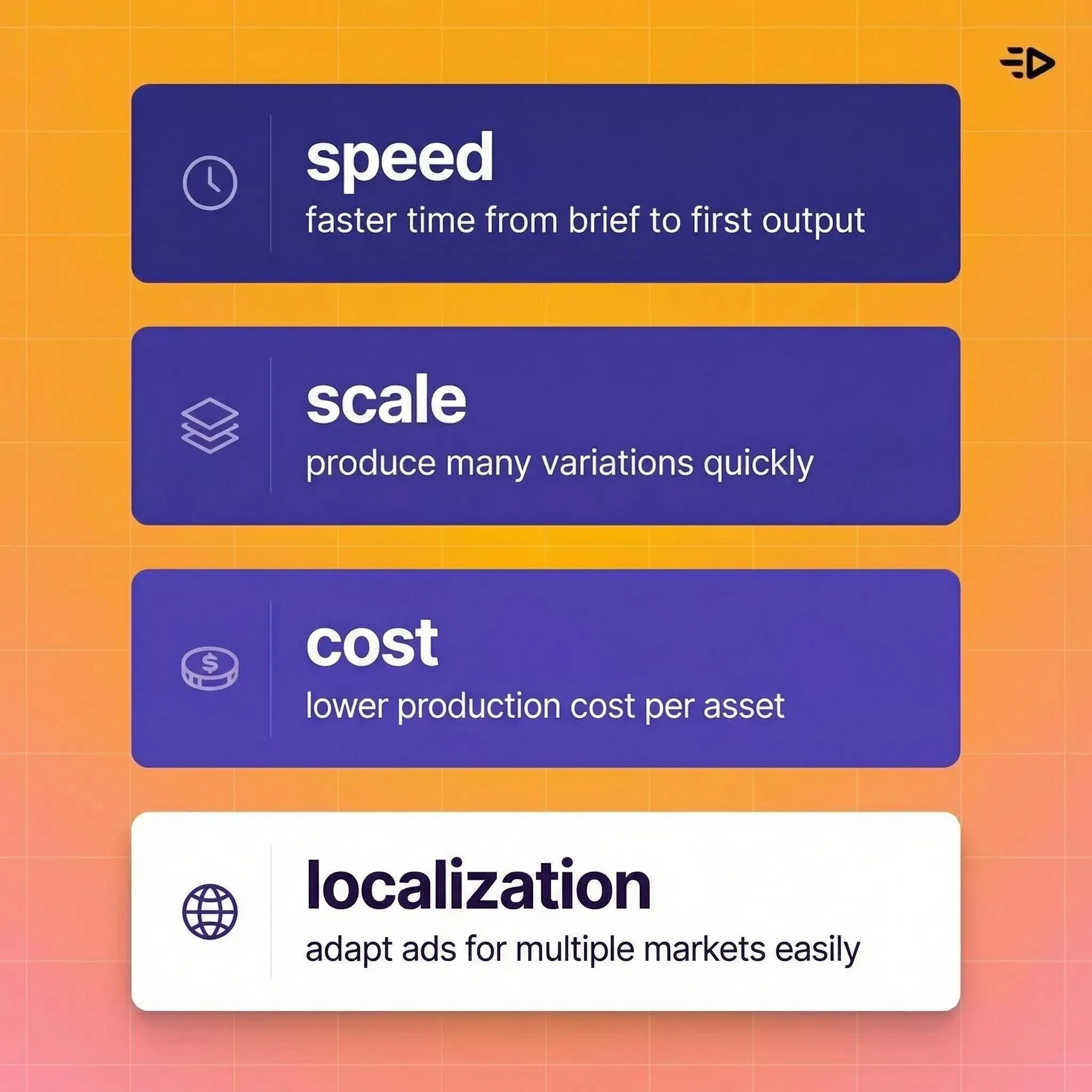
The case for AI-generated advertising isn't primarily about replacing human creativity. It's about volume, speed, and cost.

Speed. The time from brief to first cut has compressed from weeks to hours for many campaign types. BCG reports that AI-assisted production workflows can significantly compress timelines, in some cases cutting campaign cycles roughly in half for teams that have integrated them well.

Scale. Running 50 creative variations used to mean a 50x production budget. AI makes variation nearly free — which means more testing, faster learning, and better-performing campaigns over time.

Cost. Traditional video production often runs into thousands of dollars per spot, and significantly more for broadcast-quality TV. AI video platforms can bring marginal costs to tens of dollars or less per variation, depending on volume and pricing plan — which for ecommerce and DTC brands running performance campaigns changes the math entirely.

Localization. Adapting a campaign for 10 markets used to require 10 separate production runs. AI handles translation, voice synthesis, and format adaptation automatically — which is why global brands have been early adopters.
Speed Scale Cost

Where AI-generated ads could go wrong

Ad Example

The risks are real and worth taking seriously.

Creative sameness. Over-reliance on AI can produce derivative, template-feeling creative that looks like everything else generated by the same underlying models. The NYT noted early concern among creative directors about a homogenization effect — a world where AI makes all ads look vaguely alike because they all draw from similar training data.

Brand safety failures. AI models hallucinate. They produce outputs that clash with brand guidelines, misrepresent products, or include visuals that are culturally inappropriate for specific markets. Research published in ScienceDirect documents specific risks around biased depictions and off-brand outputs that require human review to catch.

Over-optimization for short-term metrics. Algorithms optimizing for CTR don't care about brand equity. BCG warns that over-reliance on automation can erode the institutional creative judgment that builds distinctive brands over time.

Consumer fatigue. The NielsenIQ findings on annoyance and skepticism aren't abstract. If audiences start identifying AI generated commercial content as a category and tuning it out, the volume advantage disappears.
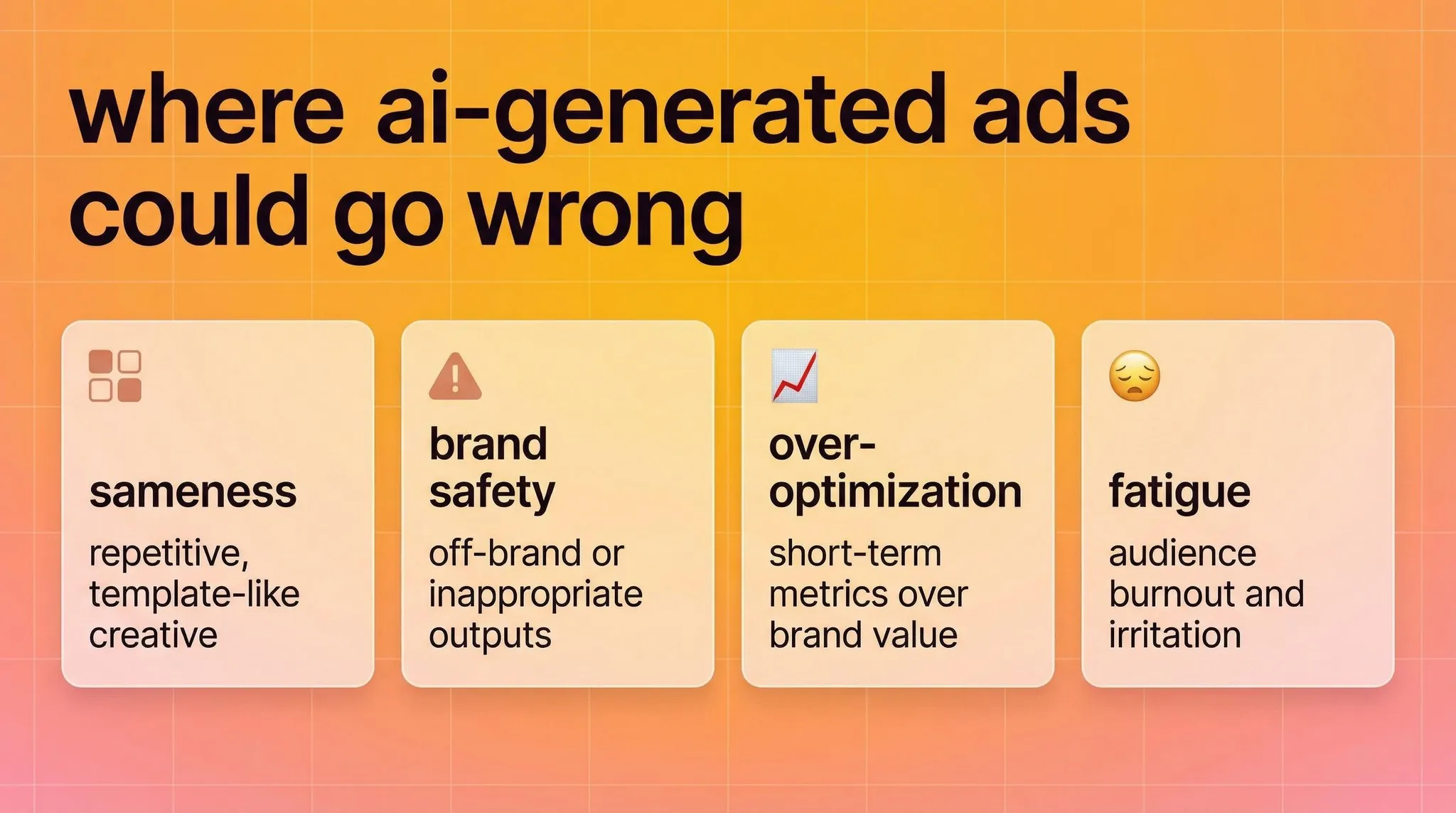
Where AI Generated ads could go wrong

The legal and regulatory landscape

This is moving fast. The core principles are stable; the specific rules are still being written.

Truth in advertising still applies. AI-generated content doesn't get a pass on FTC standards. Claims made in AI-generated ads need substantiation. Deceptive depictions are still deceptive regardless of how they were produced.

Disclosure expectations are tightening. Regulatory guidance from the EU AI Act and developing FTC frameworks are creating baseline expectations around transparency for AI-generated content, particularly where synthetic likenesses are used or where content could be mistaken for real.

The EU AI Act has specific provisions. Key prohibitions include manipulative AI practices that exploit psychological vulnerabilities and requirements for appropriate human oversight and organizational competence around AI systems. For advertisers operating in Europe, compliance is now an active concern.

Synthetic likenesses are a specific risk area. Research documented in ScienceDirect and University of Arkansas analysis both highlight deepfake and likeness issues as the highest-risk category: using AI to replicate real people in AI created commercials without documented consent creates significant legal and reputational exposure.

Platform policies layer on top of regulation. Meta, Google, TikTok, and other major ad platforms have their own evolving rules on AI-generated content and synthetic imagery. Check each platform's current policies before running campaigns.

Deepfakes and likeness: where the ethics get serious

The ethical questions around AI in commercials concentrate here.

Using AI to mimic a real person — a celebrity's voice, a public figure's face, or even a private individual's likeness — in an ad without explicit consent is both ethically problematic and increasingly legally risky. Academic research on AI-generated synthetic media in advertising consistently flags this as the category requiring the most conservative approach.

University of Arkansas research on deepfakes and manipulation identifies three principles worth codifying in any internal AI creative policy: explicit consent for any real-person likeness, clear disclosure where content may be mistaken for real, and respect for dignity in how synthetic depictions are used.

For most performance marketers using AI avatar tools, this is a non-issue — you're using fictional digital humans, not replicas of real people. But brand campaigns that want to feature celebrities, influencers, or real customer testimonials need to be careful about what AI is doing to those assets.

Creatify's approach: the platform is built around consented AI avatars (both from its library and custom avatars created with documented consent), and its AI ethics policy explicitly prohibits using the platform to create non-consensual likeness content.
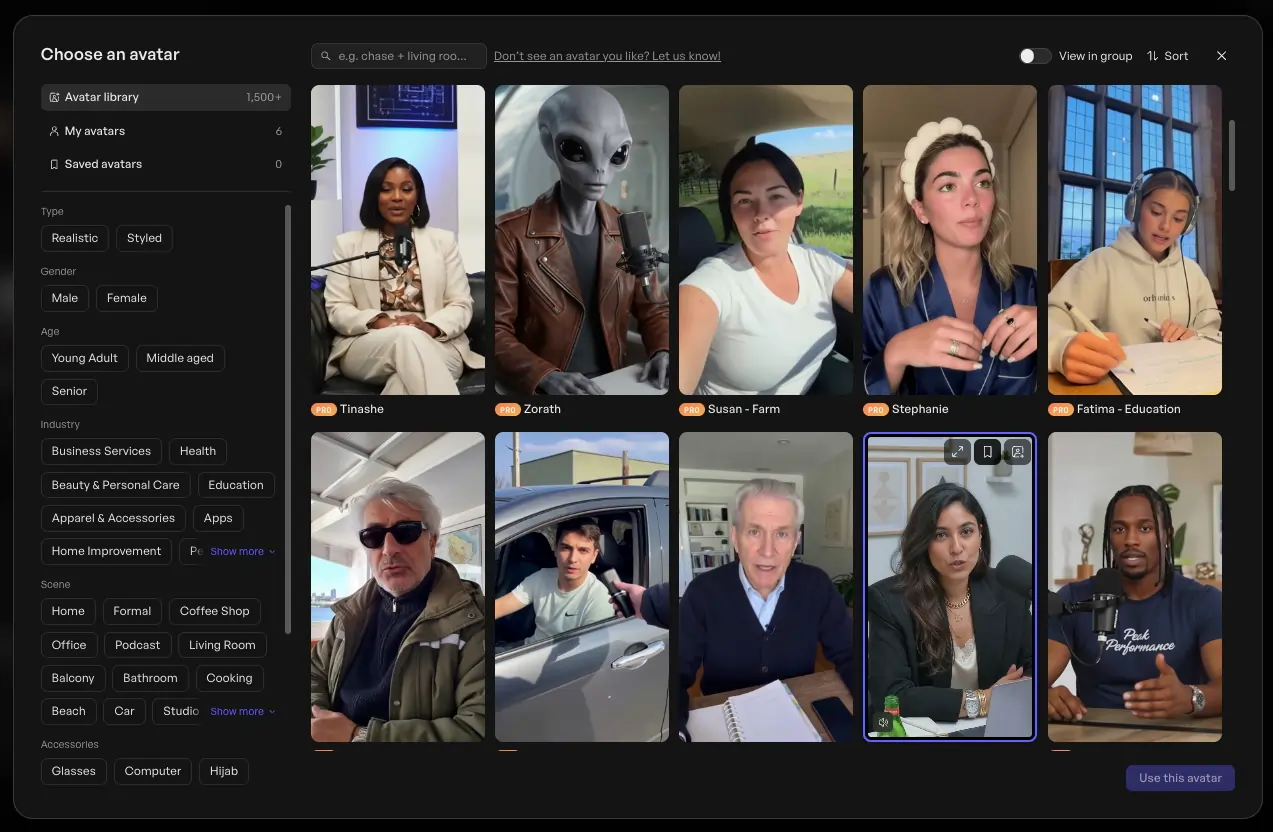
Choose an avatar

How to brief AI creative effectively

The briefing skill is genuinely new. Traditional creative briefs don't translate cleanly into AI prompts, and treating them as interchangeable produces generic outputs.

BCG's research on AI creative workflows identifies a few things that consistently improve AI generated ad output:

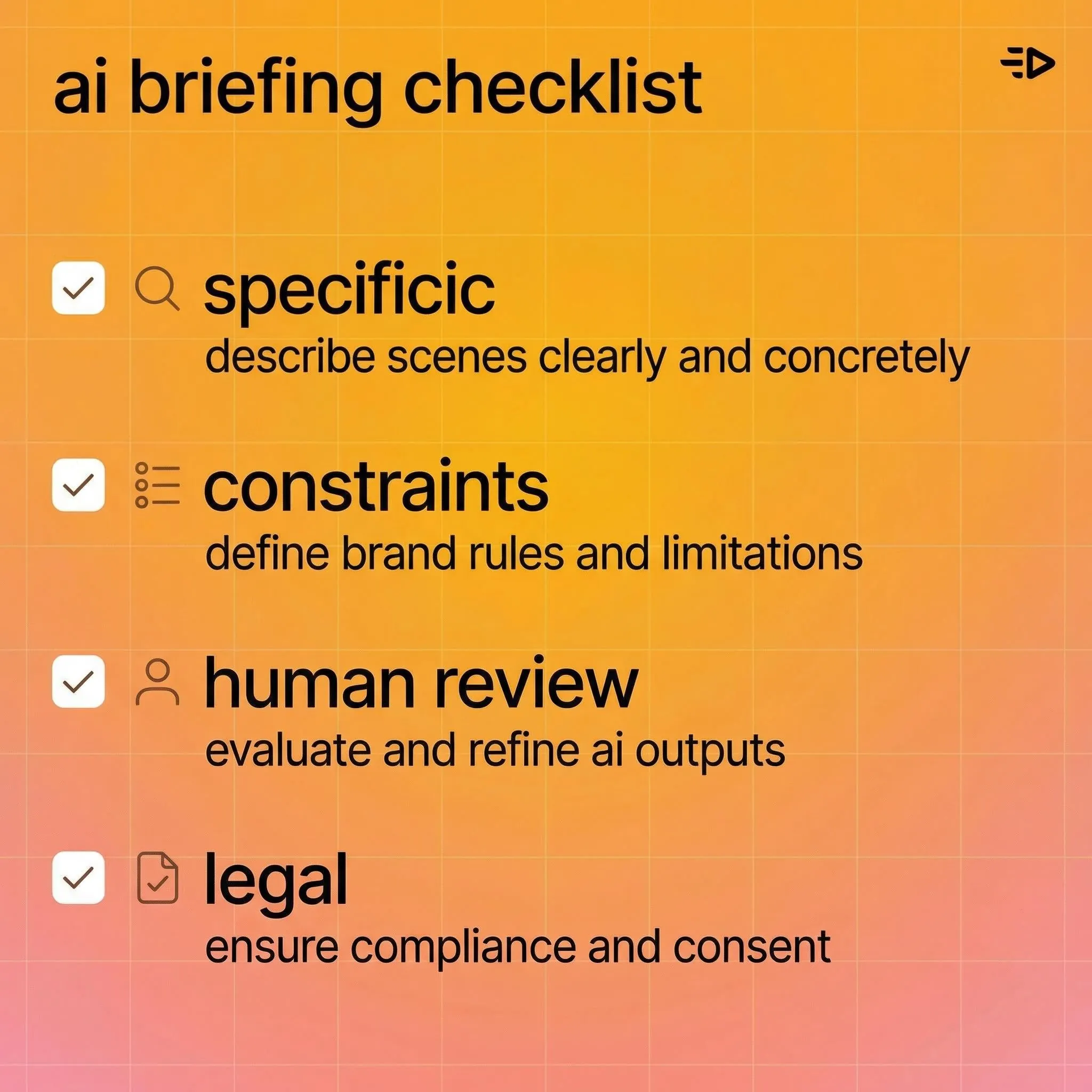
Specificity beats direction. "A 30-something woman who just finished a workout reaching for a protein shake, natural lighting, slightly out of breath" produces better visual output than "active lifestyle woman."

Brand constraints need to be explicit. AI models don't know your brand guidelines. Build them into every prompt: color palette, tone, things that must not appear, claims that can and can't be made.

Treat AI as a first-draft system, not a final-draft system. The best AI-assisted creative workflows use AI to generate volume quickly, then apply human judgment to select, refine, and elevate. Skipping the human layer produces average work.

Build review cycles that include legal and compliance. Regulatory guidance makes clear that human review isn't optional when AI is generating content that goes to market. Document who reviewed what and when.

AI briefing checklist

Measuring AI-generated ad performance

The measurement framework is essentially the same as traditional creative testing — with a few additions.

Standard metrics still apply: CTR, video completion rate, conversion rate, cost per acquisition, brand lift (for awareness campaigns). BCG's framework adds creative diversity (are your variations actually meaningfully different?) and iteration speed (how fast are you moving from insight to new creative?) as useful AI-specific signals.

The experiment design question matters more when AI in commercials is involved. Academic research illustrates the importance of deliberately isolating creative as the variable — same audience, same budget, same placement — when comparing AI-generated vs. human-produced creative, or different levels of AI involvement. Without that discipline, you're measuring many things at once and learning little.

IAB research on AI adoption in advertising notes that measurement infrastructure is often where adoption stalls: teams generate more creative than ever with AI, but lack the testing frameworks to learn systematically from what's running.

Where AI-generated advertising is heading

A few trends worth watching.

Adweek's coverage of brands doubling down on AI in 2025 shows the direction: AI moving from production tool to strategic co-pilot across the full advertising workflow, from audience research through creative development through post-buy analysis.

Fully synthetic influencers and brand characters — digital humans with consistent personalities, backstories, and visual identities — are an emerging creative format that several major brands have begun testing seriously.

IAB's AI Gap research documents a widening split between companies that have genuinely integrated AI into their advertising workflows and those still experimenting at the edges. The gap is compounding: teams with AI-native creative workflows are testing more, learning faster, and compounding those learnings into better campaigns.

The regulatory environment will continue tightening, particularly around disclosure and synthetic likenesses. Building compliance into your AI creative workflow now is cheaper than retrofitting it later.

Read also: 13 best AI marketing tools we tested for 2026

The bottom line

AI-generated advertising isn't a replacement for creative strategy or brand judgment. It's infrastructure for creative volume — which, in performance marketing, is the thing most teams don't have enough of.

The teams winning right now are the ones using AI to generate and test more creative faster, while keeping humans responsible for the strategic and ethical decisions that algorithms can't make.

For ecommerce brands, DTC marketers, and performance agencies, the most direct path in is a tool like Creatify: paste a product URL, get multiple platform-optimized video ad variations in minutes, test them, scale what works. Start with a free account and run your first product through it.

Frequently asked questions

What are AI-generated advertisements?

AI-generated advertisements are ads where artificial intelligence materially creates or transforms core creative elements — script, visuals, audio, editing — rather than just optimizing targeting or bidding. This includes ads generated by large language models (copy), generative image and video models (visuals), voice synthesis (narration), and combinations of all three. The category ranges from AI-assisted human creative to fully AI-generated commercials with minimal human-created assets.

Are AI commercials legal?

Yes, in most jurisdictions — but they're subject to the same advertising laws as human-made ads. Truth-in-advertising standards, claims substantiation requirements, and rules against deceptive depictions all apply regardless of how an ad was produced. Additional rules around synthetic likenesses and disclosure are evolving: the EU AI Act includes specific provisions relevant to AI-generated advertising, and FTC guidance on AI transparency is developing. Using AI to replicate real people's likenesses without consent is a specific high-risk area.

How are AI-generated ads made?

The typical workflow chains together several AI technologies: a large language model generates the script and copy variations, a generative video or image model produces the visuals, voice synthesis adds narration, and optimization models test variations and shift spend to better-performing creative. Tools like Creatify compress this into a single workflow — paste a product URL, configure the brief, and get multiple finished video ad variations in under 10 minutes, ready to deploy to Meta, TikTok, or other platforms.

Do AI-generated ads perform as well as human-made ads?

It depends on the campaign objective. For direct response and performance marketing, AI-generated creative often matches or exceeds human-made ads on efficiency metrics (CTR, CPA, ROAS) because the volume advantage — more variations tested faster — compounds into better performance over time. For brand campaigns focused on emotional resonance and awareness, research from NIM and NielsenIQ suggests quality and framing matter more, and that labeling content as AI-generated can trigger more critical consumer evaluation.

How do consumers feel about AI-generated advertising?

Consumer attitudes are mixed. NielsenIQ research found meaningful segments describing AI-generated ads as more annoying or confusing than human-made ads, with some negative spillover onto brand perception. NIM research identified a transparency paradox: consumers say they want to know when ads are AI-generated, but disclosure often triggers more critical evaluation of the same content. This doesn't mean hiding AI use — it means creative quality matters more, not less, when AI is in the production chain.

What is an AI-generated commercial?

An AI-generated commercial is a video advertisement where AI has materially created the core creative elements: script, visuals, voiceover, and editing. This ranges from short social video ads produced by platforms like Creatify (which generate complete video ad variations from a product URL in minutes) to longer broadcast TV spots where AI tools handle elements of scripting, virtual production, and post-production. The format is distinct from traditional AI ad optimization, which adjusts targeting and bidding without creating the creative itself.

Do you have to disclose when an ad is AI-generated?

Disclosure rules are still evolving, but the direction is toward greater transparency. The EU AI Act includes provisions requiring disclosure of AI-generated synthetic content in certain contexts. FTC guidance in the US is developing toward clearer expectations around AI transparency in advertising. Separately, using AI to create synthetic likenesses of real people in ads without disclosure (and consent) creates significant legal and reputational risk. Most brands currently err toward disclosure as a risk management position rather than a legal requirement.

What's the best AI tool for creating video ads?

For performance marketing — ecommerce, DTC, app advertising — Creatify is purpose-built for video ad creation at scale. The URL-to-video feature converts any product URL into multiple platform-optimized video ad variations in under 10 minutes, with 1,500+ AI avatars, 29 languages, direct ad launch to Meta and TikTok, and batch production for generating dozens of variations in one pass. Free plan available. For broader creative production (copy, imagery, campaign assets), tools like Jasper and Canva cover different parts of the stack.

For a decade, AI in advertising meant one thing: the algorithm. It bid on your behalf, picked your audience, decided which creative to show. It was powerful and completely invisible. Nobody called it AI. Then generative models arrived and made the whole thing impossible to ignore.

Ai generated ad

The second wave is impossible to miss. Generative AI is now creating the ads themselves: writing scripts, generating visuals, synthesizing voices, producing video. AI generated commercials and AI created commercials were once the stuff of speculation — now the line between "AI-optimized" and "AI-created" has blurred, and for most marketing teams, that changes everything from how budgets are spent to who's responsible for what goes live.

This guide covers what AI-generated advertising actually is, how it's built, what the research says about whether it works, and where the legal and ethical lines currently sit.

What counts as an AI-generated ad?

Worth getting specific here, because the term gets stretched.

Building on distinctions in a Journal of Business Research article, we can think of three levels of AI involvement in advertising:

  • AI-assisted creative is human-led with AI tools in the mix — a copywriter using an LLM to draft options, a designer using generative image tools to iterate faster. Humans make the core decisions. AI handles production tasks.

  • AI-led dynamic creative is where AI is driving personalization and assembly at scale — pulling from a library of pre-approved assets (headlines, images, CTAs) and serving combinations based on audience signals. The human built the parts; the machine assembles the ad.

  • Fully AI-generated ads use minimal human-created assets. The script, visuals, voice, and edit are all generated by AI models from a brief or prompt. Some TV spots now fall into this category.

Most campaigns in 2026 sit somewhere between the first and second category. Full AI generation is growing but still a fraction of total ad production.

AI assisted avatar ad

The building blocks of AI-generated ads

BCG's research on how AI is reshaping advertising identifies four core technologies doing most of the work:

  • Large language models generate scripts, headlines, body copy, CTAs, and concept variations. They can produce dozens of script angles from a single brief in seconds.

  • Generative image and video models produce visuals from text prompts, animate existing images, or synthesize entirely new scenes. Video generation quality has improved dramatically in 18 months.

  • Voice synthesis generates voiceovers in any language, tone, or character from text input — without a studio booking. Voice cloning (replicating an existing voice with consent) is also increasingly common for brand consistency.

  • Predictive optimization models sit on top of the creative layer, testing which combinations perform best and shifting spend toward winners automatically.

These don't operate in isolation. The most sophisticated Artificial Intelligence ad workflows chain them together: LLM writes the script, video model generates the visual, voice synthesis adds narration, optimization model tests variations and scales what works.

LLM Models Image and video models

How an AI commercial is made

The workflow has compressed significantly. BCG describes what used to take weeks now taking days or hours for mid-complexity campaigns:

  • Brief and strategy. AI tools analyze audience data, past campaign performance, and competitive signals to inform messaging territories and concept directions. This replaces or accelerates the research and planning phase.

  • Creative development. LLMs generate script variations. Generative image and video tools produce storyboards, animatics, or full motion assets. Voice synthesis handles temp or final tracks. For ecommerce and performance marketing, URL-to-video tools (like Creatify) can take a product page and output multiple ready-to-run ad variations in under 10 minutes.

  • Production and adaptation. AI handles the mechanical work: cutting different lengths, reformatting for 9:16 vs 16:9, adapting copy for different markets, generating subtitle variations. What used to require a production coordinator now runs automatically.

  • Deployment and optimization. Multivariate creative testing runs in the background. Reinforcement learning models shift budget toward better-performing creative in real time, and dynamic creative optimization serves personalized versions to different audience segments. Some platforms - Creatify included - skip the export step entirely and launch ads directly to Meta and TikTok from within the creative workflow.

Choose your ad platform

Where AI ads usually run

People watching ads

AI generated advertisements and AI created commercials have spread across every major channel.

  • TV and connected TV (CTV). The NYT documented AI-generated and heavily AI-assisted commercials appearing in traditional broadcast contexts. Virtual production techniques and synthetic actors are increasingly part of the toolkit for TV-scale spots.

  • Social and digital video. Short-form video ads, many of them AI-assisted or generated, are now the dominant format for performance marketers running campaigns on TikTok, Instagram Reels, and YouTube Shorts — with vertical formats, platform-optimized hooks, and AI-scripted copy increasingly standard.

  • Display and native. IAB research documents the rapid adoption of dynamically generated display units where copy, imagery, and offers adjust automatically to the user's context and behavior.

  • AI-native environments. Ads appearing inside AI assistants and chatbot interfaces represent a new placement category entirely, with their own emerging rules and formats.

Ad example

Does it actually perform?

The honest answer is: it depends what you're measuring, and against what.

BCG's research shows that AI's ability to iterate and personalize creative often outperforms static, one-size-fits-all approaches in direct response contexts — particularly where volume of variation matters. The more you can test, the more likely you are to find something that converts.

Academic research published in the Journal of Business Research supports the targeting and optimization side: AI applied to media decisions reliably improves efficiency metrics like CPM, CTR, and CPA.

Where it gets more complicated is brand advertising. Research from NIM (Nuremberg Institute for Market Decisions) found that labeling content as AI-generated often leads to more critical evaluations — lower perceived naturalness, lower usefulness ratings — even when the content itself is identical to human-made material. The label does work that the content doesn't.

NielsenIQ research found that many consumers describe AI-generated ads as more annoying or confusing, with some evidence of negative spillover onto brand perception. This is meaningful for brand advertisers running awareness campaigns where sentiment matters. It's less relevant for performance marketers measuring cost per acquisition.

The practical takeaway: AI-generated creative works well for performance and direct response. For brand campaigns, the quality of the output and the framing of AI involvement both matter more.

What consumers think about AI commercials

Consumer attitudes are mixed and shifting fast.

The NIM research on transparency highlights a specific tension: transparency about AI use is ethically important, but disclosure often triggers more critical evaluation of the same content. This is the transparency paradox — consumers say they want to know, but knowing changes how they judge what they see.

Trust in AI generally, and beliefs about human creativity specifically, mediate how people respond to AI ads. Audiences who are more skeptical of AI tend to rate AI-labeled creative lower regardless of actual quality. NielsenIQ found meaningful segments of consumers who view AI-generated ads as a shortcut — a signal that the brand didn't invest in real creative effort.

This doesn't mean hiding AI use (which raises separate legal problems). It means that creative quality and contextual relevance matter more, not less, when AI is in the production chain.

Tangible benefits for marketing teams

The case for AI-generated advertising isn't primarily about replacing human creativity. It's about volume, speed, and cost.

Speed. The time from brief to first cut has compressed from weeks to hours for many campaign types. BCG reports that AI-assisted production workflows can significantly compress timelines, in some cases cutting campaign cycles roughly in half for teams that have integrated them well.

Scale. Running 50 creative variations used to mean a 50x production budget. AI makes variation nearly free — which means more testing, faster learning, and better-performing campaigns over time.

Cost. Traditional video production often runs into thousands of dollars per spot, and significantly more for broadcast-quality TV. AI video platforms can bring marginal costs to tens of dollars or less per variation, depending on volume and pricing plan — which for ecommerce and DTC brands running performance campaigns changes the math entirely.

Localization. Adapting a campaign for 10 markets used to require 10 separate production runs. AI handles translation, voice synthesis, and format adaptation automatically — which is why global brands have been early adopters.

Speed Scale Cost

Where AI-generated ads could go wrong

Ad Example

The risks are real and worth taking seriously.

Creative sameness. Over-reliance on AI can produce derivative, template-feeling creative that looks like everything else generated by the same underlying models. The NYT noted early concern among creative directors about a homogenization effect — a world where AI makes all ads look vaguely alike because they all draw from similar training data.

Brand safety failures. AI models hallucinate. They produce outputs that clash with brand guidelines, misrepresent products, or include visuals that are culturally inappropriate for specific markets. Research published in ScienceDirect documents specific risks around biased depictions and off-brand outputs that require human review to catch.

Over-optimization for short-term metrics. Algorithms optimizing for CTR don't care about brand equity. BCG warns that over-reliance on automation can erode the institutional creative judgment that builds distinctive brands over time.

Consumer fatigue. The NielsenIQ findings on annoyance and skepticism aren't abstract. If audiences start identifying AI generated commercial content as a category and tuning it out, the volume advantage disappears.

Where AI Generated ads could go wrong

The legal and regulatory landscape

This is moving fast. The core principles are stable; the specific rules are still being written.

Truth in advertising still applies. AI-generated content doesn't get a pass on FTC standards. Claims made in AI-generated ads need substantiation. Deceptive depictions are still deceptive regardless of how they were produced.

Disclosure expectations are tightening. Regulatory guidance from the EU AI Act and developing FTC frameworks are creating baseline expectations around transparency for AI-generated content, particularly where synthetic likenesses are used or where content could be mistaken for real.

The EU AI Act has specific provisions. Key prohibitions include manipulative AI practices that exploit psychological vulnerabilities and requirements for appropriate human oversight and organizational competence around AI systems. For advertisers operating in Europe, compliance is now an active concern.

Synthetic likenesses are a specific risk area. Research documented in ScienceDirect and University of Arkansas analysis both highlight deepfake and likeness issues as the highest-risk category: using AI to replicate real people in AI created commercials without documented consent creates significant legal and reputational exposure.

Platform policies layer on top of regulation. Meta, Google, TikTok, and other major ad platforms have their own evolving rules on AI-generated content and synthetic imagery. Check each platform's current policies before running campaigns.

Deepfakes and likeness: where the ethics get serious

The ethical questions around AI in commercials concentrate here.

Using AI to mimic a real person — a celebrity's voice, a public figure's face, or even a private individual's likeness — in an ad without explicit consent is both ethically problematic and increasingly legally risky. Academic research on AI-generated synthetic media in advertising consistently flags this as the category requiring the most conservative approach.

University of Arkansas research on deepfakes and manipulation identifies three principles worth codifying in any internal AI creative policy: explicit consent for any real-person likeness, clear disclosure where content may be mistaken for real, and respect for dignity in how synthetic depictions are used.

For most performance marketers using AI avatar tools, this is a non-issue — you're using fictional digital humans, not replicas of real people. But brand campaigns that want to feature celebrities, influencers, or real customer testimonials need to be careful about what AI is doing to those assets.

Creatify's approach: the platform is built around consented AI avatars (both from its library and custom avatars created with documented consent), and its AI ethics policy explicitly prohibits using the platform to create non-consensual likeness content.

Choose an avatar

How to brief AI creative effectively

The briefing skill is genuinely new. Traditional creative briefs don't translate cleanly into AI prompts, and treating them as interchangeable produces generic outputs.

BCG's research on AI creative workflows identifies a few things that consistently improve AI generated ad output:

Specificity beats direction. "A 30-something woman who just finished a workout reaching for a protein shake, natural lighting, slightly out of breath" produces better visual output than "active lifestyle woman."

Brand constraints need to be explicit. AI models don't know your brand guidelines. Build them into every prompt: color palette, tone, things that must not appear, claims that can and can't be made.

Treat AI as a first-draft system, not a final-draft system. The best AI-assisted creative workflows use AI to generate volume quickly, then apply human judgment to select, refine, and elevate. Skipping the human layer produces average work.

Build review cycles that include legal and compliance. Regulatory guidance makes clear that human review isn't optional when AI is generating content that goes to market. Document who reviewed what and when.

AI briefing checklist

Measuring AI-generated ad performance

The measurement framework is essentially the same as traditional creative testing — with a few additions.

Standard metrics still apply: CTR, video completion rate, conversion rate, cost per acquisition, brand lift (for awareness campaigns). BCG's framework adds creative diversity (are your variations actually meaningfully different?) and iteration speed (how fast are you moving from insight to new creative?) as useful AI-specific signals.

The experiment design question matters more when AI in commercials is involved. Academic research illustrates the importance of deliberately isolating creative as the variable — same audience, same budget, same placement — when comparing AI-generated vs. human-produced creative, or different levels of AI involvement. Without that discipline, you're measuring many things at once and learning little.

IAB research on AI adoption in advertising notes that measurement infrastructure is often where adoption stalls: teams generate more creative than ever with AI, but lack the testing frameworks to learn systematically from what's running.

Where AI-generated advertising is heading

A few trends worth watching.

Adweek's coverage of brands doubling down on AI in 2025 shows the direction: AI moving from production tool to strategic co-pilot across the full advertising workflow, from audience research through creative development through post-buy analysis.

Fully synthetic influencers and brand characters — digital humans with consistent personalities, backstories, and visual identities — are an emerging creative format that several major brands have begun testing seriously.

IAB's AI Gap research documents a widening split between companies that have genuinely integrated AI into their advertising workflows and those still experimenting at the edges. The gap is compounding: teams with AI-native creative workflows are testing more, learning faster, and compounding those learnings into better campaigns.

The regulatory environment will continue tightening, particularly around disclosure and synthetic likenesses. Building compliance into your AI creative workflow now is cheaper than retrofitting it later.

Read also: 13 best AI marketing tools we tested for 2026

The bottom line

AI-generated advertising isn't a replacement for creative strategy or brand judgment. It's infrastructure for creative volume — which, in performance marketing, is the thing most teams don't have enough of.

The teams winning right now are the ones using AI to generate and test more creative faster, while keeping humans responsible for the strategic and ethical decisions that algorithms can't make.

For ecommerce brands, DTC marketers, and performance agencies, the most direct path in is a tool like Creatify: paste a product URL, get multiple platform-optimized video ad variations in minutes, test them, scale what works. Start with a free account and run your first product through it.

Frequently asked questions

What are AI-generated advertisements?

AI-generated advertisements are ads where artificial intelligence materially creates or transforms core creative elements — script, visuals, audio, editing — rather than just optimizing targeting or bidding. This includes ads generated by large language models (copy), generative image and video models (visuals), voice synthesis (narration), and combinations of all three. The category ranges from AI-assisted human creative to fully AI-generated commercials with minimal human-created assets.

Are AI commercials legal?

Yes, in most jurisdictions — but they're subject to the same advertising laws as human-made ads. Truth-in-advertising standards, claims substantiation requirements, and rules against deceptive depictions all apply regardless of how an ad was produced. Additional rules around synthetic likenesses and disclosure are evolving: the EU AI Act includes specific provisions relevant to AI-generated advertising, and FTC guidance on AI transparency is developing. Using AI to replicate real people's likenesses without consent is a specific high-risk area.

How are AI-generated ads made?

The typical workflow chains together several AI technologies: a large language model generates the script and copy variations, a generative video or image model produces the visuals, voice synthesis adds narration, and optimization models test variations and shift spend to better-performing creative. Tools like Creatify compress this into a single workflow — paste a product URL, configure the brief, and get multiple finished video ad variations in under 10 minutes, ready to deploy to Meta, TikTok, or other platforms.

Do AI-generated ads perform as well as human-made ads?

It depends on the campaign objective. For direct response and performance marketing, AI-generated creative often matches or exceeds human-made ads on efficiency metrics (CTR, CPA, ROAS) because the volume advantage — more variations tested faster — compounds into better performance over time. For brand campaigns focused on emotional resonance and awareness, research from NIM and NielsenIQ suggests quality and framing matter more, and that labeling content as AI-generated can trigger more critical consumer evaluation.

How do consumers feel about AI-generated advertising?

Consumer attitudes are mixed. NielsenIQ research found meaningful segments describing AI-generated ads as more annoying or confusing than human-made ads, with some negative spillover onto brand perception. NIM research identified a transparency paradox: consumers say they want to know when ads are AI-generated, but disclosure often triggers more critical evaluation of the same content. This doesn't mean hiding AI use — it means creative quality matters more, not less, when AI is in the production chain.

What is an AI-generated commercial?

An AI-generated commercial is a video advertisement where AI has materially created the core creative elements: script, visuals, voiceover, and editing. This ranges from short social video ads produced by platforms like Creatify (which generate complete video ad variations from a product URL in minutes) to longer broadcast TV spots where AI tools handle elements of scripting, virtual production, and post-production. The format is distinct from traditional AI ad optimization, which adjusts targeting and bidding without creating the creative itself.

Do you have to disclose when an ad is AI-generated?

Disclosure rules are still evolving, but the direction is toward greater transparency. The EU AI Act includes provisions requiring disclosure of AI-generated synthetic content in certain contexts. FTC guidance in the US is developing toward clearer expectations around AI transparency in advertising. Separately, using AI to create synthetic likenesses of real people in ads without disclosure (and consent) creates significant legal and reputational risk. Most brands currently err toward disclosure as a risk management position rather than a legal requirement.

What's the best AI tool for creating video ads?

For performance marketing — ecommerce, DTC, app advertising — Creatify is purpose-built for video ad creation at scale. The URL-to-video feature converts any product URL into multiple platform-optimized video ad variations in under 10 minutes, with 1,500+ AI avatars, 29 languages, direct ad launch to Meta and TikTok, and batch production for generating dozens of variations in one pass. Free plan available. For broader creative production (copy, imagery, campaign assets), tools like Jasper and Canva cover different parts of the stack.
Icon
Icon

Ready to turn your product into an engaging video?

Ready to speed up your marketing?

Test your new product ideas in minutes with AI-generated video ads

Arrow icon.
Gradient

Ready to speed up your marketing?

Test your new product ideas in minutes with AI-generated video ads

Arrow icon.
Gradient

Ready to speed up your marketing?

Test your new product ideas in minutes with AI-generated video ads

Arrow icon.
Gradient

Ready to speed up your marketing?

Test your new product ideas in minutes with AI-generated video ads

Arrow icon.
Gradient
Gradient