

クリエティファイチーム
2026年3月17日
シェア
この記事では
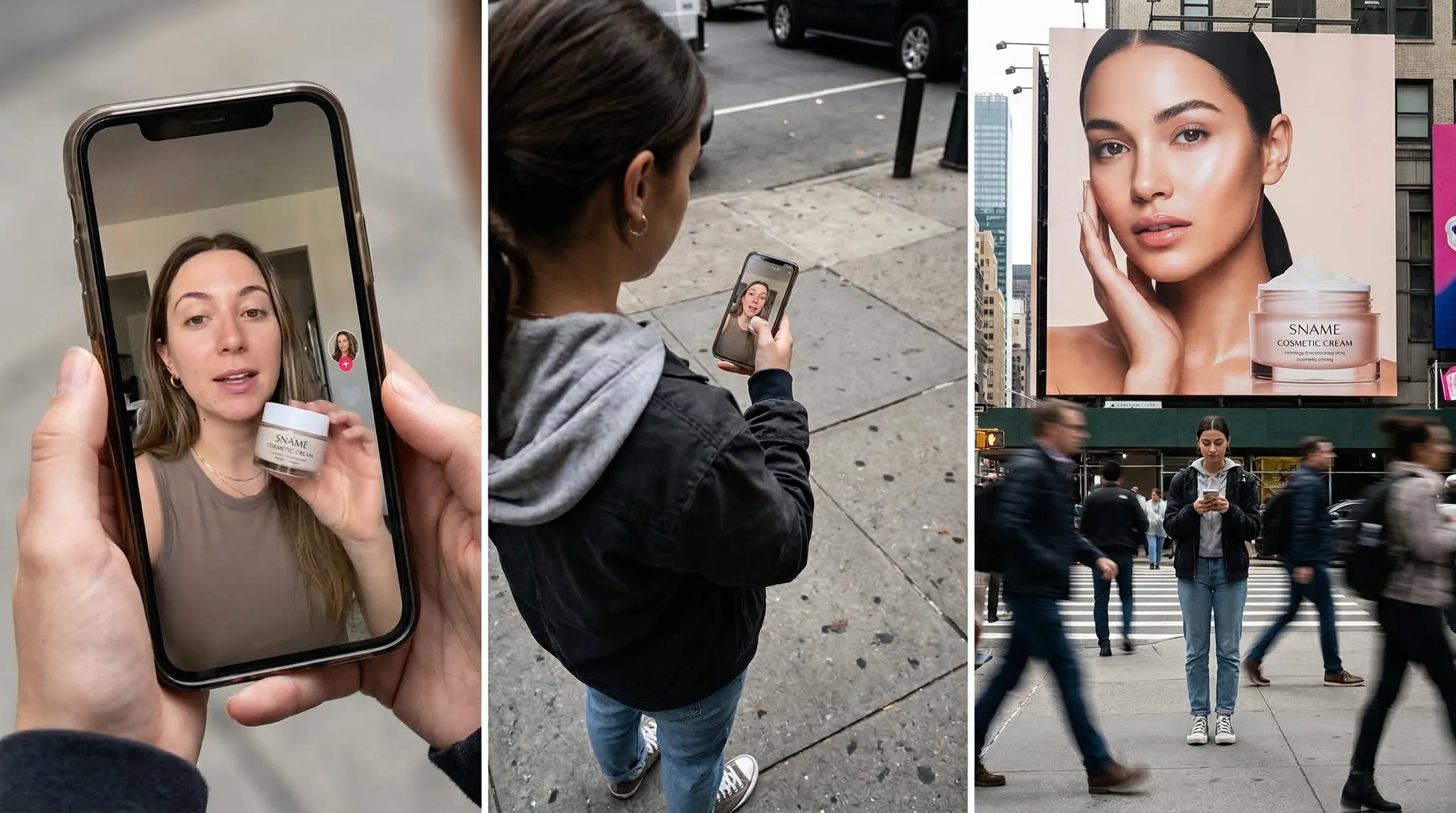
Most people scroll past ads without thinking twice. But when they see a real customer talking about a product on their phone - imperfect lighting, honest delivery, no script - they stop.

That's the core mechanic behind UGC marketing. UGC-based ads achieve 4x higher click-through rates than average brand creative and can cut cost-per-click by 50%. Campaigns that incorporate user-generated content consistently see around 29% higher conversion rates than those without it. The gap between UGC and traditional advertising has only widened as TikTok, Reels, and Shorts made lo-fi, raw, and authentic content the dominant format in social feeds.
This article covers everything you need to know: what UGC means, how it works, real examples across formats, and how to build a strategy that compounds over time.
What does UGC mean?
UGC stands for user-generated content. The American Marketing Association defines it as any content created by people - customers, fans, or "customer lookalikes" - rather than by the brand's own team. Product reviews, tagged Instagram stories, TikTok unboxings, Reddit threads where customers share experiences: all of it is UGC.
The shorthand "UGC content" is widely used in marketing to describe user-generated content as a deliberate channel - content that's collected, curated, and deployed across paid and organic campaigns rather than just appearing organically in the wild.
UGC vs UGC-style content
There's a distinction worth understanding clearly.
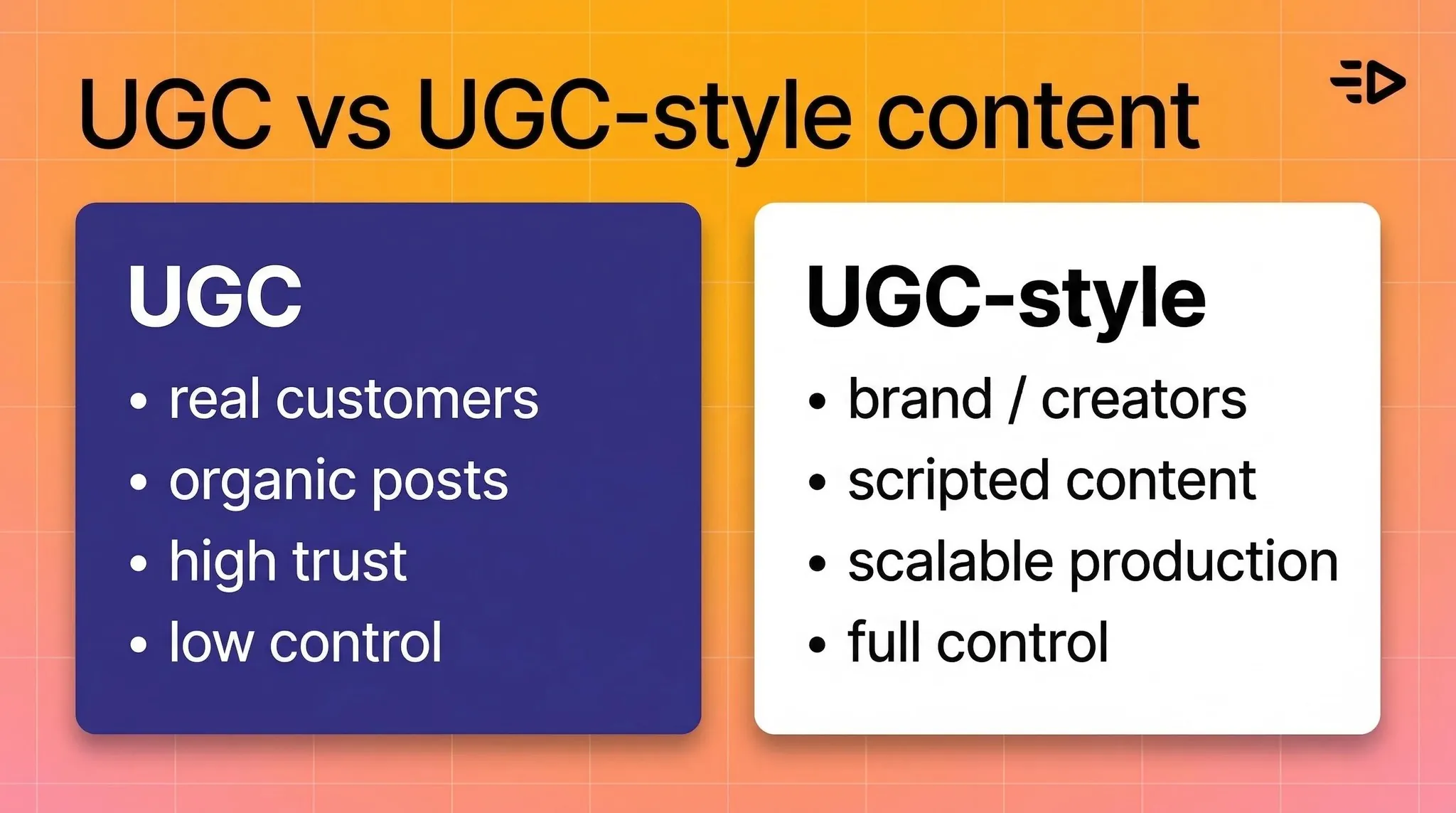
Authentic UGC is created voluntarily by real customers, usually unpaid or lightly incentivized. Its credibility comes directly from that: audiences know a stranger has no reason to lie about whether a product worked.
UGC-style content is brand-produced or creator-produced content designed to look and feel like organic user posts. Selfie framing, casual delivery, hook-first scripts, deliberately imperfect production. It's a brand asset that borrows the aesthetic of authenticity - and in paid media, it consistently outperforms polished studio creative.
Both are legitimate. Most high-performing brands use both. But they serve different purposes, and conflating them creates both strategic and legal problems.

Types of UGC in marketing
User-generated content shows up across almost every channel and format.
Social UGC is the most visible category: TikTok videos, Instagram Reels, tagged stories, and posts featuring your product in real use. It's largely outside brand control, which is part of what makes it credible.
Owned-channel UGC lives on your own properties: product reviews, star ratings, Q&A sections, and customer photos embedded on product pages. Buyers at the bottom of the funnel read these right before deciding whether to purchase.
Community UGC covers forum threads, Discord discussions, Reddit posts, Facebook groups, and branded hashtag campaigns. This category builds ongoing brand narratives and collective product knowledge that persists long after individual posts would otherwise disappear.
Read also: UGC creator: How to produce user-generated content at scale
Why UGC works: the psychology and the data
Authenticity and social proof
A 2019 peer-reviewed study in the International Journal of Advertising found that consumers exposed to UGC in social contexts showed meaningfully higher purchase intent than those exposed to traditional brand posts or disclosed ads. The primary driver: UGC triggers less "persuasion knowledge" — the cognitive process that causes people to discount content they recognize as advertising.
Three mechanisms do the work. Similarity — content from "someone like me" carries more weight than content from a brand. Social proof — seeing real people use and endorse a product reduces the uncertainty that stops people converting. Trust transfer — when a customer vouches for a brand, their personal credibility passes to the product. A polished studio ad cannot manufacture any of these three things, regardless of budget.
Performance data worth knowing
The research on UGC performance is consistent across multiple independent sources:
UGC-based ads achieve 4x higher click-through rates and 50% lower cost-per-click than standard brand creative
Integrating UGC into campaigns and product pages drives around 29% higher conversion rates versus creative without it
92% of consumers trust peer recommendations over brand advertising (Nielsen)
79% of shoppers say UGC significantly influences their buying decisions
For performance marketers, the implication is direct: UGC-style creative wins in the auction more often, at lower cost.
UGC vs influencer content vs brand content

These three categories get lumped together constantly. They work differently and belong at different funnel stages.
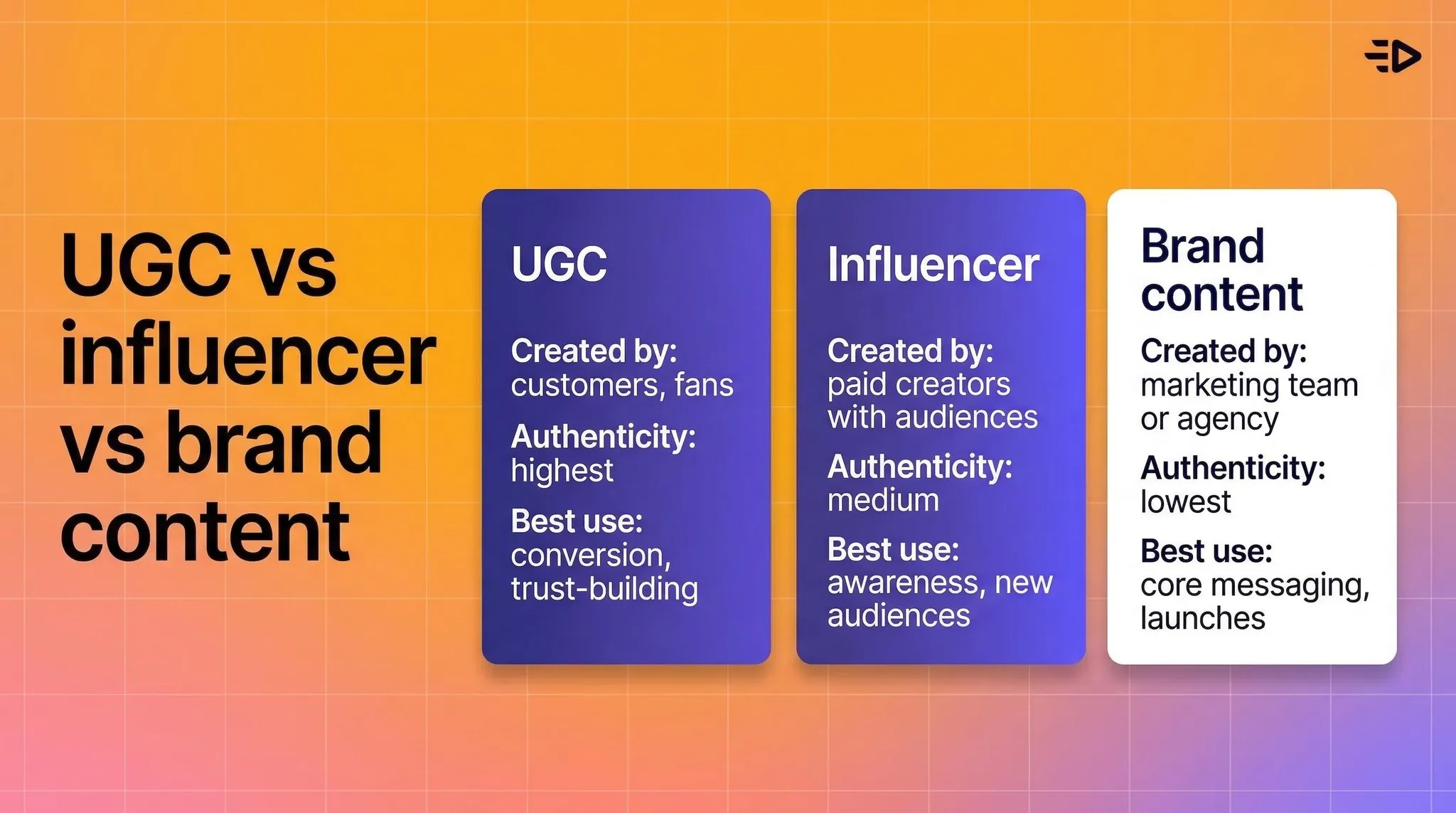
UGC | Influencer content | Brand content | |
|---|---|---|---|
Created by | Customers, fans | Paid creators with audiences | Marketing team or agency |
Perceived authenticity | Highest | Medium (labeled sponsored) | Lowest |
Brand control | Low | Medium | Full |
Cost | Low to zero | Medium to high | Variable |
Best use | Conversion, trust-building | Awareness, new audiences | Core messaging, launches |
UGC works best at the consideration and evaluation stage - when someone is 70% convinced and looking for confirmation from a real person. Influencer content reaches new audiences and shapes positioning. Brand content handles messaging precision for high-stakes campaigns.

UGC examples across formats and industries
Hashtag campaigns
Branded hashtag campaigns are the most scalable form of UGC collection. A brand creates a prompt — "share your setup," "show us how you use it," "here's my result" — pairs it with a hashtag, and turns its customer base into a distributed content library. A single well-run campaign can generate hundreds of authentic assets that feed paid creative, product pages, and email flows for months afterward.
Nonprofits and universities have used this format effectively: participant story campaigns and cause-driven initiatives collect emotional, authentic content at scale while simultaneously building community identity around shared experiences.
Read also: How to create an AI influencer in 2026: Step-by-step guide
Everyday UGC content examples
The most common UGC is less orchestrated than a campaign. A customer unboxes your product on TikTok without being asked. Someone tags your brand in an Instagram story. A buyer leaves a 300-word review that addresses the exact objections future customers have. A user posts a before-and-after on Reddit with honest commentary — including what didn't go perfectly.
This content is valuable precisely because the brand didn't commission it. The absence of brand involvement is the credibility signal.
UGC-style ads in paid media
In paid social, UGC-style creative means ads that look and feel like organic posts: selfie framing, native platform language, hook-driven scripts, lo-fi editing. The goal is to blend into the feed rather than interrupt it. Multiple hooks, multiple creators, and rapid iteration are the playbook — you're running experiments across narratives, demographics, and angles until you find the combination that scales.
UGC content examples by industry
Ecommerce: unboxing videos, try-on hauls, "here's what I actually received vs the product photo" comparisons, before-and-after transformation posts.
SaaS and apps: screen-record tutorials, "day in the life using X" videos, user case study threads, workflow walkthroughs from power users.
Education and nonprofits: student journey videos, participant testimonials, cause-driven story campaigns that document real impact.
How UGC fits into the marketing funnel

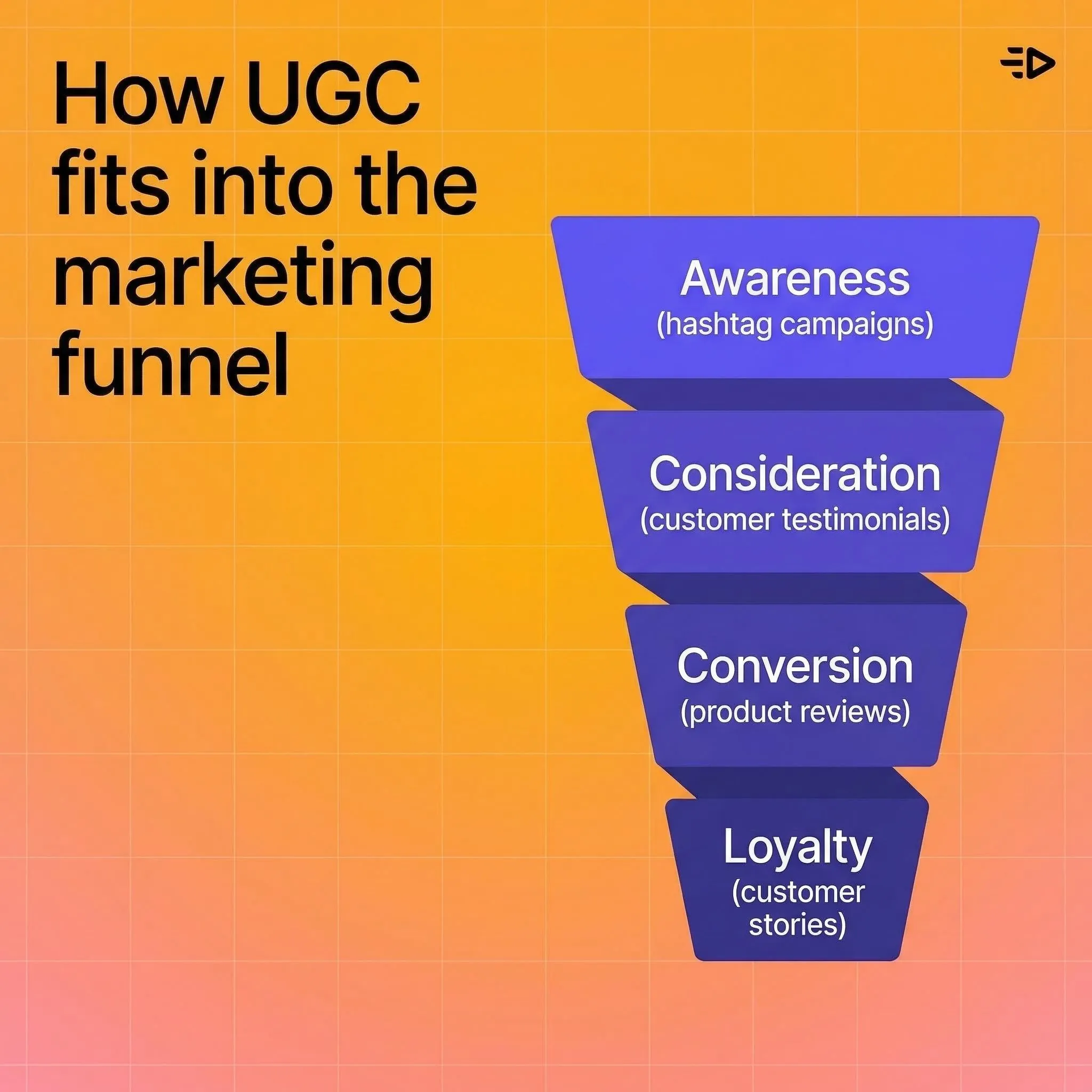
Top of funnel: awareness and reach
Branded hashtags and social challenges turn customers into distributed media channels, extending reach far beyond what a brand's own accounts can achieve organically. The content that travels at this stage is usually tied to experiences rather than products — events, community moments, lifestyle contexts that say something about who uses your product.
Mid-funnel: consideration and education
This is where UGC has the most direct impact on conversion. Embedding customer photos, testimonial videos, and "how I use it" posts on product pages addresses objections through real use cases rather than marketing claims. A buyer who's already read your feature list needs confirmation from someone who actually paid for it — not more brand copy.
Bottom of funnel: conversion and loyalty
UGC in retargeting flows and abandoned cart emails reassures hesitant buyers at the moment they're most uncertain. Post-purchase, the loop closes: prompt happy customers to share their experience, and every piece of content they create becomes top-of-funnel material for the next buyer. That compounding effect is what separates brands with mature UGC programs from those starting fresh.
Building a UGC marketing strategy
Set clear objectives and KPIs first
UGC can serve very different goals, and your objective determines which formats to prioritize. If the goal is conversion, product page reviews and testimonial videos are higher leverage than a hashtag campaign. If the goal is awareness, shareable community challenges are better. Pick one or two KPIs — CTR, CPA, conversion rate, review volume — and track them directly from the start.
Identify and empower the right contributors
Your best UGC creators are already in your customer base. Power users, repeat buyers, people who've tagged you organically or left detailed reviews — these are the people to activate first. The easiest mechanics: a clear hashtag, an in-app prompt, a post-purchase email with a direct ask. Recognition works as well as monetary incentives for many creators; being featured on a brand's channels is a meaningful reward.
Build a workflow for collection, rights, and distribution
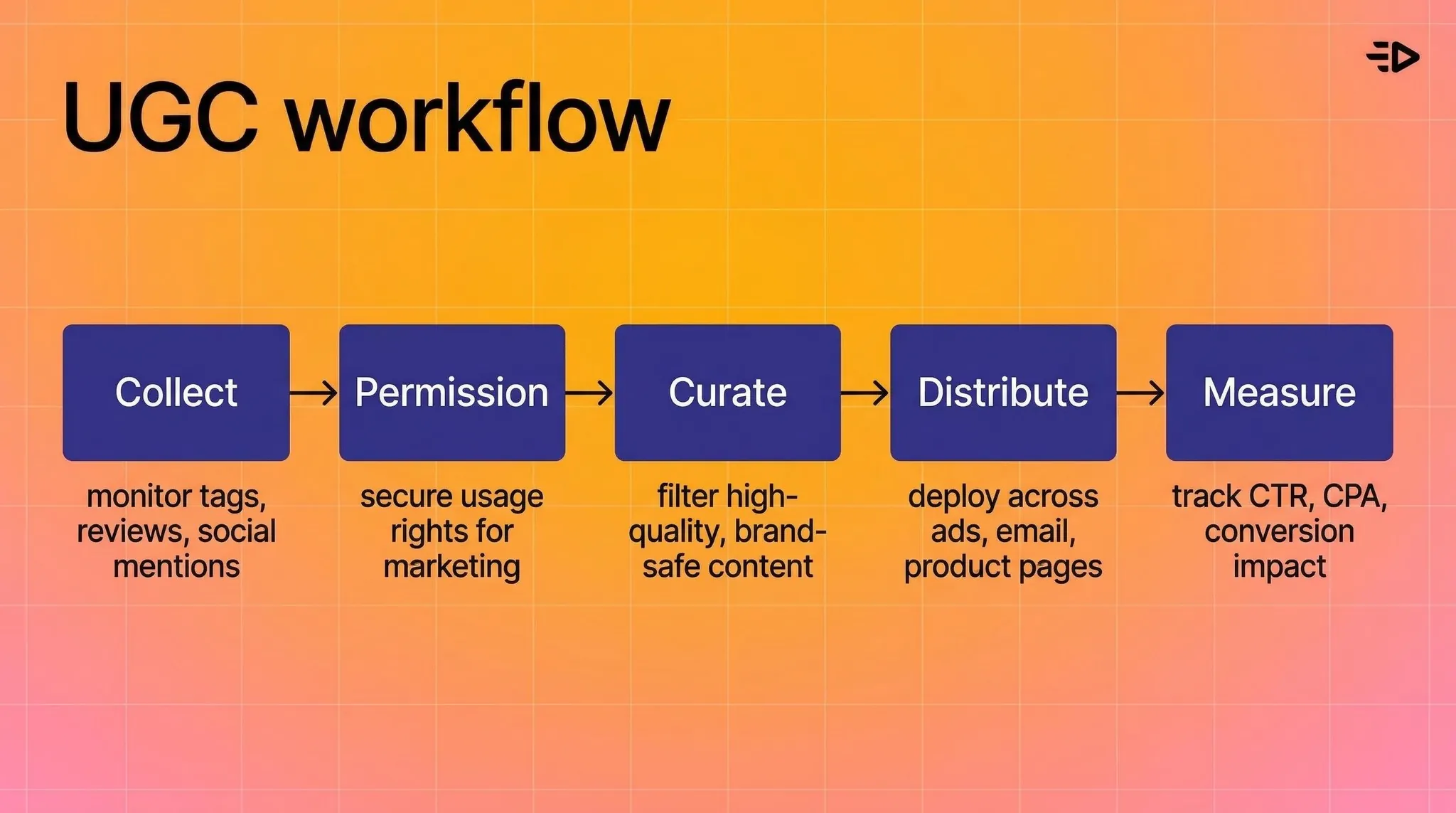
UGC doesn't manage itself. A repeatable workflow requires four steps: monitor and collect consistently across tags and review platforms; obtain explicit permission before repurposing anything in paid campaigns; curate against your brand safety standards; and distribute the best content into organic posts, email flows, product pages, and paid creative.

UGC ideas you can run this week
For any brand: a "tag us to be featured" prompt in your post-purchase email sequence, a branded hashtag with a simple seasonal challenge, and regular community spotlights on your social channels.
For ecommerce: before-and-after photo prompts for products with visible results, unboxing video contests with light incentives, and embedded customer video reviews on product pages.
For SaaS and apps: "day in the life using [product]" video prompts for power users, screenshare tutorial submissions from community members, and case study threads in your Discord or Slack community.
AI UGC: scaling what works
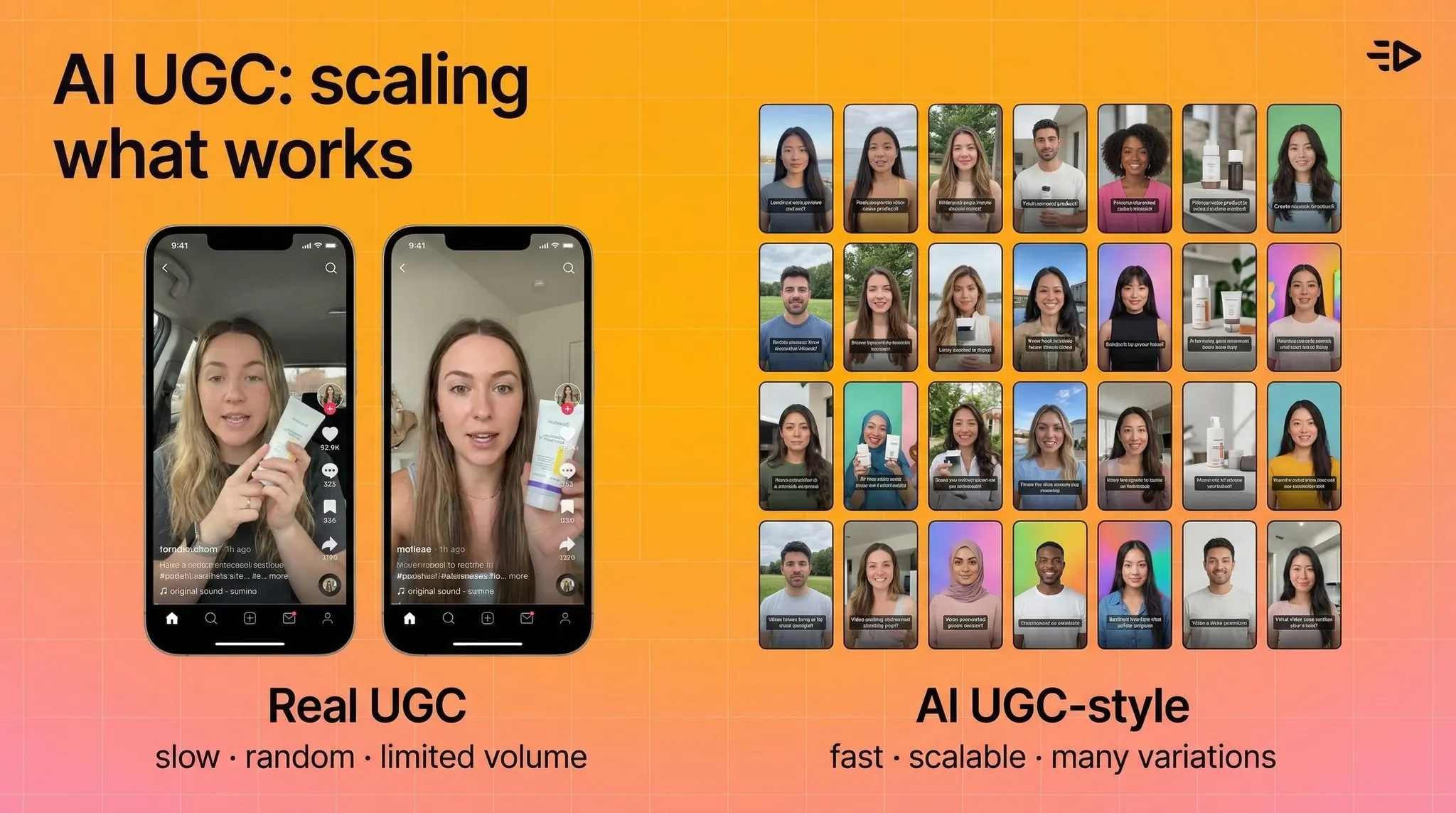
Most brands can't generate authentic UGC at the volume performance marketing actually requires. You need 10 to 20 creative variations to run meaningful A/B tests. You need different hooks, different personas, different angles. Real UGC trickles in on its own schedule and can't be produced on demand.
AI-generated UGC-style content fills that gap. Tools like Creatify produce avatar-based video ads that replicate the format and delivery of authentic UGC — selfie-style framing, casual delivery, hook-first structure — generated from a product URL or script in under 10 minutes, without coordinating creators or managing shoot logistics.
The performance data from brands using this approach is strong. LAIFE, a TikTok Shop brand, scaled from zero to profitability using AI-generated UGC-style creative at a cost per order of $3.89. Designrr saw a 73% ROAS improvement in two weeks after switching to AI-generated creative variations, with CPA dropping from $55 to $30.
The practical workflow for performance marketing: use authentic UGC for long-term trust and social proof on product pages and organic channels. Use AI-generated UGC-style creative to supply the testing volume paid campaigns actually require.

Legal and ethical considerations
Rights, permissions, and disclosure
Repurposing UGC in paid campaigns requires explicit, documented permission — not just reliance on platform terms of service, which may be insufficient in many jurisdictions. Once a creator has been compensated in any form, FTC guidelines in the US and equivalent regulations elsewhere require clear disclosure that the content is sponsored.
The academic research on persuasion and UGC makes the ethical case plainly: perceived authenticity is what drives UGC's performance advantage. When audiences discover that content presented as organic was actually commissioned without disclosure, the trust advantage reverses entirely. The short-term performance gain from obscuring paid status isn't worth the reputational cost.
Moderation and brand safety
Any program that encourages customer content creation needs a moderation policy before it launches. Offensive, misleading, or non-compliant content can appear in brand-associated feeds quickly, and reactive moderation is always slower than a clear upfront standard. Set guidelines, enforce them consistently, and document the process.
Measuring UGC success
Top-funnel metrics: reach, participation rate, number of UGC posts, hashtag uses, and engagement rate versus branded content benchmarks.
Mid and bottom-funnel metrics: CTR, CPA, conversion rate, and incremental revenue from UGC campaigns versus standard creative — tracked separately so you can quantify the actual performance gap.
Long-term signals: repeat purchase rate, active contributor count, review volume, and community health. These are the indicators of a UGC program that's compounding rather than just running.
The repeatable engine: collect, curate, deploy, measure, and use performance data to brief the next round of content. Brands that close this loop build UGC programs that get cheaper and more effective over time.
The future of UGC: AI, synthetic content, and what good faith marketing looks like
The volume of AI-generated content in social feeds is growing fast, and the line between authentic UGC and synthetic creative will keep blurring. That's not a reason to panic — it's a reason to decide early what kind of marketer you want to be.
The principle is simple: never present AI-generated content as real people. If an avatar delivered your script, say so. If a testimonial was written by a model, don't frame it as a customer review. Your audience can feel the difference even when they can't prove it — and the moment they lose trust in your creative, they lose trust in your brand.
Put yourself in their position. You'd want to know whether you're watching a real person's experience or a generated one. Treat your audience the same way: with clarity, honest claims, and marketing that earns attention rather than manufacturing it.
The brands that will win the next wave of AI-generated content aren't the ones who use it to deceive or manipulate. They're the ones who use it transparently — building creative volume at scale while making good faith claims, stating what's real, and never mistaking a short-term conversion for long-term trust.
The technology is rapidly improving. The ethics don't have to be complicated. Be honest about what you're making, make it well, and make it useful to the people you're trying to reach.
Frequently Asked Questions
What is UGC content?
UGC stands for user-generated content — any content about a brand or product created by real people rather than the brand's marketing team. This includes customer reviews, tagged social media posts, unboxing videos, Reddit threads, and testimonials. The defining characteristic is that the brand didn't commission or control it.
What does UGC mean in marketing?
In marketing, UGC refers to the strategic collection and use of customer-created content across paid and organic channels. UGC marketing uses real customer voices to build trust, improve engagement, and drive conversions at lower cost than traditional brand advertising.
What is UGC-style content?
UGC-style content is brand-produced or creator-produced content designed to imitate the look and feel of organic user posts — casual framing, honest delivery, hook-driven scripts, lo-fi production. It's used in paid ads to capture the authenticity and performance advantages of real UGC while maintaining control over volume and message.
What are some real UGC content examples?
Common UGC examples include customer unboxing videos on TikTok, "how I use it" posts on Instagram, detailed product reviews on ecommerce pages, before-and-after result photos, and user tutorials on YouTube. In paid media, UGC-style ads typically feature a creator speaking directly to camera about a specific problem your product solved, with intentionally casual production.
What are good UGC ideas for brands?
Simple starting points: a "tag us to be featured" prompt in post-purchase emails, a branded hashtag with a seasonal challenge, community spotlights on social channels, and before-and-after photo prompts for products with visible results. For SaaS and apps, "day in the life" video prompts and power user tutorial submissions work well.
Why does UGC perform better than traditional ads?
Because it triggers less persuasion knowledge — the mental process that causes people to discount content they recognize as advertising. Research consistently shows UGC drives higher purchase intent than brand posts or disclosed ads, because audiences perceive it as peer recommendation rather than marketing. The practical result: 4x higher CTR and 50% lower CPC compared to standard brand creative.
What's the difference between UGC and influencer marketing?
Authentic UGC is created voluntarily by customers without payment. Influencer marketing involves paid partnerships with creators who have established audiences, and is labeled as sponsored content. UGC typically has higher perceived authenticity but limited reach; influencer content offers audience access at lower trust. Both belong in a full-funnel strategy — at different stages.
Can AI-generated content work like UGC?
AI-generated content isn't technically user-generated, but AI tools can produce UGC-style video ads — avatar-based testimonials, product demos, casual delivery — that replicate the format and performance of real UGC at scale. For performance marketers who need high creative volume, this fills the gap authentic UGC alone can't cover. Disclosure requirements still apply to AI-generated content used in paid campaigns.
Most people scroll past ads without thinking twice. But when they see a real customer talking about a product on their phone - imperfect lighting, honest delivery, no script - they stop.

That's the core mechanic behind UGC marketing. UGC-based ads achieve 4x higher click-through rates than average brand creative and can cut cost-per-click by 50%. Campaigns that incorporate user-generated content consistently see around 29% higher conversion rates than those without it. The gap between UGC and traditional advertising has only widened as TikTok, Reels, and Shorts made lo-fi, raw, and authentic content the dominant format in social feeds.
This article covers everything you need to know: what UGC means, how it works, real examples across formats, and how to build a strategy that compounds over time.
What does UGC mean?
UGC stands for user-generated content. The American Marketing Association defines it as any content created by people - customers, fans, or "customer lookalikes" - rather than by the brand's own team. Product reviews, tagged Instagram stories, TikTok unboxings, Reddit threads where customers share experiences: all of it is UGC.
The shorthand "UGC content" is widely used in marketing to describe user-generated content as a deliberate channel - content that's collected, curated, and deployed across paid and organic campaigns rather than just appearing organically in the wild.
UGC vs UGC-style content
There's a distinction worth understanding clearly.
Authentic UGC is created voluntarily by real customers, usually unpaid or lightly incentivized. Its credibility comes directly from that: audiences know a stranger has no reason to lie about whether a product worked.
UGC-style content is brand-produced or creator-produced content designed to look and feel like organic user posts. Selfie framing, casual delivery, hook-first scripts, deliberately imperfect production. It's a brand asset that borrows the aesthetic of authenticity - and in paid media, it consistently outperforms polished studio creative.
Both are legitimate. Most high-performing brands use both. But they serve different purposes, and conflating them creates both strategic and legal problems.

Types of UGC in marketing
User-generated content shows up across almost every channel and format.
Social UGC is the most visible category: TikTok videos, Instagram Reels, tagged stories, and posts featuring your product in real use. It's largely outside brand control, which is part of what makes it credible.
Owned-channel UGC lives on your own properties: product reviews, star ratings, Q&A sections, and customer photos embedded on product pages. Buyers at the bottom of the funnel read these right before deciding whether to purchase.
Community UGC covers forum threads, Discord discussions, Reddit posts, Facebook groups, and branded hashtag campaigns. This category builds ongoing brand narratives and collective product knowledge that persists long after individual posts would otherwise disappear.
Read also: UGC creator: How to produce user-generated content at scale
Why UGC works: the psychology and the data
Authenticity and social proof
A 2019 peer-reviewed study in the International Journal of Advertising found that consumers exposed to UGC in social contexts showed meaningfully higher purchase intent than those exposed to traditional brand posts or disclosed ads. The primary driver: UGC triggers less "persuasion knowledge" — the cognitive process that causes people to discount content they recognize as advertising.
Three mechanisms do the work. Similarity — content from "someone like me" carries more weight than content from a brand. Social proof — seeing real people use and endorse a product reduces the uncertainty that stops people converting. Trust transfer — when a customer vouches for a brand, their personal credibility passes to the product. A polished studio ad cannot manufacture any of these three things, regardless of budget.
Performance data worth knowing
The research on UGC performance is consistent across multiple independent sources:
UGC-based ads achieve 4x higher click-through rates and 50% lower cost-per-click than standard brand creative
Integrating UGC into campaigns and product pages drives around 29% higher conversion rates versus creative without it
92% of consumers trust peer recommendations over brand advertising (Nielsen)
79% of shoppers say UGC significantly influences their buying decisions
For performance marketers, the implication is direct: UGC-style creative wins in the auction more often, at lower cost.
UGC vs influencer content vs brand content

These three categories get lumped together constantly. They work differently and belong at different funnel stages.
UGC | Influencer content | Brand content | |
|---|---|---|---|
Created by | Customers, fans | Paid creators with audiences | Marketing team or agency |
Perceived authenticity | Highest | Medium (labeled sponsored) | Lowest |
Brand control | Low | Medium | Full |
Cost | Low to zero | Medium to high | Variable |
Best use | Conversion, trust-building | Awareness, new audiences | Core messaging, launches |
UGC works best at the consideration and evaluation stage - when someone is 70% convinced and looking for confirmation from a real person. Influencer content reaches new audiences and shapes positioning. Brand content handles messaging precision for high-stakes campaigns.

UGC examples across formats and industries
Hashtag campaigns
Branded hashtag campaigns are the most scalable form of UGC collection. A brand creates a prompt — "share your setup," "show us how you use it," "here's my result" — pairs it with a hashtag, and turns its customer base into a distributed content library. A single well-run campaign can generate hundreds of authentic assets that feed paid creative, product pages, and email flows for months afterward.
Nonprofits and universities have used this format effectively: participant story campaigns and cause-driven initiatives collect emotional, authentic content at scale while simultaneously building community identity around shared experiences.
Read also: How to create an AI influencer in 2026: Step-by-step guide
Everyday UGC content examples
The most common UGC is less orchestrated than a campaign. A customer unboxes your product on TikTok without being asked. Someone tags your brand in an Instagram story. A buyer leaves a 300-word review that addresses the exact objections future customers have. A user posts a before-and-after on Reddit with honest commentary — including what didn't go perfectly.
This content is valuable precisely because the brand didn't commission it. The absence of brand involvement is the credibility signal.
UGC-style ads in paid media
In paid social, UGC-style creative means ads that look and feel like organic posts: selfie framing, native platform language, hook-driven scripts, lo-fi editing. The goal is to blend into the feed rather than interrupt it. Multiple hooks, multiple creators, and rapid iteration are the playbook — you're running experiments across narratives, demographics, and angles until you find the combination that scales.
UGC content examples by industry
Ecommerce: unboxing videos, try-on hauls, "here's what I actually received vs the product photo" comparisons, before-and-after transformation posts.
SaaS and apps: screen-record tutorials, "day in the life using X" videos, user case study threads, workflow walkthroughs from power users.
Education and nonprofits: student journey videos, participant testimonials, cause-driven story campaigns that document real impact.
How UGC fits into the marketing funnel

Top of funnel: awareness and reach
Branded hashtags and social challenges turn customers into distributed media channels, extending reach far beyond what a brand's own accounts can achieve organically. The content that travels at this stage is usually tied to experiences rather than products — events, community moments, lifestyle contexts that say something about who uses your product.
Mid-funnel: consideration and education
This is where UGC has the most direct impact on conversion. Embedding customer photos, testimonial videos, and "how I use it" posts on product pages addresses objections through real use cases rather than marketing claims. A buyer who's already read your feature list needs confirmation from someone who actually paid for it — not more brand copy.
Bottom of funnel: conversion and loyalty
UGC in retargeting flows and abandoned cart emails reassures hesitant buyers at the moment they're most uncertain. Post-purchase, the loop closes: prompt happy customers to share their experience, and every piece of content they create becomes top-of-funnel material for the next buyer. That compounding effect is what separates brands with mature UGC programs from those starting fresh.
Building a UGC marketing strategy
Set clear objectives and KPIs first
UGC can serve very different goals, and your objective determines which formats to prioritize. If the goal is conversion, product page reviews and testimonial videos are higher leverage than a hashtag campaign. If the goal is awareness, shareable community challenges are better. Pick one or two KPIs — CTR, CPA, conversion rate, review volume — and track them directly from the start.
Identify and empower the right contributors
Your best UGC creators are already in your customer base. Power users, repeat buyers, people who've tagged you organically or left detailed reviews — these are the people to activate first. The easiest mechanics: a clear hashtag, an in-app prompt, a post-purchase email with a direct ask. Recognition works as well as monetary incentives for many creators; being featured on a brand's channels is a meaningful reward.
Build a workflow for collection, rights, and distribution
UGC doesn't manage itself. A repeatable workflow requires four steps: monitor and collect consistently across tags and review platforms; obtain explicit permission before repurposing anything in paid campaigns; curate against your brand safety standards; and distribute the best content into organic posts, email flows, product pages, and paid creative.

UGC ideas you can run this week
For any brand: a "tag us to be featured" prompt in your post-purchase email sequence, a branded hashtag with a simple seasonal challenge, and regular community spotlights on your social channels.
For ecommerce: before-and-after photo prompts for products with visible results, unboxing video contests with light incentives, and embedded customer video reviews on product pages.
For SaaS and apps: "day in the life using [product]" video prompts for power users, screenshare tutorial submissions from community members, and case study threads in your Discord or Slack community.
AI UGC: scaling what works
Most brands can't generate authentic UGC at the volume performance marketing actually requires. You need 10 to 20 creative variations to run meaningful A/B tests. You need different hooks, different personas, different angles. Real UGC trickles in on its own schedule and can't be produced on demand.
AI-generated UGC-style content fills that gap. Tools like Creatify produce avatar-based video ads that replicate the format and delivery of authentic UGC — selfie-style framing, casual delivery, hook-first structure — generated from a product URL or script in under 10 minutes, without coordinating creators or managing shoot logistics.
The performance data from brands using this approach is strong. LAIFE, a TikTok Shop brand, scaled from zero to profitability using AI-generated UGC-style creative at a cost per order of $3.89. Designrr saw a 73% ROAS improvement in two weeks after switching to AI-generated creative variations, with CPA dropping from $55 to $30.
The practical workflow for performance marketing: use authentic UGC for long-term trust and social proof on product pages and organic channels. Use AI-generated UGC-style creative to supply the testing volume paid campaigns actually require.

Legal and ethical considerations
Rights, permissions, and disclosure
Repurposing UGC in paid campaigns requires explicit, documented permission — not just reliance on platform terms of service, which may be insufficient in many jurisdictions. Once a creator has been compensated in any form, FTC guidelines in the US and equivalent regulations elsewhere require clear disclosure that the content is sponsored.
The academic research on persuasion and UGC makes the ethical case plainly: perceived authenticity is what drives UGC's performance advantage. When audiences discover that content presented as organic was actually commissioned without disclosure, the trust advantage reverses entirely. The short-term performance gain from obscuring paid status isn't worth the reputational cost.
Moderation and brand safety
Any program that encourages customer content creation needs a moderation policy before it launches. Offensive, misleading, or non-compliant content can appear in brand-associated feeds quickly, and reactive moderation is always slower than a clear upfront standard. Set guidelines, enforce them consistently, and document the process.
Measuring UGC success
Top-funnel metrics: reach, participation rate, number of UGC posts, hashtag uses, and engagement rate versus branded content benchmarks.
Mid and bottom-funnel metrics: CTR, CPA, conversion rate, and incremental revenue from UGC campaigns versus standard creative — tracked separately so you can quantify the actual performance gap.
Long-term signals: repeat purchase rate, active contributor count, review volume, and community health. These are the indicators of a UGC program that's compounding rather than just running.
The repeatable engine: collect, curate, deploy, measure, and use performance data to brief the next round of content. Brands that close this loop build UGC programs that get cheaper and more effective over time.
The future of UGC: AI, synthetic content, and what good faith marketing looks like
The volume of AI-generated content in social feeds is growing fast, and the line between authentic UGC and synthetic creative will keep blurring. That's not a reason to panic — it's a reason to decide early what kind of marketer you want to be.
The principle is simple: never present AI-generated content as real people. If an avatar delivered your script, say so. If a testimonial was written by a model, don't frame it as a customer review. Your audience can feel the difference even when they can't prove it — and the moment they lose trust in your creative, they lose trust in your brand.
Put yourself in their position. You'd want to know whether you're watching a real person's experience or a generated one. Treat your audience the same way: with clarity, honest claims, and marketing that earns attention rather than manufacturing it.
The brands that will win the next wave of AI-generated content aren't the ones who use it to deceive or manipulate. They're the ones who use it transparently — building creative volume at scale while making good faith claims, stating what's real, and never mistaking a short-term conversion for long-term trust.
The technology is rapidly improving. The ethics don't have to be complicated. Be honest about what you're making, make it well, and make it useful to the people you're trying to reach.
Frequently Asked Questions
What is UGC content?
UGC stands for user-generated content — any content about a brand or product created by real people rather than the brand's marketing team. This includes customer reviews, tagged social media posts, unboxing videos, Reddit threads, and testimonials. The defining characteristic is that the brand didn't commission or control it.
What does UGC mean in marketing?
In marketing, UGC refers to the strategic collection and use of customer-created content across paid and organic channels. UGC marketing uses real customer voices to build trust, improve engagement, and drive conversions at lower cost than traditional brand advertising.
What is UGC-style content?
UGC-style content is brand-produced or creator-produced content designed to imitate the look and feel of organic user posts — casual framing, honest delivery, hook-driven scripts, lo-fi production. It's used in paid ads to capture the authenticity and performance advantages of real UGC while maintaining control over volume and message.
What are some real UGC content examples?
Common UGC examples include customer unboxing videos on TikTok, "how I use it" posts on Instagram, detailed product reviews on ecommerce pages, before-and-after result photos, and user tutorials on YouTube. In paid media, UGC-style ads typically feature a creator speaking directly to camera about a specific problem your product solved, with intentionally casual production.
What are good UGC ideas for brands?
Simple starting points: a "tag us to be featured" prompt in post-purchase emails, a branded hashtag with a seasonal challenge, community spotlights on social channels, and before-and-after photo prompts for products with visible results. For SaaS and apps, "day in the life" video prompts and power user tutorial submissions work well.
Why does UGC perform better than traditional ads?
Because it triggers less persuasion knowledge — the mental process that causes people to discount content they recognize as advertising. Research consistently shows UGC drives higher purchase intent than brand posts or disclosed ads, because audiences perceive it as peer recommendation rather than marketing. The practical result: 4x higher CTR and 50% lower CPC compared to standard brand creative.
What's the difference between UGC and influencer marketing?
Authentic UGC is created voluntarily by customers without payment. Influencer marketing involves paid partnerships with creators who have established audiences, and is labeled as sponsored content. UGC typically has higher perceived authenticity but limited reach; influencer content offers audience access at lower trust. Both belong in a full-funnel strategy — at different stages.
Can AI-generated content work like UGC?
AI-generated content isn't technically user-generated, but AI tools can produce UGC-style video ads — avatar-based testimonials, product demos, casual delivery — that replicate the format and performance of real UGC at scale. For performance marketers who need high creative volume, this fills the gap authentic UGC alone can't cover. Disclosure requirements still apply to AI-generated content used in paid campaigns.