Creatify Team
SHARE


IN THIS ARTICLE
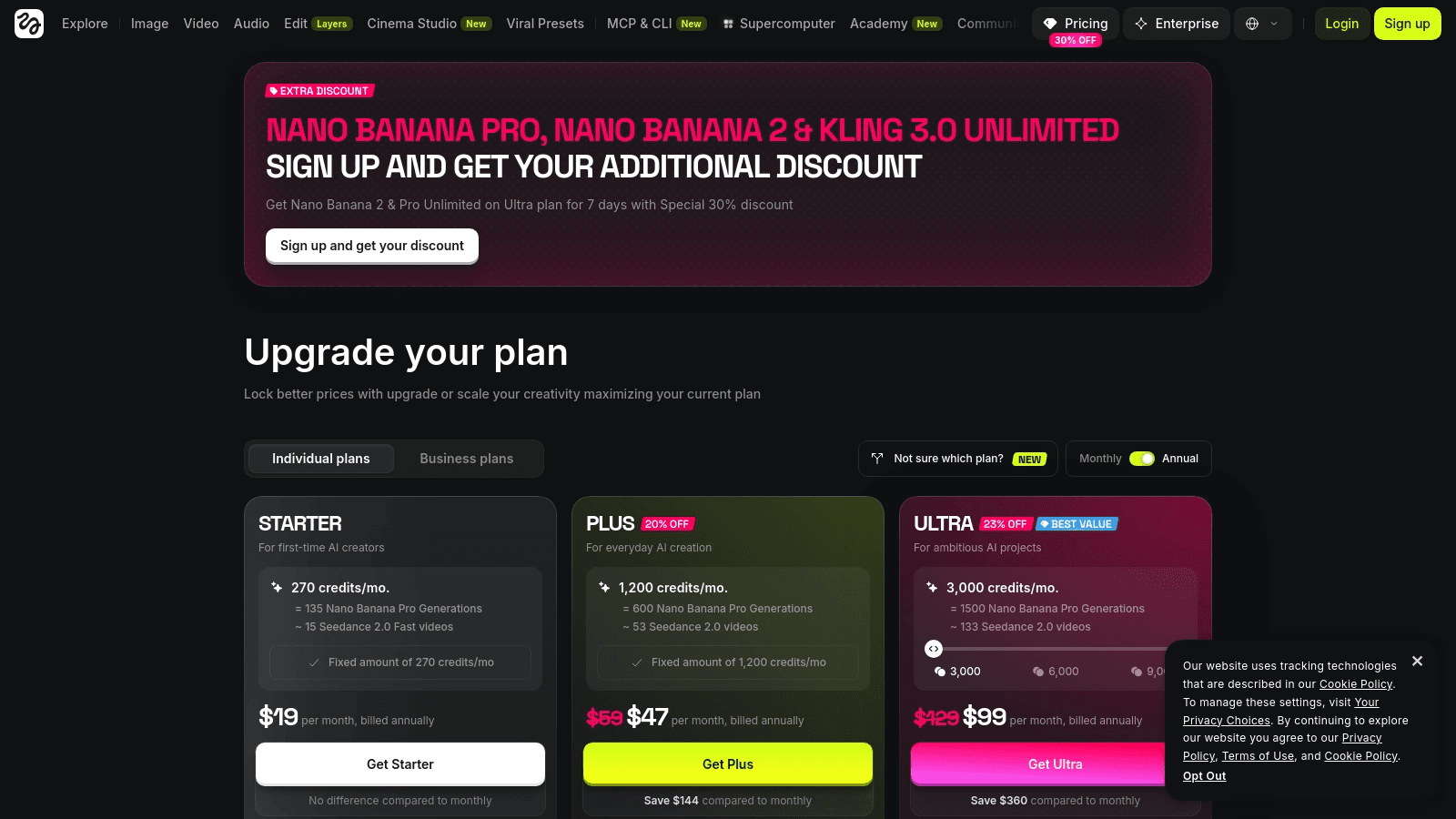
Higgsfield is an AI media suite that generates and edits images and video. Higgsfield turns prompts or references into content through Cinema Studio, Marketing Studio, and Soul ID. The Free plan includes no credits, while the Starter plan begins at about $19 a month on annual billing for 270 credits. The Plus plan costs $47 a month on annual billing or $59 monthly for 1,200 credits, and the Ultra plan costs $99 annually or $129 monthly for 3,000 base credits. This guide helps readers translate Higgsfield credits into expected output and decide when Creatify suits their ad work.
In this article, we show you a breakdown of Higgsfield’s pricing tiers and what you can expect at each tier. We will show you how to optimize generation to get the most of out Higgsfield’s subscription.
Key takeaways
Higgsfield has 3 pricing plans starting at $19, $47, and $99 per month.
What Higgsfield is
Higgsfield produces ad videos with controllable camera moves, consistent characters, and lip-synced dialogue. Higgsfield combines camera controls, character consistency, and ad-production tools across Cinema Studio, Soul ID, Speak, and Marketing Studio. Paid plans include commercial use, while the Free plan excludes commercial rights. The Free plan excludes commercial rights, so marketers need a paid plan for client assets and paid-media work.
The Higgsfield credit system, explained
Higgsfield charges credits for each generation based on the selected model, duration, and resolution, with batch size included in the generation request. Its How Credits Work documentation says the Generate button displays the exact charge before confirmation and spends subscription credits before credit packs, promotional credits, and auto-refill credits. Price the settings you intend to use before choosing a plan, rather than dividing the subscription price by its credit total.
Higgsfield’s official credit guides publish the following representative rates.
Generation setting | Credit cost |
|---|---|
Nano Banana Pro image | ~2 credits |
Nano Banana Pro image at 4K | ~4 credits |
Seedance 2.0, 5 seconds at 720p | ~22 to 23 credits |
Seedance 2.0, 5 seconds at 1080p | ~45 credits |
Seedance 2.0 Fast, 5 seconds | ~17 credits |
Kling 3.0, 5 seconds at 720p | ~7 to 10 credits |
Wan 2.7, 5 seconds | ~8 credits |
Seedance 2.5, 8 seconds at 720p | 52 credits |
The AI Video Credits Explained guide says that 1080p can nearly double the cost of some 720p generations, while 10-second renders roughly double many 5-second rates. Lower-resolution drafts consume fewer credits, leaving more balance for final high-resolution exports. That sequence protects credits for the versions that enter your ad edit.
Higgsfield’s Unlimited access reduces deductions for specific models during defined windows. Eligible web-app generations are free during the limited window, while MCP, CLI, and Canvas generations still deduct credits. Higgsfield also sells Unlimited Marketplace bundles that can limit concurrency to one video or two images. A concentrated batch on one eligible model gets the greatest value from those windows.
Some older models can include 365-day access, while newer flagship models can have windows of 7 to 33 days. Base credits remain the safer planning unit for a campaign that uses multiple models or runs across several months.
Higgsfield sells credit packs from 80 credits for $5 to 1,700 credits for $80, and an active subscription is required to buy them. Those prices equal about $0.0625 per credit at the smallest pack and about $0.047 per credit at the largest. Buy a pack for a defined overage; move up a tier when the same overage appears month after month. Plus and Ultra users can enable auto-refill below 500 credits, including an example rate of $1 for 20 credits.
Higgsfield plan pricing in 2026
Higgsfield's individual plans differ in credits, concurrent generations, and commercial rights; Unlimited plans also receive limited-time model benefits. The Higgsfield pricing page sets video concurrency at one generation on the Free plan, rising from two on the Starter plan to eight on the Ultra plan. Concurrency matters because a team that waits on sequential renders can struggle to use a large credit balance during a production sprint.
Feature | Free | Starter | Plus | Ultra |
|---|---|---|---|---|
Price | $0 | ~$19/month annual billing | $47/month annual or $59 monthly | $99/month annual or $129 monthly |
Included credits | 0 | 270 | 1,200 | 3,000 base |
Parallel video generations | 1 concurrent generation total | 2 | 6 | 8 |
Parallel image generations | 1 concurrent generation total | 4 | 8 | 8 |
Commercial use | No | Yes | Yes | Yes |
Unlimited and free-generation benefits | Limited | Varies by plan card | More eligible models and windows | Broadest eligible access and windows |
Free ($0/month)
The Free plan lets you inspect Higgsfield’s interface and available tools without buying credits. Higgsfield gives this plan zero included credits and excludes commercial use. Use the Free plan to judge the product environment before paying, then move to Starter before producing client assets or paid-media creative.
Starter (~$19/month on annual billing)
The Starter plan suits image-first work more than high-cost video experimentation. Higgsfield assigns Starter 270 credits, two parallel video generations, and four parallel image generations. At about $19 on annual billing, 270 Nano Banana Pro images at two credits each imply about $0.07 per generated image before re-rolls and tax.
Starter fits a marketer producing occasional product stills, thumbnails, or reference images. Several video alternates can exhaust Starter’s 270 credits, leaving no balance for the rest of a recurring video calendar.
Plus ($47/month on annual billing or $59/monthly)
The Plus plan provides 1,200 credits for recurring short-form asset production. Higgsfield estimates that this balance can produce about 600 Nano Banana Pro images or 50 to 55 Seedance clips before Unlimited or free-generation pools apply. Its pricing card can also include one-time selected-model pools, including an example 5,000 Soul 2.0 allocation.
Plus gives an active solo creator room to test concepts and still export finished work. A team that repeatedly renders 1080p video or tests several hooks for every concept can still empty 1,200 credits quickly. That usage pattern points toward Ultra.
Ultra ($99/month on annual billing or $129/monthly)
The Ultra plan targets teams that need high concurrency and the largest standard credit balance. Higgsfield includes 3,000 base credits, eight parallel video generations, and eight parallel image generations on its individual pricing page. Some Higgsfield pricing extracts also describe scalable Ultra options with 6,000 or 9,000 credits.
Choose Ultra when sequential render waits slow campaign production or when video generation has become a predictable monthly operating cost. Eight parallel slots only help when your team has enough planned work to consume the larger allocation.
Team, Scale, and Enterprise (per-seat or custom pricing)
Higgsfield’s Team plan pools credits across collaborators rather than isolating each person’s balance. The Team plan supports up to nine seats, pools about 1,000 credits per seat, and lists pricing around $69 per seat annually or $79 monthly. The Scale plan supports up to 15 seats, priority queueing, and SSO, while the Enterprise plan offers custom pricing, SOC 2, and dedicated capacity.
A pooled balance helps agencies because one high-volume editor can use credits that another collaborator leaves unused. Team and Scale fit organizations that need shared capacity and user controls, rather than several separate individual subscriptions.
What you’ll actually pay
Casual still-image workflow
A team that generates 80 Nano Banana Pro images a month needs 80 images × 2 credits = 160 credits. Starter’s 270-credit allowance leaves 110 credits after that workload. Those remaining credits cover about 55 more standard Nano Banana Pro images.
Starter covers 80 standard Nano Banana Pro images and leaves 110 credits for additional generations. Each 4K Nano Banana Pro image costs about four credits, which cuts the remaining margin in half.
Modest short-video calendar
A creator who produces 20 Seedance 2.0 Fast videos at five seconds each needs 20 clips × 17 credits = 340 credits. That schedule exceeds Starter’s 270 credits by 70 credits before alternate prompts, resolution upgrades, or final selects.
Plus is the minimum plan that covers this baseline video calendar without a credit pack. The practical annual-billed starting cost is therefore $47 a month, rather than Starter’s approximately $19 sticker price.
Premium 1080p video production
A team that produces 40 Seedance 2.0 videos at five seconds and 1080p needs 40 clips × 45 credits = 1,800 credits. That workload exceeds Plus’s 1,200-credit balance by 600 credits. Ultra’s 3,000 base credits leave 1,200 credits for alternate takes, new hooks, or image generation.
Ultra costs more at checkout, but its credit buffer lets a team test creative options instead of treating every paid render as a final deliverable. This workload makes Ultra the more workable monthly plan.
Eligible Unlimited window
Higgsfield deducts zero credits for qualifying web-app generations during an Unlimited model’s stated access period. A team that needs many variants from one eligible flagship model can schedule concept exploration, hook testing, and alternate takes inside that window. Credits can then cover the models and production surfaces that Unlimited access excludes.
Higgsfield versus Creatify for ad teams
Higgsfield and Creatify address different expensive parts of ad production. Higgsfield offers multi-model media generation, cinematic controls, and character tools for consistency and lipsync; usage draws from credits. Creatify’s AdFlow breaks ads into modular components such as the product image, script, and voiceover, letting teams revise one component without rebuilding the full asset.
Higgsfield offers model choice and cinematic controls for teams refining individual image and video assets. Choose Creatify when repeatable modular assembly determines how quickly your team can produce ad variants.
Creatify’s Performance Agent supports campaign analysis, launch, and optimization through connected accounts on Meta, Google Ads, and TikTok. Creatify Agent can research a brand and competitors from a brief or product URL, create concepts and scripts, and produce ad variations. Those tools connect creative work to campaign execution and performance learning.
Creatify fits teams that run creative production and campaign optimization in one workflow. A team that primarily needs high-volume generation capacity should price Higgsfield from the exact model settings it expects to use.
Who each plan is right for
The Free plan is for interface evaluation, with zero credits and no commercial use. The Starter plan's 270 credits cover up to 135 still images at two credits each, while video generations consume more credits. The Plus plan supports recurring short-form production with 1,200 credits and six parallel video generations. The Ultra plan supports a heavier video workload, with a 3,000-credit balance and eight parallel video slots.
Pooled credits let agencies shift unused capacity to the editors producing the most client work. Creatify fits teams whose paid-ad work must continue from creative generation into launch, reporting, and performance iteration.
A five-second Seedance 2.0 render at 1080p uses about 45 credits, while a Nano Banana Pro image uses about two. The resulting total shows whether a Higgsfield plan or Creatify fits the workload.
FAQs
How many credits should I expect to spend for an average 5-second video or 4K image?
Credit use varies by model, duration, and resolution. Representative examples: Nano Banana Pro images are ~2 credits (base) or ~4 credits at 4K. For 5-second clips, Seedance 2.0 is ~22–23 credits at 720p or ~45 credits at 1080p (Fast is ~17 credits). Always check the Generate button charge for your exact settings.
Do Higgsfield credits roll over to the next month?
No. Subscription credits expire at the end of each billing cycle, so irregular or seasonal production can leave paid credits unused.
What’s the real difference between Starter’s 270 credits and Plus’s 1,200 credits?
Plus generally supports more experimentation between replenishments. The article’s representative expectations: Starter’s 270 credits cover about ~135 Nano Banana Pro images, or only ~12–15 Seedance 2.0 Fast 5-second clips. Plus includes 1,200 credits (plus higher parallel generation capacity—6 concurrent video generations), so you can run more testing before credits run out.
When do “unlimited” or free-generation windows actually apply?
Only for eligible web-app models during defined limited-time windows. Even then, other generation paths (like MCP, CLI, or Canvas) still deduct credits. For long-running campaigns, plan based on base credits rather than assuming everything is free.
Can I buy extra credits instead of upgrading plans?
Yes. Higgsfield sells credit packs (subscription is required to buy packs). Packs cost about ~$0.0625 per credit at the smallest pack and about ~$0.047 per credit at the largest, and auto-refill may be available on Plus/Ultra below a specified balance (e.g., an example of ~$1 for 20 credits).
Higgsfield is an AI media suite that generates and edits images and video. Higgsfield turns prompts or references into content through Cinema Studio, Marketing Studio, and Soul ID. The Free plan includes no credits, while the Starter plan begins at about $19 a month on annual billing for 270 credits. The Plus plan costs $47 a month on annual billing or $59 monthly for 1,200 credits, and the Ultra plan costs $99 annually or $129 monthly for 3,000 base credits. This guide helps readers translate Higgsfield credits into expected output and decide when Creatify suits their ad work.
In this article, we show you a breakdown of Higgsfield’s pricing tiers and what you can expect at each tier. We will show you how to optimize generation to get the most of out Higgsfield’s subscription.
Key takeaways
Higgsfield has 3 pricing plans starting at $19, $47, and $99 per month.
What Higgsfield is
Higgsfield produces ad videos with controllable camera moves, consistent characters, and lip-synced dialogue. Higgsfield combines camera controls, character consistency, and ad-production tools across Cinema Studio, Soul ID, Speak, and Marketing Studio. Paid plans include commercial use, while the Free plan excludes commercial rights. The Free plan excludes commercial rights, so marketers need a paid plan for client assets and paid-media work.
The Higgsfield credit system, explained
Higgsfield charges credits for each generation based on the selected model, duration, and resolution, with batch size included in the generation request. Its How Credits Work documentation says the Generate button displays the exact charge before confirmation and spends subscription credits before credit packs, promotional credits, and auto-refill credits. Price the settings you intend to use before choosing a plan, rather than dividing the subscription price by its credit total.
Higgsfield’s official credit guides publish the following representative rates.
Generation setting | Credit cost |
|---|---|
Nano Banana Pro image | ~2 credits |
Nano Banana Pro image at 4K | ~4 credits |
Seedance 2.0, 5 seconds at 720p | ~22 to 23 credits |
Seedance 2.0, 5 seconds at 1080p | ~45 credits |
Seedance 2.0 Fast, 5 seconds | ~17 credits |
Kling 3.0, 5 seconds at 720p | ~7 to 10 credits |
Wan 2.7, 5 seconds | ~8 credits |
Seedance 2.5, 8 seconds at 720p | 52 credits |
The AI Video Credits Explained guide says that 1080p can nearly double the cost of some 720p generations, while 10-second renders roughly double many 5-second rates. Lower-resolution drafts consume fewer credits, leaving more balance for final high-resolution exports. That sequence protects credits for the versions that enter your ad edit.
Higgsfield’s Unlimited access reduces deductions for specific models during defined windows. Eligible web-app generations are free during the limited window, while MCP, CLI, and Canvas generations still deduct credits. Higgsfield also sells Unlimited Marketplace bundles that can limit concurrency to one video or two images. A concentrated batch on one eligible model gets the greatest value from those windows.
Some older models can include 365-day access, while newer flagship models can have windows of 7 to 33 days. Base credits remain the safer planning unit for a campaign that uses multiple models or runs across several months.
Higgsfield sells credit packs from 80 credits for $5 to 1,700 credits for $80, and an active subscription is required to buy them. Those prices equal about $0.0625 per credit at the smallest pack and about $0.047 per credit at the largest. Buy a pack for a defined overage; move up a tier when the same overage appears month after month. Plus and Ultra users can enable auto-refill below 500 credits, including an example rate of $1 for 20 credits.
Higgsfield plan pricing in 2026
Higgsfield's individual plans differ in credits, concurrent generations, and commercial rights; Unlimited plans also receive limited-time model benefits. The Higgsfield pricing page sets video concurrency at one generation on the Free plan, rising from two on the Starter plan to eight on the Ultra plan. Concurrency matters because a team that waits on sequential renders can struggle to use a large credit balance during a production sprint.
Feature | Free | Starter | Plus | Ultra |
|---|---|---|---|---|
Price | $0 | ~$19/month annual billing | $47/month annual or $59 monthly | $99/month annual or $129 monthly |
Included credits | 0 | 270 | 1,200 | 3,000 base |
Parallel video generations | 1 concurrent generation total | 2 | 6 | 8 |
Parallel image generations | 1 concurrent generation total | 4 | 8 | 8 |
Commercial use | No | Yes | Yes | Yes |
Unlimited and free-generation benefits | Limited | Varies by plan card | More eligible models and windows | Broadest eligible access and windows |
Free ($0/month)
The Free plan lets you inspect Higgsfield’s interface and available tools without buying credits. Higgsfield gives this plan zero included credits and excludes commercial use. Use the Free plan to judge the product environment before paying, then move to Starter before producing client assets or paid-media creative.
Starter (~$19/month on annual billing)
The Starter plan suits image-first work more than high-cost video experimentation. Higgsfield assigns Starter 270 credits, two parallel video generations, and four parallel image generations. At about $19 on annual billing, 270 Nano Banana Pro images at two credits each imply about $0.07 per generated image before re-rolls and tax.
Starter fits a marketer producing occasional product stills, thumbnails, or reference images. Several video alternates can exhaust Starter’s 270 credits, leaving no balance for the rest of a recurring video calendar.
Plus ($47/month on annual billing or $59/monthly)
The Plus plan provides 1,200 credits for recurring short-form asset production. Higgsfield estimates that this balance can produce about 600 Nano Banana Pro images or 50 to 55 Seedance clips before Unlimited or free-generation pools apply. Its pricing card can also include one-time selected-model pools, including an example 5,000 Soul 2.0 allocation.
Plus gives an active solo creator room to test concepts and still export finished work. A team that repeatedly renders 1080p video or tests several hooks for every concept can still empty 1,200 credits quickly. That usage pattern points toward Ultra.
Ultra ($99/month on annual billing or $129/monthly)
The Ultra plan targets teams that need high concurrency and the largest standard credit balance. Higgsfield includes 3,000 base credits, eight parallel video generations, and eight parallel image generations on its individual pricing page. Some Higgsfield pricing extracts also describe scalable Ultra options with 6,000 or 9,000 credits.
Choose Ultra when sequential render waits slow campaign production or when video generation has become a predictable monthly operating cost. Eight parallel slots only help when your team has enough planned work to consume the larger allocation.
Team, Scale, and Enterprise (per-seat or custom pricing)
Higgsfield’s Team plan pools credits across collaborators rather than isolating each person’s balance. The Team plan supports up to nine seats, pools about 1,000 credits per seat, and lists pricing around $69 per seat annually or $79 monthly. The Scale plan supports up to 15 seats, priority queueing, and SSO, while the Enterprise plan offers custom pricing, SOC 2, and dedicated capacity.
A pooled balance helps agencies because one high-volume editor can use credits that another collaborator leaves unused. Team and Scale fit organizations that need shared capacity and user controls, rather than several separate individual subscriptions.
What you’ll actually pay
Casual still-image workflow
A team that generates 80 Nano Banana Pro images a month needs 80 images × 2 credits = 160 credits. Starter’s 270-credit allowance leaves 110 credits after that workload. Those remaining credits cover about 55 more standard Nano Banana Pro images.
Starter covers 80 standard Nano Banana Pro images and leaves 110 credits for additional generations. Each 4K Nano Banana Pro image costs about four credits, which cuts the remaining margin in half.
Modest short-video calendar
A creator who produces 20 Seedance 2.0 Fast videos at five seconds each needs 20 clips × 17 credits = 340 credits. That schedule exceeds Starter’s 270 credits by 70 credits before alternate prompts, resolution upgrades, or final selects.
Plus is the minimum plan that covers this baseline video calendar without a credit pack. The practical annual-billed starting cost is therefore $47 a month, rather than Starter’s approximately $19 sticker price.
Premium 1080p video production
A team that produces 40 Seedance 2.0 videos at five seconds and 1080p needs 40 clips × 45 credits = 1,800 credits. That workload exceeds Plus’s 1,200-credit balance by 600 credits. Ultra’s 3,000 base credits leave 1,200 credits for alternate takes, new hooks, or image generation.
Ultra costs more at checkout, but its credit buffer lets a team test creative options instead of treating every paid render as a final deliverable. This workload makes Ultra the more workable monthly plan.
Eligible Unlimited window
Higgsfield deducts zero credits for qualifying web-app generations during an Unlimited model’s stated access period. A team that needs many variants from one eligible flagship model can schedule concept exploration, hook testing, and alternate takes inside that window. Credits can then cover the models and production surfaces that Unlimited access excludes.
Higgsfield versus Creatify for ad teams
Higgsfield and Creatify address different expensive parts of ad production. Higgsfield offers multi-model media generation, cinematic controls, and character tools for consistency and lipsync; usage draws from credits. Creatify’s AdFlow breaks ads into modular components such as the product image, script, and voiceover, letting teams revise one component without rebuilding the full asset.
Higgsfield offers model choice and cinematic controls for teams refining individual image and video assets. Choose Creatify when repeatable modular assembly determines how quickly your team can produce ad variants.
Creatify’s Performance Agent supports campaign analysis, launch, and optimization through connected accounts on Meta, Google Ads, and TikTok. Creatify Agent can research a brand and competitors from a brief or product URL, create concepts and scripts, and produce ad variations. Those tools connect creative work to campaign execution and performance learning.
Creatify fits teams that run creative production and campaign optimization in one workflow. A team that primarily needs high-volume generation capacity should price Higgsfield from the exact model settings it expects to use.
Who each plan is right for
The Free plan is for interface evaluation, with zero credits and no commercial use. The Starter plan's 270 credits cover up to 135 still images at two credits each, while video generations consume more credits. The Plus plan supports recurring short-form production with 1,200 credits and six parallel video generations. The Ultra plan supports a heavier video workload, with a 3,000-credit balance and eight parallel video slots.
Pooled credits let agencies shift unused capacity to the editors producing the most client work. Creatify fits teams whose paid-ad work must continue from creative generation into launch, reporting, and performance iteration.
A five-second Seedance 2.0 render at 1080p uses about 45 credits, while a Nano Banana Pro image uses about two. The resulting total shows whether a Higgsfield plan or Creatify fits the workload.
FAQs
How many credits should I expect to spend for an average 5-second video or 4K image?
Credit use varies by model, duration, and resolution. Representative examples: Nano Banana Pro images are ~2 credits (base) or ~4 credits at 4K. For 5-second clips, Seedance 2.0 is ~22–23 credits at 720p or ~45 credits at 1080p (Fast is ~17 credits). Always check the Generate button charge for your exact settings.
Do Higgsfield credits roll over to the next month?
No. Subscription credits expire at the end of each billing cycle, so irregular or seasonal production can leave paid credits unused.
What’s the real difference between Starter’s 270 credits and Plus’s 1,200 credits?
Plus generally supports more experimentation between replenishments. The article’s representative expectations: Starter’s 270 credits cover about ~135 Nano Banana Pro images, or only ~12–15 Seedance 2.0 Fast 5-second clips. Plus includes 1,200 credits (plus higher parallel generation capacity—6 concurrent video generations), so you can run more testing before credits run out.
When do “unlimited” or free-generation windows actually apply?
Only for eligible web-app models during defined limited-time windows. Even then, other generation paths (like MCP, CLI, or Canvas) still deduct credits. For long-running campaigns, plan based on base credits rather than assuming everything is free.
Can I buy extra credits instead of upgrading plans?
Yes. Higgsfield sells credit packs (subscription is required to buy packs). Packs cost about ~$0.0625 per credit at the smallest pack and about ~$0.047 per credit at the largest, and auto-refill may be available on Plus/Ultra below a specified balance (e.g., an example of ~$1 for 20 credits).