Creatify Team
SHARE


IN THIS ARTICLE
Higgsfield is an AI creative suite for video and image generation, operated by Higgsfield, Inc. in San Francisco, that bundles its own tools with a hosted marketplace of third-party models under one subscription.
The Higgsfield marketplace hosts Seedance 2.0, Kling 3.0 and Veo 3.1 among others. Higgsfield also has Soul ID, which locks one face across clips, and Cinema Studio, which gives you camera control.
In this article, we examine Higgsfield's tools, costs and buyer protections so you can estimate your monthly clip volume and choose the right plan.
Prices, credit rates and plan terms below were checked on 6 September 2026 against Higgsfield's pricing page and its help center.
Key takeaways
Higgsfield's paid plans start at $19 a month for 270 credits; the Plus plan at $59 for 1,200 unlocks the full Seedance line-up.
A 5-second Seedance 2.0 clip at 720p costs about 22 credits and a Kling 3.0 clip about 7, so model choice moves your bill 3x.
Plus and Ultra give you seven days of web-only unlimited generation, with slower service under load.
Request a Higgsfield refund within seven days before using credits to preserve your eligibility.
Filmmakers and multi-model power users get the most from it; ad teams that need in-app Meta or TikTok launch do not.
What is Higgsfield AI, and is it legit?
Yes, Higgsfield is legitimate as a company. Alex Mashrabov founded San Francisco-based Higgsfield, Inc. in 2023 after leading generative AI at Snap; Mahi de Silva is chief strategy officer, and Stripe processes payments. Menlo Ventures led a seed round of about $8 million in April 2024, GFT Ventures a $50 million Series A in September 2025, and Accel an $80 million extension on 15 January 2026 at $1.3 billion. DST Global led the $400 million Series B on 17 August 2026, with Goldman Sachs Alternatives and Intel Capital among the participants, as reported by TechCrunch and the Financial Times.
Higgsfield reports $700 million in annualized revenue and 30 million users. It also says 390 Fortune 500 companies are customers. The Next Web says the Fortune 500 claim has not been independently audited. Business Insider reported in June 2026 that the company was cash-flow positive at the end of May and that commercial advertising made up about 70% of platform activity.
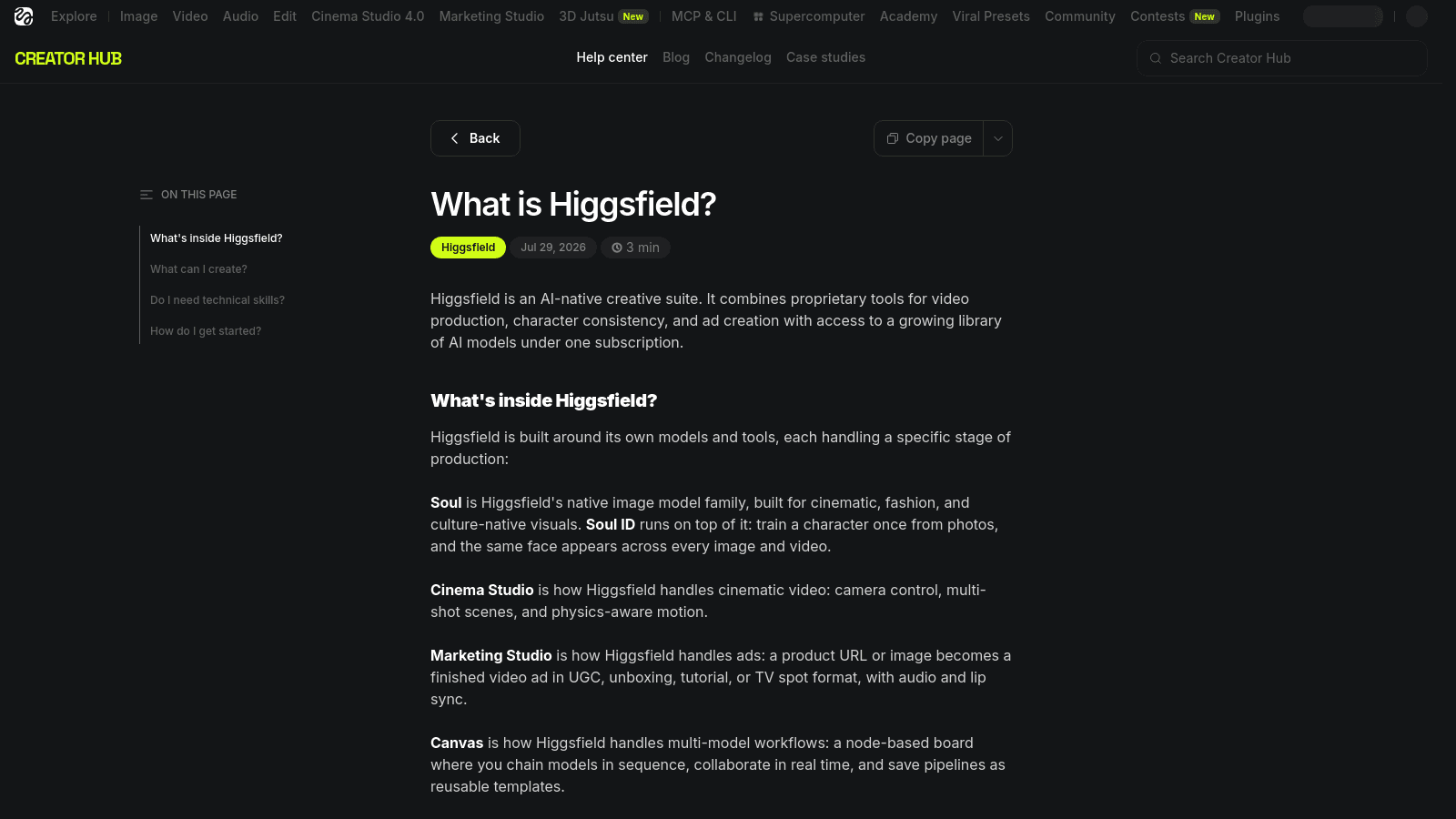
Think of it as a model marketplace with a film studio bolted on top, rather than a single video model. Two things "legit" does not cover come later: Trustpilot scores it 4.0 with a heavy 1-star tail on billing, and Forbes reported on 11 February 2026 on offensive influencer-kit videos, an X account suspension and creator-payment complaints, which the chief strategy officer attributed to an employee error. On data, the VerifyWise AI Trust Index graded Higgsfield A, 79 out of 100, on 13 August 2026, third of 211 apps, while penalising default training on user content; only Enterprise opts out. Higgsfield also publishes its own "is Higgsfield legit" page telling users to pay only on higgsfield.ai, which tells you lookalike sites exist.
How Higgsfield works: the product surface
A Higgsfield help article dated 1 August 2026 maps seven creative jobs to the appropriate tools.
Job | Tool |
|---|---|
Cinematic video with camera control | Cinema Studio |
Same face across clips | Cinema Studio + Soul ID |
Product ad from a URL or image, UGC-style ads at scale | Marketing Studio |
Persistent AI influencer | Character Studio |
Chain models and save pipelines | Canvas |
Whole project from one chat | Supercomputer |
Generate from Claude or coding agents | MCP and CLI |

Soul and Soul ID
Soul is Higgsfield's image family. Soul 2.0 combines presets and moodboards with the Soul HEX and Soul ID tools; Soul Cinema produces cinematic stills without the preset panel. Soul ID trains a persistent face from roughly 20 or more reference photos and reuses it across Kling 3.0, Veo 3.1 and Seedance 2.0, with WAN 2.6 on the list too.
Higgsfield claims one Soul 2.0 image at 2K costs 0.125 credits, and its short-film cost sketch puts Soul ID at about 25 credits per character. The one-time pool of free Soul V2 and Cinema generations does not renew: Plus currently lists 5,000 generations, while older cards listed 300 for Starter and 10,000 for Ultra.
Cinema Studio and Popcorn
Cinema Studio gives filmmakers camera and lighting controls, builds multi-shot scenes with reusable assets, and provides access to every model on the platform. Higgsfield says it built the tool with a former director of photography and around 200 people from the film industry.
The Cinema Studio 4.0 changelog entry of 12 August 2026 lists 30-second generations; the product page claims native 4K and generations up to one minute, and the one-minute figure stays marketing until it shows up in the product. The company's short-film pipeline post prices a shot at about 75 credits for 8 seconds at 720p or about 150 credits for 15 seconds at 1080p.
Use Popcorn to turn reference images into four-, six- or eight-frame storyboards before generating the shots in Cinema Studio. It takes up to 4 image references and outputs 4, 6 or 8 frames at about 5 credits per scene, in aspect ratios from 3:4 and 1:1 to 9:16. Popcorn locks continuity within a session; Soul ID carries identity across sessions.
Marketing Studio, Supercomputer and Canvas
Marketing Studio is the ad workspace, rebuilt in 2026 around 1,500+ templates in six categories, from Product Shots and Ads to UGC Videos and Motion. You feed it a product image, a product-page URL or a reference ad, and Product Shots includes 20 avatar templates. Higgsfield claimed 68,000 marketers used it in the first 30 days, a company figure.
It generates assets and stops there. The official tool map lists no Meta, TikTok or AppLovin publisher.
Supercomputer turns a brief into finished assets by selecting the models and planning the workflow. Higgsfield says version 2.0, released in June 2026, uses the NVIDIA Agent Toolkit and includes more than 20 production pipelines. Supercomputer shows the credit cost before rendering and also charges credits for its text-processing calls. Canvas chains models and saves the resulting pipelines.
MCP, CLI and the hosted model marketplace
Higgsfield has no public REST API. Agents reach it through the hosted MCP endpoint at mcp.higgsfield.ai/mcp and a CLI, which expose the same video models as the web app (Seedance 2.0, Kling 3.0 and Veo 3.1 among them), image models including GPT Image 2 and Nano Banana Pro, and Marketing Studio presets.
The pricing page publishes credit rates for the whole shelf, from Seedance, Kling and Wan through Veo, Hailuo and Grok Video on the video side to GPT Image, FLUX.2 and Nano Banana on the image side; the credit-burn table below carries the rates.
One rule decides your bill on every surface above. Unlimited and free generations never apply inside Marketing Studio, Shorts Studio or Canvas, and never through MCP, the CLI or Supercomputer; those surfaces always charge credits, per the company's X thread of 21 July 2026 and its "Introducing New Unlimited" post.
What "Unlimited" is: three paths, not one entitlement
Unlimited on Higgsfield is three different things.
The 7-day window bundled with Plus and Ultra at purchase. Starter does not start one.
Paid Unlimited Bundles in the marketplace. July 2026 list prices were $99 for 1 day and $250 for 3 days, with video capped at 15 seconds; single-model 1-day passes ran $73 for Seedance 2.0 at 720p, $35 for Kling 3.0 at 1080p and $5 for Nano Banana Pro.
"365 Unlimited" on a short list of mostly image models, valid only while the eligible subscription stays active. The 365 Unlimited entitlement ends with the current billing period after either cancellation or downgrade.
The pricing-page FAQ sets the terms for all three. Zero credits apply only on supported models, resolutions and quality tiers in your plan. Under load Higgsfield cuts speed and concurrency dynamically; unlimited jobs run in the standard queue while credit jobs run in the priority queue, and Credit Mode lets you buy priority with credits. Fair use means "personal, human use only," so Higgsfield prohibits automation and account sharing. Unusual activity can pause access for manual review. Step outside a resolution or duration ceiling and the job silently falls back to credits.
Higgsfield pricing in 2026
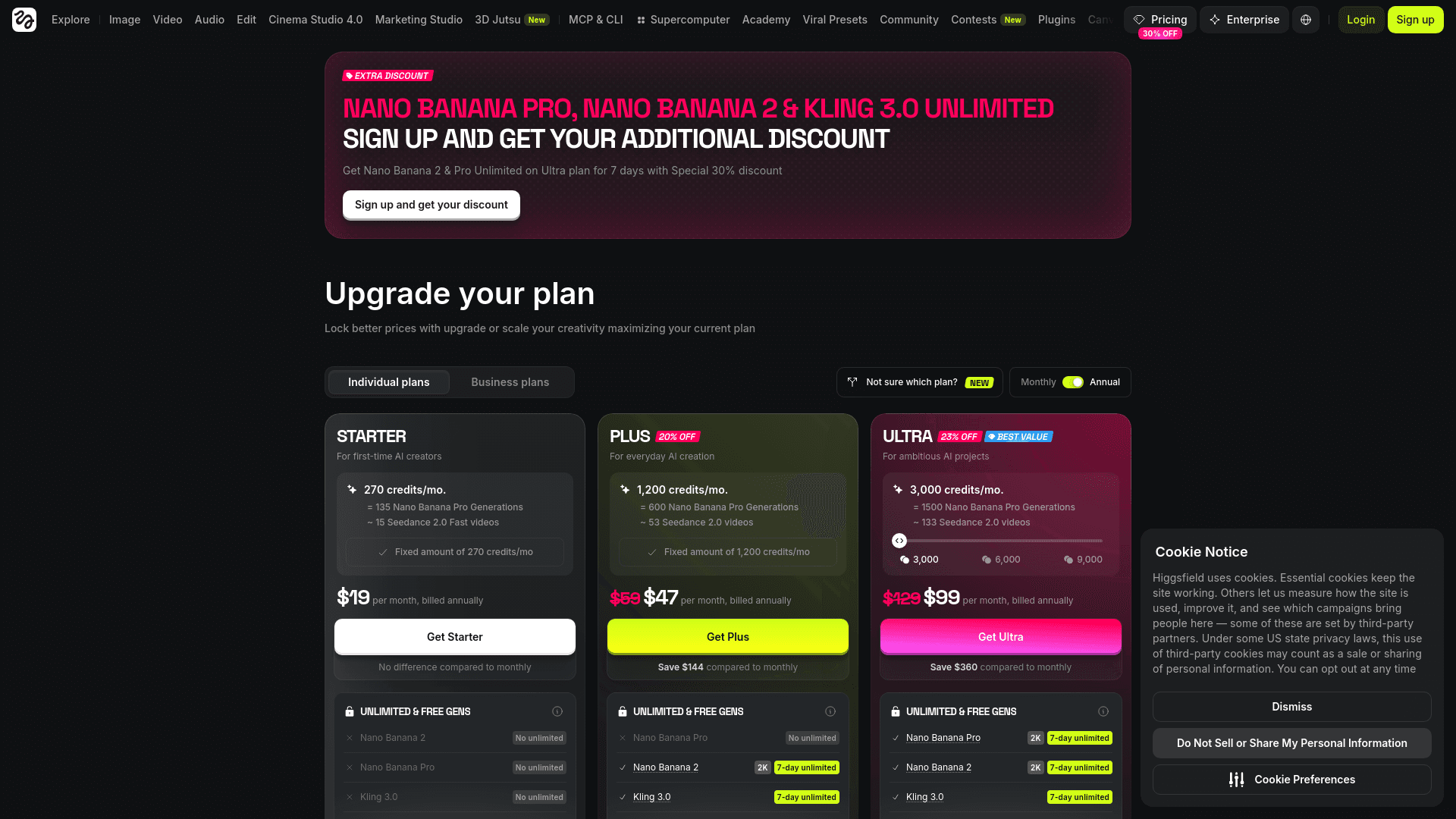
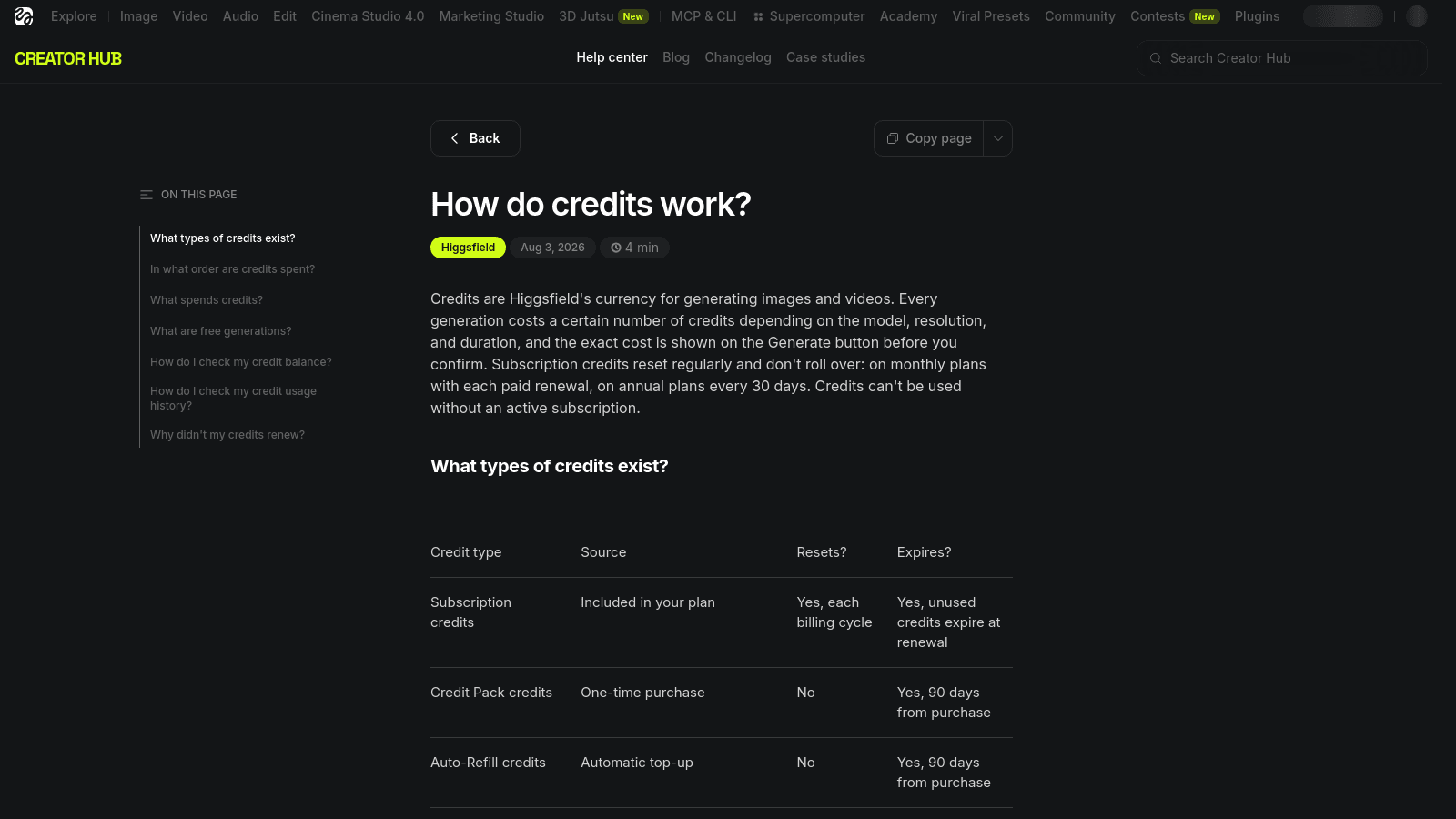
$47 a month is what Plus costs billed annually, $12 under its monthly price, and Starter gets no annual discount at all. The pricing page, captured 6 September 2026, advertises the toggle as "Annual 30% OFF"; prices exclude VAT.
Plan | Monthly | Annual per month | Credits per month | Parallel video and image jobs | Seedance access | 7-day unlimited window | Watermark |
|---|---|---|---|---|---|---|---|
Free | $0 | $0 | 0 on the compare row | 1 and 1 | No full Seedance 2.0 | No | Yes, every generation |
Starter | $19 | $19 ("No difference compared to monthly") | 270 | 2 and 4 | Fast and Mini only, no Seedance 2.0 or 2.5 | No | None on new generations |
Plus | $59 | $47 (save $144 a year) | 1,200 | 6 and 8 | Full line-up, incl. Seedance 2.5 1080p and Seedance 2.0 4K | Yes: Nano Banana 2 2K + Kling 3.0, "7 unlimited & free generation models" | None |
Ultra | $129 | $99 (save $360 a year) | 3,000 base; UI also offers 6,000 and 9,000 | 8 and 8 | Full line-up | Yes, adds Nano Banana Pro 2K | None |

The cards translate credits into output: Plus's 1,200 credits equal about 53 Seedance 2.0 videos, while Ultra's 3,000 equal about 133. The help docs also list Team, Scale and Enterprise tiers with pooled credits. Scale adds SSO and spend controls; Enterprise adds rollover and legal indemnification.
Credit packs sit at higgsfield.ai/credits:
80 credits for $5
170 credits for $10
380 credits for $20
840 credits for $40, marked "Best deal"
1,700 credits for $80
Packs require an active subscription, expire after 90 days and do not renew. They do not change plan gates.
The plan mechanics are one account, one subscription. An upgrade applies immediately with a prorated charge. A downgrade takes effect when the current period ends. Individual credits expire at the end of each allocation period, and annual plans issue a fresh allocation every 30 days.
The ladder has moved. PulseSignal (5 September 2026) records a Plus cut from $99 to $59 on 15 July 2026, and Creetr's July ladder of $15, $49 and $129, like the older $9 Basic plan, is retired.
Credit burn per model and per second
Exact button costs vary with duration, audio and mode, and with how many references you attach. The compare table supplied the clip costs on 6 September 2026; the per-second column divides each cost by the listed duration.
Model and setting | Credits per clip | Implied credits per second |
|---|---|---|
Seedance 2.0 720p | ~22 per 5s | ~4.4 |
Seedance 2.0 1080p | ~45 per 5s | ~9.0 |
Seedance 2.0 4K | ~110 per 5s | ~22.0 |
Seedance 2.0 Fast 720p | ~17 per 5s | ~3.4 |
Seedance 1.5 720p | ~3 per 5s | ~0.6 |
Kling 3.0 720p | ~7 per 5s (planner copy: ~14 for 8s) | ~1.4 |
Kling 3.0 1080p | ~8 per 5s | ~1.6 |
Kling 3.0 4K | ~30 per 5s | ~6.0 |
Kling 2.6 with sound | ~10 per 5s (without sound ~5) | ~2.0 |
Wan 2.6 720p | ~13 per 5s | ~2.6 |
Wan 3.0 720p | 8.75 per 5s (1080p 17.5) | 1.75 |
Wan 3.0 Prime 1080p | 30 per 5s | 6.0 |
Veo 3.1 Fast | ~11 per 4s | ~2.75 |
Veo 3.1 | ~29 per 4s | ~7.25 |
Veo 3 Fast 720p | ~22 per 8s | ~2.75 |
Veo 3 720p | ~58 per 8s | ~7.25 |
Hailuo 2.3 Fast 768p | ~4 per 6s | ~0.67 (cheapest video row) |
Hailuo 2.3 1080p | ~10 per 6s | ~1.67 |
Grok Video | ~7 per 5s | ~1.4 |
GPT Image, FLUX.2 Pro | 1 per image | n/a |
Nano Banana Pro | 2 per image | n/a |
At the Plus monthly rate of $0.0492 per credit, a 5-second Kling 3.0 clip at 720p costs about $0.34 and a 5-second Seedance 2.0 clip about $1.08; Veo 3.1 runs about $1.43 for 4 seconds and Veo 3 about $2.85 for 8. Ultra billed annually, at $0.033 per credit, is roughly a third cheaper per generation than Starter at $0.070.
The Veo gap produces the loudest cost complaint. Monica wrote on Trustpilot on 24 March 2026 that in her second month the cost "jumped from 22 credits to 58 credits" for nearly identical videos, with no warning and no explanation; support replied on the same thread that she had switched from Veo 3 Fast at 22 credits to full Veo 3 at 58.
Rates also move without a versioned changelog row. An r/HiggsfieldAI thread on Kling motion control (28 December 2025) records 10 credits for 720p one day and 14 the next, and the top comment concluded, "It's cheaper to use Kling in Kling itself." Higgsfield's blog estimates about $3 per Seedance 2.0 clip and $1 per Kling 3.0 clip. The live comparison table provides the current billing figures.
What the Higgsfield free plan really includes
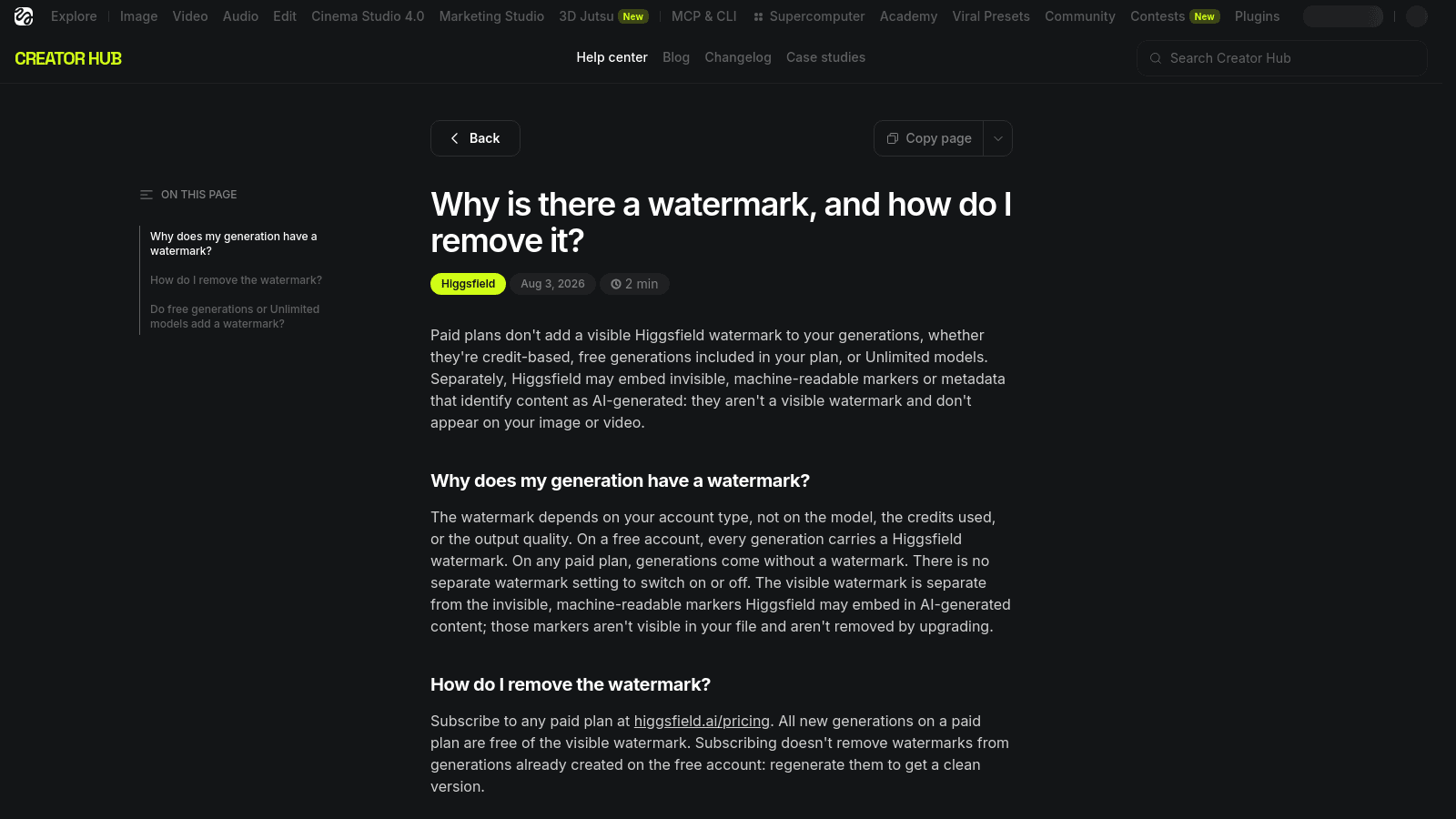
The Higgsfield free plan gives you limited model access with no full Seedance 2.0, 0 credits on the compare row (older copy sometimes said about 10 a day), one job at a time, and a visible watermark on every generation. The compare table marks commercial use as "Not included" for the free plan.
Paid plans have no visible watermark on new generations, including free-gen and unlimited output, per the help center. Watermarks remain baked into files created on the free plan after an upgrade. Higgsfield may also embed invisible C2PA-style provenance markers in output from any plan.
Commercial rights do not depend on the plan. Terms of Use §4.4 claims no ownership of your inputs or outputs and does not restrict commercial use; rights survive cancellation, and outputs are not exclusive. The help center says the Terms do not tie commercial rights to a paid plan. In practice the "Commercial use" row marks which plans produce watermark-free output. By default Higgsfield trains on inputs and outputs; Enterprise agreements carve that out, and deleting content stops future training use.
The 1-day All Unlimited trial ran as a promo in July 2026 rather than as a permanent plan: new free-plan users, one per person, card on file, $0 at activation, 24 hours at Plus-like resolution. It auto-renews into monthly Plus, which then adds 7 unlimited days, unless you cancel under Manage Account, Subscription, Cancel auto-renewal; cancelling does not cut the remaining hours, and Higgsfield says it sends a reminder before the trial ends.
An r/HiggsfieldAI poster described that promo on 22 July 2026: "turns out it wasn't free... They tried to flog me a 63% discount." A comment on the thread said the company spams one-day and one-week offers to lock users into a full year, and Techraisal (6 July 2026) scored the checkout 6.5 out of 10, "good product, exhausting salesperson," for its countdown discounts and annual-default checkout.
Output quality against Kling, Runway and Veo 3
The Kling 3.0, Veo 3.1 and Seedance 2.0 clips you generate on Higgsfield come from the same models scored on public arenas, so the arena scores are the quality evidence.
Artificial Analysis text-to-video-with-audio leaderboard, early September 2026, hosted-on-Higgsfield rows plus the leaders:
Model | Elo | 95% CI | Samples |
|---|---|---|---|
Alibaba Wan 3.0 (rank 1 to 3) | 1238 | ±10 | 5,578 |
Google Gemini Omni Flash (rank 1 to 3) | 1238 | ±6 | 18,107 |
Dreamina Seedance 2.0 720p (rank 5) | 1222 | ±5 | 24,822 |
Kling 3.0 1080p Pro (rank 10) | 1108 | ±5 | 22,486 |
Kling 3.0 720p Standard (rank 13) | 1100 | ±5 | 21,611 |
Google Veo 3.1 (rank 14 to 18) | 1091 | ±6 | 9,485 |
Veo 3.1 Fast (rank 14 to 18) | 1086 | ±5 | 20,306 |
Wan 3.0 sits at the top of the board and costs 8.75 credits per 5 seconds at 720p on Higgsfield, while Veo 3.1 ranks 14 to 18 and costs 29 credits per 4 seconds. The highest-ranked model on the shelf is also one of the cheapest to run there.
The April Artificial Analysis image-to-video table places Seedance 2.0 at the top. June practitioner tables report similar Elo scores of about 1,344 to 1,347. Runway's Gen-4.5 ranks near the top of some older text-to-video snapshots and often lacks API access, making hosting and workflow the useful comparison with Higgsfield.
Render quality gaps are user-reported rather than lab-measured. A Trustpilot 4-star review on 5 September 2026 notes occasional hallucinations in Seedance 2.5 renders, and an r/HiggsfieldAI commenter on 22 July 2026 wrote, "I barely even use my unlimited plan because the quality is much worse than the paid credit generations." Artificial Analysis generation-time charts cover provider APIs, so they cannot establish the speed of Higgsfield's queue.
Who Higgsfield is actually for
Filmmakers and motion designers are the first fit. They get camera language in Cinema Studio, Soul ID continuity, and a shelf of frontier video models under one login; the G2 reviews, weighted to professional users, and the Hack'celeration praise for camera-motion range are the evidence.
Teams that will sit inside Cinema Studio, Canvas or Supercomputer are the second. Higgsfield rewards a team that builds a pipeline and reuses it; a team that exports one talking-head ad and leaves is paying for a studio it never enters.
High-volume generators on Plus or Ultra are the third. They use the 7-day window for exploration, then switch on Credit Mode when the standard queue slows. A Trustpilot reviewer on an annual plan wrote around 28 August 2026: "I paid for a year long package allowing 3,000 credits every month, which has equated to about 10 sixty-second videos a month, every month for a discounted $600 total one time fee."
The honest Higgsfield win is volume. An r/AskMarketing poster ran the math on 1 September 2026 at a $500 a month budget: Higgsfield Scale yielded about 82 finished videos against about 29 on Creatify Pro, and the poster's takeaway was clip count rather than ad-platform fit.
Higgsfield's limitations: the complaint record
4,193 reviews on Trustpilot as of 6 September 2026 give Higgsfield a TrustScore of 4.0 out of 5, with 4,059 of them in the last 12 months. The company claimed the profile in July 2025 on a paid Trustpilot subscription and replies to 93% of negative reviews, typically within a week, possibly with AI assistance. The distribution says more than the average: ecom-tools.de's snapshot on 3 July 2026, at 4.1 from about 3,000 reviews, found around 64% top ratings and roughly 18% 1-star, and Tugan.ai records a spring 2026 low of 3.2.
The complaints fall into three clusters.
Unlimited plan was misleading. Nick wrote on Trustpilot on 23 January 2026 that he paid for "unlimited 4K generations," then got "2K with limitations through a 'battery system'" and "only auto-replies from AI support." An r/HiggsfieldAI cancellation thread from 15 October 2025 says Sora, Veo and Wan were unlimited "for a very short period of time." In "Beware of the unlimited trap" (25 December 2025), Hailuo showed unlimited on an Ultimate account but consumed credits; support acknowledged the bug and promised the credits back plus a 150-credit promo. In late August 2026 an r/seedance poster reported jobs sitting 40 or more hours after an unlimited promo while other accounts ran normally, and that Seedance Unlimited later left the pricing page. The early-September 1-star cluster reads "Never ever buy unlimited mode."
Throttling under unlimited. On 22 July 2026 an r/HiggsfieldAI poster wrote that after buying unlimited, generation went from "taking under a minute to as long as 5 hours sometime for one 10 second video generation." The official FAQ's standard-queue and dynamic-speed language is the mechanism behind that.
Billing and renewals. A Trustpilot 1-star from about 3 September 2026 accuses Higgsfield of "charging renewals days earlier than the date clearly listed on their profile," calling it "the 4th time this has happened." A review in the 6 September window reports a refund declined because the user "had used credits and generated images." On r/StableDiffusion (26 January 2026), a user who bought an annual plan by accident with 99% of credits unused was told, in their words, "sorry, refer to our Terms of Use, no refunds."
None of that makes Higgsfield a scam. It is a legitimate, heavily marketed credit marketplace with a documented refund wall.
Refund and cancellation terms
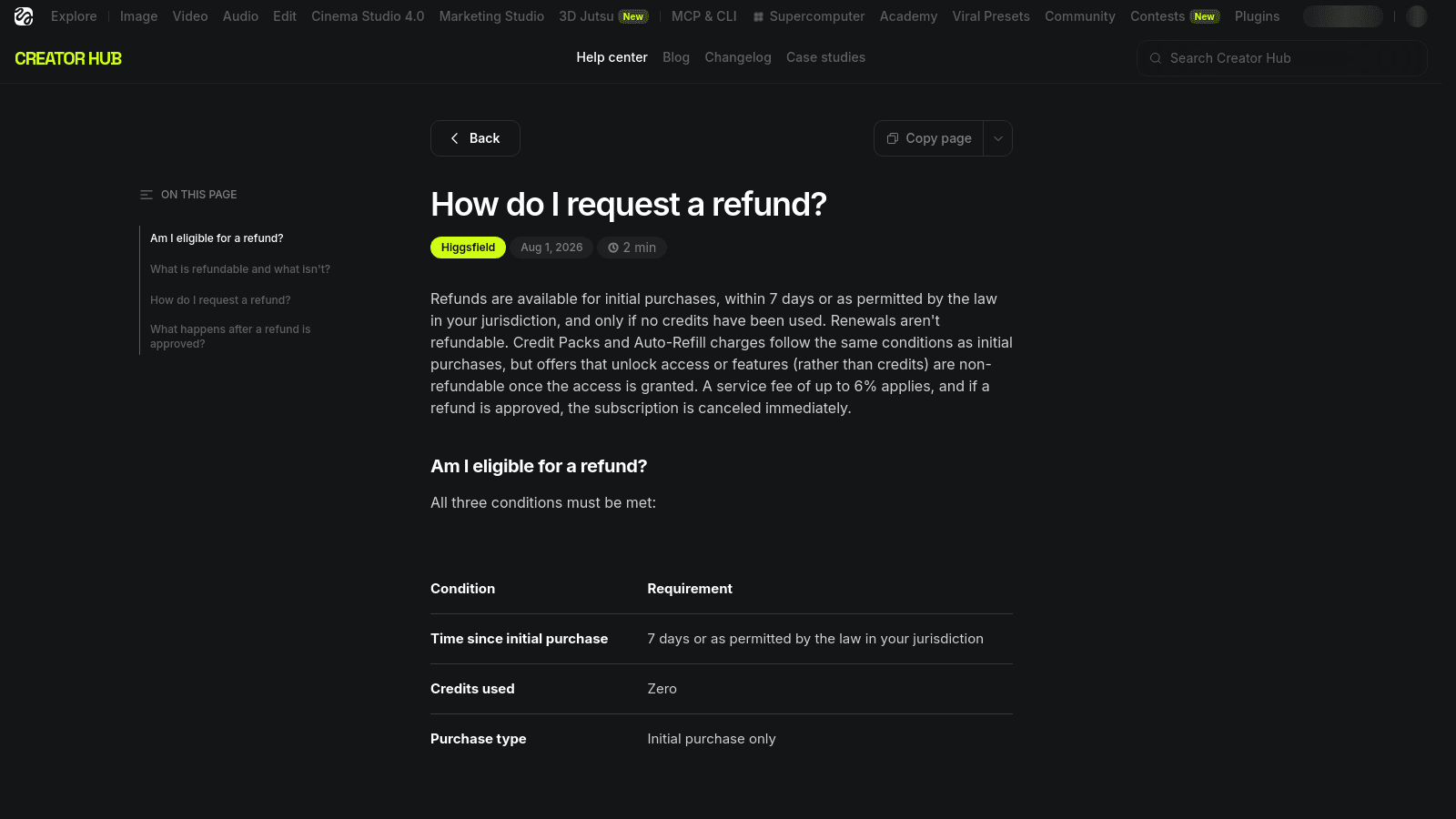
Email [email protected] from the affected account. Include the purchase date and amount, and explain why you want a refund. The "How to Request a Refund" help article sets the rules:
Initial purchases are refundable within 7 days only if zero credits from that purchase were used, with a service fee of up to 6%. Free-gen and Unlimited usage does not count as credit usage.
EEA and UK buyers get a 14-day withdrawal right that ends early once you spend credits or generate.
Renewals are not refundable.
Cancelling stops future charges and does not itself create a refund. A processed refund drops the account to the free tier immediately, and processing takes up to 3 business days.
If Higgsfield terminates an account through no fault of yours, it refunds unused subscription fees and unused purchased credits, promo credits excluded.
An accidental annual purchase with a single generation on it falls outside the policy by its own text.
Is Higgsfield worth it?
Higgsfield is worth it for buyers who need high-volume, multi-model generation with film-style controls. Higgsfield stops at asset generation, leaving performance-ad teams to launch campaigns through another platform.
Solo filmmaker or motion designer: yes. Plus at $47 a month billed annually, with the 7-day window for exploration and Kling 3.0 at about 7 credits per clip for volume.
High-volume studio or agency generation desk: yes. Ultra billed annually at $99 for 3,000 credits, $0.033 per credit, or the Scale tier for pooled credits and a priority queue.
Single-model buyer who only wants Kling or Veo: no. The native subscriptions can be cheaper, as the Kling motion-control thread concluded.
Anyone who budgeted a year of flagship video at zero marginal cost on "unlimited": no. Buy for the credits and treat unlimited as a 7-day bonus.
Privacy-sensitive brand that will not sign Enterprise: no, because the default terms train on your inputs and outputs.
Using one credit generally ends refund eligibility, making Higgsfield unsuitable for buyers who need flexibility. Test on the free plan or a $5 credit pack after subscribing, and cancel any trial before it converts.
Performance-ad team: not as the system of record.
Where Creatify fits for performance ad teams
The job is "URL in, tested Meta or TikTok ad out, launched from the same app." Higgsfield and Creatify split that job rather than compete for it.
Job | Higgsfield | Creatify | What the evidence supports |
|---|---|---|---|
Core job | Multi-model suite and filmmaking UI | AI ad generator: URL-to-video, avatars, launch | Different products: a studio versus an ads system |
URL-to-video | Marketing Studio takes a product URL or image into 1,500+ templates | Headline workflow: paste a product page, get an avatar-led ad | Both start from a URL; only Creatify positions it as the product |
Avatars | Soul ID trained from photos, plus 20 avatar templates | 300 stock actors on Free and Starter, 1,500 plus 3 custom on Pro | Creatify wins on stock UGC-actor library; Higgsfield wins on trained identity across cinematic models |
Ad-platform launch | Not listed as a Meta, TikTok or AppLovin publisher in the official tool map | Ad Launcher and Performance Agent (Meta, Google, TikTok, AppLovin) on Pro | Creatify leads on in-app launch and media buying |
Model shelf and raw clip quality | Hosts Seedance 2.0 (Elo 1222), Kling 3.0, Wan 3.0 (Elo 1238), Veo 3.1 | "100+ premium models" on Pro, no arena product Elo | Higgsfield leads on named frontier models with published scores |
Volume at about $99 to $129 | Ultra $129 for 3,000 credits | Pro $99 for 300 credits | Higgsfield produces more raw clips per dollar when the job is generation, not launch |
Commercial use and watermark | Paid plans clean, terms allow commercial use | Paid plans remove the watermark, Free is watermarked | Tie |
Billing complaints | Large Trustpilot book with a loud 1-star cluster | Not researched to the same depth | No claim either way |
Creatify's live pricing in the first week of September 2026 runs Free at 10 credits a month with a watermark, Starter at 100 credits with Ad Launcher for Meta, TikTok and AppLovin (widely reported at $39 a month), and Pro at $99 a month for 300 credits scalable to 5,000. The Pro plan includes 1,500 AI actors, three custom actors and 10-minute videos. It also includes the Competitor Ad Tracker, Creatify Agent and Performance Agent; annual billing advertises savings of up to 50%. Creatify's billing docs price URL to Video and AI Avatar at 5 credits per 30 seconds through the API, and Ad Clone at 12 credits per 5 seconds.
Creatify Agent researches the product, writes scripts and produces avatar-led ad variations. Performance Agent connects ad accounts and manages spend, launches and optimization. Higgsfield's Marketing Studio stops at the asset, and a team that generates hero footage in Cinema Studio and runs the ad loop in Creatify is a coherent stack. Vendor claims on both sides, Higgsfield's 68,000 marketers and Creatify's 18,000+ brands and $1B+ ad spend, are unaudited.
How to get started with Higgsfield
Open higgsfield.ai in the browser and pay only on that domain; Higgsfield's own legitimacy page says so because lookalike sites exist. Agents connect through MCP.
Pick the first step by budget. The free plan teaches you the interface with watermarked output; Starter at $19 covers Kling, Wan or Hailuo clips, with Seedance 2.0 gated to Plus; Plus is the floor if you need Seedance 2.0 or the 7-day window; and once subscribed, the $5 pack of 80 credits is the cheapest way to test a flagship model.
On day one, verify the model mode and generation surface: Fast and full cost 22 and 58 credits respectively, while only the web app honours unlimited. Marketing Studio, MCP and Supercomputer always use credits. If you start a trial, set your own reminder to cancel auto-renewal, because the trial converts into monthly Plus.
Over the same months Unlimited moved from a plan into a 7-day bonus and a marketplace add-on. Whether the next pricing page still prints the word "unlimited" on a plan card at all, or prices every model by the second, is the thing to re-check before you buy; the pricing page is the one document in this review with a 14-day shelf life.
FAQs
Is Higgsfield AI worth it in 2026 for video generation?
It can be worth it if you need multi-model video plus tools like Cinema Studio and Soul ID. If you only need one model or mostly want marketing exports for social platforms inside Marketing Studio, other tools may be cheaper because unlimited does not apply there and credits still burn.
What plans does Higgsfield offer, and how much do they cost?
Starter is $19 a month for 270 credits. Plus is $59 a month for 1,200 credits. Ultra is $129 a month billed annually for 3,000 credits.
Does Higgsfield have a free plan, and what are the limits?
Yes, there is a free plan, but it is watermarked and shows 0 credits in the compare table, so it is mainly for trying the workflow rather than producing full output.
What does “7 days unlimited” mean on Higgsfield?
Plus and Ultra include a 7-day unlimited window on the web app. It is throttled in a web queue, and it does not apply inside Marketing Studio, Supercomputer, Shorts Studio, Canvas, or via the MCP endpoint or CLI, where generations keep burning credits.
How do credits work, and where is the per-clip cost guidance?
You pay per credit based on your plan. Model choice heavily changes cost. For example, the article estimates a 5-second Seedance 2.0 clip is about 22 credits, while a Kling 3.0 clip is about 7 credits, and similar differences apply across the catalog.
Can I use Soul ID to keep the same face across clips?
Yes. Soul ID is designed to lock a face across clips and reuse that identity across models like Kling 3.0, Veo 3.1, and Seedance 2.0. It is a billed feature rather than a free recurring pool.
What is Higgsfield’s refund policy?
You must request a refund within seven days before using credits to preserve eligibility. If you already used credits, refunds may not be available under the documented rules.
Higgsfield is an AI creative suite for video and image generation, operated by Higgsfield, Inc. in San Francisco, that bundles its own tools with a hosted marketplace of third-party models under one subscription.
The Higgsfield marketplace hosts Seedance 2.0, Kling 3.0 and Veo 3.1 among others. Higgsfield also has Soul ID, which locks one face across clips, and Cinema Studio, which gives you camera control.
In this article, we examine Higgsfield's tools, costs and buyer protections so you can estimate your monthly clip volume and choose the right plan.
Prices, credit rates and plan terms below were checked on 6 September 2026 against Higgsfield's pricing page and its help center.
Key takeaways
Higgsfield's paid plans start at $19 a month for 270 credits; the Plus plan at $59 for 1,200 unlocks the full Seedance line-up.
A 5-second Seedance 2.0 clip at 720p costs about 22 credits and a Kling 3.0 clip about 7, so model choice moves your bill 3x.
Plus and Ultra give you seven days of web-only unlimited generation, with slower service under load.
Request a Higgsfield refund within seven days before using credits to preserve your eligibility.
Filmmakers and multi-model power users get the most from it; ad teams that need in-app Meta or TikTok launch do not.
What is Higgsfield AI, and is it legit?
Yes, Higgsfield is legitimate as a company. Alex Mashrabov founded San Francisco-based Higgsfield, Inc. in 2023 after leading generative AI at Snap; Mahi de Silva is chief strategy officer, and Stripe processes payments. Menlo Ventures led a seed round of about $8 million in April 2024, GFT Ventures a $50 million Series A in September 2025, and Accel an $80 million extension on 15 January 2026 at $1.3 billion. DST Global led the $400 million Series B on 17 August 2026, with Goldman Sachs Alternatives and Intel Capital among the participants, as reported by TechCrunch and the Financial Times.
Higgsfield reports $700 million in annualized revenue and 30 million users. It also says 390 Fortune 500 companies are customers. The Next Web says the Fortune 500 claim has not been independently audited. Business Insider reported in June 2026 that the company was cash-flow positive at the end of May and that commercial advertising made up about 70% of platform activity.
Think of it as a model marketplace with a film studio bolted on top, rather than a single video model. Two things "legit" does not cover come later: Trustpilot scores it 4.0 with a heavy 1-star tail on billing, and Forbes reported on 11 February 2026 on offensive influencer-kit videos, an X account suspension and creator-payment complaints, which the chief strategy officer attributed to an employee error. On data, the VerifyWise AI Trust Index graded Higgsfield A, 79 out of 100, on 13 August 2026, third of 211 apps, while penalising default training on user content; only Enterprise opts out. Higgsfield also publishes its own "is Higgsfield legit" page telling users to pay only on higgsfield.ai, which tells you lookalike sites exist.
How Higgsfield works: the product surface
A Higgsfield help article dated 1 August 2026 maps seven creative jobs to the appropriate tools.
Job | Tool |
|---|---|
Cinematic video with camera control | Cinema Studio |
Same face across clips | Cinema Studio + Soul ID |
Product ad from a URL or image, UGC-style ads at scale | Marketing Studio |
Persistent AI influencer | Character Studio |
Chain models and save pipelines | Canvas |
Whole project from one chat | Supercomputer |
Generate from Claude or coding agents | MCP and CLI |
Soul and Soul ID
Soul is Higgsfield's image family. Soul 2.0 combines presets and moodboards with the Soul HEX and Soul ID tools; Soul Cinema produces cinematic stills without the preset panel. Soul ID trains a persistent face from roughly 20 or more reference photos and reuses it across Kling 3.0, Veo 3.1 and Seedance 2.0, with WAN 2.6 on the list too.
Higgsfield claims one Soul 2.0 image at 2K costs 0.125 credits, and its short-film cost sketch puts Soul ID at about 25 credits per character. The one-time pool of free Soul V2 and Cinema generations does not renew: Plus currently lists 5,000 generations, while older cards listed 300 for Starter and 10,000 for Ultra.
Cinema Studio and Popcorn
Cinema Studio gives filmmakers camera and lighting controls, builds multi-shot scenes with reusable assets, and provides access to every model on the platform. Higgsfield says it built the tool with a former director of photography and around 200 people from the film industry.
The Cinema Studio 4.0 changelog entry of 12 August 2026 lists 30-second generations; the product page claims native 4K and generations up to one minute, and the one-minute figure stays marketing until it shows up in the product. The company's short-film pipeline post prices a shot at about 75 credits for 8 seconds at 720p or about 150 credits for 15 seconds at 1080p.
Use Popcorn to turn reference images into four-, six- or eight-frame storyboards before generating the shots in Cinema Studio. It takes up to 4 image references and outputs 4, 6 or 8 frames at about 5 credits per scene, in aspect ratios from 3:4 and 1:1 to 9:16. Popcorn locks continuity within a session; Soul ID carries identity across sessions.
Marketing Studio, Supercomputer and Canvas
Marketing Studio is the ad workspace, rebuilt in 2026 around 1,500+ templates in six categories, from Product Shots and Ads to UGC Videos and Motion. You feed it a product image, a product-page URL or a reference ad, and Product Shots includes 20 avatar templates. Higgsfield claimed 68,000 marketers used it in the first 30 days, a company figure.
It generates assets and stops there. The official tool map lists no Meta, TikTok or AppLovin publisher.
Supercomputer turns a brief into finished assets by selecting the models and planning the workflow. Higgsfield says version 2.0, released in June 2026, uses the NVIDIA Agent Toolkit and includes more than 20 production pipelines. Supercomputer shows the credit cost before rendering and also charges credits for its text-processing calls. Canvas chains models and saves the resulting pipelines.
MCP, CLI and the hosted model marketplace
Higgsfield has no public REST API. Agents reach it through the hosted MCP endpoint at mcp.higgsfield.ai/mcp and a CLI, which expose the same video models as the web app (Seedance 2.0, Kling 3.0 and Veo 3.1 among them), image models including GPT Image 2 and Nano Banana Pro, and Marketing Studio presets.
The pricing page publishes credit rates for the whole shelf, from Seedance, Kling and Wan through Veo, Hailuo and Grok Video on the video side to GPT Image, FLUX.2 and Nano Banana on the image side; the credit-burn table below carries the rates.
One rule decides your bill on every surface above. Unlimited and free generations never apply inside Marketing Studio, Shorts Studio or Canvas, and never through MCP, the CLI or Supercomputer; those surfaces always charge credits, per the company's X thread of 21 July 2026 and its "Introducing New Unlimited" post.
What "Unlimited" is: three paths, not one entitlement
Unlimited on Higgsfield is three different things.
The 7-day window bundled with Plus and Ultra at purchase. Starter does not start one.
Paid Unlimited Bundles in the marketplace. July 2026 list prices were $99 for 1 day and $250 for 3 days, with video capped at 15 seconds; single-model 1-day passes ran $73 for Seedance 2.0 at 720p, $35 for Kling 3.0 at 1080p and $5 for Nano Banana Pro.
"365 Unlimited" on a short list of mostly image models, valid only while the eligible subscription stays active. The 365 Unlimited entitlement ends with the current billing period after either cancellation or downgrade.
The pricing-page FAQ sets the terms for all three. Zero credits apply only on supported models, resolutions and quality tiers in your plan. Under load Higgsfield cuts speed and concurrency dynamically; unlimited jobs run in the standard queue while credit jobs run in the priority queue, and Credit Mode lets you buy priority with credits. Fair use means "personal, human use only," so Higgsfield prohibits automation and account sharing. Unusual activity can pause access for manual review. Step outside a resolution or duration ceiling and the job silently falls back to credits.
Higgsfield pricing in 2026
$47 a month is what Plus costs billed annually, $12 under its monthly price, and Starter gets no annual discount at all. The pricing page, captured 6 September 2026, advertises the toggle as "Annual 30% OFF"; prices exclude VAT.
Plan | Monthly | Annual per month | Credits per month | Parallel video and image jobs | Seedance access | 7-day unlimited window | Watermark |
|---|---|---|---|---|---|---|---|
Free | $0 | $0 | 0 on the compare row | 1 and 1 | No full Seedance 2.0 | No | Yes, every generation |
Starter | $19 | $19 ("No difference compared to monthly") | 270 | 2 and 4 | Fast and Mini only, no Seedance 2.0 or 2.5 | No | None on new generations |
Plus | $59 | $47 (save $144 a year) | 1,200 | 6 and 8 | Full line-up, incl. Seedance 2.5 1080p and Seedance 2.0 4K | Yes: Nano Banana 2 2K + Kling 3.0, "7 unlimited & free generation models" | None |
Ultra | $129 | $99 (save $360 a year) | 3,000 base; UI also offers 6,000 and 9,000 | 8 and 8 | Full line-up | Yes, adds Nano Banana Pro 2K | None |
The cards translate credits into output: Plus's 1,200 credits equal about 53 Seedance 2.0 videos, while Ultra's 3,000 equal about 133. The help docs also list Team, Scale and Enterprise tiers with pooled credits. Scale adds SSO and spend controls; Enterprise adds rollover and legal indemnification.
Credit packs sit at higgsfield.ai/credits:
80 credits for $5
170 credits for $10
380 credits for $20
840 credits for $40, marked "Best deal"
1,700 credits for $80
Packs require an active subscription, expire after 90 days and do not renew. They do not change plan gates.
The plan mechanics are one account, one subscription. An upgrade applies immediately with a prorated charge. A downgrade takes effect when the current period ends. Individual credits expire at the end of each allocation period, and annual plans issue a fresh allocation every 30 days.
The ladder has moved. PulseSignal (5 September 2026) records a Plus cut from $99 to $59 on 15 July 2026, and Creetr's July ladder of $15, $49 and $129, like the older $9 Basic plan, is retired.
Credit burn per model and per second
Exact button costs vary with duration, audio and mode, and with how many references you attach. The compare table supplied the clip costs on 6 September 2026; the per-second column divides each cost by the listed duration.
Model and setting | Credits per clip | Implied credits per second |
|---|---|---|
Seedance 2.0 720p | ~22 per 5s | ~4.4 |
Seedance 2.0 1080p | ~45 per 5s | ~9.0 |
Seedance 2.0 4K | ~110 per 5s | ~22.0 |
Seedance 2.0 Fast 720p | ~17 per 5s | ~3.4 |
Seedance 1.5 720p | ~3 per 5s | ~0.6 |
Kling 3.0 720p | ~7 per 5s (planner copy: ~14 for 8s) | ~1.4 |
Kling 3.0 1080p | ~8 per 5s | ~1.6 |
Kling 3.0 4K | ~30 per 5s | ~6.0 |
Kling 2.6 with sound | ~10 per 5s (without sound ~5) | ~2.0 |
Wan 2.6 720p | ~13 per 5s | ~2.6 |
Wan 3.0 720p | 8.75 per 5s (1080p 17.5) | 1.75 |
Wan 3.0 Prime 1080p | 30 per 5s | 6.0 |
Veo 3.1 Fast | ~11 per 4s | ~2.75 |
Veo 3.1 | ~29 per 4s | ~7.25 |
Veo 3 Fast 720p | ~22 per 8s | ~2.75 |
Veo 3 720p | ~58 per 8s | ~7.25 |
Hailuo 2.3 Fast 768p | ~4 per 6s | ~0.67 (cheapest video row) |
Hailuo 2.3 1080p | ~10 per 6s | ~1.67 |
Grok Video | ~7 per 5s | ~1.4 |
GPT Image, FLUX.2 Pro | 1 per image | n/a |
Nano Banana Pro | 2 per image | n/a |
At the Plus monthly rate of $0.0492 per credit, a 5-second Kling 3.0 clip at 720p costs about $0.34 and a 5-second Seedance 2.0 clip about $1.08; Veo 3.1 runs about $1.43 for 4 seconds and Veo 3 about $2.85 for 8. Ultra billed annually, at $0.033 per credit, is roughly a third cheaper per generation than Starter at $0.070.
The Veo gap produces the loudest cost complaint. Monica wrote on Trustpilot on 24 March 2026 that in her second month the cost "jumped from 22 credits to 58 credits" for nearly identical videos, with no warning and no explanation; support replied on the same thread that she had switched from Veo 3 Fast at 22 credits to full Veo 3 at 58.
Rates also move without a versioned changelog row. An r/HiggsfieldAI thread on Kling motion control (28 December 2025) records 10 credits for 720p one day and 14 the next, and the top comment concluded, "It's cheaper to use Kling in Kling itself." Higgsfield's blog estimates about $3 per Seedance 2.0 clip and $1 per Kling 3.0 clip. The live comparison table provides the current billing figures.
What the Higgsfield free plan really includes
The Higgsfield free plan gives you limited model access with no full Seedance 2.0, 0 credits on the compare row (older copy sometimes said about 10 a day), one job at a time, and a visible watermark on every generation. The compare table marks commercial use as "Not included" for the free plan.
Paid plans have no visible watermark on new generations, including free-gen and unlimited output, per the help center. Watermarks remain baked into files created on the free plan after an upgrade. Higgsfield may also embed invisible C2PA-style provenance markers in output from any plan.
Commercial rights do not depend on the plan. Terms of Use §4.4 claims no ownership of your inputs or outputs and does not restrict commercial use; rights survive cancellation, and outputs are not exclusive. The help center says the Terms do not tie commercial rights to a paid plan. In practice the "Commercial use" row marks which plans produce watermark-free output. By default Higgsfield trains on inputs and outputs; Enterprise agreements carve that out, and deleting content stops future training use.
The 1-day All Unlimited trial ran as a promo in July 2026 rather than as a permanent plan: new free-plan users, one per person, card on file, $0 at activation, 24 hours at Plus-like resolution. It auto-renews into monthly Plus, which then adds 7 unlimited days, unless you cancel under Manage Account, Subscription, Cancel auto-renewal; cancelling does not cut the remaining hours, and Higgsfield says it sends a reminder before the trial ends.
An r/HiggsfieldAI poster described that promo on 22 July 2026: "turns out it wasn't free... They tried to flog me a 63% discount." A comment on the thread said the company spams one-day and one-week offers to lock users into a full year, and Techraisal (6 July 2026) scored the checkout 6.5 out of 10, "good product, exhausting salesperson," for its countdown discounts and annual-default checkout.
Output quality against Kling, Runway and Veo 3
The Kling 3.0, Veo 3.1 and Seedance 2.0 clips you generate on Higgsfield come from the same models scored on public arenas, so the arena scores are the quality evidence.
Artificial Analysis text-to-video-with-audio leaderboard, early September 2026, hosted-on-Higgsfield rows plus the leaders:
Model | Elo | 95% CI | Samples |
|---|---|---|---|
Alibaba Wan 3.0 (rank 1 to 3) | 1238 | ±10 | 5,578 |
Google Gemini Omni Flash (rank 1 to 3) | 1238 | ±6 | 18,107 |
Dreamina Seedance 2.0 720p (rank 5) | 1222 | ±5 | 24,822 |
Kling 3.0 1080p Pro (rank 10) | 1108 | ±5 | 22,486 |
Kling 3.0 720p Standard (rank 13) | 1100 | ±5 | 21,611 |
Google Veo 3.1 (rank 14 to 18) | 1091 | ±6 | 9,485 |
Veo 3.1 Fast (rank 14 to 18) | 1086 | ±5 | 20,306 |
Wan 3.0 sits at the top of the board and costs 8.75 credits per 5 seconds at 720p on Higgsfield, while Veo 3.1 ranks 14 to 18 and costs 29 credits per 4 seconds. The highest-ranked model on the shelf is also one of the cheapest to run there.
The April Artificial Analysis image-to-video table places Seedance 2.0 at the top. June practitioner tables report similar Elo scores of about 1,344 to 1,347. Runway's Gen-4.5 ranks near the top of some older text-to-video snapshots and often lacks API access, making hosting and workflow the useful comparison with Higgsfield.
Render quality gaps are user-reported rather than lab-measured. A Trustpilot 4-star review on 5 September 2026 notes occasional hallucinations in Seedance 2.5 renders, and an r/HiggsfieldAI commenter on 22 July 2026 wrote, "I barely even use my unlimited plan because the quality is much worse than the paid credit generations." Artificial Analysis generation-time charts cover provider APIs, so they cannot establish the speed of Higgsfield's queue.
Who Higgsfield is actually for
Filmmakers and motion designers are the first fit. They get camera language in Cinema Studio, Soul ID continuity, and a shelf of frontier video models under one login; the G2 reviews, weighted to professional users, and the Hack'celeration praise for camera-motion range are the evidence.
Teams that will sit inside Cinema Studio, Canvas or Supercomputer are the second. Higgsfield rewards a team that builds a pipeline and reuses it; a team that exports one talking-head ad and leaves is paying for a studio it never enters.
High-volume generators on Plus or Ultra are the third. They use the 7-day window for exploration, then switch on Credit Mode when the standard queue slows. A Trustpilot reviewer on an annual plan wrote around 28 August 2026: "I paid for a year long package allowing 3,000 credits every month, which has equated to about 10 sixty-second videos a month, every month for a discounted $600 total one time fee."
The honest Higgsfield win is volume. An r/AskMarketing poster ran the math on 1 September 2026 at a $500 a month budget: Higgsfield Scale yielded about 82 finished videos against about 29 on Creatify Pro, and the poster's takeaway was clip count rather than ad-platform fit.
Higgsfield's limitations: the complaint record
4,193 reviews on Trustpilot as of 6 September 2026 give Higgsfield a TrustScore of 4.0 out of 5, with 4,059 of them in the last 12 months. The company claimed the profile in July 2025 on a paid Trustpilot subscription and replies to 93% of negative reviews, typically within a week, possibly with AI assistance. The distribution says more than the average: ecom-tools.de's snapshot on 3 July 2026, at 4.1 from about 3,000 reviews, found around 64% top ratings and roughly 18% 1-star, and Tugan.ai records a spring 2026 low of 3.2.
The complaints fall into three clusters.
Unlimited plan was misleading. Nick wrote on Trustpilot on 23 January 2026 that he paid for "unlimited 4K generations," then got "2K with limitations through a 'battery system'" and "only auto-replies from AI support." An r/HiggsfieldAI cancellation thread from 15 October 2025 says Sora, Veo and Wan were unlimited "for a very short period of time." In "Beware of the unlimited trap" (25 December 2025), Hailuo showed unlimited on an Ultimate account but consumed credits; support acknowledged the bug and promised the credits back plus a 150-credit promo. In late August 2026 an r/seedance poster reported jobs sitting 40 or more hours after an unlimited promo while other accounts ran normally, and that Seedance Unlimited later left the pricing page. The early-September 1-star cluster reads "Never ever buy unlimited mode."
Throttling under unlimited. On 22 July 2026 an r/HiggsfieldAI poster wrote that after buying unlimited, generation went from "taking under a minute to as long as 5 hours sometime for one 10 second video generation." The official FAQ's standard-queue and dynamic-speed language is the mechanism behind that.
Billing and renewals. A Trustpilot 1-star from about 3 September 2026 accuses Higgsfield of "charging renewals days earlier than the date clearly listed on their profile," calling it "the 4th time this has happened." A review in the 6 September window reports a refund declined because the user "had used credits and generated images." On r/StableDiffusion (26 January 2026), a user who bought an annual plan by accident with 99% of credits unused was told, in their words, "sorry, refer to our Terms of Use, no refunds."
None of that makes Higgsfield a scam. It is a legitimate, heavily marketed credit marketplace with a documented refund wall.
Refund and cancellation terms
Email [email protected] from the affected account. Include the purchase date and amount, and explain why you want a refund. The "How to Request a Refund" help article sets the rules:
Initial purchases are refundable within 7 days only if zero credits from that purchase were used, with a service fee of up to 6%. Free-gen and Unlimited usage does not count as credit usage.
EEA and UK buyers get a 14-day withdrawal right that ends early once you spend credits or generate.
Renewals are not refundable.
Cancelling stops future charges and does not itself create a refund. A processed refund drops the account to the free tier immediately, and processing takes up to 3 business days.
If Higgsfield terminates an account through no fault of yours, it refunds unused subscription fees and unused purchased credits, promo credits excluded.
An accidental annual purchase with a single generation on it falls outside the policy by its own text.
Is Higgsfield worth it?
Higgsfield is worth it for buyers who need high-volume, multi-model generation with film-style controls. Higgsfield stops at asset generation, leaving performance-ad teams to launch campaigns through another platform.
Solo filmmaker or motion designer: yes. Plus at $47 a month billed annually, with the 7-day window for exploration and Kling 3.0 at about 7 credits per clip for volume.
High-volume studio or agency generation desk: yes. Ultra billed annually at $99 for 3,000 credits, $0.033 per credit, or the Scale tier for pooled credits and a priority queue.
Single-model buyer who only wants Kling or Veo: no. The native subscriptions can be cheaper, as the Kling motion-control thread concluded.
Anyone who budgeted a year of flagship video at zero marginal cost on "unlimited": no. Buy for the credits and treat unlimited as a 7-day bonus.
Privacy-sensitive brand that will not sign Enterprise: no, because the default terms train on your inputs and outputs.
Using one credit generally ends refund eligibility, making Higgsfield unsuitable for buyers who need flexibility. Test on the free plan or a $5 credit pack after subscribing, and cancel any trial before it converts.
Performance-ad team: not as the system of record.
Where Creatify fits for performance ad teams
The job is "URL in, tested Meta or TikTok ad out, launched from the same app." Higgsfield and Creatify split that job rather than compete for it.
Job | Higgsfield | Creatify | What the evidence supports |
|---|---|---|---|
Core job | Multi-model suite and filmmaking UI | AI ad generator: URL-to-video, avatars, launch | Different products: a studio versus an ads system |
URL-to-video | Marketing Studio takes a product URL or image into 1,500+ templates | Headline workflow: paste a product page, get an avatar-led ad | Both start from a URL; only Creatify positions it as the product |
Avatars | Soul ID trained from photos, plus 20 avatar templates | 300 stock actors on Free and Starter, 1,500 plus 3 custom on Pro | Creatify wins on stock UGC-actor library; Higgsfield wins on trained identity across cinematic models |
Ad-platform launch | Not listed as a Meta, TikTok or AppLovin publisher in the official tool map | Ad Launcher and Performance Agent (Meta, Google, TikTok, AppLovin) on Pro | Creatify leads on in-app launch and media buying |
Model shelf and raw clip quality | Hosts Seedance 2.0 (Elo 1222), Kling 3.0, Wan 3.0 (Elo 1238), Veo 3.1 | "100+ premium models" on Pro, no arena product Elo | Higgsfield leads on named frontier models with published scores |
Volume at about $99 to $129 | Ultra $129 for 3,000 credits | Pro $99 for 300 credits | Higgsfield produces more raw clips per dollar when the job is generation, not launch |
Commercial use and watermark | Paid plans clean, terms allow commercial use | Paid plans remove the watermark, Free is watermarked | Tie |
Billing complaints | Large Trustpilot book with a loud 1-star cluster | Not researched to the same depth | No claim either way |
Creatify's live pricing in the first week of September 2026 runs Free at 10 credits a month with a watermark, Starter at 100 credits with Ad Launcher for Meta, TikTok and AppLovin (widely reported at $39 a month), and Pro at $99 a month for 300 credits scalable to 5,000. The Pro plan includes 1,500 AI actors, three custom actors and 10-minute videos. It also includes the Competitor Ad Tracker, Creatify Agent and Performance Agent; annual billing advertises savings of up to 50%. Creatify's billing docs price URL to Video and AI Avatar at 5 credits per 30 seconds through the API, and Ad Clone at 12 credits per 5 seconds.
Creatify Agent researches the product, writes scripts and produces avatar-led ad variations. Performance Agent connects ad accounts and manages spend, launches and optimization. Higgsfield's Marketing Studio stops at the asset, and a team that generates hero footage in Cinema Studio and runs the ad loop in Creatify is a coherent stack. Vendor claims on both sides, Higgsfield's 68,000 marketers and Creatify's 18,000+ brands and $1B+ ad spend, are unaudited.
How to get started with Higgsfield
Open higgsfield.ai in the browser and pay only on that domain; Higgsfield's own legitimacy page says so because lookalike sites exist. Agents connect through MCP.
Pick the first step by budget. The free plan teaches you the interface with watermarked output; Starter at $19 covers Kling, Wan or Hailuo clips, with Seedance 2.0 gated to Plus; Plus is the floor if you need Seedance 2.0 or the 7-day window; and once subscribed, the $5 pack of 80 credits is the cheapest way to test a flagship model.
On day one, verify the model mode and generation surface: Fast and full cost 22 and 58 credits respectively, while only the web app honours unlimited. Marketing Studio, MCP and Supercomputer always use credits. If you start a trial, set your own reminder to cancel auto-renewal, because the trial converts into monthly Plus.
Over the same months Unlimited moved from a plan into a 7-day bonus and a marketplace add-on. Whether the next pricing page still prints the word "unlimited" on a plan card at all, or prices every model by the second, is the thing to re-check before you buy; the pricing page is the one document in this review with a 14-day shelf life.
FAQs
Is Higgsfield AI worth it in 2026 for video generation?
It can be worth it if you need multi-model video plus tools like Cinema Studio and Soul ID. If you only need one model or mostly want marketing exports for social platforms inside Marketing Studio, other tools may be cheaper because unlimited does not apply there and credits still burn.
What plans does Higgsfield offer, and how much do they cost?
Starter is $19 a month for 270 credits. Plus is $59 a month for 1,200 credits. Ultra is $129 a month billed annually for 3,000 credits.
Does Higgsfield have a free plan, and what are the limits?
Yes, there is a free plan, but it is watermarked and shows 0 credits in the compare table, so it is mainly for trying the workflow rather than producing full output.
What does “7 days unlimited” mean on Higgsfield?
Plus and Ultra include a 7-day unlimited window on the web app. It is throttled in a web queue, and it does not apply inside Marketing Studio, Supercomputer, Shorts Studio, Canvas, or via the MCP endpoint or CLI, where generations keep burning credits.
How do credits work, and where is the per-clip cost guidance?
You pay per credit based on your plan. Model choice heavily changes cost. For example, the article estimates a 5-second Seedance 2.0 clip is about 22 credits, while a Kling 3.0 clip is about 7 credits, and similar differences apply across the catalog.
Can I use Soul ID to keep the same face across clips?
Yes. Soul ID is designed to lock a face across clips and reuse that identity across models like Kling 3.0, Veo 3.1, and Seedance 2.0. It is a billed feature rather than a free recurring pool.
What is Higgsfield’s refund policy?
You must request a refund within seven days before using credits to preserve eligibility. If you already used credits, refunds may not be available under the documented rules.