
Creatify チーム
シェア
この記事では
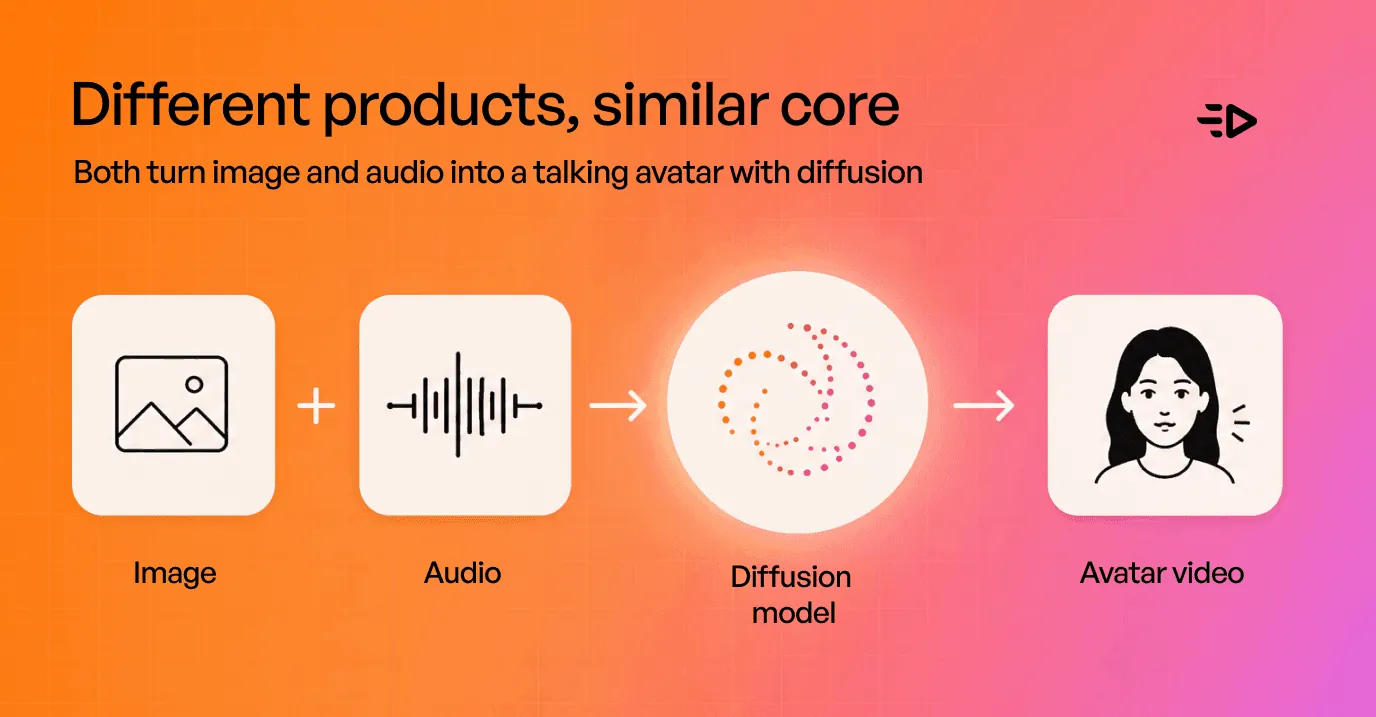
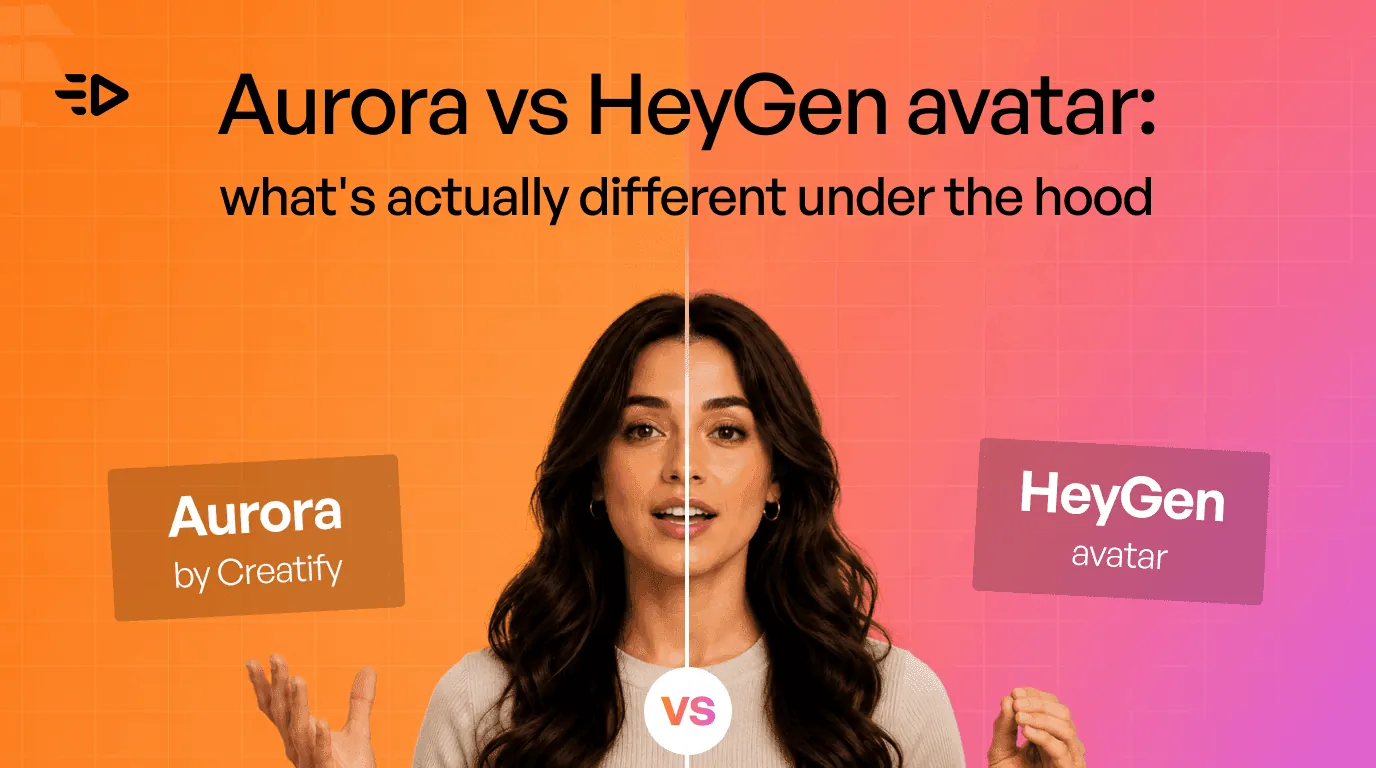
Creatify Aurora model and HeyGen's Avatar IV are both AI avatar systems that take an image and an audio track and produce a person who appears to speak. Read the model page on either site and you'd think they work on opposite principles. Look at how the video gets generated, and the surprise is how much of the core is shared. Both are diffusion models. Both are driven by audio. Both infer a full performance, including gestures the source image never showed, from limited visual evidence. This piece separates the parts that are genuinely different under the hood from the parts that are the same idea wearing different branding, and it's honest about where neither of us has said much at all.
One note before the technical detail: Aurora is our own model, so we're holding it to exactly the same scrutiny as HeyGen's.
Pricing at a glance
The two use different billing systems, so this is a reference rather than a like-for-like table. HeyGen sells monthly plans metered in credits; we price Aurora in credits inside our broader plans.
HeyGen | Aurora (our model) | |
|---|---|---|
Entry | Free: 3 videos/month, up to 1 minute, watermarked | Included in our plans; Aurora runs on the Pro tier and above |
Paid start | Creator $29/month (about $24 annual): 600 credits, 1080p, no watermark | Aurora costs 5 credits per 15 seconds of video |
Higher tiers | Pro from about $49/month (1,000 credits, 4K); Business $149/month plus $20 per seat (1,500 credits, 4K, SSO) | Our Pro tier and above; higher plans add concurrency and length |
Avatar render cost | Roughly 20 credits per minute for Avatar IV on the simplified Studio rate, or 16 (photo) to 31 (video) per minute on HeyGen's detailed per-look rates | 5 credits per 15 seconds |
Because a HeyGen credit and one of our credits are not the same unit and the plans bundle different things, don't read across the two credit numbers directly. Price your actual usage on each platform. Worth flagging: HeyGen's older "unlimited" plans have moved to this credit model, and its Pro tier now starts around $49 a month rather than the $99 some older write-ups list.
The shared foundation behind both AI avatar generators

Strip both down to the avatar model technology underneath and the same primitive is doing the work. Aurora is, in our own terms, a proprietary diffusion transformer that joins image, text, and audio encoders in a shared latent space and renders an avatar from them. HeyGen calls Avatar IV a "diffusion-inspired audio-to-expression engine," and its engineering material describes the Avatar IV and V family as a diffusion transformer trained with flow matching, with the IV research page citing a diffusion stack above 18 billion parameters. In both cases, audio is the driver: the model reads vocal tone, rhythm, and emphasis and turns them into lip movement, facial expression, and timing.
That's the honest headline. At the level of "what kind of model is this," Aurora and Avatar IV are close relatives, both audio-conditioned diffusion systems that generate talking-avatar video. The real differences live one level down, in what each is optimized to do and how each gets its motion, and that's where the rest of this goes.
It's also where the published detail runs out on both sides. HeyGen documents Avatar IV's behavior but not its full implementation, and it hasn't released an IV-specific model card with the exact training recipe. Our own materials describe what Aurora does more than the internals of how it's trained. So treat the specs on either side as vendor descriptions rather than independently reproduced benchmarks.
HeyGen avatar under the hood

HeyGen has published more about its inference pipeline than most avatar vendors, and it's worth walking through because it explains both the strengths and the rough edges. By HeyGen's own description, an Avatar IV generation runs in stages: a base diffusion transformer generates low-resolution video latents conditioned on the reference identity, the audio features, and other controls; an identity-aware super-resolution model then refines the face, mouth, and other high-sensitivity regions; and a streaming decoder publishes frames progressively, which is what lets HeyGen generate long clips and hit better-than-real-time 720p. Longer videos are stitched from chunks with interpolation at the boundaries so motion doesn't reset between segments.
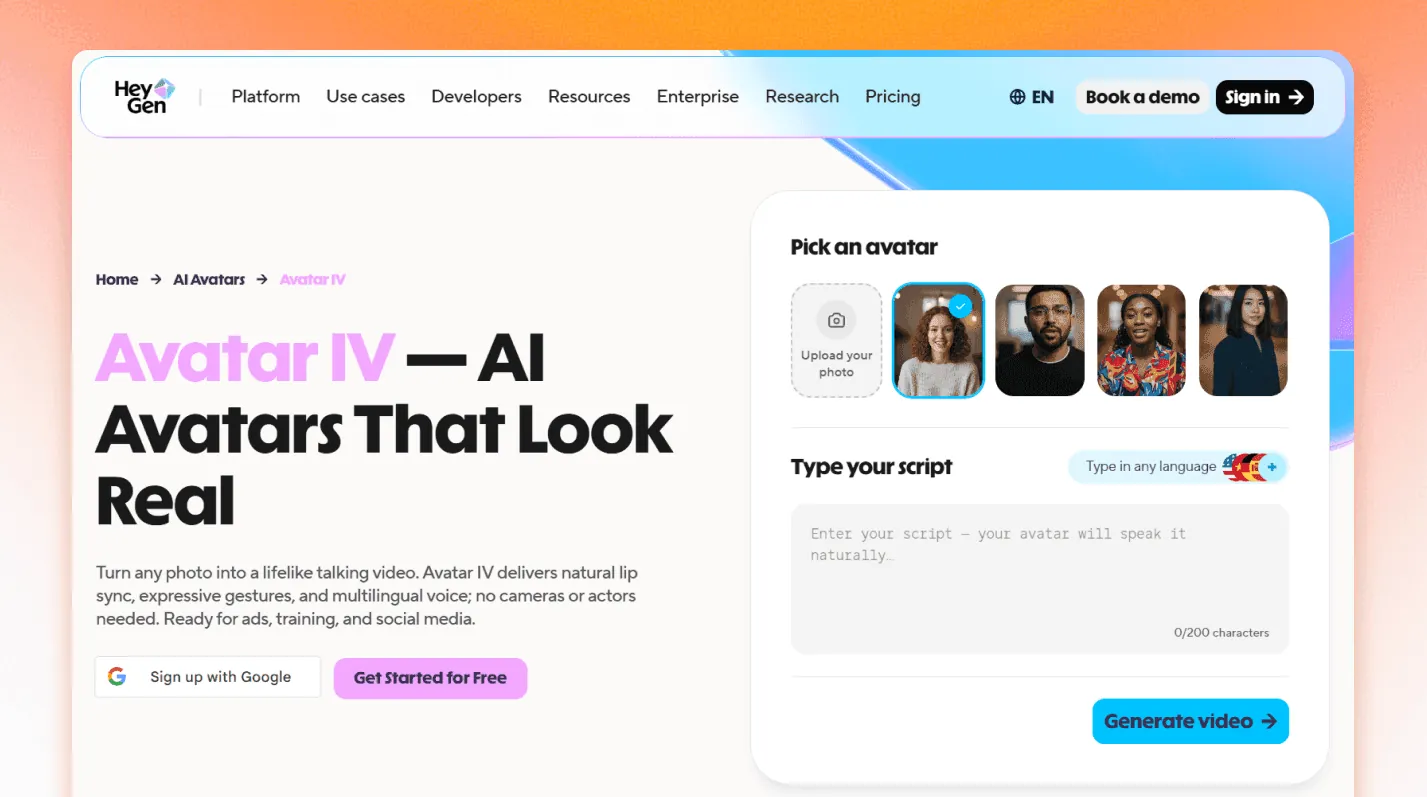
On the input side, Avatar IV animates from a single still image plus a script or audio file, producing lip sync, head movement, micro-expressions, and hand gestures, and it will generate several minutes of continuous video. Its most distinctive strength is subject range: HeyGen explicitly supports non-human inputs, so pets, cartoon characters, 3D renders, illustrations, and anime all animate through the same photo workflow. The catch is inherent to the approach. When a model has to invent hands, posture, and a moving body from one static photo, it sometimes produces temporal artifacts or leaves the background static, because it's hallucinating information the source never contained.
Avatar V is where HeyGen does something genuinely different, and it's easy to miss because the naming makes it sound like a small increment. Instead of inferring a performance from one image, Avatar V learns a real person's motion from a short reference video. HeyGen describes it as conditioning on the full token sequence of that reference, using a technique it calls Sparse Reference Attention to keep longer footage manageable, and modeling both static identity (skin, facial geometry, teeth, hair) and dynamic identity (speaking rhythm, habitual micro-expressions, gestural style). It pairs that with a separate audio engine for timbre and prosody and a multi-stage training curriculum. The practical distinction: Avatar IV guesses a plausible performance, while Avatar V reproduces a specific person's real one, which is why HeyGen points IV at stylized and non-human subjects and V at high-fidelity human digital twins.
Creatify Aurora under the hood

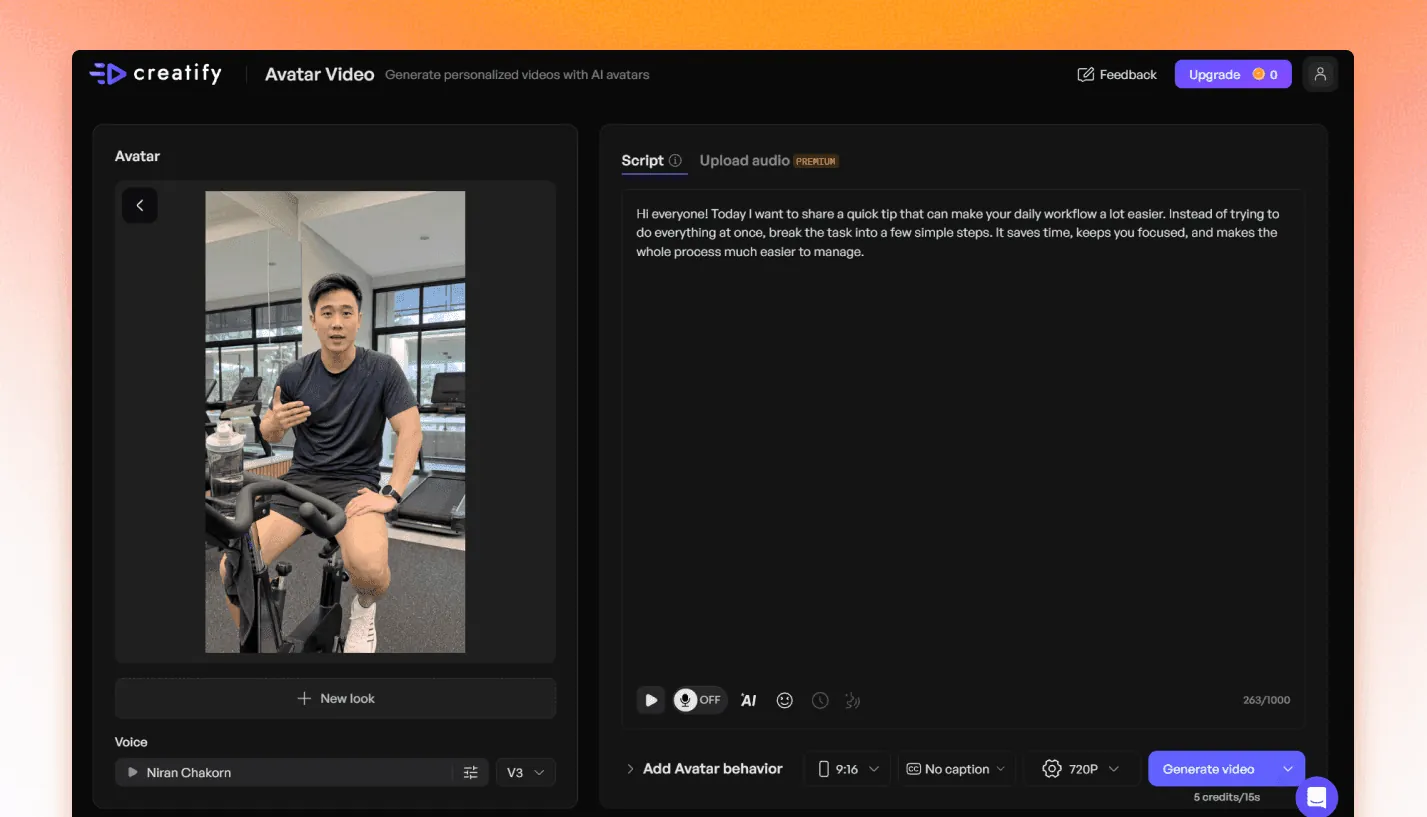
We built Aurora as a proprietary diffusion transformer, a multimodal foundation model with image, text, and audio encoders that exchange information in a shared latent space. Its capabilities are audio-driven emotion, 24-frames-per-second lip sync, eye movement, hand gestures, and upper- and full-body motion, plus long-form consistency across a clip. It reads emotional tags such as [laugh] and [excited] to steer delivery, supports 75-plus languages and 140-plus voices, ships more than 1,500 prebuilt avatars, and lets you bring your own from a photo or video or generate a character from a text description. It handles photorealistic humans as well as mascots, cartoons, and branded characters.

As with any vendor's spec sheet, HeyGen's included, these are stated capabilities rather than figures an outside party has independently reproduced. What we can be specific about is Creatify Aurora's orientation. We tuned it for advertising: avatars holding products, wearing branded clothing, and moving with the kind of physical presence that direct-response video tends to reward, generated inside a pipeline built to turn out many ad variants.
AI avatar comparison: what's genuinely different
Put the two side by side and the real distinctions are narrower and more specific than the marketing implies.
First, the thing that is not a difference. Both Aurora and HeyGen Avatar IV infer a performance from limited evidence, an image plus audio, and both have to synthesize plausible hands, posture, and eye behavior that the still image never provided. On that mechanism they're siblings, so "one is a diffusion transformer and the other is photo-to-video" is a false split; both are audio-driven diffusion video models.

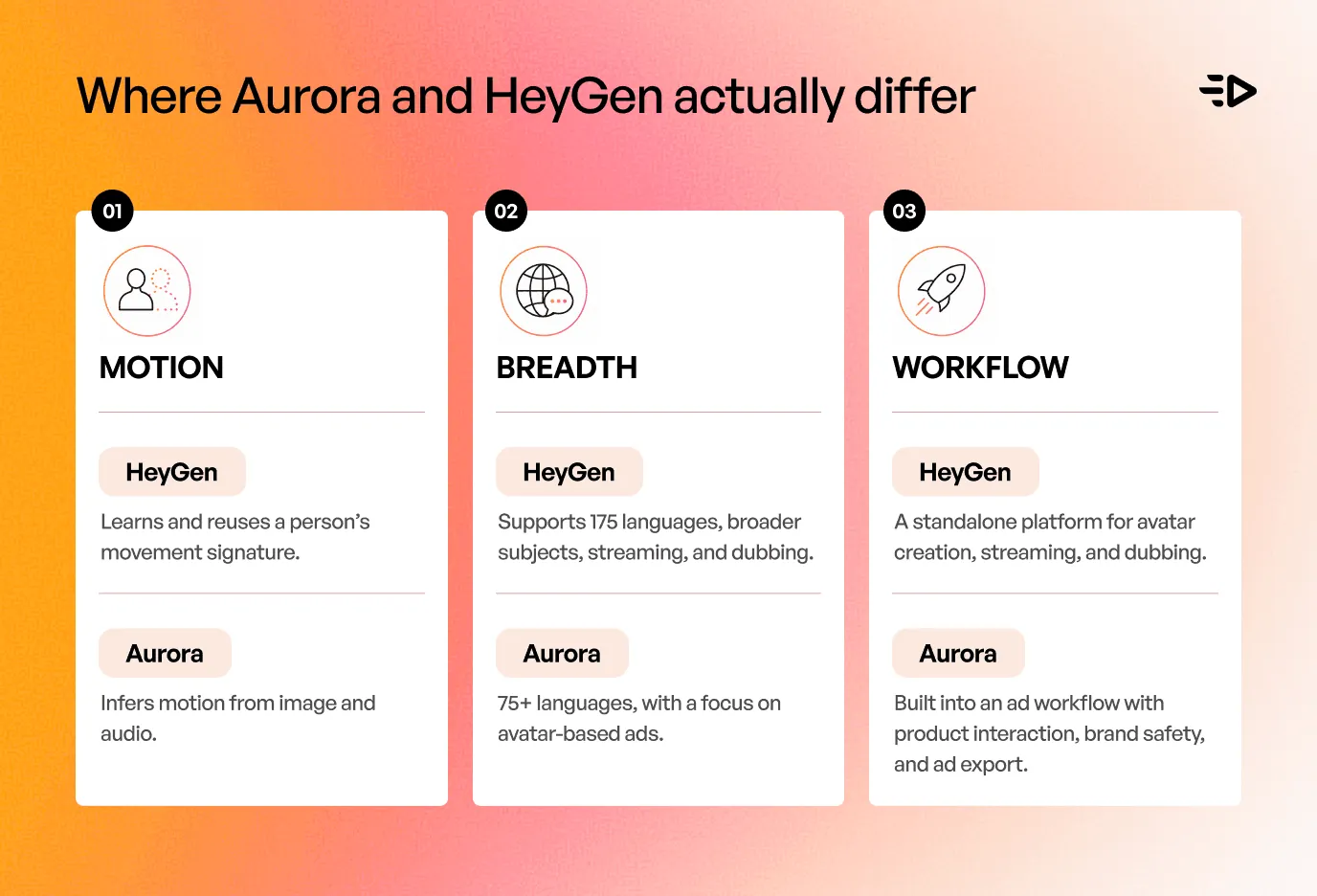
The clearest architectural fork is HeyGen Avatar V. Its motion-reference approach, learning and reusing a real individual's movement signature, is a different design goal from anything we publicly describe about Aurora, and it's what makes HeyGen strong for personal digital twins that need to move like the actual person.
The second real difference is breadth. HeyGen supports 175 languages on its paid tiers against our stated 75-plus, animates a much wider range of non-human subjects as a headline feature, and ships a mature standalone product with streaming and dubbing built around it. If your job is localized spokesperson video or animating a mascot from a drawing, that range matters, and we'll say plainly that HeyGen leads there today.
The third difference is where Aurora pulls ahead, and it's a system-level advantage rather than a deeper model. Aurora sits inside our ad-production workflow, with product interaction, branded wardrobe, a brand-safety review layer, and direct export to ad platforms. So if you're evaluating Aurora as a HeyGen alternative, that workflow is the reason to switch, not a claim about a better generative core. That's a product and data-prior edge for one specific job, making performance ad variants at volume, not evidence of a unique generative primitive under the hood. It's a fair advantage to claim, and a narrow one, and we'd rather be honest about the scope than oversell it.
Which AI avatar generator fits which job
For localized presenter videos, animating illustrations, pets, or anime, and building a high-fidelity digital twin that moves like a specific real person, HeyGen is the stronger and more mature choice, and Avatar V in particular has no direct equivalent in Aurora today. For producing large batches of ad creative with avatars that hold products and move with full-body presence, inside a workflow that carries the output through to ad platforms, Aurora is built for that lane. Neither is the better model in the abstract; they're optimized for different work, and both of us keep enough of the internals private that anyone claiming a definitive technical winner is guessing.
Read also: What is an AI avatar? Definition, types, and uses
Frequently Asked Questions
Are Aurora and HeyGen Avatar IV the same thing under the hood?
Not identical, but closer than the branding suggests. Both are audio-driven diffusion models that generate talking-avatar video by inferring a performance from an image plus audio. The meaningful differences are in optimization and, in HeyGen's case, in Avatar V's separate motion-reference approach, rather than in the basic type of model.
Which supports more languages?
HeyGen, on paper: it lists 175 languages on its paid plans, while we support 75-plus in Aurora. Free HeyGen plans are limited to around 30. Language count is a stated capability on each side, so verify the specific languages you need.
Which is better for non-human avatars like pets or anime?
HeyGen markets this as a headline strength, explicitly supporting pets, cartoons, 3D characters, illustrations, and anime through Avatar IV's single-photo workflow. Aurora handles mascots, cartoons, and branded characters too, but we'll be straight that HeyGen's non-human range is the more prominent, more documented capability.
What's the real difference between HeyGen Avatar IV and Avatar V?
Avatar IV infers a plausible performance from a single still image and audio, which is why it works on stylized and non-human subjects. Avatar V learns a real person's actual motion and mannerisms from a short reference video and reuses them, which is why HeyGen recommends it for high-fidelity human digital twins. They're different tools, not just versions.
How does pricing compare?
They use different systems, so compare your real usage rather than the headline credit numbers. HeyGen runs on monthly credit plans, from a free tier up through Creator at $29 a month, Pro from about $49, and Business at $149 plus per-seat, with Avatar IV costing roughly 16 to 31 credits a minute depending on the mode. Aurora is priced at 5 credits per 15 seconds inside our plans and runs on the Pro tier and above. Since the credit units differ, the only reliable comparison is running your own typical job on each.
Creatify Aurora model and HeyGen's Avatar IV are both AI avatar systems that take an image and an audio track and produce a person who appears to speak. Read the model page on either site and you'd think they work on opposite principles. Look at how the video gets generated, and the surprise is how much of the core is shared. Both are diffusion models. Both are driven by audio. Both infer a full performance, including gestures the source image never showed, from limited visual evidence. This piece separates the parts that are genuinely different under the hood from the parts that are the same idea wearing different branding, and it's honest about where neither of us has said much at all.
One note before the technical detail: Aurora is our own model, so we're holding it to exactly the same scrutiny as HeyGen's.
Pricing at a glance
The two use different billing systems, so this is a reference rather than a like-for-like table. HeyGen sells monthly plans metered in credits; we price Aurora in credits inside our broader plans.
HeyGen | Aurora (our model) | |
|---|---|---|
Entry | Free: 3 videos/month, up to 1 minute, watermarked | Included in our plans; Aurora runs on the Pro tier and above |
Paid start | Creator $29/month (about $24 annual): 600 credits, 1080p, no watermark | Aurora costs 5 credits per 15 seconds of video |
Higher tiers | Pro from about $49/month (1,000 credits, 4K); Business $149/month plus $20 per seat (1,500 credits, 4K, SSO) | Our Pro tier and above; higher plans add concurrency and length |
Avatar render cost | Roughly 20 credits per minute for Avatar IV on the simplified Studio rate, or 16 (photo) to 31 (video) per minute on HeyGen's detailed per-look rates | 5 credits per 15 seconds |
Because a HeyGen credit and one of our credits are not the same unit and the plans bundle different things, don't read across the two credit numbers directly. Price your actual usage on each platform. Worth flagging: HeyGen's older "unlimited" plans have moved to this credit model, and its Pro tier now starts around $49 a month rather than the $99 some older write-ups list.
The shared foundation behind both AI avatar generators

Strip both down to the avatar model technology underneath and the same primitive is doing the work. Aurora is, in our own terms, a proprietary diffusion transformer that joins image, text, and audio encoders in a shared latent space and renders an avatar from them. HeyGen calls Avatar IV a "diffusion-inspired audio-to-expression engine," and its engineering material describes the Avatar IV and V family as a diffusion transformer trained with flow matching, with the IV research page citing a diffusion stack above 18 billion parameters. In both cases, audio is the driver: the model reads vocal tone, rhythm, and emphasis and turns them into lip movement, facial expression, and timing.
That's the honest headline. At the level of "what kind of model is this," Aurora and Avatar IV are close relatives, both audio-conditioned diffusion systems that generate talking-avatar video. The real differences live one level down, in what each is optimized to do and how each gets its motion, and that's where the rest of this goes.
It's also where the published detail runs out on both sides. HeyGen documents Avatar IV's behavior but not its full implementation, and it hasn't released an IV-specific model card with the exact training recipe. Our own materials describe what Aurora does more than the internals of how it's trained. So treat the specs on either side as vendor descriptions rather than independently reproduced benchmarks.
HeyGen avatar under the hood

HeyGen has published more about its inference pipeline than most avatar vendors, and it's worth walking through because it explains both the strengths and the rough edges. By HeyGen's own description, an Avatar IV generation runs in stages: a base diffusion transformer generates low-resolution video latents conditioned on the reference identity, the audio features, and other controls; an identity-aware super-resolution model then refines the face, mouth, and other high-sensitivity regions; and a streaming decoder publishes frames progressively, which is what lets HeyGen generate long clips and hit better-than-real-time 720p. Longer videos are stitched from chunks with interpolation at the boundaries so motion doesn't reset between segments.
On the input side, Avatar IV animates from a single still image plus a script or audio file, producing lip sync, head movement, micro-expressions, and hand gestures, and it will generate several minutes of continuous video. Its most distinctive strength is subject range: HeyGen explicitly supports non-human inputs, so pets, cartoon characters, 3D renders, illustrations, and anime all animate through the same photo workflow. The catch is inherent to the approach. When a model has to invent hands, posture, and a moving body from one static photo, it sometimes produces temporal artifacts or leaves the background static, because it's hallucinating information the source never contained.
Avatar V is where HeyGen does something genuinely different, and it's easy to miss because the naming makes it sound like a small increment. Instead of inferring a performance from one image, Avatar V learns a real person's motion from a short reference video. HeyGen describes it as conditioning on the full token sequence of that reference, using a technique it calls Sparse Reference Attention to keep longer footage manageable, and modeling both static identity (skin, facial geometry, teeth, hair) and dynamic identity (speaking rhythm, habitual micro-expressions, gestural style). It pairs that with a separate audio engine for timbre and prosody and a multi-stage training curriculum. The practical distinction: Avatar IV guesses a plausible performance, while Avatar V reproduces a specific person's real one, which is why HeyGen points IV at stylized and non-human subjects and V at high-fidelity human digital twins.
Creatify Aurora under the hood

We built Aurora as a proprietary diffusion transformer, a multimodal foundation model with image, text, and audio encoders that exchange information in a shared latent space. Its capabilities are audio-driven emotion, 24-frames-per-second lip sync, eye movement, hand gestures, and upper- and full-body motion, plus long-form consistency across a clip. It reads emotional tags such as [laugh] and [excited] to steer delivery, supports 75-plus languages and 140-plus voices, ships more than 1,500 prebuilt avatars, and lets you bring your own from a photo or video or generate a character from a text description. It handles photorealistic humans as well as mascots, cartoons, and branded characters.

As with any vendor's spec sheet, HeyGen's included, these are stated capabilities rather than figures an outside party has independently reproduced. What we can be specific about is Creatify Aurora's orientation. We tuned it for advertising: avatars holding products, wearing branded clothing, and moving with the kind of physical presence that direct-response video tends to reward, generated inside a pipeline built to turn out many ad variants.
AI avatar comparison: what's genuinely different
Put the two side by side and the real distinctions are narrower and more specific than the marketing implies.
First, the thing that is not a difference. Both Aurora and HeyGen Avatar IV infer a performance from limited evidence, an image plus audio, and both have to synthesize plausible hands, posture, and eye behavior that the still image never provided. On that mechanism they're siblings, so "one is a diffusion transformer and the other is photo-to-video" is a false split; both are audio-driven diffusion video models.

The clearest architectural fork is HeyGen Avatar V. Its motion-reference approach, learning and reusing a real individual's movement signature, is a different design goal from anything we publicly describe about Aurora, and it's what makes HeyGen strong for personal digital twins that need to move like the actual person.
The second real difference is breadth. HeyGen supports 175 languages on its paid tiers against our stated 75-plus, animates a much wider range of non-human subjects as a headline feature, and ships a mature standalone product with streaming and dubbing built around it. If your job is localized spokesperson video or animating a mascot from a drawing, that range matters, and we'll say plainly that HeyGen leads there today.
The third difference is where Aurora pulls ahead, and it's a system-level advantage rather than a deeper model. Aurora sits inside our ad-production workflow, with product interaction, branded wardrobe, a brand-safety review layer, and direct export to ad platforms. So if you're evaluating Aurora as a HeyGen alternative, that workflow is the reason to switch, not a claim about a better generative core. That's a product and data-prior edge for one specific job, making performance ad variants at volume, not evidence of a unique generative primitive under the hood. It's a fair advantage to claim, and a narrow one, and we'd rather be honest about the scope than oversell it.
Which AI avatar generator fits which job
For localized presenter videos, animating illustrations, pets, or anime, and building a high-fidelity digital twin that moves like a specific real person, HeyGen is the stronger and more mature choice, and Avatar V in particular has no direct equivalent in Aurora today. For producing large batches of ad creative with avatars that hold products and move with full-body presence, inside a workflow that carries the output through to ad platforms, Aurora is built for that lane. Neither is the better model in the abstract; they're optimized for different work, and both of us keep enough of the internals private that anyone claiming a definitive technical winner is guessing.
Read also: What is an AI avatar? Definition, types, and uses
Frequently Asked Questions
Are Aurora and HeyGen Avatar IV the same thing under the hood?
Not identical, but closer than the branding suggests. Both are audio-driven diffusion models that generate talking-avatar video by inferring a performance from an image plus audio. The meaningful differences are in optimization and, in HeyGen's case, in Avatar V's separate motion-reference approach, rather than in the basic type of model.
Which supports more languages?
HeyGen, on paper: it lists 175 languages on its paid plans, while we support 75-plus in Aurora. Free HeyGen plans are limited to around 30. Language count is a stated capability on each side, so verify the specific languages you need.
Which is better for non-human avatars like pets or anime?
HeyGen markets this as a headline strength, explicitly supporting pets, cartoons, 3D characters, illustrations, and anime through Avatar IV's single-photo workflow. Aurora handles mascots, cartoons, and branded characters too, but we'll be straight that HeyGen's non-human range is the more prominent, more documented capability.
What's the real difference between HeyGen Avatar IV and Avatar V?
Avatar IV infers a plausible performance from a single still image and audio, which is why it works on stylized and non-human subjects. Avatar V learns a real person's actual motion and mannerisms from a short reference video and reuses them, which is why HeyGen recommends it for high-fidelity human digital twins. They're different tools, not just versions.
How does pricing compare?
They use different systems, so compare your real usage rather than the headline credit numbers. HeyGen runs on monthly credit plans, from a free tier up through Creator at $29 a month, Pro from about $49, and Business at $149 plus per-seat, with Avatar IV costing roughly 16 to 31 credits a minute depending on the mode. Aurora is priced at 5 credits per 15 seconds inside our plans and runs on the Pro tier and above. Since the credit units differ, the only reliable comparison is running your own typical job on each.