Creatify Team
SHARE


IN THIS ARTICLE
Creating YouTube ads that actually convert isn't about having the biggest production budget. You need to understand how attention works on the platform and structure your video advertising to match how people watch.
YouTube ads differ from traditional television commercials and other social media advertising in three critical ways:
Viewers can skip most ads after 5 seconds, requiring faster hooks
Viewers arrive with search intent rather than passive scrolling, creating higher purchase intent, and
Multiple ad format options (in-stream, in-feed, Shorts) require format-specific creative strategies.
This guide breaks down how to create ads for every YouTube ad format: in-stream (skippable and non-skippable), in-feed discovery ads, YouTube Shorts ads, and native creator integrations. You'll learn what actually drives conversions, backed by platform research and advertiser data.
How does attention work on YouTube?
YouTube ads operate in a unique attention environment compared to other digital advertising platforms. People come to YouTube with intent - they're searching for something specific or choosing videos deliberately. This means you have slightly more patience than TikTok, but you still need to earn every second.
The first 3-5 seconds determine everything. Multiple studies show that if viewers stay past this window, they're significantly more likely to watch through and take action.
According to Google's Gemini analysis of over 13,000 successful YouTube ads in 2024, 44% of top-performing YouTube ads differed from traditional ad lengths (15, 30, and 60 seconds), and 52% of Shorts and in-stream ads from this year were over 15 seconds long.
Viewer mindset also varies by format. Long-form viewers are more open to narrative and explanation. They came to watch a 20-minute video, so a 60-second story arc doesn't feel like an interruption if it's relevant.
Shorts viewers scroll like TikTok. They're pattern-matching for entertainment or quick value, with ultra-short attention spans. You need to break the pattern visually and verbally in the first 1-2 seconds or they're gone.
YouTube Ad Type | Length | Placement | Primary Goal | Creative Best Practices |
|---|---|---|---|---|
Skippable In Stream | 15 to 60 seconds | Before or during videos | Conversions and direct response | Strong 3 to 5 second hook, early branding, clear problem solution flow |
Non Skippable In Stream | 6 to 15 seconds | Before or during videos | Brand awareness | One clear message, fast pacing, simple CTA |
YouTube Shorts Ads | 15 to 30 seconds | Shorts feed | Engagement and creative testing | UGC style, bold visuals, 1 to 2 second hooks |
In Feed Discovery | 60 to 120 seconds | Search results, home feed, watch next | Qualified traffic and education | Strong thumbnail, curiosity driven title, softer selling |
Bumper Ads | 6 seconds | Before videos | Reach and recall | Single idea, high frequency, strong brand cue |
Native Creator Integrations | 30 to 90 seconds | Inside creator videos | Trust and consideration | Match creator tone, story based mention, soft CTA |
The ABCD framework for YouTube creative
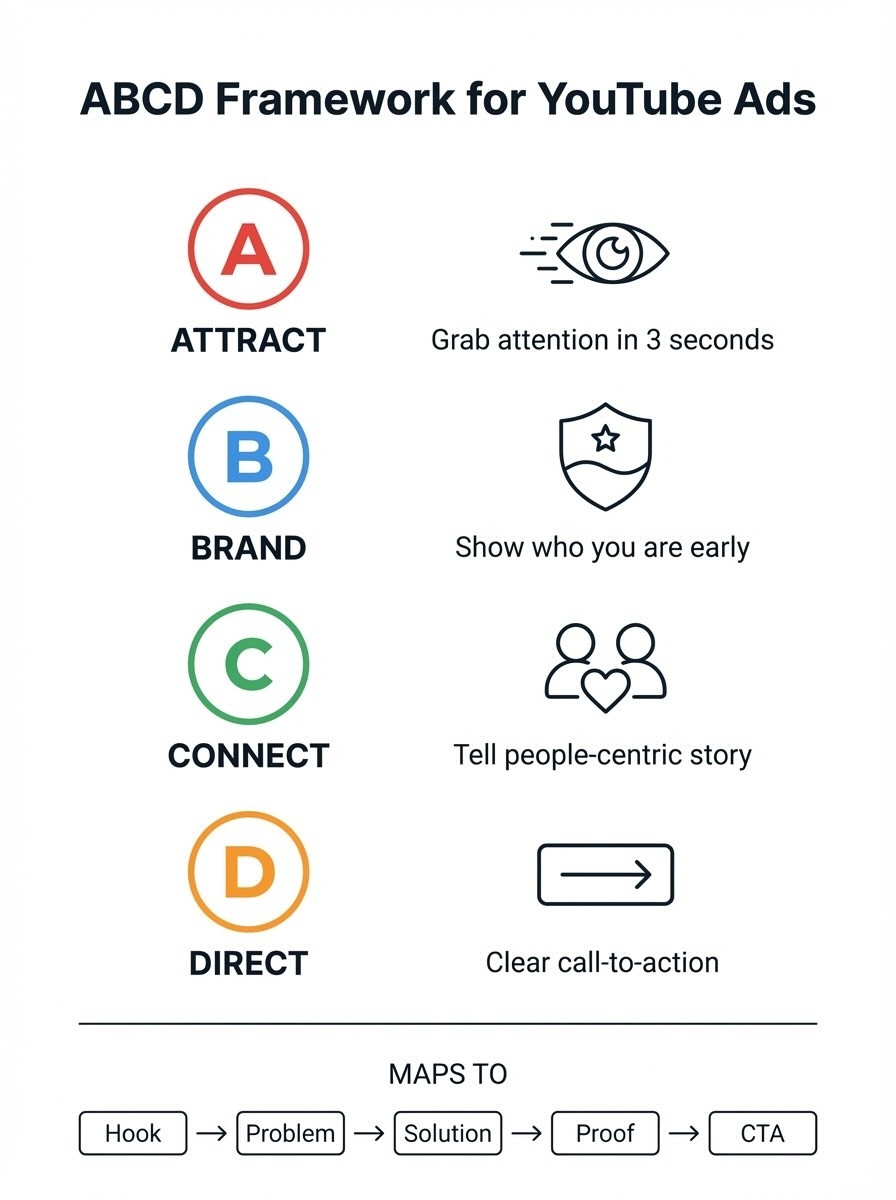
Google's ABCD framework gives you a research-backed structure for any YouTube ad format:
Attract: Grab attention fast with movement, faces, bold framing, or unexpected visuals. Purely static shots often underperform compared with ads that use movement, faces, and visual changes.
Brand: Introduce recognizable brand cues early - logo, colors, product in use - without killing the story. Viewers need to know who you are within the first few seconds, especially in skippable formats.
Connect: Tell a people-centric story. Show the functional or emotional benefit through real use cases, not abstract claims.
Direct: Give a clear, simple call-to-action on screen and in audio. Tell viewers exactly what to do next: "Try it free," "Download the template," "Watch the full demo."
This maps cleanly to performance advertising structure: Hook → Problem → Tension → Solution → Proof → CTA. Every high-converting YouTube ad follows some version of this arc, compressed or expanded based on format.
5 YouTube Ad Hook Frameworks That Increase View-Through Rates
The first 3-5 seconds carry disproportionate weight. If you lose viewers here, nothing else matters. Your mid-video storytelling, your proof points, your CTA - all worthless if they never see them.
Here are hook frameworks that consistently drive thumb-stops:
Pattern break: Unexpected visual or statement that doesn't match YouTube norms. Example: opening with a graph before showing your face, starting mid-sentence, or cutting straight to a dramatic result.
Hyper-specific promise: "In the next 15 seconds, you'll see exactly how we cut ad costs by 60% without changing targeting." Specificity signals value and gives viewers a reason to stay.
Pain call-out: "If your YouTube ads keep getting skipped, you're making this mistake." Calls out a concrete frustration your audience recognizes.
Social proof lead: "This ad structure cut our cost per lead by 42% in 30 days." Opens with a specific, credible result that makes viewers want to know how.
Curiosity gap: "Everyone tells you to do X in YouTube ads. Here's why that kills your ROAS." Creates tension by challenging conventional wisdom.
The hook style should match the viewer's mindset. Shorts need more direct, visually bold hooks—think TikTok energy. Long-form in-stream can afford slightly more context because viewers give you an extra second or two.
Testing multiple hooks on the same body content is the fastest way to improve performance. Same problem, same solution, same CTA—just swap the first 5 seconds. You'll quickly learn which angles resonate with your audience.
How to structure long-form YouTube ads (15-60 seconds)
Long-form in-stream YT ads (the ones that play before or during videos) follow a classic story arc: hook → context/problem → solution/offer → proof/demo → CTA.
Hook (0-3 seconds): Pattern break or specific promise that stops the scroll.
Context/Problem (3-10 seconds): Quickly establish the pain point or situation your viewer faces. Don't spend half of the minute building drama—state it clearly and move on.
Solution (10-25 seconds): Show your product or service solving the problem. Demonstrate it visually. If you're selling software, show the interface. If you're selling a service, show real results.
Proof (25-40 seconds): Brief testimonial, stat, or before/after. Something concrete that validates your solution works.
CTA (40-60 seconds): Clear instructions on what to do next, with urgency if relevant. "Start your free trial," "Get 20% off this week," "Download the guide."
The key difference from other platforms: assume many viewers only see 5-10 seconds. Get your main benefit and brand cues in early, but reward those who stay with more detail and proof.
Use tight framing on faces and key objects. Close-ups increase impact and brand lift in short ad windows - Google's data shows this consistently. Wide shots lose attention.
How to structure YouTube Shorts ads (15-30 seconds)
YouTube Shorts are closer to TikTok in pace and style. Your hook must land visually and verbally in 1-2 seconds—bold movement, text overlays, or surprising scenarios that break the scroll pattern.
Structure for 15-30 second Shorts ads:
0-2 seconds: Visual pattern break + text hook. Use movement, unexpected framing, or bold on-screen text that viewers can parse in under a second.
2-8 seconds: Problem dramatization or "before" snapshot. Show the pain point quickly—don't explain it with narration.
8-18 seconds: Product demonstration in a native, lo-fi style. This should feel like organic Shorts content, not a polished commercial.
18-25 seconds: Social proof or quick outcome. A stat, a testimonial clip, or a visual before/after.
Final seconds: Big, legible CTA card plus verbal CTA. "Try it free—link in bio" or "Download now" with clear visual emphasis.
Shorts work best when they feel native. UGC-style creative—handheld footage, first-person voice, minimal editing—blends with organic content and doesn't trigger "ad blindness." Polished commercial spots often underperform because they scream "this is an ad."
Creating high-quality YouTube Shorts ads used to mean hiring creators or shooting dozens of takes yourself. AI-powered video tools changed this. You can generate multiple Shorts variations with different hooks and styles in minutes, test them with small budgets, and scale what works. This is particularly useful when you're targeting multiple audience segments and need different creative angles for each.

In-feed video ads (YouTube Discovery)
In-feed ads appear in search results, home feed, and watch next recommendations. Unlike in-stream ads that auto-play, these rely on click appeal—your thumbnail and title need to win attention before the video even starts.
Thumbnail strategy: Bold, legible, emotionally charged or curiosity-driven visual that stands out against surrounding videos. Use faces, contrasting colors, and minimal text that's readable on mobile.
Title strategy: Clear benefit or curiosity angle, optimized like a YouTube organic title but aligned with your ad promise. "How we cut YouTube ad costs by 60%" performs better than "Amazing YouTube advertising tips."
Video structure: Treat it like a strong organic video with a performance spine. Hook in the first sentence, build tension, deliver value, and integrate a mid/end CTA rather than hard-selling from second one. These viewers chose to click—they're more qualified, so you can afford a softer sell.
YouTube Ad Placement Strategies: Pre-roll, mid-roll, and non-skippable
Skippable pre-roll (the most common format) gives viewers the skip button after 5 seconds. Make those first 5 seconds self-contained—state who the ad is for, what outcome you promise, and visually show the product or result before the skip button appears.
Treat the skip moment as a natural beat to escalate the stakes. "Still watching? Here's the part where it gets interesting…" or cut to a more dramatic proof point right at the 5-second mark. Reward viewers who stay with additional depth.
Non-skippable 6-15 second ads need tighter structure. You have no skip option, so viewers are forced to watch—but this also means higher risk of irritation if your ad is bad.
Structure like a mini-commercial: 1 hook, 1 main idea, 1 clear CTA. High pacing, no dead air. Research shows that shorter native ads (around 6 seconds) can produce more positive reactions than 15-30 second spots, so test concise variants.
Mid-roll ads appear during videos and are generally seen as more intrusive than pre-rolls. To minimize negative reaction, make your ad feel like value-added content—educational, entertaining, or offering something immediately useful rather than a hard sell.
How to structure native and in-content ad integrations?
Native integrations are sponsorship segments inside creator videos. These work when they match the host's tone, pacing, and humor while delivering your message.
Best practices from high-performing integrations:
Match the host's style completely. If the creator is comedic, the sponsorship should be comedic. If they're educational, make the integration educational. Forcing your brand voice onto their content kills trust.
Integrate the product into the main narrative rather than isolating a 60-second read. Story-based integrations ("I was editing this video and realized I needed X…") feel more natural and perform better than interruptions.
Disclose transparently but keep the segment tight. "This video is sponsored by X, and here's how they solve this exact problem I was just talking about."
Soft CTAs work best here. Link in description, discount code on screen, and a quick recap of who it's for. Don't ask for hard conversions in the middle of someone else's content.
3 YouTube Ad Storytelling Structures That Drive Conversions
Strong YouTube ads follow classic advertising structures: problem–agitation–solution or transformation arcs. Narratives and emotional appeals deepen engagement and memory.
Testimonial story: Customer journey from problem to solution to concrete outcome. "I was spending $10k/month on YouTube ads with terrible ROAS. Then I restructured my creative using this framework. Now I'm at 4.2x ROAS and spending $30k/month profitably."
Founder story: Origin problem, frustration, breakthrough, product as crystallized solution. "I was a freelance designer losing clients to agencies with bigger teams. So I built this tool to compete. Now I book projects 3x faster than agencies."
Demo-driven: Cold open on impressive result, then rewind and explain how it works. "This company went from $0 to $50k MRR in 90 days. Here's the exact YouTube ad strategy they used."
Adjust storytelling depth by format. You have time for full story arcs in 30-60 second in-stream and in-feed ads. Shorts and 6-second bumpers need ultra-compressed, punchier versions—same structure, 80% less words.
How to maintain viewer attention: The "second hook" technique
Even if your hook works, you'll lose viewers mid-video without dynamic pacing. The solution: "double hooks." An initial attention grabber, then a secondary curiosity spike around 5-10 seconds to counter mid-video drop-off.
Add visual changes every few seconds. Scene switches, angle changes, overlays, or on-screen text to refresh attention. Static shots kill retention.
Use narrative micro-cliffhangers. "In a second, you'll see exactly how this cut our CPA in half" or "Wait until you see what happens next." These create small tension loops that keep viewers watching.
Research shows that dynamic pacing, movement, and emotional shifts help maintain attention beyond the initial hook window. Your ad should feel like it's constantly moving forward, not plateauing.
Tailoring creative to different YouTube audiences
YouTube audiences have different expectations based on what they're watching:
Lean-back viewers (tutorials, documentaries, long-form essays) give you more patience. They came for depth, so ads can open like mini-tutorials that segue into your product. Emphasize clarity, credibility, and detailed proof.
Background viewers (music, podcasts, ambient content) aren't fully engaged with the screen. Use bold audio hooks and clear verbal CTAs since they might not see your visuals. Keep it simple.
Feed scrollers (Shorts, home feed on mobile) behave like TikTok users. Lean on humor, character, and surprise. Ads should feel like sketches or bits within the platform's culture, not traditional commercials.
For education/"how-to" audiences, your ad can be more instructional. For entertainment or commentary audiences, make your ad entertaining—don't break the mood with a corporate spot.
YouTube ad visual and audio design best practices
Tight framing on faces and key objects increases brand lift and engagement. Google's data consistently shows that close-ups outperform wide shots in short ad windows. Show faces. Show products. Don't waste space on empty backgrounds.
Bold on-screen text and captions are critical because many viewers watch without sound or are partially distracted. Your key message should be legible as text overlays, not just in voiceover.
Use motion, contrast, and color strategically to create pattern breaks. Cutting from a talking head to screen capture, or from a dark scene to bright, refreshes attention.
Simple sonic branding helps with recognition. A distinctive audio logo or consistent music style becomes a fast route to brand recall, especially for viewers who watch without looking at the screen.
Native look vs polished commercial look
Native, UGC-style creative often outperforms polished commercials in Shorts and in-feed formats. It blends with organic content and feels less like a hard sell, increasing initial engagement and completion rates.
The spectrum:
Highly polished brand film: Best for non-skippable in-stream, brand campaigns, and in-feed ads promoting long-form content. Use this when you need to establish authority or luxury positioning.
Hybrid "creator-hosted" ads: Creator talking to camera with light production. Works across all formats. Feels authentic but maintains quality.
Pure UGC-style: Phone camera, minimal editing, first-person voice. Especially effective in Shorts, re-marketing, and native integrations. This is what performs best for direct-response campaigns targeting younger audiences.
Traditional production for high-quality ads costs $3,000-$15,000 per video and takes 2-4 weeks. This makes creative testing financially impossible—you can't afford to test 10 different hooks or styles when each variant costs thousands.
AI video generation tools solve this. Generate multiple creative variations with different avatars, hooks, and styles in minutes instead of weeks. Test them with small budgets, kill the losers, scale the winners. This approach lets you test like a brand with a $100k production budget while spending $49/month on tools.
How to structure CTAs and conversion moments
Clear CTAs drive conversions. Google's ABCD framework emphasizes this: prompt action via on-screen and spoken CTAs, specific offers, and simple next steps.
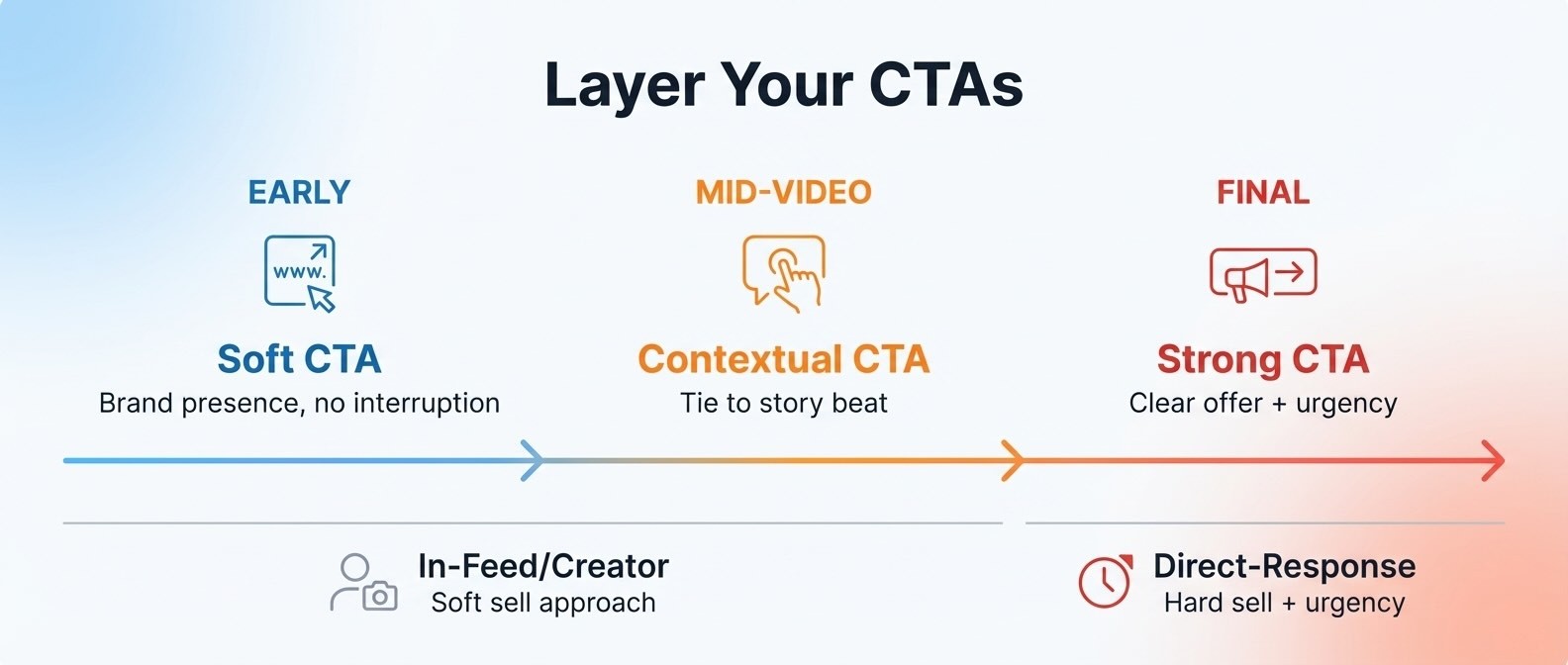
Layer your CTAs:
Early soft CTA: Visual URL or logo in corner. Establishes brand presence without interrupting the narrative.
Mid-video contextual CTA: "If this sounds like you, click the link below" or "Still struggling with X? Here's what to do." Ties the CTA to the story beat.
Strong final CTA: Clear offer, urgency, and visual emphasis. "Try it free today," "Get 20% off this week," "Download the template now." Make the action obvious and easy.
For in-feed and creator content, softer CTAs work better. "Learn more in the full breakdown video" or "Check the description for the full guide." Match user expectations—they clicked to watch content, not get sold.
For direct-response pre-rolls, you can push harder. Trials, discounts, or lead magnets with tight urgency ("Offer ends Friday") perform well when the targeting is right.
How to test YouTube Ads
Systematic creative testing turns good campaigns into great ones. Here's how to do it without becoming a full-time media buyer:
Test families of hooks on the same body content. Keep your problem, solution, proof, and CTA identical—just swap the first 3-5 seconds. This isolates what's working (or not) in your hook strategy.
Test native vs polished vs creator-led versions for the same offer. Use format-appropriate metrics: view rates and brand lift for in-stream, CTR and watch time for in-feed, engagement rate and swipe-through for Shorts.
Log winning patterns by format. Track which hooks work in Shorts vs in-stream, which stories resonate with which audience segments, and which CTAs drive action. Codify these into a simple playbook you can reference for future campaigns.
Most advertisers never test creative because production is too slow and expensive. By the time you get three variants back from an agency, your campaign is already running and you've lost the optimization window.
Faster production unlocks faster learning. When you can generate 10 creative variants in an afternoon, test them with $50 each over the weekend, and have clear winners by Monday, you're operating at a different speed than competitors stuck in traditional production cycles.
Ready to create YouTube ads that convert?
Generate video ads from any product URL or description in minutes. Test multiple creative variations without traditional production costs or timelines.
FAQs about advertising on YouTube
What are YouTube ads?
YouTube ads are video advertisements that appear before, during, or alongside YouTube content. Main formats include skippable in-stream ads (that play before videos with a skip option after 5 seconds), non-skippable ads (6-15 seconds with no skip), in-feed discovery ads (that appear in search results and recommendations), and YouTube Shorts ads (vertical video ads in the Shorts feed).
How much do YouTube ads cost?
YouTube ads operate on a cost-per-view (CPV) or cost-per-click (CPC) model, typically ranging from $0.01 to $0.30 per view depending on targeting and competition. However, creative production is often the bigger cost—traditional video production runs $3,000-$15,000 per video. AI video tools have reduced this to under $10 / video ad, making creative testing financially accessible.
What makes a good YouTube ad?
Good YouTube ads hook attention in the first 3 seconds with a pattern break or specific promise, clearly show the product solving a real problem, include proof points or social proof, and end with a clear call-to-action. The best performers feel native to the platform—using tight framing on faces, bold on-screen text, and dynamic pacing rather than static shots. Testing multiple creative variations is critical to finding what resonates with your specific audience.
How do YouTube Shorts ads work?
YouTube Shorts ads are vertical video ads (9:16 aspect ratio) that appear in the Shorts feed between organic content. They're 15-60 seconds long and designed for mobile viewing with scrolling behavior similar to TikTok or Instagram Reels. Shorts ads require faster hooks (1-2 seconds) and native, UGC-style creative to blend with organic Shorts content and avoid triggering ad blindness.
Can I create YouTube ads with AI?
Yes, AI video generation tools let you create YouTube ads in minutes without traditional video production. You can generate multiple creative variations with different hooks, avatars, and styles, then test them to find what converts best. This is particularly useful for Shorts ads and creative testing where you need high volume at low cost. AI-generated ads work best when they follow YouTube's creative best practices—strong hooks, clear problem-solution structure, and native visual style.
What's the difference between YouTube in-stream and in-feed ads?
In-stream ads (also called TrueView ads) auto-play before, during, or after YouTube videos and are either skippable after 5 seconds or non-skippable for 6-15 seconds. In-feed ads (discovery ads) appear in YouTube search results, home feed, and watch next recommendations—viewers must click to watch, so thumbnail and title quality determine performance. In-stream focuses on capturing forced attention quickly; in-feed relies on voluntary clicks, so it performs better with curiosity-driven thumbnails and softer selling.
How do I test YouTube ad creative effectively?
Test one variable at a time to isolate what's working. Start by testing 3-5 different hooks on the same body content (same problem, solution, and CTA). Run each variant with equal budget for 3-7 days, then kill underperformers and scale winners. Next, test different storytelling approaches (testimonial vs founder story vs demo) or visual styles (polished vs native vs creator-led). Track view rate, click-through rate, and conversion rate by format—what works in Shorts may not work in long-form in-stream ads.
Creating YouTube ads that actually convert isn't about having the biggest production budget. You need to understand how attention works on the platform and structure your video advertising to match how people watch.
YouTube ads differ from traditional television commercials and other social media advertising in three critical ways:
Viewers can skip most ads after 5 seconds, requiring faster hooks
Viewers arrive with search intent rather than passive scrolling, creating higher purchase intent, and
Multiple ad format options (in-stream, in-feed, Shorts) require format-specific creative strategies.
This guide breaks down how to create ads for every YouTube ad format: in-stream (skippable and non-skippable), in-feed discovery ads, YouTube Shorts ads, and native creator integrations. You'll learn what actually drives conversions, backed by platform research and advertiser data.
How does attention work on YouTube?
YouTube ads operate in a unique attention environment compared to other digital advertising platforms. People come to YouTube with intent - they're searching for something specific or choosing videos deliberately. This means you have slightly more patience than TikTok, but you still need to earn every second.
The first 3-5 seconds determine everything. Multiple studies show that if viewers stay past this window, they're significantly more likely to watch through and take action.
According to Google's Gemini analysis of over 13,000 successful YouTube ads in 2024, 44% of top-performing YouTube ads differed from traditional ad lengths (15, 30, and 60 seconds), and 52% of Shorts and in-stream ads from this year were over 15 seconds long.
Viewer mindset also varies by format. Long-form viewers are more open to narrative and explanation. They came to watch a 20-minute video, so a 60-second story arc doesn't feel like an interruption if it's relevant.
Shorts viewers scroll like TikTok. They're pattern-matching for entertainment or quick value, with ultra-short attention spans. You need to break the pattern visually and verbally in the first 1-2 seconds or they're gone.
YouTube Ad Type | Length | Placement | Primary Goal | Creative Best Practices |
|---|---|---|---|---|
Skippable In Stream | 15 to 60 seconds | Before or during videos | Conversions and direct response | Strong 3 to 5 second hook, early branding, clear problem solution flow |
Non Skippable In Stream | 6 to 15 seconds | Before or during videos | Brand awareness | One clear message, fast pacing, simple CTA |
YouTube Shorts Ads | 15 to 30 seconds | Shorts feed | Engagement and creative testing | UGC style, bold visuals, 1 to 2 second hooks |
In Feed Discovery | 60 to 120 seconds | Search results, home feed, watch next | Qualified traffic and education | Strong thumbnail, curiosity driven title, softer selling |
Bumper Ads | 6 seconds | Before videos | Reach and recall | Single idea, high frequency, strong brand cue |
Native Creator Integrations | 30 to 90 seconds | Inside creator videos | Trust and consideration | Match creator tone, story based mention, soft CTA |
The ABCD framework for YouTube creative
Google's ABCD framework gives you a research-backed structure for any YouTube ad format:
Attract: Grab attention fast with movement, faces, bold framing, or unexpected visuals. Purely static shots often underperform compared with ads that use movement, faces, and visual changes.
Brand: Introduce recognizable brand cues early - logo, colors, product in use - without killing the story. Viewers need to know who you are within the first few seconds, especially in skippable formats.
Connect: Tell a people-centric story. Show the functional or emotional benefit through real use cases, not abstract claims.
Direct: Give a clear, simple call-to-action on screen and in audio. Tell viewers exactly what to do next: "Try it free," "Download the template," "Watch the full demo."
This maps cleanly to performance advertising structure: Hook → Problem → Tension → Solution → Proof → CTA. Every high-converting YouTube ad follows some version of this arc, compressed or expanded based on format.
5 YouTube Ad Hook Frameworks That Increase View-Through Rates
The first 3-5 seconds carry disproportionate weight. If you lose viewers here, nothing else matters. Your mid-video storytelling, your proof points, your CTA - all worthless if they never see them.
Here are hook frameworks that consistently drive thumb-stops:
Pattern break: Unexpected visual or statement that doesn't match YouTube norms. Example: opening with a graph before showing your face, starting mid-sentence, or cutting straight to a dramatic result.
Hyper-specific promise: "In the next 15 seconds, you'll see exactly how we cut ad costs by 60% without changing targeting." Specificity signals value and gives viewers a reason to stay.
Pain call-out: "If your YouTube ads keep getting skipped, you're making this mistake." Calls out a concrete frustration your audience recognizes.
Social proof lead: "This ad structure cut our cost per lead by 42% in 30 days." Opens with a specific, credible result that makes viewers want to know how.
Curiosity gap: "Everyone tells you to do X in YouTube ads. Here's why that kills your ROAS." Creates tension by challenging conventional wisdom.
The hook style should match the viewer's mindset. Shorts need more direct, visually bold hooks—think TikTok energy. Long-form in-stream can afford slightly more context because viewers give you an extra second or two.
Testing multiple hooks on the same body content is the fastest way to improve performance. Same problem, same solution, same CTA—just swap the first 5 seconds. You'll quickly learn which angles resonate with your audience.
How to structure long-form YouTube ads (15-60 seconds)
Long-form in-stream YT ads (the ones that play before or during videos) follow a classic story arc: hook → context/problem → solution/offer → proof/demo → CTA.
Hook (0-3 seconds): Pattern break or specific promise that stops the scroll.
Context/Problem (3-10 seconds): Quickly establish the pain point or situation your viewer faces. Don't spend half of the minute building drama—state it clearly and move on.
Solution (10-25 seconds): Show your product or service solving the problem. Demonstrate it visually. If you're selling software, show the interface. If you're selling a service, show real results.
Proof (25-40 seconds): Brief testimonial, stat, or before/after. Something concrete that validates your solution works.
CTA (40-60 seconds): Clear instructions on what to do next, with urgency if relevant. "Start your free trial," "Get 20% off this week," "Download the guide."
The key difference from other platforms: assume many viewers only see 5-10 seconds. Get your main benefit and brand cues in early, but reward those who stay with more detail and proof.
Use tight framing on faces and key objects. Close-ups increase impact and brand lift in short ad windows - Google's data shows this consistently. Wide shots lose attention.
How to structure YouTube Shorts ads (15-30 seconds)
YouTube Shorts are closer to TikTok in pace and style. Your hook must land visually and verbally in 1-2 seconds—bold movement, text overlays, or surprising scenarios that break the scroll pattern.
Structure for 15-30 second Shorts ads:
0-2 seconds: Visual pattern break + text hook. Use movement, unexpected framing, or bold on-screen text that viewers can parse in under a second.
2-8 seconds: Problem dramatization or "before" snapshot. Show the pain point quickly—don't explain it with narration.
8-18 seconds: Product demonstration in a native, lo-fi style. This should feel like organic Shorts content, not a polished commercial.
18-25 seconds: Social proof or quick outcome. A stat, a testimonial clip, or a visual before/after.
Final seconds: Big, legible CTA card plus verbal CTA. "Try it free—link in bio" or "Download now" with clear visual emphasis.
Shorts work best when they feel native. UGC-style creative—handheld footage, first-person voice, minimal editing—blends with organic content and doesn't trigger "ad blindness." Polished commercial spots often underperform because they scream "this is an ad."
Creating high-quality YouTube Shorts ads used to mean hiring creators or shooting dozens of takes yourself. AI-powered video tools changed this. You can generate multiple Shorts variations with different hooks and styles in minutes, test them with small budgets, and scale what works. This is particularly useful when you're targeting multiple audience segments and need different creative angles for each.
In-feed video ads (YouTube Discovery)
In-feed ads appear in search results, home feed, and watch next recommendations. Unlike in-stream ads that auto-play, these rely on click appeal—your thumbnail and title need to win attention before the video even starts.
Thumbnail strategy: Bold, legible, emotionally charged or curiosity-driven visual that stands out against surrounding videos. Use faces, contrasting colors, and minimal text that's readable on mobile.
Title strategy: Clear benefit or curiosity angle, optimized like a YouTube organic title but aligned with your ad promise. "How we cut YouTube ad costs by 60%" performs better than "Amazing YouTube advertising tips."
Video structure: Treat it like a strong organic video with a performance spine. Hook in the first sentence, build tension, deliver value, and integrate a mid/end CTA rather than hard-selling from second one. These viewers chose to click—they're more qualified, so you can afford a softer sell.
YouTube Ad Placement Strategies: Pre-roll, mid-roll, and non-skippable
Skippable pre-roll (the most common format) gives viewers the skip button after 5 seconds. Make those first 5 seconds self-contained—state who the ad is for, what outcome you promise, and visually show the product or result before the skip button appears.
Treat the skip moment as a natural beat to escalate the stakes. "Still watching? Here's the part where it gets interesting…" or cut to a more dramatic proof point right at the 5-second mark. Reward viewers who stay with additional depth.
Non-skippable 6-15 second ads need tighter structure. You have no skip option, so viewers are forced to watch—but this also means higher risk of irritation if your ad is bad.
Structure like a mini-commercial: 1 hook, 1 main idea, 1 clear CTA. High pacing, no dead air. Research shows that shorter native ads (around 6 seconds) can produce more positive reactions than 15-30 second spots, so test concise variants.
Mid-roll ads appear during videos and are generally seen as more intrusive than pre-rolls. To minimize negative reaction, make your ad feel like value-added content—educational, entertaining, or offering something immediately useful rather than a hard sell.
How to structure native and in-content ad integrations?
Native integrations are sponsorship segments inside creator videos. These work when they match the host's tone, pacing, and humor while delivering your message.
Best practices from high-performing integrations:
Match the host's style completely. If the creator is comedic, the sponsorship should be comedic. If they're educational, make the integration educational. Forcing your brand voice onto their content kills trust.
Integrate the product into the main narrative rather than isolating a 60-second read. Story-based integrations ("I was editing this video and realized I needed X…") feel more natural and perform better than interruptions.
Disclose transparently but keep the segment tight. "This video is sponsored by X, and here's how they solve this exact problem I was just talking about."
Soft CTAs work best here. Link in description, discount code on screen, and a quick recap of who it's for. Don't ask for hard conversions in the middle of someone else's content.
3 YouTube Ad Storytelling Structures That Drive Conversions
Strong YouTube ads follow classic advertising structures: problem–agitation–solution or transformation arcs. Narratives and emotional appeals deepen engagement and memory.
Testimonial story: Customer journey from problem to solution to concrete outcome. "I was spending $10k/month on YouTube ads with terrible ROAS. Then I restructured my creative using this framework. Now I'm at 4.2x ROAS and spending $30k/month profitably."
Founder story: Origin problem, frustration, breakthrough, product as crystallized solution. "I was a freelance designer losing clients to agencies with bigger teams. So I built this tool to compete. Now I book projects 3x faster than agencies."
Demo-driven: Cold open on impressive result, then rewind and explain how it works. "This company went from $0 to $50k MRR in 90 days. Here's the exact YouTube ad strategy they used."
Adjust storytelling depth by format. You have time for full story arcs in 30-60 second in-stream and in-feed ads. Shorts and 6-second bumpers need ultra-compressed, punchier versions—same structure, 80% less words.
How to maintain viewer attention: The "second hook" technique
Even if your hook works, you'll lose viewers mid-video without dynamic pacing. The solution: "double hooks." An initial attention grabber, then a secondary curiosity spike around 5-10 seconds to counter mid-video drop-off.
Add visual changes every few seconds. Scene switches, angle changes, overlays, or on-screen text to refresh attention. Static shots kill retention.
Use narrative micro-cliffhangers. "In a second, you'll see exactly how this cut our CPA in half" or "Wait until you see what happens next." These create small tension loops that keep viewers watching.
Research shows that dynamic pacing, movement, and emotional shifts help maintain attention beyond the initial hook window. Your ad should feel like it's constantly moving forward, not plateauing.
Tailoring creative to different YouTube audiences
YouTube audiences have different expectations based on what they're watching:
Lean-back viewers (tutorials, documentaries, long-form essays) give you more patience. They came for depth, so ads can open like mini-tutorials that segue into your product. Emphasize clarity, credibility, and detailed proof.
Background viewers (music, podcasts, ambient content) aren't fully engaged with the screen. Use bold audio hooks and clear verbal CTAs since they might not see your visuals. Keep it simple.
Feed scrollers (Shorts, home feed on mobile) behave like TikTok users. Lean on humor, character, and surprise. Ads should feel like sketches or bits within the platform's culture, not traditional commercials.
For education/"how-to" audiences, your ad can be more instructional. For entertainment or commentary audiences, make your ad entertaining—don't break the mood with a corporate spot.
YouTube ad visual and audio design best practices
Tight framing on faces and key objects increases brand lift and engagement. Google's data consistently shows that close-ups outperform wide shots in short ad windows. Show faces. Show products. Don't waste space on empty backgrounds.
Bold on-screen text and captions are critical because many viewers watch without sound or are partially distracted. Your key message should be legible as text overlays, not just in voiceover.
Use motion, contrast, and color strategically to create pattern breaks. Cutting from a talking head to screen capture, or from a dark scene to bright, refreshes attention.
Simple sonic branding helps with recognition. A distinctive audio logo or consistent music style becomes a fast route to brand recall, especially for viewers who watch without looking at the screen.
Native look vs polished commercial look
Native, UGC-style creative often outperforms polished commercials in Shorts and in-feed formats. It blends with organic content and feels less like a hard sell, increasing initial engagement and completion rates.
The spectrum:
Highly polished brand film: Best for non-skippable in-stream, brand campaigns, and in-feed ads promoting long-form content. Use this when you need to establish authority or luxury positioning.
Hybrid "creator-hosted" ads: Creator talking to camera with light production. Works across all formats. Feels authentic but maintains quality.
Pure UGC-style: Phone camera, minimal editing, first-person voice. Especially effective in Shorts, re-marketing, and native integrations. This is what performs best for direct-response campaigns targeting younger audiences.
Traditional production for high-quality ads costs $3,000-$15,000 per video and takes 2-4 weeks. This makes creative testing financially impossible—you can't afford to test 10 different hooks or styles when each variant costs thousands.
AI video generation tools solve this. Generate multiple creative variations with different avatars, hooks, and styles in minutes instead of weeks. Test them with small budgets, kill the losers, scale the winners. This approach lets you test like a brand with a $100k production budget while spending $49/month on tools.
How to structure CTAs and conversion moments
Clear CTAs drive conversions. Google's ABCD framework emphasizes this: prompt action via on-screen and spoken CTAs, specific offers, and simple next steps.
Layer your CTAs:
Early soft CTA: Visual URL or logo in corner. Establishes brand presence without interrupting the narrative.
Mid-video contextual CTA: "If this sounds like you, click the link below" or "Still struggling with X? Here's what to do." Ties the CTA to the story beat.
Strong final CTA: Clear offer, urgency, and visual emphasis. "Try it free today," "Get 20% off this week," "Download the template now." Make the action obvious and easy.
For in-feed and creator content, softer CTAs work better. "Learn more in the full breakdown video" or "Check the description for the full guide." Match user expectations—they clicked to watch content, not get sold.
For direct-response pre-rolls, you can push harder. Trials, discounts, or lead magnets with tight urgency ("Offer ends Friday") perform well when the targeting is right.
How to test YouTube Ads
Systematic creative testing turns good campaigns into great ones. Here's how to do it without becoming a full-time media buyer:
Test families of hooks on the same body content. Keep your problem, solution, proof, and CTA identical—just swap the first 3-5 seconds. This isolates what's working (or not) in your hook strategy.
Test native vs polished vs creator-led versions for the same offer. Use format-appropriate metrics: view rates and brand lift for in-stream, CTR and watch time for in-feed, engagement rate and swipe-through for Shorts.
Log winning patterns by format. Track which hooks work in Shorts vs in-stream, which stories resonate with which audience segments, and which CTAs drive action. Codify these into a simple playbook you can reference for future campaigns.
Most advertisers never test creative because production is too slow and expensive. By the time you get three variants back from an agency, your campaign is already running and you've lost the optimization window.
Faster production unlocks faster learning. When you can generate 10 creative variants in an afternoon, test them with $50 each over the weekend, and have clear winners by Monday, you're operating at a different speed than competitors stuck in traditional production cycles.
Ready to create YouTube ads that convert?
Generate video ads from any product URL or description in minutes. Test multiple creative variations without traditional production costs or timelines.
FAQs about advertising on YouTube
What are YouTube ads?
YouTube ads are video advertisements that appear before, during, or alongside YouTube content. Main formats include skippable in-stream ads (that play before videos with a skip option after 5 seconds), non-skippable ads (6-15 seconds with no skip), in-feed discovery ads (that appear in search results and recommendations), and YouTube Shorts ads (vertical video ads in the Shorts feed).
How much do YouTube ads cost?
YouTube ads operate on a cost-per-view (CPV) or cost-per-click (CPC) model, typically ranging from $0.01 to $0.30 per view depending on targeting and competition. However, creative production is often the bigger cost—traditional video production runs $3,000-$15,000 per video. AI video tools have reduced this to under $10 / video ad, making creative testing financially accessible.
What makes a good YouTube ad?
Good YouTube ads hook attention in the first 3 seconds with a pattern break or specific promise, clearly show the product solving a real problem, include proof points or social proof, and end with a clear call-to-action. The best performers feel native to the platform—using tight framing on faces, bold on-screen text, and dynamic pacing rather than static shots. Testing multiple creative variations is critical to finding what resonates with your specific audience.
How do YouTube Shorts ads work?
YouTube Shorts ads are vertical video ads (9:16 aspect ratio) that appear in the Shorts feed between organic content. They're 15-60 seconds long and designed for mobile viewing with scrolling behavior similar to TikTok or Instagram Reels. Shorts ads require faster hooks (1-2 seconds) and native, UGC-style creative to blend with organic Shorts content and avoid triggering ad blindness.
Can I create YouTube ads with AI?
Yes, AI video generation tools let you create YouTube ads in minutes without traditional video production. You can generate multiple creative variations with different hooks, avatars, and styles, then test them to find what converts best. This is particularly useful for Shorts ads and creative testing where you need high volume at low cost. AI-generated ads work best when they follow YouTube's creative best practices—strong hooks, clear problem-solution structure, and native visual style.
What's the difference between YouTube in-stream and in-feed ads?
In-stream ads (also called TrueView ads) auto-play before, during, or after YouTube videos and are either skippable after 5 seconds or non-skippable for 6-15 seconds. In-feed ads (discovery ads) appear in YouTube search results, home feed, and watch next recommendations—viewers must click to watch, so thumbnail and title quality determine performance. In-stream focuses on capturing forced attention quickly; in-feed relies on voluntary clicks, so it performs better with curiosity-driven thumbnails and softer selling.
How do I test YouTube ad creative effectively?
Test one variable at a time to isolate what's working. Start by testing 3-5 different hooks on the same body content (same problem, solution, and CTA). Run each variant with equal budget for 3-7 days, then kill underperformers and scale winners. Next, test different storytelling approaches (testimonial vs founder story vs demo) or visual styles (polished vs native vs creator-led). Track view rate, click-through rate, and conversion rate by format—what works in Shorts may not work in long-form in-stream ads.