
Say it's Monday morning and cost per acquisition on your best Meta campaign jumped 40% over the weekend. An automation rule would pause the ad set. A chatbot with no account access would explain possible causes once you export the data and paste it in. An AI agent with access to the account investigates on its own, flags a burned-out creative as the likely cause, drafts three replacement ads, and sends you the fix to approve.
That last version is agentic marketing. Here's what the term means, how it works in paid ads today, what the 2026 adoption data says, and how to start without handing an agent your whole budget on day one.
Agentic marketing definition: what it means
Agentic marketing is marketing work carried out by AI agents that get a goal, a set of rules and access to your tools, then plan and run the steps to reach that goal. People set the strategy and the limits. The agent does the research, production and execution in between, and reports back.
McKinsey describes agentic AI as systems "capable of acting and executing multistep processes," with people designing and overseeing networks of agents (McKinsey).
A quick test from Supermetrics: check "whether the AI recommends the next step or takes it." Add one more question: did it choose that step itself, working toward your goal? A script that fires a fixed action takes a step too, but it doesn't plan anything.
Read more: How to Use AI in Marketing
Agentic AI vs marketing automation vs AI copilots
All three use software to save time, but they split the work differently.
Marketing automation | AI copilot | Agentic marketing | |
|---|---|---|---|
Who decides the next step | You, in advance, as a rule | You, after each answer | The agent, within your goals and limits |
仕組みについて | Trigger and action | You ask, it answers, then waits | It plans, uses tools, acts, checks results |
Paid ads example | Pause an ad when spend passes $500 | Explain why CPA went up | Find the cause, draft new ads and a campaign fix, send them for approval, then monitor |
Where it struggles | Situations the rule didn't plan for | You coordinate every next step | Bad data or loose limits |
The lines blur in real products (some chat assistants can read your account and make approved changes), and the three stack in practice. Your welcome email flow stays a rule, your copywriter keeps a chat assistant, and an agent handles the multi-step work that used to need a person moving between five tabs.
How an AI agent runs a paid campaign
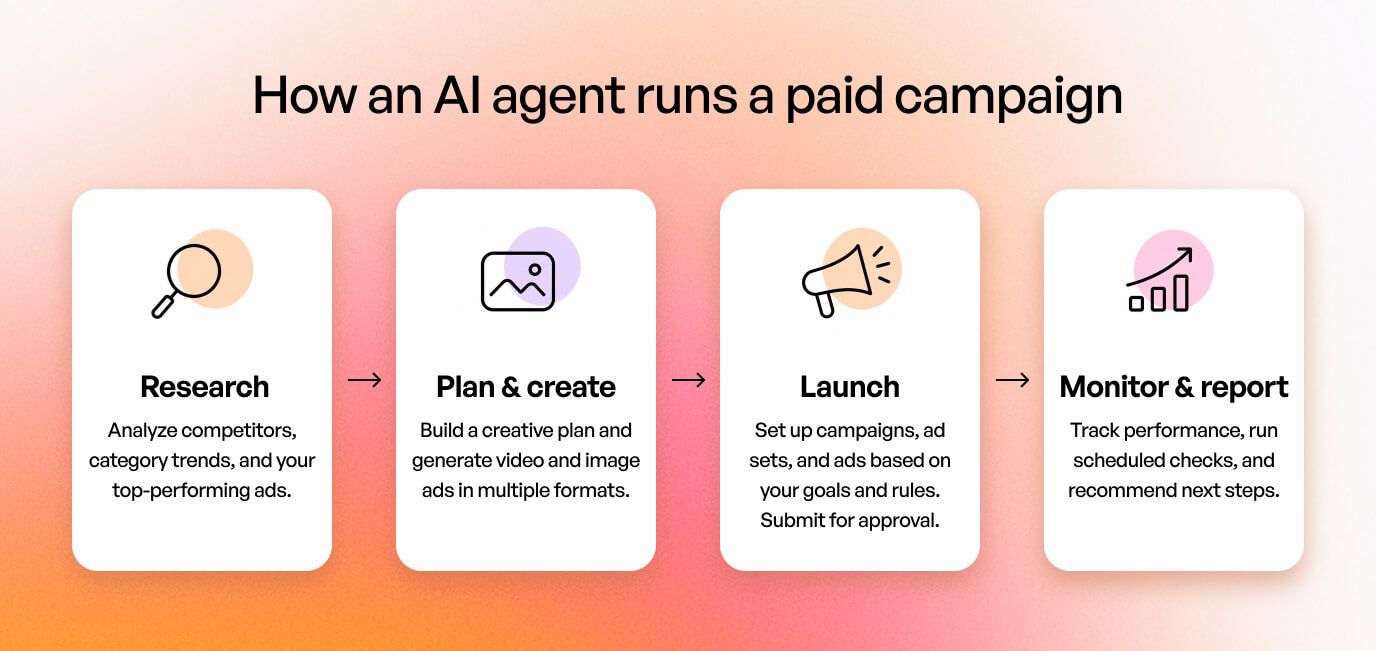
Paid ads are one of the clearest agentic AI use cases in marketing, because the loop is long and the data changes every hour. Depending on its integrations and permissions, a connected AI marketing agent can handle these stages.
1. Research
The agent scans what competitors are running (hooks, offers, formats, how long each ad stays live), checks category trends and compares them with your own top performers. You get a short list of gaps worth testing, with the reason for each.
2. Plan and create
Once you approve the plan, the agent makes the ads: UGC-style videos, product videos, image ads, in the formats each placement supports. Platforms are building pieces of this natively. TikTok's Symphony Automation, for example, can generate videos with scripts, voiceovers and virtual avatars from your destination URL for Smart+ web campaigns (TikTok).
3. Launch
The agent builds campaigns, ad sets and ads from a product link or brief, following your naming, budget and targeting rules. Good agents stop here and ask. Google's Ask Advisor in Google Ads (in beta for eligible accounts) can investigate performance changes, generate keywords and assets, and apply supported campaign changes once you approve them (Google).
4. Monitor and report
You set routines in plain words: a daily spend check, a Monday report, a weekly look at competitor launches. The agent runs them on schedule and comes back with what changed and the fix, ready to approve.
Agentic advertising across platforms
Platform AI like Meta Advantage+, Google's Ask Advisor and TikTok Smart+ works inside its own ad platform. A cross-platform AI marketing agent sits above them and works across all your accounts at once.
That's the job Creatify Max does, from research and creative to AI media buying. Max researches competitors, makes the video and image ads, builds campaigns, and runs scheduled reports from the Creatify app or Slack. Max reads results and makes approved changes on Meta, Google Ads, TikTok, Snapchat, Reddit, LinkedIn and OpenAI Ads. By default, every launch, budget move or pause arrives as an approval card, and you can let a routine you trust act on its own.
Creatify reports that its own performance marketing team, which runs Meta, Google and TikTok through Max, spends 80% less time on campaign setup. In one case, when cost per subscriber doubled on an account, Max traced it to a bid strategy change made two weeks earlier in about 10 minutes (Creatify).
Read more: Introducing AI Media Buyer: The AI Agent That Runs Your Ads
Agentic AI in marketing: where adoption stands in 2026
Interest in AI agents for marketing is high. Real end-to-end use is still early.
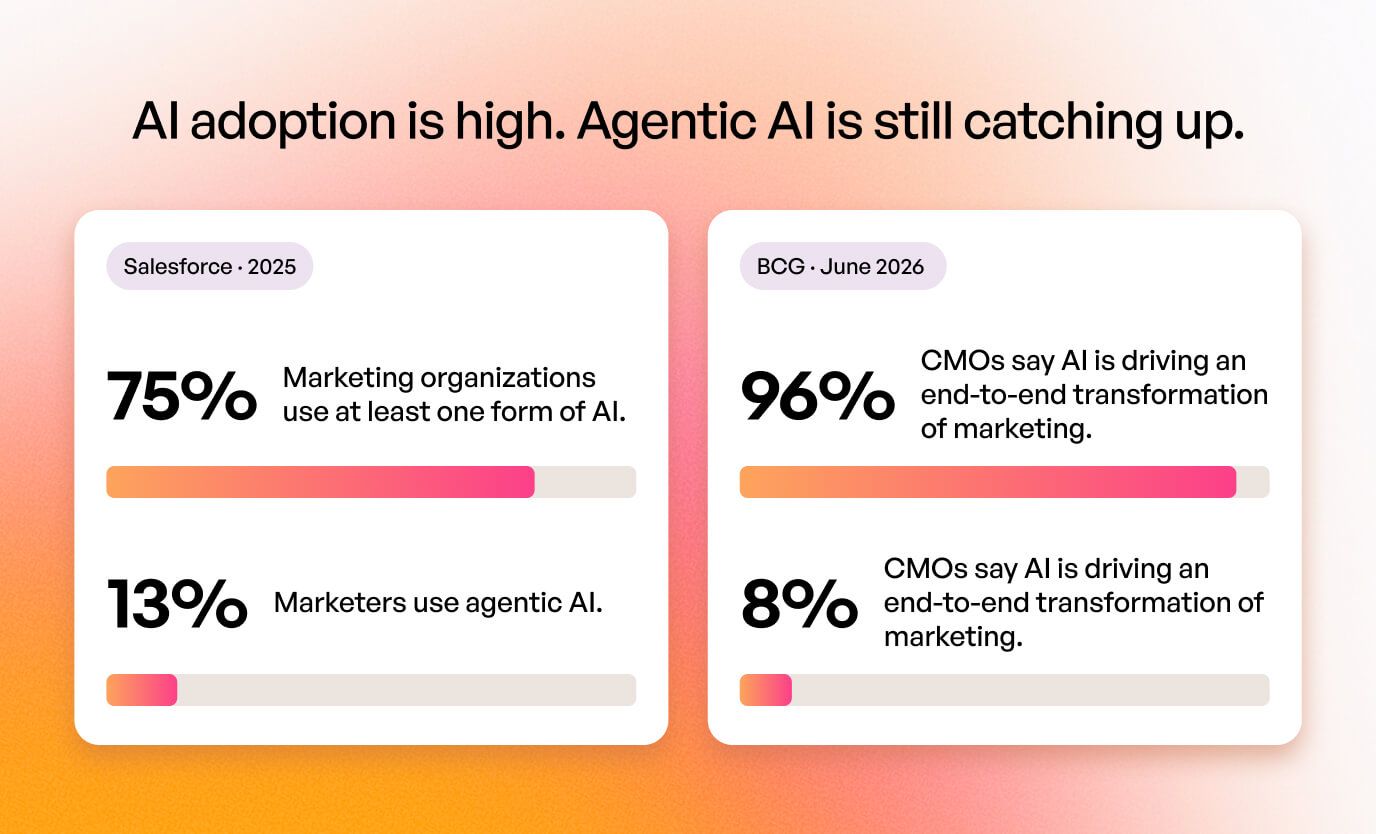
75% of marketing organizations use at least one form of AI, but only 13% of marketers say they use agentic AI (Salesforce State of Marketing, 4,450 marketers surveyed in October and November 2025).
96% of CMOs say AI is driving an end-to-end transformation of marketing, yet only 8% run campaigns where multiple AI agents operate autonomously (BCG, survey of 300 CMOs published June 2026).
40% of respondents at companies with more than $1 billion in revenue say they're scaling AI agents in at least one business function, up from 27% a year earlier. That covers all functions, marketing included (McKinsey State of AI 2026).
McKinsey estimates agentic systems could speed up campaign creation and execution by 10 to 15 times, with workflows redesigned around them (McKinsey).
In June 2025, Gartner forecast that at least 15% of day-to-day work decisions will be made autonomously by agentic AI by 2028, up from zero in 2024 (Gartner).
The gap between 75% and 13% is the story. AI use is everywhere, and far fewer teams let it take the next step.
Read more: AI Marketing Trends Reshaping the Industry
The risks: agent washing and other ways it goes wrong
Agent washing
Gartner calls it "agent washing": vendors rebranding chatbots, assistants or automation scripts as agents. In June 2025 it estimated only about 130 of the thousands of vendors claiming agentic AI were real, and forecast that more than 40% of agentic AI projects will be canceled by the end of 2027 over costs, unclear value or weak risk controls (Gartner).
Budget burn
In agentic AI advertising, an agent with write access can turn a bad read of the data into real spend. If your conversion tracking is broken, the agent will optimize toward the wrong thing faster than a person would.
計測・評価
Putting Meta, Google and TikTok reports in one chat gives you a faster report, and the same attribution overlap. Each platform can claim credit for the same purchase under its own rules, even with tracking set up correctly. Check the agent's numbers against your store or CRM before you add conversions up.
Brand drift
Ads made at speed still need someone checking claims, offers and tone before they go live.
How to evaluate an agentic marketing platform
When a vendor pitches an agentic AI marketing tool, ask them to run one full workflow in front of you, then ask:
What can it read, and what can it change?
Does it publish campaigns, or only suggest a setup?
Can it investigate a result and revise its own plan?
Which actions need a person to approve them?
Can you see every change it made and undo it?
What happens when tracking breaks or an API call fails?
If it can't investigate, plan or act (even with your approval), you're looking at a copilot with a new label.
How to start with agentic marketing for marketing teams
1. Pick one outcome and record a baseline. Choose one campaign goal (say, CPA on prospecting) and note how long setup, reporting and creative refreshes take today.
2. Start read-only. Let the agent run spend checks, account audits and weekly reports. Check its explanations against the raw numbers.
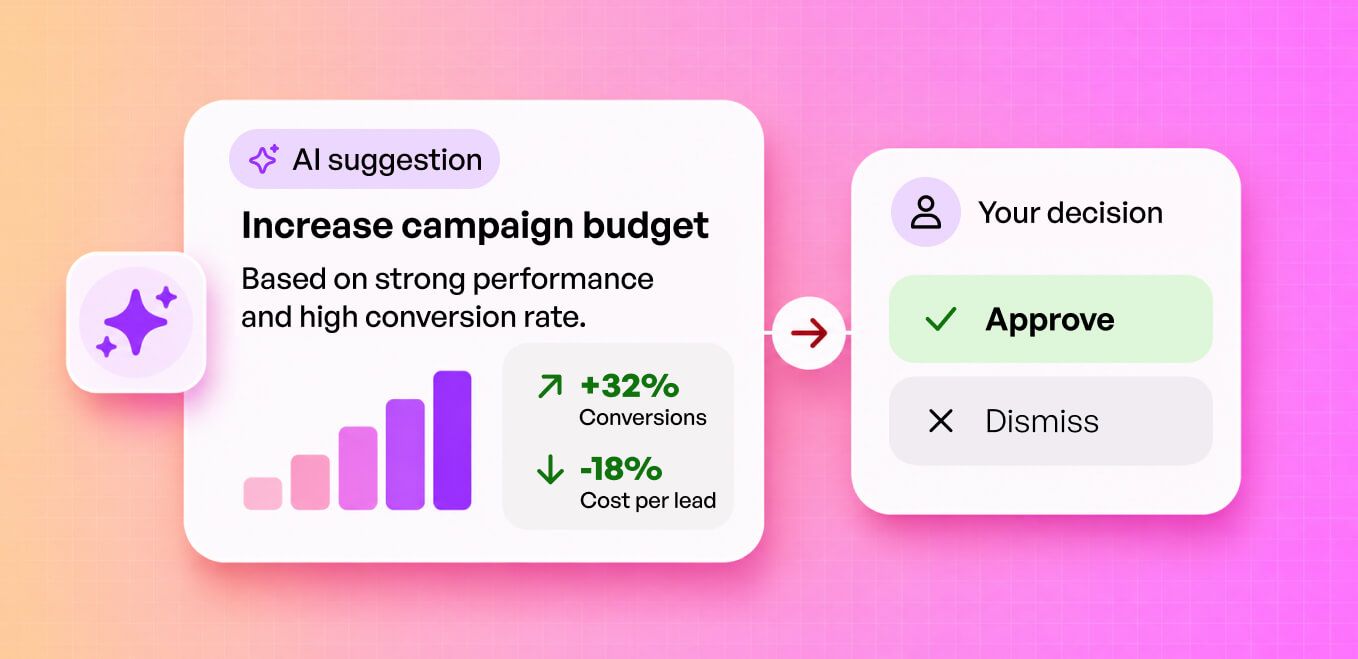
3. Move to draft and approve. Let it build a small batch of ads and a campaign draft, and approve every launch, budget change and pause.
4. Write your rules down. Target CPA, naming, budget caps, words your brand never uses in an ad. For example:
Goal: target CPA under $18, flag anything over $30 after 3 days
Naming: Brand_Market_Objective_Month
Budget: never raise a daily budget more than 30% at once
Brand: no discounts in hooks, show the product in the first 2 seconds
5. Hand over one routine at a time. Once a routine has run cleanly for a few weeks (a daily pacing check, say), let that one act on its own and keep approvals on everything else.
まとめ
Agentic marketing means AI agents that take a goal and your rules, then plan and run the work: research, creative, launch, monitoring and reporting, with a person approving the changes that matter. Adoption is early (13% of marketers, per Salesforce), agent washing is common, and the safest way in is in stages: read-only first, then draft and approve, then one trusted routine at a time.
One bonus thought: the biggest time savings usually come from the gaps between tasks. Exporting data, re-explaining context and copying a winning insight into the next brief eat more hours than any single task, and an agent that holds the whole loop removes them.
See how Creatify Max runs your ads
よくある質問
What is agentic marketing?
Agentic marketing is the use of AI agents that get a goal, rules and access to your tools, then plan and carry out the marketing work to reach that goal. In paid ads, that means researching competitors, making ads, launching campaigns and reporting, with people approving the big changes.
What is the difference between agentic AI and marketing automation?
Marketing automation follows rules you write in advance, like pausing an ad when spend passes a limit. Agentic AI decides the steps toward a goal, uses tools to act, and adjusts based on the results.
What are examples of agentic AI in marketing?
Google's Ask Advisor investigates campaign changes and applies supported fixes after your approval. TikTok's Symphony Automation generates video ads from a destination URL for Smart+ campaigns. Creatify Max researches competitors, makes ads, builds campaigns and runs scheduled reports across Meta, Google, TikTok and other ad platforms.
Are AI marketing agents safe to use with real ad budgets?
They're as safe as the limits you set. Start with read-only tasks, require approval for launches and budget changes, and set hard caps before you let any routine act on its own.
How many marketers use agentic AI?
Salesforce's 2026 State of Marketing report found 13% of marketers use agentic AI, while 75% of marketing organizations use some form of AI. BCG found only 8% of CMOs run campaigns where multiple agents operate autonomously.
What is agent washing?
Agent washing is Gartner's term for vendors relabeling chatbots, assistants or automation tools as AI agents. In June 2025, Gartner estimated only about 130 of the thousands of vendors claiming agentic AI were real.