
Ask 25 different AI models for a metaphor about time, and most of them say some version of "time is a river." That's one example from "Artificial Hivemind," a study of more than 70 models that won a best paper award at NeurIPS 2025, and it captures the whole debate about artificial intelligence and creativity in one line.
AI can produce ideas that score as creative, often more creative than the average person's. It also tends to produce the same ideas as every other AI. And when people use it, they get better and more alike at the same time.
Here's what the research says, where the popular claims go too far, and how to use AI for creativity without ending up with the same idea as everyone else.
Can AI create new ideas?
Yes, with an asterisk. In fields where a new idea can be checked automatically, AI has already produced results no human had found. Google DeepMind's AlphaEvolve found a way to multiply 4x4 complex-valued matrices with 48 multiplications, the first improvement in that setting since Strassen's 1969 algorithm, and improved the best known solutions on about 20% of the 50+ open math problems it was tested on.
The asterisk is the checker. AlphaEvolve works because a program scores every candidate. In open-ended work like ads, stories, or product concepts, there is no automatic grader for "good idea," and that's where the evidence gets more mixed.
AI creativity vs. humans: what the tests show
Psychologists measure creative potential with divergent thinking tests, like listing unusual uses for a fork, and most research on creativity and artificial intelligence starts there. AI does well on them.
In a 2024 Scientific Reports study, GPT-4 gave more original answers than 151 human participants across three divergent thinking tasks.
On the Torrance Tests of Creative Thinking, GPT-4 scored in the top 1% for originality and fluency against US norms, though that study used only 8 submissions.
In a 2023 study of 256 people, chatbots beat the average human, but the best humans still produced the top-rated answers in most comparisons.
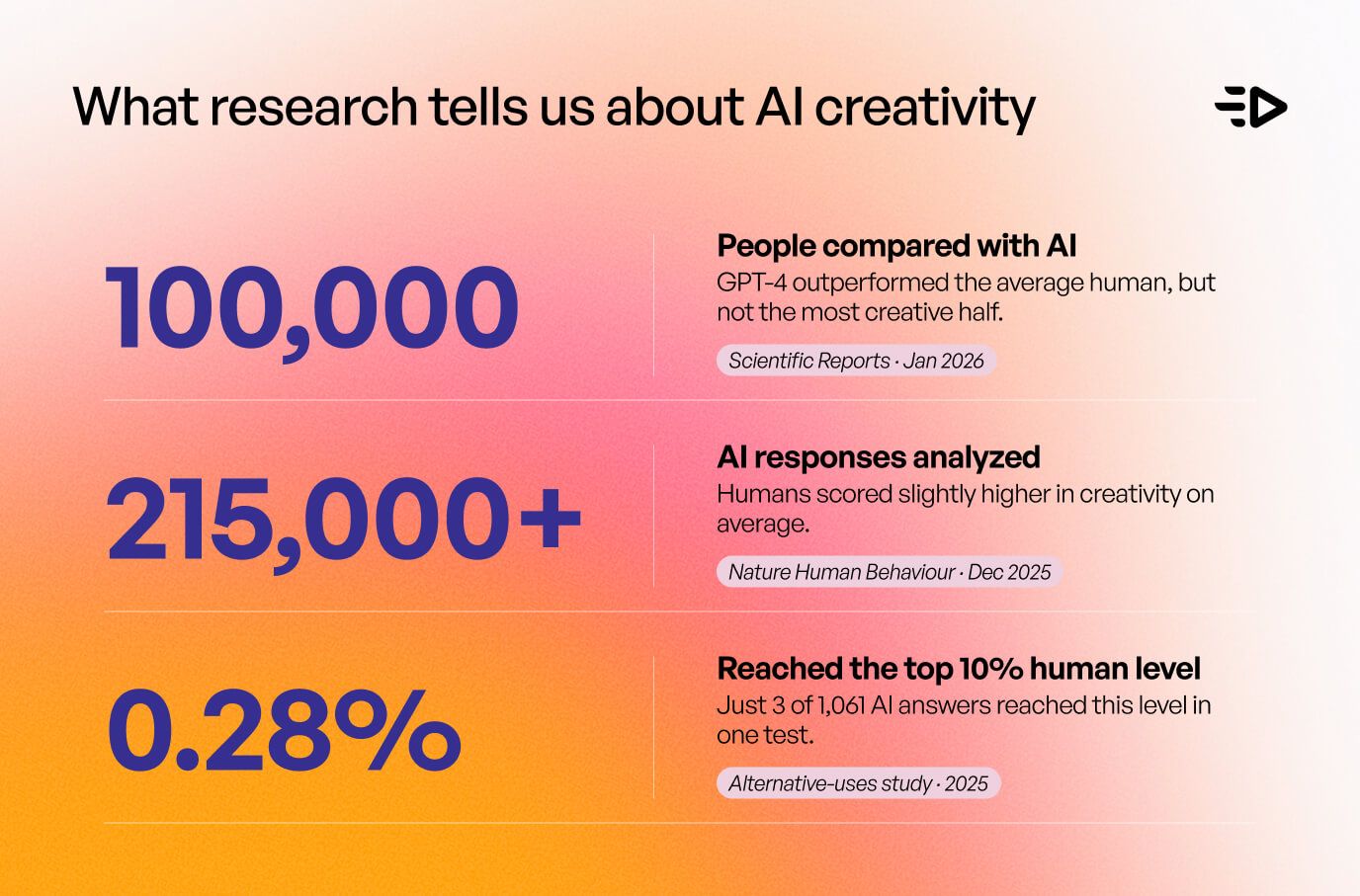
The largest test so far compared AI models with 100,000 people (Scientific Reports, January 2026). GPT-4 beat the average human on a word-association creativity test, but the more creative half of people still scored higher on average than even the best models.
And it depends on the test. A Nature Human Behaviour study published in December 2025 compared 9,198 people with more than 215,000 AI responses and found humans slightly more creative on average, with far more people at the very top. Telling the models to act like geniuses helped only up to a point.
And the models may have stalled. A 2025 study of 14 models, including GPT-4o, Claude 3.7, and DeepSeek-R1, found no improvement in creativity scores over the previous 18 to 24 months. All of them beat the median human on an alternative-uses task, but only 3 of 1,061 AI answers (0.28%) reached the level of the top 10% of humans.
Some test setups also flatter AI. In one replication, giving people more time and different instructions closed the gap between the best human answers and AI's. And when automated scorers grade only the core idea instead of how elaborately it's described, AI's originality edge shrinks or vanishes (a 2026 preprint).
How AI ideas hold up outside the lab
Creativity tests measure potential. Two studies looked at ideas meant for real use.
In a 2023 Wharton study, GPT-4 and students in a product design course pitched new products for college students. Consumers said they were more likely to buy GPT-4's ideas, and 35 of the top 40 ideas by purchase intent came from GPT-4. The students' ideas, though, were rated more novel.
Stanford researchers then asked more than 100 AI researchers to write and review research ideas. AI-generated ideas were rated more novel than the experts' (5.64 vs 4.84 out of 10). In a follow-up study, 43 experts each spent over 100 hours executing randomly assigned ideas. The AI ideas' scores dropped more than the human ones on every measure, and many rankings flipped. In that study, at least, AI ideas looked better on paper than they turned out.
One more detail from the Stanford study: the AI generated 4,000 seed ideas per topic, and only about 200 weren't duplicates.
The sameness problem
That duplication shows up everywhere. In the Artificial Hivemind study's main test of 100 open-ended prompts, a model's repeated answers to the same prompt were highly similar in about 79% of cases, even with randomness settings turned up. Different models from different companies converged on the same answers too.
A 2026 PNAS Nexus study put a number on it. Across 22 language models and 102 people, a single AI answer was about as original as a single human one. But the AI answers were far less varied as a group, and prompting the models to "be very creative" only partly closed the gap.
You can see it in the word lists from that 100,000-person study. 70% of GPT-4's answers included the word "microscope." The most common word among humans, "car," showed up in just 1.4% of theirs.
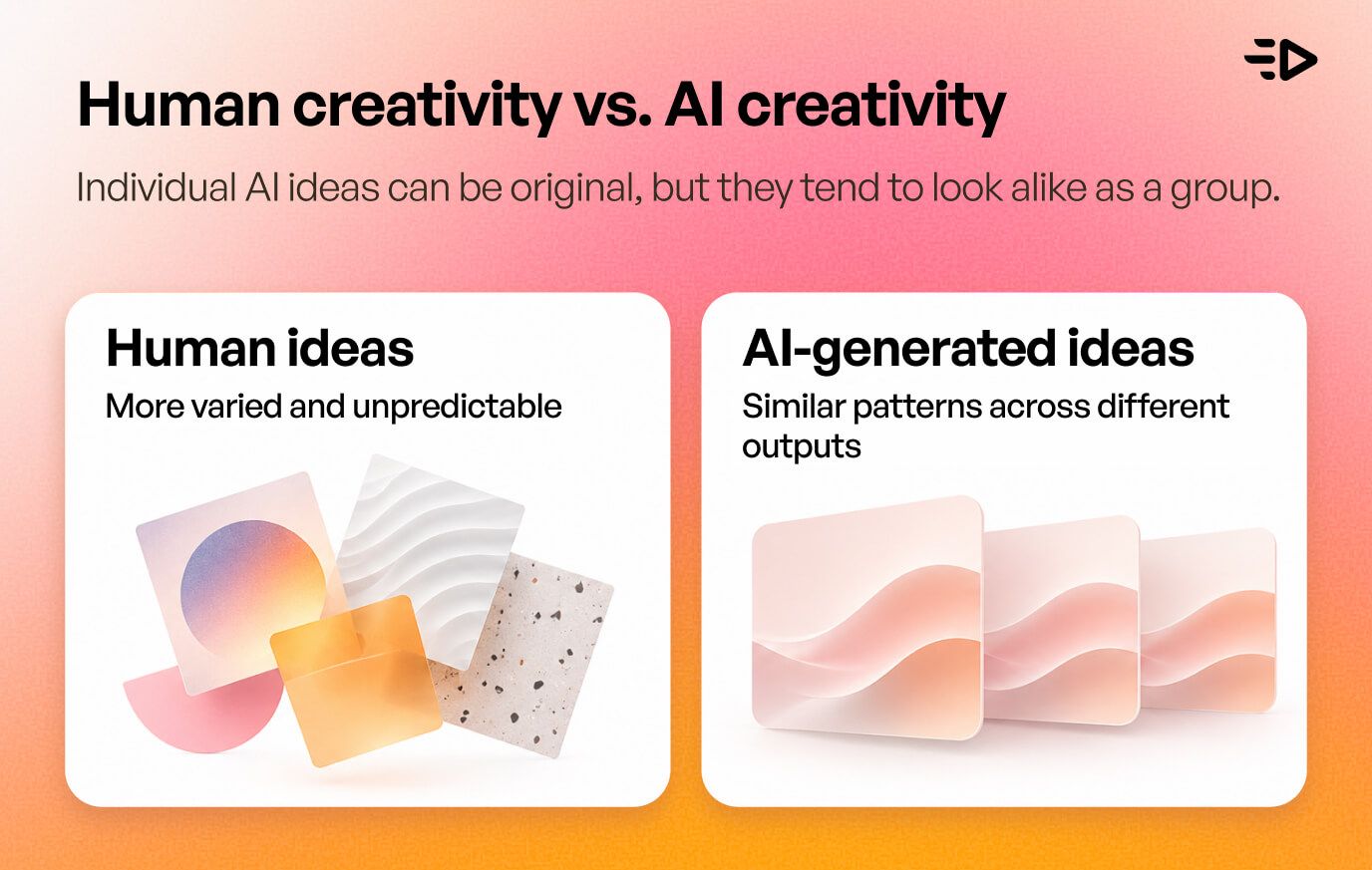
So the honest answer to "is AI creative?" is that each answer can be creative, and the answers as a group are repetitive.
How generative AI can augment human creativity and what it costs
Most of us aren't asking whether AI can out-think us. We're using it to think. Here, the most common finding is that people with AI produce better work, and their work looks more alike.
Short stories: in Doshi and Hauser's 2024 Science Advances study of 293 writers, access to up to 5 story ideas from GPT-4 made stories 8.1% more novel and 9% more useful, according to 600 evaluators. The least creative writers gained the most. But AI-assisted stories were more similar to each other.
Brainstorming: ChatGPT helped people produce ideas rated more creative, mostly incremental ones, in Lee and Chung's 2024 experiments. A 2025 Wharton reanalysis found that in one toy-design task, only 6% of ChatGPT's ideas were unique, against 100% of ideas from people working alone. Several participants even landed on the same toy name, "Build-a-Breeze Castle."
Consulting work: in a Harvard and BCG study of 758 consultants, GPT-4 raised the quality of creative product-innovation work by about a third in the published 2026 version (the 2023 working paper reported more than 40%). On a task outside what the AI did well, though, consultants using it were 19 percentage points less likely to get the right answer.
A 2025 meta-analysis of 28 studies and 8,214 participants pulls it together: AI alone was about as creative as humans alone, people using AI did better than people without it, and the diversity of ideas dropped sharply (it's a preprint, so treat the exact sizes with care). A second meta-analysis, published at a European ergonomics conference in September 2026, pooled 19 studies and found a small but significant homogenizing effect from AI use.
It isn't automatic, though. In a large experiment with more than 800 people, seeing lots of AI-written examples mixed into a pool of human ideas made the group's ideas more varied, while individual creativity stayed the same. How you bring AI in matters.
Does the AI boost last?
Often, it doesn't. In a University of Toronto study of 1,100 people (CHI 2025), participants who used AI help for a few rounds did no better, and in some conditions worse, once the AI was taken away. People who had been given AI-written creative strategies also kept producing more similar ideas than people who never used AI.
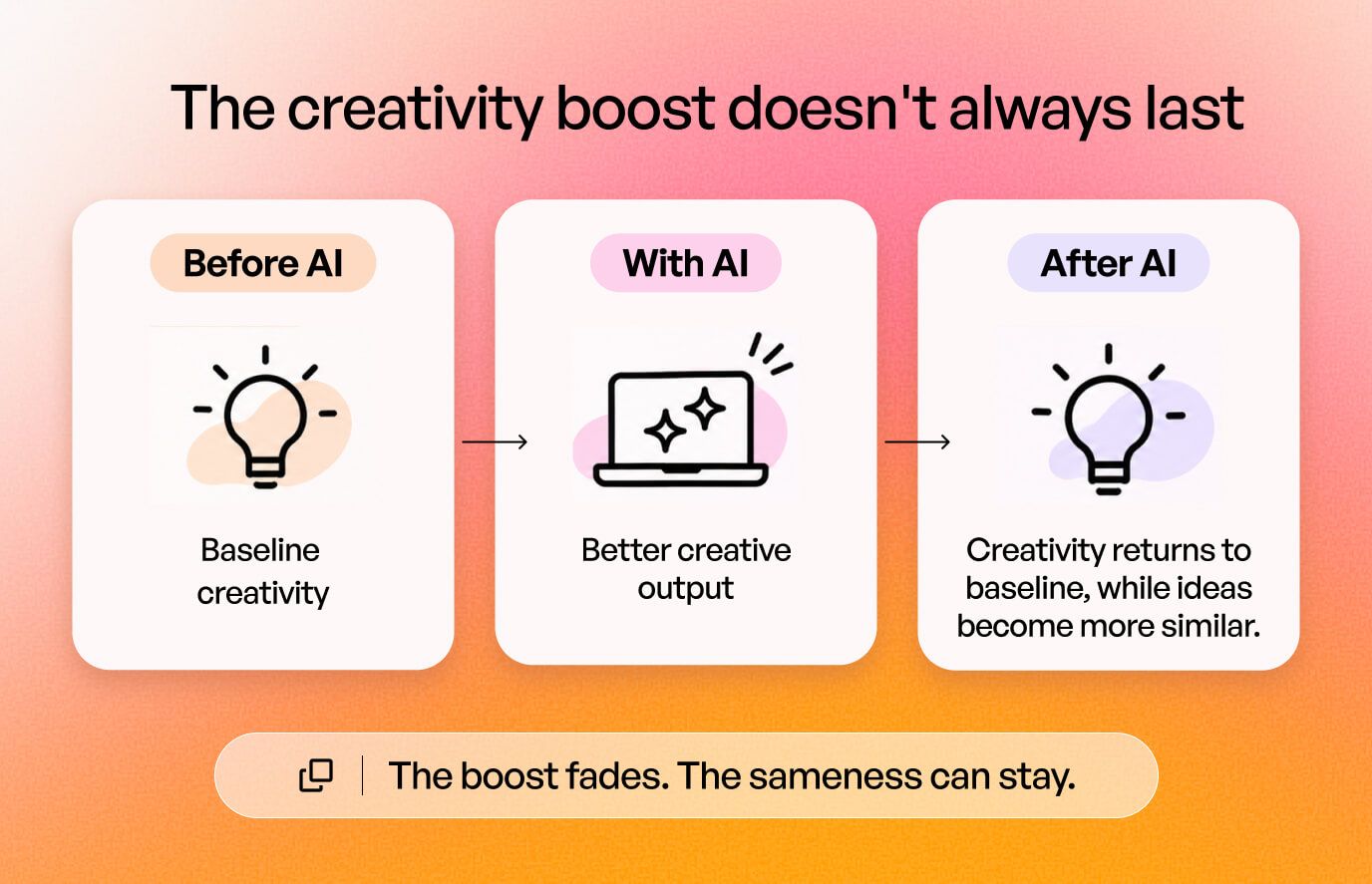
A smaller lab study published in Technology in Society followed 61 students over two months. Their creativity dropped back to baseline once ChatGPT was gone, while the sameness of their ideas kept climbing.
In these studies, the gain looked rented, and the sameness stuck around.
What this means for marketing and ads
In advertising, sameness costs money. If your ads look like your competitors' ads, they blend into the feed, and on Meta, agencies report that ads sharing the same look or opening hook can get treated as essentially the same ad.
The upside is real, too. In a 2025 study from NYU Stern and Emory, ads generated entirely by AI earned up to 19% higher click-through rates than ads made by human experts, while using AI to tweak human-made ads didn't help. One catch: labeling an ad as AI-generated cut clicks by as much as 31.5%.
So the goal for marketers is AI that widens your range of concepts, plus a process that keeps your own judgment in charge of which ideas run.
How to use AI for creativity without losing originality
The research points to a few habits for creativity with AI that keep the upside and limit the sameness.
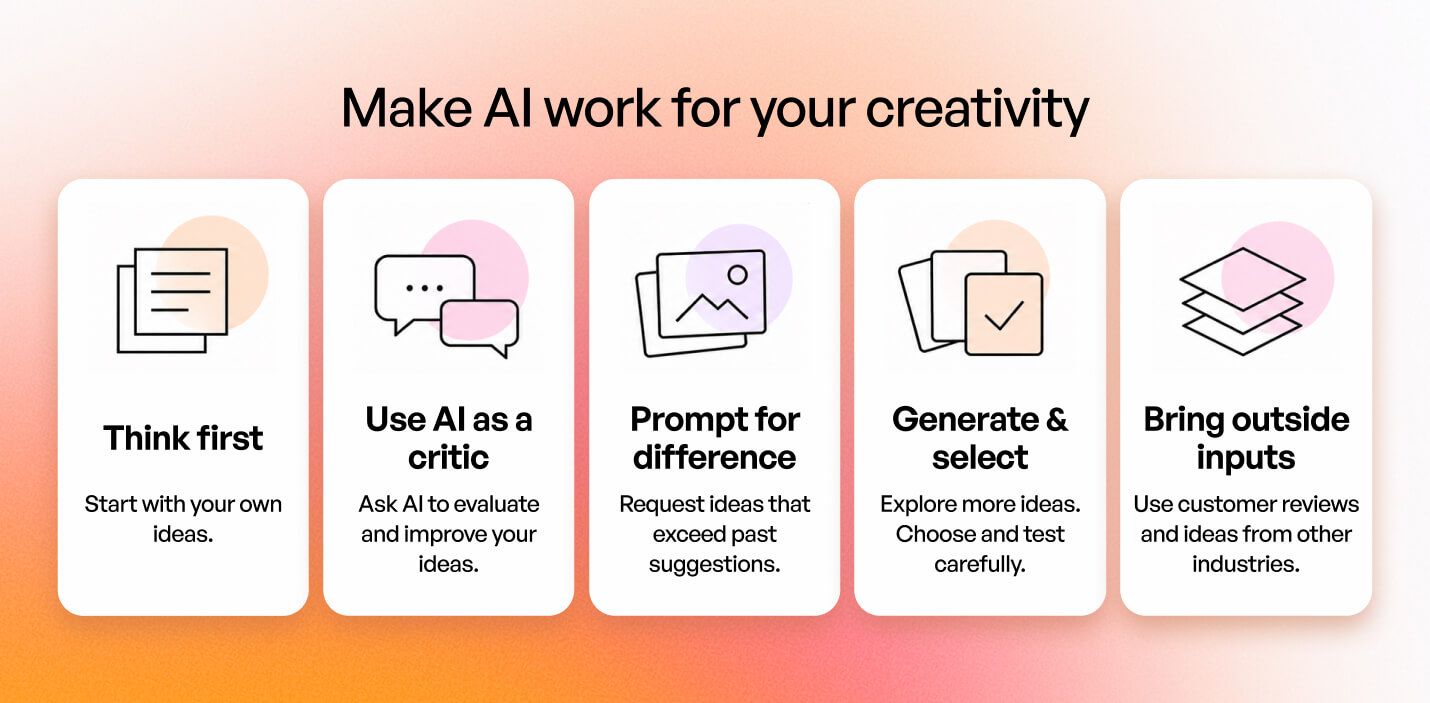
Think first, then bring in AI. In a 2026 study of 196 students, people who used ChatGPT freely did best on the first task, then fell back to the no-AI group's level once ChatGPT was gone. Students who wrote their own ideas first and then used ChatGPT to improve them beat both groups on the later task without AI.
Use AI as a critic. In a 2025 study that included more than 36,000 museum visitors, real-time AI scoring of people's own ideas made their ideas more original (it's a preprint).
Prompt for difference. Having GPT-4 work step by step (generate ideas, push them to be more different, then flesh them out) produced one of the most varied idea pools of 35 prompting strategies Wharton researchers tested. Asking for ideas that differ from the ones it already gave also helps.
Generate a lot, then choose hard. AI makes ideas cheap. The Wharton team expects the critical task to shift from generating ideas to evaluating and selecting them, so put your effort into picking and testing.
Bring in outside inputs. Different models often converge on the same answers, so feed in material AI wouldn't come up with on its own (customer reviews, sales calls, ideas from other industries).
How to increase your creativity, with or without AI
A few findings from creativity research hold up well and cost nothing.
Walk. In Stanford experiments, people's creative output on a brainstorming task rose about 60% while walking compared with sitting.
Keep going past your first ideas. People underestimate how many good ideas they have left. In Kellogg research, people expected their ideas to get worse as a brainstorm went on, but creativity held up or improved.
Take a break. A meta-analysis of 117 studies found that stepping away from a problem helps, especially for open-ended creative tasks and after you've worked on it for a while.
Add a constraint. A review of 145 studies suggests an inverted U: some constraints boost creativity, too many kill it.
Sleep on it. In a 2004 Nature study, more than twice as many people found a hidden shortcut in a task after sleeping than after staying awake.
Creatifyの立ち位置
In ads, the hard part of creativity is usually volume and range: enough clearly different concepts to test. That's where we built Creatify to help.
Creatify Agent researches your brand, studies competitors and trending content in your category, writes scripts, and produces finished video ads for about $5 to $8 each. In AdFlow, Co-Pilot proposes a creative angle (hook, scene structure, tone, and its reasoning), and you push back, swap the hook, or branch into variants that change a single element while keeping the rest.
That's how we'd apply the research: let AI widen the set of concepts, keep your judgment on which ones run, and let real campaign results decide.
まとめ
Can AI create new ideas? Yes. Top models beat the average person on several creativity tests, AI has produced real discoveries in math and computing, and it generates good ideas fast and cheap. The most creative people still beat it on those tests, its ideas tend to converge, and AI ideas that look great on paper can fade when executed.
For people, AI raises the quality of the average idea and lowers the variety across ideas, and the boost fades when the AI goes away. Think first, use AI to expand and critique, prompt for difference, and choose carefully.
One bonus thought: I think as more people lean on the same few models, distinctive ideas will get rarer and more valuable. As AI use spreads, the edge goes to marketers who use it to explore territory the default answer never reaches.
よくある質問
Can AI be creative?
On standard creativity tests, models like GPT-4 score above the average person, and in math and computing AI has found truly new results. Its weakness is variety: different models tend to give similar answers, and the most creative people still outperform it.
Is AI more creative than humans?
It beats the average person on some lab tests, but not the most creative people. In a 2026 study comparing AI models with 100,000 people, the more creative half of humans still scored higher on average than the best models, and a separate study of 9,198 people found humans slightly ahead on average.
How can generative AI augment human creativity?
It helps most when it adds options and feedback. Studies find people produce better work with AI, especially people who start out less creative, but their ideas become more alike, so use it to expand and critique ideas you've already started rather than to replace your first thinking.
Does using AI make you less creative?
It can leave you no better off once the AI is gone. Several studies found the creativity boost disappeared when AI help was removed, while ideas stayed more alike. Coming up with your own ideas first and using AI afterward protected later independent creativity in a 2026 study.
What is the best way to use AI for creativity?
Start with your own ideas, ask AI for many varied alternatives, prompt it to push its ideas further apart or avoid repeating itself, use it to critique your ideas, and test the best options with real people.
How do you increase your creativity?
Walk while you brainstorm, keep generating past your first few ideas, take breaks, work with a useful constraint, and sleep on hard problems. Each of these has experimental support.