
Equipo Creatify
COMPARTIR


EN ESTE ARTÍCULO
You have seen the video. A drone shot of a glass office, a CEO in a quarter-zip saying "innovation" and "partnership," some stock footage of hands typing, a logo, done. It cost a fortune and roughly nobody watched it. That video exists because someone treated B2B video as B2C with a suit on: same instincts, more restraint, a tie. This LinkedIn slop does not work, and the reason it does not work is worth grasping, because once you see what makes B2B genuinely different, the approach that moves pipeline becomes obvious.
This is a guide to that difference and to building a B2B video marketing strategy around it. First, what really separates B2B from B2C and what each difference means for your marketing asset. Then the plays that earn their keep, with B2B video marketing examples from real companies that ran them. It is written for marketing leads who are tired of pretty films that do nothing.
Why B2B video content is a different job
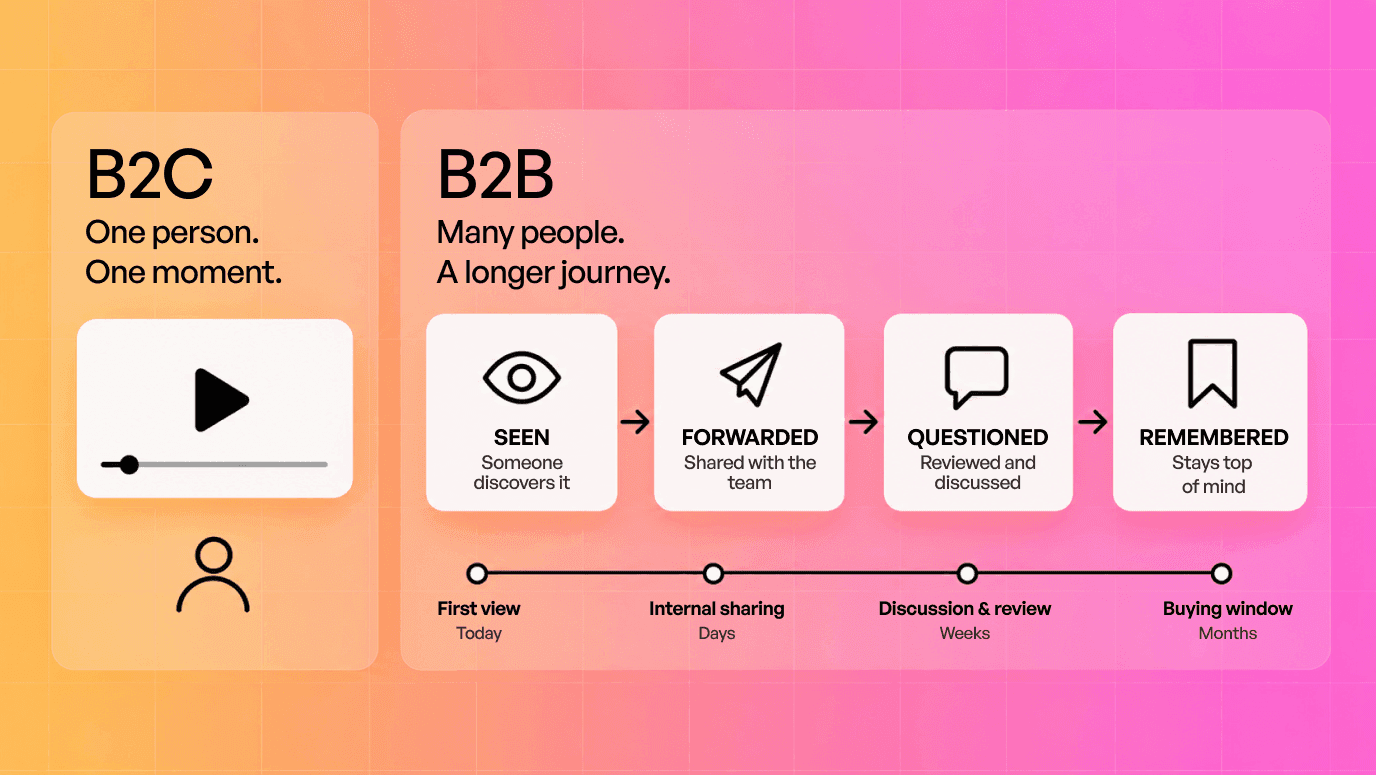
Here is the whole thing in one line. B2C video usually has to persuade one person in a single moment. B2B video has to help a group of people reach confidence over months, often before your brand ever gets a meeting. That is a different job, and it changes the brief for assets. Your video has to survive scrutiny from skeptics, travel through an organization in a forwarded link, and stay memorable long enough to be recalled when the buying window finally opens. The common misread is that a considered, high-stakes purchase calls for cautious, serious creative. The opposite is true: the longer and riskier the decision, the more your brand needs to be specific, distinctive, opinionated and remembered, which is exactly what dull corporate video fails to do.
What is really different about video marketing for B2B
You are not selling to one person, you are talking to a committee
The single biggest difference: nobody buys your product alone. Gartner's B2B buying research found that a typical purchase involves roughly six to ten decision-makers, each showing up with four or five pieces of research they gathered on their own. Treat that as a benchmark rather than a fresh 2026 statistic, but the shape is right.
So your video's real audience is often not the buyer watching it; it is the people that buyer forwards it to. The most useful B2B video is forwardable: something a champion can drop into a Slack channel or an email to finance, IT, security, and their boss, each of whom cares about something different. That is why one glossy hero video usually fails. You are better served by modular pieces aimed at distinct roles and specific pains, the ROI angle for finance, the security and integration angle for IT, the day-to-day ease angle for the people who will live in the thing.
The cycle is long, and it loops
B2B decisions play out over months instead of minutes, and they are not a tidy funnel. Gartner describes buying as a set of jobs (identifying the problem, exploring solutions, building requirements, choosing a supplier, validating, and getting everyone to agree) that buyers loop through in no fixed order. So a single "conversion" video is the wrong unit. What works is a B2B video content marketing system that spans the journey: problem and category videos for people who do not yet know they have a problem, use-case explainers and technical walkthroughs for people evaluating, and proof and implementation content for people trying to get to yes. And because the decision takes months, urgency gimmicks like countdown timers are pointless; the job is to be remembered, not to force a click today.
Your buyers barely talk to sales
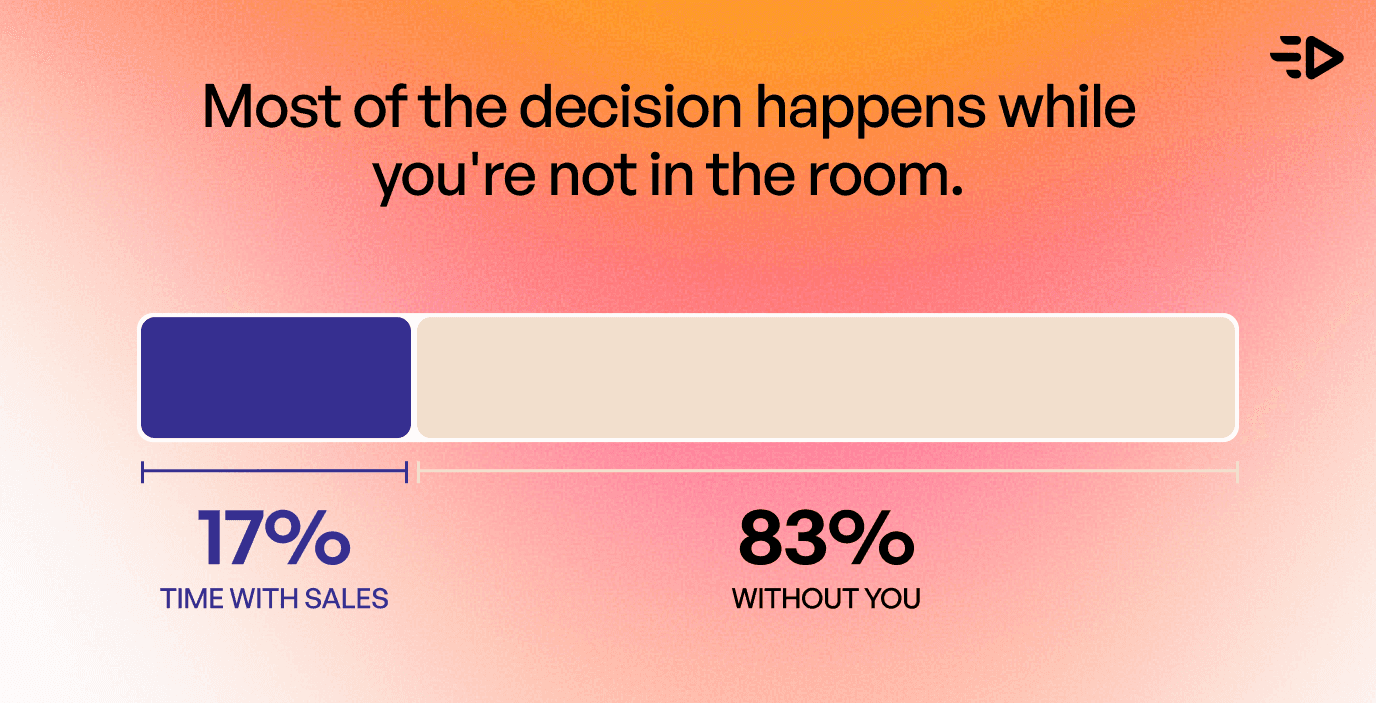
In Gartner's research, buyers spent only about 17% of their purchase time meeting with potential suppliers, and when they are comparing several vendors, each one gets a sliver of that. Most of the decision happens while you are not in the room. The implication for video is: it has to work with no salesperson narrating it. That means clear titles, plain searchable language, chapters or short modular clips someone can jump around in, and an obvious next step, because the person watching may be alone at 11pm building a business case for a meeting you will never attend.
Ninety-five percent of your market is not buying right now
The Ehrenberg-Bass Institute's work, popularized by LinkedIn's B2B Institute, gives us the 95-5 rule: at any given moment, only around 5% of potential buyers are in-market, and about 95% are not. It is a heuristic, and the exact split varies by category and season, but the lesson holds. If all your video chases the 5% ready to buy, you are ignoring the 95% who will buy eventually and who will only remember the brands that taught or entertained them while they were not looking. Distinctive, memorable video aimed at that 95% is a brand investment, so judge it on longer horizons than this quarter's demo requests.
It is rational and emotional, not one or the other
The tired stereotype in video marketing: B2B is a spreadsheet and B2C is emotional. The research from Google, CEB, and Motista, known as "From Promotion to Emotion," found the opposite can be true: B2B buyers are often more emotionally connected to the brands they buy, because a business purchase carries personal stakes, your credibility, your job, your reputation if it goes wrong. This does not mean emotion beats logic; it means you need both. Pair the functional proof (the workflow, the results, the implementation detail) with the human stakes (relief, competence, looking smart to your boss, not getting fired for a bad call).
The audience is niche, and a lot happens in the dark
With video, B2B marketing usually targets a narrow slice: a specific role, industry, tech stack, or company size. That is a gift, because specificity outperforms reach for its own sake. "For RevOps teams drowning in call data" will always beat "the future of work." And much of what shapes a B2B decision, the peer advice, the internal debate, the link shared in a private channel, happens where you cannot track it. So build video to be a shareable decision artifact: give it a real title, a simple link, and clips a champion can genuinely reuse.
The plays worth trying: B2B video marketing examples that work
Now the fun part: the moves that work, and the companies that proved them.
Founder or executive point of view
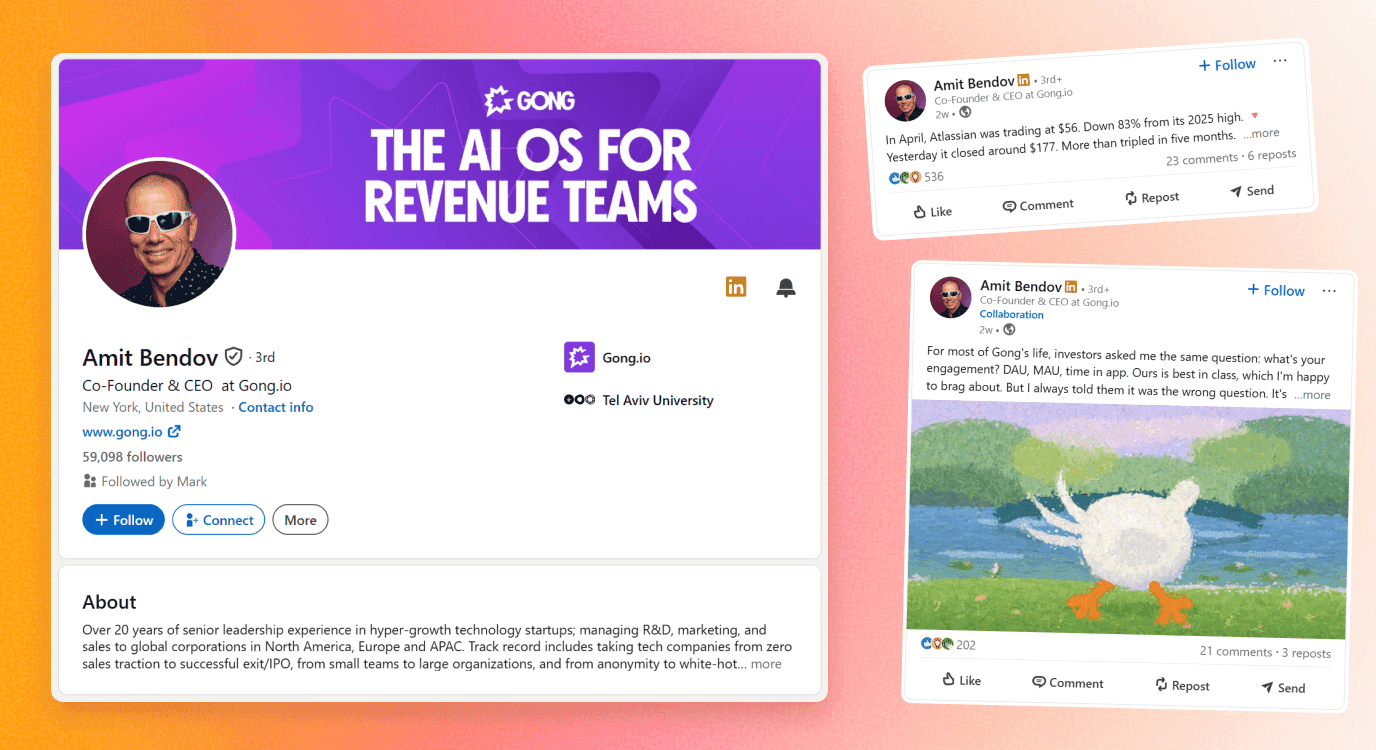
Give a credible person inside the company a sharp, repeatable opinion about the buyer's world, and put it where the buyer already spends time. Gong is the reference case: as part of a broader thought-leadership and employee-advocacy push, its executives, including co-founder and CEO Amit Bendov and longtime marketing leader Udi Ledergor, built recognizable voices on LinkedIn around sales, revenue, and go-to-market, making the people behind the product part of its credibility. The lesson is not "post every day." It is to turn an operator into an editorial franchise with a real point of view, not a talking head reading product news.
Tell the customer story as a real story
The most-loved B2B video ever made is arguably Slack's "So Yeah, We Tried Slack," produced with the video studio Sandwich in 2014. It is a mockumentary of Sandwich itself, skeptical at first, adopting Slack and being changed by it, shot documentary-style in their own office with employees playing themselves. It opens on the objection ("tools like this never work") and resolves it through a relatable team's lived experience rather than a list of features. It is a product intro, a customer story, and a genuinely funny film at once. That is the template: make the viewer watch someone like them get the win.
Show the work
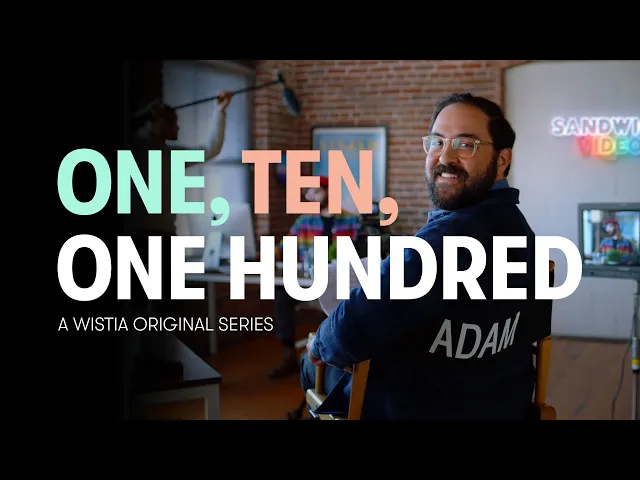
Teach your buyers something useful whether or not they ever pay you, which is how you earn attention during that long out-of-market stretch. Wistia's "One, Ten, One Hundred" (made with Sandwich in 2018) is the model: they produced the same ad at three budgets, $1,000, $10,000, and $100,000, and wrapped a documentary around the creative choices. A video-hosting company made the craft and economics of video itself the story, which is category education and brand-building in one. Wistia has said it saw lasting lifts from it; take the exact numbers as their own reporting, but the play is sound.
Make the invisible vivid

If your product's benefit is hard to see, do not narrate it, dramatize its consequence. Volvo Trucks did this in 2013 with "The Epic Split," where Jean-Claude Van Damme performs a split between two reversing trucks to make an abstract claim about steering precision unforgettable in one shot. GE did the abstract version the same year with "Datalandia," using a town menaced by vampires to explain what data analytics could do, a spot Marketing Dive reported passing 700,000 YouTube views at the time. Neither is B2C fluff; both sell to businesses, and both prove that a technical or "boring" category can be the most creative brief in the building.
Build proof for the whole committee
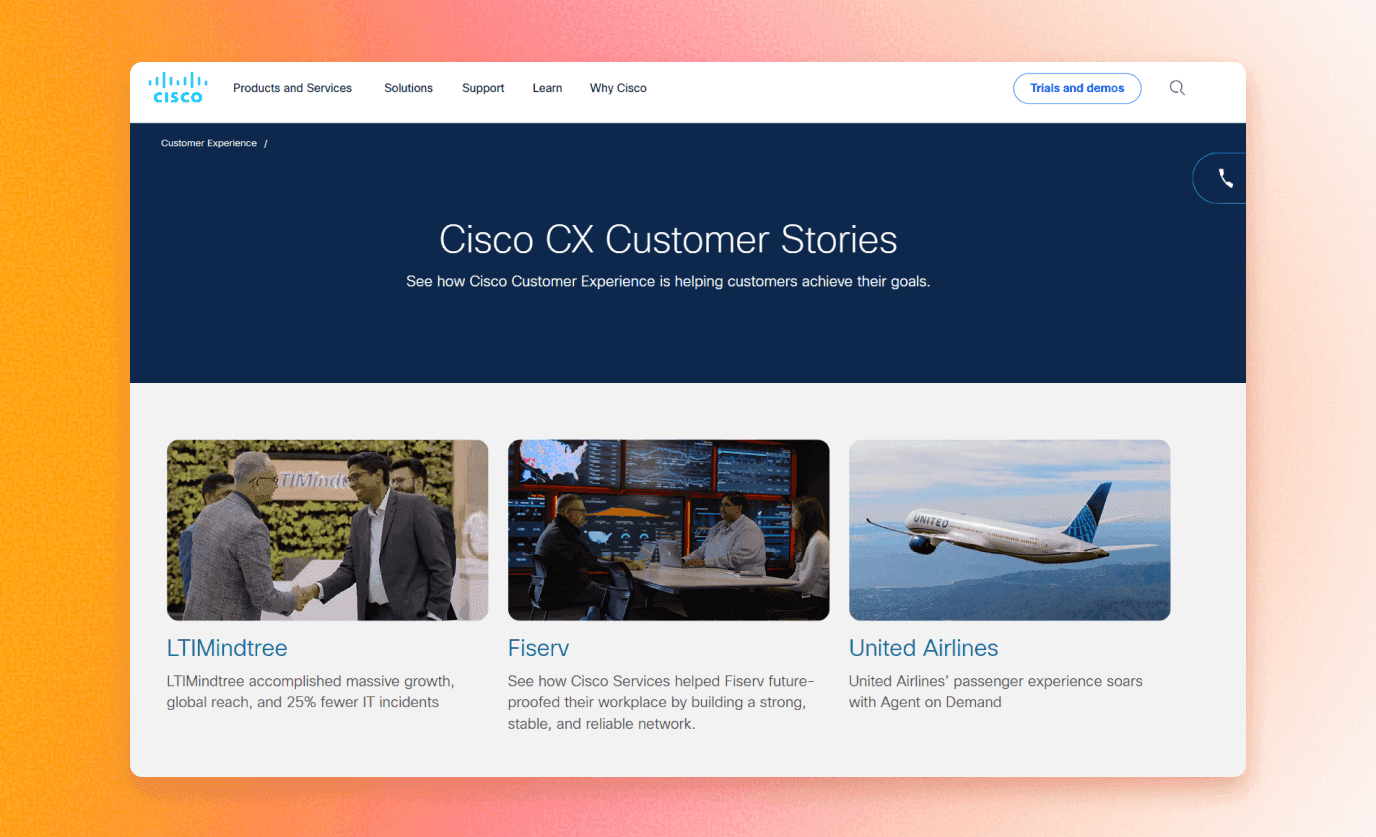
Because a group has to agree, your customer proof has to be specific enough that different stakeholders trust and reuse it. Cisco's customer-story library is a good model at scale: stories that name the customer, spell out the prior constraint, describe what was implemented, and show a concrete outcome. That specificity is what makes a case study portable inside a buying group; a vague "they loved us" testimonial gives a champion nothing to forward.
Assemble an internal champion kit
This is the direct video answer to committee buying. Make one strong flagship video, then deliberately produce the pieces around it that a champion can circulate: a 45-to-90-second overview for executives, a role-specific clip for the technical evaluator, a two-to-five-minute workflow walkthrough for people actively testing, a named-customer proof clip, and a one-page summary that repeats the core evidence. The goal is not volume for its own sake; it is making your case portable so it survives the meetings you are not in.
Put video in the sales motion, one to one
Not every B2B marketing video is broadcast. Async, personal video, the kind Vidyard and Loom are built for, lets a rep record a short screen-and-camera message that shows they did the homework and gives the recipient something easy to forward internally. Loom has reported that Intercom lifted its cold-email reply rate by 19% after adding video messages to outreach; treat that as a vendor case study rather than a universal benchmark, but the principle is real: a specific, personal clip beats another templated email.
Earn attention with short-form clips
You do not need a film for every idea. One insight, one teardown, one objection answered, cut into a short clip for LinkedIn or YouTube, is how you stay visible to that 95% who are not buying yet. LinkedIn's own benchmark research has pointed to short-form social video as the highest-return video format among the marketers it surveyed; it is self-reported, so hold it loosely, but the direction matches what works. Use short clips to earn the first bit of attention, then route interested viewers to the deeper proof.
Where to start with your B2B video marketing strategy
If this is a lot, start narrow. Pick your highest-stakes buyer role and the one objection that most often stalls your deals, and make a single forwardable video that resolves it, with a clear title and a couple of modular clips cut from it. Add one named-customer proof clip so a champion has something concrete to pass around. Distribute where the out-of-market majority already are, which for most B2B is LinkedIn and YouTube, using short-form to earn attention. Then judge it over quarters, not days.
The honest bottleneck for most teams is not ideas, it is production: the champion kit and the short-form cadence both call for many role-specific cuts and variations, which is more than one video a quarter. That volume problem is what we built Creatify for, turning a script or a product URL into on-brand B2B video variations you can test without booking a shoot. However you make them, the shift that matters is the one this whole piece is about: stop making one polished video for an imaginary single buyer, and start making video that helps a real group of people get to yes.
▶ Read also: How to make a clothing ad that converts, with examples
Frequently Asked Questions
What makes B2B video marketing different from B2C?
The buyer is a group, not a person; the decision takes months and loops rather than converting in a moment; and most of it happens without a salesperson in the room. So B2B video has to be forwardable across a committee, work without narration, and stay memorable over a long cycle, rather than driving an impulse purchase from one viewer.
What should a B2B video marketing strategy include?
A system of video across the buying journey rather than one hero film. That means problem and category videos for people who do not yet know they have a problem, use-case explainers and technical walkthroughs for people evaluating, and proof and implementation content for people trying to get to yes. Around a flagship video, build a champion kit of role-specific clips, and use short-form on LinkedIn and YouTube to stay visible to the 95% who are not buying yet.
What types of B2B video really work?
Founder or executive point-of-view content, customer stories told as real stories, "show the work" education, vivid demonstrations that make an abstract benefit visible, specific customer-proof clips built for a buying committee, one-to-one async sales video, and short-form clips for LinkedIn and YouTube. The best programs use several of these as connected assets across the buyer's journey, not one hero video.
How do you measure B2B video?
Not by immediate demo requests alone, because most of your audience is not in-market yet. Track leading signals over longer horizons: branded search, direct traffic, engagement and saves on short-form, how often sales and champions use your videos in real deals, and self-reported "how did you hear about us" data. Judge brand-building video across quarters, and reserve fast conversion metrics for bottom-of-funnel assets.
Does B2B video have to be serious?
No, and serious is often the problem. Slack, Wistia, Volvo Trucks, and GE all sold to businesses with genuinely creative, funny, or dramatic video. A long, high-stakes purchase makes distinctiveness more valuable, not less, because your brand has to be remembered across months and across a whole committee. The rule is that the creativity has to carry a real point, not that it has to wear a suit.
How much should you spend on B2B video?
Less on polish than most teams assume, and more on volume and relevance. Wistia's "One, Ten, One Hundred" experiment showed budget matters far less than the idea. For most B2B teams, a steady stream of specific, role-aware video (some of it filmed on a webcam) will outperform one expensive brand film, because it feeds the champion kit, the sales motion, and the short-form cadence that move a committee.
You have seen the video. A drone shot of a glass office, a CEO in a quarter-zip saying "innovation" and "partnership," some stock footage of hands typing, a logo, done. It cost a fortune and roughly nobody watched it. That video exists because someone treated B2B video as B2C with a suit on: same instincts, more restraint, a tie. This LinkedIn slop does not work, and the reason it does not work is worth grasping, because once you see what makes B2B genuinely different, the approach that moves pipeline becomes obvious.
This is a guide to that difference and to building a B2B video marketing strategy around it. First, what really separates B2B from B2C and what each difference means for your marketing asset. Then the plays that earn their keep, with B2B video marketing examples from real companies that ran them. It is written for marketing leads who are tired of pretty films that do nothing.
Why B2B video content is a different job
Here is the whole thing in one line. B2C video usually has to persuade one person in a single moment. B2B video has to help a group of people reach confidence over months, often before your brand ever gets a meeting. That is a different job, and it changes the brief for assets. Your video has to survive scrutiny from skeptics, travel through an organization in a forwarded link, and stay memorable long enough to be recalled when the buying window finally opens. The common misread is that a considered, high-stakes purchase calls for cautious, serious creative. The opposite is true: the longer and riskier the decision, the more your brand needs to be specific, distinctive, opinionated and remembered, which is exactly what dull corporate video fails to do.
What is really different about video marketing for B2B
You are not selling to one person, you are talking to a committee
The single biggest difference: nobody buys your product alone. Gartner's B2B buying research found that a typical purchase involves roughly six to ten decision-makers, each showing up with four or five pieces of research they gathered on their own. Treat that as a benchmark rather than a fresh 2026 statistic, but the shape is right.
So your video's real audience is often not the buyer watching it; it is the people that buyer forwards it to. The most useful B2B video is forwardable: something a champion can drop into a Slack channel or an email to finance, IT, security, and their boss, each of whom cares about something different. That is why one glossy hero video usually fails. You are better served by modular pieces aimed at distinct roles and specific pains, the ROI angle for finance, the security and integration angle for IT, the day-to-day ease angle for the people who will live in the thing.
The cycle is long, and it loops
B2B decisions play out over months instead of minutes, and they are not a tidy funnel. Gartner describes buying as a set of jobs (identifying the problem, exploring solutions, building requirements, choosing a supplier, validating, and getting everyone to agree) that buyers loop through in no fixed order. So a single "conversion" video is the wrong unit. What works is a B2B video content marketing system that spans the journey: problem and category videos for people who do not yet know they have a problem, use-case explainers and technical walkthroughs for people evaluating, and proof and implementation content for people trying to get to yes. And because the decision takes months, urgency gimmicks like countdown timers are pointless; the job is to be remembered, not to force a click today.
Your buyers barely talk to sales
In Gartner's research, buyers spent only about 17% of their purchase time meeting with potential suppliers, and when they are comparing several vendors, each one gets a sliver of that. Most of the decision happens while you are not in the room. The implication for video is: it has to work with no salesperson narrating it. That means clear titles, plain searchable language, chapters or short modular clips someone can jump around in, and an obvious next step, because the person watching may be alone at 11pm building a business case for a meeting you will never attend.
Ninety-five percent of your market is not buying right now
The Ehrenberg-Bass Institute's work, popularized by LinkedIn's B2B Institute, gives us the 95-5 rule: at any given moment, only around 5% of potential buyers are in-market, and about 95% are not. It is a heuristic, and the exact split varies by category and season, but the lesson holds. If all your video chases the 5% ready to buy, you are ignoring the 95% who will buy eventually and who will only remember the brands that taught or entertained them while they were not looking. Distinctive, memorable video aimed at that 95% is a brand investment, so judge it on longer horizons than this quarter's demo requests.
It is rational and emotional, not one or the other
The tired stereotype in video marketing: B2B is a spreadsheet and B2C is emotional. The research from Google, CEB, and Motista, known as "From Promotion to Emotion," found the opposite can be true: B2B buyers are often more emotionally connected to the brands they buy, because a business purchase carries personal stakes, your credibility, your job, your reputation if it goes wrong. This does not mean emotion beats logic; it means you need both. Pair the functional proof (the workflow, the results, the implementation detail) with the human stakes (relief, competence, looking smart to your boss, not getting fired for a bad call).
The audience is niche, and a lot happens in the dark
With video, B2B marketing usually targets a narrow slice: a specific role, industry, tech stack, or company size. That is a gift, because specificity outperforms reach for its own sake. "For RevOps teams drowning in call data" will always beat "the future of work." And much of what shapes a B2B decision, the peer advice, the internal debate, the link shared in a private channel, happens where you cannot track it. So build video to be a shareable decision artifact: give it a real title, a simple link, and clips a champion can genuinely reuse.
The plays worth trying: B2B video marketing examples that work
Now the fun part: the moves that work, and the companies that proved them.
Founder or executive point of view
Give a credible person inside the company a sharp, repeatable opinion about the buyer's world, and put it where the buyer already spends time. Gong is the reference case: as part of a broader thought-leadership and employee-advocacy push, its executives, including co-founder and CEO Amit Bendov and longtime marketing leader Udi Ledergor, built recognizable voices on LinkedIn around sales, revenue, and go-to-market, making the people behind the product part of its credibility. The lesson is not "post every day." It is to turn an operator into an editorial franchise with a real point of view, not a talking head reading product news.
Tell the customer story as a real story
The most-loved B2B video ever made is arguably Slack's "So Yeah, We Tried Slack," produced with the video studio Sandwich in 2014. It is a mockumentary of Sandwich itself, skeptical at first, adopting Slack and being changed by it, shot documentary-style in their own office with employees playing themselves. It opens on the objection ("tools like this never work") and resolves it through a relatable team's lived experience rather than a list of features. It is a product intro, a customer story, and a genuinely funny film at once. That is the template: make the viewer watch someone like them get the win.
Show the work
Teach your buyers something useful whether or not they ever pay you, which is how you earn attention during that long out-of-market stretch. Wistia's "One, Ten, One Hundred" (made with Sandwich in 2018) is the model: they produced the same ad at three budgets, $1,000, $10,000, and $100,000, and wrapped a documentary around the creative choices. A video-hosting company made the craft and economics of video itself the story, which is category education and brand-building in one. Wistia has said it saw lasting lifts from it; take the exact numbers as their own reporting, but the play is sound.
Make the invisible vivid
If your product's benefit is hard to see, do not narrate it, dramatize its consequence. Volvo Trucks did this in 2013 with "The Epic Split," where Jean-Claude Van Damme performs a split between two reversing trucks to make an abstract claim about steering precision unforgettable in one shot. GE did the abstract version the same year with "Datalandia," using a town menaced by vampires to explain what data analytics could do, a spot Marketing Dive reported passing 700,000 YouTube views at the time. Neither is B2C fluff; both sell to businesses, and both prove that a technical or "boring" category can be the most creative brief in the building.
Build proof for the whole committee
Because a group has to agree, your customer proof has to be specific enough that different stakeholders trust and reuse it. Cisco's customer-story library is a good model at scale: stories that name the customer, spell out the prior constraint, describe what was implemented, and show a concrete outcome. That specificity is what makes a case study portable inside a buying group; a vague "they loved us" testimonial gives a champion nothing to forward.
Assemble an internal champion kit
This is the direct video answer to committee buying. Make one strong flagship video, then deliberately produce the pieces around it that a champion can circulate: a 45-to-90-second overview for executives, a role-specific clip for the technical evaluator, a two-to-five-minute workflow walkthrough for people actively testing, a named-customer proof clip, and a one-page summary that repeats the core evidence. The goal is not volume for its own sake; it is making your case portable so it survives the meetings you are not in.
Put video in the sales motion, one to one
Not every B2B marketing video is broadcast. Async, personal video, the kind Vidyard and Loom are built for, lets a rep record a short screen-and-camera message that shows they did the homework and gives the recipient something easy to forward internally. Loom has reported that Intercom lifted its cold-email reply rate by 19% after adding video messages to outreach; treat that as a vendor case study rather than a universal benchmark, but the principle is real: a specific, personal clip beats another templated email.
Earn attention with short-form clips
You do not need a film for every idea. One insight, one teardown, one objection answered, cut into a short clip for LinkedIn or YouTube, is how you stay visible to that 95% who are not buying yet. LinkedIn's own benchmark research has pointed to short-form social video as the highest-return video format among the marketers it surveyed; it is self-reported, so hold it loosely, but the direction matches what works. Use short clips to earn the first bit of attention, then route interested viewers to the deeper proof.
Where to start with your B2B video marketing strategy
If this is a lot, start narrow. Pick your highest-stakes buyer role and the one objection that most often stalls your deals, and make a single forwardable video that resolves it, with a clear title and a couple of modular clips cut from it. Add one named-customer proof clip so a champion has something concrete to pass around. Distribute where the out-of-market majority already are, which for most B2B is LinkedIn and YouTube, using short-form to earn attention. Then judge it over quarters, not days.
The honest bottleneck for most teams is not ideas, it is production: the champion kit and the short-form cadence both call for many role-specific cuts and variations, which is more than one video a quarter. That volume problem is what we built Creatify for, turning a script or a product URL into on-brand B2B video variations you can test without booking a shoot. However you make them, the shift that matters is the one this whole piece is about: stop making one polished video for an imaginary single buyer, and start making video that helps a real group of people get to yes.
▶ Read also: How to make a clothing ad that converts, with examples
Frequently Asked Questions
What makes B2B video marketing different from B2C?
The buyer is a group, not a person; the decision takes months and loops rather than converting in a moment; and most of it happens without a salesperson in the room. So B2B video has to be forwardable across a committee, work without narration, and stay memorable over a long cycle, rather than driving an impulse purchase from one viewer.
What should a B2B video marketing strategy include?
A system of video across the buying journey rather than one hero film. That means problem and category videos for people who do not yet know they have a problem, use-case explainers and technical walkthroughs for people evaluating, and proof and implementation content for people trying to get to yes. Around a flagship video, build a champion kit of role-specific clips, and use short-form on LinkedIn and YouTube to stay visible to the 95% who are not buying yet.
What types of B2B video really work?
Founder or executive point-of-view content, customer stories told as real stories, "show the work" education, vivid demonstrations that make an abstract benefit visible, specific customer-proof clips built for a buying committee, one-to-one async sales video, and short-form clips for LinkedIn and YouTube. The best programs use several of these as connected assets across the buyer's journey, not one hero video.
How do you measure B2B video?
Not by immediate demo requests alone, because most of your audience is not in-market yet. Track leading signals over longer horizons: branded search, direct traffic, engagement and saves on short-form, how often sales and champions use your videos in real deals, and self-reported "how did you hear about us" data. Judge brand-building video across quarters, and reserve fast conversion metrics for bottom-of-funnel assets.
Does B2B video have to be serious?
No, and serious is often the problem. Slack, Wistia, Volvo Trucks, and GE all sold to businesses with genuinely creative, funny, or dramatic video. A long, high-stakes purchase makes distinctiveness more valuable, not less, because your brand has to be remembered across months and across a whole committee. The rule is that the creativity has to carry a real point, not that it has to wear a suit.
How much should you spend on B2B video?
Less on polish than most teams assume, and more on volume and relevance. Wistia's "One, Ten, One Hundred" experiment showed budget matters far less than the idea. For most B2B teams, a steady stream of specific, role-aware video (some of it filmed on a webcam) will outperform one expensive brand film, because it feeds the champion kit, the sales motion, and the short-form cadence that move a committee.

¿Listo para convertir tu producto en un video atractivo?