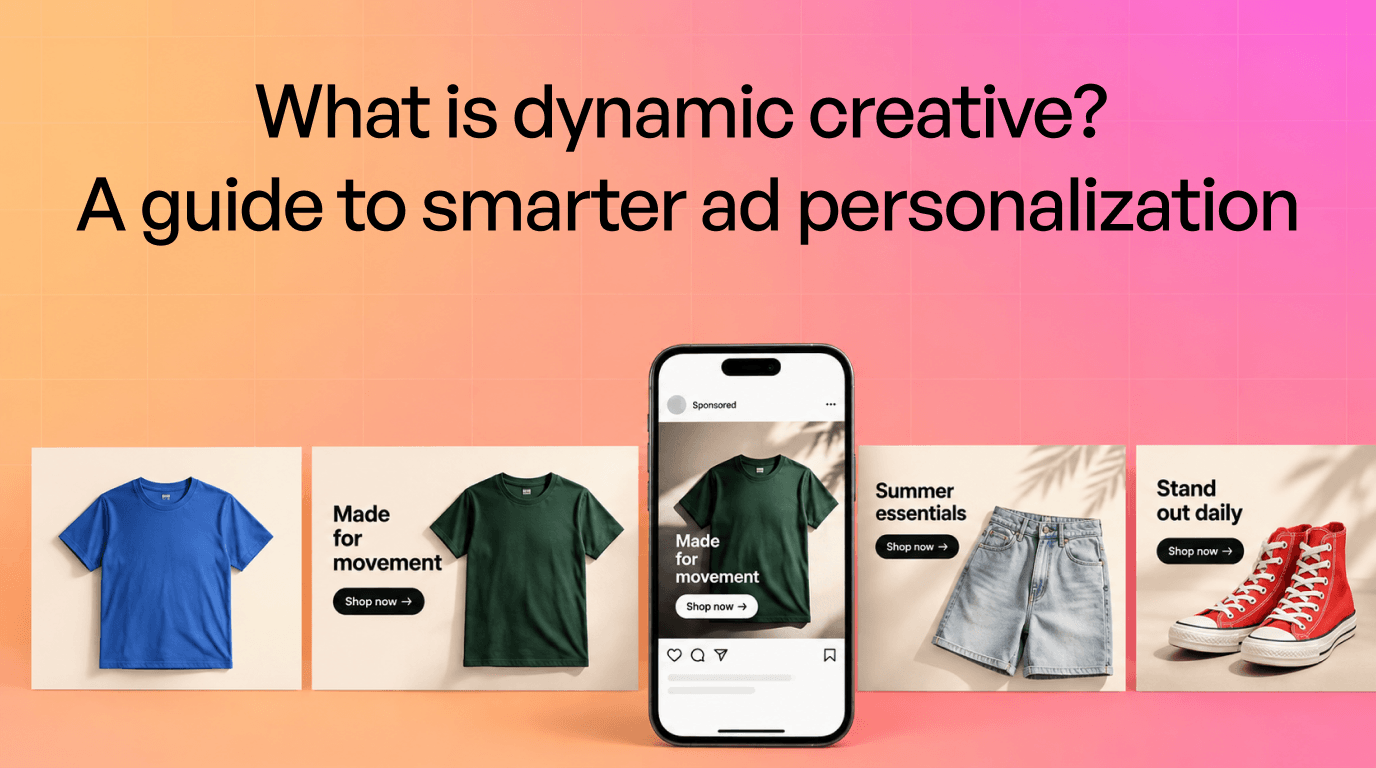

When Facebook launched Dynamic Creative in 2017, an advertiser could upload 30 assets and get up to 6,250 unique combinations of one ad. Nine years later the ambition is bigger: Meta aims to let brands hand over a product image and a budget and have AI build the ad by the end of 2026, Reuters reported, citing The Wall Street Journal.
The idea underneath both is the same. You stop shipping one finished ad and start shipping parts, and software decides which parts each person sees.
This guide covers what dynamic creative is, how dynamic creative advertising works on each ad platform, what the research says about when personalization helps (and when it hurts), and what you need to feed it.
What is dynamic creative?
Dynamic creative is an ad assembled from interchangeable parts at the moment it's shown. The parts are the things you'd normally lock in: the image or video, the headline, the body text, the call to action, the product.
Quick vocabulary first. An ad creative is the part of an ad people see and hear. A static creative is one fixed version. A dynamic ad creative is a template plus a pool of options.
The IAB put it well when it published its Dynamic Content Ad Standard in 2017: an ad "simply becomes a rendering of several pieces of content," with assets "rotated or selected based on data triggers."
The confusing part is that people use "dynamic creative" for four related things:
用語 | What it means |
|---|---|
Dynamic creative | The general technique: ads built from swappable parts |
Dynamic creative optimization (DCO) | Dynamic creative plus a system that learns which parts perform and shifts delivery toward them |
Dynamic product ads | Ads filled from a product catalog, often used to show shoppers items they viewed |
Meta Dynamic Creative | One specific feature in Meta Ads Manager |
They overlap without being the same thing. A weather-triggered banner can be dynamic creative with no optimization at all. A catalog ad can reach people who've never visited your site.
Read more: Creative Automation Tools Compared
How dynamic creative advertising works
Most dynamic creative setups come down to four pieces. On platforms like Meta and TikTok, the platform handles the first one for you.
A template. Google's Studio documentation, which calls them dynamic creatives, describes the template as a frame: "Dynamic creative files act as a frame, so you can easily swap out the creative content of your ad."
A pool of assets. Images, videos, headlines, descriptions, calls to action, or rows in a product feed.
Signals. Who's looking, where they are, what device they're on, what the weather is, what they browsed, what's in stock.
A decision. Either rules you write ("if it's raining, show the jacket") or a machine learning model that tests combinations and favors the ones that get results.
Imagine you sell running shoes. You upload 4 videos, 5 headlines, and 3 calls to action. A runner in Seattle in November gets the trail shoe in the rain with "Grip that holds." A first-time visitor in Phoenix gets the lightweight road shoe and "Start with your first 5K." Same campaign, same budget, different ad.
That's dynamic creative advertising in one example. You're personalizing the message without building each version by hand.
Read more: Automated Ads Explained
Dynamic creative on each ad platform
Each platform has its own name for it, and the names keep changing.
Meta dynamic creative
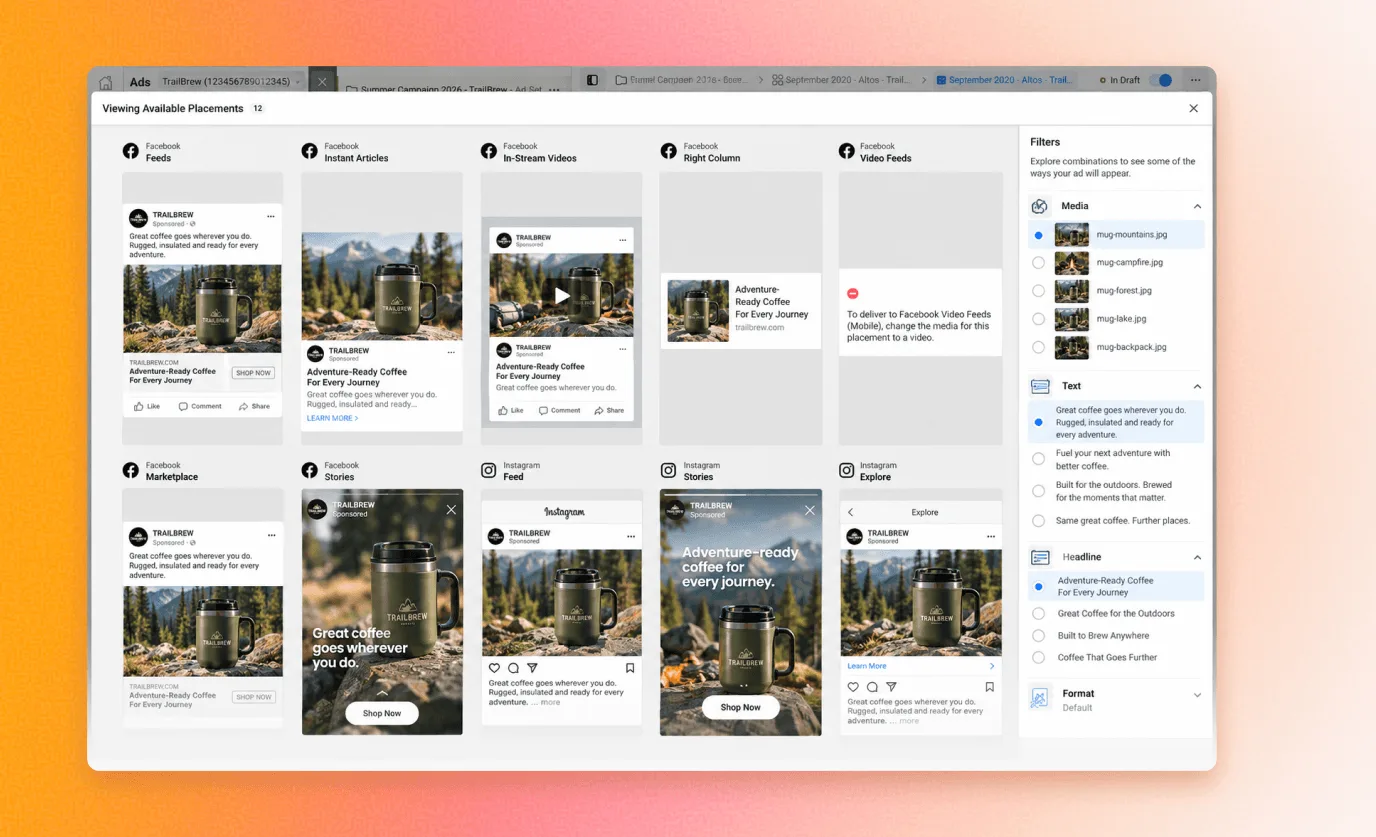
Meta's developer docs define the feature in one line: "Dynamic Creative allows you to automatically deliver different combinations of an ad's creative to your users." You upload several images or videos and several versions of each text field, and Meta mixes them.
Two things to know before you rely on it.
First, reporting is by element. You can see how each image or headline did, but you can't see how a specific image-plus-headline pair did.
Second, Meta has been moving away from it. Meta's help page says that since June 2024, advertisers may no longer be able to use Dynamic Creative in new ad sets with Sales or App promotion objectives, and points them to the Flexible ad format instead.
Here's how Meta's current options differ:
Dynamic Creative mixes the assets you upload and reports on each element
Flexible ad format takes up to 10 images and videos and also picks the format (single image, video, or carousel) for each viewer
Advantage+ catalog ads fill the ad from your product catalog
Advantage+ creative uses AI to adjust or generate variations of your ad
That last one is where Meta's effort is going. At Advertising Week this month, Meta said its tool for generating video from static assets is now generally available.
Read more: How to Make Meta Ad Creatives and Google PMax Assets With AI
Google responsive ads and dynamic remarketing
Google spreads dynamic creative across several products.
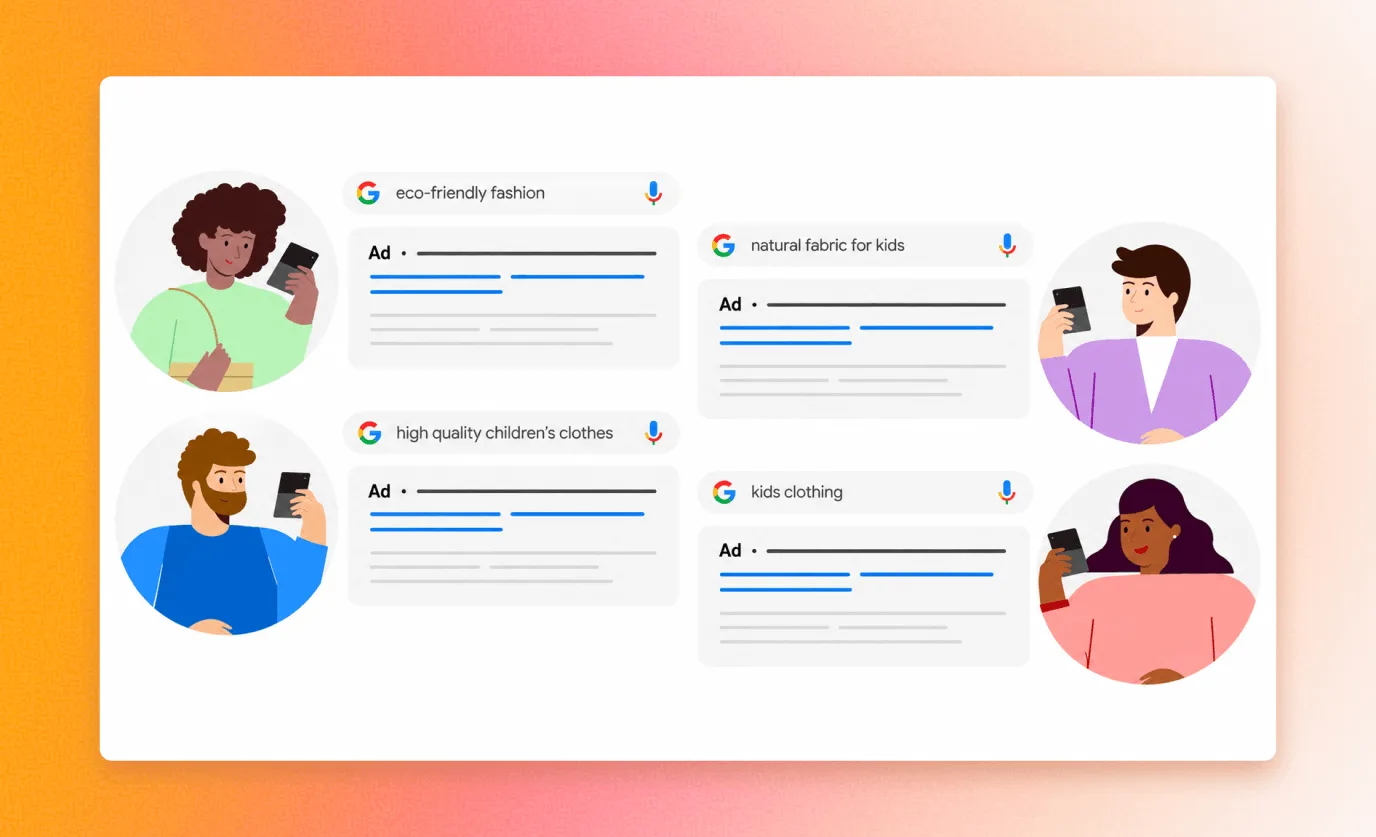
Responsive search ads take up to 15 headlines and 4 descriptions and assemble them per search. Responsive display ads do the same for banners, and Google says its AI "determines the optimal combination of assets for each ad slot." Performance Max and Demand Gen campaigns use the same asset-pool approach across more of Google's inventory, including YouTube, Gmail, Discover, and Display.
Dynamic remarketing is Google's catalog version. Its recommendation engine will "pull products and services from your feed and determine the best mix of products for each ad."
Read more: What Is Google Performance Max?
TikTok Smart Creative
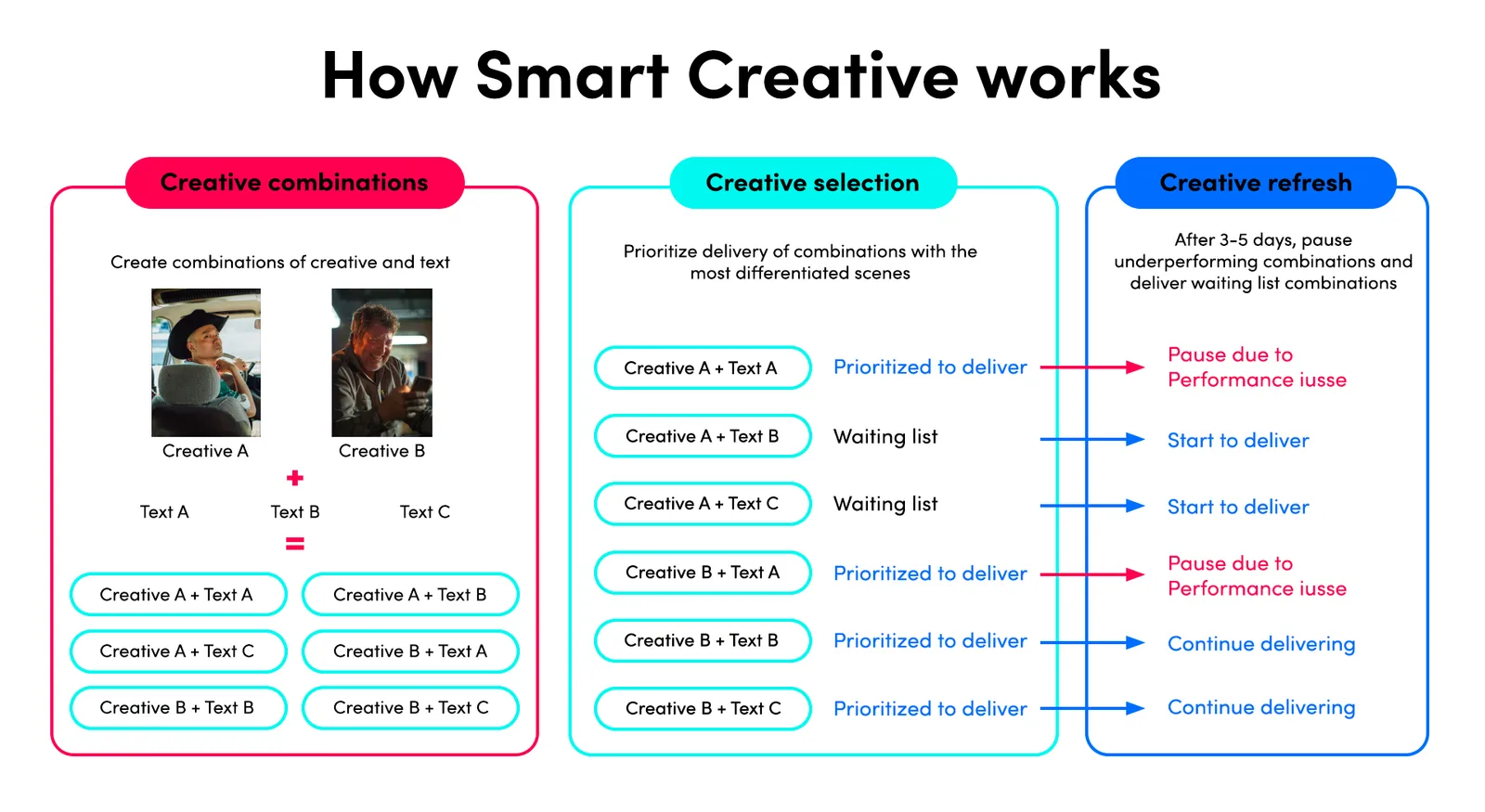
TikTok calls its version Smart Creative, "an automated creative solution that optimizes ad creative combinations." It also pauses videos that have gone stale and swaps in replacements. A newer version called Automate Creative is rolling out to some advertisers.
In TikTok's upgraded Smart+ campaigns, where available, each ad works like an asset group with up to 50 creative assets.
AppLovin and Unity
The in-app ad networks have their own versions.
AppLovin Ads (formerly Axon Ads Manager) covers dynamic creative under other names. For website and ecommerce advertisers, its creative guide says every impression runs as "three sequential steps": a fullscreen video, an interactive page, and a dynamic catalog. Each step has a dynamic piece:
Creative Sets do the mixing. A set holds at least one video and one interactive page, up to 10 of each, and "the system automatically tests and finds the winning combinations"
The interactive page can be generated for you. AppLovin's AI tool builds it from reference URLs, assets, and prompts
The Dynamic Catalog is the personalized part. This optional third screen shows up to 12 products or offers picked for each viewer, drawn from your Shopify store, a CSV file, or AppLovin Pixel data
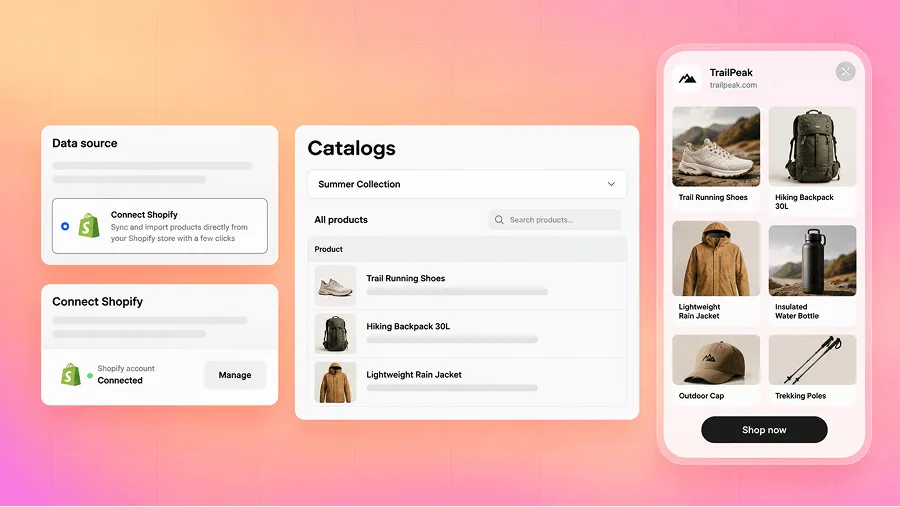
AppLovin says dynamic catalogs increase conversions by up to 20% when set up correctly (its own figure). App and game advertisers work with creative sets on AppLovin too.
Unity's version is built for game advertisers. In Unity Playworks, a dynamic playable lets you tag elements of a playable ad as variables and test the combinations. The tool "continuously adjusts delivery, prioritising the top-performing permutations," then sends all the traffic to the winner.
LinkedIn, Amazon, Pinterest, and Snapchat
LinkedIn's dynamic ads pull from the viewer's own profile, such as their photo, company, or job title. Amazon's responsive ecommerce creative draws on up to 20 products and skips any that are out of stock. Pinterest and Snapchat both run catalog-driven dynamic ads tied to their tracking tags and conversion APIs.
Dynamic creative retargeting
Dynamic creative retargeting shows people the products they looked at. Someone views a blue backpack on your site, leaves, and sees that backpack in their feed the next day.
It needs three things: a product catalog, a tracking tag, app SDK, or server connection that records which products each visitor viewed or added to cart, and an ad template that the platform fills in.
It's the most familiar kind of dynamic creative, and it's the one with the most surprising research behind it.
In a field experiment with a travel company, researchers Anja Lambrecht and Catherine Tucker found that dynamic retargeted ads showing the exact product someone viewed were, on average, less effective than generic brand ads.
The gap closed once shoppers showed signs of having narrowed down what they wanted, for example after visiting a travel review site.
The lesson is about timing. A quick look at one product doesn't mean someone has settled on it. Showing them that exact product assumes a decision they may not have made.
Does ad personalization work? What the research says
Short answer: yes, a little, when it's relevant and people are comfortable with the data behind it.
A 2025 meta-analysis in the Journal of Advertising Research pooled 53 experiments and found that personalized ads are generally more persuasive than generic ones, by a small margin. Perceived relevance explained the effect. The studies measured attitudes and intentions, so you still need to prove the sales impact in your own tests.
Three studies show where it goes wrong.
Wrong stage. The travel study above: product-level ads underperformed until shoppers had firm preferences
Hidden data collection. A Journal of Retailing study found click-through dropped when people realized their data had been collected without their knowledge
Data from somewhere else. Research in the Journal of Consumer Research found ads lost effectiveness when people learned the targeting used information gathered on other websites, or inferred about them
Trust changes the math. Another retail study found that the payoff from personalized retargeting depends heavily on how much shoppers trust the retailer.
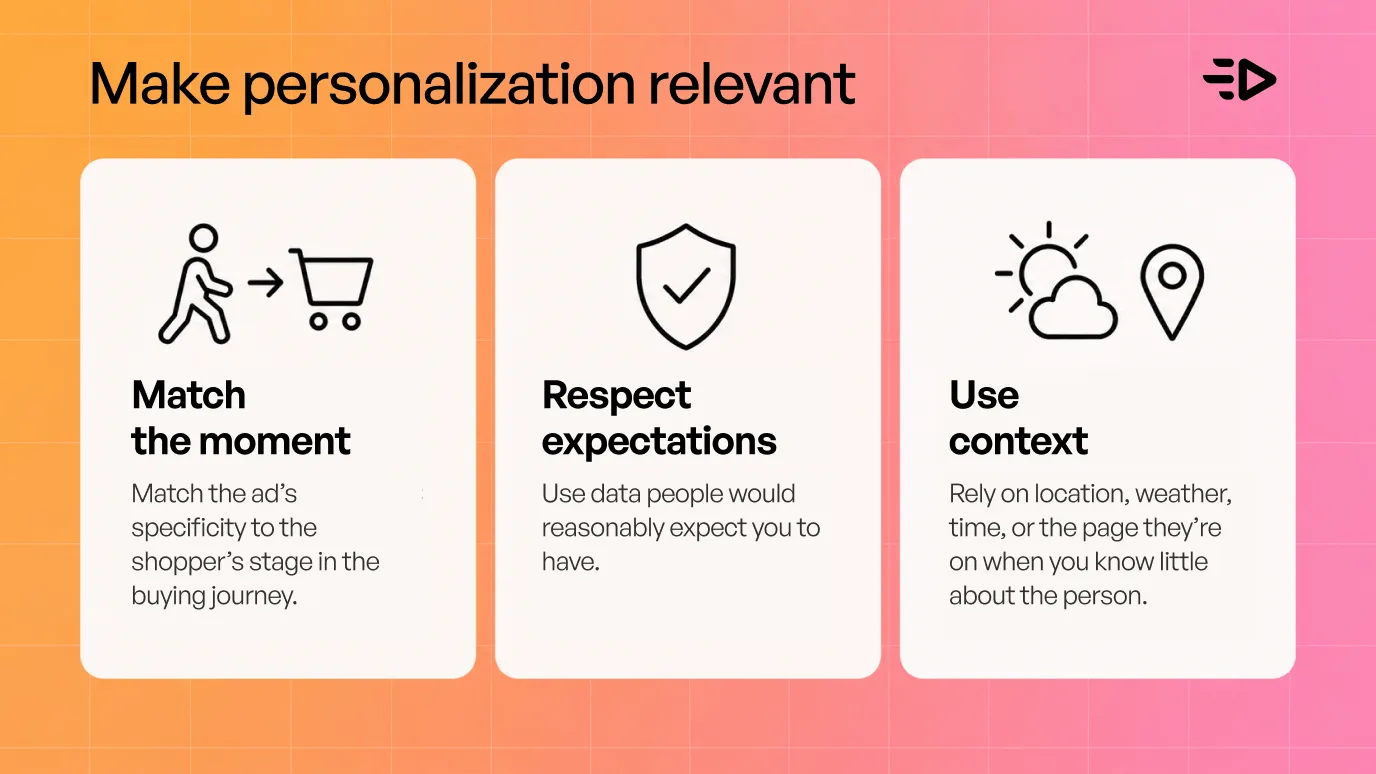
So "smarter" personalization comes down to three habits:
Match how specific the ad is to how far along the shopper is
Use data people would expect you to have
Lean on context (location, weather, time, the page they're on) when you don't know much about the person
Privacy rules shape what you can use
The signals available keep shifting. Apple's App Tracking Transparency prompt arrived in April 2021 and made cross-app tracking opt-in. Chrome went the other way. Google abandoned its plan to phase out third-party cookies, and in 2025 it confirmed it won't add a new cookie prompt either.
In the EU, the Digital Services Act bans ads based on profiling minors on online platforms, along with profiling-based ads that use sensitive data such as religion or health.
Where AI fits: from mixing assets to making them
Classic dynamic creative picks from what you upload. Generative AI adds to the pool.
That shift is well underway. Nearly two in three ad buyers now use generative AI for digital video creative, according to the IAB's 2026 report. In December 2024, Meta said more than a million advertisers had used its generative tools to create over 15 million ads in a single month.
Two cautions.
Full automation may be further off than the headlines suggest. Marketers told Marketing Brew in April 2026 that AI-built ads from a product image alone are "likely much further off," and that Meta's delivery system rewards a greater diversity of creative.
Younger audiences are cooler on AI ads than advertisers think. In an IAB study, 82% of ad executives believed Gen Z and millennial consumers feel positive about AI-generated ads. Only 45% of those consumers said they do.
Read more: AI-Generated Advertising: Everything You Need to Know
What dynamic creative needs from you
Here's the practical catch. A dynamic system mostly works with the ad creative you give it. Five versions of the same video with different captions don't give it much range.
For video, range means different hooks, different presenters, different settings, different lengths. That's a production problem, and it's the one we built Creatify for.
Our Creatify Agent takes a product link or a brief, researches the brand and competitors, and produces finished video ads for about $5 to $8 each. You can change a single scene (the avatar, the location, the voiceover) without redoing the rest, which is how you get variations that differ in ways that matter.
In AdFlow, our node-based builder, you can branch one base ad into several versions by swapping a single element such as the hook, the call to action, or the presenter.
To be clear about the division of labor: we make the assets, and the ad platform's dynamic creative system decides who sees which.
How to get more out of dynamic creative
A few rules that hold across platforms.
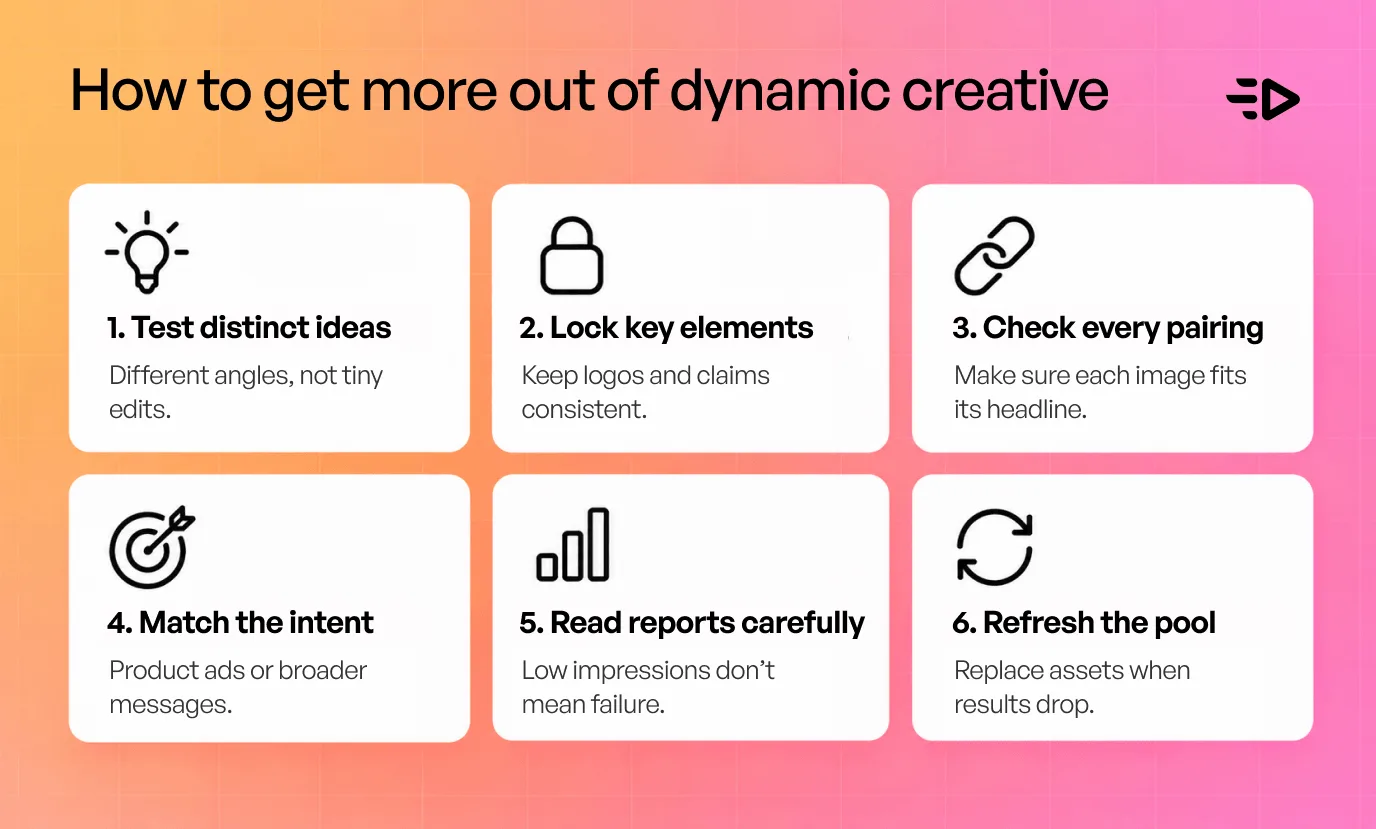
Upload distinct ideas. Three different angles usually give the system more to work with than 10 small edits of one
Fix what can't change. Use each format's controls, such as pinned text or locked template fields, to keep your logo, product claims, and legal lines in every version
Check every pairing. If any headline can run with any image, make sure each pair makes sense
Match specificity to intent. Test product-level ads against broader messages for people who are still browsing
Read element reports carefully. The platform tends to shift delivery toward early winners, so an asset with few impressions may never have had a fair test
Refresh the pool. Swap in new assets when results slide
まとめ
Dynamic creative swaps one finished ad for a kit of parts and lets software build the version each person sees. It covers Meta's Dynamic Creative and Flexible formats, Google's responsive ads, TikTok's Smart Creative, AppLovin's dynamic catalog, catalog retargeting, and the DCO tools used in programmatic.
The research points the same way throughout: personalization pays off when it's relevant, well timed, and built on data people are comfortable with. Start broad, get specific as people show intent, and give the system enough different creative to have a real choice.
よくある質問
What is dynamic creative?
Dynamic creative is an ad built from interchangeable parts, such as images, videos, headlines, and calls to action, that an ad platform assembles for each viewer. One campaign can show many versions of the ad without each being made by hand.
What's the difference between dynamic creative and DCO?
Dynamic creative is the technique of building ads from swappable parts. Dynamic creative optimization (DCO) adds a system that measures how each part performs and shows the stronger combinations more often.
Is Meta dynamic creative still available?
Partly. Meta's help page says that since June 2024 advertisers may no longer be able to use it in new ad sets with Sales or App promotion objectives. Meta recommends the Flexible ad format for those, and availability varies by account.
What is dynamic creative retargeting?
Dynamic creative retargeting shows people ads featuring the specific products they viewed or added to a cart. It uses a product catalog and tracking signals to fill an ad template for each person.
Does dynamic creative improve results?
It can, depending on your assets and campaign. A 2025 meta-analysis of 53 experiments found personalized ads are generally a little more persuasive than generic ones. Other studies show it can backfire when the ad is too specific too early or uses data people didn't expect you to have.
How many assets do you need for dynamic creative?
It depends on the platform. Google's responsive search ads take up to 15 headlines and 4 descriptions, and Meta's Flexible ad format takes up to 10 images and videos. Variety matters more than volume.