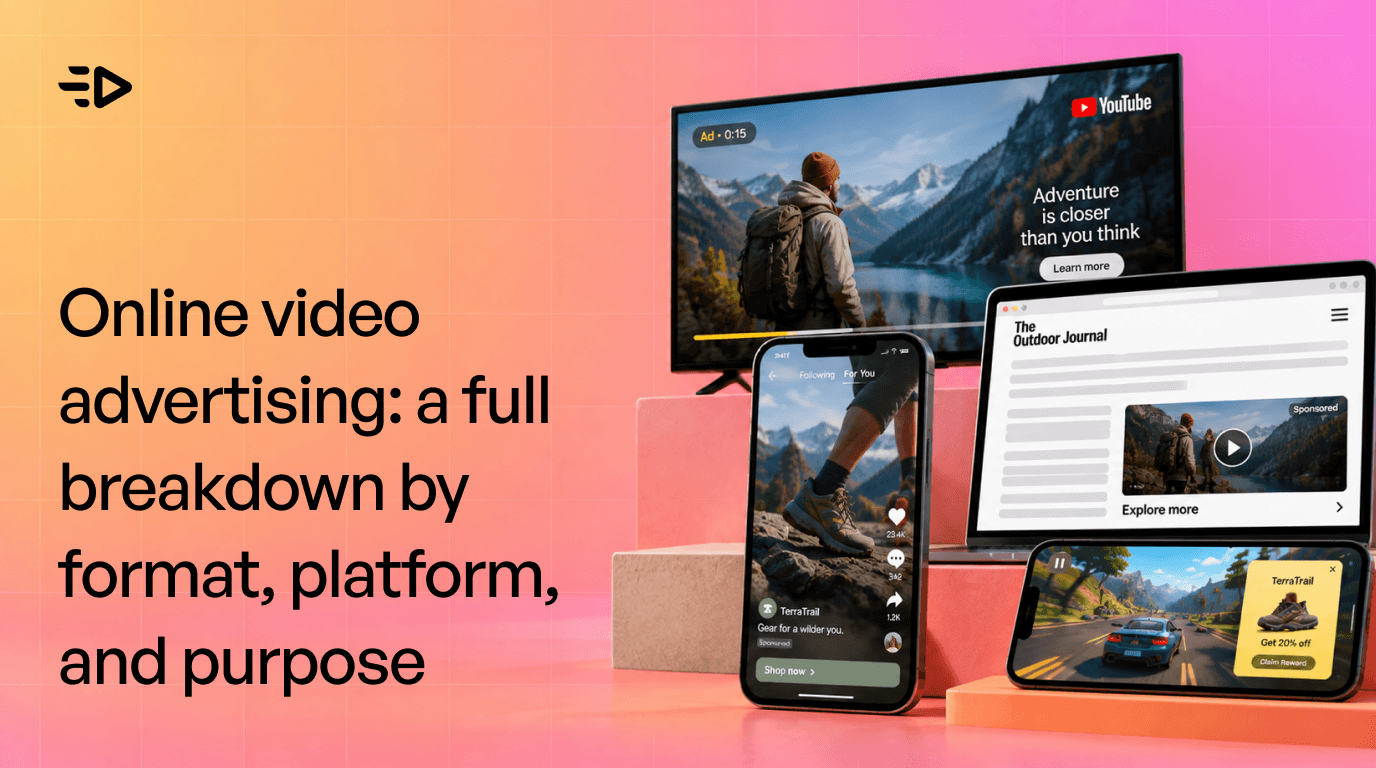

US advertisers are on track to spend more than $80 billion on digital video in 2026, and for the first time that would be over 60% of everything spent on TV and video combined, according to IAB projections.
The vocabulary hasn't kept up with the money. "Video ad" can mean a 6-second bumper on YouTube, a pause screen on Prime Video, a vertical clip in a TikTok feed, or a rewarded ad inside a mobile game. In September 2026 the IAB published a new standard for classifying video advertising because buyers and sellers kept using the same words for different things.
So this guide sorts online video advertising three ways: by format (what the ad is), by platform (where it runs), and by purpose (what you want it to do). Pick the axis you need, or read all three.
What is online video advertising?
Online video advertising is any paid video message delivered over the internet. That covers online video ads that play before, during, or after a video, ads that sit in a social feed or an article, and ads on a streaming service watched on a TV.
The IAB groups it into three channels: "Digital video comprises CTV (connected TV), online video, and social video, which includes YouTube." Here's how the money splits in 2026, per the IAB's figures as reported by MediaPost:
Kanal | 2026 US spend (forecast) | Growth |
|---|---|---|
Social video (including YouTube) | $31.9 billion | +13% |
Connected TV | $29.3 billion | +11% |
Total digital video | $81.9 billion | +11% |
Online video (the web and app inventory outside social and CTV) makes up the rest, growing about 10%.
One wrinkle: people use "online video" two ways. In everyday use it means all internet video ads. In the IAB's narrower sense, online video (OLV) is video "delivered on desktop and mobile devices outside the TV screen." This article uses the broad meaning and flags OLV when the narrow one matters.
The idea that makes everything else easier
The new IAB standard has one line worth memorizing: "Platform is not an attribute."
YouTube on a living-room TV, YouTube on a laptop, and YouTube Shorts on a phone are three different ad environments. The standard sorts every impression into one of three viewing environments:
Large screen, communal viewing: the TV in the living room, where someone chose to sit down and watch
Personal screen: phones, tablets, and computers
Public ambient display: screens in bars, gyms, airports, and on digital billboards
Keep that in your head and the format list below stops looking like alphabet soup.
Types of video advertising by format
There are five families of video ad formats in the IAB standard: in-stream, outstream and in-feed, interstitial, interactive and shoppable, and overlay and companion. This guide adds two more that deserve their own entry, vertical short-form and the newer CTV formats.
In-stream video ads
In-stream ads play inside video content the viewer chose to watch. Pre-roll runs before the video, mid-roll during, post-roll after.
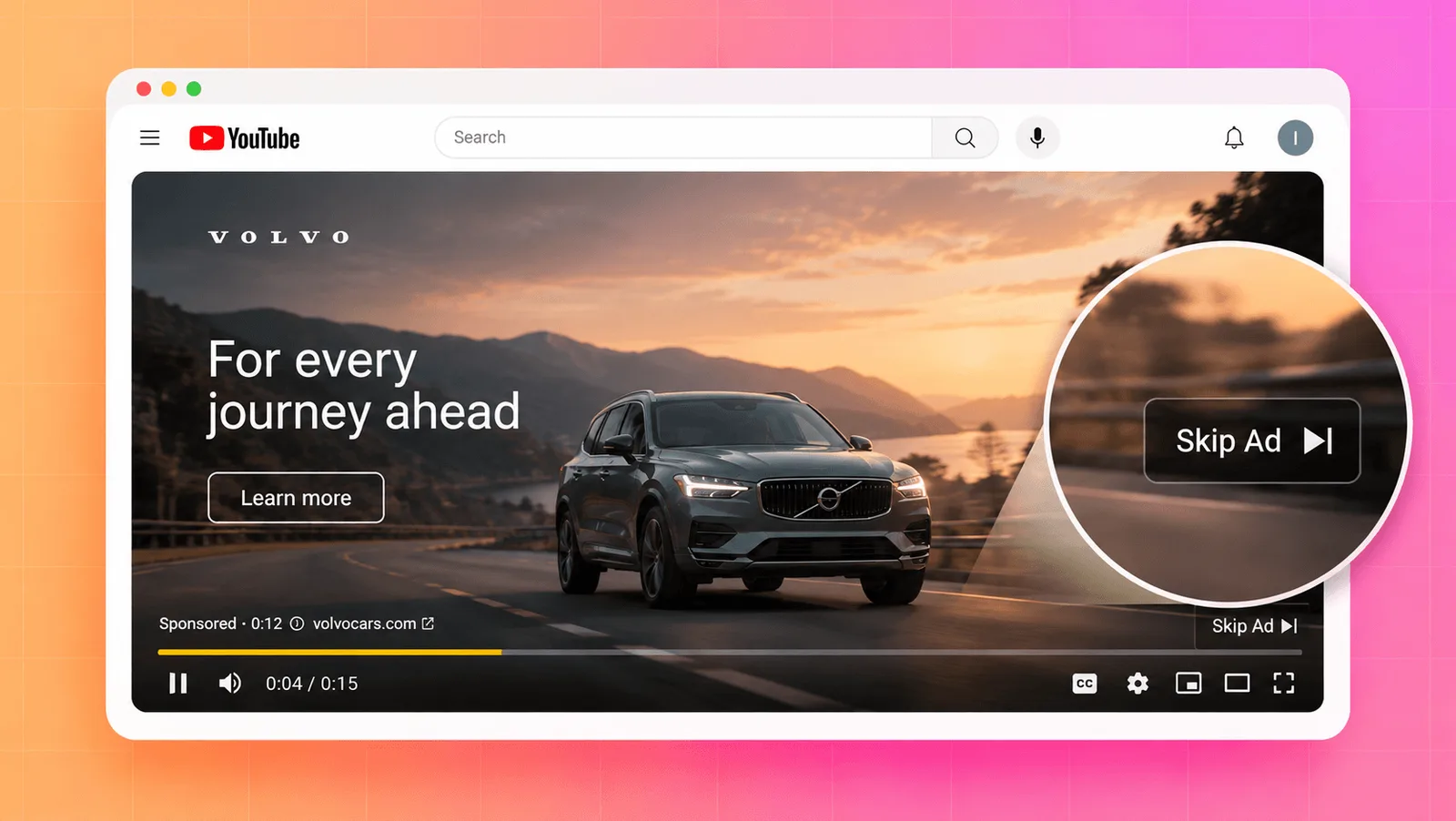
YouTube is the reference case. Google Ads lists skippable in-stream ads (skip after 5 seconds), non-skippable in-stream ads, and 6-second bumper ads. Standard non-skippable ads run up to 15 seconds, or up to 30 seconds on connected TV, and some campaign types allow up to 60.
The definition got stricter in 2022 and 2023. Before then, plenty of muted autoplay players next to news articles were sold as in-stream. The IAB Tech Lab's OpenRTB update split video placements into four types:
Placement type | What it means |
|---|---|
Instream | Plays around video the viewer asked for, with sound on by default or clear intent to watch |
Accompanying content | Plays around video content in a player that sits among text or images, often starting when it scrolls into view |
Interstitial | Plays with no video content around it and fills most of the screen |
No content / standalone | A video ad on its own: in a feed, inside an article, in a banner slot, or floating |
If you buy programmatically, check which type you're paying for. The four are different products, so make sure the report matches what you thought you bought.
Outstream video ads and native video advertising

Outstream ads don't need a video to attach to. They appear between paragraphs of an article, in a feed, or in a corner of the page, and usually autoplay muted.
Native video advertising overlaps with it. Native describes an ad styled to match its surroundings, like a sponsored video card in a news feed. Both extend reach beyond sites that have video content of their own.
Interstitial video ads and rewarded video
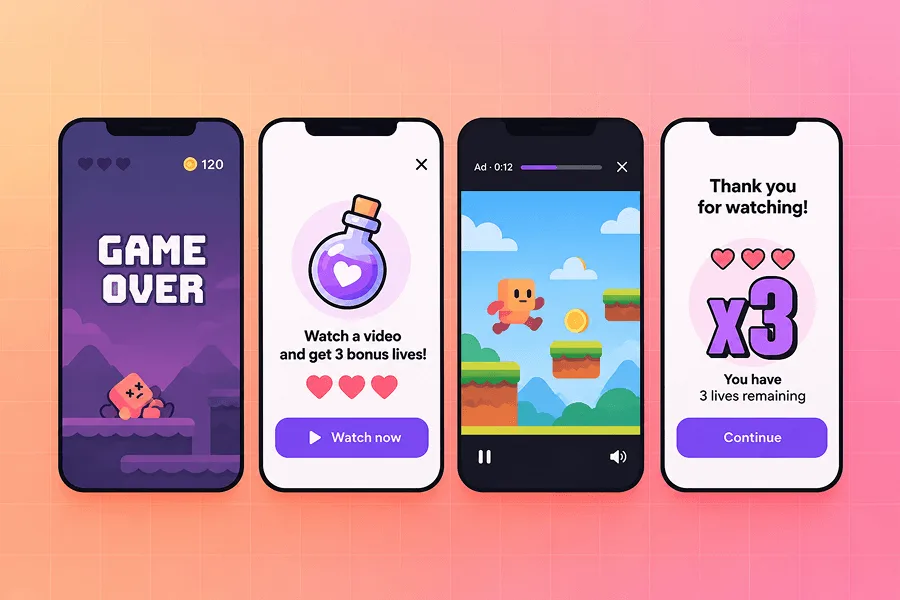
Interstitial video ads take over the full screen at a natural break, such as between game levels or app screens. It's a staple of mobile video advertising.
Rewarded video adds an incentive. Google's AdMob describes it as an ad "served after a user explicitly chooses to view a rewarded ad" in exchange for something like an extra life or in-app currency.
Vertical short-form video ads
Short vertical clips in a swipeable feed: TikTok, Instagram Reels, YouTube Shorts, Snapchat Spotlight. The IAB files these under social video, "platform-native short-form and mid-form video in algorithmically curated social feeds on personal devices."
The ad sits between organic clips and gets judged by the same thumb. Google recommends keeping Shorts ads under 60 seconds, and TikTok's own guidance is to land the hook in the first 6 seconds.
Interactive video ads and shoppable video

Interactive video ads add something to do: tap to see products, scan a QR code, answer a poll, add to cart. Shoppable video ties the ad to a shopping action, like browsing products or adding one to a cart.
The plumbing changed here too. The old interactive standard, VPAID, has been deprecated and replaced by two newer ones, SIMID for interactivity and Open Measurement for verification.
Overlay and companion ads
Overlays are banners or graphics that sit on top of the video while it keeps playing. Companion ads are display units shown alongside a video ad, like a clickable banner that stays after the pre-roll ends. Both are supporting acts, useful for giving a video ad something to click.
CTV advertising beyond the commercial break
Most guides stop at "CTV means 15- and 30-second non-skippable spots." That's out of date. In July 2026 the IAB Tech Lab finalized its CTV Ad Portfolio, which standardizes six formats that live outside the ad break:
Format | What happens |
|---|---|
Pause ad | Appears when the viewer pauses the show with the remote |
Screensaver ad | Appears when the TV or app goes idle |
Menu ad | Sits in the home screen or navigation of the TV or streaming app |
In-scene ad | Places a brand inside the content itself, such as a virtual billboard in a scene |
Overlay ad | Runs over the program, outside the ad break, often in the lower third |
Squeezeback ad | Shrinks the program so the ad shares the screen, often in an L shape |
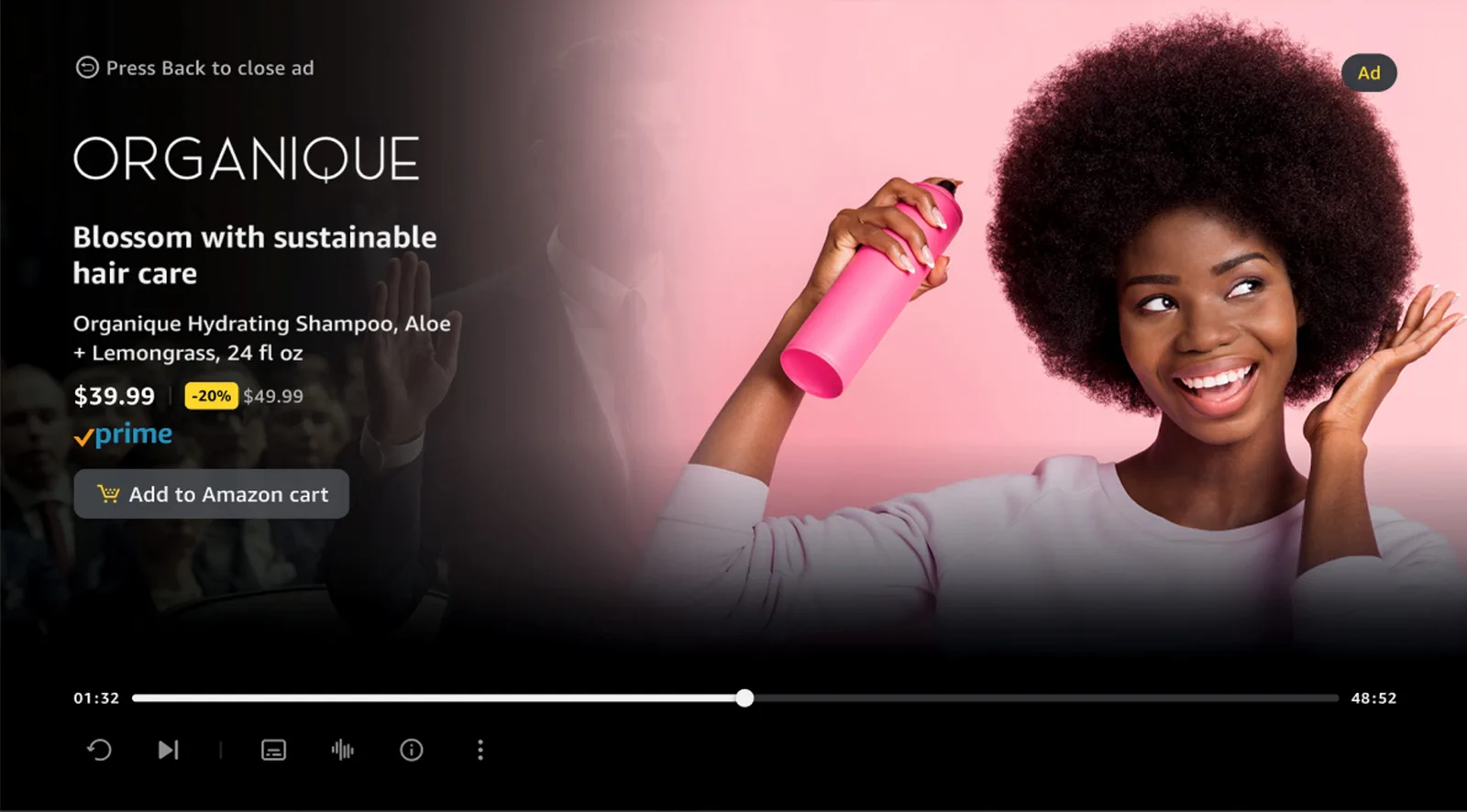
Some of these use a static image instead of moving video, but they're sold on the same screens as video. And they're already for sale. Amazon launched interactive pause ads on Prime Video in September 2025, letting viewers add a product to their Amazon cart with the remote.
Video advertising platforms: Where online video ads run
Now the second axis: where the ads run. Each platform sells several of the formats above under its own names.
YouTube
YouTube runs on both personal screens and TVs, which is why it shows up in so many plans. Its menu: skippable and non-skippable in-stream, bumpers, in-feed video ads (in search results and the home feed), Shorts ads, and the Masthead on the home page.
Read more: YouTube Advertising Best Practices
It's also the most-watched streaming platform on American TVs. YouTube took a record 14.2% of all US TV viewing in July 2026, per Nielsen's The Gauge, with streaming as a whole at 49%.
Ad revenue reached $40.4 billion in 2025, according to WARC figures reported by The Desk. The same WARC analysis expects TikTok to pass YouTube in global ad revenue by 2030, partly because TikTok has done a better job convincing marketers it drives purchases.
Meta: Facebook and Instagram
Meta sells video across Feed, Stories, Reels, and in-stream placements on Facebook and Instagram. Meta's automated placements can spread one campaign across all of them, so it helps to supply creative in several shapes.
Demand is still climbing. In Q2 2026, Meta's ad impressions grew 14% and the average price per ad rose 12% year over year, per its earnings release.
TikTok
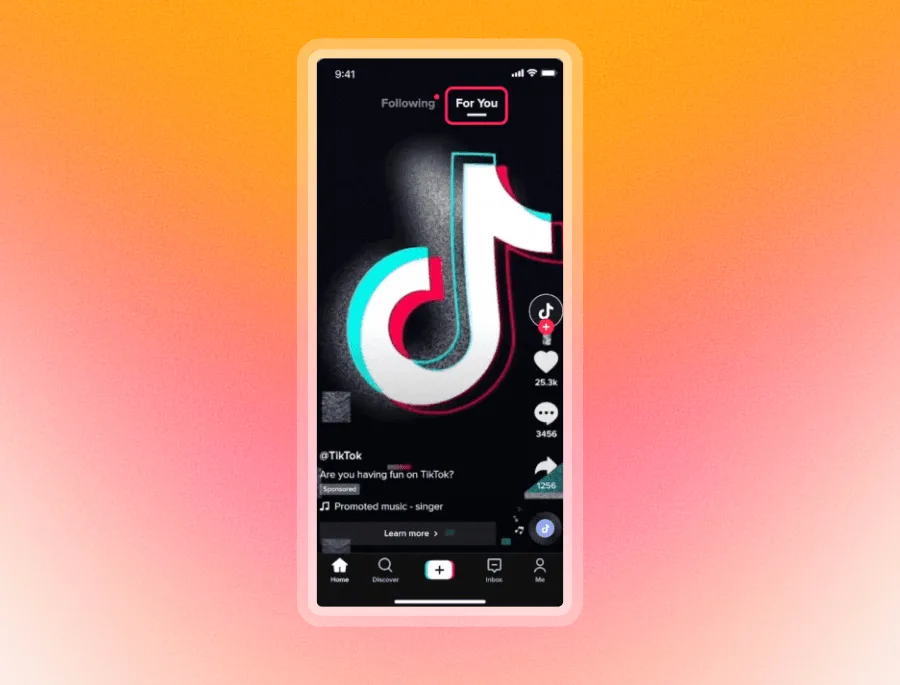
TikTok's core unit is the In-Feed ad, a vertical video between organic clips. TikTok's specs allow uploads up to 10 minutes. Spark Ads let you promote an existing organic post, yours or a creator's.
Read more: TikTok Ad Types Explained
For selling products, new TikTok Shop campaigns run through one campaign type. Since July 2025, GMV Max is the default and only supported option for creating them.
LinkedIn, Snapchat, Pinterest, X, and Reddit
LinkedIn is the B2B option. Beyond feed video, it now sells pre-roll against publisher content through BrandLink and CTV ads bought through partners, as LinkedIn announced in March 2026.
Snapchat sells full-screen vertical video between Stories and in Spotlight. Its ad formats page lists video ads from 3 to 180 seconds, plus Commercials, where the first 6 seconds can't be skipped.
Read more: How to Run Snapchat Ads
Pinterest, X, and Reddit each sell in-feed video. They're worth testing when your audience is clearly there: Pinterest for shopping and home, Reddit for niche communities, X for news and live events.
CTV advertising and streaming video advertising
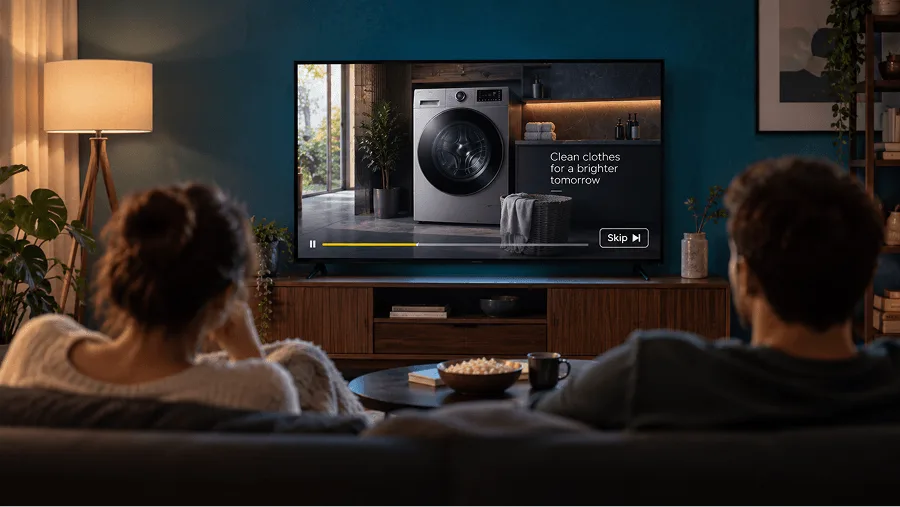
Streaming services sell the TV-screen version of in-stream: full-screen, mostly non-skippable, watched with the sound on.
The ad tiers are big now. Netflix says its ad-supported plan reaches more than 250 million monthly active viewers worldwide (its own modeled audience figure), as TheWrap reported in May 2026. Prime Video, Disney+, Hulu, Peacock, HBO Max, Roku, and free ad-supported channels fill out the rest.
Prices have come down as supply grew. Netflix launched its ad tier in 2022 asking about $65 per thousand impressions. By late 2024 EMARKETER had it near $31 and Prime Video near $28, according to Digiday.
Programmatic video advertising and the open web
Programmatic video advertising means buying video impressions through software (a demand-side platform) across many publishers at once, usually by auction. Outstream, CTV, and publisher in-stream are all commonly bought this way.
The trade-off is control. In the IAB's 2026 buyer survey, 67% of buyers said they had "somewhat to no confidence" in the quality of CTV inventory bought on open exchanges, against 43% for direct, programmatic guaranteed, and self-serve buys. Private marketplaces sit in between at 55%.
Mobile video advertising, retail media, and screens in public
Three more places video ads run:
Mobile apps and games, mostly interstitial and rewarded video, bought through ad networks
Retail media, where a retailer sells video on its site, app, or TV. Amazon's Sponsored Brands video is the familiar example, and Walmart is bringing its shopper data to Vizio TVs
Digital out-of-home, the IAB's "public ambient display": video on billboards and venue screens
Online video advertising by purpose
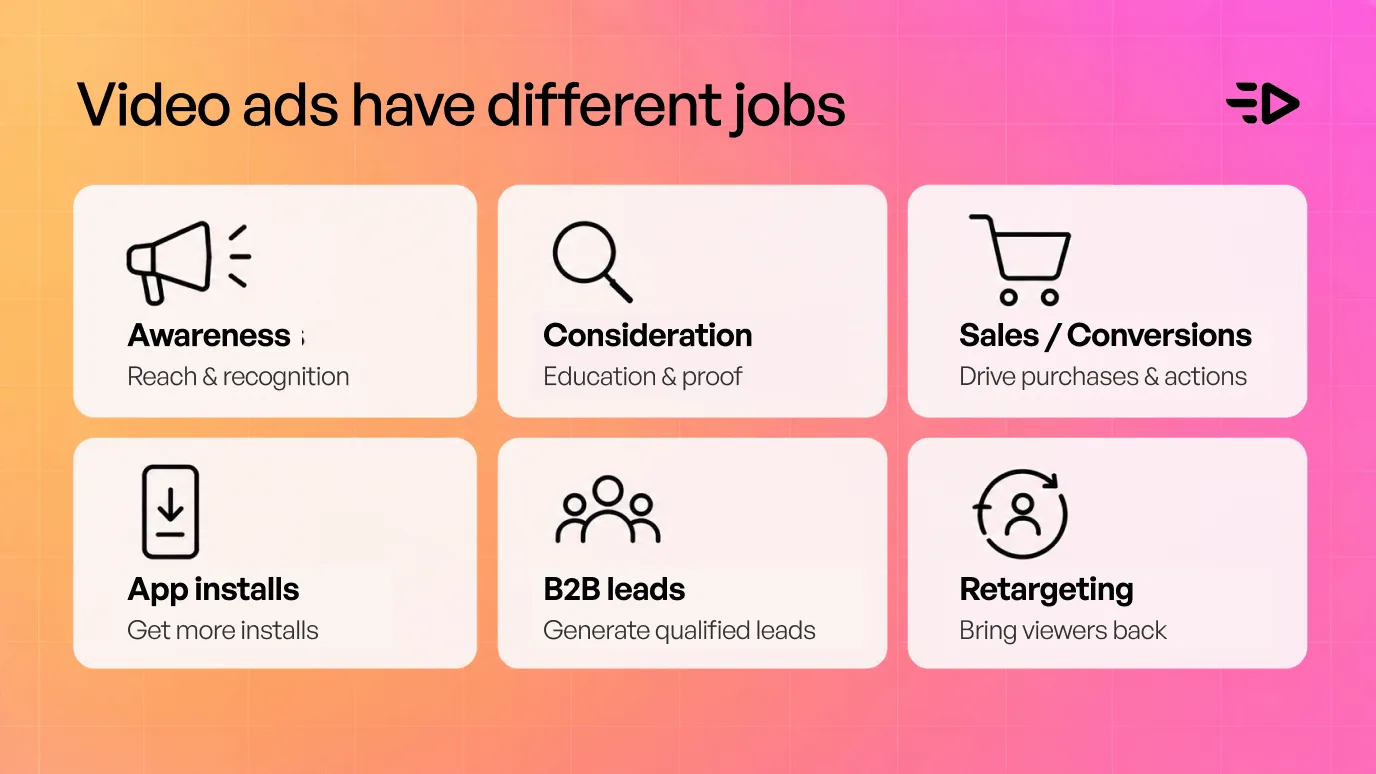
The third axis is the one that should drive the other two. Start with the job, then pick the format and platform.
Goal | Formats that fit | Where to run them | What to measure |
|---|---|---|---|
Markenbewusstsein | Non-skippable in-stream, bumpers, CTV spots | Streaming services, YouTube on TV | Reach, completion rate, brand lift |
Consideration | Skippable in-stream, in-feed, demos and explainers | YouTube, Meta, LinkedIn | View rate, watch time, site visits |
Sales | Vertical short-form, shoppable, creator-style ads | TikTok, Reels, Shorts, retail media | Cost per purchase, return on ad spend |
App-Installationen | Rewarded, interstitial, playable | In-app networks, TikTok, Meta | Cost per install, retention |
B2B leads | In-feed video, pre-roll on business content | LinkedIn, YouTube | Cost per lead, lead quality |
Retargeting | Short in-feed and in-stream cuts | Meta, YouTube, programmatic | Conversion rate, frequency |
Brand awareness and reach
Big screens and uninterrupted formats do the heavy lifting. Thinkbox's Profit Ability 2 study of 141 UK brands, published in April 2024, found that linear TV and broadcaster streaming together delivered 54.7% of all advertising-driven profit.
Online video (mostly YouTube in this study) held its own, returning £3.86 in profit for every £1 spent over two years. The study also found that 58% of advertising's profit arrives after the first 13 weeks, so judge awareness spending on a longer clock than a sales campaign.
Consideration
This is where people who've heard of you decide whether to care. Skippable in-stream suits it because viewers who stay past the skip button are choosing to.
Structure matters more than polish. Google's ABCD guidelines (attention, branding, connection, direction) were tested by Kantar, and ads that followed them saw "a 30% lift in short-term sales likelihood and a 17% lift in long-term brand contribution."
Sales and direct response
Short vertical video sells, and the evidence is getting specific. A System1 and TikTok study of 887 ads found that emotionally neutral ads were 27% less effective at driving conversions, and that ads whose brand was recognized early drove 88% higher memory lift.
Format fit counts too. In 2022, Google found that adding vertical assets to its Video action campaigns delivered 10% to 20% more conversions per dollar on Shorts than horizontal assets alone.
App installs and user acquisition
Games and apps lean on rewarded and interstitial video inside other apps, plus short-form social. Playable ads, a mini demo of the game inside the ad, are common here too.
Volume is the constraint. User acquisition teams burn through creative fast, so the question is usually how many new variations you can test this week.
Lead generation and B2B
B2B video works best when it answers one question a buyer has: what it does, who it's for, or how a customer used it. LinkedIn is the natural home, with YouTube for search-driven demand.
Pair the video with a lead form in the same unit where the platform offers one. Fewer steps between the video and the form usually means fewer drop-offs.
Retargeting, local, and political
Retargeting uses short cuts of ads people have already seen, capped so they don't see them 14 times.
Local and political advertisers have moved onto streaming because it lets them buy by zip code. AdImpact projects $10.8 billion in political ad spending for the 2026 midterms, with nearly $2.5 billion of it on CTV, as Campaigns & Elections reported.
How online video ads are bought and what they cost
These are the pricing terms you'll see most:
CPM: cost per thousand impressions, the default for awareness and CTV
CPV: cost per view, where you pay when someone watches past a threshold
CPCV: cost per completed view
CPA or CPI: cost per action or per install. These are often bidding targets, with the bill still based on impressions
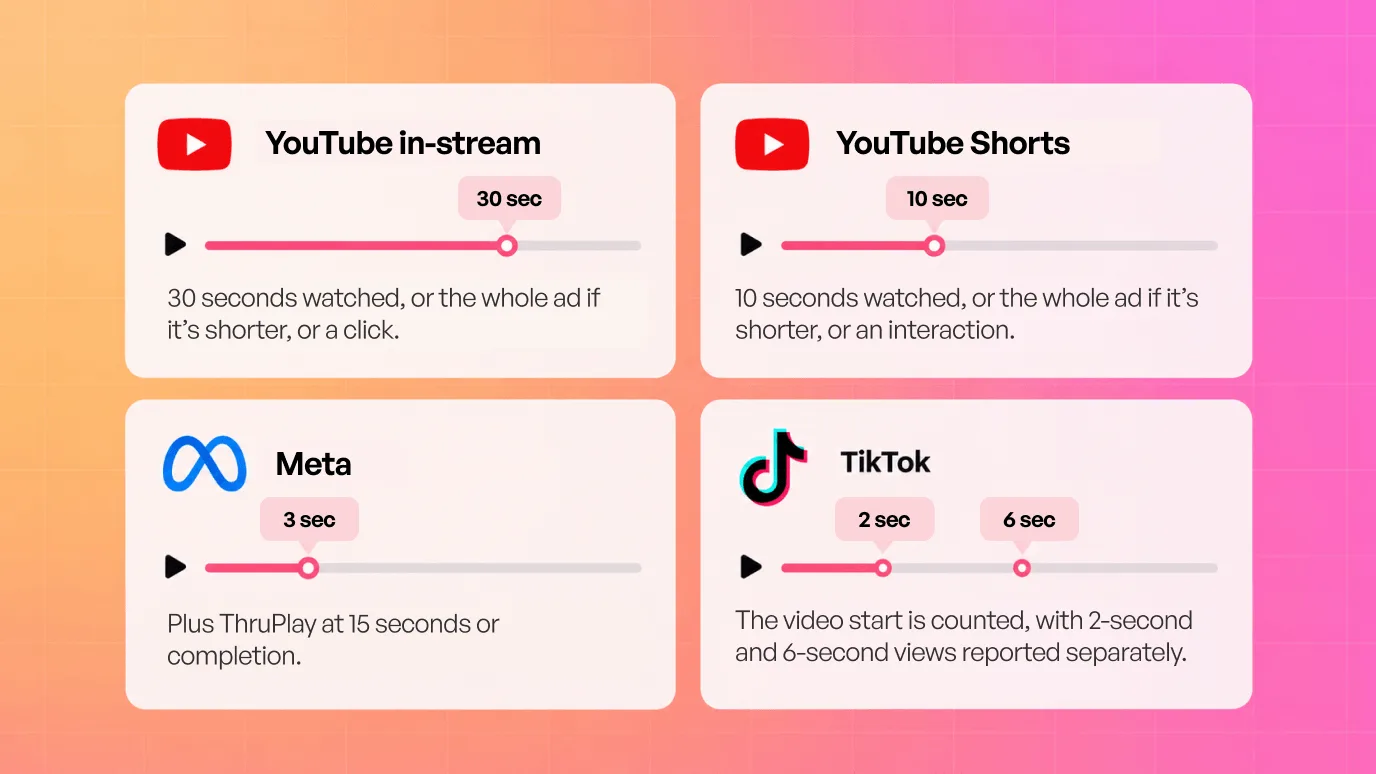
The catch is that every platform defines a "view" differently.
Plattform | How a view is counted in reporting |
|---|---|
YouTube skippable in-stream | 30 seconds watched, or the whole ad if it's shorter, or a click |
YouTube Shorts ads | 10 seconds watched, or the whole ad if it's shorter, or an interaction |
Meta | 3-second plays, plus ThruPlay at 15 seconds or completion |
TikTok | The moment the video starts, with 2-second and 6-second views reported separately |
Those definitions come from Google Ads Help, Meta's Business Help Center, and TikTok Ads Help. A "view" on one platform can be a tenth the length of a view on another, so compare cost per result, or cost per completed view for ads of the same length.
On price, EMARKETER's forecast for early 2025 put average social ad CPMs at $12.53 for Meta, $12.44 for YouTube, $7.03 for TikTok, and $4.19 for Snapchat. Those cover every ad type on each platform, so read them as a rough guide for video. Netflix and Prime Video sat around $28 to $31 in late 2024, as noted above. Treat any benchmark as a starting point, since your audience and season will move it a lot.
Measurement in one minute
Viewability is the floor. Under the Media Rating Council standard, a video ad counts as viewable when half its pixels are on screen while it plays for 2 continuous seconds.
Attention metrics sit above that, and the IAB and MRC published joint guidelines for them in November 2025. Their caution is worth quoting: "Attention in and of itself should not be considered or used as a measure of outcomes." Attention tells you how closely people watched. Lift tests and sales data tell you whether it worked.
Read more: Ad Analytics Tools Compared
Creative does the heaviest lifting in video advertising
What's in the ad matters at least as much as where it runs. NCSolutions analyzed nearly 450 consumer packaged goods campaigns and found that creative drives 49% of incremental sales, more than reach, targeting, and recency combined. In a Kantar and WARC analysis of about 450 ads, the most creative and effective ones generated more than four times the profit.
Three things the research agrees on:
Make the brand recognizable early. In the System1 and TikTok study, ads that managed it drove 88% higher memory lift
Build for the placement. Vertical feeds reward vertical video, as the Google result above shows
Shorter can hold up. In a Kantar test of one brand's Super Bowl ad, the 15-second cut matched the 30-second one on brand building
The practical problem is volume. Every format in this guide wants its own length and shape, and performance teams refresh creative constantly. That's a lot of video.
Where AI video ads fit
This is why AI video advertising went mainstream so quickly. In the IAB's 2026 survey, nearly two in three buyers said they use generative AI for digital video creative, up from half a year earlier, and they expect about a third of their ad assets to involve it this year.
It's the problem we work on at Creatify. Our Creatify Agent takes a product link or a brief, researches the brand and its competitors, writes the script, generates the shots, and checks the finished cut against the brief. A finished ad typically costs about $5 to $8, and you can change one scene without redoing the rest.
For teams that want to direct individual shots, our Boreal-H3 video model is built for ads. It's tuned to keep labels and packaging intact, takes up to 9 reference images in one shot, and costs $0.04 per second at 768p. Creatify exports in 9:16, 16:9, and 1:1, which covers most of the placements above.
One honest caveat: AI makes it cheap to produce many versions, and it can't tell you which one will convert. You still have to run the test.
Video advertising examples: three sample plans
These are hypothetical, built to show how format, platform, and purpose fit together.
A skincare brand launching a new serum might run 15-second vertical creator-style ads on TikTok and Reels for sales, retarget viewers with 6-second cuts, and put a 30-second version on a streaming service in its three best markets for awareness.
A mobile puzzle game would spend most of its budget on rewarded and interstitial video inside other games, test 20 short-form variations a week on TikTok, and judge everything on cost per install and day-7 retention.
A B2B software company could run a 45-second customer story as LinkedIn in-feed video with a lead form attached, plus skippable in-stream on YouTube aimed at people searching for its category.
Häufig gestellte Fragen
What is online video advertising?
Online video advertising is paid video delivered over the internet: on streaming services, YouTube, social feeds, websites, apps, and connected TVs. The IAB divides it into connected TV, social video, and online video. The IAB projects US spending on it will pass $80 billion in 2026.
What are the main types of video advertising?
The main types are in-stream (pre-roll, mid-roll, post-roll), outstream and in-feed, interstitial and rewarded, vertical short-form, interactive and shoppable, and overlay and companion ads. Connected TV adds pause, screensaver, menu, in-scene, overlay, and squeezeback ads.
What's the difference between in-stream and outstream video ads?
In-stream video ads play inside video content the viewer chose to watch, usually with sound on. Outstream video ads play on their own, between paragraphs of an article or in a feed, and usually start muted. Since 2023, programmatic buyers can see which of the two they're getting.
How much does online video advertising cost?
It depends on the platform and how you buy. EMARKETER's forecast for early 2025 put average social ad CPMs between about $4 and $13, with Netflix and Prime Video around $28 to $31 in late 2024. Performance campaigns bid toward a cost per view, action, or install.
Which video advertising platforms are best?
YouTube covers many formats across phones, computers, and TVs. TikTok and Instagram Reels are the usual starting point for short-form sales campaigns, LinkedIn for B2B leads, and streaming services for awareness on the TV screen. The right one depends on your goal and where your audience watches.
What is CTV advertising?
CTV advertising is video advertising on internet-connected TVs through streaming apps like Netflix, Prime Video, Hulu, and YouTube. Ads are mostly full-screen and non-skippable. Newer formats include pause ads and home-screen menu ads.
Can AI make online video ads?
Yes. In the IAB's 2026 survey, nearly two in three buyers said they use generative AI for digital video creative. AI video ads are most useful for producing many variations quickly, which short-form and performance campaigns need.
Zum Schluss
Online video advertising looks complicated because one word covers a dozen different products. Sort it by format, platform, and purpose and it gets manageable: decide what the ad needs to do, pick the formats that do that job, then choose the platforms that sell those formats to your audience.
One more thing worth keeping from the IAB's new standard. Plan by viewing environment, since a 30-second ad on a living-room TV and the same 30 seconds in a phone feed are different purchases, even when the same platform sells both.