Equipe Creatify
COMPARTILHAR


NESTE ARTIGO
By 2026, AI in social media marketing has stopped being a debate. By every major industry survey, the large majority of marketers now use generative AI somewhere in their work, up sharply from just a couple of years earlier, which means the interesting question is no longer whether to use it but where it earns its place. And the honest answer, judging by the AI in social media market trends of the past year, is uneven. In the same year adoption went near-universal, the backlash arrived too: Gartner found that 49% of US consumers believe generative AI has made online content quality worse. So AI is both everywhere and, in places, working against the brands using it.
This article is a scorecard on AI and social media marketing for in-house social teams and social media marketers. Instead of another list of ten shiny features of 2026, it sorts the real use cases into three buckets: what works now, what needs a human in the loop, and what is still catching up. The goal is to help you point AI at the jobs where it genuinely pays off and keep it away from the ones where it quietly costs you trust.
The one test that sorts it out
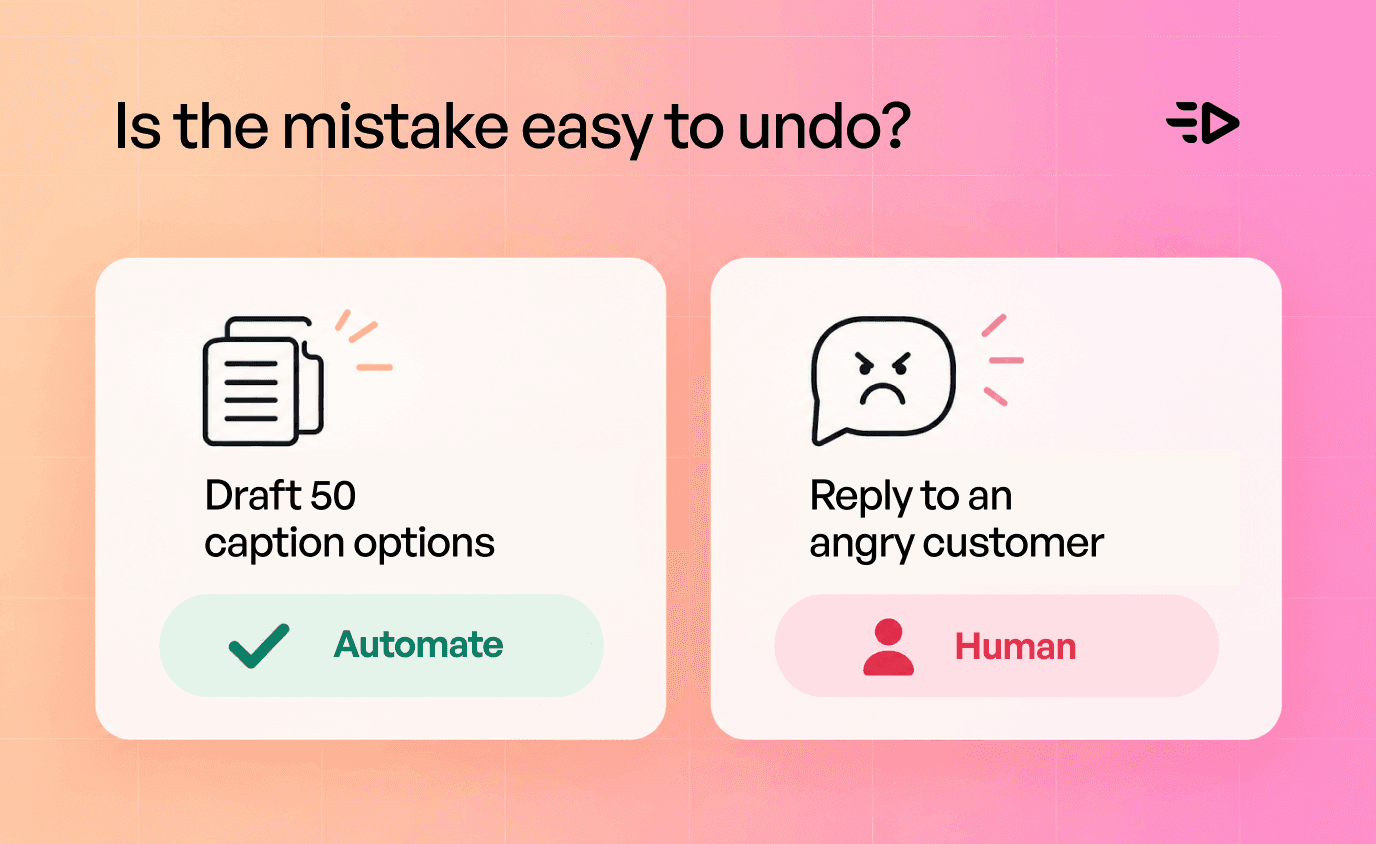
Before the use cases, here is the test that decides which bucket each one lands in. It is not whether the output looks impressive. Modern AI produces plausible-looking work for almost every task on this list. The real question is whether a wrong answer is cheap and reversible. Drafting fifty caption options is cheap: you throw out the bad ones and no one sees them. Auto-replying to an angry customer in public is not: one tone-deaf response is live, screenshotted, and attached to your brand. Automate the tasks where mistakes are cheap and easy to undo. Keep people in charge of the ones where a mistake is public, permanent, or personal. Almost everything below follows from that.
What works now in AI and social media marketing
These are the areas that show most clearly how AI is changing social media marketing, because AI is dependable enough here to run inside sensible guardrails, and the work is high-volume and the failure modes are cheap.
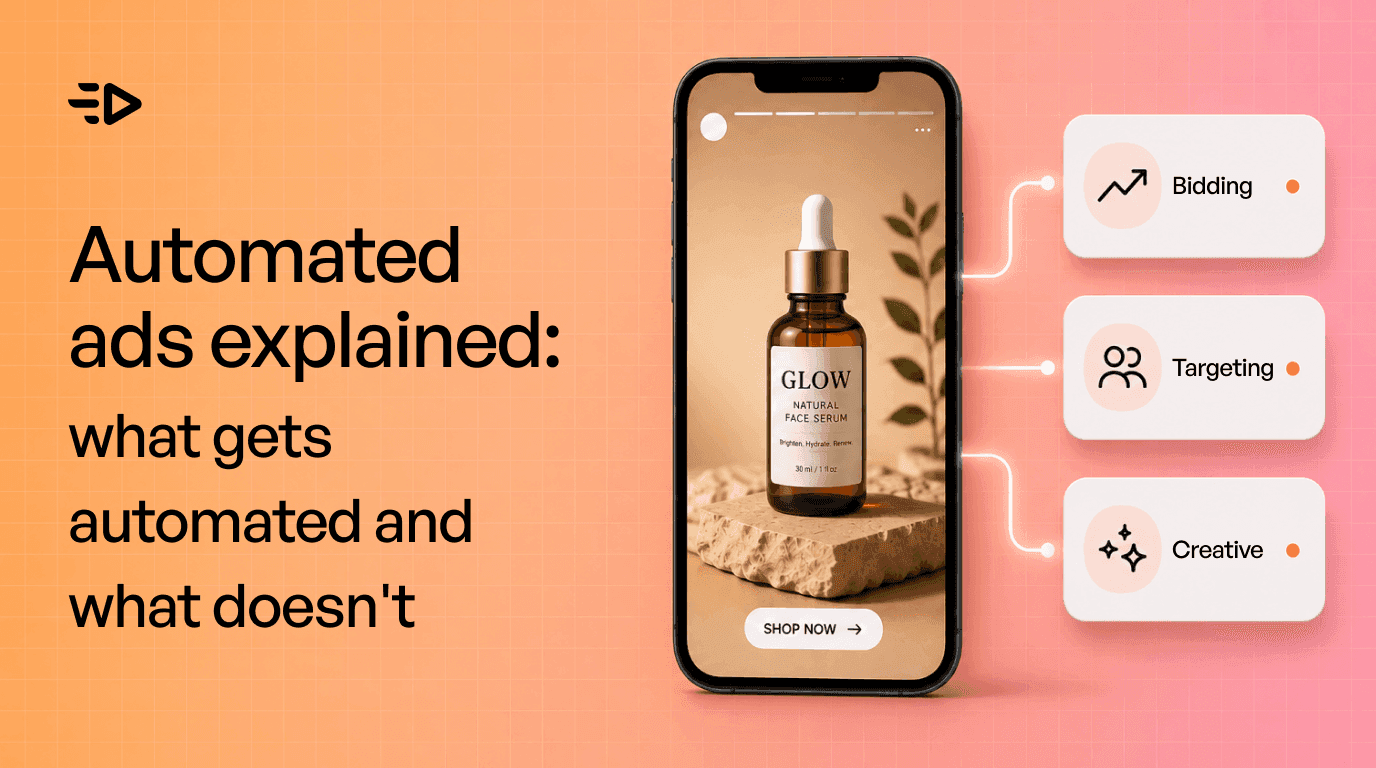
Ad targeting and campaign automation. This is among the most proven commercial uses of AI in marketing, because the prediction engines behind it have years of training that generative tools do not. The automated campaign types the platforms now push, Meta Advantage+ and TikTok Smart+ on social, plus Google's cross-inventory Performance Max, take targeting, budget allocation, placement, and creative combinations off your plate and optimize them against live conversion data faster than any human could. The caveats are real, though: read the platforms' own performance claims as directional rather than gospel, keep an eye on budget pacing and automated creative cropping, and set guardrails, because results still depend on your conversion tracking, offer, and creative. On the media-buying side this is also where we point our own Performance Agent, which connects to Meta, Google, TikTok, and AppLovin to audit spend and run campaigns, because it is the part of the job automation handles most reliably.
Ideation and planning. AI is excellent at beating the blank page. Hand it your positioning, past top performers, and a campaign brief, and it will turn them into theme clusters, hook lists, content calendars, and repurposing plans in minutes. It expands a good input into many usable options. What it cannot do is tell you which of those options is culturally timely, distinctive in your category, or safe to publish this week, so the pattern that works is to let AI generate the menu and let a strategist choose from it.
Analytics and reporting. Turning a week of cross-platform data into a readable summary used to eat an afternoon; AI now does the first pass in seconds, flagging anomalies, clustering comment themes, and writing plain-language readouts. This genuinely saves hours. The line to hold is between reporting and concluding: AI is good at telling you what happened and terrible at reliably telling you why. It will confidently confuse correlation with causation and over-explain random noise, so ask it to cite the date range and baseline behind any claim, and have a person validate attribution before you move budget.
Scheduling. The operational side of scheduling, queuing posts, adapting formats per platform, coordinating a calendar, is mature and safe to automate. Treat the "best time to post" prediction with more caution: it is a reasonable hypothesis drawn from your history, not a lever that beats good creative. In 2026, relevance and early engagement drive distribution far more than the exact minute you publish, so test AI's recommended windows against a few of your own and judge the downstream results.
What needs a human in the loop
These use cases are useful every day, but the output is public-facing or judgment-heavy enough that a person has to own it.
Content creation and creative. AI is a fast, capable first-drafter: captions, image variants, short-form video concepts, translations, and dubbing all come quicker with it, and for a team that needs volume that is a real advantage. The risk is what it produces when left alone. It invents product details, drifts off your brand voice, adds visual artifacts, and defaults to the same generic hooks everyone else's AI is writing, which is precisely what audiences are now tuning out. A human still has to own the claims, the voice, and the question of whether the piece earns attention in its first second. This is also where the product-accuracy problem bites hardest, and it is the reason our Creatify Agent checks each generated scene against your real product, logo, and approved claims before it ships, so the speed of AI creative does not come at the cost of a melted label or an invented feature.
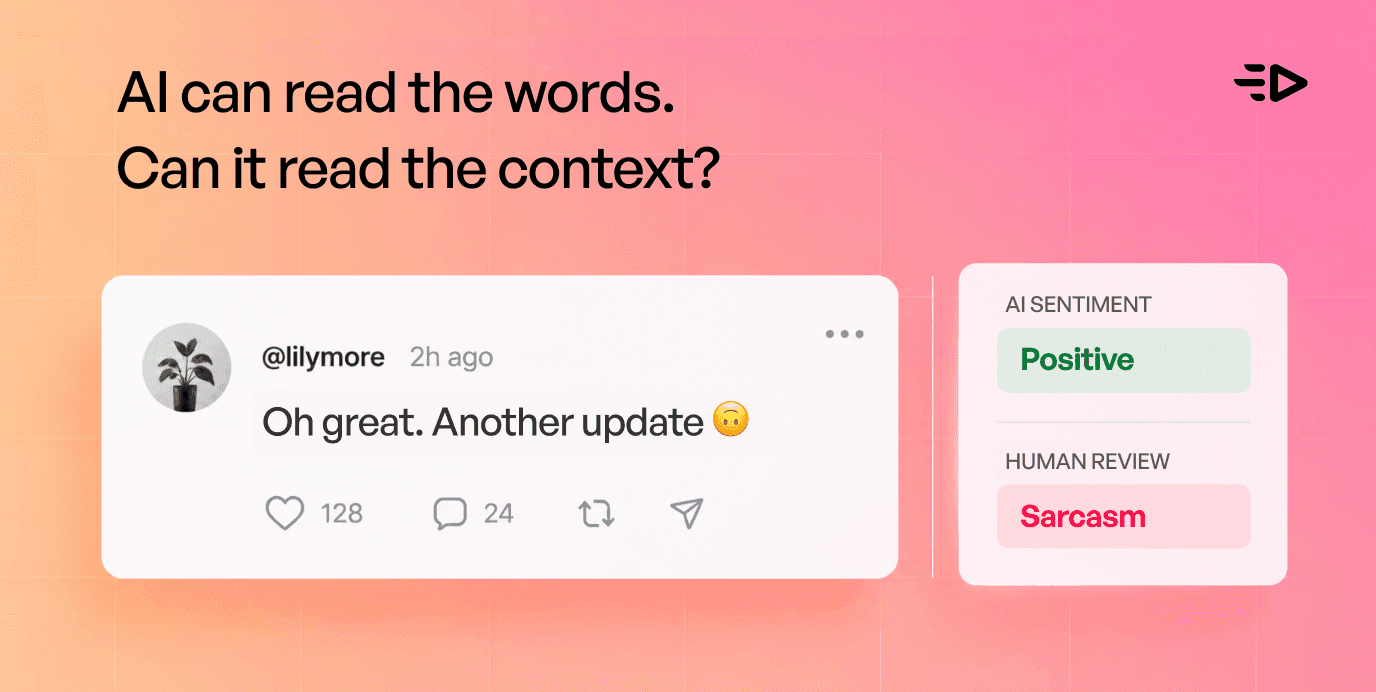
Social listening and sentiment analysis. For catching volume and spotting spikes, mention tracking, trend detection, routing likely-urgent issues to a person, AI listening is a genuine time-saver. As a precise read on how people feel, it is shakier than the dashboards suggest. Sentiment models do well on clean, straightforward text and then degrade sharply on the things that fill real feeds: sarcasm, negation like "not bad at all," emoji, slang, and mixed languages. Use it for triage and direction, keep a human sample-checking its calls, and never let a sentiment score alone tell you a crisis is or is not happening.
Community management and replies. AI handles the top of the support funnel well: sorting incoming comments and DMs, answering repeat FAQs from approved sources, translating, and acknowledging people after hours. The reason it needs supervision is that a public reply carries outsized reputation risk, and audiences are quick to spot canned AI empathy. The workable split is by stakes: let the bot answer "where do I track my order," and route anything about billing, safety, a complaint, or a crisis to a trained person with a clear handoff. The cost of the bot confidently mishandling the wrong message is a screenshot that outlives the efficiency you gained.
What's still catching up: The future of AI in social media
Influencer marketing and AI avatars. AI already helps around the edges of influencer work: finding and vetting creators, flagging fraud, drafting briefs, handling admin, and generating disclosed synthetic avatars for low-stakes jobs like localized product explainers. Where it is not there yet is the thing influence runs on, earned trust and lived experience. The audience data is blunt: an August 2026 Clutch survey of 601 consumers found 53% were less likely to buy from a brand they knew used AI on social, and nearly 90% said brands and creators should disclose when social content is AI-generated. Platforms are also moving to auto-label AI-generated content, so undisclosed synthetic influence is a shrinking option. Treat AI avatars as a production format for controlled, disclosed content, not as a shortcut to the credibility a real creator brings.
Read also: AI influencer marketing: the trend that shouldn't work, but it does
The myth to retire
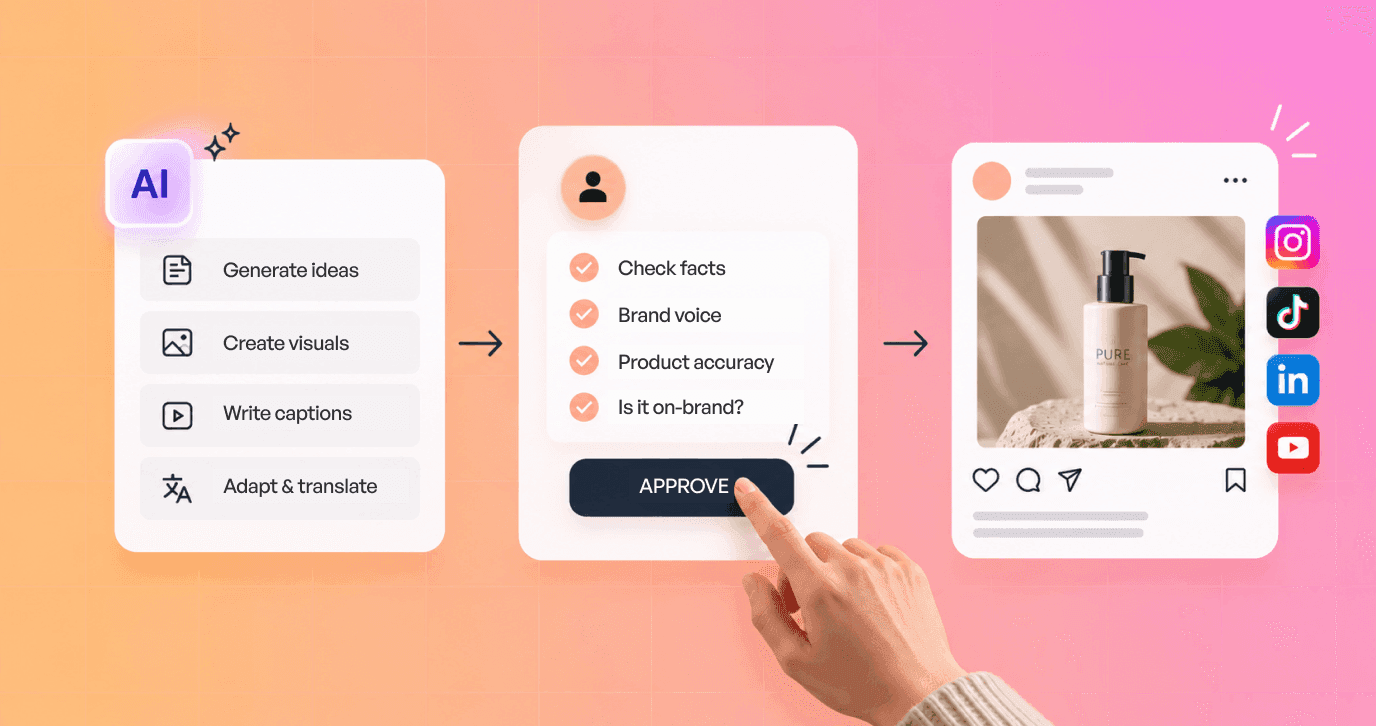
If there is one claim to be skeptical of in 2026, it is the pitch that AI can run your social media end to end, hands-off, on autopilot. It cannot, and the brands that try it tend to produce exactly the sterile, interchangeable feeds that audiences are learning to scroll past. AI can execute a strategy at scale; it cannot set a differentiated brand position, judge when a cultural moment makes your scheduled post inappropriate, or weigh which cheap engagement win quietly erodes long-term trust. Even the most automated ad products reflect this: the fully "give it a URL and walk away" campaign is still a limited test, not the norm, while the automation that genuinely works keeps a human on the strategy. Full autopilot is the version of AI that is still catching up, and may be for a while, because the missing piece is judgment, not horsepower.
How to use AI for social media marketing: where this leaves your team
The practical model that falls out of all this is simple. Let AI do the high-volume, reversible, and repetitive work: variants, first drafts, tagging, reporting drafts, scheduling, low-risk replies, and optimization inside agreed limits. Keep people accountable for everything public-facing, sensitive, or strategic: final creative, brand voice, claims, crisis replies, creator choices, and budget decisions. Give the tools a source of truth to work from, your approved product facts, brand vocabulary, and escalation rules, because a general model will not invent good governance on its own. Used that way, AI does not replace your social team; it removes the grunt work so the team can spend its judgment where judgment is the whole point. That is also how we think about our own tools: speed on the production and media-buying that AI does well, with a person owning the calls that carry real risk.
Read also: How to choose a real estate video maker that moves properties faster
Frequently Asked Questions
How is AI changing social media marketing in 2026?
It has shifted from a novelty to standard infrastructure, with most marketers using it daily for drafting, ideation, reporting, and ad optimization. The bigger change is where the human effort goes: as AI absorbs production and optimization, a team's time moves toward strategy, brand voice, cultural judgment, and the public-facing moments AI still handles poorly.
How do you use AI for social media marketing?
Point it at the high-volume, low-risk parts of the job: brainstorming angles and calendars, drafting captions and creative variants, adapting posts per platform, summarizing analytics, and running automated ad campaigns like Advantage+ or Smart+. Keep a person in charge of final creative, sensitive replies, and anything that makes a public claim, and give the tools your approved brand facts so they do not invent details.
Can AI run social media by itself?
Not well. AI can execute a defined plan at scale, but it cannot set strategy, read cultural context, or protect long-term trust, and fully hands-off feeds tend to read as generic. The reliable model in 2026 is AI-assisted, human-owned, not autonomous.
Can people tell when a post is AI-generated?
Increasingly, yes, and many react to it. Gartner found 49% of US consumers feel generative AI has worsened content quality (rising to 57% among Gen Z and millennials), and audiences now scroll past content that looks obviously synthetic. Platforms are also rolling out automatic AI labels. The takeaway is not to hide AI use but to edit AI output enough that it carries your voice and holds up on its own.
What can't AI do yet in social media marketing?
It struggles with cultural timing and appropriateness, reads sarcasm and nuanced sentiment unreliably (fine on clean text, but dropping off on the sarcasm, negation, emoji, and slang that fill real feeds), cannot carry the earned trust that real creators bring, and should not be trusted to handle crises or sensitive customer issues unsupervised. Those remain human jobs.
By 2026, AI in social media marketing has stopped being a debate. By every major industry survey, the large majority of marketers now use generative AI somewhere in their work, up sharply from just a couple of years earlier, which means the interesting question is no longer whether to use it but where it earns its place. And the honest answer, judging by the AI in social media market trends of the past year, is uneven. In the same year adoption went near-universal, the backlash arrived too: Gartner found that 49% of US consumers believe generative AI has made online content quality worse. So AI is both everywhere and, in places, working against the brands using it.
This article is a scorecard on AI and social media marketing for in-house social teams and social media marketers. Instead of another list of ten shiny features of 2026, it sorts the real use cases into three buckets: what works now, what needs a human in the loop, and what is still catching up. The goal is to help you point AI at the jobs where it genuinely pays off and keep it away from the ones where it quietly costs you trust.
The one test that sorts it out
Before the use cases, here is the test that decides which bucket each one lands in. It is not whether the output looks impressive. Modern AI produces plausible-looking work for almost every task on this list. The real question is whether a wrong answer is cheap and reversible. Drafting fifty caption options is cheap: you throw out the bad ones and no one sees them. Auto-replying to an angry customer in public is not: one tone-deaf response is live, screenshotted, and attached to your brand. Automate the tasks where mistakes are cheap and easy to undo. Keep people in charge of the ones where a mistake is public, permanent, or personal. Almost everything below follows from that.
What works now in AI and social media marketing
These are the areas that show most clearly how AI is changing social media marketing, because AI is dependable enough here to run inside sensible guardrails, and the work is high-volume and the failure modes are cheap.
Ad targeting and campaign automation. This is among the most proven commercial uses of AI in marketing, because the prediction engines behind it have years of training that generative tools do not. The automated campaign types the platforms now push, Meta Advantage+ and TikTok Smart+ on social, plus Google's cross-inventory Performance Max, take targeting, budget allocation, placement, and creative combinations off your plate and optimize them against live conversion data faster than any human could. The caveats are real, though: read the platforms' own performance claims as directional rather than gospel, keep an eye on budget pacing and automated creative cropping, and set guardrails, because results still depend on your conversion tracking, offer, and creative. On the media-buying side this is also where we point our own Performance Agent, which connects to Meta, Google, TikTok, and AppLovin to audit spend and run campaigns, because it is the part of the job automation handles most reliably.
Ideation and planning. AI is excellent at beating the blank page. Hand it your positioning, past top performers, and a campaign brief, and it will turn them into theme clusters, hook lists, content calendars, and repurposing plans in minutes. It expands a good input into many usable options. What it cannot do is tell you which of those options is culturally timely, distinctive in your category, or safe to publish this week, so the pattern that works is to let AI generate the menu and let a strategist choose from it.
Analytics and reporting. Turning a week of cross-platform data into a readable summary used to eat an afternoon; AI now does the first pass in seconds, flagging anomalies, clustering comment themes, and writing plain-language readouts. This genuinely saves hours. The line to hold is between reporting and concluding: AI is good at telling you what happened and terrible at reliably telling you why. It will confidently confuse correlation with causation and over-explain random noise, so ask it to cite the date range and baseline behind any claim, and have a person validate attribution before you move budget.
Scheduling. The operational side of scheduling, queuing posts, adapting formats per platform, coordinating a calendar, is mature and safe to automate. Treat the "best time to post" prediction with more caution: it is a reasonable hypothesis drawn from your history, not a lever that beats good creative. In 2026, relevance and early engagement drive distribution far more than the exact minute you publish, so test AI's recommended windows against a few of your own and judge the downstream results.
What needs a human in the loop
These use cases are useful every day, but the output is public-facing or judgment-heavy enough that a person has to own it.
Content creation and creative. AI is a fast, capable first-drafter: captions, image variants, short-form video concepts, translations, and dubbing all come quicker with it, and for a team that needs volume that is a real advantage. The risk is what it produces when left alone. It invents product details, drifts off your brand voice, adds visual artifacts, and defaults to the same generic hooks everyone else's AI is writing, which is precisely what audiences are now tuning out. A human still has to own the claims, the voice, and the question of whether the piece earns attention in its first second. This is also where the product-accuracy problem bites hardest, and it is the reason our Creatify Agent checks each generated scene against your real product, logo, and approved claims before it ships, so the speed of AI creative does not come at the cost of a melted label or an invented feature.
Social listening and sentiment analysis. For catching volume and spotting spikes, mention tracking, trend detection, routing likely-urgent issues to a person, AI listening is a genuine time-saver. As a precise read on how people feel, it is shakier than the dashboards suggest. Sentiment models do well on clean, straightforward text and then degrade sharply on the things that fill real feeds: sarcasm, negation like "not bad at all," emoji, slang, and mixed languages. Use it for triage and direction, keep a human sample-checking its calls, and never let a sentiment score alone tell you a crisis is or is not happening.
Community management and replies. AI handles the top of the support funnel well: sorting incoming comments and DMs, answering repeat FAQs from approved sources, translating, and acknowledging people after hours. The reason it needs supervision is that a public reply carries outsized reputation risk, and audiences are quick to spot canned AI empathy. The workable split is by stakes: let the bot answer "where do I track my order," and route anything about billing, safety, a complaint, or a crisis to a trained person with a clear handoff. The cost of the bot confidently mishandling the wrong message is a screenshot that outlives the efficiency you gained.
What's still catching up: The future of AI in social media
Influencer marketing and AI avatars. AI already helps around the edges of influencer work: finding and vetting creators, flagging fraud, drafting briefs, handling admin, and generating disclosed synthetic avatars for low-stakes jobs like localized product explainers. Where it is not there yet is the thing influence runs on, earned trust and lived experience. The audience data is blunt: an August 2026 Clutch survey of 601 consumers found 53% were less likely to buy from a brand they knew used AI on social, and nearly 90% said brands and creators should disclose when social content is AI-generated. Platforms are also moving to auto-label AI-generated content, so undisclosed synthetic influence is a shrinking option. Treat AI avatars as a production format for controlled, disclosed content, not as a shortcut to the credibility a real creator brings.
Read also: AI influencer marketing: the trend that shouldn't work, but it does
The myth to retire
If there is one claim to be skeptical of in 2026, it is the pitch that AI can run your social media end to end, hands-off, on autopilot. It cannot, and the brands that try it tend to produce exactly the sterile, interchangeable feeds that audiences are learning to scroll past. AI can execute a strategy at scale; it cannot set a differentiated brand position, judge when a cultural moment makes your scheduled post inappropriate, or weigh which cheap engagement win quietly erodes long-term trust. Even the most automated ad products reflect this: the fully "give it a URL and walk away" campaign is still a limited test, not the norm, while the automation that genuinely works keeps a human on the strategy. Full autopilot is the version of AI that is still catching up, and may be for a while, because the missing piece is judgment, not horsepower.
How to use AI for social media marketing: where this leaves your team
The practical model that falls out of all this is simple. Let AI do the high-volume, reversible, and repetitive work: variants, first drafts, tagging, reporting drafts, scheduling, low-risk replies, and optimization inside agreed limits. Keep people accountable for everything public-facing, sensitive, or strategic: final creative, brand voice, claims, crisis replies, creator choices, and budget decisions. Give the tools a source of truth to work from, your approved product facts, brand vocabulary, and escalation rules, because a general model will not invent good governance on its own. Used that way, AI does not replace your social team; it removes the grunt work so the team can spend its judgment where judgment is the whole point. That is also how we think about our own tools: speed on the production and media-buying that AI does well, with a person owning the calls that carry real risk.
Read also: How to choose a real estate video maker that moves properties faster
Frequently Asked Questions
How is AI changing social media marketing in 2026?
It has shifted from a novelty to standard infrastructure, with most marketers using it daily for drafting, ideation, reporting, and ad optimization. The bigger change is where the human effort goes: as AI absorbs production and optimization, a team's time moves toward strategy, brand voice, cultural judgment, and the public-facing moments AI still handles poorly.
How do you use AI for social media marketing?
Point it at the high-volume, low-risk parts of the job: brainstorming angles and calendars, drafting captions and creative variants, adapting posts per platform, summarizing analytics, and running automated ad campaigns like Advantage+ or Smart+. Keep a person in charge of final creative, sensitive replies, and anything that makes a public claim, and give the tools your approved brand facts so they do not invent details.
Can AI run social media by itself?
Not well. AI can execute a defined plan at scale, but it cannot set strategy, read cultural context, or protect long-term trust, and fully hands-off feeds tend to read as generic. The reliable model in 2026 is AI-assisted, human-owned, not autonomous.
Can people tell when a post is AI-generated?
Increasingly, yes, and many react to it. Gartner found 49% of US consumers feel generative AI has worsened content quality (rising to 57% among Gen Z and millennials), and audiences now scroll past content that looks obviously synthetic. Platforms are also rolling out automatic AI labels. The takeaway is not to hide AI use but to edit AI output enough that it carries your voice and holds up on its own.
What can't AI do yet in social media marketing?
It struggles with cultural timing and appropriateness, reads sarcasm and nuanced sentiment unreliably (fine on clean text, but dropping off on the sarcasm, negation, emoji, and slang that fill real feeds), cannot carry the earned trust that real creators bring, and should not be trusted to handle crises or sensitive customer issues unsupervised. Those remain human jobs.

Pronto para transformar seu produto em um vídeo envolvente?