
Equipe Creatify
COMPARTILHAR


NESTE ARTIGO
Buyers rate listing photos as very useful 81% of the time. Virtual tours manage 38%. Both numbers come from the 2025 NAR Profile of Home Buyers and Sellers, and together they say something most tool roundups miss.
Then there's the other number in the same report: 52% of buyers used an online video site during their search, and 52% found the home they bought online.
Put those together and video's job gets clear. Nobody buys a house off a 45-second reel. The reel is how somebody finds the listing, and then they study the photos and the floor plan to decide. Video is distribution.
Which changes what you should be shopping for. If you pick a real estate video maker on how cinematic the output looks, you're optimizing the wrong axis. Here's how the product categories differ, what separates them for property work, then the tools worth a look, then the disclosure rules that got real in January.
What a listing video does for you
Reach, mostly. NAR's 2025 REALTOR® Technology Survey found social media is the top lead-generating technology at 39%, ahead of CRM at 23% and the local MLS at 17%. Video is what you put into that channel.
It's also a listing-acquisition tool, which agents underrate. Zillow's 2024 Consumer Housing Trends Report, cited in its own announcement, found 71% of sellers are more likely to hire an agent who uses interactive media. The video you make for one property is partly a pitch for the next listing.
On the portal side, Zillow's Showcase facts page, last updated in May 2025, says Showcase listings get 79% more page views, 76% more saves and 91% more shares, are 10% more likely to go pending in the first 14 days, and sell for about 2% more.
Read that one with your eyes open. It's Zillow's data about a paid Zillow product that also buys "specialized exposure on Zillow," and Showcase is under 1% of listings. Better media and paid placement are bundled together in that figure, so treat it as directional. Worth knowing too that Zillow's April 2024 press release put the same 14-day metric at 20% rather than 10%, and that the current page quotes the 2% price lift as both 9,000 and 7,000 dollars in different places. Vendor performance numbers move around. Check the date on any you get quoted.

The timing pressure is the part that should shape your choice. In the same NAR report, sellers reported a median of four weeks on the market, and buyers searched for a median of 10 weeks. The window where a listing is new and interesting is short, and it opens the day the photos land.
Real estate video maker, app or editor: three different products
The words get used interchangeably in search results and they buy you different things.
A real estate video maker takes assets you already have and assembles a finished video. You supply photos or a listing link, it does the rest. Fastest route, least control over the result.
A real estate video app usually means that same job on a phone, sometimes with capture built in, so you film and finish in one place without touching a desktop.
A real estate video editor, which is what most people mean by real estate video editing software, puts you on a timeline with your own footage. Total control, and slower than the other two by an order of magnitude.
Plenty of agents go looking for one and need another. If you list twenty properties a year and have no editing habit, real estate video software will sit unopened on your desktop and a maker is what you wanted. If you're a real estate photographer delivering to agent clients, the makers and the one-tap real estate video apps will frustrate you inside a week and editing software is the only thing that will do.
The five criteria below apply whichever category you land in.
The five things that matter when choosing real estate video software
Time from photos to first post. Every other industry can batch its content. You can't. Each property is a one-off, the asset is worthless the day it goes under contract, and the useful window opens the moment the photographer delivers. The right question is whether you can publish something the same afternoon, not how many templates are in the library.
Cost per listing, not cost per seat. Real Estate Bees put the question to more than 2,000 real estate photographers in 2024, and the rates they reported cluster around 200 to 300 dollars for a standard property under 5,000 square feet, with roughly 350 dollars quoted for stills plus video. Those are practitioner-reported ranges rather than a national average, and they move with square footage and local competition. That's fine for a flagship listing. Multiply it across 20 listings a year and it's a five-figure line item. Compare tools on what one listing costs you, and count the extras that don't show on the pricing page: music licensing, extra seats, render caps, AI credits.
Branded and unbranded from one project. This one is specific to your industry and it's the criterion most roundups skip entirely. Your MLS almost certainly wants an unbranded version. realMLS spells out the distinction: branded tours "contain your contact information or image," unbranded ones "only contain images of the property. No contact information," and getting the branding disclosure wrong is a rules violation. A tool that can't produce both cuts from one project makes you do the job twice on every listing.
Every aspect ratio without a re-cut. Vertical for Reels and TikTok, horizontal for YouTube and the portal, square for the feed. If you have to rebuild the edit for each one, your real production time is triple what the demo suggested.
Whether the output is legal to publish. Which needs its own section.
The disclosure rules changed in January
If you sell in California, this is now statute rather than best practice.
AB 723 was chaptered on 10 October 2025 as Chapter 497, adding Section 10140.8 to the Business and Professions Code, and it took effect on 1 January 2026. Where a still image used to market a property has been digitally altered, the listing has to carry a disclosure statement that's "reasonably conspicuous and located on or adjacent to the image," plus a link, URL or QR code to a publicly accessible copy of the original unaltered image.
Note that it's written around still photographs rather than video. That still reaches most of these tools, because photo-to-video products are built on the same stills.
Ordinary retouching is fine. The statute exempts "lighting, sharpening, white balance, color correction, angle, straightening, cropping, exposure, or other common photo editing adjustments" as long as they "do not change the representation of the real property." Adding, removing or changing what's in the room is a different thing.
The NAR rule applies wherever you work, though only if you're a member: the Code binds REALTORS®, not every licensee. Article 12: "REALTORS® shall be honest and truthful in their real estate communications and shall present a true picture in their advertising, marketing, and other representations." Standard of Practice 12-10 prohibits manipulating listing content "in any way that produces a deceptive or misleading result," including misleading images.
Other states are following. Writing for HousingWire in June 2026, Paul Parker points to Wisconsin Act 69 landing in 2027 and New York S9584 pending, the latter reaching video and immersive media alongside stills.
Parker's test includes the question that catches video specifically: does the clip show aerial motion or a walkthrough generated from photos that were never shot that way? His suggested wording is worth stealing. "Drone-style movement is simulated. No drone footage was captured." Also "Virtually staged. Furniture shown is not included."
So the buying question becomes: what does this tool generate, versus what does it arrange? A product that pans and zooms across your real photos sits in a different position from one that invents a room. Ask before you subscribe, because the disclosure obligation lands on you, not the vendor.
Worth noting how fast the ground is shifting. Zillow put AI-powered Virtual Staging into Showcase on 10 September 2025, letting buyers restyle a room across seven design styles or strip the furniture out. The announcement doesn't say how those restyled images get labelled. The portals are shipping generative tools into the same market where the disclosure law just tightened, and the agent is the one holding the licence.
The best real estate video apps and tools, by the job they do
These aren't substitutes for each other, so ranking them one to ten would be useless. Pick by the input you have.
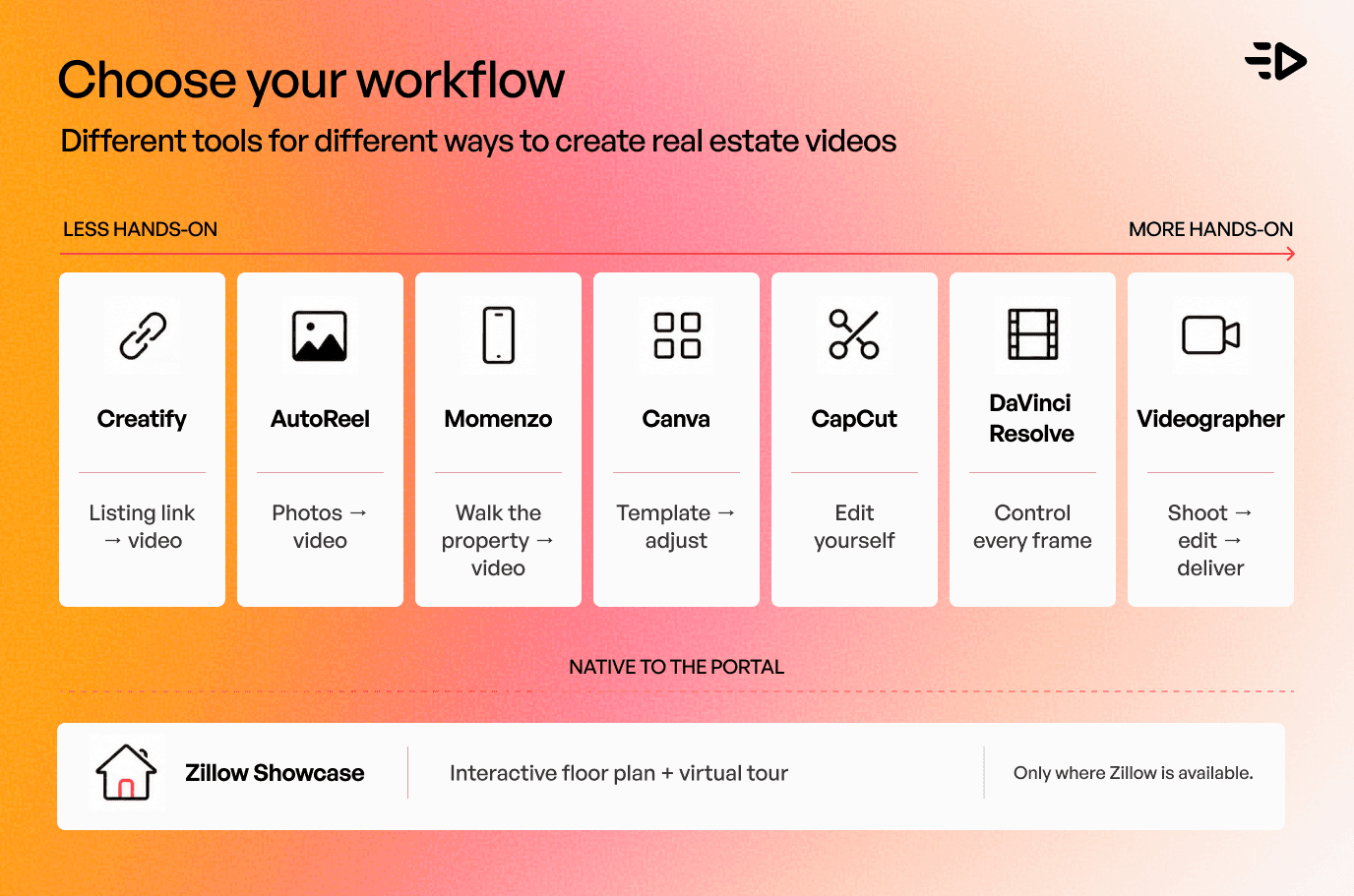
You have the listing link: Creatify
Paste the listing URL into the agent and let it work. Creatify Agent takes a link, researches, writes the script, casts, generates the shots, scores the audio, composites the cut and runs QA against the brief before anything ships. For property listing video ads, Creatify puts it at under 4 dollars per unique video and under 2 dollars for variations, produced when the listing hits the market rather than weeks later.
The part that matters given the section above is the guardrail layer. A vision-capable critic checks every scene against the brief, verified features and claims are locked as constraints, and on-screen text gets validated against confirmed data before it makes the cut. Output comes in 9:16, 16:9 and 1:1, so the format problem is handled in one pass.
Zumper, the rental listings platform, went from zero to more than 300 videos in a single quarter this way and saved about 20,000 dollars a month.
Fair warning on fit: this is built for ad creative, so it's the right call when the video's job is distribution and paid promotion. If what you want is a slow cinematic walkthrough of a 4 million dollar property, hire someone.
You have the photo set: AutoReel
AutoReel turns listing photos into a video and imports directly from Realtor.com. Each photo becomes a 3-second clip, and depending on your plan you get five to 20 photos per video, making clips of 15 to 60 seconds, ready in 10 to 15 minutes. There's a free tier at two videos a month with a watermark.
It's a slideshow with motion, so it inherits whatever your photos are. Also the case where Parker's simulated-movement question applies most directly.
You'd rather film it: Momenzo
Momenzo is a real estate video app built for the phone that runs on iPhone and Android. You walk the property following in-app prompts, and it handles subtitles, lighting correction and branded overlays. 59 dollars for three months or 169 dollars a year, unlimited listing videos.
You still have to walk the property, which is either the point or the problem depending on your week.
You want templates you can adjust: Canva
Canva has a real estate video template library and most teams already know it. Free to start, drag-and-drop control over the edit, and no per-listing automation whatsoever. Fine at low volume, painful at twenty listings.
You want to edit it yourself: CapCut or DaVinci Resolve
This is the real estate video editing software question, and it deserves a straight answer rather than a dismissal. Video editing for real estate agents splits by device more than by product: the phone between appointments, or the desktop after hours.
CapCut is where most agents editing on a phone end up, and it's the closest thing the category has to a default real estate video editing app despite nothing in it being built for property. Free to use, and it runs on mobile, tablet, desktop and web, so a cut you start between showings finishes on a laptop. Being general-purpose cuts both ways: no template in there knows what a listing is, and you build every video from scratch.
On the desktop, DaVinci Resolve is free in a version that handles most 8-bit formats up to 60fps at Ultra HD, with Resolve Studio at 295 dollars once rather than a subscription, on Mac, Windows and Linux. It's a professional colour and finishing suite, which is either precisely what you want or a month of your life you won't get back. Premiere Pro runs 22.99 dollars a month on the annual plan if your brokerage already lives in Adobe.
The honest read on this category: editing software is the right answer for real estate photographers and videographers delivering to clients, and for agents who genuinely enjoy the craft. For an agent with a listing to post this afternoon, a timeline is the most expensive way in the world to produce a 30-second vertical.
You want it native to the portal: Zillow Showcase
Interactive floor plan, virtual tour, and promoted placement on Zillow. It only works where Zillow is, it's under 1% of listings so availability is rationed, and every performance claim about it comes from Zillow.
You should still hire a videographer
Source: Kyle Loftus
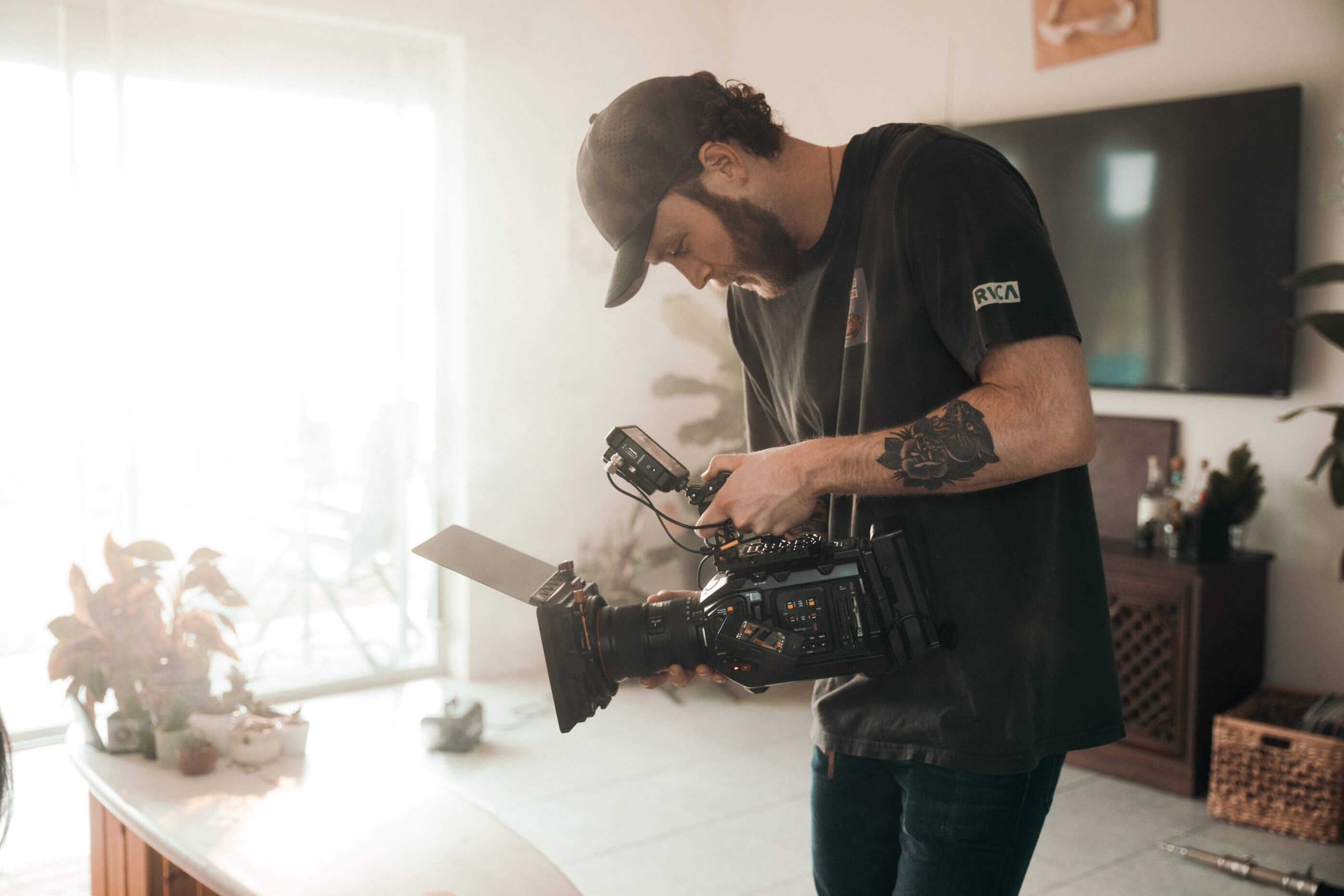
Luxury listings, architecturally distinctive properties, anything where the building is the story, and any shoot that needs real drone footage instead of a simulated move. At 200 to 350 dollars a property that's the right call on a handful of listings a year and the wrong call across all of them.
A 48-hour workflow for a new listing
Photos land. Pick the 15 to 20 that tell the walkthrough in order: exterior, entry, main living space, kitchen, primary bedroom, the one standout feature, back exterior.
Make the vertical cut first. That's where discovery happens. The horizontal version for the portal and YouTube comes from the same assets afterward.
Write the disclosure line before the caption. If anything was staged, added, removed or generated, the disclosure goes with the media rather than in a separate document, and California listings need the original reachable by link or QR.
Export the unbranded version at the same time. Not next week, when you've forgotten which project file it was.
Post while the listing is new. Against a 4-week median time on market, day one and day two carry more weight than the rest of the run combined.
Cut a second version with a different opening line. Same footage, new hook. Cheapest performance lever you have and the one everybody skips.
Keep the originals. Original photos, edited versions, and the disclosure language you used, filed together. It's Parker's fifth test point and it's also just how you survive a complaint.
Before you commit to any tool, run one listing through it end to end and produce both a 16:9 and a 9:16. An hour on a real property tells you more than a month of demos.
Picking one
Photos in hand and ten minutes to spare: AutoReel or Creatify
Want the listing link to produce the whole thing: Creatify
Happy to walk the property with a phone: Momenzo
Want to adjust a template yourself: Canva
Want to control every frame on a timeline: CapCut on a phone, DaVinci Resolve on a desktop
The property is the product and the budget exists: a videographer
Any tool at all: ask what it generates versus what it arranges
Read also: Automated ads explained: what gets automated and what doesn't
Frequently Asked Questions
What is the best real estate video maker?
There isn't one, and any roundup that crowns a winner is guessing about your workflow. Pick by input: Creatify if you want to paste a listing link and get finished ad creative, AutoReel if you have a photo set, Momenzo if you'd rather film on your phone, Canva if you want manual control, a videographer for flagship listings.
What is the best app for creating real estate videos?
For a phone-first workflow, Momenzo is built for it: you film following in-app prompts and it adds subtitles, lighting correction and branding, at 59 dollars for three months. Most rankings of the best real estate video apps put Momenzo, AutoReel and Canva against each other, which only helps once you know whether you're filming, feeding it a photo set, or laying it out yourself. If "app" means anything browser-based, the question is which input you have, and the answer above applies.
How much does a real estate videographer cost?
In a 2024 Real Estate Bees survey of more than 2,000 real estate photographers, reported rates cluster around 200 to 300 dollars for a standard property under 5,000 square feet, with about 350 dollars quoted for stills plus video and beginners nearer 100 to 200. These are practitioner-reported ranges, not a national average, and they move with square footage, video length and local competition. Get a quote for the specific property.
Can I use AI to make real estate videos, and which AI tool is best?
Yes, and plenty of agents do. Best depends on your input again: Creatify if you want a listing link turned into finished ad creative, AutoReel if you're feeding it a photo set. The constraint isn't the technology, it's disclosure: if the tool alters what the property looks like, you have obligations under NAR's Standard of Practice 12-10 everywhere and under California's AB 723 if you sell there.
What is the best real estate video editing software?
The best video editing software for real estate depends on who's holding the mouse. For agents, CapCut covers most of it: free, and it runs on phone, desktop and web so one project moves between them. For desktop finishing, DaVinci Resolve is free in a version that handles up to Ultra HD at 60fps, with Studio at 295 dollars as a one-time purchase, and Premiere Pro is 22.99 dollars a month on the annual plan. Real estate photographers delivering to clients tend to land on Resolve or Premiere. Agents who just need a listing posted usually find editing software is more tool than the job needs.
What app can I use to turn real estate photos into videos?
AutoReel is purpose-built for it and imports from Realtor.com, turning each photo into a 3-second clip. Creatify will do it from the listing link rather than the photo set. Canva works if you'd rather place the photos yourself. Whichever you use, if the tool adds motion the camera never made, Paul Parker's suggested disclosure line applies: "Drone-style movement is simulated. No drone footage was captured."
Is there a free real estate video maker?
Several, with limits. AutoReel has a free tier at two videos a month with a watermark. Canva is free to start. CapCut and DaVinci Resolve are both free to use, though they're editors rather than makers, so you're doing the assembly. Free tiers generally cost you a watermark, a render cap or your time, and on a listing that's about to go live the watermark is the one that matters.
How much does it cost to edit a real estate video?
Two different answers. Outsourced, you're in the range real estate photographers quoted to Real Estate Bees, roughly 200 to 300 dollars for a standard property and about 350 for stills plus video. In-house, the software is close to free and the cost is your time: budget an hour or two per listing on a timeline once you know the tool, which is the number most agents leave out of the comparison.
Do I have to disclose virtually staged or AI-altered listing images?
In California, since 1 January 2026, yes: a disclosure statement plus a link, URL or QR code to the original unaltered image. Elsewhere, NAR's Article 12 and Standard of Practice 12-10 already prohibit misleading images, and Wisconsin and New York have measures moving. Routine lighting and colour correction are exempt under AB 723. Check your own position with your broker or counsel rather than relying on a summary.
How long should a real estate listing video be?
Short for the feed, longer for the portal. A vertical cut of 20 to 45 seconds is doing discovery work, and tools like AutoReel cap at 60 seconds by design. Keep the full walkthrough separate and longer for people who've already decided they're interested.
Does listing video help a property sell faster?
The honest answer is that it helps the listing get found, and getting found earlier is what moves the timeline. Zillow's own Showcase numbers point that way, though they bundle media quality with paid placement. Video won't rescue a mispriced house.
Wrapping up
Choose on the boring criteria. How fast can you publish after the photos land, what does one listing cost you across a full year of listings, does it hand you branded and unbranded cuts together, does it export every ratio in one pass, and can you publish the output without a disclosure problem.
One thing worth sitting with. The agents getting the most out of these tools treat the listing video as the ad and the photo set as the product page: volume and speed on the ad, accuracy and detail on the page. Most people spend their money and their attention the other way round, then wonder why the polished walkthrough didn't move anything.
Buyers rate listing photos as very useful 81% of the time. Virtual tours manage 38%. Both numbers come from the 2025 NAR Profile of Home Buyers and Sellers, and together they say something most tool roundups miss.
Then there's the other number in the same report: 52% of buyers used an online video site during their search, and 52% found the home they bought online.
Put those together and video's job gets clear. Nobody buys a house off a 45-second reel. The reel is how somebody finds the listing, and then they study the photos and the floor plan to decide. Video is distribution.
Which changes what you should be shopping for. If you pick a real estate video maker on how cinematic the output looks, you're optimizing the wrong axis. Here's how the product categories differ, what separates them for property work, then the tools worth a look, then the disclosure rules that got real in January.
What a listing video does for you
Reach, mostly. NAR's 2025 REALTOR® Technology Survey found social media is the top lead-generating technology at 39%, ahead of CRM at 23% and the local MLS at 17%. Video is what you put into that channel.
It's also a listing-acquisition tool, which agents underrate. Zillow's 2024 Consumer Housing Trends Report, cited in its own announcement, found 71% of sellers are more likely to hire an agent who uses interactive media. The video you make for one property is partly a pitch for the next listing.
On the portal side, Zillow's Showcase facts page, last updated in May 2025, says Showcase listings get 79% more page views, 76% more saves and 91% more shares, are 10% more likely to go pending in the first 14 days, and sell for about 2% more.
Read that one with your eyes open. It's Zillow's data about a paid Zillow product that also buys "specialized exposure on Zillow," and Showcase is under 1% of listings. Better media and paid placement are bundled together in that figure, so treat it as directional. Worth knowing too that Zillow's April 2024 press release put the same 14-day metric at 20% rather than 10%, and that the current page quotes the 2% price lift as both 9,000 and 7,000 dollars in different places. Vendor performance numbers move around. Check the date on any you get quoted.
The timing pressure is the part that should shape your choice. In the same NAR report, sellers reported a median of four weeks on the market, and buyers searched for a median of 10 weeks. The window where a listing is new and interesting is short, and it opens the day the photos land.
Real estate video maker, app or editor: three different products
The words get used interchangeably in search results and they buy you different things.
A real estate video maker takes assets you already have and assembles a finished video. You supply photos or a listing link, it does the rest. Fastest route, least control over the result.
A real estate video app usually means that same job on a phone, sometimes with capture built in, so you film and finish in one place without touching a desktop.
A real estate video editor, which is what most people mean by real estate video editing software, puts you on a timeline with your own footage. Total control, and slower than the other two by an order of magnitude.
Plenty of agents go looking for one and need another. If you list twenty properties a year and have no editing habit, real estate video software will sit unopened on your desktop and a maker is what you wanted. If you're a real estate photographer delivering to agent clients, the makers and the one-tap real estate video apps will frustrate you inside a week and editing software is the only thing that will do.
The five criteria below apply whichever category you land in.
The five things that matter when choosing real estate video software
Time from photos to first post. Every other industry can batch its content. You can't. Each property is a one-off, the asset is worthless the day it goes under contract, and the useful window opens the moment the photographer delivers. The right question is whether you can publish something the same afternoon, not how many templates are in the library.
Cost per listing, not cost per seat. Real Estate Bees put the question to more than 2,000 real estate photographers in 2024, and the rates they reported cluster around 200 to 300 dollars for a standard property under 5,000 square feet, with roughly 350 dollars quoted for stills plus video. Those are practitioner-reported ranges rather than a national average, and they move with square footage and local competition. That's fine for a flagship listing. Multiply it across 20 listings a year and it's a five-figure line item. Compare tools on what one listing costs you, and count the extras that don't show on the pricing page: music licensing, extra seats, render caps, AI credits.
Branded and unbranded from one project. This one is specific to your industry and it's the criterion most roundups skip entirely. Your MLS almost certainly wants an unbranded version. realMLS spells out the distinction: branded tours "contain your contact information or image," unbranded ones "only contain images of the property. No contact information," and getting the branding disclosure wrong is a rules violation. A tool that can't produce both cuts from one project makes you do the job twice on every listing.
Every aspect ratio without a re-cut. Vertical for Reels and TikTok, horizontal for YouTube and the portal, square for the feed. If you have to rebuild the edit for each one, your real production time is triple what the demo suggested.
Whether the output is legal to publish. Which needs its own section.
The disclosure rules changed in January
If you sell in California, this is now statute rather than best practice.
AB 723 was chaptered on 10 October 2025 as Chapter 497, adding Section 10140.8 to the Business and Professions Code, and it took effect on 1 January 2026. Where a still image used to market a property has been digitally altered, the listing has to carry a disclosure statement that's "reasonably conspicuous and located on or adjacent to the image," plus a link, URL or QR code to a publicly accessible copy of the original unaltered image.
Note that it's written around still photographs rather than video. That still reaches most of these tools, because photo-to-video products are built on the same stills.
Ordinary retouching is fine. The statute exempts "lighting, sharpening, white balance, color correction, angle, straightening, cropping, exposure, or other common photo editing adjustments" as long as they "do not change the representation of the real property." Adding, removing or changing what's in the room is a different thing.
The NAR rule applies wherever you work, though only if you're a member: the Code binds REALTORS®, not every licensee. Article 12: "REALTORS® shall be honest and truthful in their real estate communications and shall present a true picture in their advertising, marketing, and other representations." Standard of Practice 12-10 prohibits manipulating listing content "in any way that produces a deceptive or misleading result," including misleading images.
Other states are following. Writing for HousingWire in June 2026, Paul Parker points to Wisconsin Act 69 landing in 2027 and New York S9584 pending, the latter reaching video and immersive media alongside stills.
Parker's test includes the question that catches video specifically: does the clip show aerial motion or a walkthrough generated from photos that were never shot that way? His suggested wording is worth stealing. "Drone-style movement is simulated. No drone footage was captured." Also "Virtually staged. Furniture shown is not included."
So the buying question becomes: what does this tool generate, versus what does it arrange? A product that pans and zooms across your real photos sits in a different position from one that invents a room. Ask before you subscribe, because the disclosure obligation lands on you, not the vendor.
Worth noting how fast the ground is shifting. Zillow put AI-powered Virtual Staging into Showcase on 10 September 2025, letting buyers restyle a room across seven design styles or strip the furniture out. The announcement doesn't say how those restyled images get labelled. The portals are shipping generative tools into the same market where the disclosure law just tightened, and the agent is the one holding the licence.
The best real estate video apps and tools, by the job they do
These aren't substitutes for each other, so ranking them one to ten would be useless. Pick by the input you have.
You have the listing link: Creatify
Paste the listing URL into the agent and let it work. Creatify Agent takes a link, researches, writes the script, casts, generates the shots, scores the audio, composites the cut and runs QA against the brief before anything ships. For property listing video ads, Creatify puts it at under 4 dollars per unique video and under 2 dollars for variations, produced when the listing hits the market rather than weeks later.
The part that matters given the section above is the guardrail layer. A vision-capable critic checks every scene against the brief, verified features and claims are locked as constraints, and on-screen text gets validated against confirmed data before it makes the cut. Output comes in 9:16, 16:9 and 1:1, so the format problem is handled in one pass.
Zumper, the rental listings platform, went from zero to more than 300 videos in a single quarter this way and saved about 20,000 dollars a month.
Fair warning on fit: this is built for ad creative, so it's the right call when the video's job is distribution and paid promotion. If what you want is a slow cinematic walkthrough of a 4 million dollar property, hire someone.
You have the photo set: AutoReel
AutoReel turns listing photos into a video and imports directly from Realtor.com. Each photo becomes a 3-second clip, and depending on your plan you get five to 20 photos per video, making clips of 15 to 60 seconds, ready in 10 to 15 minutes. There's a free tier at two videos a month with a watermark.
It's a slideshow with motion, so it inherits whatever your photos are. Also the case where Parker's simulated-movement question applies most directly.
You'd rather film it: Momenzo
Momenzo is a real estate video app built for the phone that runs on iPhone and Android. You walk the property following in-app prompts, and it handles subtitles, lighting correction and branded overlays. 59 dollars for three months or 169 dollars a year, unlimited listing videos.
You still have to walk the property, which is either the point or the problem depending on your week.
You want templates you can adjust: Canva
Canva has a real estate video template library and most teams already know it. Free to start, drag-and-drop control over the edit, and no per-listing automation whatsoever. Fine at low volume, painful at twenty listings.
You want to edit it yourself: CapCut or DaVinci Resolve
This is the real estate video editing software question, and it deserves a straight answer rather than a dismissal. Video editing for real estate agents splits by device more than by product: the phone between appointments, or the desktop after hours.
CapCut is where most agents editing on a phone end up, and it's the closest thing the category has to a default real estate video editing app despite nothing in it being built for property. Free to use, and it runs on mobile, tablet, desktop and web, so a cut you start between showings finishes on a laptop. Being general-purpose cuts both ways: no template in there knows what a listing is, and you build every video from scratch.
On the desktop, DaVinci Resolve is free in a version that handles most 8-bit formats up to 60fps at Ultra HD, with Resolve Studio at 295 dollars once rather than a subscription, on Mac, Windows and Linux. It's a professional colour and finishing suite, which is either precisely what you want or a month of your life you won't get back. Premiere Pro runs 22.99 dollars a month on the annual plan if your brokerage already lives in Adobe.
The honest read on this category: editing software is the right answer for real estate photographers and videographers delivering to clients, and for agents who genuinely enjoy the craft. For an agent with a listing to post this afternoon, a timeline is the most expensive way in the world to produce a 30-second vertical.
You want it native to the portal: Zillow Showcase
Interactive floor plan, virtual tour, and promoted placement on Zillow. It only works where Zillow is, it's under 1% of listings so availability is rationed, and every performance claim about it comes from Zillow.
You should still hire a videographer
Source: Kyle Loftus
Luxury listings, architecturally distinctive properties, anything where the building is the story, and any shoot that needs real drone footage instead of a simulated move. At 200 to 350 dollars a property that's the right call on a handful of listings a year and the wrong call across all of them.
A 48-hour workflow for a new listing
Photos land. Pick the 15 to 20 that tell the walkthrough in order: exterior, entry, main living space, kitchen, primary bedroom, the one standout feature, back exterior.
Make the vertical cut first. That's where discovery happens. The horizontal version for the portal and YouTube comes from the same assets afterward.
Write the disclosure line before the caption. If anything was staged, added, removed or generated, the disclosure goes with the media rather than in a separate document, and California listings need the original reachable by link or QR.
Export the unbranded version at the same time. Not next week, when you've forgotten which project file it was.
Post while the listing is new. Against a 4-week median time on market, day one and day two carry more weight than the rest of the run combined.
Cut a second version with a different opening line. Same footage, new hook. Cheapest performance lever you have and the one everybody skips.
Keep the originals. Original photos, edited versions, and the disclosure language you used, filed together. It's Parker's fifth test point and it's also just how you survive a complaint.
Before you commit to any tool, run one listing through it end to end and produce both a 16:9 and a 9:16. An hour on a real property tells you more than a month of demos.
Picking one
Photos in hand and ten minutes to spare: AutoReel or Creatify
Want the listing link to produce the whole thing: Creatify
Happy to walk the property with a phone: Momenzo
Want to adjust a template yourself: Canva
Want to control every frame on a timeline: CapCut on a phone, DaVinci Resolve on a desktop
The property is the product and the budget exists: a videographer
Any tool at all: ask what it generates versus what it arranges
Read also: Automated ads explained: what gets automated and what doesn't
Frequently Asked Questions
What is the best real estate video maker?
There isn't one, and any roundup that crowns a winner is guessing about your workflow. Pick by input: Creatify if you want to paste a listing link and get finished ad creative, AutoReel if you have a photo set, Momenzo if you'd rather film on your phone, Canva if you want manual control, a videographer for flagship listings.
What is the best app for creating real estate videos?
For a phone-first workflow, Momenzo is built for it: you film following in-app prompts and it adds subtitles, lighting correction and branding, at 59 dollars for three months. Most rankings of the best real estate video apps put Momenzo, AutoReel and Canva against each other, which only helps once you know whether you're filming, feeding it a photo set, or laying it out yourself. If "app" means anything browser-based, the question is which input you have, and the answer above applies.
How much does a real estate videographer cost?
In a 2024 Real Estate Bees survey of more than 2,000 real estate photographers, reported rates cluster around 200 to 300 dollars for a standard property under 5,000 square feet, with about 350 dollars quoted for stills plus video and beginners nearer 100 to 200. These are practitioner-reported ranges, not a national average, and they move with square footage, video length and local competition. Get a quote for the specific property.
Can I use AI to make real estate videos, and which AI tool is best?
Yes, and plenty of agents do. Best depends on your input again: Creatify if you want a listing link turned into finished ad creative, AutoReel if you're feeding it a photo set. The constraint isn't the technology, it's disclosure: if the tool alters what the property looks like, you have obligations under NAR's Standard of Practice 12-10 everywhere and under California's AB 723 if you sell there.
What is the best real estate video editing software?
The best video editing software for real estate depends on who's holding the mouse. For agents, CapCut covers most of it: free, and it runs on phone, desktop and web so one project moves between them. For desktop finishing, DaVinci Resolve is free in a version that handles up to Ultra HD at 60fps, with Studio at 295 dollars as a one-time purchase, and Premiere Pro is 22.99 dollars a month on the annual plan. Real estate photographers delivering to clients tend to land on Resolve or Premiere. Agents who just need a listing posted usually find editing software is more tool than the job needs.
What app can I use to turn real estate photos into videos?
AutoReel is purpose-built for it and imports from Realtor.com, turning each photo into a 3-second clip. Creatify will do it from the listing link rather than the photo set. Canva works if you'd rather place the photos yourself. Whichever you use, if the tool adds motion the camera never made, Paul Parker's suggested disclosure line applies: "Drone-style movement is simulated. No drone footage was captured."
Is there a free real estate video maker?
Several, with limits. AutoReel has a free tier at two videos a month with a watermark. Canva is free to start. CapCut and DaVinci Resolve are both free to use, though they're editors rather than makers, so you're doing the assembly. Free tiers generally cost you a watermark, a render cap or your time, and on a listing that's about to go live the watermark is the one that matters.
How much does it cost to edit a real estate video?
Two different answers. Outsourced, you're in the range real estate photographers quoted to Real Estate Bees, roughly 200 to 300 dollars for a standard property and about 350 for stills plus video. In-house, the software is close to free and the cost is your time: budget an hour or two per listing on a timeline once you know the tool, which is the number most agents leave out of the comparison.
Do I have to disclose virtually staged or AI-altered listing images?
In California, since 1 January 2026, yes: a disclosure statement plus a link, URL or QR code to the original unaltered image. Elsewhere, NAR's Article 12 and Standard of Practice 12-10 already prohibit misleading images, and Wisconsin and New York have measures moving. Routine lighting and colour correction are exempt under AB 723. Check your own position with your broker or counsel rather than relying on a summary.
How long should a real estate listing video be?
Short for the feed, longer for the portal. A vertical cut of 20 to 45 seconds is doing discovery work, and tools like AutoReel cap at 60 seconds by design. Keep the full walkthrough separate and longer for people who've already decided they're interested.
Does listing video help a property sell faster?
The honest answer is that it helps the listing get found, and getting found earlier is what moves the timeline. Zillow's own Showcase numbers point that way, though they bundle media quality with paid placement. Video won't rescue a mispriced house.
Wrapping up
Choose on the boring criteria. How fast can you publish after the photos land, what does one listing cost you across a full year of listings, does it hand you branded and unbranded cuts together, does it export every ratio in one pass, and can you publish the output without a disclosure problem.
One thing worth sitting with. The agents getting the most out of these tools treat the listing video as the ad and the photo set as the product page: volume and speed on the ad, accuracy and detail on the page. Most people spend their money and their attention the other way round, then wonder why the polished walkthrough didn't move anything.

Pronto para transformar seu produto em um vídeo envolvente?