
MiniMax H3 vs Seedance 2.0: a side-by-side breakdown for video creators

MiniMax H3 vs Seedance 2.0: a side-by-side breakdown for video creators

作者:

Creatify 团队

MiniMax H3 vs Seedance 2.0
Creatify logo

Creatify 团队

分享

LinkedIn 图标
X 图标
Facebook 图标

在本文中

MiniMax H3 and ByteDance's Seedance 2.0 are both 2026 omni-modal video models, which means each one reads text, images, video, and audio in a single context and returns a clip with its sound already generated against the picture, no separate audio pass. On that core, they're closer than their spec sheets suggest. Where they split is how each one bills you and how high it renders. The prices below are each maker's own published rates, from MiniMax for H3 and from ByteDance's Volcano Engine for Seedance, because that's the real cost of the model; third-party resellers wrap these models and mark them up, sometimes heavily, which can distort the comparison. Since cost is usually the first question, this breakdown starts there.

MiniMax H3 vs Seedance 2.0 pricing, up front

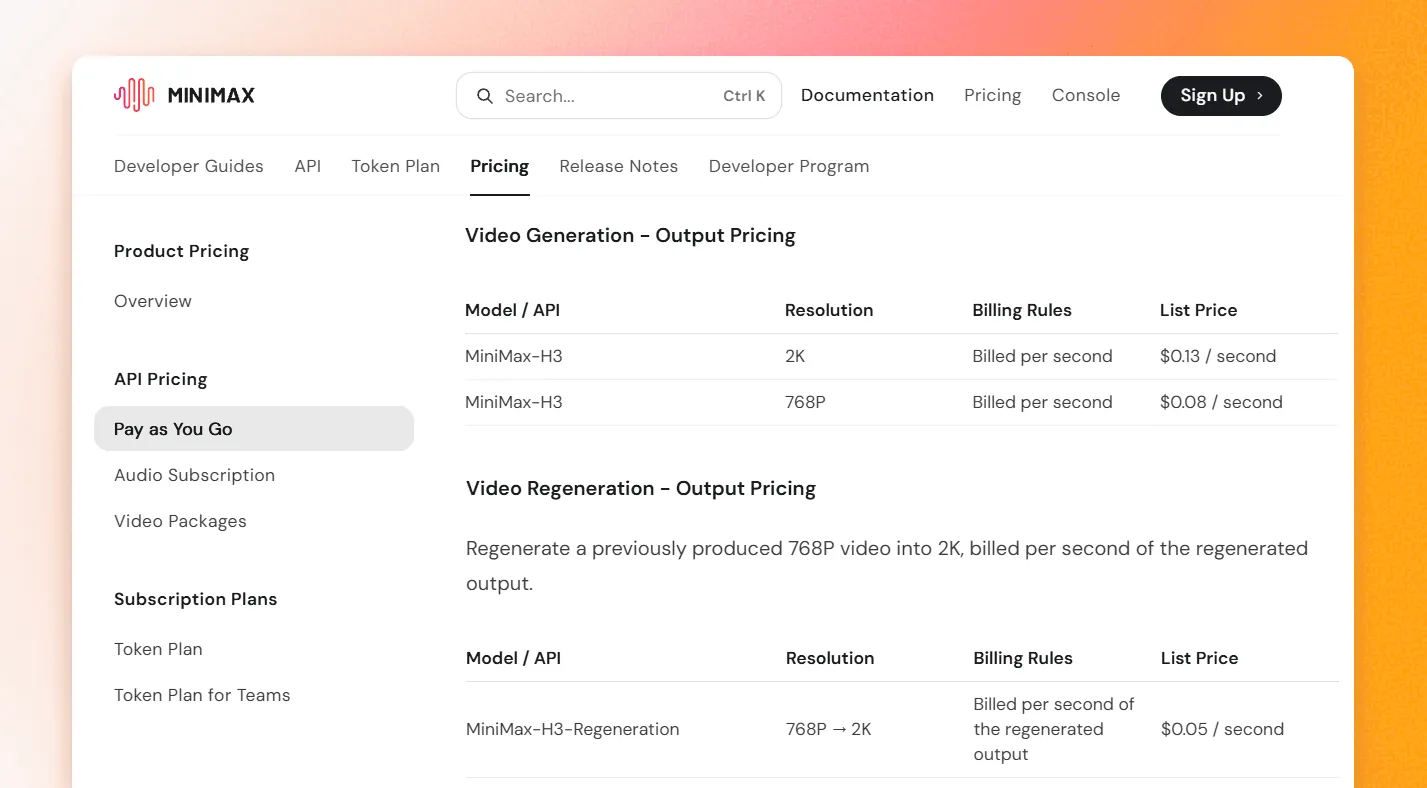
The two providers bill differently, so read this as a normalized reference rather than a matched grid. MiniMax charges per second by resolution. ByteDance charges Seedance by output tokens, which scales with resolution and length.


MiniMax H3 (MiniMax API)

Seedance 2.0 (ByteDance / Volcano Engine)

768p

$0.08/sec

not offered

2K

$0.13/sec (768p base plus a $0.05/sec regeneration step)

not offered

1080p

not offered

token-billed; see below

Billing model

flat per second, by resolution

per output token: about 46 yuan per million tokens for pure generation, about 28 yuan per million with video input

Rough per-second cost

$0.08 at 768p, $0.13 at 2K

ByteDance's "one yuan per second" tier, roughly $0.14 per second for a standard clip, rising with resolution

The headline that resellers can hide is that these two are in the same rough range at their source. ByteDance publicly pitched Seedance 2.0 as a "one yuan per second" model, which works out to roughly fourteen cents a second for a standard generation, while H3 runs eight to thirteen cents depending on resolution. So H3 is somewhat cheaper, especially at lower resolutions, but not by the lopsided margin a marked-up reseller price can suggest. The more useful distinction is the billing shape: H3's flat per-second rate is easy to predict, while Seedance's token pricing rewards lower resolutions and gets cheaper when you feed it a reference video (28 versus 46 yuan per million tokens). Volcano Engine bills in RMB for mainland China; ByteDance's BytePlus offers the same model with USD billing internationally.

What MiniMax H3 and Seedance 2.0 share

What both models can do

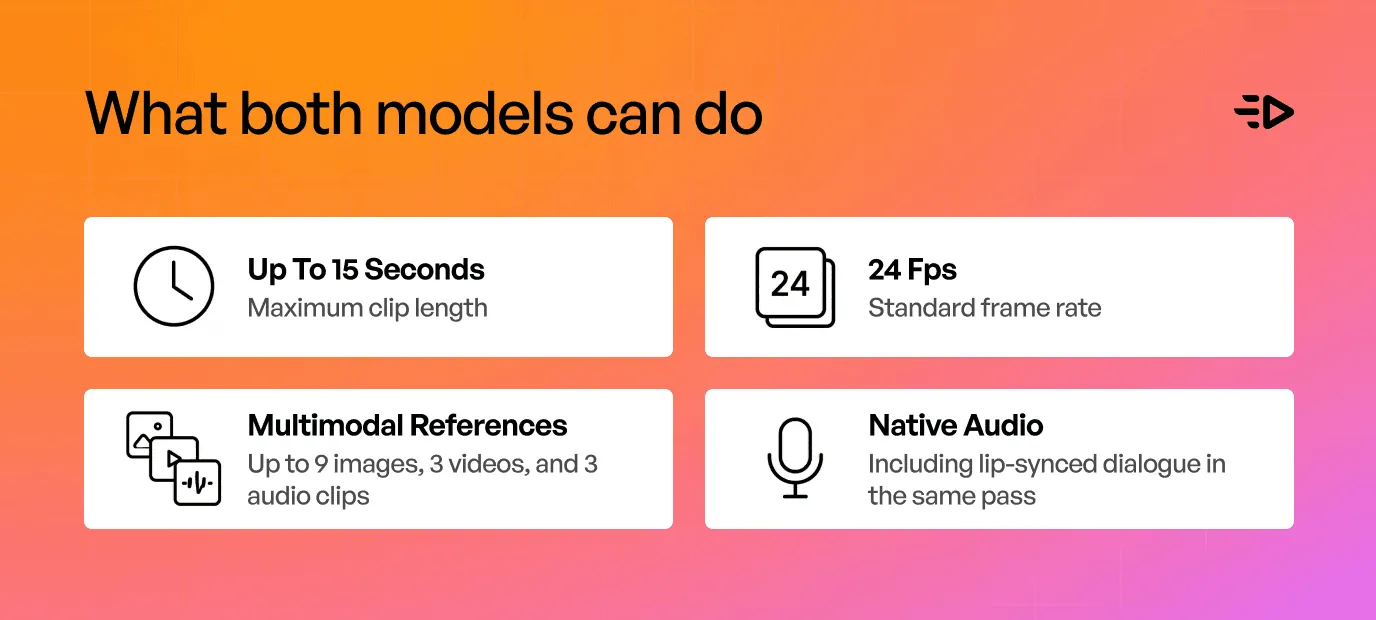
Strip away the marketing and the two models overlap on most of the fundamentals. Both generate short clips up to 15 seconds at 24 frames per second. Both accept up to nine reference images, three reference video clips, and three reference audio clips, twelve files in all. Both produce native audio, including lip-synced dialogue, in the same pass that makes the picture. Both permit commercial use, subject to each provider's terms. If your bar is "a short clip with matching sound from a multimodal prompt," either model clears it, and the choice comes down to the details below.

MiniMax H3, in detail

MiniMax H3 in detal

MiniMax H3, which the community also calls Hailuo 3.0 though MiniMax's own materials use "MiniMax H3," is a roughly 33-billion-parameter omni-modal transformer that MiniMax announced at the end of July 2026 and released as open weights on Hugging Face in early August. Its audio is a real strength: it jointly predicts video and audio and outputs 32 kHz stereo, so the sound is generated with the image rather than dubbed on afterward.

MiniMax H3 interface

Resolution is where H3's design shows. The model generates a 768p base, and its 2K output is not a native render but a separate regeneration stage that upscales that base, which is why MiniMax prices it as 768p at $0.08 a second plus a $0.05-a-second regeneration step, landing 2K at $0.13. That regeneration stage, H3-Regenerate-2K, was not part of the initial open-weights release, and the prompt-understanding system, H3-Context-IR, is hosted and closed too. So the downloadable weights give you the 768p base engine, while the pieces that push it to 2K and sharpen the prompt handling stay on MiniMax's API. In other words, "open weights" describes the base model, not the full production pipeline. Some third-party resellers add a further 4K upscale on top, but that's the reseller's layer, not MiniMax's model.

The license adds a sharper caveat. H3 ships under the MiniMax H3 Community License, not a permissive license like MIT or Apache. It defines its "Applicable Territory" so that the United States, the European Union, the United Kingdom, and South Korea are excluded, and it restricts using H3 outputs outside that territory, according to the license text on Hugging Face. In plain terms, a creator in any of those regions is not permitted to self-host the weights under the standard community terms and would need to pursue the separate authorization path the license provides. On top of that, any commercial product earning more than $20 million a year needs written authorization, commercial interfaces have to display "MiniMax H3," and you're barred from using its outputs to train competing models. None of this makes H3 a bad tool; it means the word "open" is doing less work than it appears to.

Seedance 2.0, in detail

Seedance 2.0

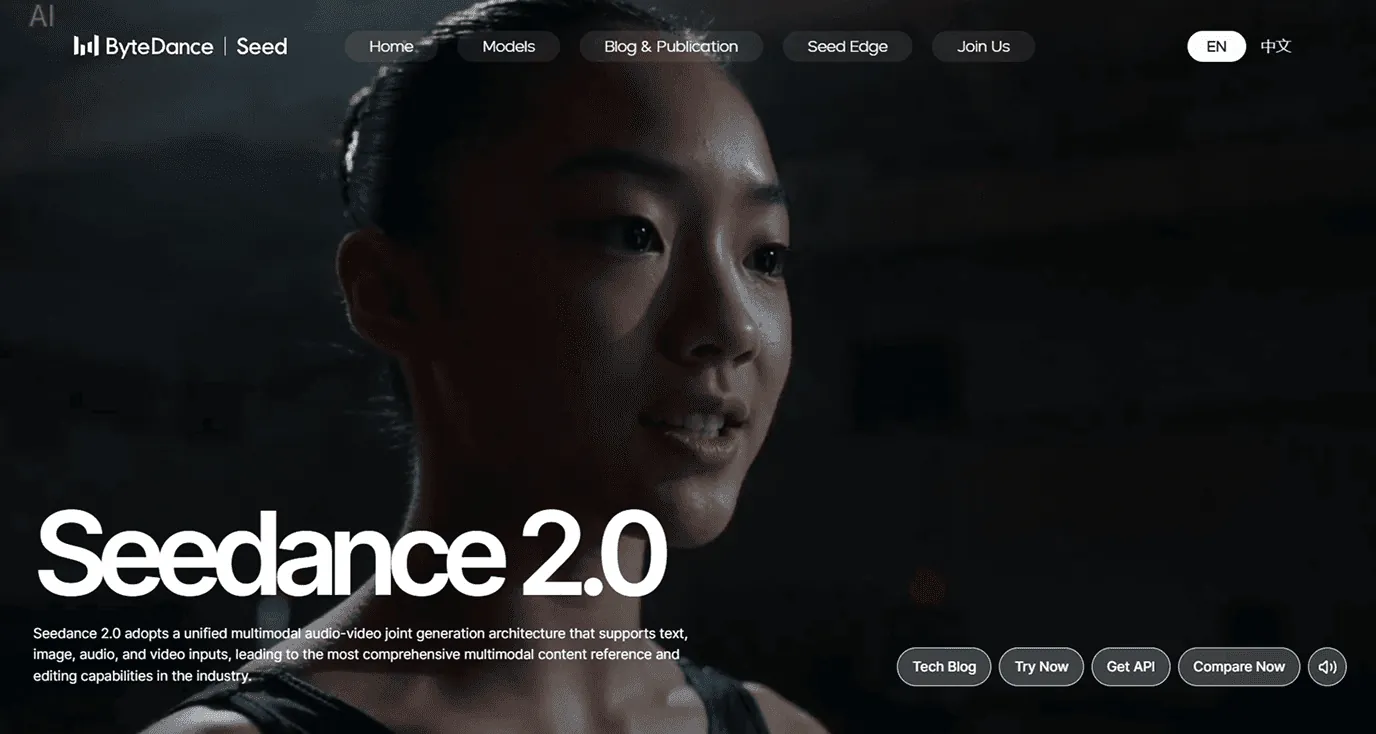
Seedance 2.0 is ByteDance's closed flagship, launched on February 12, 2026. It runs the same omni-modal idea, text, images, video, and audio into one context with native sound out. It generates up to 1080p natively, and rather than a per-second rate it bills by output tokens, roughly 46 yuan per million tokens for pure generation and about 28 yuan per million when you include a reference video, which ByteDance summed up as its "one yuan per second" tier. Because it's token-based, the cost tracks resolution and duration, so lower-resolution drafts are cheaper and 1080p costs more.

On quality, Seedance 2.0 scored well on the Artificial Analysis Video Arena. As of late August 2026 its public listings put it around fourth in text-to-video-with-audio (roughly 1,221 Elo) and first in image-to-video-with-audio (around 1,193), and it ranked higher at launch. Treat any single number as a dated snapshot, because those leaderboards move constantly and the exact figure depends on the mode and whether audio is scored. Access runs through ByteDance's own surfaces, Jimeng and Doubao and CapCut for consumers, and Volcano Engine or the international BytePlus platform for developers, though early on the API was limited to internal use and select partners rather than open signup.

Its reference workflow has a useful wrinkle: because a reference video drops the token rate from 46 to 28 yuan per million, Seedance is comparatively economical for the video-conditioned, reference-driven work that a lot of ad and continuity tasks need, where H3 charges the same per-second rate regardless of what you feed it.

Seedance vs MiniMax: the differences that matter most to creators

Where MiniMax H3 and Seedance 2.0 differ

Cut through everything and a few differences decide this.

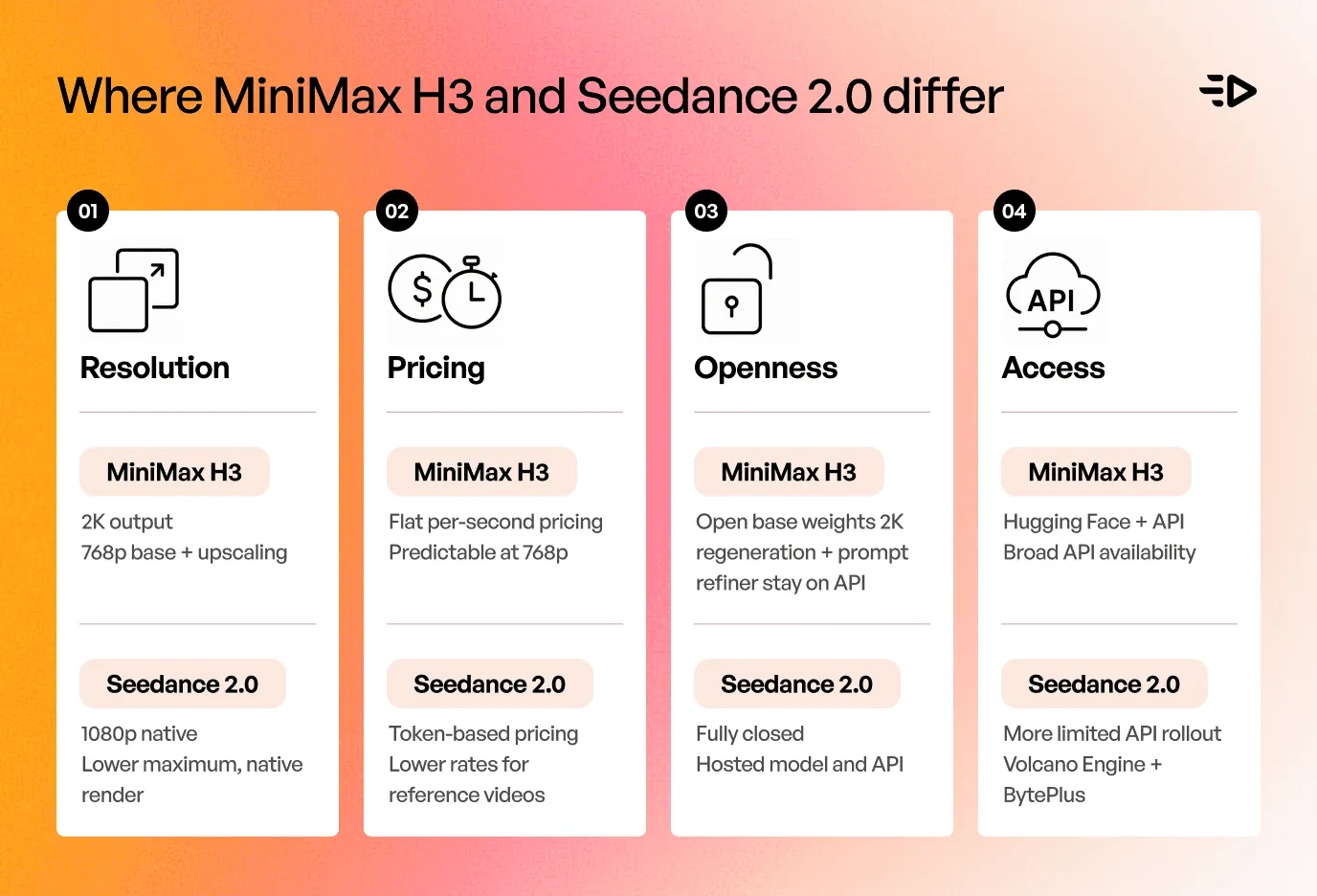
The first is the resolution ceiling, and at the providers' own level it runs opposite to what reseller listings imply. H3 reaches 2K while Seedance 2.0 tops out at 1080p natively. The catch is that H3's 2K is an upscale of a 768p base, per MiniMax's own pricing structure, whereas Seedance's 1080p is a native render. So H3 hits the higher number, but through upscaling; Seedance stops lower, but generates it directly. If you need genuine high-resolution detail rather than a bigger frame, test both rather than trusting the label.

The second is the shape of the bill. H3's flat per-second pricing is predictable and cheap at 768p. Seedance's token pricing is harder to eyeball but rewards two things: lower resolutions and reference-video workflows, where its rate drops by roughly a third. For heavy reference-driven iteration, that discount can flip the total in Seedance's favor even though its sticker sounds higher.

The third is how open each one really is. Seedance is fully closed and hosted. H3 is open in name, with downloadable base weights, but the 2K regeneration and prompt refiner stay on MiniMax's API, and its license excludes several major markets, so for most Western creators the practical experience is closer to a hosted product than a self-hosted one.

The fourth is access. H3's weights are on Hugging Face, and its API is broadly available, while Seedance 2.0's developer API rolled out more cautiously through Volcano Engine and BytePlus, so availability and billing currency (RMB versus USD) can decide the matter before quality does.

Which is the best AI video model for your work

For cheap, predictable per-second pricing, strong native stereo audio, and a 2K option, MiniMax H3 is the more economical and simpler choice, provided you're either using it through a hosted API or operating in a territory its license allows. For native 1080p, token pricing that rewards reference-heavy and lower-resolution work, and a home inside ByteDance's Jimeng, Doubao, and CapCut ecosystem, Seedance 2.0 fits. Neither is the flat winner, and the honest answer for a lot of teams is that they serve different jobs and bill on different logic, so the right pick depends on your resolution target and how reference-driven your prompts are.

If you'd rather not wire up each provider's API separately, multi-model playgrounds make switching easier; Creatify's model playground, for instance, lists both Seedance and MiniMax's Hailuo models among its 40-plus options, so you can compare outputs from one interface.

One caveat: the field already moved

Worth saying plainly: this is a comparison of two models that are no longer the newest in their own lineups. ByteDance launched Seedance 2.5 on July 31, 2026, with API access through BytePlus and Volcano Engine, and it pushes clip length up to 30 seconds and accepts far more references, up to 30 images, 10 videos, and 10 audio clips. It also moved pricing, to roughly 70 yuan per million tokens for pure generation and 42 with video input, which ByteDance illustrates as about 112 yuan, near 16 US dollars, for a 30-second 1080p clip. If you're choosing today, price and check both the 2.x models rather than assuming 2.0 is the current bar, and factor in that MiniMax will likely answer.

Read also: Best ad testing platforms in 2026: what each one is good for

Frequently Asked Questions

Which is cheaper, MiniMax H3 or Seedance 2.0?

At each maker's own rates they're close. MiniMax charges H3 at $0.08 a second for 768p and $0.13 for 2K. ByteDance prices Seedance 2.0 by tokens at what it calls a "one yuan per second" tier, roughly fourteen cents a second for a standard clip, with a lower rate when you supply a reference video. H3 is somewhat cheaper, especially at lower resolutions, but the wide gaps you may see quoted usually come from third-party resellers marking up one model, not from the models themselves.

Which one has higher resolution?

MiniMax H3, at the provider level: it reaches 2K, while Seedance 2.0 generates up to 1080p natively. The catch is that H3's 2K is an upscale of a 768p base rather than a native render, so if you care about true detail rather than frame size, compare actual output.

Is MiniMax H3 really open source?

Partly. The base weights are downloadable on Hugging Face, but the 2K regeneration stage and the prompt-preprocessing system stay on MiniMax's API, and the model ships under a restrictive community license rather than an open one. It's more accurate to call it open-weights with a hosted, licensed pipeline around it.

Can I use MiniMax H3 commercially in the US or EU?

Read the license carefully first. Its "Applicable Territory" excludes the United States, the European Union, the United Kingdom, and South Korea, so self-hosting under the standard community terms in those regions is not permitted, and commercial revenue above $20 million a year requires written authorization regardless. The license does provide a separate authorization path, and creators in those markets typically access H3 through a licensed hosted API instead.

What about Seedance 2.5?

It's already out. ByteDance released Seedance 2.5 on July 31, 2026, extending clips to 30 seconds, accepting more references, and shifting to higher token rates. This article covers 2.0 because it's the model most tools still expose, but if 2.5 is available to you, benchmark it before committing.

MiniMax H3 and ByteDance's Seedance 2.0 are both 2026 omni-modal video models, which means each one reads text, images, video, and audio in a single context and returns a clip with its sound already generated against the picture, no separate audio pass. On that core, they're closer than their spec sheets suggest. Where they split is how each one bills you and how high it renders. The prices below are each maker's own published rates, from MiniMax for H3 and from ByteDance's Volcano Engine for Seedance, because that's the real cost of the model; third-party resellers wrap these models and mark them up, sometimes heavily, which can distort the comparison. Since cost is usually the first question, this breakdown starts there.

MiniMax H3 vs Seedance 2.0 pricing, up front

The two providers bill differently, so read this as a normalized reference rather than a matched grid. MiniMax charges per second by resolution. ByteDance charges Seedance by output tokens, which scales with resolution and length.


MiniMax H3 (MiniMax API)

Seedance 2.0 (ByteDance / Volcano Engine)

768p

$0.08/sec

not offered

2K

$0.13/sec (768p base plus a $0.05/sec regeneration step)

not offered

1080p

not offered

token-billed; see below

Billing model

flat per second, by resolution

per output token: about 46 yuan per million tokens for pure generation, about 28 yuan per million with video input

Rough per-second cost

$0.08 at 768p, $0.13 at 2K

ByteDance's "one yuan per second" tier, roughly $0.14 per second for a standard clip, rising with resolution

The headline that resellers can hide is that these two are in the same rough range at their source. ByteDance publicly pitched Seedance 2.0 as a "one yuan per second" model, which works out to roughly fourteen cents a second for a standard generation, while H3 runs eight to thirteen cents depending on resolution. So H3 is somewhat cheaper, especially at lower resolutions, but not by the lopsided margin a marked-up reseller price can suggest. The more useful distinction is the billing shape: H3's flat per-second rate is easy to predict, while Seedance's token pricing rewards lower resolutions and gets cheaper when you feed it a reference video (28 versus 46 yuan per million tokens). Volcano Engine bills in RMB for mainland China; ByteDance's BytePlus offers the same model with USD billing internationally.

What MiniMax H3 and Seedance 2.0 share

What both models can do

Strip away the marketing and the two models overlap on most of the fundamentals. Both generate short clips up to 15 seconds at 24 frames per second. Both accept up to nine reference images, three reference video clips, and three reference audio clips, twelve files in all. Both produce native audio, including lip-synced dialogue, in the same pass that makes the picture. Both permit commercial use, subject to each provider's terms. If your bar is "a short clip with matching sound from a multimodal prompt," either model clears it, and the choice comes down to the details below.

MiniMax H3, in detail

MiniMax H3 in detal

MiniMax H3, which the community also calls Hailuo 3.0 though MiniMax's own materials use "MiniMax H3," is a roughly 33-billion-parameter omni-modal transformer that MiniMax announced at the end of July 2026 and released as open weights on Hugging Face in early August. Its audio is a real strength: it jointly predicts video and audio and outputs 32 kHz stereo, so the sound is generated with the image rather than dubbed on afterward.

MiniMax H3 interface

Resolution is where H3's design shows. The model generates a 768p base, and its 2K output is not a native render but a separate regeneration stage that upscales that base, which is why MiniMax prices it as 768p at $0.08 a second plus a $0.05-a-second regeneration step, landing 2K at $0.13. That regeneration stage, H3-Regenerate-2K, was not part of the initial open-weights release, and the prompt-understanding system, H3-Context-IR, is hosted and closed too. So the downloadable weights give you the 768p base engine, while the pieces that push it to 2K and sharpen the prompt handling stay on MiniMax's API. In other words, "open weights" describes the base model, not the full production pipeline. Some third-party resellers add a further 4K upscale on top, but that's the reseller's layer, not MiniMax's model.

The license adds a sharper caveat. H3 ships under the MiniMax H3 Community License, not a permissive license like MIT or Apache. It defines its "Applicable Territory" so that the United States, the European Union, the United Kingdom, and South Korea are excluded, and it restricts using H3 outputs outside that territory, according to the license text on Hugging Face. In plain terms, a creator in any of those regions is not permitted to self-host the weights under the standard community terms and would need to pursue the separate authorization path the license provides. On top of that, any commercial product earning more than $20 million a year needs written authorization, commercial interfaces have to display "MiniMax H3," and you're barred from using its outputs to train competing models. None of this makes H3 a bad tool; it means the word "open" is doing less work than it appears to.

Seedance 2.0, in detail

Seedance 2.0

Seedance 2.0 is ByteDance's closed flagship, launched on February 12, 2026. It runs the same omni-modal idea, text, images, video, and audio into one context with native sound out. It generates up to 1080p natively, and rather than a per-second rate it bills by output tokens, roughly 46 yuan per million tokens for pure generation and about 28 yuan per million when you include a reference video, which ByteDance summed up as its "one yuan per second" tier. Because it's token-based, the cost tracks resolution and duration, so lower-resolution drafts are cheaper and 1080p costs more.

On quality, Seedance 2.0 scored well on the Artificial Analysis Video Arena. As of late August 2026 its public listings put it around fourth in text-to-video-with-audio (roughly 1,221 Elo) and first in image-to-video-with-audio (around 1,193), and it ranked higher at launch. Treat any single number as a dated snapshot, because those leaderboards move constantly and the exact figure depends on the mode and whether audio is scored. Access runs through ByteDance's own surfaces, Jimeng and Doubao and CapCut for consumers, and Volcano Engine or the international BytePlus platform for developers, though early on the API was limited to internal use and select partners rather than open signup.

Its reference workflow has a useful wrinkle: because a reference video drops the token rate from 46 to 28 yuan per million, Seedance is comparatively economical for the video-conditioned, reference-driven work that a lot of ad and continuity tasks need, where H3 charges the same per-second rate regardless of what you feed it.

Seedance vs MiniMax: the differences that matter most to creators

Where MiniMax H3 and Seedance 2.0 differ

Cut through everything and a few differences decide this.

The first is the resolution ceiling, and at the providers' own level it runs opposite to what reseller listings imply. H3 reaches 2K while Seedance 2.0 tops out at 1080p natively. The catch is that H3's 2K is an upscale of a 768p base, per MiniMax's own pricing structure, whereas Seedance's 1080p is a native render. So H3 hits the higher number, but through upscaling; Seedance stops lower, but generates it directly. If you need genuine high-resolution detail rather than a bigger frame, test both rather than trusting the label.

The second is the shape of the bill. H3's flat per-second pricing is predictable and cheap at 768p. Seedance's token pricing is harder to eyeball but rewards two things: lower resolutions and reference-video workflows, where its rate drops by roughly a third. For heavy reference-driven iteration, that discount can flip the total in Seedance's favor even though its sticker sounds higher.

The third is how open each one really is. Seedance is fully closed and hosted. H3 is open in name, with downloadable base weights, but the 2K regeneration and prompt refiner stay on MiniMax's API, and its license excludes several major markets, so for most Western creators the practical experience is closer to a hosted product than a self-hosted one.

The fourth is access. H3's weights are on Hugging Face, and its API is broadly available, while Seedance 2.0's developer API rolled out more cautiously through Volcano Engine and BytePlus, so availability and billing currency (RMB versus USD) can decide the matter before quality does.

Which is the best AI video model for your work

For cheap, predictable per-second pricing, strong native stereo audio, and a 2K option, MiniMax H3 is the more economical and simpler choice, provided you're either using it through a hosted API or operating in a territory its license allows. For native 1080p, token pricing that rewards reference-heavy and lower-resolution work, and a home inside ByteDance's Jimeng, Doubao, and CapCut ecosystem, Seedance 2.0 fits. Neither is the flat winner, and the honest answer for a lot of teams is that they serve different jobs and bill on different logic, so the right pick depends on your resolution target and how reference-driven your prompts are.

If you'd rather not wire up each provider's API separately, multi-model playgrounds make switching easier; Creatify's model playground, for instance, lists both Seedance and MiniMax's Hailuo models among its 40-plus options, so you can compare outputs from one interface.

One caveat: the field already moved

Worth saying plainly: this is a comparison of two models that are no longer the newest in their own lineups. ByteDance launched Seedance 2.5 on July 31, 2026, with API access through BytePlus and Volcano Engine, and it pushes clip length up to 30 seconds and accepts far more references, up to 30 images, 10 videos, and 10 audio clips. It also moved pricing, to roughly 70 yuan per million tokens for pure generation and 42 with video input, which ByteDance illustrates as about 112 yuan, near 16 US dollars, for a 30-second 1080p clip. If you're choosing today, price and check both the 2.x models rather than assuming 2.0 is the current bar, and factor in that MiniMax will likely answer.

Read also: Best ad testing platforms in 2026: what each one is good for

Frequently Asked Questions

Which is cheaper, MiniMax H3 or Seedance 2.0?

At each maker's own rates they're close. MiniMax charges H3 at $0.08 a second for 768p and $0.13 for 2K. ByteDance prices Seedance 2.0 by tokens at what it calls a "one yuan per second" tier, roughly fourteen cents a second for a standard clip, with a lower rate when you supply a reference video. H3 is somewhat cheaper, especially at lower resolutions, but the wide gaps you may see quoted usually come from third-party resellers marking up one model, not from the models themselves.

Which one has higher resolution?

MiniMax H3, at the provider level: it reaches 2K, while Seedance 2.0 generates up to 1080p natively. The catch is that H3's 2K is an upscale of a 768p base rather than a native render, so if you care about true detail rather than frame size, compare actual output.

Is MiniMax H3 really open source?

Partly. The base weights are downloadable on Hugging Face, but the 2K regeneration stage and the prompt-preprocessing system stay on MiniMax's API, and the model ships under a restrictive community license rather than an open one. It's more accurate to call it open-weights with a hosted, licensed pipeline around it.

Can I use MiniMax H3 commercially in the US or EU?

Read the license carefully first. Its "Applicable Territory" excludes the United States, the European Union, the United Kingdom, and South Korea, so self-hosting under the standard community terms in those regions is not permitted, and commercial revenue above $20 million a year requires written authorization regardless. The license does provide a separate authorization path, and creators in those markets typically access H3 through a licensed hosted API instead.

What about Seedance 2.5?

It's already out. ByteDance released Seedance 2.5 on July 31, 2026, extending clips to 30 seconds, accepting more references, and shifting to higher token rates. This article covers 2.0 because it's the model most tools still expose, but if 2.5 is available to you, benchmark it before committing.

图标
图标

准备好将您的产品转变为引人入胜的视频了吗?

准备好加速您的营销了吗?

使用AI生成的视频广告,在几分钟内测试您的新产品理念

箭头图标。
渐变

准备好加速您的营销了吗?

使用AI生成的视频广告,在几分钟内测试您的新产品理念

箭头图标。
渐变

准备好加速您的营销了吗?

使用AI生成的视频广告,在几分钟内测试您的新产品理念

箭头图标。
渐变

准备好加速您的营销了吗?

使用AI生成的视频广告,在几分钟内测试您的新产品理念

箭头图标。
渐变
背景