11 ChatGPT prompts for marketing worth adding to your workflow

11 ChatGPT prompts for marketing worth adding to your workflow

作者:

Creatify 团队

ChatGPT prompts for marketing
Creatify logo

Creatify 团队

分享

LinkedIn 图标
X 图标
Facebook 图标

在本文中

Most "ChatGPT prompts for marketing" lists hand you some version of "act as a world-class marketer and write a campaign for my product." You paste it in, and you get back the average of the internet: confident, fluent, and generic enough to describe any brand in your category. It reads fine and usually helps nothing.

The output is only ever as good as the context behind it. A language model with no information about your positioning, your customers, or your numbers can only reach for the mid-market average, so that's what it gives you. Feed it the specifics of your business and the same model turns into a sharp strategic partner.

So each prompt below is built for a real marketing job, and each comes with the exact context to feed it, the "training data" that makes the output yours. Set that context up once, and these become marketing prompts for ChatGPT you keep.

Why most marketing prompt lists fall flat

When you give a model a vague instruction, it fills the gaps with the most statistically likely marketing language, which is another way of saying the most clichéd. Ask for "a value proposition for our SaaS tool" and you get "streamline your workflow and boost productivity," because that sentence appears in ten thousand training examples. The model has nothing else to build upon.

The ChatGPT marketing prompts that work fix that by doing one thing consistently: they supply your proprietary material and ask the model to organize what you already know. Your positioning, your buyers' actual words, your real numbers, your constraints. That shift, from inventing to organizing what you already know, is the whole difference between a prompt worth keeping and one worth deleting.

Do this first: set up your marketing source of truth

Before the prompts, the highest-impact move in this entire article: stop pasting the same background into every chat and give the model a permanent memory of your business.

OpenAI's Projects let you group chats, upload reference files, and set custom instructions so ChatGPT keeps your context on hand across every chat in that project. A Custom GPT goes further, pairing standing instructions with a knowledge base of files it can draw from. Either one turns "explain my whole business every time" into "it already knows."

marketing sources

Load it with the documents that define your marketing reality. Some good examples:

  • Your positioning and messaging: the category you compete in, the claim you can defend, your differentiators, and the proof behind them.

  • Your ICP and segments: who you sell to, their role, the outcomes they care about, and what disqualifies a bad-fit lead.

  • Voice of customer: exports of sales-call transcripts, customer reviews, support tickets, and survey verbatims, in your buyers' actual words.

  • Brand voice: a short guide plus five real examples of copy that sound like you, and five that don't.

  • Offers and pricing: your products, tiers, prices, and the objections each one tends to raise.

  • Recent performance: a current snapshot of what's working across channels, so recommendations start from reality.

That library is the training data every prompt below assumes. Once it exists, each prompt runs against your business instead of against the internet's idea of a business like yours. If you can't build a Custom GPT on your plan, paste the relevant file into the chat before the prompt. The point is the same: context first, request second.

The best marketing prompts for ChatGPT worth keeping

Each one names the job, the context to feed it, and the prompt itself. Fill the bracketed slots, or let your source-of-truth GPT supply them. These aren't throwaway ChatGPT marketing prompts; they're the ones you return to.

1. Pressure-test your positioning

What it's for: finding out whether your positioning holds up against the alternatives a buyer is really weighing, including "do nothing."

Context to feed it: your current positioning statement, your top three competitors' homepage and pricing copy, and any win/loss notes on why deals are won or lost.

Prompt: "You are a positioning strategist in the tradition of April Dunford. Here is our current positioning: [paste]. Here is how our top three alternatives position themselves: [paste competitor copy]. Here is why we win and lose deals: [paste win/loss notes]. First, list the real alternatives a buyer considers, including doing nothing and building it in-house. For each, state what it's better at than us. Then identify the one attribute we can credibly own that the alternatives can't claim, and rewrite our positioning around it. Flag any claim in our current positioning that a competitor could copy word for word, because if they can, it isn't positioning."

2. Rebuild your ICP from your actual customers

What it's for: replacing the persona you invented in a workshop with one grounded in who buys, stays, and refers.

Context to feed it: a CRM export of your best customers (high retention, high expansion, short sales cycle) and your worst (churned, discounted, painful), with firmographics, call recording summaries, and any notes.

Prompt: "Here is data on our best customers and our worst: [paste export]. Compare the two groups across firmographics, use case, how they found us, sales-cycle length, and any patterns in the notes. Identify the three traits most strongly shared by the best group and absent in the worst. Turn that into a tightened ICP definition: who to target, the trigger that makes them ready to buy, and a short disqualification checklist to keep sales from chasing bad-fit leads. Point out any belief we seem to hold about our ideal customer that the data contradicts."

3. Mine voice-of-customer language into messaging

What it's for: writing copy in your buyers' own words, the single biggest lever on message resonance.

Context to feed it: raw sales-call transcripts, customer reviews, support tickets, and survey open-ends. The messier and more verbatim, the better.

Prompt: "Here are raw customer inputs: sales-call transcripts, reviews, and support tickets: [paste]. Extract, in the customers' own words: the exact phrases they use to describe the problem, the outcome they say they want, the objections they raise, and the moment they decided we were worth it. Group these into themes and rank them by how often they appear. Then draft three versions of our core value proposition using their language, not ours. Do not smooth their phrasing into marketing speak. If they say 'stop guessing,' the copy says 'stop guessing.'"

4. Competitive teardown, and the gap you can own

What it's for: mapping where every competitor is crowded so you can move to where they aren't.

Context to feed it: the homepage, product, and pricing copy of three to five competitors, plus your own positioning.

Prompt: "Here is the marketing copy from [N] competitors: [paste, labeled by competitor]. For each, summarize their core promise, the pain points they lead with, the proof they use, and their tone. Then build a map: which messages and audiences is everyone crowding into, and which real buyer needs is nobody addressing well. Given our differentiator, [describe], recommend one positioning angle and three campaign themes that move us into the open space rather than into the fight everyone is already having."

5. Full-funnel campaign architecture from one offer

What it's for: turning a single offer into a coherent campaign across awareness, consideration, and conversion, so the channels reinforce each other.

Context to feed it: the offer or launch brief, your ICP, the channels you can run, the budget, and the primary goal.

Prompt: "Here is our offer and launch brief: [paste]. Our ICP is [paste or reference]. We can run [list channels] with a budget of [amount] and a primary goal of [goal]. Design a full-funnel campaign: the single core message, then how it adapts by stage (awareness, consideration, decision) and by channel. For each stage, specify the job that stage does, the asset types, the metric that proves it's working, and the handoff to the next stage. Call out the one place this campaign is most likely to leak, and how to shore it up. Keep the message consistent across stages; only the depth and format change."

6. Landing-page teardown and rewrite

What it's for: diagnosing why a page converts poorly against the visitor's actual job and objections, then fixing it.

Context to feed it: the full page copy, the traffic source and its promise, the conversion and scroll or bounce data, and the top objections from voice of customer.

Prompt: "Here is our landing page copy: [paste]. Visitors arrive from [source] expecting [the promise that ad or link made]. Here's the performance: [paste bounce, scroll depth, conversion rate]. Here are the objections our buyers raise: [paste from VoC]. Audit the page against one question: does it move a skeptical visitor from their problem to our solution without a gap? Identify where the message-match with the traffic source breaks, where an unanswered objection stalls the reader, and where the CTA asks for too much too soon. Then rewrite the hero, the top objection-handling section, and the CTA. Explain the reasoning behind each change."

7. Email lifecycle and nurture design

What it's for: building lifecycle flows that move people forward based on where they are in the journey.

Context to feed it: your funnel stages and what qualifies a move between them, the product, the main objections by stage, and your voice of customer.

Prompt: "Here is our funnel: [stages and the trigger that moves someone between them]. Our product is [describe]. The main objections by stage are [paste]. Design three lifecycle email flows: a welcome and activation sequence, a consideration nurture, and a win-back for people who went cold. For each flow, give the number of emails, the job of each email, the specific objection or motivation it targets, the trigger that sends it, and a subject line plus opening line written in our voice-of-customer language. No 'just checking in' emails. Every send has to earn its place with a reason the reader would care about."

8. SEO topic cluster from real demand

What it's for: building a content cluster around the questions buyers ask, mapped to the funnel stage.

Context to feed it: a keyword export (from Ahrefs, Semrush, or Search Console) with volume and difficulty, the questions your sales and support teams hear most, and the competitor gaps you know of.

Prompt: "Here is a keyword export with volume and difficulty: [paste]. Here are the questions our sales and support teams hear most: [paste]. Cluster these into a pillar-and-supporting-content structure: one pillar topic we can realistically own, and the supporting articles that ladder up to it. Map each piece to a funnel stage and to the buyer question it answers, not just the keyword it targets. Prioritize by a blend of demand, difficulty, and how close the intent sits to a purchase. Flag any high-volume keyword that looks like demand but carries the wrong intent for us, so we don't waste a piece on it."

9. Paid search: from search terms to assets and negatives

What it's for: turning a raw search-terms report into responsive ad assets, negative themes, and angle tests, grounded in what people typed.

Context to feed it: an exported search-terms report with clicks, cost, and conversions, plus the offer and the landing page it points to.

Prompt: "Here is our search-terms report with clicks, cost, and conversions: [paste]. Our offer is [describe], and the landing page promises [paste hero]. First, group the converting search terms by the intent behind them, and the wasted-spend terms by the reason they don't fit. From the converting intents, write [N] responsive search ad headlines and [N] descriptions that match the searcher's language and the landing page promise. From the wasted-spend terms, propose negative keyword themes. Finally, suggest three messaging angles worth testing, each tied to a specific intent cluster from the data."

10. The marketing report that ends in decisions

What it's for: turning a metrics export into a decision-ready narrative, so a review meeting produces decisions.

Context to feed it: a performance export across your channels for the period and the prior period, your goals, and any context on what changed (launches, budget shifts, seasonality).

Prompt: "Here is our marketing performance for this period and the prior one: [paste export]. Our goals were [paste]. Here's what changed during the period: [paste context]. Write a report a busy executive can act on. Lead with the three things that matter most and why. Separate what moved because of something we did from what moved because of the market or seasonality. For each meaningful change, state the likely cause and your confidence in it. End with three recommended decisions for next period, each with the trade-off it carries. No vanity metrics, and no restating the numbers I can already see in the export."

11. Red-team your own strategy

What it's for: catching the generic before it ships, by making the model attack the plan the way a skeptical CMO would.

Context to feed it: the strategy, campaign, or positioning you're about to commit to, plus your positioning and ICP for grounding.

Prompt: "Here is a marketing plan we're about to commit to: [paste]. Here is our positioning and ICP for reference: [paste or reference]. Attack it. First, find every sentence that would still be true if you swapped our brand name for a competitor's, because those sentences say nothing. Then name the assumptions this plan depends on that we haven't validated, the audience it quietly ignores, and the single most likely reason it underperforms. Be specific and unsparing. End with the three changes that would most improve it, ranked by impact."

Read also: What is AI-powered marketing? Real examples & how big brands do it

Making the output genuinely yours

The prompts are frameworks; the quality comes from what context you feed them. A few habits separate teams that get real value from teams that get a slightly faster way to produce mediocrity.

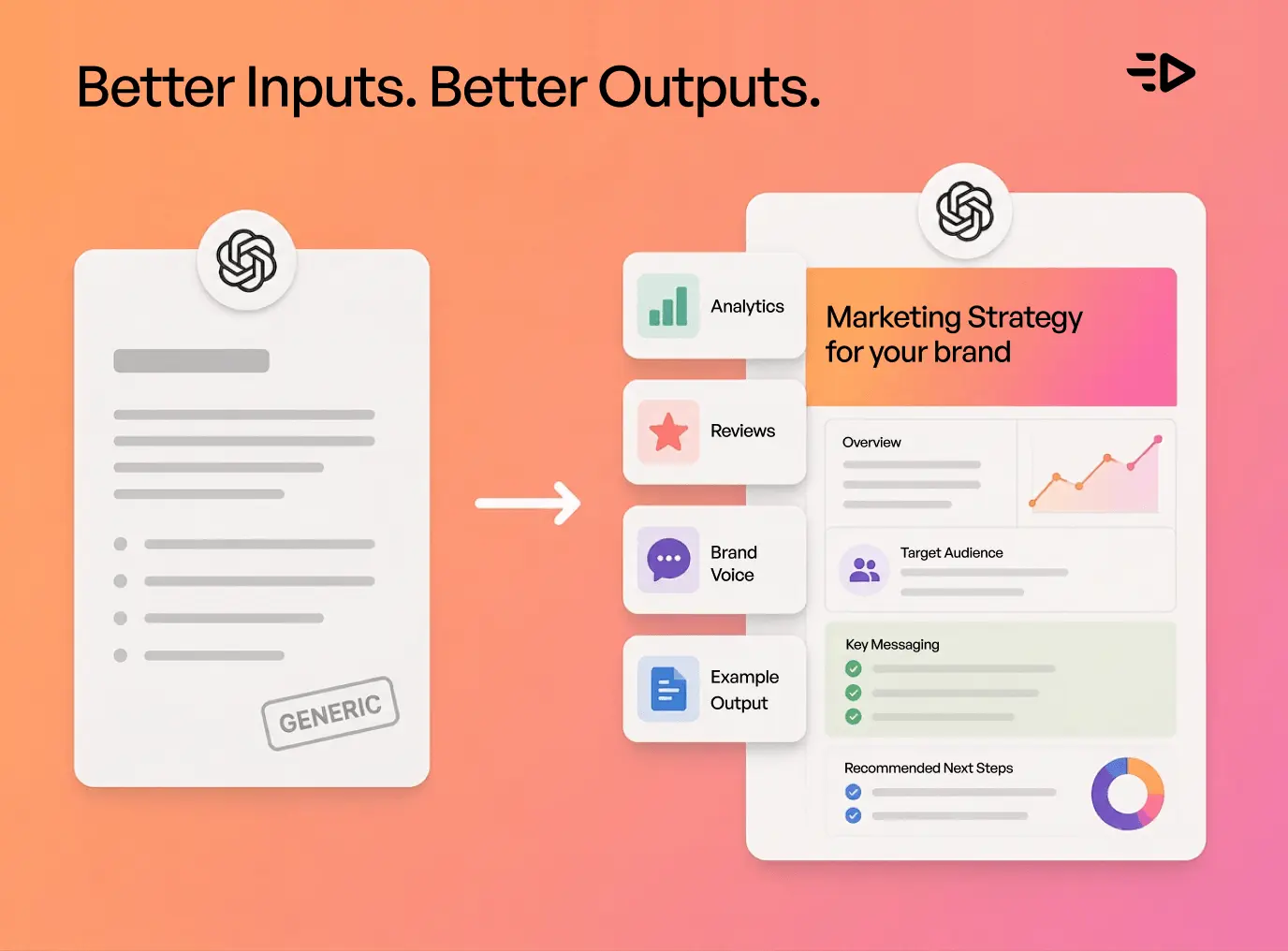
Better inputs better outputs

Give the model real data. "Our conversion rate is around 3%" tells it far less than the actual export, where it can spot patterns you'd round away. Separate your instructions from your context so the model knows which is which, and give it one real example of the output you want, since a single on-brand sample teaches more than a paragraph of description. After a first draft, ask the model to critique its own work for anything generic or unsupported, and it will catch issues you'd otherwise fix by hand. And keep your source-of-truth GPT current, because a plan built on last quarter's positioning ages the moment your positioning moves.

One more, for the creative that comes out the other end. When a prompt gives you ad concepts or a script worth testing, the bottleneck moves to production. A tool like Creatify turns a concept or a product URL into finished video ad variations, so the angles you just generated can run as real ads and let the data pick the winner, rather than sitting in a document.

Read also: 27 ChatGPT prompts for social media marketing in 2026

Frequently Asked Questions

What are the best ChatGPT prompts for marketing?

The best ones are built for a specific marketing job and supplied with your own context: your positioning, your customers' actual language, and your real performance data. A prompt like "write a campaign for my product" returns generic output because the model has nothing to work from. The prompts worth keeping cover strategic jobs, positioning, ICP, messaging, competitive analysis, campaign architecture, CRO, email, SEO, paid search, and analysis, and each one specifies the context to feed it.

How do I make ChatGPT output specific to my brand?

Give it your material before you give it the task. Load your positioning, ideal-customer profile, voice-of-customer language, brand voice examples, pricing, and recent performance into a Custom GPT or a Project so the model works from your reality. Then every request runs against that context. Pasting the relevant document into the chat works too; the principle is context first, request second.

What should I put in a marketing Custom GPT or Project?

Your positioning and messaging, your ICP and segments, exports of voice-of-customer inputs (sales calls, reviews, support tickets, surveys), a short brand-voice guide with real examples, your offers and pricing with common objections, and a current performance snapshot. This becomes the knowledge base the model draws from, which is what turns generic output into output grounded in your business.

Can ChatGPT do marketing strategy?

It can be a strong strategic partner when you treat it as one. Fed your positioning, customer data, and constraints, it can pressure-test positioning, synthesize customer research, map competitive gaps, and stress-test a plan. It performs poorly when asked to invent strategy from a one-line prompt with no context. The judgment stays yours; the model organizes and challenges your thinking faster than you could alone.

How are these different from generic marketing prompt lists?

Generic lists give you one-line requests that produce interchangeable output. These are built around your proprietary context and cover the upstream strategic work, positioning, ICP, messaging, and analysis, that generic lists skip. Each prompt tells you exactly what to feed it, and the whole set is designed to run against a source-of-truth GPT loaded with your business, which is where the specificity comes from.

Most "ChatGPT prompts for marketing" lists hand you some version of "act as a world-class marketer and write a campaign for my product." You paste it in, and you get back the average of the internet: confident, fluent, and generic enough to describe any brand in your category. It reads fine and usually helps nothing.

The output is only ever as good as the context behind it. A language model with no information about your positioning, your customers, or your numbers can only reach for the mid-market average, so that's what it gives you. Feed it the specifics of your business and the same model turns into a sharp strategic partner.

So each prompt below is built for a real marketing job, and each comes with the exact context to feed it, the "training data" that makes the output yours. Set that context up once, and these become marketing prompts for ChatGPT you keep.

Why most marketing prompt lists fall flat

When you give a model a vague instruction, it fills the gaps with the most statistically likely marketing language, which is another way of saying the most clichéd. Ask for "a value proposition for our SaaS tool" and you get "streamline your workflow and boost productivity," because that sentence appears in ten thousand training examples. The model has nothing else to build upon.

The ChatGPT marketing prompts that work fix that by doing one thing consistently: they supply your proprietary material and ask the model to organize what you already know. Your positioning, your buyers' actual words, your real numbers, your constraints. That shift, from inventing to organizing what you already know, is the whole difference between a prompt worth keeping and one worth deleting.

Do this first: set up your marketing source of truth

Before the prompts, the highest-impact move in this entire article: stop pasting the same background into every chat and give the model a permanent memory of your business.

OpenAI's Projects let you group chats, upload reference files, and set custom instructions so ChatGPT keeps your context on hand across every chat in that project. A Custom GPT goes further, pairing standing instructions with a knowledge base of files it can draw from. Either one turns "explain my whole business every time" into "it already knows."

marketing sources

Load it with the documents that define your marketing reality. Some good examples:

  • Your positioning and messaging: the category you compete in, the claim you can defend, your differentiators, and the proof behind them.

  • Your ICP and segments: who you sell to, their role, the outcomes they care about, and what disqualifies a bad-fit lead.

  • Voice of customer: exports of sales-call transcripts, customer reviews, support tickets, and survey verbatims, in your buyers' actual words.

  • Brand voice: a short guide plus five real examples of copy that sound like you, and five that don't.

  • Offers and pricing: your products, tiers, prices, and the objections each one tends to raise.

  • Recent performance: a current snapshot of what's working across channels, so recommendations start from reality.

That library is the training data every prompt below assumes. Once it exists, each prompt runs against your business instead of against the internet's idea of a business like yours. If you can't build a Custom GPT on your plan, paste the relevant file into the chat before the prompt. The point is the same: context first, request second.

The best marketing prompts for ChatGPT worth keeping

Each one names the job, the context to feed it, and the prompt itself. Fill the bracketed slots, or let your source-of-truth GPT supply them. These aren't throwaway ChatGPT marketing prompts; they're the ones you return to.

1. Pressure-test your positioning

What it's for: finding out whether your positioning holds up against the alternatives a buyer is really weighing, including "do nothing."

Context to feed it: your current positioning statement, your top three competitors' homepage and pricing copy, and any win/loss notes on why deals are won or lost.

Prompt: "You are a positioning strategist in the tradition of April Dunford. Here is our current positioning: [paste]. Here is how our top three alternatives position themselves: [paste competitor copy]. Here is why we win and lose deals: [paste win/loss notes]. First, list the real alternatives a buyer considers, including doing nothing and building it in-house. For each, state what it's better at than us. Then identify the one attribute we can credibly own that the alternatives can't claim, and rewrite our positioning around it. Flag any claim in our current positioning that a competitor could copy word for word, because if they can, it isn't positioning."

2. Rebuild your ICP from your actual customers

What it's for: replacing the persona you invented in a workshop with one grounded in who buys, stays, and refers.

Context to feed it: a CRM export of your best customers (high retention, high expansion, short sales cycle) and your worst (churned, discounted, painful), with firmographics, call recording summaries, and any notes.

Prompt: "Here is data on our best customers and our worst: [paste export]. Compare the two groups across firmographics, use case, how they found us, sales-cycle length, and any patterns in the notes. Identify the three traits most strongly shared by the best group and absent in the worst. Turn that into a tightened ICP definition: who to target, the trigger that makes them ready to buy, and a short disqualification checklist to keep sales from chasing bad-fit leads. Point out any belief we seem to hold about our ideal customer that the data contradicts."

3. Mine voice-of-customer language into messaging

What it's for: writing copy in your buyers' own words, the single biggest lever on message resonance.

Context to feed it: raw sales-call transcripts, customer reviews, support tickets, and survey open-ends. The messier and more verbatim, the better.

Prompt: "Here are raw customer inputs: sales-call transcripts, reviews, and support tickets: [paste]. Extract, in the customers' own words: the exact phrases they use to describe the problem, the outcome they say they want, the objections they raise, and the moment they decided we were worth it. Group these into themes and rank them by how often they appear. Then draft three versions of our core value proposition using their language, not ours. Do not smooth their phrasing into marketing speak. If they say 'stop guessing,' the copy says 'stop guessing.'"

4. Competitive teardown, and the gap you can own

What it's for: mapping where every competitor is crowded so you can move to where they aren't.

Context to feed it: the homepage, product, and pricing copy of three to five competitors, plus your own positioning.

Prompt: "Here is the marketing copy from [N] competitors: [paste, labeled by competitor]. For each, summarize their core promise, the pain points they lead with, the proof they use, and their tone. Then build a map: which messages and audiences is everyone crowding into, and which real buyer needs is nobody addressing well. Given our differentiator, [describe], recommend one positioning angle and three campaign themes that move us into the open space rather than into the fight everyone is already having."

5. Full-funnel campaign architecture from one offer

What it's for: turning a single offer into a coherent campaign across awareness, consideration, and conversion, so the channels reinforce each other.

Context to feed it: the offer or launch brief, your ICP, the channels you can run, the budget, and the primary goal.

Prompt: "Here is our offer and launch brief: [paste]. Our ICP is [paste or reference]. We can run [list channels] with a budget of [amount] and a primary goal of [goal]. Design a full-funnel campaign: the single core message, then how it adapts by stage (awareness, consideration, decision) and by channel. For each stage, specify the job that stage does, the asset types, the metric that proves it's working, and the handoff to the next stage. Call out the one place this campaign is most likely to leak, and how to shore it up. Keep the message consistent across stages; only the depth and format change."

6. Landing-page teardown and rewrite

What it's for: diagnosing why a page converts poorly against the visitor's actual job and objections, then fixing it.

Context to feed it: the full page copy, the traffic source and its promise, the conversion and scroll or bounce data, and the top objections from voice of customer.

Prompt: "Here is our landing page copy: [paste]. Visitors arrive from [source] expecting [the promise that ad or link made]. Here's the performance: [paste bounce, scroll depth, conversion rate]. Here are the objections our buyers raise: [paste from VoC]. Audit the page against one question: does it move a skeptical visitor from their problem to our solution without a gap? Identify where the message-match with the traffic source breaks, where an unanswered objection stalls the reader, and where the CTA asks for too much too soon. Then rewrite the hero, the top objection-handling section, and the CTA. Explain the reasoning behind each change."

7. Email lifecycle and nurture design

What it's for: building lifecycle flows that move people forward based on where they are in the journey.

Context to feed it: your funnel stages and what qualifies a move between them, the product, the main objections by stage, and your voice of customer.

Prompt: "Here is our funnel: [stages and the trigger that moves someone between them]. Our product is [describe]. The main objections by stage are [paste]. Design three lifecycle email flows: a welcome and activation sequence, a consideration nurture, and a win-back for people who went cold. For each flow, give the number of emails, the job of each email, the specific objection or motivation it targets, the trigger that sends it, and a subject line plus opening line written in our voice-of-customer language. No 'just checking in' emails. Every send has to earn its place with a reason the reader would care about."

8. SEO topic cluster from real demand

What it's for: building a content cluster around the questions buyers ask, mapped to the funnel stage.

Context to feed it: a keyword export (from Ahrefs, Semrush, or Search Console) with volume and difficulty, the questions your sales and support teams hear most, and the competitor gaps you know of.

Prompt: "Here is a keyword export with volume and difficulty: [paste]. Here are the questions our sales and support teams hear most: [paste]. Cluster these into a pillar-and-supporting-content structure: one pillar topic we can realistically own, and the supporting articles that ladder up to it. Map each piece to a funnel stage and to the buyer question it answers, not just the keyword it targets. Prioritize by a blend of demand, difficulty, and how close the intent sits to a purchase. Flag any high-volume keyword that looks like demand but carries the wrong intent for us, so we don't waste a piece on it."

9. Paid search: from search terms to assets and negatives

What it's for: turning a raw search-terms report into responsive ad assets, negative themes, and angle tests, grounded in what people typed.

Context to feed it: an exported search-terms report with clicks, cost, and conversions, plus the offer and the landing page it points to.

Prompt: "Here is our search-terms report with clicks, cost, and conversions: [paste]. Our offer is [describe], and the landing page promises [paste hero]. First, group the converting search terms by the intent behind them, and the wasted-spend terms by the reason they don't fit. From the converting intents, write [N] responsive search ad headlines and [N] descriptions that match the searcher's language and the landing page promise. From the wasted-spend terms, propose negative keyword themes. Finally, suggest three messaging angles worth testing, each tied to a specific intent cluster from the data."

10. The marketing report that ends in decisions

What it's for: turning a metrics export into a decision-ready narrative, so a review meeting produces decisions.

Context to feed it: a performance export across your channels for the period and the prior period, your goals, and any context on what changed (launches, budget shifts, seasonality).

Prompt: "Here is our marketing performance for this period and the prior one: [paste export]. Our goals were [paste]. Here's what changed during the period: [paste context]. Write a report a busy executive can act on. Lead with the three things that matter most and why. Separate what moved because of something we did from what moved because of the market or seasonality. For each meaningful change, state the likely cause and your confidence in it. End with three recommended decisions for next period, each with the trade-off it carries. No vanity metrics, and no restating the numbers I can already see in the export."

11. Red-team your own strategy

What it's for: catching the generic before it ships, by making the model attack the plan the way a skeptical CMO would.

Context to feed it: the strategy, campaign, or positioning you're about to commit to, plus your positioning and ICP for grounding.

Prompt: "Here is a marketing plan we're about to commit to: [paste]. Here is our positioning and ICP for reference: [paste or reference]. Attack it. First, find every sentence that would still be true if you swapped our brand name for a competitor's, because those sentences say nothing. Then name the assumptions this plan depends on that we haven't validated, the audience it quietly ignores, and the single most likely reason it underperforms. Be specific and unsparing. End with the three changes that would most improve it, ranked by impact."

Read also: What is AI-powered marketing? Real examples & how big brands do it

Making the output genuinely yours

The prompts are frameworks; the quality comes from what context you feed them. A few habits separate teams that get real value from teams that get a slightly faster way to produce mediocrity.

Better inputs better outputs

Give the model real data. "Our conversion rate is around 3%" tells it far less than the actual export, where it can spot patterns you'd round away. Separate your instructions from your context so the model knows which is which, and give it one real example of the output you want, since a single on-brand sample teaches more than a paragraph of description. After a first draft, ask the model to critique its own work for anything generic or unsupported, and it will catch issues you'd otherwise fix by hand. And keep your source-of-truth GPT current, because a plan built on last quarter's positioning ages the moment your positioning moves.

One more, for the creative that comes out the other end. When a prompt gives you ad concepts or a script worth testing, the bottleneck moves to production. A tool like Creatify turns a concept or a product URL into finished video ad variations, so the angles you just generated can run as real ads and let the data pick the winner, rather than sitting in a document.

Read also: 27 ChatGPT prompts for social media marketing in 2026

Frequently Asked Questions

What are the best ChatGPT prompts for marketing?

The best ones are built for a specific marketing job and supplied with your own context: your positioning, your customers' actual language, and your real performance data. A prompt like "write a campaign for my product" returns generic output because the model has nothing to work from. The prompts worth keeping cover strategic jobs, positioning, ICP, messaging, competitive analysis, campaign architecture, CRO, email, SEO, paid search, and analysis, and each one specifies the context to feed it.

How do I make ChatGPT output specific to my brand?

Give it your material before you give it the task. Load your positioning, ideal-customer profile, voice-of-customer language, brand voice examples, pricing, and recent performance into a Custom GPT or a Project so the model works from your reality. Then every request runs against that context. Pasting the relevant document into the chat works too; the principle is context first, request second.

What should I put in a marketing Custom GPT or Project?

Your positioning and messaging, your ICP and segments, exports of voice-of-customer inputs (sales calls, reviews, support tickets, surveys), a short brand-voice guide with real examples, your offers and pricing with common objections, and a current performance snapshot. This becomes the knowledge base the model draws from, which is what turns generic output into output grounded in your business.

Can ChatGPT do marketing strategy?

It can be a strong strategic partner when you treat it as one. Fed your positioning, customer data, and constraints, it can pressure-test positioning, synthesize customer research, map competitive gaps, and stress-test a plan. It performs poorly when asked to invent strategy from a one-line prompt with no context. The judgment stays yours; the model organizes and challenges your thinking faster than you could alone.

How are these different from generic marketing prompt lists?

Generic lists give you one-line requests that produce interchangeable output. These are built around your proprietary context and cover the upstream strategic work, positioning, ICP, messaging, and analysis, that generic lists skip. Each prompt tells you exactly what to feed it, and the whole set is designed to run against a source-of-truth GPT loaded with your business, which is where the specificity comes from.

图标
图标

准备好将您的产品转变为引人入胜的视频了吗?

准备好加速您的营销了吗?

使用AI生成的视频广告,在几分钟内测试您的新产品理念

箭头图标。
渐变

准备好加速您的营销了吗?

使用AI生成的视频广告,在几分钟内测试您的新产品理念

箭头图标。
渐变

准备好加速您的营销了吗?

使用AI生成的视频广告,在几分钟内测试您的新产品理念

箭头图标。
渐变

准备好加速您的营销了吗?

使用AI生成的视频广告,在几分钟内测试您的新产品理念

箭头图标。
渐变
渐变