Creatify 团队
分享
在本文中
Competitor ad analysis is the recurring study of rivals’ public paid ads. It reveals their creative, messaging, and funnel choices. Meta Ad Library provides free access to active Meta ads and campaign context. Google Ads Transparency Center shows active Google ads and search copy. TikTok Creative Center offers free access to short-form TikTok ad videos and campaign context. In AdSpyder’s May 2026 sample of 24,650 ads, 54% ended within seven days, 22% ran for 30 days or more, and about 9.4% lasted beyond 90 days. In the sample, 22% of ads ran for at least 30 days. Marketers can use competitor ads to create original variants with a seven-step loop that collects ads, scores patterns, and launches tests.
In this article, we will go over how to run a competitor analysis on Meta and Google ad library. Running a competitor ad analysis will let you find the top performing ads and discover hooks that work well.
Key takeaways
Build a watch list of three to seven direct, indirect, and aspirational brands to compare relevant offers with strong creative.
Prioritize 30-day ads to create a shortlist of sustained campaigns.
Teams record the hook, offer, and landing-page message in the worksheet to turn a recurring pattern into an original test.
Use a five-dimension scorecard to rate Creative, Messaging, and Channel from one to five and identify the weakness for your next test.
Turn each competitor finding into a measurable test within 48 to 72 hours to learn whether the pattern improves the KPI in your account.
Build the research set
Step 1: Define the competitors and decision you need to study
A seven-brand watch list tied to one campaign decision prevents a spreadsheet from filling with irrelevant ads. Benly separates direct brands that sell to the same audience, indirect brands that solve the same need, and aspirational brands that earn attention through creative execution. Teams can begin with three to seven competitors and add brands only when a new brand helps answer the same decision.
Assign each brand a tier in your worksheet. Direct competitors reveal offer pressure, while aspirational brands expose formats or hooks that your category may ignore. Teams prevent aspirational creative from outweighing a direct competitor’s offer signal by assigning each brand a tier.
Write one decision at the top of the worksheet before you search. For example:
Find a stronger trial offer for first-time buyers.
Develop three new UGC hooks for a product demo.
The worksheet decision determines which ads and fields the team records. A brand campaign does not answer a worksheet decision about improving a product-demo opening.
Step 2: Pull comparable ads from the platform libraries
Meta Ad Library, Google Ads Transparency Center, and TikTok Creative Center reveal different parts of a competitor’s paid-media activity. Meta Ad Library shows active commercial ads across Facebook, Instagram, and Messenger. Audience Network ads appear alongside the platform’s Facebook, Instagram, and Messenger results. It also shows ad variations. Google Ads Transparency Center supports advertiser and domain searches across Google’s search and display inventory. TikTok Creative Center highlights engagement and CTR for short-form ads.
Match ads by market, platform, and format before saving them. Those filters let you compare two ads that reached similar people in similar placements. Different markets and formats can reveal messaging without providing comparable distribution evidence.
Use Meta for paid-social volume and visible variations. Use Google for search messaging and offers. Use TikTok for short-form hooks. Record the same market and format beside every saved ad so your team can count patterns later.
Paid tools can add historical archives, alerts, and modeled spend estimates. Hawky estimates that free libraries cover roughly 80% of many teams’ needs, so public evidence gives most teams a sound starting point before they buy more data.
Turn ads into evidence
Step 3: Rank ads by longevity, volume, and format
Have your researcher rank ads by days running, variant density, and format so the shortlist favors ads that have persisted and show active testing. AdSpyder’s May 2026 analysis found a four-day real-time median lifespan for Meta ads and a 43.3-day median for LinkedIn ads. The platform difference means a 30-day Meta creative deserves more scrutiny than a 30-day LinkedIn creative.
Treat 30-plus days as a shortlist threshold. Treat 60 to 90-plus days as a stronger validation signal. Those thresholds help you find ads that an advertiser chose to keep funding without pretending that a public library reveals ROAS.
Hawky reports that top performers often run two to three times more creative variations, while five to 15 parallel variants can indicate active testing. Count the variants around a long-running ad. Ten related openings around one offer suggest an advertiser is testing a pattern, while one isolated asset may reflect a narrow campaign.
AdSpyder states that longevity records continued advertiser spending and does not measure return or incremental lift. Researchers should add visible variants and impression movement to days-running data where a library provides them. That combination gives you a ranked research queue rather than an unsupported claim about a competitor’s profit.
Step 4: Deconstruct the ad DNA and landing-page handoff
The opening hook and proof sequence reveal a video ad’s persuasion structure. Its offer and destination page show how you can adapt that structure through the landing-page handoff. MagicBrief analyzes the hook, script, and visual execution. Benly’s Ad DNA model captures the hook, structure, and CTA; the table below records the full field set.
Record each shortlisted ad’s hook, proof, and CTA in the table:
Field | Record | Example |
|---|---|---|
Hook | The first one to three seconds | “Still paying for unused software?” |
Structure | The order of the argument | Problem → demo → review → trial |
Proof | The evidence inside the ad | Customer quote or product result |
Offer | The exchange | 14-day trial |
CTA | The final requested action | Start free |
Record the landing page beside those fields. The landing page should match the ad’s headline, proof, and offer. A product-demo ad that sends visitors to a generic homepage creates a different funnel than an ad that opens on a matching trial page.
This record separates a reusable structure from protected expression. You can test a creator-led product demo with your own claims, actors, and visual assets. Competitors’ scripts and footage remain protected expression.
Step 5: Score the competitor and identify the gap
A 25-point scorecard helps teams identify whether a competitor’s advantage comes from creative, messaging, channel, budget signal, or funnel. AdMapix’s framework scores each dimension from one to five.
Use the same definitions for the competitor and your own account.
Dimension | Score 1 | Score 5 |
|---|---|---|
Creative | Few weak openings or variants | Clear hooks and active variant testing |
Messaging | Generic claims and little proof | Specific pain, proof, and segmented CTAs |
Channel | One inconsistent placement | Deliberate platform and format coverage |
Budget | Little longevity or variation evidence | Long-running ads with visible variant depth |
Funnel | Weak ad-to-page match | Matched message, offer, and page flow |
Score the ads and your account after you finish the teardown. Then choose the lowest-scoring dimension that overlaps with a high-confidence competitor pattern. A competitor with strong messaging and a weak funnel gives you a reason to test a tighter message-to-page handoff instead of another cosmetic video remake.
The scorecard also protects teams from copying a competitor’s most visible strength. A rival may own an expensive creator format while leaving its trial page unclear. Your next test can target the exposed weakness instead.
Ship and improve original tests
Step 6: Write a hypothesis and generate original variants
A written hypothesis turns a competitor pattern into an original ad with a measurable reason to run. AdMapix recommends moving each hypothesis into testing within 48 to 72 hours. It benchmarks structured-system hypothesis hit rates at 25% to 40%. A short deadline prevents saved ads from becoming a private archive.
Write each backlog item in this form:
For [audience], test [original hook or offer] in [format] because [observed pattern] may improve [CTR, CVR, CPA, or hold rate]
For example:
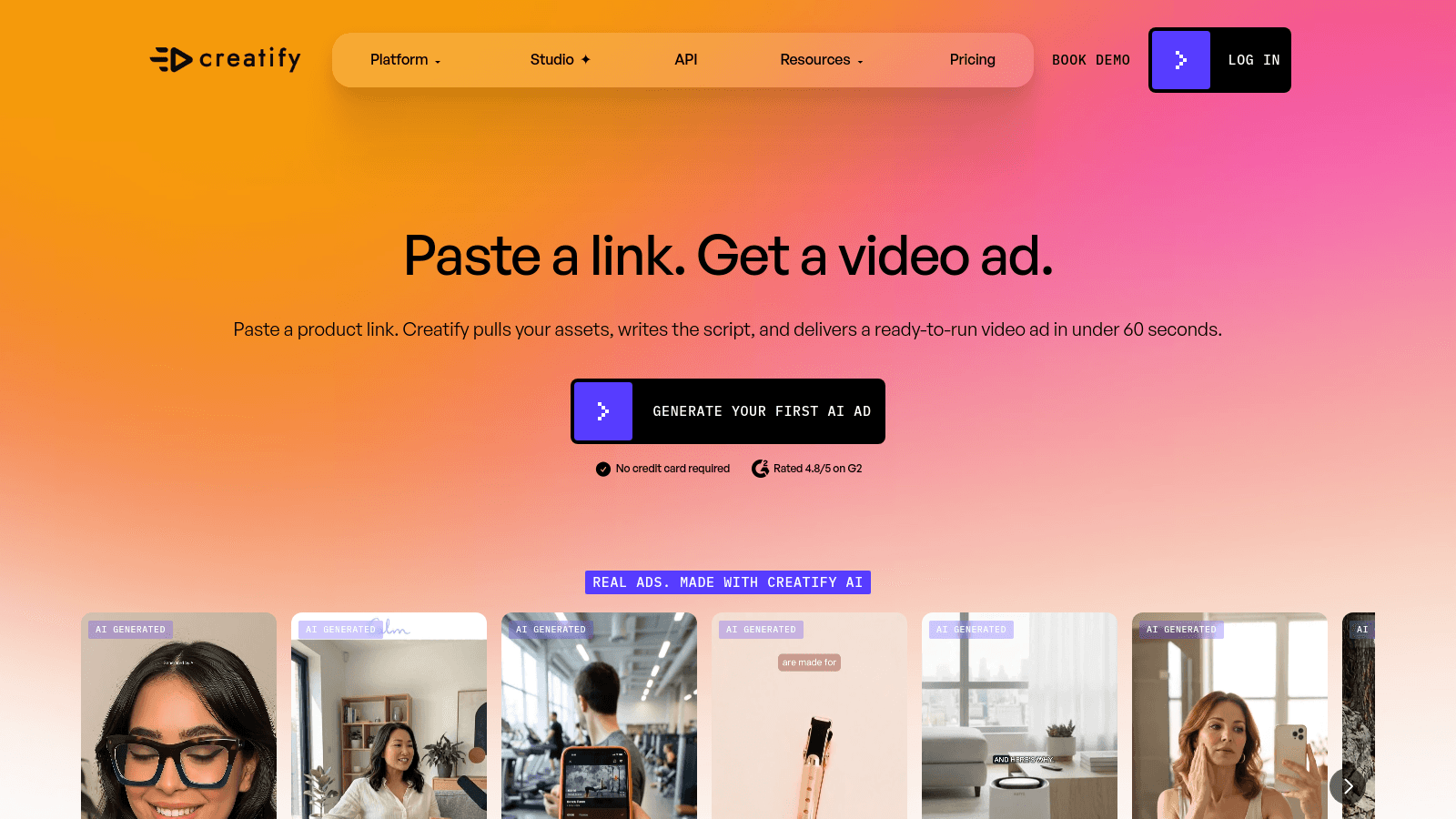
Creatify Agent can develop original ad concepts and scripts from a brief or product URL. Creatify lets teams vary the hook while retaining their own brand claims and product evidence.

Creatify marketing page featuring an AI video generator tool with a URL input for ad creation.
Creatify Agent can use a brief or product URL to develop original concepts, scripts, and video variations. That workflow can help a team move from a logged pattern to several distinct starting points without rebuilding every video from scratch.

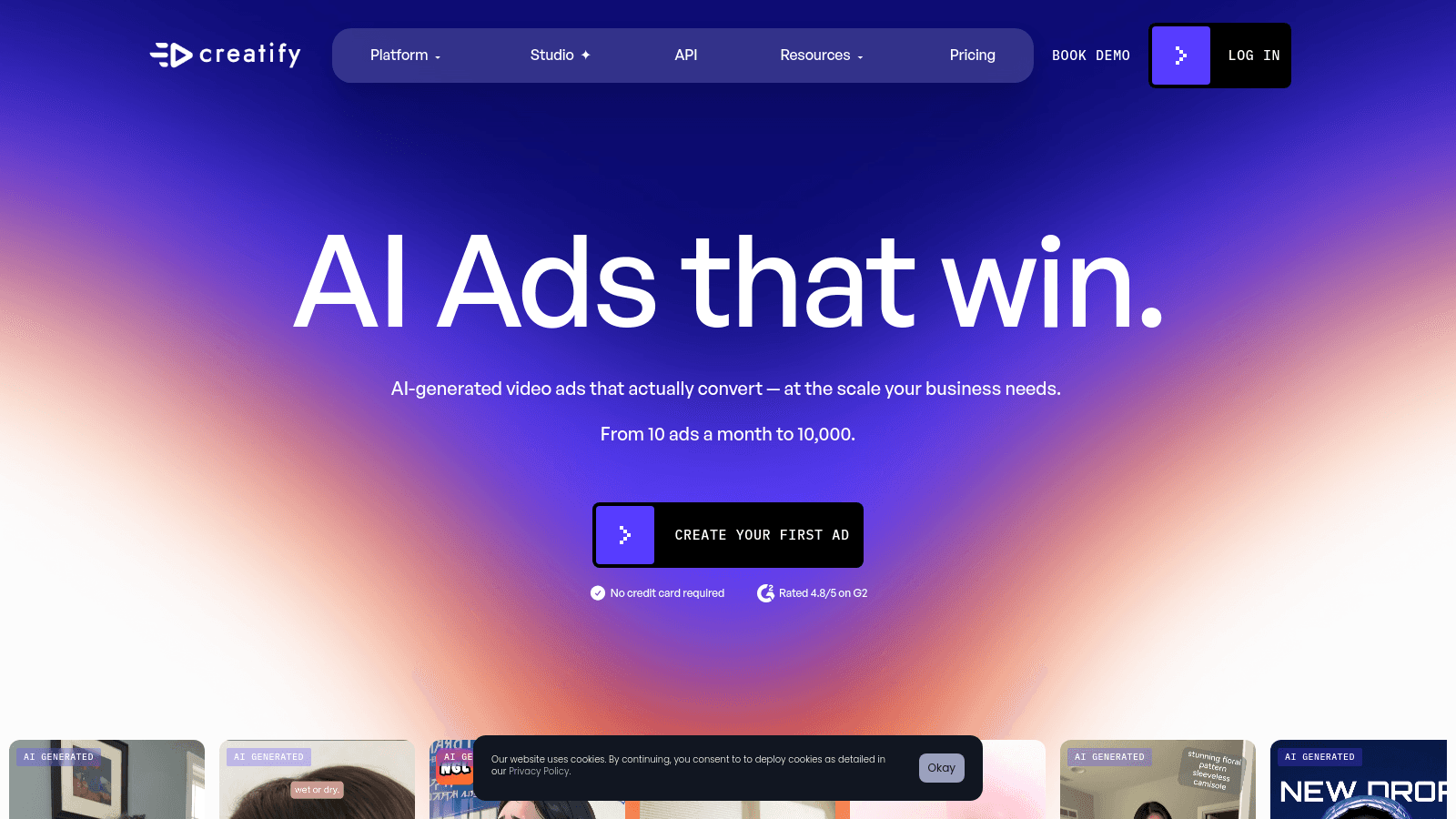
The homepage of Creatify.ai featuring a hero section for creating AI-generated video ads with a gradient background.
Ryan’s summary of Meta 2025 research cites 11% higher CTR and 7.6% better conversion rates for competitor-informed creative strategies than for creative developed without competitive insight. The finding supports tests built from observed creative patterns. Your account decides whether the adapted pattern works for your audience.
Step 7: Launch, measure, and refresh the intelligence loop
Your account results decide whether a competitor-derived hypothesis becomes a reusable creative pattern. AdMapix recommends daily scans for new launches and regular deeper reviews of competitor ads. That cadence gives teams fresh inputs without turning competitor research into a full-time job.
At launch, compare the variant with the control on the KPI named in the hypothesis. Record each result in the competitor-ad matrix as a keep, iterate, or kill decision. That label preserves the link between the outside signal and your own result.
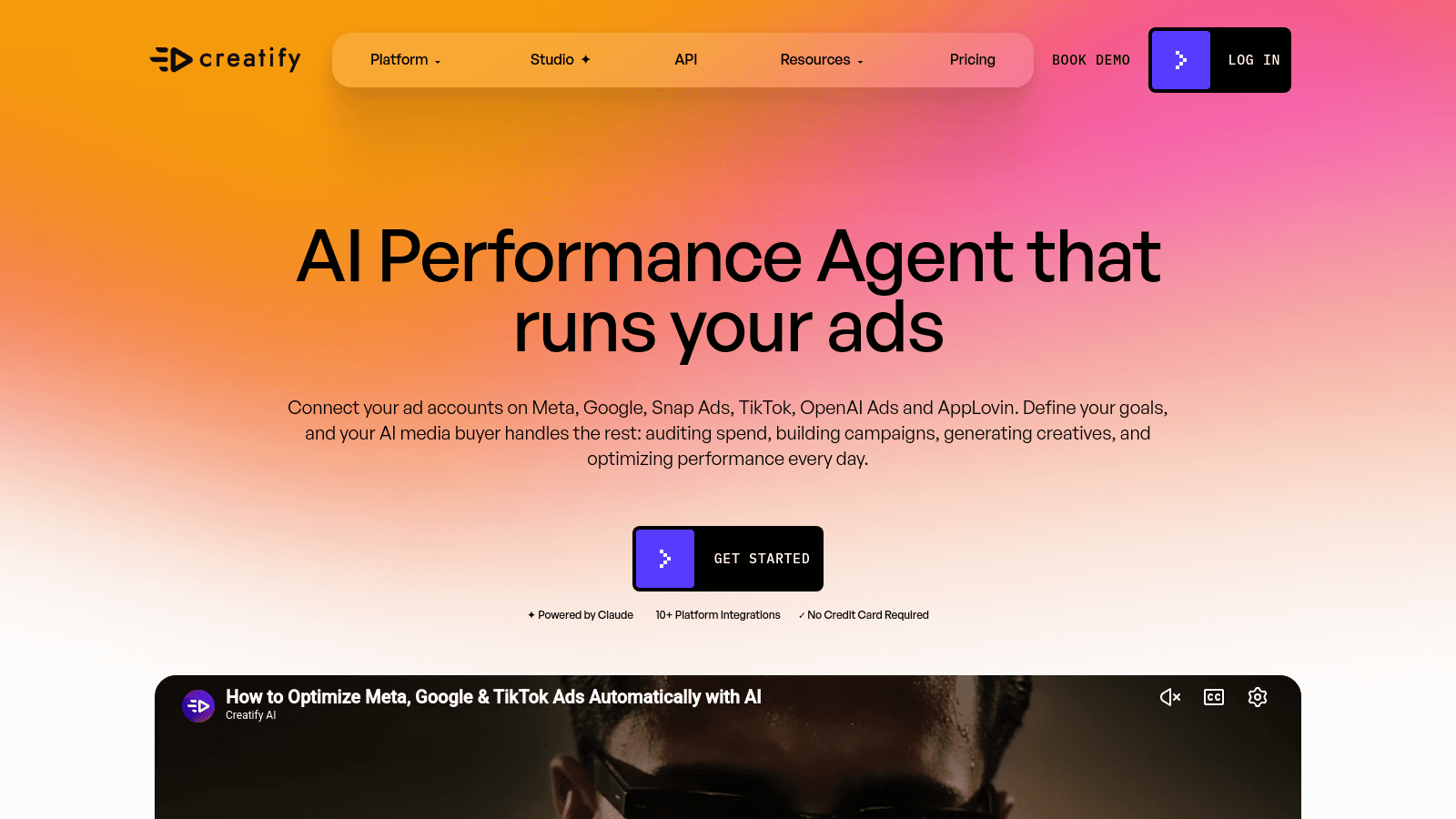
Creatify Performance Agent connects to an advertising account and analyzes its historical performance before campaign launch.

Creatify AI marketing page describing an AI performance agent that manages and optimizes digital advertising campaigns.
Record the campaign result in the same matrix, then use a winning hook to inform the next original variant while the result is current.
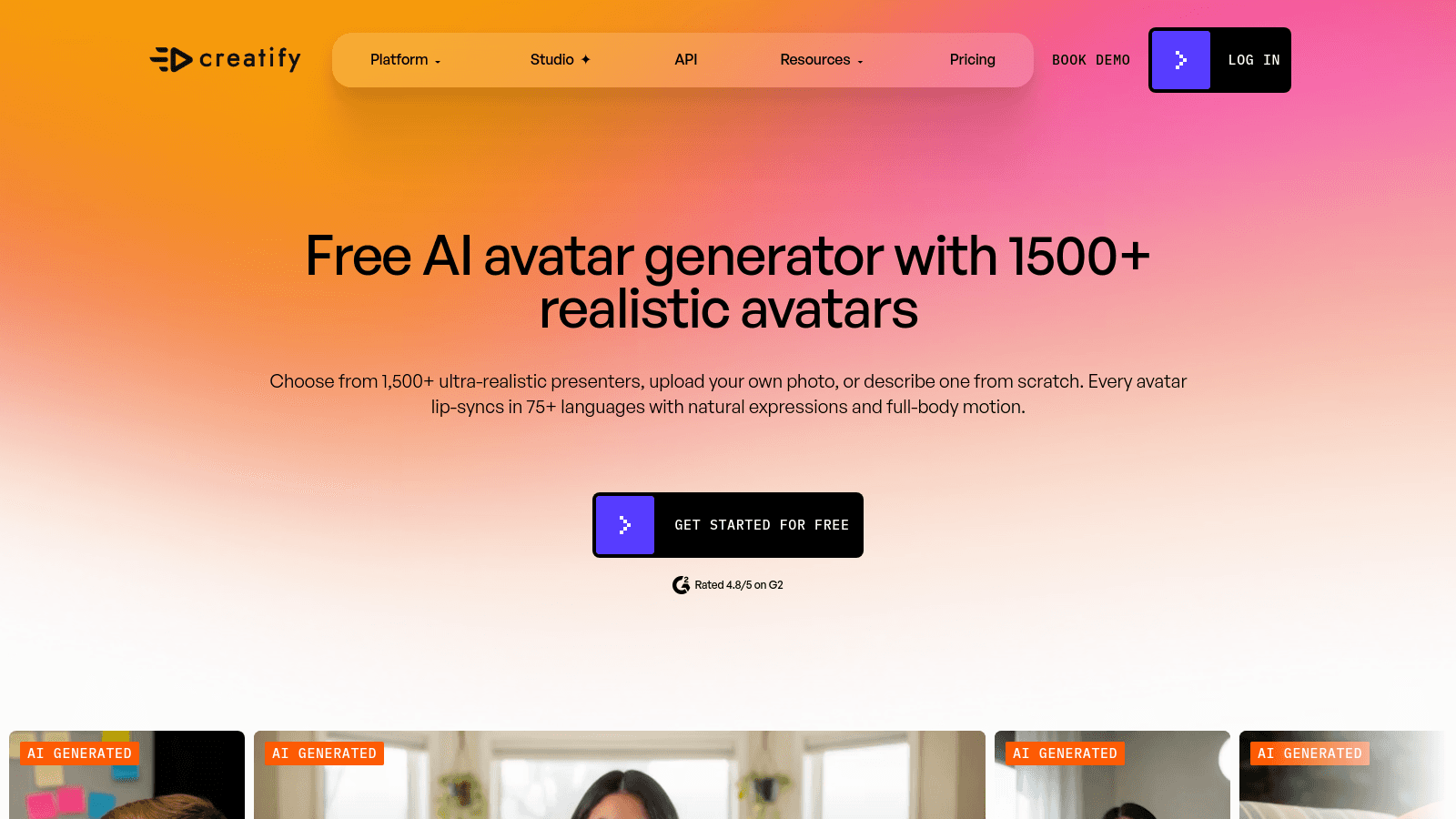
Creatify’s avatar library lets teams create distinct presenters for original variants instead of borrowing a competitor’s actor or footage. Teams can use those choices to create distinct presenters for their own variants rather than borrowing a competitor’s actor or footage.

Creatify marketing page for their AI avatar generator featuring a title and a get started button.
Use competitor signals without mistaking them for performance data
Meta, Google, and TikTok benchmarks provide context for your account, while public competitor ads prioritize the tests you run. Aggregated 2025 to 2026 benchmarks place Meta median CTR at roughly 1.0% to 2.2%, Google Search CTR near 6.6%, and TikTok CTR near 1.77%. Those ranges help you judge movement against your own baseline in the channel where the ad ran.
Compare your variant with your control before you compare it with an industry aggregate. Meta attribution changes in early 2026 and different Google and TikTok attribution practices make absolute ROAS comparisons across platforms noisy. A Meta result and a Google Search result can both be useful without being directly interchangeable.
Public libraries show creative and distribution signals. Your account shows whether the hypothesis holds against the KPI you chose: clicks, conversions, or revenue per dollar spent.
Start with one competitor and one live hypothesis
AdMapix reports that a 10-question competitor teardown can take about 30 minutes per brand. Choose one direct competitor, save its longest-running and newest ads, and use five-dimension scores to write one hypothesis before the next weekly review.
A 47-day UGC winner becomes useful when its problem-first hook, proof sequence, and offer-to-page match produce a better original variant in your own account.

Creatify Studio landing page promoting AI-generated high-converting video ad production services for brands.
FAQs
What are the best sources to use for competitor ad analysis in 2026?
Use Meta Ad Library (Meta apps), Google Ads Transparency Center (Google search/display copy), and TikTok Creative Center (short-form video + engagement). Add paid tools only if you need deeper history, alerts, or modeled spend.
How do I pick which competitors to analyze without creating a huge spreadsheet?
Create a watch list of 3–7 brands tied to one specific campaign decision. Include direct (same audience), indirect (same need), and aspirational (strong creative) competitors so every brand helps you answer the same decision.
Why should I prioritize ads that ran for 30+ days?
Longevity is a quick proxy for sustained advertiser investment. It helps you shortlist patterns worth testing. Use longer runs (e.g., 60–90+ days) as stronger validation, while remembering it’s not direct proof of ROAS.
What should I record from each competitor ad to turn it into a test?
In your worksheet, capture the recurring hook, the offer, and the landing-page (or handoff) message. Those fields let you convert one observed pattern into an original variant you can test quickly.
How fast can I turn competitor findings into experiments?
Aim to build and launch a measurable test within 48–72 hours. The goal is to move before creative fatigue (often around a week for many Meta creatives) removes the most reusable signals.
Competitor ad analysis is the recurring study of rivals’ public paid ads. It reveals their creative, messaging, and funnel choices. Meta Ad Library provides free access to active Meta ads and campaign context. Google Ads Transparency Center shows active Google ads and search copy. TikTok Creative Center offers free access to short-form TikTok ad videos and campaign context. In AdSpyder’s May 2026 sample of 24,650 ads, 54% ended within seven days, 22% ran for 30 days or more, and about 9.4% lasted beyond 90 days. In the sample, 22% of ads ran for at least 30 days. Marketers can use competitor ads to create original variants with a seven-step loop that collects ads, scores patterns, and launches tests.
In this article, we will go over how to run a competitor analysis on Meta and Google ad library. Running a competitor ad analysis will let you find the top performing ads and discover hooks that work well.
Key takeaways
Build a watch list of three to seven direct, indirect, and aspirational brands to compare relevant offers with strong creative.
Prioritize 30-day ads to create a shortlist of sustained campaigns.
Teams record the hook, offer, and landing-page message in the worksheet to turn a recurring pattern into an original test.
Use a five-dimension scorecard to rate Creative, Messaging, and Channel from one to five and identify the weakness for your next test.
Turn each competitor finding into a measurable test within 48 to 72 hours to learn whether the pattern improves the KPI in your account.
Build the research set
Step 1: Define the competitors and decision you need to study
A seven-brand watch list tied to one campaign decision prevents a spreadsheet from filling with irrelevant ads. Benly separates direct brands that sell to the same audience, indirect brands that solve the same need, and aspirational brands that earn attention through creative execution. Teams can begin with three to seven competitors and add brands only when a new brand helps answer the same decision.
Assign each brand a tier in your worksheet. Direct competitors reveal offer pressure, while aspirational brands expose formats or hooks that your category may ignore. Teams prevent aspirational creative from outweighing a direct competitor’s offer signal by assigning each brand a tier.
Write one decision at the top of the worksheet before you search. For example:
Find a stronger trial offer for first-time buyers.
Develop three new UGC hooks for a product demo.
The worksheet decision determines which ads and fields the team records. A brand campaign does not answer a worksheet decision about improving a product-demo opening.
Step 2: Pull comparable ads from the platform libraries
Meta Ad Library, Google Ads Transparency Center, and TikTok Creative Center reveal different parts of a competitor’s paid-media activity. Meta Ad Library shows active commercial ads across Facebook, Instagram, and Messenger. Audience Network ads appear alongside the platform’s Facebook, Instagram, and Messenger results. It also shows ad variations. Google Ads Transparency Center supports advertiser and domain searches across Google’s search and display inventory. TikTok Creative Center highlights engagement and CTR for short-form ads.
Match ads by market, platform, and format before saving them. Those filters let you compare two ads that reached similar people in similar placements. Different markets and formats can reveal messaging without providing comparable distribution evidence.
Use Meta for paid-social volume and visible variations. Use Google for search messaging and offers. Use TikTok for short-form hooks. Record the same market and format beside every saved ad so your team can count patterns later.
Paid tools can add historical archives, alerts, and modeled spend estimates. Hawky estimates that free libraries cover roughly 80% of many teams’ needs, so public evidence gives most teams a sound starting point before they buy more data.
Turn ads into evidence
Step 3: Rank ads by longevity, volume, and format
Have your researcher rank ads by days running, variant density, and format so the shortlist favors ads that have persisted and show active testing. AdSpyder’s May 2026 analysis found a four-day real-time median lifespan for Meta ads and a 43.3-day median for LinkedIn ads. The platform difference means a 30-day Meta creative deserves more scrutiny than a 30-day LinkedIn creative.
Treat 30-plus days as a shortlist threshold. Treat 60 to 90-plus days as a stronger validation signal. Those thresholds help you find ads that an advertiser chose to keep funding without pretending that a public library reveals ROAS.
Hawky reports that top performers often run two to three times more creative variations, while five to 15 parallel variants can indicate active testing. Count the variants around a long-running ad. Ten related openings around one offer suggest an advertiser is testing a pattern, while one isolated asset may reflect a narrow campaign.
AdSpyder states that longevity records continued advertiser spending and does not measure return or incremental lift. Researchers should add visible variants and impression movement to days-running data where a library provides them. That combination gives you a ranked research queue rather than an unsupported claim about a competitor’s profit.
Step 4: Deconstruct the ad DNA and landing-page handoff
The opening hook and proof sequence reveal a video ad’s persuasion structure. Its offer and destination page show how you can adapt that structure through the landing-page handoff. MagicBrief analyzes the hook, script, and visual execution. Benly’s Ad DNA model captures the hook, structure, and CTA; the table below records the full field set.
Record each shortlisted ad’s hook, proof, and CTA in the table:
Field | Record | Example |
|---|---|---|
Hook | The first one to three seconds | “Still paying for unused software?” |
Structure | The order of the argument | Problem → demo → review → trial |
Proof | The evidence inside the ad | Customer quote or product result |
Offer | The exchange | 14-day trial |
CTA | The final requested action | Start free |
Record the landing page beside those fields. The landing page should match the ad’s headline, proof, and offer. A product-demo ad that sends visitors to a generic homepage creates a different funnel than an ad that opens on a matching trial page.
This record separates a reusable structure from protected expression. You can test a creator-led product demo with your own claims, actors, and visual assets. Competitors’ scripts and footage remain protected expression.
Step 5: Score the competitor and identify the gap
A 25-point scorecard helps teams identify whether a competitor’s advantage comes from creative, messaging, channel, budget signal, or funnel. AdMapix’s framework scores each dimension from one to five.
Use the same definitions for the competitor and your own account.
Dimension | Score 1 | Score 5 |
|---|---|---|
Creative | Few weak openings or variants | Clear hooks and active variant testing |
Messaging | Generic claims and little proof | Specific pain, proof, and segmented CTAs |
Channel | One inconsistent placement | Deliberate platform and format coverage |
Budget | Little longevity or variation evidence | Long-running ads with visible variant depth |
Funnel | Weak ad-to-page match | Matched message, offer, and page flow |
Score the ads and your account after you finish the teardown. Then choose the lowest-scoring dimension that overlaps with a high-confidence competitor pattern. A competitor with strong messaging and a weak funnel gives you a reason to test a tighter message-to-page handoff instead of another cosmetic video remake.
The scorecard also protects teams from copying a competitor’s most visible strength. A rival may own an expensive creator format while leaving its trial page unclear. Your next test can target the exposed weakness instead.
Ship and improve original tests
Step 6: Write a hypothesis and generate original variants
A written hypothesis turns a competitor pattern into an original ad with a measurable reason to run. AdMapix recommends moving each hypothesis into testing within 48 to 72 hours. It benchmarks structured-system hypothesis hit rates at 25% to 40%. A short deadline prevents saved ads from becoming a private archive.
Write each backlog item in this form:
For [audience], test [original hook or offer] in [format] because [observed pattern] may improve [CTR, CVR, CPA, or hold rate]
For example:
Creatify Agent can develop original ad concepts and scripts from a brief or product URL. Creatify lets teams vary the hook while retaining their own brand claims and product evidence.

Creatify marketing page featuring an AI video generator tool with a URL input for ad creation.
Creatify Agent can use a brief or product URL to develop original concepts, scripts, and video variations. That workflow can help a team move from a logged pattern to several distinct starting points without rebuilding every video from scratch.

The homepage of Creatify.ai featuring a hero section for creating AI-generated video ads with a gradient background.
Ryan’s summary of Meta 2025 research cites 11% higher CTR and 7.6% better conversion rates for competitor-informed creative strategies than for creative developed without competitive insight. The finding supports tests built from observed creative patterns. Your account decides whether the adapted pattern works for your audience.
Step 7: Launch, measure, and refresh the intelligence loop
Your account results decide whether a competitor-derived hypothesis becomes a reusable creative pattern. AdMapix recommends daily scans for new launches and regular deeper reviews of competitor ads. That cadence gives teams fresh inputs without turning competitor research into a full-time job.
At launch, compare the variant with the control on the KPI named in the hypothesis. Record each result in the competitor-ad matrix as a keep, iterate, or kill decision. That label preserves the link between the outside signal and your own result.
Creatify Performance Agent connects to an advertising account and analyzes its historical performance before campaign launch.

Creatify AI marketing page describing an AI performance agent that manages and optimizes digital advertising campaigns.
Record the campaign result in the same matrix, then use a winning hook to inform the next original variant while the result is current.
Creatify’s avatar library lets teams create distinct presenters for original variants instead of borrowing a competitor’s actor or footage. Teams can use those choices to create distinct presenters for their own variants rather than borrowing a competitor’s actor or footage.

Creatify marketing page for their AI avatar generator featuring a title and a get started button.
Use competitor signals without mistaking them for performance data
Meta, Google, and TikTok benchmarks provide context for your account, while public competitor ads prioritize the tests you run. Aggregated 2025 to 2026 benchmarks place Meta median CTR at roughly 1.0% to 2.2%, Google Search CTR near 6.6%, and TikTok CTR near 1.77%. Those ranges help you judge movement against your own baseline in the channel where the ad ran.
Compare your variant with your control before you compare it with an industry aggregate. Meta attribution changes in early 2026 and different Google and TikTok attribution practices make absolute ROAS comparisons across platforms noisy. A Meta result and a Google Search result can both be useful without being directly interchangeable.
Public libraries show creative and distribution signals. Your account shows whether the hypothesis holds against the KPI you chose: clicks, conversions, or revenue per dollar spent.
Start with one competitor and one live hypothesis
AdMapix reports that a 10-question competitor teardown can take about 30 minutes per brand. Choose one direct competitor, save its longest-running and newest ads, and use five-dimension scores to write one hypothesis before the next weekly review.
A 47-day UGC winner becomes useful when its problem-first hook, proof sequence, and offer-to-page match produce a better original variant in your own account.

Creatify Studio landing page promoting AI-generated high-converting video ad production services for brands.
FAQs
What are the best sources to use for competitor ad analysis in 2026?
Use Meta Ad Library (Meta apps), Google Ads Transparency Center (Google search/display copy), and TikTok Creative Center (short-form video + engagement). Add paid tools only if you need deeper history, alerts, or modeled spend.
How do I pick which competitors to analyze without creating a huge spreadsheet?
Create a watch list of 3–7 brands tied to one specific campaign decision. Include direct (same audience), indirect (same need), and aspirational (strong creative) competitors so every brand helps you answer the same decision.
Why should I prioritize ads that ran for 30+ days?
Longevity is a quick proxy for sustained advertiser investment. It helps you shortlist patterns worth testing. Use longer runs (e.g., 60–90+ days) as stronger validation, while remembering it’s not direct proof of ROAS.
What should I record from each competitor ad to turn it into a test?
In your worksheet, capture the recurring hook, the offer, and the landing-page (or handoff) message. Those fields let you convert one observed pattern into an original variant you can test quickly.
How fast can I turn competitor findings into experiments?
Aim to build and launch a measurable test within 48–72 hours. The goal is to move before creative fatigue (often around a week for many Meta creatives) removes the most reusable signals.