Equipe Creatify
COMPARTILHAR


NESTE ARTIGO
Three years ago, a marketer using generative AI had an edge. Today they have company. Salesforce's State of Marketing 2026 found 87% of marketers now run it in at least one recurring workflow, up from half in 2024.
When almost everyone has the same tools, the tools stop being the story. The 2026 story is the widening gap between teams getting real money back from AI in marketing and teams just producing more noise with it.
These eight AI marketing trends are where that gap is opening. Each comes with the data behind it and one concrete move you can make, so you can skip the future-of-marketing speeches and act.
1. Generative AI became default infrastructure
The adoption numbers are past the point of being a talking point. McKinsey's 2025 global survey found 88% of organizations now use AI in at least one business function, with marketing and sales among the biggest jumps.
When almost nine in ten teams have the same tools, owning the tools buys you nothing. The edge moved to execution: which workflows you point AI at, how deep you build it in, and whether the output is good enough to ship.
A quick gut check: if you removed AI from your marketing stack tomorrow, would anything break? If the honest answer is "not much," you're using it as a toy, not as infrastructure.
2. The adoption-versus-impact gap is the real 2026 story
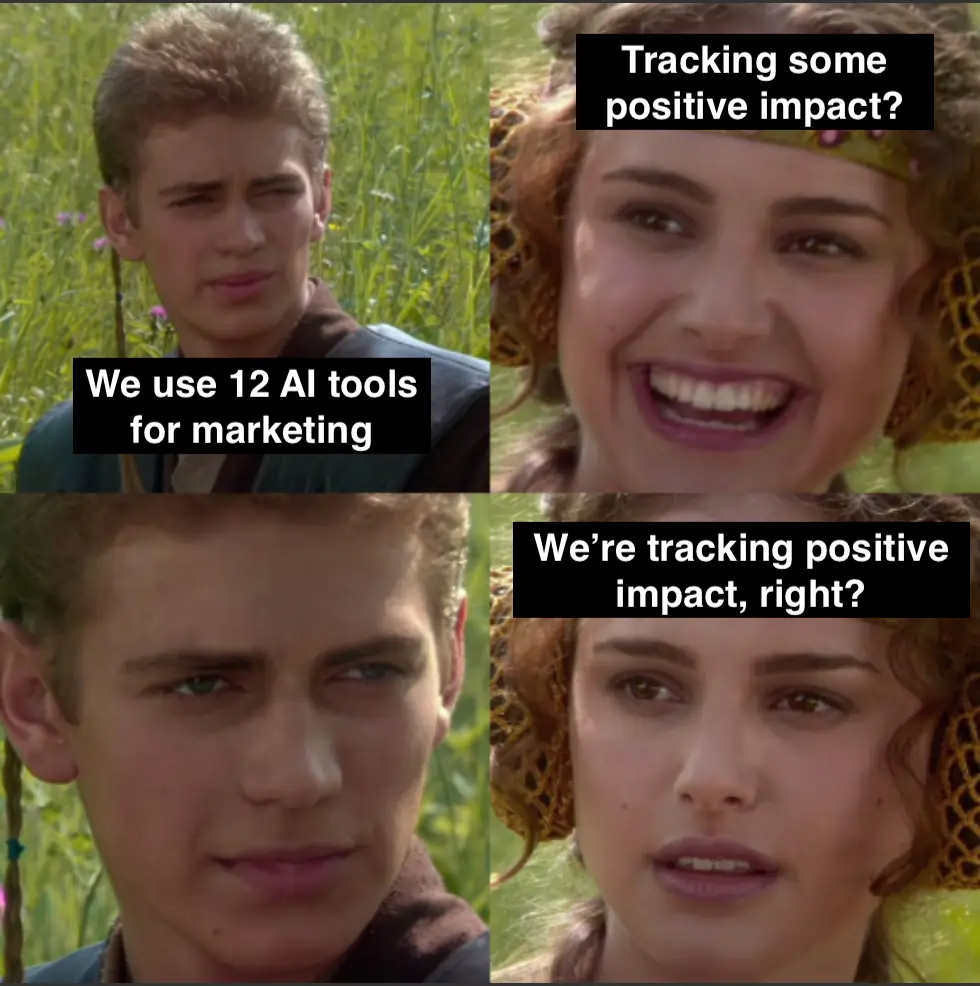
Here's the part the trend listicles skip. Adoption is near-universal, and results are not.
The same McKinsey survey found that among organizations using AI, roughly two-thirds are still stuck in pilot or experiment mode, and only about a third report genuine scaling. More than 80% say generative AI hasn't yet moved enterprise-level profit in any measurable way.
Marketing has its own version of this gap. Salesforce found that even with 75% of marketers using AI for marketing, plenty are still firing off one-way, generic campaigns. The tech got smart. The output stayed dumb.
What to do about it: stop spreading AI thinly across 20 tasks. Pick one or two workflows where volume or speed genuinely limits you (ad creative, personalization, reporting) and rebuild them around AI properly. One scaled workflow beats ten half-finished pilots.
3. Agentic AI moves from copilot to coworker
For two years AI mostly waited for a prompt. In 2026 it started acting on its own.
Agentic AI describes systems that plan, decide, and run multi-step workflows without you holding their hand at every step. McKinsey frames 2025 as the year the conversation shifted from generative tools to agents, and Google positions 2026 as the "agent leap", where AI orchestrates entire end-to-end workflows instead of single tasks.
Marketers see the prize. Salesforce found only about 13% currently use agentic AI, but 82% of those who use or plan to use agents expect major or moderate ROI gains, and 73% of teams plan to expand their AI use heading into 2027.
One honest caveat, because the hype is loud: McKinsey found agents are usually live in only one or two functions, and fewer than 10% of companies have scaled them in any single function. This is early. Treat it that way.
Where this shows up in ad production is the obvious place to start. Creatify's agentic system, Creatify Agent, runs the whole pipeline from a brief: it researches the brand, studies competitors and trending content, writes scripts, casts avatars, generates shots in parallel, and runs a vision-based QA pass against the original brief before anything ships. A separate critic model checks each scene for off-brand visuals or invented claims and routes failures back for regeneration. That last part matters, because an autonomous agent with no quality gate is just a faster way to publish mistakes.
What to do about it: hand agents bounded, repetitive jobs first, keep a human reviewing the output, and widen the leash as trust builds.
4. Generative engine optimization changes how buyers find you
Search is splitting in two. People still type queries into Google, and a growing share just ask an AI and take the answer.
The traffic shift is steep. Adobe Analytics reported that visits to U.S. retail sites from generative AI sources jumped roughly 1,200% year over year in early 2025, then grew another 693% year over year across the 2025 holiday season. And these visitors aren't tire-kickers. Over the holidays they converted about 31% higher than other traffic sources, with revenue per visit climbing sharply.
It's still early in absolute terms. Pew found just 9% of U.S. adults get news from AI chatbots even sometimes, and people have genuinely mixed feelings about AI summaries in search. But the people who do use AI to research purchases convert well, which makes them worth chasing now.
This is where generative engine optimization (GEO) comes in: structuring content so AI models cite and recommend you, not just so Google ranks you. The mechanics reward original data, clear structure, and content an AI can quote cleanly.
What to do about it: start tracking AI referral traffic as its own channel, and write at least some content to be quoted by a model, with direct answers and original numbers near the top.
5. Personalization moves from segments to individuals
Personalization used to mean a handful of audience buckets and a swapped first name. AI is collapsing that into something closer to one message per person.
McKinsey found that revenue lift from AI shows up most often in marketing and sales use cases, with personalization engines among the higher-ROI applications. The catch is the gap from Trend 2: most teams have the capability and still blast the same creative at everyone.
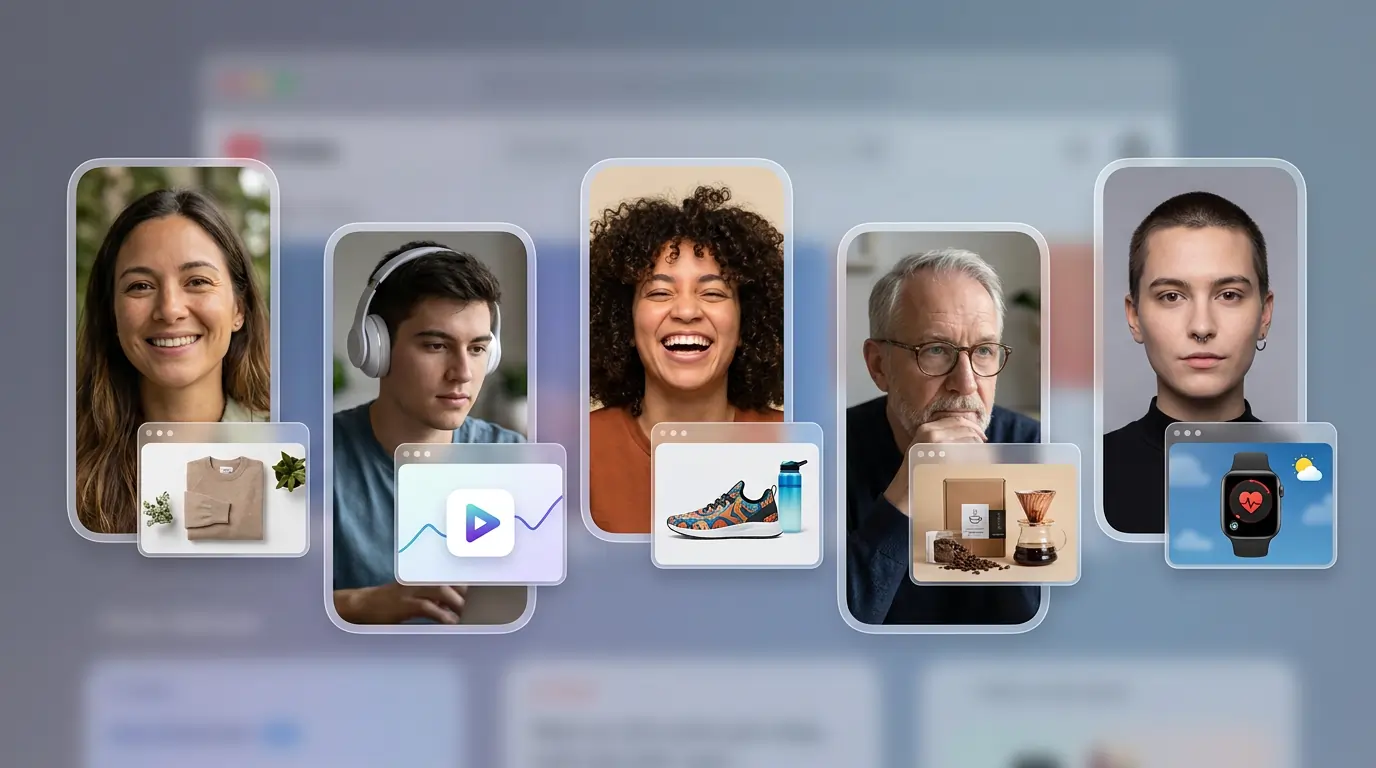
The real gain comes from generating 30 versions of an ad, each tuned to a segment, an angle, or a platform, for roughly the cost of producing one. That's a different production model, and it's where AI earns its keep.
What to do about it: build your creative process to output variants by default, then let performance data decide the winners instead of a planning meeting.
6. AI video becomes the default creative format
If there's one place AI marketing went mainstream in 2026, it's video.
Generative AI is now a cornerstone of video ad production. IAB reports that 86% of buyers use or plan to use it to build video ad creative, and U.S. digital video ad spend is set to pass $80 billion in 2026, growing about 20% faster than the total ad market. Big brands have made it visible, with AI-generated spots from Coca-Cola, Volvo, and Kalshi running in the past year.
The reason is math. Video has always pulled better than static, and AI finally made it affordable to produce at volume. According to Creatify's Tec-Do 2.0 case study, the digital marketing provider, which serves more than 80,000 clients, replaced human actors with AI avatars and cut cost per video from $20 to $2, a 90% reduction, while dropping production time from three days to under an hour. Their AI video ads pulled 3x more views than image-based creative and landed at 80% of the performance of real-actor video. At those economics, "good enough video, lots of it" beats "perfect video, almost none of it."
This is the core of what Creatify does: paste a product URL and the URL-to-Video tool returns platform-ready ad variations in under a minute, drawing on 1,500+ avatars and 75+ languages. The goal is enough variations to run a real test.
What to do about it: treat video as a volume game. Ship more variants, kill the losers fast, and scale the few that work.
7. The trust gap in AI advertising is widening, and disclosure is the fix
Here's the tension under all of this. Advertisers love AI, and a lot of consumers don't.
IAB's 2026 research lays it out plainly. 83% of ad executives say their company has used AI in the creative process, up from 60% in 2024. But 82% of those executives think Gen Z and Millennial consumers feel positive about AI-generated ads, while only 45% of those consumers do. That perception gap widened from 32 points in 2024 to 37 points in 2026.
Gen Z is the sharp edge: 39% feel negative about AI ads, nearly double the 20% of Millennials. And the broader public mood is wary, with half of U.S. adults telling Pew they're more concerned than excited about AI in daily life, against just 10% who feel the reverse.
Part of the problem is why advertisers reach for AI. Cost efficiency became the top cited benefit in 2026 at 64%, which raises the risk of cheap, generic "AI slop" that consumers can smell.
The fix is counterintuitive but well-supported: tell people. IAB found that 73% of Gen Z and Millennial consumers said knowing an ad was made with AI would either increase their purchase likelihood or make no difference. Clear disclosure even ranked as the third-highest driver of attention to an ad. Hiding the AI costs you more than admitting it.
What to do about it: use AI to raise creative quality, not just to cut costs, and disclose AI use plainly, especially in video and images.
8. Agentic commerce turns AI into the new shopfront
The last trend ties the others together. As buyers research and shop through AI assistants, the assistant becomes the storefront.
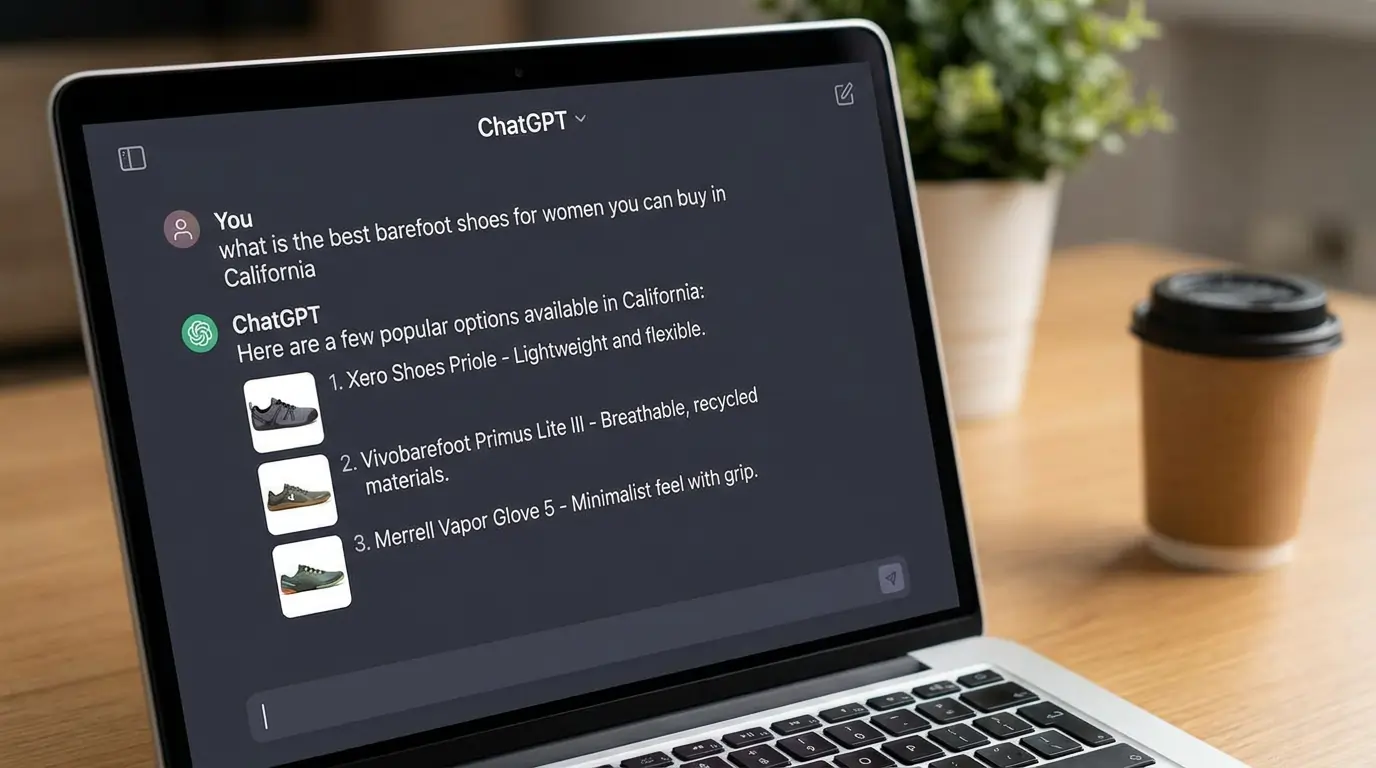
Adobe's data already shows AI-referred shoppers converting at a premium and spending more per visit. Pair that with the rise of autonomous agents from Trend 3, and you get a near future where an AI does the comparing, shortlisting, and sometimes the buying on a person's behalf.
That changes who you're optimizing for. Some of your marketing now has to be legible to a machine that's deciding what to recommend.
What to do about it: structure your product content, specs, and proof points so an AI agent can find them, understand them, and put you on the shortlist.
Where these AI marketing insights leave you
The pattern across all eight trends is the same. The tools are everywhere, and the advantage went to the teams that use them well: scaling a few workflows instead of dabbling in many, producing more and testing harder, and being honest with people about how the work gets made.
One last thought that didn't fit neatly above. The teams pulling ahead with AI tend to share a habit: they took a boring process, usually creative production, rebuilt it around AI, and let volume plus fast feedback do the work. Exotic tech has little to do with it. That's less exciting than "autonomous agents," and it's where the returns are sitting in 2026.
If video is the workflow you want to scale first, Creatify is built for exactly that, and you can try it for free.
Frequently Asked Questions
What are the biggest AI marketing trends in 2026?
The defining shift is that AI in marketing is now standard, so the advantage comes from using it well rather than at all. The biggest trends are agentic AI that runs full workflows, generative engine optimization for AI search, individual-level personalization, AI video as the default ad format, a widening consumer-trust gap, and AI-driven commerce.
How is AI used in marketing today?
The most common uses of AI in marketing are generating ad creative and video, personalizing content, drafting copy, analyzing campaign performance, and increasingly running multi-step tasks through AI agents. Salesforce found 87% of marketers now use generative AI in at least one recurring workflow.
Is artificial intelligence in advertising hurting consumer trust?
It's straining it, especially with younger audiences. IAB found only 45% of Gen Z and Millennial consumers feel positive about AI-generated ads, far below what advertisers assume. The most reliable fix is disclosing AI use clearly, which most consumers say would not lower their likelihood to buy.
What is generative engine optimization (GEO)?
GEO is the practice of structuring content so AI models cite and recommend your brand when they answer questions, rather than optimizing only for traditional search rankings. It rewards original data, clear structure, and content an AI can quote directly.
How do marketers get real ROI from AI for marketing?
Most teams stall because they spread AI across too many small tasks. The teams seeing returns pick one or two high-impact workflows, rebuild them around AI, scale them, and measure results, instead of running endless pilots. McKinsey found only about a third of organizations have moved beyond the pilot stage.
Will AI replace marketers?
Not in 2026. AI agents are still live in only one or two functions at most companies, and human review is what separates useful automation from published mistakes. The near-term shift is marketers directing and editing AI output rather than producing everything by hand.
Three years ago, a marketer using generative AI had an edge. Today they have company. Salesforce's State of Marketing 2026 found 87% of marketers now run it in at least one recurring workflow, up from half in 2024.
When almost everyone has the same tools, the tools stop being the story. The 2026 story is the widening gap between teams getting real money back from AI in marketing and teams just producing more noise with it.
These eight AI marketing trends are where that gap is opening. Each comes with the data behind it and one concrete move you can make, so you can skip the future-of-marketing speeches and act.
1. Generative AI became default infrastructure
The adoption numbers are past the point of being a talking point. McKinsey's 2025 global survey found 88% of organizations now use AI in at least one business function, with marketing and sales among the biggest jumps.
When almost nine in ten teams have the same tools, owning the tools buys you nothing. The edge moved to execution: which workflows you point AI at, how deep you build it in, and whether the output is good enough to ship.
A quick gut check: if you removed AI from your marketing stack tomorrow, would anything break? If the honest answer is "not much," you're using it as a toy, not as infrastructure.
2. The adoption-versus-impact gap is the real 2026 story
Here's the part the trend listicles skip. Adoption is near-universal, and results are not.
The same McKinsey survey found that among organizations using AI, roughly two-thirds are still stuck in pilot or experiment mode, and only about a third report genuine scaling. More than 80% say generative AI hasn't yet moved enterprise-level profit in any measurable way.
Marketing has its own version of this gap. Salesforce found that even with 75% of marketers using AI for marketing, plenty are still firing off one-way, generic campaigns. The tech got smart. The output stayed dumb.
What to do about it: stop spreading AI thinly across 20 tasks. Pick one or two workflows where volume or speed genuinely limits you (ad creative, personalization, reporting) and rebuild them around AI properly. One scaled workflow beats ten half-finished pilots.
3. Agentic AI moves from copilot to coworker
For two years AI mostly waited for a prompt. In 2026 it started acting on its own.
Agentic AI describes systems that plan, decide, and run multi-step workflows without you holding their hand at every step. McKinsey frames 2025 as the year the conversation shifted from generative tools to agents, and Google positions 2026 as the "agent leap", where AI orchestrates entire end-to-end workflows instead of single tasks.
Marketers see the prize. Salesforce found only about 13% currently use agentic AI, but 82% of those who use or plan to use agents expect major or moderate ROI gains, and 73% of teams plan to expand their AI use heading into 2027.
One honest caveat, because the hype is loud: McKinsey found agents are usually live in only one or two functions, and fewer than 10% of companies have scaled them in any single function. This is early. Treat it that way.
Where this shows up in ad production is the obvious place to start. Creatify's agentic system, Creatify Agent, runs the whole pipeline from a brief: it researches the brand, studies competitors and trending content, writes scripts, casts avatars, generates shots in parallel, and runs a vision-based QA pass against the original brief before anything ships. A separate critic model checks each scene for off-brand visuals or invented claims and routes failures back for regeneration. That last part matters, because an autonomous agent with no quality gate is just a faster way to publish mistakes.
What to do about it: hand agents bounded, repetitive jobs first, keep a human reviewing the output, and widen the leash as trust builds.
4. Generative engine optimization changes how buyers find you
Search is splitting in two. People still type queries into Google, and a growing share just ask an AI and take the answer.
The traffic shift is steep. Adobe Analytics reported that visits to U.S. retail sites from generative AI sources jumped roughly 1,200% year over year in early 2025, then grew another 693% year over year across the 2025 holiday season. And these visitors aren't tire-kickers. Over the holidays they converted about 31% higher than other traffic sources, with revenue per visit climbing sharply.
It's still early in absolute terms. Pew found just 9% of U.S. adults get news from AI chatbots even sometimes, and people have genuinely mixed feelings about AI summaries in search. But the people who do use AI to research purchases convert well, which makes them worth chasing now.
This is where generative engine optimization (GEO) comes in: structuring content so AI models cite and recommend you, not just so Google ranks you. The mechanics reward original data, clear structure, and content an AI can quote cleanly.
What to do about it: start tracking AI referral traffic as its own channel, and write at least some content to be quoted by a model, with direct answers and original numbers near the top.
5. Personalization moves from segments to individuals
Personalization used to mean a handful of audience buckets and a swapped first name. AI is collapsing that into something closer to one message per person.
McKinsey found that revenue lift from AI shows up most often in marketing and sales use cases, with personalization engines among the higher-ROI applications. The catch is the gap from Trend 2: most teams have the capability and still blast the same creative at everyone.
The real gain comes from generating 30 versions of an ad, each tuned to a segment, an angle, or a platform, for roughly the cost of producing one. That's a different production model, and it's where AI earns its keep.
What to do about it: build your creative process to output variants by default, then let performance data decide the winners instead of a planning meeting.
6. AI video becomes the default creative format
If there's one place AI marketing went mainstream in 2026, it's video.
Generative AI is now a cornerstone of video ad production. IAB reports that 86% of buyers use or plan to use it to build video ad creative, and U.S. digital video ad spend is set to pass $80 billion in 2026, growing about 20% faster than the total ad market. Big brands have made it visible, with AI-generated spots from Coca-Cola, Volvo, and Kalshi running in the past year.
The reason is math. Video has always pulled better than static, and AI finally made it affordable to produce at volume. According to Creatify's Tec-Do 2.0 case study, the digital marketing provider, which serves more than 80,000 clients, replaced human actors with AI avatars and cut cost per video from $20 to $2, a 90% reduction, while dropping production time from three days to under an hour. Their AI video ads pulled 3x more views than image-based creative and landed at 80% of the performance of real-actor video. At those economics, "good enough video, lots of it" beats "perfect video, almost none of it."
This is the core of what Creatify does: paste a product URL and the URL-to-Video tool returns platform-ready ad variations in under a minute, drawing on 1,500+ avatars and 75+ languages. The goal is enough variations to run a real test.
What to do about it: treat video as a volume game. Ship more variants, kill the losers fast, and scale the few that work.
7. The trust gap in AI advertising is widening, and disclosure is the fix
Here's the tension under all of this. Advertisers love AI, and a lot of consumers don't.
IAB's 2026 research lays it out plainly. 83% of ad executives say their company has used AI in the creative process, up from 60% in 2024. But 82% of those executives think Gen Z and Millennial consumers feel positive about AI-generated ads, while only 45% of those consumers do. That perception gap widened from 32 points in 2024 to 37 points in 2026.
Gen Z is the sharp edge: 39% feel negative about AI ads, nearly double the 20% of Millennials. And the broader public mood is wary, with half of U.S. adults telling Pew they're more concerned than excited about AI in daily life, against just 10% who feel the reverse.
Part of the problem is why advertisers reach for AI. Cost efficiency became the top cited benefit in 2026 at 64%, which raises the risk of cheap, generic "AI slop" that consumers can smell.
The fix is counterintuitive but well-supported: tell people. IAB found that 73% of Gen Z and Millennial consumers said knowing an ad was made with AI would either increase their purchase likelihood or make no difference. Clear disclosure even ranked as the third-highest driver of attention to an ad. Hiding the AI costs you more than admitting it.
What to do about it: use AI to raise creative quality, not just to cut costs, and disclose AI use plainly, especially in video and images.
8. Agentic commerce turns AI into the new shopfront
The last trend ties the others together. As buyers research and shop through AI assistants, the assistant becomes the storefront.
Adobe's data already shows AI-referred shoppers converting at a premium and spending more per visit. Pair that with the rise of autonomous agents from Trend 3, and you get a near future where an AI does the comparing, shortlisting, and sometimes the buying on a person's behalf.
That changes who you're optimizing for. Some of your marketing now has to be legible to a machine that's deciding what to recommend.
What to do about it: structure your product content, specs, and proof points so an AI agent can find them, understand them, and put you on the shortlist.
Where these AI marketing insights leave you
The pattern across all eight trends is the same. The tools are everywhere, and the advantage went to the teams that use them well: scaling a few workflows instead of dabbling in many, producing more and testing harder, and being honest with people about how the work gets made.
One last thought that didn't fit neatly above. The teams pulling ahead with AI tend to share a habit: they took a boring process, usually creative production, rebuilt it around AI, and let volume plus fast feedback do the work. Exotic tech has little to do with it. That's less exciting than "autonomous agents," and it's where the returns are sitting in 2026.
If video is the workflow you want to scale first, Creatify is built for exactly that, and you can try it for free.
Frequently Asked Questions
What are the biggest AI marketing trends in 2026?
The defining shift is that AI in marketing is now standard, so the advantage comes from using it well rather than at all. The biggest trends are agentic AI that runs full workflows, generative engine optimization for AI search, individual-level personalization, AI video as the default ad format, a widening consumer-trust gap, and AI-driven commerce.
How is AI used in marketing today?
The most common uses of AI in marketing are generating ad creative and video, personalizing content, drafting copy, analyzing campaign performance, and increasingly running multi-step tasks through AI agents. Salesforce found 87% of marketers now use generative AI in at least one recurring workflow.
Is artificial intelligence in advertising hurting consumer trust?
It's straining it, especially with younger audiences. IAB found only 45% of Gen Z and Millennial consumers feel positive about AI-generated ads, far below what advertisers assume. The most reliable fix is disclosing AI use clearly, which most consumers say would not lower their likelihood to buy.
What is generative engine optimization (GEO)?
GEO is the practice of structuring content so AI models cite and recommend your brand when they answer questions, rather than optimizing only for traditional search rankings. It rewards original data, clear structure, and content an AI can quote directly.
How do marketers get real ROI from AI for marketing?
Most teams stall because they spread AI across too many small tasks. The teams seeing returns pick one or two high-impact workflows, rebuild them around AI, scale them, and measure results, instead of running endless pilots. McKinsey found only about a third of organizations have moved beyond the pilot stage.
Will AI replace marketers?
Not in 2026. AI agents are still live in only one or two functions at most companies, and human review is what separates useful automation from published mistakes. The near-term shift is marketers directing and editing AI output rather than producing everything by hand.

Pronto para transformar seu produto em um vídeo envolvente?